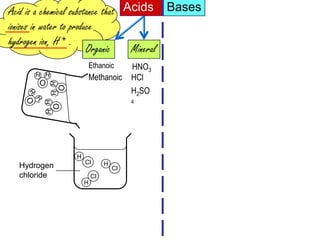
Acid is a chemical substance that Acids Bases
ionises in water to produce
hydrogen ion, H + .
                         Organic   Mineral
                       Ethanoic      HNO3
                    Methanoic        HCl
                                     H2SO
                                     4


               H
                   Cl       H
  Hydrogen                      Cl
  chloride             Cl
                   H
Acid is a chemical substance that Acids Bases           Substance that reacts
ionises in waterthehydrogenof ionisable
  Basicity – to produce
                    number                              with acid to form a salt
                of            atom per
hydrogen ion, H + .
                molecule of an acid                       and water only
                          Organic     Mineral
                                              Na2O + 2HCl g 2NaCl+ H2O
  Ionisation of acidEthanoic Basicity
                               HNO3
                             Methanoic      HCl            NaOH + HCl        g NaCl + H2O
  HClg     H++    Cl-                     monoprotic
                                            H2SO                Bases
                                              4
  H2SO4g2H++ SO42-                        diprotic                            All metal oxide and
                                                                              metal hydroxide.
                                                                alkali
  H3PO4g 3H++ PO42-                       triprotic                         Bases that dissolve
                                                                            in water and produce
                                                                            Hydroxide ion, OH-
  CH3COOH gCH3COO- + H+
            H H          +     +
                                                         Soluble base          Insoluble base
                                   Cl-
                                                         (alkali)              (base)
   Hydrochloric              Cl-         Cl-
      acid              H+                               Sodium oxide        Copper(II) oxide
                   Hydroxonium ions                      Potassium oxide     Copper(II) hydroxide
     H2O                                                 Sodium hydroxide
HCl g H3O+ + Cl-                                                             Zinc hydroxide
                                                         Potassium hydroxide Aluminium Oxide
                                   HClgH++           Cl Barium hydroxide
                                                       -
 H3O+ g H+ + H2O                                                             Lead(II) hydroxide
                                                         Ammonia            Magnesium hydroxide
Acids       Bases
                                       pH Scale
        acid                           neutral                              alkali

        pH1     pH2 pH3              pH6 pH7 pH8           pH12 pH13 pH14

        Strong acid        Weak acid             Weak alkali         Strong alkali

an acid that                                   an alkali that
                      an acid that             partially ionises
ionises completely
                      partially ionises        in water to produce   an alkali that
In water to produce
                      in water to produce      low concentration     ionises completely
high concentration
                      low concentration        of hydroxide ions,    In water to produce
of hydrogen ions,
                      of hydrogen ions,        OH-.                  high concentration
H+.
                      H+.                                            of hydroxide ions,
                                                                     OH-.
  Indicator                 acid            neutral      alkali
  Litmus solution           RED             PURPLE      BLUE
  Methyl orange             RED         ORANGE         YELLOW
  Phenolphthalein       COLOURLESS COLOURLESS            PINK
  Universal                 RED             GREEN      PURPLE
  indicator
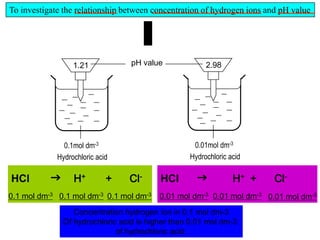
To investigate the relationship between concentration of hydrogen ions and pH value


                  1.21            pH value             2.98


               0.1mol dm-3                         0.01mol dm-3
             Hydrochloric acid                    Hydrochloric acid

HCl        g      H+         +   Cl-      HCl       g           H+ +     Cl-
0.1 mol dm-3 0.1 mol dm-3 0.1 mol dm-3    0.01 mol dm-3 0.01 mol dm-3 0.01 mol dm-3

                  Concentration hydrogen ion in 0.1 mol dm-3
               Of hydrochloric acid is higher than 0.01 mol dm-3
                              of hydrochloric acid.
Acids         Bases
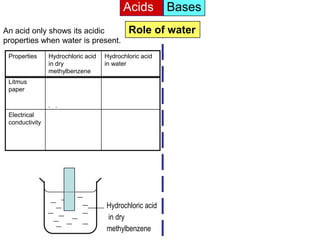
An acid only shows its acidic               Role of water
properties when water is present.
 Properties     Hydrochloric acid   Hydrochloric acid
                in dry              in water
                methylbenzene
 Litmus         It does not
 paper          change the colour
                of blue litmus
                paper
 Electrical
 conductivity


                                    Hydrochloric acid
                                    in dry
                                    methylbenzene
Acids         Bases
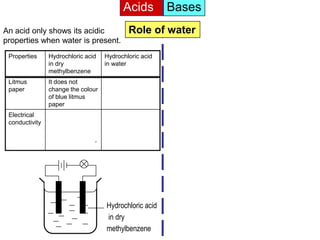
An acid only shows its acidic                 Role of water
properties when water is present.
 Properties     Hydrochloric acid     Hydrochloric acid
                in dry                in water
                methylbenzene
 Litmus         It does not
 paper          change the colour
                of blue litmus
                paper
 Electrical     The bulb does
 conductivity   not lights up.
                It does not
                conduct electricity


                                      Hydrochloric acid
                                      in dry
                                      methylbenzene
Acids           Bases
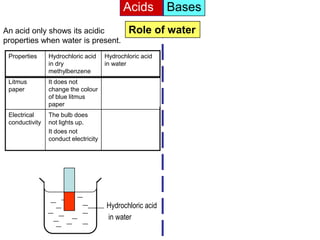
An acid only shows its acidic                  Role of water
properties when water is present.
 Properties     Hydrochloric acid     Hydrochloric acid
                in dry                in water
                methylbenzene
 Litmus         It does not           It turns the blue
 paper          change the colour     litmus paper to red.
                of blue litmus
                paper
 Electrical     The bulb does
 conductivity   not lights up.
                It does not
                conduct electricity


                                      Hydrochloric acid
                                      in water
Acids           Bases
An acid only shows its acidic                  Role of water                An alkali only shows its alkalinity
properties when water is present.                                           properties when water is present.

 Properties     Hydrochloric acid     Hydrochloric acid
                in dry                in water               Properties      ammonia in dry      ammonia in water
                methylbenzene                                                trichloromethane

 Litmus         It does not           It turns the blue      Litmus          It does not
 paper          change the colour     litmus paper to red.   paper           change the colour
                of blue litmus                                               of red litmus
                paper                                                        paper
 Electrical     The bulb does         The bulb lights up.    Electrical
 conductivity   not lights up.        It conducts            conductivity
                It does not           electricity.
                conduct electricity


                                                                                                 ammonia in
                                      Hydrochloric acid
                                                                                                 dry
                                      in water                                                   trichloromethane
Acids           Bases
An acid only shows its acidic                  Role of water                An alkali only shows its alkalinity
properties when water is present.                                           properties when water is present.

 Properties     Hydrochloric acid     Hydrochloric acid
                in dry                in water               Properties      ammonia in dry        ammonia in water
                methylbenzene                                                trichloromethane

 Litmus         It does not           It turns the blue      Litmus          It does not
 paper          change the colour     litmus paper to red.   paper           change the colour
                of blue litmus                                               of red litmus
                paper                                                        paper
 Electrical     The bulb does         The bulb lights up.    Electrical      The bulb does
 conductivity   not lights up.        It conducts            conductivity    not lights up.
                It does not           electricity.                           It does not
                conduct electricity                                          conduct electricity


                                      Hydrochloric acid                                            ammonia in
                                                                                                   dry
                                      in water
                                                                                                   trichloromethane
Acids           Bases
An acid only shows its acidic                  Role of water                An alkali only shows its alkalinity
properties when water is present.                                           properties when water is present.

 Properties     Hydrochloric acid     Hydrochloric acid
                in dry                in water               Properties      ammonia in dry        ammonia in water
                methylbenzene                                                trichloromethane

 Litmus         It does not           It turns the blue      Litmus          It does not           It turns the red
 paper          change the colour     litmus paper to red.   paper           change the colour     litmus paper to
                of blue litmus                                               of red litmus         blue.
                paper                                                        paper
 Electrical     The bulb does         The bulb lights up.    Electrical      The bulb does
 conductivity   not lights up.        It conducts            conductivity    not lights up.
                It does not           electricity.                           It does not
                conduct electricity                                          conduct electricity


                                      Hydrochloric acid                                              Ammonia
                                      in water                                                       in water
Acids           Bases
An acid only shows its acidic                  Role of water                An alkali only shows its alkalinity
properties when water is present.                                           properties when water is present.

 Properties     Hydrochloric acid     Hydrochloric acid
                in dry                in water               Properties      ammonia in dry        ammonia in water
                methylbenzene                                                trichloromethane

 Litmus         It does not           It turns the blue      Litmus          It does not           It turns the red
 paper          change the colour     litmus paper to red.   paper           change the colour     litmus paper to
                of blue litmus                                               of red litmus         blue.
                paper                                                        paper
 Electrical     The bulb does         The bulb lights up.    Electrical      The bulb does         The bulb lights up.
 conductivity   not lights up.        It conducts            conductivity    not lights up.        It conducts
                It does not           electricity.                           It does not           electricity.
                conduct electricity                                          conduct electricity


                                      Hydrochloric acid                                              Ammonia
                                      in water                                                       in water
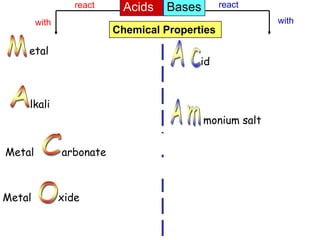
react    Acids   Bases        react
        with                                                with
                          Chemical Properties
    etal
                                          id
  Mg + 2 HCl g MgCl2 + H2
                                   HNO3 + KOH g KNO3 + H2O

    lkali
 HNO3 + NaOH g NaNO3 + H2O                 monium salt

                              NaOH+NH4Cl g NaCl         + NH3 + H2O
Metal          arbonate
H2SO4+ CaCO3g CaSO4 + CO2 + H2O

Metal          xide

 K2O + HCl g 2 KCl + H2O
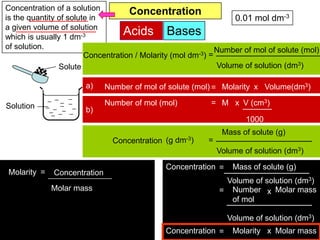
Concentration of a solution         Concentration
is the quantity of solute in                                      0.01 mol dm-3
a given volume of solution
which is usually 1 dm-3
                                   Acids Bases
of solution.                                                  Number of mol of solute (mol)
                        Concentration / Molarity (mol dm-3) =
                Solute                                        Volume of solution (dm3)

                       a)     Number of mol of solute (mol) = Molarity x Volume(dm3)

Solution                      Number of mol (mol)          = M x V (cm3)
                       b)
                                                                       1000
                                                                Mass of solute (g)
                                Concentration (g   dm-3)   =
                                                               Volume of solution (dm3)

                                              Concentration =      Mass of solute (g)
Molarity =    Concentration
                                                                Volume of solution (dm3)
             Molar mass                                        = Number x Molar mass
                                                                 of mol

                                                                 Volume of solution (dm3)
                                              Concentration =      Molarity x Molar mass
Standard solution              Standard Solution
is a solution which its
concentration is accurately
known.
                                Acids        Bases

            You are given solid sodium hidroxide. Describe the procedure
            to prepare 500cm3 of 1.0 mol dm-3 sodium hidroxide solution.
            [Relative atomic mass: H=1; 0=16; Na=23]
  1. Calculate the mass of solute needed to give the required volume and molarity.

Number of mol, = M V (cm3)           Number of mol, = Mass, NaOH
NaOH                                 NaOH
                  1000                                 Molar mass
                = 1.0 mol dm-3 (500cm3
                               )           Mass, = Number of mol x Molar mass
                     1000                  NaOH
                = 0.5 mol                           = 0.5 mol x (23 + 16 +1) g mol-1
                                                     = 20.0 g
  2. The solute is weighed.


                                20.0g       Electronic Balance
Standard solution                Standard Solution
is a solution which its
concentration is accurately
known.
                                  Acids        Bases

            You are given solid sodium hidroxide. Describe the procedure
            to prepare 500cm3 of 1.0 mol dm-3 sodium hidroxide solution.
            [Relative atomic mass: H=1; 0=16; Na=23]

 3. Dissolve the solute in distilled water in a beaker.
                               20.0g Sodium hydroxide

                                         glass rod

     Sodium hydroxide
        Distilled water
     solution
Standard solution               Standard Solution
is a solution which its
concentration is accurately
known.
                                 Acids       Bases

            You are given solid sodium hidroxide. Describe the procedure
            to prepare 500cm3 of 1.0 mol dm-3 sodium hidroxide solution.
            [Relative atomic mass: H=1; 0=16; Na=23]

 4. Transfer the content into a 500cm3 volumetric flask.


                                       Calibration mark

                                           Volumetric flask
                                           500cm3
Standard solution                Standard Solution
is a solution which its
concentration is accurately
known.
                                  Acids        Bases

            You are given solid sodium hidroxide. Describe the procedure
            to prepare 500cm3 of 1.0 mol dm-3 sodium hidroxide solution.
            [Relative atomic mass: H=1; 0=16; Na=23]

 5. Rinse the beaker with distilled water and transfer all the content into the
      volumetric flask.

                                                     Wash bottle
Standard solution                Standard Solution
is a solution which its
concentration is accurately
known.
                                  Acids         Bases

            You are given solid sodium hidroxide. Describe the procedure
            to prepare 500cm3 of 1.0 mol dm-3 sodium hidroxide solution.
            [Relative atomic mass: H=1; 0=16; Na=23]

6. Distilled water is added to the volumetric flask untill the calibration mark.
Standard solution               Standard Solution
is a solution which its
concentration is accurately
known.
                                 Acids        Bases

            You are given solid sodium hidroxide. Describe the procedure
            to prepare 500cm3 of 1.0 mol dm-3 sodium hidroxide solution.
            [Relative atomic mass: H=1; 0=16; Na=23]

7. The volumetric flask is closed tightly with stopper and inverted a few time to get
    homogeneous solution.
Standard solution               Standard Solution
is a solution which its
concentration is accurately
known.
                                 Acids        Bases

            You are given solid sodium hidroxide. Describe the procedure
            to prepare 500cm3 of 1.0 mol dm-3 sodium hidroxide solution.
            [Relative atomic mass: H=1; 0=16; Na=23]

7. The volumetric flask is closed tightly with stopper and inverted a few time to get
    homogeneous solution.
Standard solution               Standard Solution
is a solution which its
concentration is accurately
known.
                                 Acids        Bases

            You are given solid sodium hidroxide. Describe the procedure
            to prepare 500cm3 of 1.0 mol dm-3 sodium hidroxide solution.
            [Relative atomic mass: H=1; 0=16; Na=23]

7. The volumetric flask is closed tightly with stopper and inverted a few time to get
    homogeneous solution.
Standard solution               Standard Solution
is a solution which its
concentration is accurately
known.
                                 Acids        Bases

            You are given solid sodium hidroxide. Describe the procedure
            to prepare 500cm3 of 1.0 mol dm-3 sodium hidroxide solution.
            [Relative atomic mass: H=1; 0=16; Na=23]

7. The volumetric flask is closed tightly with stopper and inverted a few time to get
    homogeneous solution.


                                           500 cm3 1.0 mol dm-3,
                                           Sodium hydroxide solution
Dilute the solution by                   Dilution
adding water to the
standard solution.
                                Acids          Bases

            You are asked to dilute the standard sodium hydroxide solution
            that you had made before to 250cm3 of 0.1 mol dm-3.

            Describe how you would prepare the dilute solution.
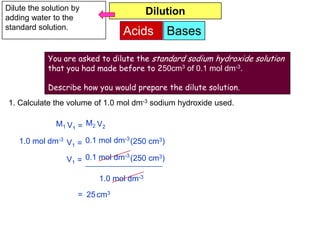
1. Calculate the volume of 1.0 mol dm-3 sodium hydroxide used.

               M1 V1 = M2 V2

    1.0 mol dm-3 V1 = 0.1 mol dm-3 (250 cm3)
                                 -3
                  V1 = 0.1 mol dm (250 cm3)

                          1.0 mol dm-3
                     = 25 cm3
Dilute the solution by                Dilution
adding water to the
standard solution.
                                Acids       Bases
            You are asked to dilute the standard sodium hydroxide solution
            that you had made before into 250cm3 of 0.1 mol dm-3.

            Describe how you would prepare the dilute solution.

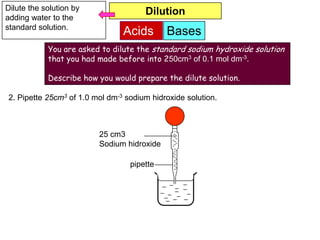
2. Pipette 25cm3 of 1.0 mol dm-3 sodium hidroxide solution.


                         25 cm3
                         Sodium hidroxide

                                  pipette
Dilute the solution by                Dilution
adding water to the
standard solution.
                                Acids       Bases
            You are asked to dilute the standard sodium hydroxide solution
            that you had made before into 250cm3 of 0.1 mol dm-3.

            Describe how you would prepare the dilute solution.

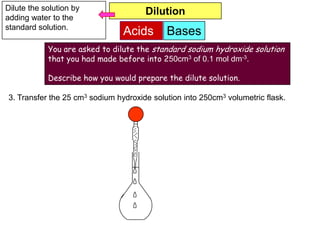
3. Transfer the 25 cm3 sodium hydroxide solution into 250cm3 volumetric flask.
Dilute the solution by                   Dilution
adding water to the
standard solution.
                                  Acids        Bases
            You are asked to dilute the standard sodium hydroxide solution
            that you had made before into 250cm3 of 0.1 mol dm-3.

            Describe how you would prepare the dilute solution.

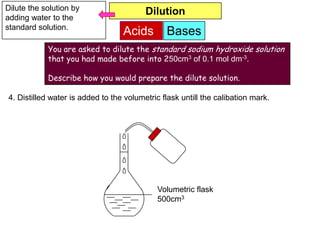
4. Distilled water is added to the volumetric flask untill the calibation mark.


                                             Volumetric flask
                                             500cm3
Dilute the solution by                  Dilution
adding water to the
standard solution.
                                 Acids        Bases
            You are asked to dilute the standard sodium hydroxide solution
            that you had made before into 250cm3 of 0.1 mol dm-3.

            Describe how you would prepare the dilute solution.

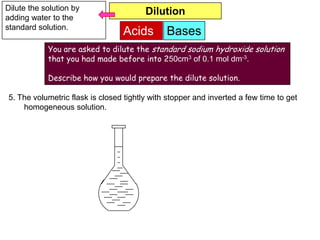
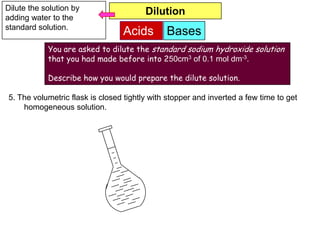
5. The volumetric flask is closed tightly with stopper and inverted a few time to get
    homogeneous solution.
Dilute the solution by                  Dilution
adding water to the
standard solution.
                                 Acids        Bases
            You are asked to dilute the standard sodium hydroxide solution
            that you had made before into 250cm3 of 0.1 mol dm-3.

            Describe how you would prepare the dilute solution.

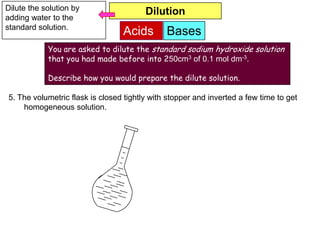
5. The volumetric flask is closed tightly with stopper and inverted a few time to get
    homogeneous solution.
Dilute the solution by                  Dilution
adding water to the
standard solution.
                                 Acids        Bases
            You are asked to dilute the standard sodium hydroxide solution
            that you had made before into 250cm3 of 0.1 mol dm-3.

            Describe how you would prepare the dilute solution.

5. The volumetric flask is closed tightly with stopper and inverted a few time to get
    homogeneous solution.
Dilute the solution by                  Dilution
adding water to the
standard solution.
                                 Acids        Bases
            You are asked to dilute the standard sodium hydroxide solution
            that you had made before into 250cm3 of 0.1 mol dm-3.

            Describe how you would prepare the dilute solution.

5. The volumetric flask is closed tightly with stopper and inverted a few time to get
    homogeneous solution.


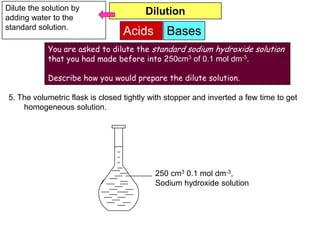
                                           250 cm3 0.1 mol dm-3,
                                           Sodium hydroxide solution
Neutralisation is the                Neutralisation
reaction between an acid
and a base to form only
salt and water
                                   Acids       + Bases                salt + water


 An acid-base titration           Daily Life
is a technique used to
determine the volume        Agriculture
of an acid required
to neutralise a fixed                     Industries
volume of an alkali
with the help of                                        Health
Acid-base indicator

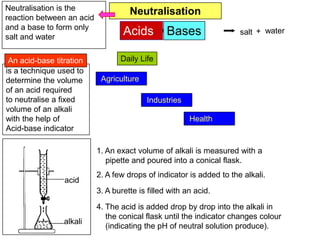
                           1. An exact volume of alkali is measured with a
                              pipette and poured into a conical flask.
                           2. A few drops of indicator is added to the alkali.
                 acid
             dropper       3. A burette is filled with an acid.

                           4. The acid is added drop by drop into the alkali in
                              the conical flask until the indicator changes colour
                 alkali
                              (indicating the pH of neutral solution produce).
Acid bases

Acid bases

  • 1.
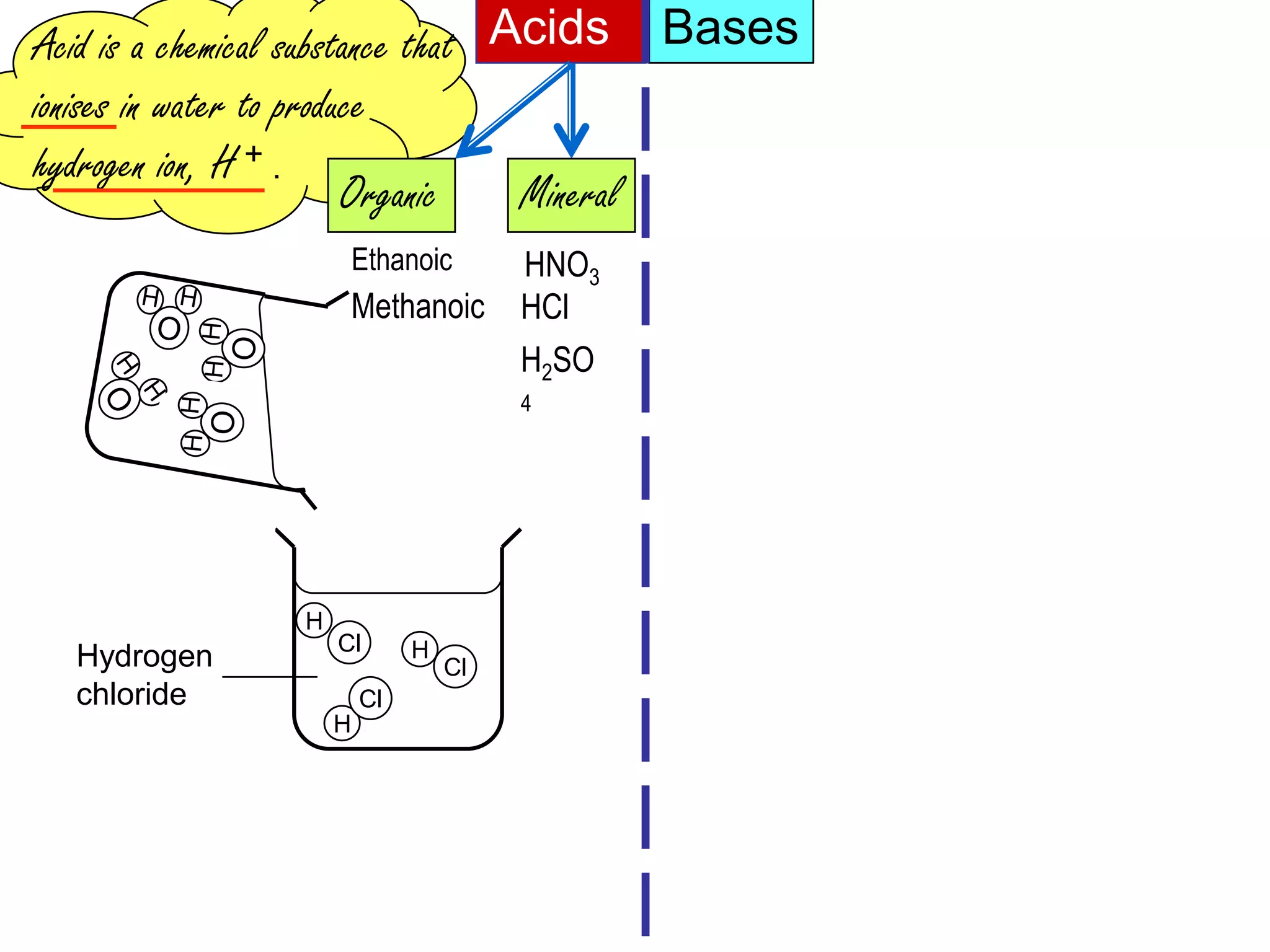
    Acid is achemical substance that Acids Bases ionises in water to produce hydrogen ion, H + . Organic Mineral Ethanoic HNO3 Methanoic HCl H2SO 4 H Cl H Hydrogen Cl chloride Cl H
  • 2.
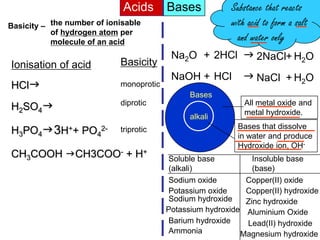
    Acid is achemical substance that Acids Bases Substance that reacts ionises in waterthehydrogenof ionisable Basicity – to produce number with acid to form a salt of atom per hydrogen ion, H + . molecule of an acid and water only Organic Mineral Na2O + 2HCl g 2NaCl+ H2O Ionisation of acidEthanoic Basicity HNO3 Methanoic HCl NaOH + HCl g NaCl + H2O HClg H++ Cl- monoprotic H2SO Bases 4 H2SO4g2H++ SO42- diprotic All metal oxide and metal hydroxide. alkali H3PO4g 3H++ PO42- triprotic Bases that dissolve in water and produce Hydroxide ion, OH- CH3COOH gCH3COO- + H+ H H + + Soluble base Insoluble base Cl- (alkali) (base) Hydrochloric Cl- Cl- acid H+ Sodium oxide Copper(II) oxide Hydroxonium ions Potassium oxide Copper(II) hydroxide H2O Sodium hydroxide HCl g H3O+ + Cl- Zinc hydroxide Potassium hydroxide Aluminium Oxide HClgH++ Cl Barium hydroxide - H3O+ g H+ + H2O Lead(II) hydroxide Ammonia Magnesium hydroxide
  • 3.
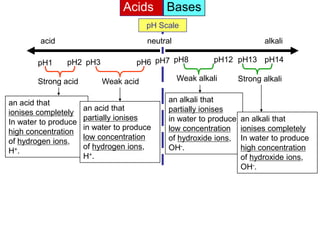
    Acids Bases pH Scale acid neutral alkali pH1 pH2 pH3 pH6 pH7 pH8 pH12 pH13 pH14 Strong acid Weak acid Weak alkali Strong alkali an acid that an alkali that an acid that partially ionises ionises completely partially ionises in water to produce an alkali that In water to produce in water to produce low concentration ionises completely high concentration low concentration of hydroxide ions, In water to produce of hydrogen ions, of hydrogen ions, OH-. high concentration H+. H+. of hydroxide ions, OH-. Indicator acid neutral alkali Litmus solution RED PURPLE BLUE Methyl orange RED ORANGE YELLOW Phenolphthalein COLOURLESS COLOURLESS PINK Universal RED GREEN PURPLE indicator
  • 4.
    To investigate therelationship between concentration of hydrogen ions and pH value 1.21 pH value 2.98 0.1mol dm-3 0.01mol dm-3 Hydrochloric acid Hydrochloric acid HCl g H+ + Cl- HCl g H+ + Cl- 0.1 mol dm-3 0.1 mol dm-3 0.1 mol dm-3 0.01 mol dm-3 0.01 mol dm-3 0.01 mol dm-3 Concentration hydrogen ion in 0.1 mol dm-3 Of hydrochloric acid is higher than 0.01 mol dm-3 of hydrochloric acid.
  • 5.
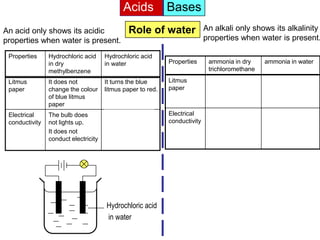
    Acids Bases An acid only shows its acidic Role of water properties when water is present. Properties Hydrochloric acid Hydrochloric acid in dry in water methylbenzene Litmus It does not paper change the colour of blue litmus paper Electrical conductivity Hydrochloric acid in dry methylbenzene
  • 6.
    Acids Bases An acid only shows its acidic Role of water properties when water is present. Properties Hydrochloric acid Hydrochloric acid in dry in water methylbenzene Litmus It does not paper change the colour of blue litmus paper Electrical The bulb does conductivity not lights up. It does not conduct electricity Hydrochloric acid in dry methylbenzene
  • 7.
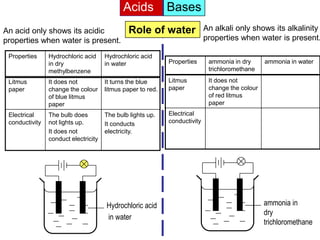
    Acids Bases An acid only shows its acidic Role of water properties when water is present. Properties Hydrochloric acid Hydrochloric acid in dry in water methylbenzene Litmus It does not It turns the blue paper change the colour litmus paper to red. of blue litmus paper Electrical The bulb does conductivity not lights up. It does not conduct electricity Hydrochloric acid in water
  • 8.
    Acids Bases An acid only shows its acidic Role of water An alkali only shows its alkalinity properties when water is present. properties when water is present. Properties Hydrochloric acid Hydrochloric acid in dry in water Properties ammonia in dry ammonia in water methylbenzene trichloromethane Litmus It does not It turns the blue Litmus It does not paper change the colour litmus paper to red. paper change the colour of blue litmus of red litmus paper paper Electrical The bulb does The bulb lights up. Electrical conductivity not lights up. It conducts conductivity It does not electricity. conduct electricity ammonia in Hydrochloric acid dry in water trichloromethane
  • 9.
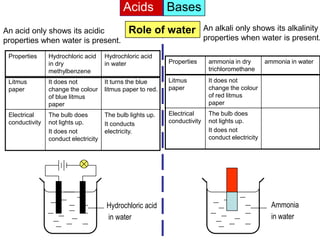
    Acids Bases An acid only shows its acidic Role of water An alkali only shows its alkalinity properties when water is present. properties when water is present. Properties Hydrochloric acid Hydrochloric acid in dry in water Properties ammonia in dry ammonia in water methylbenzene trichloromethane Litmus It does not It turns the blue Litmus It does not paper change the colour litmus paper to red. paper change the colour of blue litmus of red litmus paper paper Electrical The bulb does The bulb lights up. Electrical The bulb does conductivity not lights up. It conducts conductivity not lights up. It does not electricity. It does not conduct electricity conduct electricity Hydrochloric acid ammonia in dry in water trichloromethane
  • 10.
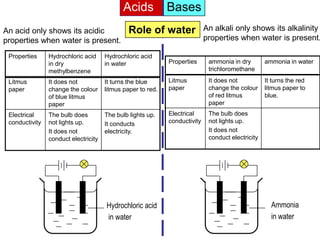
    Acids Bases An acid only shows its acidic Role of water An alkali only shows its alkalinity properties when water is present. properties when water is present. Properties Hydrochloric acid Hydrochloric acid in dry in water Properties ammonia in dry ammonia in water methylbenzene trichloromethane Litmus It does not It turns the blue Litmus It does not It turns the red paper change the colour litmus paper to red. paper change the colour litmus paper to of blue litmus of red litmus blue. paper paper Electrical The bulb does The bulb lights up. Electrical The bulb does conductivity not lights up. It conducts conductivity not lights up. It does not electricity. It does not conduct electricity conduct electricity Hydrochloric acid Ammonia in water in water
  • 11.
    Acids Bases An acid only shows its acidic Role of water An alkali only shows its alkalinity properties when water is present. properties when water is present. Properties Hydrochloric acid Hydrochloric acid in dry in water Properties ammonia in dry ammonia in water methylbenzene trichloromethane Litmus It does not It turns the blue Litmus It does not It turns the red paper change the colour litmus paper to red. paper change the colour litmus paper to of blue litmus of red litmus blue. paper paper Electrical The bulb does The bulb lights up. Electrical The bulb does The bulb lights up. conductivity not lights up. It conducts conductivity not lights up. It conducts It does not electricity. It does not electricity. conduct electricity conduct electricity Hydrochloric acid Ammonia in water in water
  • 12.
    react Acids Bases react with with Chemical Properties etal id Mg + 2 HCl g MgCl2 + H2 HNO3 + KOH g KNO3 + H2O lkali HNO3 + NaOH g NaNO3 + H2O monium salt NaOH+NH4Cl g NaCl + NH3 + H2O Metal arbonate H2SO4+ CaCO3g CaSO4 + CO2 + H2O Metal xide K2O + HCl g 2 KCl + H2O
  • 13.
    Concentration of asolution Concentration is the quantity of solute in 0.01 mol dm-3 a given volume of solution which is usually 1 dm-3 Acids Bases of solution. Number of mol of solute (mol) Concentration / Molarity (mol dm-3) = Solute Volume of solution (dm3) a) Number of mol of solute (mol) = Molarity x Volume(dm3) Solution Number of mol (mol) = M x V (cm3) b) 1000 Mass of solute (g) Concentration (g dm-3) = Volume of solution (dm3) Concentration = Mass of solute (g) Molarity = Concentration Volume of solution (dm3) Molar mass = Number x Molar mass of mol Volume of solution (dm3) Concentration = Molarity x Molar mass
  • 14.
    Standard solution Standard Solution is a solution which its concentration is accurately known. Acids Bases You are given solid sodium hidroxide. Describe the procedure to prepare 500cm3 of 1.0 mol dm-3 sodium hidroxide solution. [Relative atomic mass: H=1; 0=16; Na=23] 1. Calculate the mass of solute needed to give the required volume and molarity. Number of mol, = M V (cm3) Number of mol, = Mass, NaOH NaOH NaOH 1000 Molar mass = 1.0 mol dm-3 (500cm3 ) Mass, = Number of mol x Molar mass 1000 NaOH = 0.5 mol = 0.5 mol x (23 + 16 +1) g mol-1 = 20.0 g 2. The solute is weighed. 20.0g Electronic Balance
  • 15.
    Standard solution Standard Solution is a solution which its concentration is accurately known. Acids Bases You are given solid sodium hidroxide. Describe the procedure to prepare 500cm3 of 1.0 mol dm-3 sodium hidroxide solution. [Relative atomic mass: H=1; 0=16; Na=23] 3. Dissolve the solute in distilled water in a beaker. 20.0g Sodium hydroxide glass rod Sodium hydroxide Distilled water solution
  • 16.
    Standard solution Standard Solution is a solution which its concentration is accurately known. Acids Bases You are given solid sodium hidroxide. Describe the procedure to prepare 500cm3 of 1.0 mol dm-3 sodium hidroxide solution. [Relative atomic mass: H=1; 0=16; Na=23] 4. Transfer the content into a 500cm3 volumetric flask. Calibration mark Volumetric flask 500cm3
  • 17.
    Standard solution Standard Solution is a solution which its concentration is accurately known. Acids Bases You are given solid sodium hidroxide. Describe the procedure to prepare 500cm3 of 1.0 mol dm-3 sodium hidroxide solution. [Relative atomic mass: H=1; 0=16; Na=23] 5. Rinse the beaker with distilled water and transfer all the content into the volumetric flask. Wash bottle
  • 18.
    Standard solution Standard Solution is a solution which its concentration is accurately known. Acids Bases You are given solid sodium hidroxide. Describe the procedure to prepare 500cm3 of 1.0 mol dm-3 sodium hidroxide solution. [Relative atomic mass: H=1; 0=16; Na=23] 6. Distilled water is added to the volumetric flask untill the calibration mark.
  • 19.
    Standard solution Standard Solution is a solution which its concentration is accurately known. Acids Bases You are given solid sodium hidroxide. Describe the procedure to prepare 500cm3 of 1.0 mol dm-3 sodium hidroxide solution. [Relative atomic mass: H=1; 0=16; Na=23] 7. The volumetric flask is closed tightly with stopper and inverted a few time to get homogeneous solution.
  • 20.
    Standard solution Standard Solution is a solution which its concentration is accurately known. Acids Bases You are given solid sodium hidroxide. Describe the procedure to prepare 500cm3 of 1.0 mol dm-3 sodium hidroxide solution. [Relative atomic mass: H=1; 0=16; Na=23] 7. The volumetric flask is closed tightly with stopper and inverted a few time to get homogeneous solution.
  • 21.
    Standard solution Standard Solution is a solution which its concentration is accurately known. Acids Bases You are given solid sodium hidroxide. Describe the procedure to prepare 500cm3 of 1.0 mol dm-3 sodium hidroxide solution. [Relative atomic mass: H=1; 0=16; Na=23] 7. The volumetric flask is closed tightly with stopper and inverted a few time to get homogeneous solution.
  • 22.
    Standard solution Standard Solution is a solution which its concentration is accurately known. Acids Bases You are given solid sodium hidroxide. Describe the procedure to prepare 500cm3 of 1.0 mol dm-3 sodium hidroxide solution. [Relative atomic mass: H=1; 0=16; Na=23] 7. The volumetric flask is closed tightly with stopper and inverted a few time to get homogeneous solution. 500 cm3 1.0 mol dm-3, Sodium hydroxide solution
  • 23.
    Dilute the solutionby Dilution adding water to the standard solution. Acids Bases You are asked to dilute the standard sodium hydroxide solution that you had made before to 250cm3 of 0.1 mol dm-3. Describe how you would prepare the dilute solution. 1. Calculate the volume of 1.0 mol dm-3 sodium hydroxide used. M1 V1 = M2 V2 1.0 mol dm-3 V1 = 0.1 mol dm-3 (250 cm3) -3 V1 = 0.1 mol dm (250 cm3) 1.0 mol dm-3 = 25 cm3
  • 24.
    Dilute the solutionby Dilution adding water to the standard solution. Acids Bases You are asked to dilute the standard sodium hydroxide solution that you had made before into 250cm3 of 0.1 mol dm-3. Describe how you would prepare the dilute solution. 2. Pipette 25cm3 of 1.0 mol dm-3 sodium hidroxide solution. 25 cm3 Sodium hidroxide pipette
  • 25.
    Dilute the solutionby Dilution adding water to the standard solution. Acids Bases You are asked to dilute the standard sodium hydroxide solution that you had made before into 250cm3 of 0.1 mol dm-3. Describe how you would prepare the dilute solution. 3. Transfer the 25 cm3 sodium hydroxide solution into 250cm3 volumetric flask.
  • 26.
    Dilute the solutionby Dilution adding water to the standard solution. Acids Bases You are asked to dilute the standard sodium hydroxide solution that you had made before into 250cm3 of 0.1 mol dm-3. Describe how you would prepare the dilute solution. 4. Distilled water is added to the volumetric flask untill the calibation mark. Volumetric flask 500cm3
  • 27.
    Dilute the solutionby Dilution adding water to the standard solution. Acids Bases You are asked to dilute the standard sodium hydroxide solution that you had made before into 250cm3 of 0.1 mol dm-3. Describe how you would prepare the dilute solution. 5. The volumetric flask is closed tightly with stopper and inverted a few time to get homogeneous solution.
  • 28.
    Dilute the solutionby Dilution adding water to the standard solution. Acids Bases You are asked to dilute the standard sodium hydroxide solution that you had made before into 250cm3 of 0.1 mol dm-3. Describe how you would prepare the dilute solution. 5. The volumetric flask is closed tightly with stopper and inverted a few time to get homogeneous solution.
  • 29.
    Dilute the solutionby Dilution adding water to the standard solution. Acids Bases You are asked to dilute the standard sodium hydroxide solution that you had made before into 250cm3 of 0.1 mol dm-3. Describe how you would prepare the dilute solution. 5. The volumetric flask is closed tightly with stopper and inverted a few time to get homogeneous solution.
  • 30.
    Dilute the solutionby Dilution adding water to the standard solution. Acids Bases You are asked to dilute the standard sodium hydroxide solution that you had made before into 250cm3 of 0.1 mol dm-3. Describe how you would prepare the dilute solution. 5. The volumetric flask is closed tightly with stopper and inverted a few time to get homogeneous solution. 250 cm3 0.1 mol dm-3, Sodium hydroxide solution
  • 31.
    Neutralisation is the Neutralisation reaction between an acid and a base to form only salt and water Acids + Bases salt + water An acid-base titration Daily Life is a technique used to determine the volume Agriculture of an acid required to neutralise a fixed Industries volume of an alkali with the help of Health Acid-base indicator 1. An exact volume of alkali is measured with a pipette and poured into a conical flask. 2. A few drops of indicator is added to the alkali. acid dropper 3. A burette is filled with an acid. 4. The acid is added drop by drop into the alkali in the conical flask until the indicator changes colour alkali (indicating the pH of neutral solution produce).