Chapter 11- Nervous System II PowerPoint Presentation to accompany  Hole’s Human Anatomy and Physiology,  10 th  edition ,  edited   by S.C. Wache for Biol2064.01
  You are responsible for the following figures and tables : Review Fig. 10.7. Differentiate  CNS and PNS  general tasks. Compare Fig. 11.5 - Structure of the CNS - the brain and spinal cord. Compare Tab. 11.9 and Fig. 11.29 - Components of the PNS  Fig. 11.1 , 11.2 - meninges. Fig. 11.3, 11.4 - CSF.  TB, blue box, p. 368 Clinical Applications 11.1 - Spinal tap. Fig. 11.6 - Structure of the spinal cord. Fig. 11.7 - Define 'reflex arc‘. Fig. 11.8, 11.9 - Examples: Knee-jerk reflex, withdrawal reflex.  Tab. 11.2 - Study the parts of a reflex arc. Fig. 11.15, Tab. 11.7 -  CNS/ Brain structure  - Read p.388-391, endocrine functions. Fig. 11.16 - Note fissures, sulci, gyri.  Fig. 11.17, 11.18 - Areas of the cerebrum. Tab. 11.5 - Functions of the cerebral lobes. Fig. 11.25.  PNS / Cranial nerves . Fig. 11.26. The vagus nerve # X, is important.  Fig. 11.6.-  CNS/ Spinal cord structure. Fig. 11.29 -  PNS/ Spinal nerves  - (see table in the attached lecture handout). Fig. 11.35 - ANS innervates smooth muscle and glands.  Fig. 11.40 - sympathetic / parasympathetic nerves (see diagram in the attached lecture).
 
 
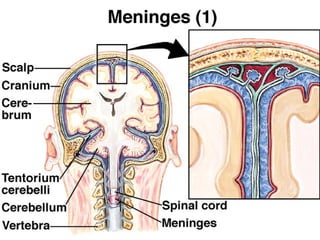
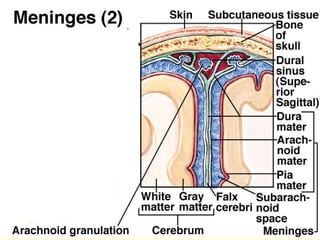
The meninges are membranes that protect the brain and the spinal cord Dura mater:  outermost layer, composed of tough, white, dense connective tissue Arachnoid mater:  thin, weblike membrane, subarachnoid space contains the cerebrospinal fluid Pia mater:  thin membrane with nerves and blood vessels, attached to the brain and spinal cord Meninges
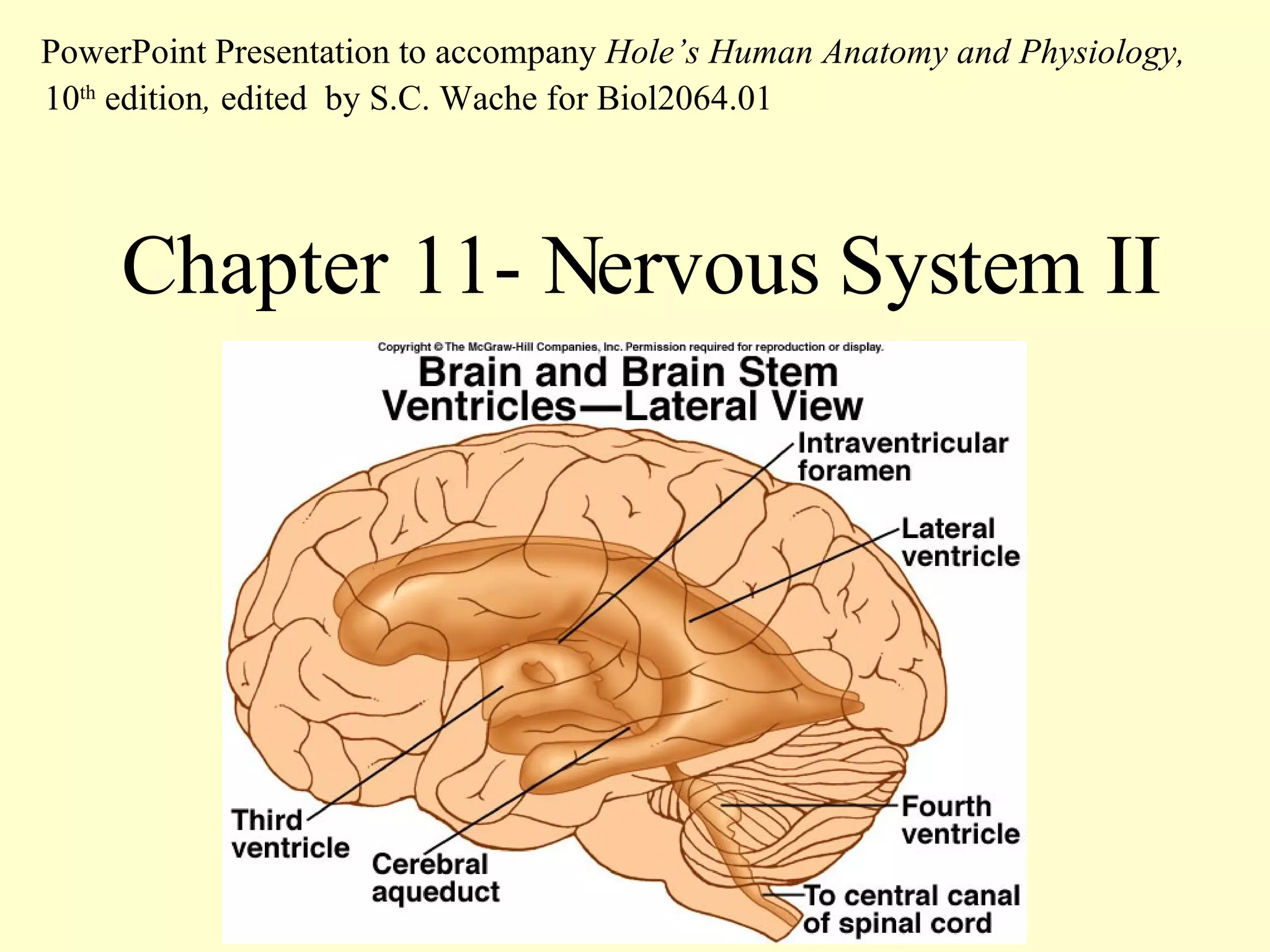
Ventricles The ventricles are a series of interconnected cavities continuous with the central canal of the spinal cord which  transport the cerebrospinal fluid (CSF). Lateral  ventricles : first and second ventricles located in the cerebrum Third ventricle:  located in the midbrain, connected to the fourth ventricle via the cerebral aqueduct Fourth ventricle:  located in the brain stem
Cerebrospinal Fluid (CSF) CSF is a clear fluid with high Na +  and glucose  and low K +  concentration, compared to other body  fluids. Choroid plexuses are specialized capillaries of the pia mater, secrete cerebrospinal fluid. 500 ml of CSF are secreted each day, but only 140 ml circulates, due to reabsorption through the arachnoid granulations.
 
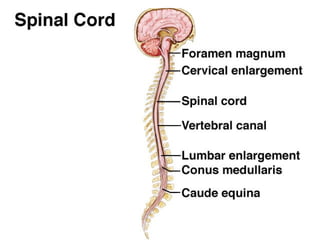
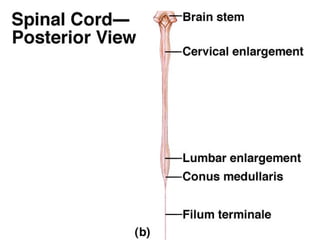
Spinal Cord It  begins where nervous tissue leaves the cranium at the  foramen magnum . It  tapers to a point near the first and second lumbar   vertebrae . Below this is the filum terminale and the cauda equina. It consists of  31 segments  each giving rise to a pair of spinal nerves. The cervical and lumbar enlargements give off  nerves to the upper and lower limbs respectively.
 
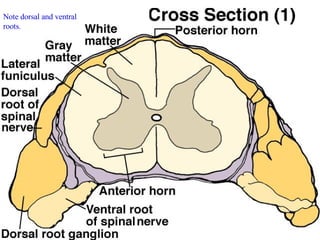
Note dorsal and ventral  roots.
Anterior median fissure and posterior median sulcus are  grooves dividing the cord into right and left halves. Gray butterfly is the inner  gray matter  consisting of interneurons. Anterior and posterior horn  are the wings. Between them is the lateral horn. The gray commissure connects the wings. The  central canal  contains CSF. The  white matter  contains the myelinated nerve tracts. Spinal Cord
Reflex Arcs Definition:   The simplest nerve pathway is a reflex arc which is autonomically controlled. Reflexes whose arcs pass through the spinal cord are  spinal reflexes . Reflexes are  autonomic and subconscious .  They help maintain homeostasis by controlling heart rate, breathing rate, etc. They carry out automatic actions such as swallowing, sneezing, coughing, vomiting.
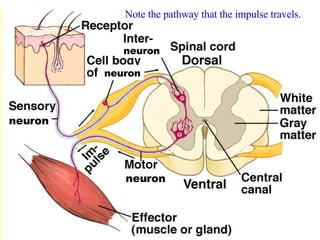
Note the pathway that the impulse travels. neuron neuron neuron  neuron
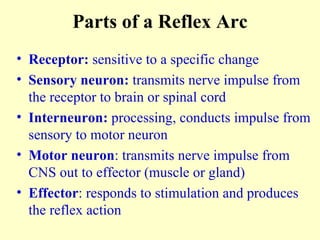
Parts of a Reflex Arc Receptor:  sensitive to a specific change Sensory neuron:  transmits nerve impulse from the receptor to brain or spinal cord Interneuron:  processing, conducts impulse from sensory to motor neuron Motor neuron : transmits nerve impulse from CNS out to effector (muscle or gland) Effector : responds to stimulation and produces the reflex action
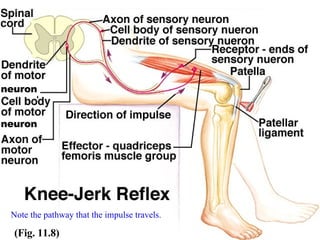
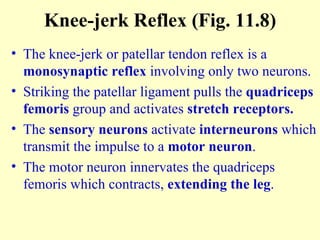
(Fig. 11.8) Note the pathway that the impulse travels. neuron neuron
Knee-jerk Reflex (Fig. 11.8) The knee-jerk or patellar tendon reflex is a  monosynaptic reflex  involving only two neurons. Striking the patellar ligament pulls the  quadriceps femoris  group and activates  stretch receptors. The  sensory neurons  activate  interneurons  which transmit the impulse to a  motor neuron .  The motor neuron innervates the quadriceps femoris which contracts,  extending the leg .
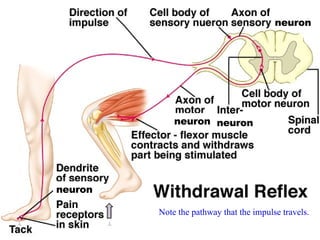
Note the pathway that the impulse travels. neuron neuron neuron neuron
Withdrawal Reflex (Fig. 11.9) Occurs in response to touching something painful,  such as pricking the finger. Sensory impulses  are activated by  pressure receptors  in the skin and send a message to the spinal cord. Interneurons  are stimulated and synapse with motor neurons. Motor neurons  signal flexor muscles.
 
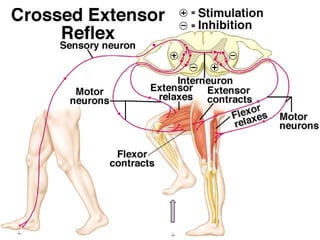
Crossed Extensor Reflex (Fig. 11.10)  Occurs with the withdrawal reflex. This reflex is due to interneurons within the reflex center  of the spinal cord. Flexors  are inhibited on the affected side (ipsilateral). Extensors  are stimulated on the opposite side (contralateral) allowing body weight to be supported.
Spinal Cord Nerve Tracts  (Fig. 11.11)   Spinal cord ascending and descending nerve  tracts: Ascending and sensory -  conduct impulses to the brain. Anterior/Posterior spino-cerebellar tract Anterior/ Lateral spino-thalamic tract Medial reticulo-spinal tract Descending and motor -  conduct motor impulses from the brain to muscle and glands. Anterior/ Lateral cortico-spinal tract Anterior/ Lateral reticulo-spinal tract
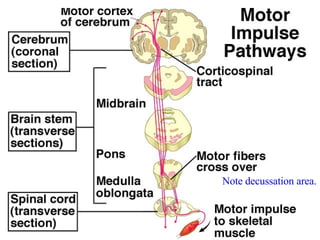
Note decussation area.
 
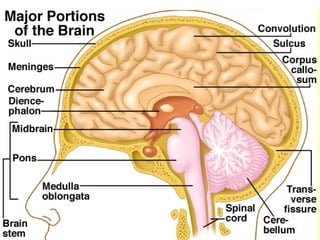
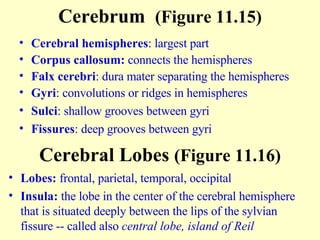
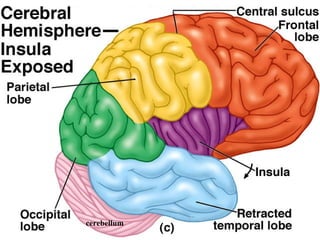
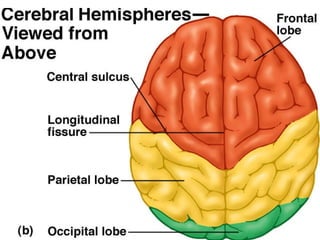
Cerebral hemispheres : largest part Corpus callosum:  connects the hemispheres Falx cerebri : dura mater separating the hemispheres Gyri : convolutions or ridges in hemispheres Sulci : shallow grooves between gyri Fissures : deep grooves between gyri Cerebrum  (Figure 11.15) Cerebral Lobes  (Figure 11.16) Lobes:  frontal, parietal, temporal, occipital  Insula:  the lobe in the center of the cerebral hemisphere that is situated deeply between the lips of the sylvian fissure -- called also  central lobe,   island of Reil
Note the lobes, fissures and sulci.
 
cerebellum
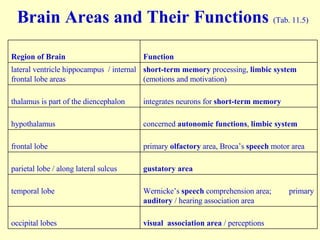
Brain Areas and Their Functions  (Tab. 11.5) visual  association area  / perceptions occipital lobes Wernicke’s  speech  comprehension area;  primary  auditory  / hearing association area temporal lobe gustatory   area parietal lobe / along lateral sulcus primary  olfactory  area, Broca’s  speech  motor area frontal lobe concerned  autonomic functions ,  limbic system hypothalamus integrates neurons for  short-term memory thalamus is part of the diencephalon short-term memory  processing,  limbic system  (emotions and motivation) lateral ventricle hippocampus  / internal frontal lobe areas Function Region of Brain
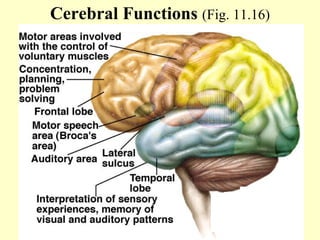
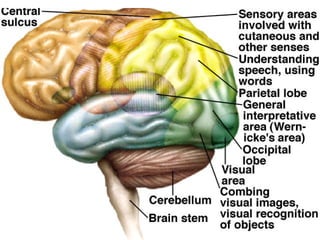
Cerebral Functions  (Fig. 11.16)
 
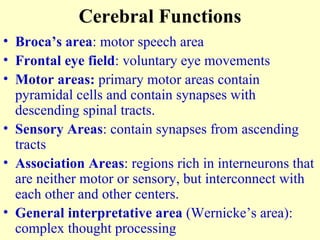
Broca’s area : motor speech area Frontal eye field : voluntary eye movements Motor areas:  primary motor areas contain pyramidal cells and contain synapses with descending spinal tracts. Sensory Areas : contain synapses from ascending tracts Association Areas : regions rich in interneurons that are neither motor or sensory, but interconnect with each other and other centers. General interpretative area  (Wernicke’s area): complex thought processing Cerebral Functions
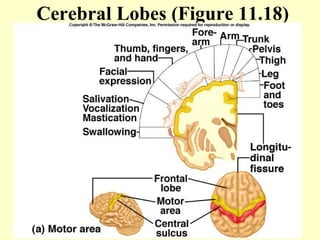
Cerebral Lobes (Figure 11.18)
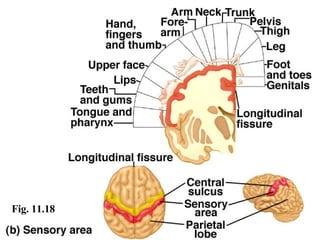
Fig. 11.18
Frontal lobes : motor areas for voluntary skeletal muscles, association areas Parietal lobes : sensory areas of temperature, touch, pressure, pain, speech association Temporal lobes:  sensory area for hearing, sensory association areas Occipital lobes : sensory area for vision, visual association area Cerebral Lobe Functions
Hemisphere Dominance Both hemispheres participate in basic functions. One side is usually the  dominant hemisphere  for some functions. For  90% of the population  the  left side  is dominant for language-related activities of speech, writing, reading.
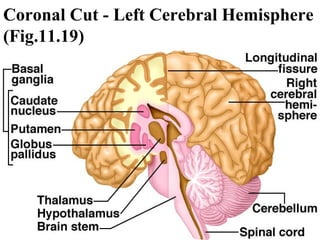
Coronal Cut - Left Cerebral Hemisphere (Fig.11.19)
Memory Short-term memory : patterns of synapses that change; no permanent synapses formed. Lateral ventricle hippocampus  / internal frontal lobe areas :  short-term memory processing.  Limbic system (emotions and motivation):  thalamus integrates neurons for short-term memory Long-term memory :  patterns of synapses that remain unchanged.
Basal Nuclei Basal Nuclei:  masses of gray matter which consists of unmyelinated interneurons within the cerebral hemispheres Hippocampus:  a curved elongated ridge that is an important part of the  limbic system , extends over the floor of the descending horn of each lateral ventricle of the brain, and consists of gray matter covered on the ventricular surface with white matter; a region of the cerebral cortex that performs repeated stimulations to strengthen synapses. Caudate nucleus, putamen, globus pallidus:  Relay motor impulses and produce the inhibitory neurotransmitter,  dopamine
Diencephalon Thalamus : gateway for sensory impulses Hypothalamus : controls anterior pituitary which, in turn, controls effector glands Posterior and  anterior pituitary gland  (controls a variety of effector endocrine glands) attached to the hypothalamus via the infundibulum Optic tract and optic chiasma ( cranial sensory nerve II ) Mammillary bodies Pineal gland  releases melatonin which controls the biorhythm / circadian rhythm
Limbic System Composed of portions of the  cerebral cortex, thalamus, hypothalamus, basal nuclei, and other deep nuclei Controls  emotional experiences Produces feelings of fear, anger, pleasure Interprets sensory impulses of  smell / olfactory sense
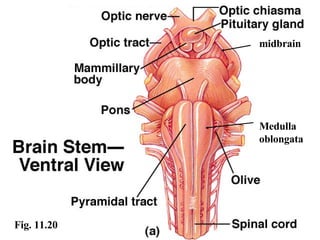
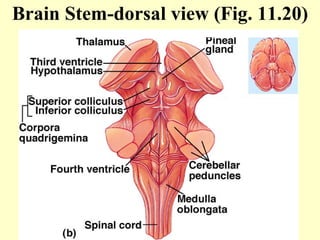
Brain Stem-Midbrain Connects brain stem and spinal cord with the CNS Cerebral peduncles : motor and sensory pathways Red nucleus : posture reflexes Corpora quadrigemina Superior colliculi:  visual reflexes Inferior colliculi:  auditory reflexes
Fig. 11.20 midbrain Medulla oblongata
Brain Stem-dorsal view (Fig. 11.20)
Brain Stem Midbrain:  the middle division of the three primary divisions of the adult brain that includes a ventral part with the  cerebral peduncles  and a dorsal part with the  corpora quadrigemina  and that surrounds the aqueduct of Sylvius  connecting the third and fourth ventricles Pons:  sensory impulses relayed to brain, works with the medulla oblongata Medulla Oblongata:  ascending and descending tracts pass through; contains the  cardiac center  which controls heart rate; contains the  vasomotor center  which controls blood pressure; contains the  respiratory center  which controls rate, rhythm, depth of breathing; corticospinal tract:  any of four columns of motor fibers of which two run on each side of the spinal cord and which are continuations of the pyramids of the medulla oblongata  :  PYRAMIDAL TRACT :  a   : LATERAL CORTICOSPINAL TRACT   b   : VENTRAL CORTICOSPINAL TRACT
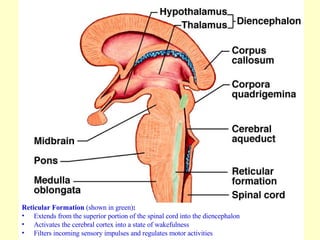
Reticular Formation  (shown in green) :  Extends from the superior portion of the spinal cord into the diencephalon Activates the cerebral cortex into a state of wakefulness Filters incoming sensory impulses and regulates motor activities
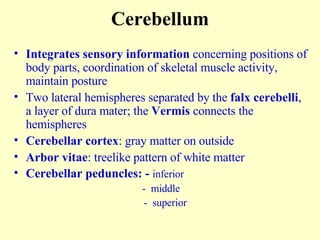
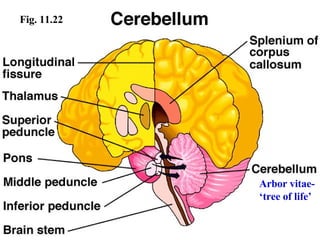
Cerebellum Integrates sensory information  concerning positions of body parts, coordination of skeletal muscle activity, maintain posture Two lateral hemispheres separated by the  falx cerebelli , a layer of dura mater; the  Vermis  connects the hemispheres Cerebellar cortex : gray matter on outside Arbor vitae : treelike pattern of white matter Cerebellar peduncles: -  inferior  -  middle    -  superior
Fig. 11.22 Arbor vitae-  ‘ tree of life’
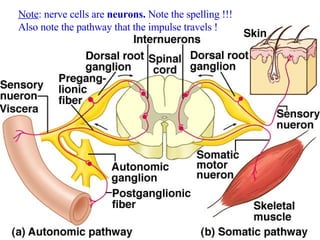
Peripheral Nervous System Cranial nerves and spinal nerves: Somatic Nervous System : nerves that connect CNS to skin and skeletal muscles Autonomic Nervous System : nerves that connect CNS to viscera, smooth muscle nad glands.
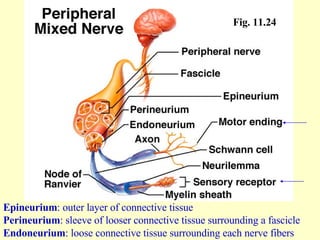
Fig. 11.24 Epineurium : outer layer of connective tissue Perineurium : sleeve of looser connective tissue surrounding a fascicle Endoneurium : loose connective tissue surrounding each nerve fibers
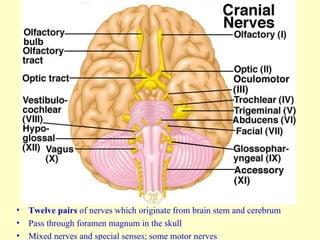
Twelve pairs  of nerves which originate from brain stem and cerebrum Pass through foramen magnum in the skull Mixed nerves and special senses; some motor nerves
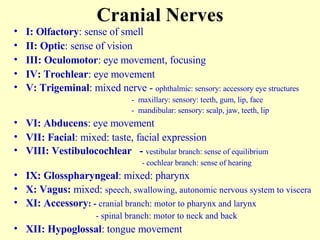
Cranial Nerves I: Olfactory : sense of smell II: Optic : sense of vision III: Oculomotor : eye movement, focusing IV: Trochlear : eye movement V: Trigeminal : mixed nerve -  ophthalmic: sensory: accessory eye structures   -  maxillary: sensory: teeth, gum, lip, face   -  mandibular: sensory: scalp, jaw, teeth, lip VI: Abducens : eye movement VII: Facial : mixed: taste, facial expression VIII: Vestibulocochlear  -  vestibular branch: sense of equilibrium - cochlear branch: sense of hearing IX: Glosspharyngeal : mixed: pharynx X: Vagus:  mixed:  speech, swallowing, autonomic nervous system to viscera XI: Accessory : -  cranial branch: motor to pharynx and larynx   - spinal branch: motor to neck and back XII: Hypoglossal : tongue movement
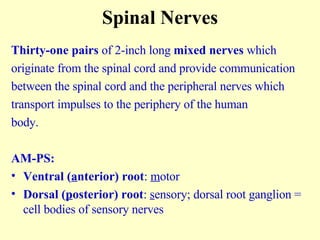
Spinal Nerves Thirty-one pairs  of 2-inch long  mixed nerves  which  originate from the spinal cord and provide communication  between the spinal cord and the peripheral nerves which transport impulses to the periphery of the human  body. AM-PS: Ventral ( a nterior) root :  m otor Dorsal ( p osterior) root :  s ensory; dorsal root ganglion = cell bodies of sensory nerves
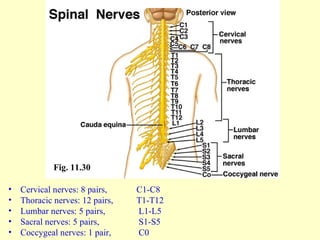
Cervical nerves: 8 pairs,  C1-C8 Thoracic nerves: 12 pairs,  T1-T12 Lumbar nerves: 5 pairs,   L1-L5 Sacral nerves: 5 pairs,   S1-S5 Coccygeal nerves: 1 pair,   C0 Fig. 11.30
Plexuses Cervical : first four cervical nerves [C1-C4] Brachial : lower four cervical nerves and first thoracic nerve [C5-C8 and T1] Lumbosacral : last thoracic nerve and lumbar, sacral, and coccygeal nerves [T12-S5] PNS - Autonomic Nervous System Functions independently,  involuntary / subconscious control Controls visceral activities by regulating  smooth and cardiac muscles and glands Regulates heart rate, blood pressure, breathing, body temperature and other homeostatic mechanisms Responds to stress
Note : nerve cells are  neurons.  Note the spelling !!! Also note the pathway that the impulse travels !
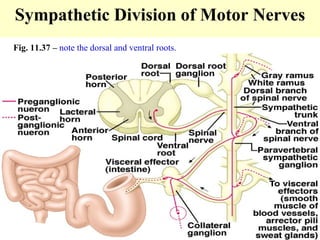
Sympathetic Division of Motor Nerves Fig. 11.37 –  note the dorsal and ventral roots.
Fig. 11.36  –  note the meninges, dorsal and ventral roots.   Note that the spinal nerves are mixed function nerves [AM-PS].
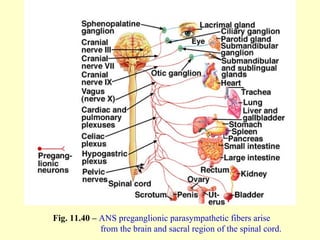
Parasympathetic Division of Motor Nerves Fibers arise from brain stem and sacral spinal cord. The vagus nerve (X) carries 75% of the parasympathetic fibers. Fibers travel to terminal ganglia close to viscera. Postganglionic fibers  travel to specific muscles or glands.
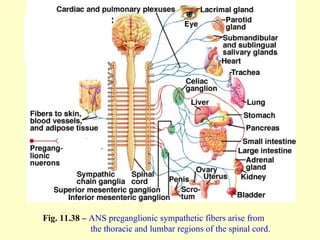
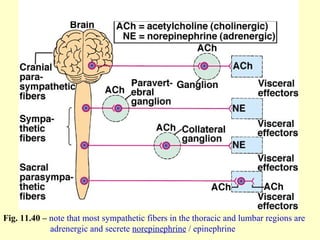
Neurotransmitters  (Tab. 11.10) Acetylcholine functions to maintain homeostasis. Preganglionic fibers are  cholinergic  and secrete  acetylcholine : Preganglionic sympathetic fibers  of the ANS arise from the thoracic and lumbar regions of the spinal cord. Preganglionic parasympathetic fibers  of the ANS arise from the brain and sacral region of the spinal cord. Postganglionic parasympathetic and sympathetic fibers   of sweat glands   are also  cholinergic . Norepinephrine and epinephrine  function to  respond to stress All other postganglionic sympathetic fibers are  adrenergic  and secrete  norepinephrine
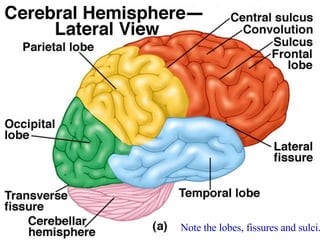
Fig. 11.38 –  ANS   preganglionic sympathetic fibers arise from    the thoracic and lumbar regions of the spinal cord.
Fig. 11.40 –  ANS preganglionic parasympathetic fibers arise    from the brain and sacral region of the spinal cord.
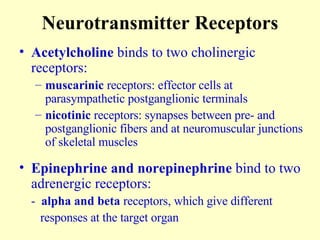
Neurotransmitter Receptors Acetylcholine  binds to two cholinergic receptors: muscarinic  receptors: effector cells at parasympathetic postganglionic terminals nicotinic  receptors: synapses between pre- and postganglionic fibers and at neuromuscular junctions of skeletal muscles Epinephrine and norepinephrine  bind to two adrenergic receptors: -  alpha and beta  receptors, which give different    responses at the target organ
Fig. 11.40 –  note that most sympathetic fibers in the thoracic and lumbar regions are    adrenergic and secrete  norepinephrine  / epinephrine
Programmed cell death  ( apoptosis ) begins at birth and is a natural control point within the cell cycle (G o , G 1 , S, G 2 , mitosis/meiosis, apoptosis or G o ). Loss of neurons  does not always mean loss of function. Signs of aging:  fading memory, slowed responses and reflexes, and other changes. Life-Span Changes

Ch11 Ppt Lect

  • 1.
    Chapter 11- NervousSystem II PowerPoint Presentation to accompany Hole’s Human Anatomy and Physiology, 10 th edition , edited by S.C. Wache for Biol2064.01
  • 2.
      You areresponsible for the following figures and tables : Review Fig. 10.7. Differentiate CNS and PNS general tasks. Compare Fig. 11.5 - Structure of the CNS - the brain and spinal cord. Compare Tab. 11.9 and Fig. 11.29 - Components of the PNS Fig. 11.1 , 11.2 - meninges. Fig. 11.3, 11.4 - CSF. TB, blue box, p. 368 Clinical Applications 11.1 - Spinal tap. Fig. 11.6 - Structure of the spinal cord. Fig. 11.7 - Define 'reflex arc‘. Fig. 11.8, 11.9 - Examples: Knee-jerk reflex, withdrawal reflex. Tab. 11.2 - Study the parts of a reflex arc. Fig. 11.15, Tab. 11.7 - CNS/ Brain structure - Read p.388-391, endocrine functions. Fig. 11.16 - Note fissures, sulci, gyri. Fig. 11.17, 11.18 - Areas of the cerebrum. Tab. 11.5 - Functions of the cerebral lobes. Fig. 11.25. PNS / Cranial nerves . Fig. 11.26. The vagus nerve # X, is important. Fig. 11.6.- CNS/ Spinal cord structure. Fig. 11.29 - PNS/ Spinal nerves - (see table in the attached lecture handout). Fig. 11.35 - ANS innervates smooth muscle and glands. Fig. 11.40 - sympathetic / parasympathetic nerves (see diagram in the attached lecture).
  • 3.
  • 4.
  • 5.
    The meninges aremembranes that protect the brain and the spinal cord Dura mater: outermost layer, composed of tough, white, dense connective tissue Arachnoid mater: thin, weblike membrane, subarachnoid space contains the cerebrospinal fluid Pia mater: thin membrane with nerves and blood vessels, attached to the brain and spinal cord Meninges
  • 6.
    Ventricles The ventriclesare a series of interconnected cavities continuous with the central canal of the spinal cord which transport the cerebrospinal fluid (CSF). Lateral ventricles : first and second ventricles located in the cerebrum Third ventricle: located in the midbrain, connected to the fourth ventricle via the cerebral aqueduct Fourth ventricle: located in the brain stem
  • 7.
    Cerebrospinal Fluid (CSF)CSF is a clear fluid with high Na + and glucose and low K + concentration, compared to other body fluids. Choroid plexuses are specialized capillaries of the pia mater, secrete cerebrospinal fluid. 500 ml of CSF are secreted each day, but only 140 ml circulates, due to reabsorption through the arachnoid granulations.
  • 8.
  • 9.
    Spinal Cord It begins where nervous tissue leaves the cranium at the foramen magnum . It tapers to a point near the first and second lumbar vertebrae . Below this is the filum terminale and the cauda equina. It consists of 31 segments each giving rise to a pair of spinal nerves. The cervical and lumbar enlargements give off nerves to the upper and lower limbs respectively.
  • 10.
  • 11.
    Note dorsal andventral roots.
  • 12.
    Anterior median fissureand posterior median sulcus are grooves dividing the cord into right and left halves. Gray butterfly is the inner gray matter consisting of interneurons. Anterior and posterior horn are the wings. Between them is the lateral horn. The gray commissure connects the wings. The central canal contains CSF. The white matter contains the myelinated nerve tracts. Spinal Cord
  • 13.
    Reflex Arcs Definition: The simplest nerve pathway is a reflex arc which is autonomically controlled. Reflexes whose arcs pass through the spinal cord are spinal reflexes . Reflexes are autonomic and subconscious . They help maintain homeostasis by controlling heart rate, breathing rate, etc. They carry out automatic actions such as swallowing, sneezing, coughing, vomiting.
  • 14.
    Note the pathwaythat the impulse travels. neuron neuron neuron neuron
  • 15.
    Parts of aReflex Arc Receptor: sensitive to a specific change Sensory neuron: transmits nerve impulse from the receptor to brain or spinal cord Interneuron: processing, conducts impulse from sensory to motor neuron Motor neuron : transmits nerve impulse from CNS out to effector (muscle or gland) Effector : responds to stimulation and produces the reflex action
  • 16.
    (Fig. 11.8) Notethe pathway that the impulse travels. neuron neuron
  • 17.
    Knee-jerk Reflex (Fig.11.8) The knee-jerk or patellar tendon reflex is a monosynaptic reflex involving only two neurons. Striking the patellar ligament pulls the quadriceps femoris group and activates stretch receptors. The sensory neurons activate interneurons which transmit the impulse to a motor neuron . The motor neuron innervates the quadriceps femoris which contracts, extending the leg .
  • 18.
    Note the pathwaythat the impulse travels. neuron neuron neuron neuron
  • 19.
    Withdrawal Reflex (Fig.11.9) Occurs in response to touching something painful, such as pricking the finger. Sensory impulses are activated by pressure receptors in the skin and send a message to the spinal cord. Interneurons are stimulated and synapse with motor neurons. Motor neurons signal flexor muscles.
  • 20.
  • 21.
    Crossed Extensor Reflex(Fig. 11.10) Occurs with the withdrawal reflex. This reflex is due to interneurons within the reflex center of the spinal cord. Flexors are inhibited on the affected side (ipsilateral). Extensors are stimulated on the opposite side (contralateral) allowing body weight to be supported.
  • 22.
    Spinal Cord NerveTracts (Fig. 11.11) Spinal cord ascending and descending nerve tracts: Ascending and sensory - conduct impulses to the brain. Anterior/Posterior spino-cerebellar tract Anterior/ Lateral spino-thalamic tract Medial reticulo-spinal tract Descending and motor - conduct motor impulses from the brain to muscle and glands. Anterior/ Lateral cortico-spinal tract Anterior/ Lateral reticulo-spinal tract
  • 23.
  • 24.
  • 25.
    Cerebral hemispheres :largest part Corpus callosum: connects the hemispheres Falx cerebri : dura mater separating the hemispheres Gyri : convolutions or ridges in hemispheres Sulci : shallow grooves between gyri Fissures : deep grooves between gyri Cerebrum (Figure 11.15) Cerebral Lobes (Figure 11.16) Lobes: frontal, parietal, temporal, occipital Insula: the lobe in the center of the cerebral hemisphere that is situated deeply between the lips of the sylvian fissure -- called also central lobe, island of Reil
  • 26.
    Note the lobes,fissures and sulci.
  • 27.
  • 28.
  • 29.
    Brain Areas andTheir Functions (Tab. 11.5) visual association area / perceptions occipital lobes Wernicke’s speech comprehension area; primary auditory / hearing association area temporal lobe gustatory area parietal lobe / along lateral sulcus primary olfactory area, Broca’s speech motor area frontal lobe concerned autonomic functions , limbic system hypothalamus integrates neurons for short-term memory thalamus is part of the diencephalon short-term memory processing, limbic system (emotions and motivation) lateral ventricle hippocampus / internal frontal lobe areas Function Region of Brain
  • 30.
    Cerebral Functions (Fig. 11.16)
  • 31.
  • 32.
    Broca’s area :motor speech area Frontal eye field : voluntary eye movements Motor areas: primary motor areas contain pyramidal cells and contain synapses with descending spinal tracts. Sensory Areas : contain synapses from ascending tracts Association Areas : regions rich in interneurons that are neither motor or sensory, but interconnect with each other and other centers. General interpretative area (Wernicke’s area): complex thought processing Cerebral Functions
  • 33.
  • 34.
  • 35.
    Frontal lobes :motor areas for voluntary skeletal muscles, association areas Parietal lobes : sensory areas of temperature, touch, pressure, pain, speech association Temporal lobes: sensory area for hearing, sensory association areas Occipital lobes : sensory area for vision, visual association area Cerebral Lobe Functions
  • 36.
    Hemisphere Dominance Bothhemispheres participate in basic functions. One side is usually the dominant hemisphere for some functions. For 90% of the population the left side is dominant for language-related activities of speech, writing, reading.
  • 37.
    Coronal Cut -Left Cerebral Hemisphere (Fig.11.19)
  • 38.
    Memory Short-term memory: patterns of synapses that change; no permanent synapses formed. Lateral ventricle hippocampus / internal frontal lobe areas : short-term memory processing. Limbic system (emotions and motivation): thalamus integrates neurons for short-term memory Long-term memory : patterns of synapses that remain unchanged.
  • 39.
    Basal Nuclei BasalNuclei: masses of gray matter which consists of unmyelinated interneurons within the cerebral hemispheres Hippocampus: a curved elongated ridge that is an important part of the limbic system , extends over the floor of the descending horn of each lateral ventricle of the brain, and consists of gray matter covered on the ventricular surface with white matter; a region of the cerebral cortex that performs repeated stimulations to strengthen synapses. Caudate nucleus, putamen, globus pallidus: Relay motor impulses and produce the inhibitory neurotransmitter, dopamine
  • 40.
    Diencephalon Thalamus :gateway for sensory impulses Hypothalamus : controls anterior pituitary which, in turn, controls effector glands Posterior and anterior pituitary gland (controls a variety of effector endocrine glands) attached to the hypothalamus via the infundibulum Optic tract and optic chiasma ( cranial sensory nerve II ) Mammillary bodies Pineal gland releases melatonin which controls the biorhythm / circadian rhythm
  • 41.
    Limbic System Composedof portions of the cerebral cortex, thalamus, hypothalamus, basal nuclei, and other deep nuclei Controls emotional experiences Produces feelings of fear, anger, pleasure Interprets sensory impulses of smell / olfactory sense
  • 42.
    Brain Stem-Midbrain Connectsbrain stem and spinal cord with the CNS Cerebral peduncles : motor and sensory pathways Red nucleus : posture reflexes Corpora quadrigemina Superior colliculi: visual reflexes Inferior colliculi: auditory reflexes
  • 43.
    Fig. 11.20 midbrainMedulla oblongata
  • 44.
  • 45.
    Brain Stem Midbrain: the middle division of the three primary divisions of the adult brain that includes a ventral part with the cerebral peduncles and a dorsal part with the corpora quadrigemina and that surrounds the aqueduct of Sylvius connecting the third and fourth ventricles Pons: sensory impulses relayed to brain, works with the medulla oblongata Medulla Oblongata: ascending and descending tracts pass through; contains the cardiac center which controls heart rate; contains the vasomotor center which controls blood pressure; contains the respiratory center which controls rate, rhythm, depth of breathing; corticospinal tract: any of four columns of motor fibers of which two run on each side of the spinal cord and which are continuations of the pyramids of the medulla oblongata : PYRAMIDAL TRACT : a : LATERAL CORTICOSPINAL TRACT b : VENTRAL CORTICOSPINAL TRACT
  • 46.
    Reticular Formation (shown in green) : Extends from the superior portion of the spinal cord into the diencephalon Activates the cerebral cortex into a state of wakefulness Filters incoming sensory impulses and regulates motor activities
  • 47.
    Cerebellum Integrates sensoryinformation concerning positions of body parts, coordination of skeletal muscle activity, maintain posture Two lateral hemispheres separated by the falx cerebelli , a layer of dura mater; the Vermis connects the hemispheres Cerebellar cortex : gray matter on outside Arbor vitae : treelike pattern of white matter Cerebellar peduncles: - inferior - middle - superior
  • 48.
    Fig. 11.22 Arborvitae- ‘ tree of life’
  • 49.
    Peripheral Nervous SystemCranial nerves and spinal nerves: Somatic Nervous System : nerves that connect CNS to skin and skeletal muscles Autonomic Nervous System : nerves that connect CNS to viscera, smooth muscle nad glands.
  • 50.
    Fig. 11.24 Epineurium: outer layer of connective tissue Perineurium : sleeve of looser connective tissue surrounding a fascicle Endoneurium : loose connective tissue surrounding each nerve fibers
  • 51.
    Twelve pairs of nerves which originate from brain stem and cerebrum Pass through foramen magnum in the skull Mixed nerves and special senses; some motor nerves
  • 52.
    Cranial Nerves I:Olfactory : sense of smell II: Optic : sense of vision III: Oculomotor : eye movement, focusing IV: Trochlear : eye movement V: Trigeminal : mixed nerve - ophthalmic: sensory: accessory eye structures - maxillary: sensory: teeth, gum, lip, face - mandibular: sensory: scalp, jaw, teeth, lip VI: Abducens : eye movement VII: Facial : mixed: taste, facial expression VIII: Vestibulocochlear - vestibular branch: sense of equilibrium - cochlear branch: sense of hearing IX: Glosspharyngeal : mixed: pharynx X: Vagus: mixed: speech, swallowing, autonomic nervous system to viscera XI: Accessory : - cranial branch: motor to pharynx and larynx - spinal branch: motor to neck and back XII: Hypoglossal : tongue movement
  • 53.
    Spinal Nerves Thirty-onepairs of 2-inch long mixed nerves which originate from the spinal cord and provide communication between the spinal cord and the peripheral nerves which transport impulses to the periphery of the human body. AM-PS: Ventral ( a nterior) root : m otor Dorsal ( p osterior) root : s ensory; dorsal root ganglion = cell bodies of sensory nerves
  • 54.
    Cervical nerves: 8pairs, C1-C8 Thoracic nerves: 12 pairs, T1-T12 Lumbar nerves: 5 pairs, L1-L5 Sacral nerves: 5 pairs, S1-S5 Coccygeal nerves: 1 pair, C0 Fig. 11.30
  • 55.
    Plexuses Cervical :first four cervical nerves [C1-C4] Brachial : lower four cervical nerves and first thoracic nerve [C5-C8 and T1] Lumbosacral : last thoracic nerve and lumbar, sacral, and coccygeal nerves [T12-S5] PNS - Autonomic Nervous System Functions independently, involuntary / subconscious control Controls visceral activities by regulating smooth and cardiac muscles and glands Regulates heart rate, blood pressure, breathing, body temperature and other homeostatic mechanisms Responds to stress
  • 56.
    Note : nervecells are neurons. Note the spelling !!! Also note the pathway that the impulse travels !
  • 57.
    Sympathetic Division ofMotor Nerves Fig. 11.37 – note the dorsal and ventral roots.
  • 58.
    Fig. 11.36 – note the meninges, dorsal and ventral roots. Note that the spinal nerves are mixed function nerves [AM-PS].
  • 59.
    Parasympathetic Division ofMotor Nerves Fibers arise from brain stem and sacral spinal cord. The vagus nerve (X) carries 75% of the parasympathetic fibers. Fibers travel to terminal ganglia close to viscera. Postganglionic fibers travel to specific muscles or glands.
  • 60.
    Neurotransmitters (Tab.11.10) Acetylcholine functions to maintain homeostasis. Preganglionic fibers are cholinergic and secrete acetylcholine : Preganglionic sympathetic fibers of the ANS arise from the thoracic and lumbar regions of the spinal cord. Preganglionic parasympathetic fibers of the ANS arise from the brain and sacral region of the spinal cord. Postganglionic parasympathetic and sympathetic fibers of sweat glands are also cholinergic . Norepinephrine and epinephrine function to respond to stress All other postganglionic sympathetic fibers are adrenergic and secrete norepinephrine
  • 61.
    Fig. 11.38 – ANS preganglionic sympathetic fibers arise from the thoracic and lumbar regions of the spinal cord.
  • 62.
    Fig. 11.40 – ANS preganglionic parasympathetic fibers arise from the brain and sacral region of the spinal cord.
  • 63.
    Neurotransmitter Receptors Acetylcholine binds to two cholinergic receptors: muscarinic receptors: effector cells at parasympathetic postganglionic terminals nicotinic receptors: synapses between pre- and postganglionic fibers and at neuromuscular junctions of skeletal muscles Epinephrine and norepinephrine bind to two adrenergic receptors: - alpha and beta receptors, which give different responses at the target organ
  • 64.
    Fig. 11.40 – note that most sympathetic fibers in the thoracic and lumbar regions are adrenergic and secrete norepinephrine / epinephrine
  • 65.
    Programmed cell death ( apoptosis ) begins at birth and is a natural control point within the cell cycle (G o , G 1 , S, G 2 , mitosis/meiosis, apoptosis or G o ). Loss of neurons does not always mean loss of function. Signs of aging: fading memory, slowed responses and reflexes, and other changes. Life-Span Changes