The nervous system is the major controlling, regulatory, and
communicating system in the body. It is the center of all mental
activities including thinking, learning, and memorizing. Through its
receptors, the nervous system keeps you in touch with your
environment, both external and internal.
LET’S LEARN
Three Important Functions of the Nervous System
1. Receive information from the environment inside the body.
2. Interpret the information it receives.
3. To make the body respond to the information it has received.
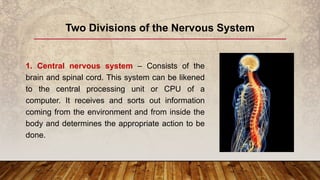
1. Central nervous system – Consists of the
brain and spinal cord. This system can be likened
to the central processing unit or CPU of a
computer. It receives and sorts out information
coming from the environment and from inside the
body and determines the appropriate action to be
done.
Two Divisions of the Nervous System
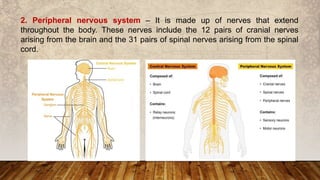
2. Peripheral nervous system – It is made up of nerves that extend
throughout the body. These nerves include the 12 pairs of cranial nerves
arising from the brain and the 31 pairs of spinal nerves arising from the spinal
cord.
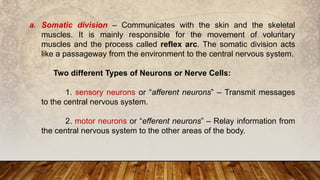
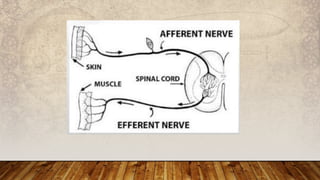
a. Somatic division – Communicates with the skin and the skeletal
muscles. It is mainly responsible for the movement of voluntary
muscles and the process called reflex arc. The somatic division acts
like a passageway from the environment to the central nervous system.
Two different Types of Neurons or Nerve Cells:
1. sensory neurons or “afferent neurons” – Transmit messages
to the central nervous system.
2. motor neurons or “efferent neurons” – Relay information from
the central nervous system to the other areas of the body.
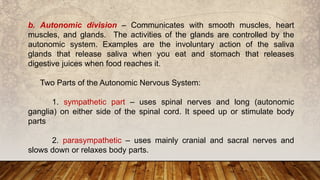
b. Autonomic division – Communicates with smooth muscles, heart
muscles, and glands. The activities of the glands are controlled by the
autonomic system. Examples are the involuntary action of the saliva
glands that release saliva when you eat and stomach that releases
digestive juices when food reaches it.
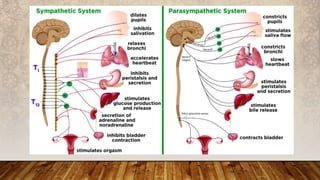
Two Parts of the Autonomic Nervous System:
1. sympathetic part – uses spinal nerves and long (autonomic
ganglia) on either side of the spinal cord. It speed up or stimulate body
parts
2. parasympathetic – uses mainly cranial and sacral nerves and
slows down or relaxes body parts.
Nervous system
Nervous system

Nervous system

  • 2.
    The nervous systemis the major controlling, regulatory, and communicating system in the body. It is the center of all mental activities including thinking, learning, and memorizing. Through its receptors, the nervous system keeps you in touch with your environment, both external and internal. LET’S LEARN
  • 3.
    Three Important Functionsof the Nervous System 1. Receive information from the environment inside the body. 2. Interpret the information it receives. 3. To make the body respond to the information it has received.
  • 4.
    1. Central nervoussystem – Consists of the brain and spinal cord. This system can be likened to the central processing unit or CPU of a computer. It receives and sorts out information coming from the environment and from inside the body and determines the appropriate action to be done. Two Divisions of the Nervous System
  • 5.
    2. Peripheral nervoussystem – It is made up of nerves that extend throughout the body. These nerves include the 12 pairs of cranial nerves arising from the brain and the 31 pairs of spinal nerves arising from the spinal cord.
  • 6.
    a. Somatic division– Communicates with the skin and the skeletal muscles. It is mainly responsible for the movement of voluntary muscles and the process called reflex arc. The somatic division acts like a passageway from the environment to the central nervous system. Two different Types of Neurons or Nerve Cells: 1. sensory neurons or “afferent neurons” – Transmit messages to the central nervous system. 2. motor neurons or “efferent neurons” – Relay information from the central nervous system to the other areas of the body.
  • 8.
    b. Autonomic division– Communicates with smooth muscles, heart muscles, and glands. The activities of the glands are controlled by the autonomic system. Examples are the involuntary action of the saliva glands that release saliva when you eat and stomach that releases digestive juices when food reaches it. Two Parts of the Autonomic Nervous System: 1. sympathetic part – uses spinal nerves and long (autonomic ganglia) on either side of the spinal cord. It speed up or stimulate body parts 2. parasympathetic – uses mainly cranial and sacral nerves and slows down or relaxes body parts.