By  Dr Irum Junaid
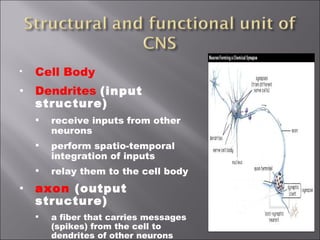
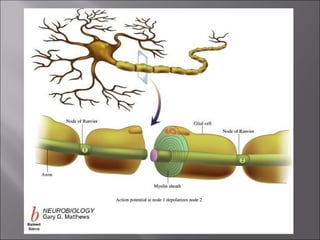
Cell Body Dendrites  (input structure) receive inputs from other neurons perform spatio-temporal integration of inputs relay them to the cell body axon  (output structure) a fiber that carries messages (spikes) from the cell to dendrites of other neurons
The cell membranes of all the excitable body cells in the resting condition are, polarized which means that they show an electrical potential difference. Membrane potential refers to a separation of charges across the membrane or a difference in the relative number of cations and anions in the ICF and ECF.
Diffusion potential Equilibrium potential
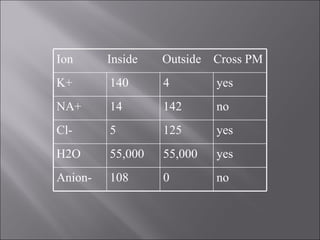
Ion  Inside  Outside  Cross PM K+ 140 4 yes NA+ 14 142 no Cl- 5 125 yes H2O 55,000 55,000 yes Anion- 108 0 no
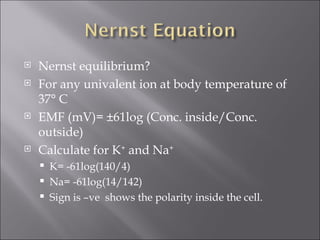
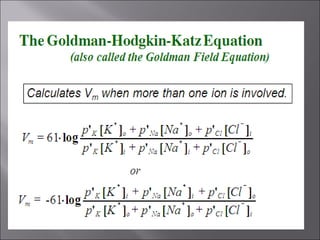
Nernst equilibrium? For any univalent ion at body temperature of 37 ° C EMF (mV)= ±61log (Conc. inside/Conc. outside) Calculate for K +  and Na + K= -61log(140/4) Na= -61log(14/142) Sign is –ve  shows the polarity inside the cell.
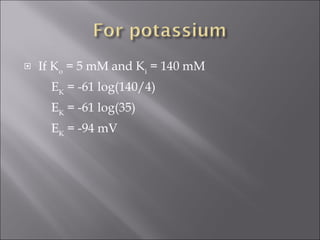
If K o  = 5 mM and K i  = 140 mM  E K  = -61 log(140/4)  E K  = -61 log(35)  E K  = -94 mV
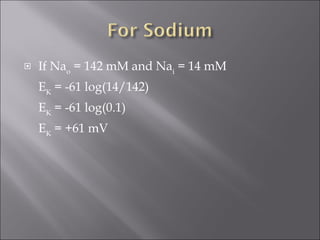
If Na o  = 142 mM and Na i  = 14 mM  E K  = -61 log(14/142)  E K  = -61 log(0.1)  E K  = +61 mV
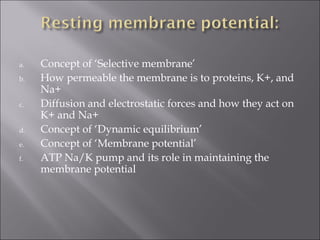
Concept of ‘Selective membrane’  How permeable the membrane is to proteins, K+, and Na+ Diffusion and electrostatic forces and how they act on K+ and Na+ Concept of ‘Dynamic equilibrium’ Concept of ‘Membrane potential’  ATP Na/K pump and its role in maintaining the membrane potential
Polarity of each ion Membrane permeability of the ions Concentrations of respective ions on both sides: (i= inside), (o= outside)
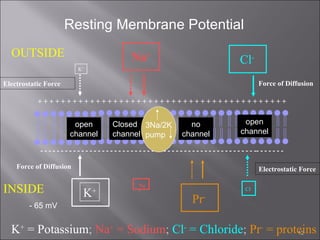
OUTSIDE INSIDE K +  = Potassium ;  Na +  = Sodium ;  Cl -  = Chloride ;  Pr -  = proteins + + + + + + + + + + + + + + + + + + + + + + + + + + + + + + + + + + + + + + + + + + +  - - - - - - - - - - - - - - - - - - - - - - - - - - - - - - - - - - - - - - - - - - - - - - - - - - - - -- - - - - - -  Closed channel open channel open channel no channel Resting Membrane Potential - 65 mV Na + Na + K + K + Force of Diffusion Electrostatic Force Cl - Force of Diffusion Cl - Electrostatic Force Pr - 3Na/2K pump
 
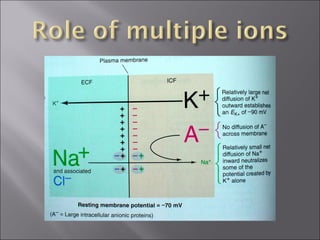
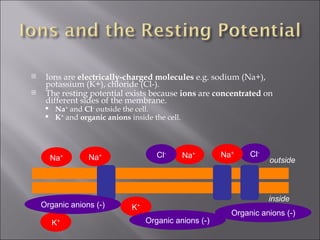
Ions are  electrically-charged molecules  e.g. sodium (Na+), potassium (K+), chloride (Cl-). The resting potential exists because  ions  are  concentrated  on different sides of the membrane. Na +  and  Cl -  outside the cell. K +  and  organic anions  inside the cell.  inside outside Na + Cl - Na + K + Cl - K + Organic anions (-) Na + Na + Organic anions (-) Organic anions (-)
 
 
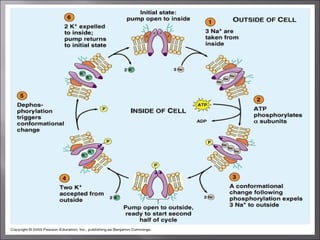
Electrogenic pump Maintains Concentration gradient  Contributes -4mV.
 
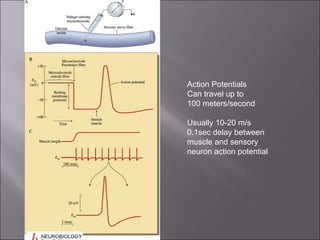
These are rapid transient changes in the membrane potential that spread in the form of a chain reaction rapidly along the nerve fiber membrane .
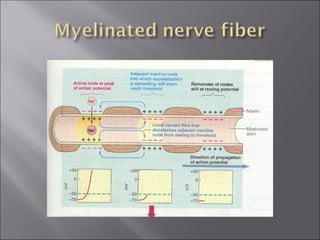
Action Potentials Can travel up to 100 meters/second Usually 10-20 m/s 0.1sec delay between muscle and sensory neuron action potential
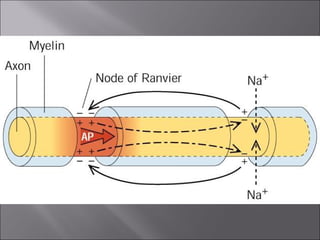
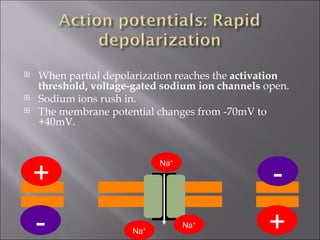
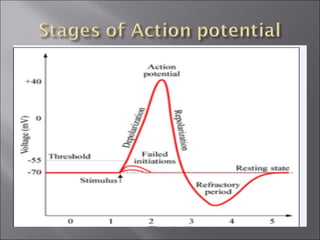
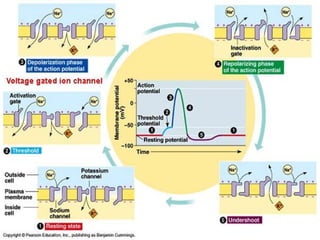
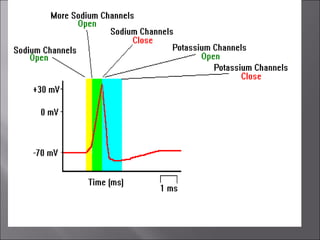
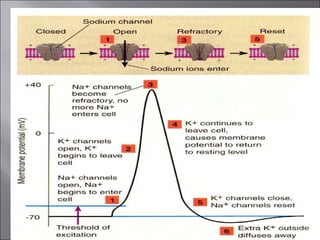
When partial depolarization reaches the  activation threshold,   voltage-gated sodium ion channels  open. Sodium ions rush in. The membrane potential changes from -70mV to +40mV. Na + Na + Na + - + + -
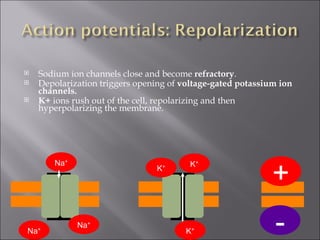
Sodium ion channels close and become  refractory . Depolarization triggers opening of  voltage-gated potassium ion channels. K+  ions rush out of the cell, repolarizing and then hyperpolarizing the membrane. K + K + K + Na + Na + Na + + -
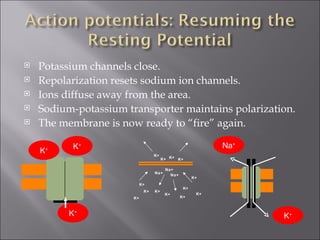
Potassium channels close. Repolarization resets sodium ion channels. Ions diffuse away from the area. Sodium-potassium transporter maintains polarization. The membrane is now ready to “fire” again. K + K + K + K + Na + K+ K+ K+ K+ Na+ Na+ Na+ K+ K+ K+ K+ K+ K+ K+ K+ K+
 
 
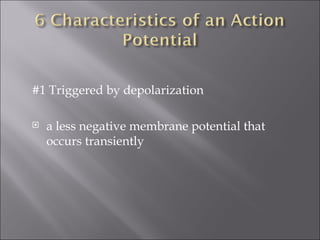
#1 Triggered by depolarization  a less negative membrane potential that occurs transiently
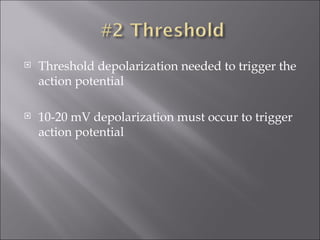
Threshold depolarization needed to trigger the action potential 10-20 mV depolarization must occur to trigger action potential
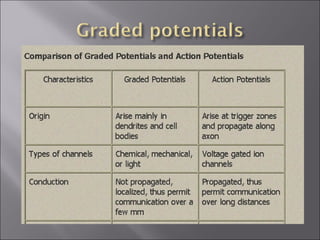
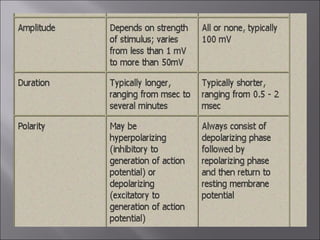
Are all-or- none event Amplitude of AP is the same regardless of whether the depolarizing event was weak (+20mV) or strong (+40mV).
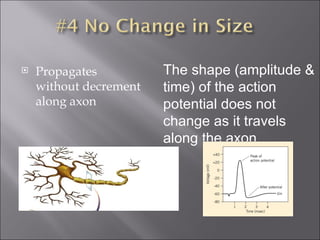
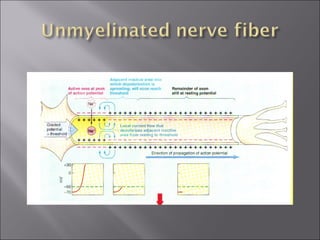
Propagates without decrement along axon The shape (amplitude & time) of the action potential does not change as it travels along the axon
At peak of action potential the membrane potential reverses polarity Becomes positive inside as predicted by the E na  Called OVERSHOOT Return to membrane potential to a more negative potential than at rest  Called UNDERSHOOT
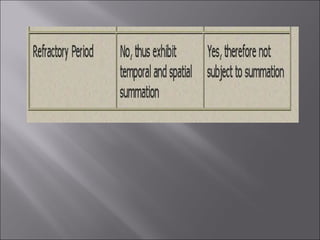
Absolute refractory period follows an action potential. Lasts 1 msec During this time another action potential CANNOT be fired even if there is a transient depolarization. Limits firing rate to 1000AP/sec


The number of voltage gated sodium channels per square micrometer of the membrane in mylinated neuron is; A. cell body 50-75 B. initial segment 350-500 C. on the surface of the myelin <25 D. Node of the ranvier 2000-12000 E. axon terminal 20-75 Unmylinated neuron: 110
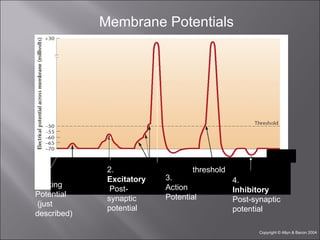
Copyright © Allyn & Bacon 2004 Membrane Potentials 1.  Resting Potential  (just described) threshold 2.  Excitatory   Post-synaptic potential 4.  Inhibitory   Post-synaptic potential 3.  Action  Potential
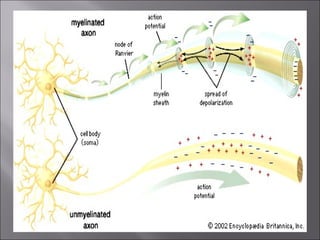
Increase internal diameter of axon which decreases the internal resistance to ion flow Increase the resistance of the plasma membrane to charge flow by insulating it with myelin.


Sodium: Decreasing the external Na +  concentration reduces the size of the action potential but has little effect on the resting membrane potential. The lack of much effect on the resting membrane potential would be predicted, since the permeability of the membrane to Na +  at rest is relatively low.  Potassium: Conversely, increasing the external K +  concentration decreases the resting membrane potential. Calcium:
 
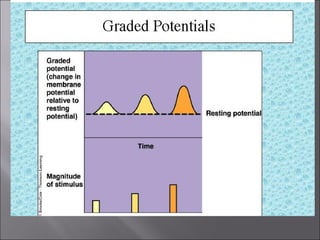
It is possible to determine the minimal intensity of stimulating current  (threshold intensity)  that, acting for a given duration, will just produce an action potential. Action potential fails to occur if the stimulus is subthreshold in magnitude,produces graded potentials. Suprathreshold stimuli produce action potential during relative refractory period.