Java – Decision
Organized By: Vinay Arora
Assistant Professor
CSED, Thapar University
www.slideshare.net/aroravinay
Vinay Arora
CSED
Decision
 There are two types of decision making statements in Java.
They are:
 if statements
 switch statements
Vinay Arora
CSED
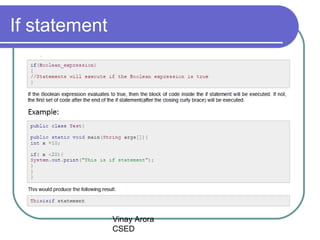
If statement
Vinay Arora
CSED
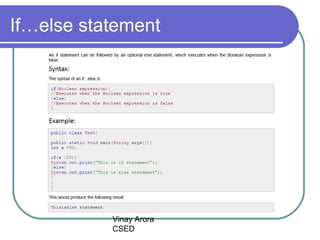
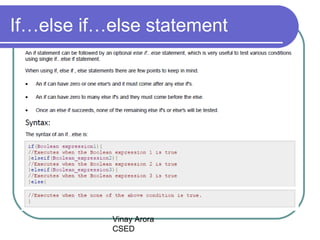
If…else statement
Vinay Arora
CSED
If…else if…else statement
Vinay Arora
CSED
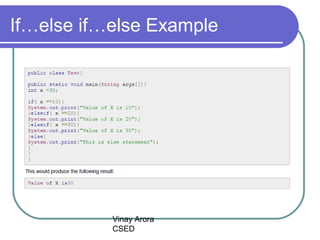
If…else if…else Example
Vinay Arora
CSED
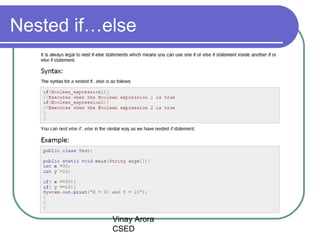
Nested if…else
Vinay Arora
CSED
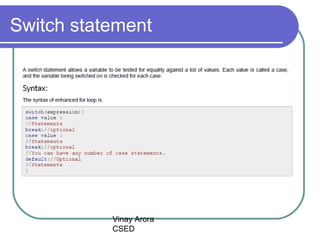
Switch statement
Vinay Arora
CSED
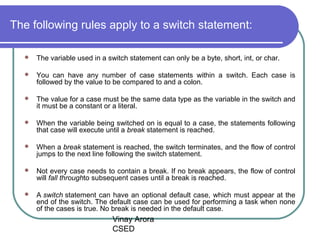
The following rules apply to a switch statement:
 The variable used in a switch statement can only be a byte, short, int, or char.
 You can have any number of case statements within a switch. Each case is
followed by the value to be compared to and a colon.
 The value for a case must be the same data type as the variable in the switch and
it must be a constant or a literal.
 When the variable being switched on is equal to a case, the statements following
that case will execute until a break statement is reached.
 When a break statement is reached, the switch terminates, and the flow of control
jumps to the next line following the switch statement.
 Not every case needs to contain a break. If no break appears, the flow of control
will fall throughto subsequent cases until a break is reached.
 A switch statement can have an optional default case, which must appear at the
end of the switch. The default case can be used for performing a task when none
of the cases is true. No break is needed in the default case.
Vinay Arora
CSED
Vinay Arora
CSED
Vinay Arora
CSED
Vinay Arora
CSED
Vinay Arora
CSED
Thnx…

4 java - decision