CG - Module 1
1. Colour CRT Monitors
2. Flat-Panel Displays
1. Colour CRT Monitors
● A CRT monitor displays color pictures by using a combination of
phosphors that emit different-colored light.
● By combining the emitted light from the different phosphors, a range of
colors can be generated.
● Two basic techniques for producing color displays with a CRT are
○ beam-penetration method
○ shadow-mask method
Beam-penetration method
● for displaying color pictures has been
used with random-scan monitors
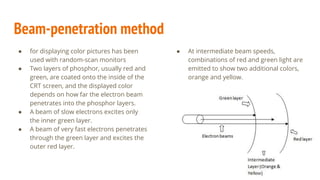
● Two layers of phosphor, usually red and
green, are coated onto the inside of the
CRT screen, and the displayed color
depends on how far the electron beam
penetrates into the phosphor layers.
● A beam of slow electrons excites only
the inner green layer.
● A beam of very fast electrons penetrates
through the green layer and excites the
outer red layer.
● At intermediate beam speeds,
combinations of red and green light are
emitted to show two additional colors,
orange and yellow.
Shadow-mask method
● commonly used in raster scan systems
(including color TV) because they
produce a much wider range of colors
than the beam penetration method.
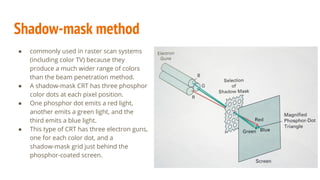
● A shadow-mask CRT has three phosphor
color dots at each pixel position.
● One phosphor dot emits a red light,
another emits a green light, and the
third emits a blue light.
● This type of CRT has three electron guns,
one for each color dot, and a
shadow-mask grid just behind the
phosphor-coated screen.
Shadow-mask method (Cont’d)
● The three electron beams are deflected
and focused as a group onto the
shadow mask, which contains a series of
holes aligned with the phosphor-dot
patterns.
● When the three beams pass through a
hole in the shadow mask, they activate a
dot triangle, which appears as a small
color spot on the screen.
● We obtain color variations in a
shadow-mask CRT by varying the
intensity levels of the three electron
beams.
● By turning off the red and green guns,
we get only the color coming from the
blue phosphor.
● A white (or gray) area is the result of
activating all three dots with equal
intensity.
● Yellow is produced with the green and
red dots only, magenta is produced
with the blue and red dots, and cyan
shows up when blue and green are
activated equally.
2. Flat-Panel Displays
● The term Flat-panel display refers to a
class of video devices that have reduced
volume, weight, and power
requirements compared to a CRT.
● We can separate flat-panel displays into
two categories:
1. emissive displays
2. Non emissive displays
● The emissive displays (or emitters) are
devices that convert electrical energy
into light.
● Plasma panels, thin-film
electroluminescent displays, and
Light-emitting diodes are examples of
emissive displays.
● Non emissive displays (or non
emitters) use optical effects to convert
sunlight or light from some other source
into graphics patterns.
Emissive Displays - Plasma panels
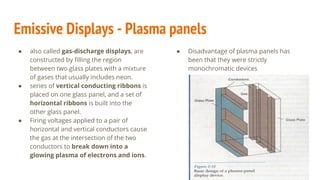
● also called gas-discharge displays, are
constructed by filling the region
between two glass plates with a mixture
of gases that usually includes neon.
● series of vertical conducting ribbons is
placed on one glass panel, and a set of
horizontal ribbons is built into the
other glass panel.
● Firing voltages applied to a pair of
horizontal and vertical conductors cause
the gas at the intersection of the two
conductors to break down into a
glowing plasma of electrons and ions.
● Disadvantage of plasma panels has
been that they were strictly
monochromatic devices
Emissive - Thin-film electroluminescent displays
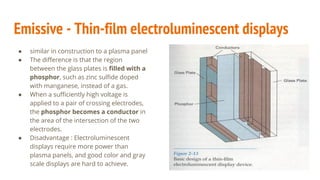
● similar in construction to a plasma panel
● The difference is that the region
between the glass plates is filled with a
phosphor, such as zinc sulfide doped
with manganese, instead of a gas.
● When a sufficiently high voltage is
applied to a pair of crossing electrodes,
the phosphor becomes a conductor in
the area of the intersection of the two
electrodes.
● Disadvantage : Electroluminescent
displays require more power than
plasma panels, and good color and gray
scale displays are hard to achieve.
●
Emissive Displays - Light-emitting diode (LED)
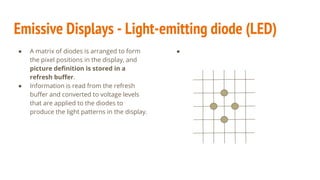
● A matrix of diodes is arranged to form
the pixel positions in the display, and
picture definition is stored in a
refresh buffer.
● Information is read from the refresh
buffer and converted to voltage levels
that are applied to the diodes to
produce the light patterns in the display.
●
Non emissive displays - Liquid Crystal Displays
● LCDS are commonly used in small
systems, such as calculators and
portable, laptop computers.
● Produce a picture by passing polarized
light from the surroundings or from
an internal light source through a
liquid-crystal material that can be
aligned to either block or transmit the
light.
● The term liquid crystal refers to the fact
that these compounds have a crystalline
arrangement of molecules, yet they flow
like a liquid.
● Two glass plates, each containing a light
polarizer at right angles to the-other
plate, sandwich the liquid-crystal
material.
● Rows of horizontal transparent
conductors are built into one glass plate,
and columns of vertical conductors are
put into the other plate.
● The intersection of two conductors
defines a pixel position
● There are two states
ON state - light will transmit
OFF state - light will not transmit

Computer graphics - colour crt and flat-panel displays

  • 1.
    CG - Module1 1. Colour CRT Monitors 2. Flat-Panel Displays
  • 2.
    1. Colour CRTMonitors ● A CRT monitor displays color pictures by using a combination of phosphors that emit different-colored light. ● By combining the emitted light from the different phosphors, a range of colors can be generated. ● Two basic techniques for producing color displays with a CRT are ○ beam-penetration method ○ shadow-mask method
  • 3.
    Beam-penetration method ● fordisplaying color pictures has been used with random-scan monitors ● Two layers of phosphor, usually red and green, are coated onto the inside of the CRT screen, and the displayed color depends on how far the electron beam penetrates into the phosphor layers. ● A beam of slow electrons excites only the inner green layer. ● A beam of very fast electrons penetrates through the green layer and excites the outer red layer. ● At intermediate beam speeds, combinations of red and green light are emitted to show two additional colors, orange and yellow.
  • 4.
    Shadow-mask method ● commonlyused in raster scan systems (including color TV) because they produce a much wider range of colors than the beam penetration method. ● A shadow-mask CRT has three phosphor color dots at each pixel position. ● One phosphor dot emits a red light, another emits a green light, and the third emits a blue light. ● This type of CRT has three electron guns, one for each color dot, and a shadow-mask grid just behind the phosphor-coated screen.
  • 5.
    Shadow-mask method (Cont’d) ●The three electron beams are deflected and focused as a group onto the shadow mask, which contains a series of holes aligned with the phosphor-dot patterns. ● When the three beams pass through a hole in the shadow mask, they activate a dot triangle, which appears as a small color spot on the screen. ● We obtain color variations in a shadow-mask CRT by varying the intensity levels of the three electron beams. ● By turning off the red and green guns, we get only the color coming from the blue phosphor. ● A white (or gray) area is the result of activating all three dots with equal intensity. ● Yellow is produced with the green and red dots only, magenta is produced with the blue and red dots, and cyan shows up when blue and green are activated equally.
  • 6.
    2. Flat-Panel Displays ●The term Flat-panel display refers to a class of video devices that have reduced volume, weight, and power requirements compared to a CRT. ● We can separate flat-panel displays into two categories: 1. emissive displays 2. Non emissive displays ● The emissive displays (or emitters) are devices that convert electrical energy into light. ● Plasma panels, thin-film electroluminescent displays, and Light-emitting diodes are examples of emissive displays. ● Non emissive displays (or non emitters) use optical effects to convert sunlight or light from some other source into graphics patterns.
  • 7.
    Emissive Displays -Plasma panels ● also called gas-discharge displays, are constructed by filling the region between two glass plates with a mixture of gases that usually includes neon. ● series of vertical conducting ribbons is placed on one glass panel, and a set of horizontal ribbons is built into the other glass panel. ● Firing voltages applied to a pair of horizontal and vertical conductors cause the gas at the intersection of the two conductors to break down into a glowing plasma of electrons and ions. ● Disadvantage of plasma panels has been that they were strictly monochromatic devices
  • 8.
    Emissive - Thin-filmelectroluminescent displays ● similar in construction to a plasma panel ● The difference is that the region between the glass plates is filled with a phosphor, such as zinc sulfide doped with manganese, instead of a gas. ● When a sufficiently high voltage is applied to a pair of crossing electrodes, the phosphor becomes a conductor in the area of the intersection of the two electrodes. ● Disadvantage : Electroluminescent displays require more power than plasma panels, and good color and gray scale displays are hard to achieve. ●
  • 9.
    Emissive Displays -Light-emitting diode (LED) ● A matrix of diodes is arranged to form the pixel positions in the display, and picture definition is stored in a refresh buffer. ● Information is read from the refresh buffer and converted to voltage levels that are applied to the diodes to produce the light patterns in the display. ●
  • 10.
    Non emissive displays- Liquid Crystal Displays ● LCDS are commonly used in small systems, such as calculators and portable, laptop computers. ● Produce a picture by passing polarized light from the surroundings or from an internal light source through a liquid-crystal material that can be aligned to either block or transmit the light. ● The term liquid crystal refers to the fact that these compounds have a crystalline arrangement of molecules, yet they flow like a liquid. ● Two glass plates, each containing a light polarizer at right angles to the-other plate, sandwich the liquid-crystal material. ● Rows of horizontal transparent conductors are built into one glass plate, and columns of vertical conductors are put into the other plate. ● The intersection of two conductors defines a pixel position ● There are two states ON state - light will transmit OFF state - light will not transmit