Video Display Devices
Primary output Device – Video Monitor
Video monitors are based on standard Cathode ray
   tube (CRT) design.
Refresh Cathode Ray Tubes:-
Working
 A beam of electrons (cathode rays), emitted by
   an electron gun, passed through focusing &
   deflecting system that direct the beam towards
   specified positions on the phosphor coated
   screen.
   The phosphor emits a small spot of light at each
    position contacted by the electron screen.
   For maintaining the screen picture glowing
    redraw the picture repeatedly by quickly
    directing the electron beam back over the same
    points. This type of display is called a refresh
    CRT.
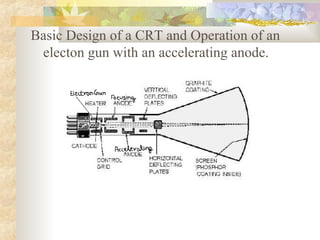
Basic Design of a CRT and Operation of an
 electon gun with an accelerating anode.
Primary Components of electron gun in CRT are:-

1.) Heated metal cathode: Heating Filament causes
     –vely charged electrons to “boiled off” and
    accelerate towards phosphor coated screen by a
    high +ve voltage.
2.) Accelerating anode: The accelerating voltage can
    be generated with a +vely charged metal coating
    on the inside of CRT envelop near the phosphor
    screen, or we can say Accelerating anode can be
    used.
3.) Control grid: It is a metal cylinder fits over
   cathode and used to control the intensity of
   electron beam by setting the voltage level.
4.) Focusing System: need to force the
   electron beam to converge into a small
   spot. Otherwise, electron would repel each
   other and beam will spread out.
5.) Deflection Coils: Deflection can be
   controlled either with electric field or
   magnetic field.
How the spot of light produced?
 The Kinetic energy of electron is absorbed
  by phosphor.
 Part of beam energy is converted by
  friction into heat energy and remainder
  causes phosphor atom to move up to higher
  quantum energy levels.
 After short time, “ excited” phosphour
  atom come back to stable ground state,
  giving up their extra energy as small
  quantum of light energy.
Basic properties of phosphors:
   Phosphors Persistence: The time it takes
    the emitted light from the screen to decay
    to one-tenth of its original intensity.
    Low persitance require high refresh rate
    for eg animations.
    High persistance is used for complex,
    static pictures, monitors in the range from
    10 to 60 microseconds.
   Resolution: The max no. of pts that can be
    displayed without overlap on a CRT is
    referred to as resolution. OR
    No. of pts per centimeter that can be
    plotted horizontally and vertically.
   Intensity Distribution: of a spot on the
    screen is greatest at the center of the spot,
    and decrease with a gaussian distribution
    out to the edges of the spot.
   Aspect Ratio: It is the ratio of vertical pts
    to horizontal pts necessary to produce
    equal length lines in both directions on the
    screen.
    Aspect ratio ¾ means that a vertical line
    plotted with 3 pts has the same length as a
    horizontal line plotted with 4 pts.
   Aspect Ratio: It is the ratio of vertical pts
    to horizontal pts necessary to produce
    equal length lines in both directions on the
    screen.
    Aspect ratio ¾ means that a vertical line
    plotted with 3 pts has the same length as a
    horizontal line plotted with 4 pts.

Video display devices

  • 1.
    Video Display Devices Primaryoutput Device – Video Monitor Video monitors are based on standard Cathode ray tube (CRT) design. Refresh Cathode Ray Tubes:- Working  A beam of electrons (cathode rays), emitted by an electron gun, passed through focusing & deflecting system that direct the beam towards specified positions on the phosphor coated screen.
  • 2.
    The phosphor emits a small spot of light at each position contacted by the electron screen.  For maintaining the screen picture glowing redraw the picture repeatedly by quickly directing the electron beam back over the same points. This type of display is called a refresh CRT.
  • 3.
    Basic Design ofa CRT and Operation of an electon gun with an accelerating anode.
  • 4.
    Primary Components ofelectron gun in CRT are:- 1.) Heated metal cathode: Heating Filament causes –vely charged electrons to “boiled off” and accelerate towards phosphor coated screen by a high +ve voltage. 2.) Accelerating anode: The accelerating voltage can be generated with a +vely charged metal coating on the inside of CRT envelop near the phosphor screen, or we can say Accelerating anode can be used.
  • 5.
    3.) Control grid:It is a metal cylinder fits over cathode and used to control the intensity of electron beam by setting the voltage level. 4.) Focusing System: need to force the electron beam to converge into a small spot. Otherwise, electron would repel each other and beam will spread out. 5.) Deflection Coils: Deflection can be controlled either with electric field or magnetic field.
  • 6.
    How the spotof light produced?  The Kinetic energy of electron is absorbed by phosphor.  Part of beam energy is converted by friction into heat energy and remainder causes phosphor atom to move up to higher quantum energy levels.  After short time, “ excited” phosphour atom come back to stable ground state, giving up their extra energy as small quantum of light energy.
  • 7.
    Basic properties ofphosphors:  Phosphors Persistence: The time it takes the emitted light from the screen to decay to one-tenth of its original intensity. Low persitance require high refresh rate for eg animations. High persistance is used for complex, static pictures, monitors in the range from 10 to 60 microseconds.
  • 8.
    Resolution: The max no. of pts that can be displayed without overlap on a CRT is referred to as resolution. OR No. of pts per centimeter that can be plotted horizontally and vertically.  Intensity Distribution: of a spot on the screen is greatest at the center of the spot, and decrease with a gaussian distribution out to the edges of the spot.
  • 9.
    Aspect Ratio: It is the ratio of vertical pts to horizontal pts necessary to produce equal length lines in both directions on the screen. Aspect ratio ¾ means that a vertical line plotted with 3 pts has the same length as a horizontal line plotted with 4 pts.
  • 10.
    Aspect Ratio: It is the ratio of vertical pts to horizontal pts necessary to produce equal length lines in both directions on the screen. Aspect ratio ¾ means that a vertical line plotted with 3 pts has the same length as a horizontal line plotted with 4 pts.