NERVOUS SYSTEMAbalos, AilynJuatas, KennethLlorin, PatriciaMansibang, RaniaSunio, LeslieDMD 1-F
Functions Of Nervous SystemCommunication and coordination- Adapt and respond to changes from both inside and outside the bodysends messages to the rest of the bodycontrols all of the body functionsSite of reasoning
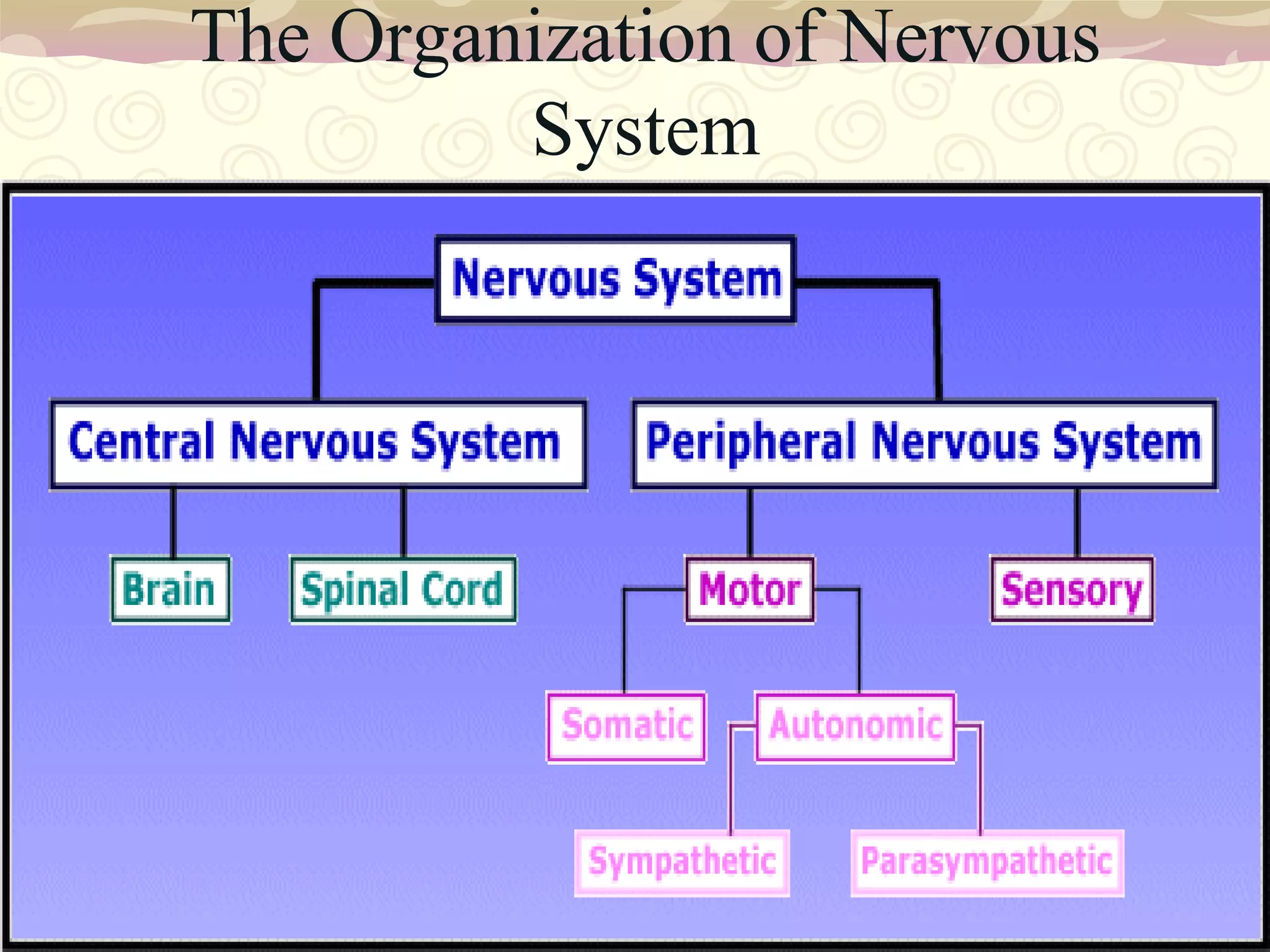
The Organization of Nervous System
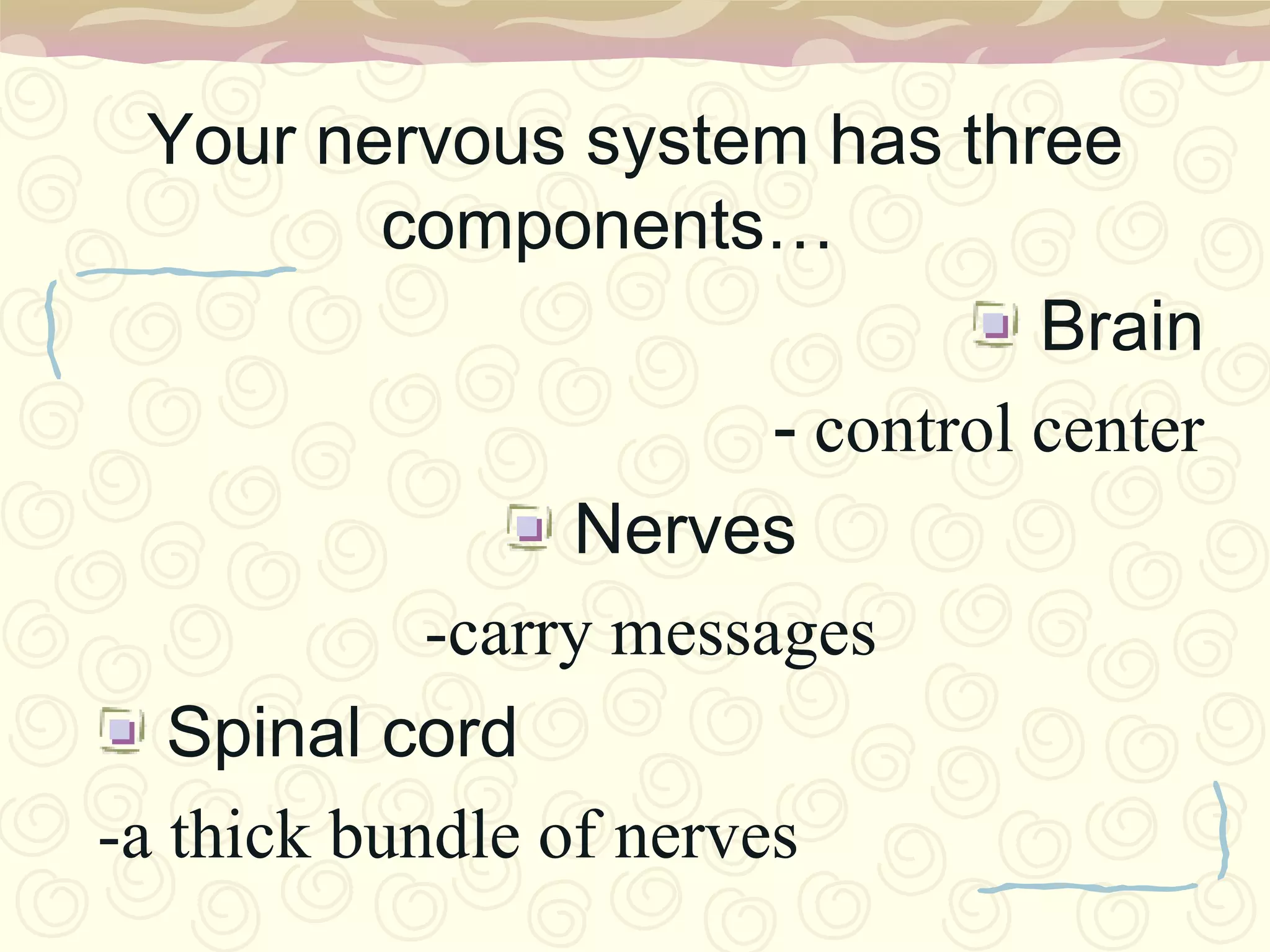
Your nervous system has three components…	 Brain- control center Nerves-carry messages Spinal cord-a thick bundle of nerves
Brain
Characteristics of the BrainWeight:  1.3-kg (3-lb) mass of pinkish-gray jellylike tissue 		Varies in gender:			Male: 1380 grams			Female: 1250 gramsWith 100 billion nerve cell:		NeuronsNeuroglia (supporting-tissue) cells
4 types of Memory:Short-term memory – when we say things over and over again so you remember them.Long term memory – we remember important events or things that we do over and over again.Ancestral Memory – We remember things right when we were born. Example is when humans remember how to get milk from their mom or feeding bottles.Eidetic Memory – a.k.a photographic memory
The Cranial Cavity
1. MeningesDura Mater - outermost membrane. The toughest and thickest.Arachnoid Layer - middle membrane.Pia Mater - innermost membrane. Consists of small blood vessels.
Cerebrospinal Fluid – A clear liquid that bathes the entire brain and fills a series of four cavities called ventricles Gray Matter – Composed of Nerve cell bodiesWhite Matter – Composed of myelinated nerve fibersNucleus – Mass of nerve cells in any part of the brain and spinal cord.Ganglion – Mass of nerve cell outside of the brain and spinal cord.Commisure – Band of fibers joining corresponding opposite parts of the brain and spinal cord.
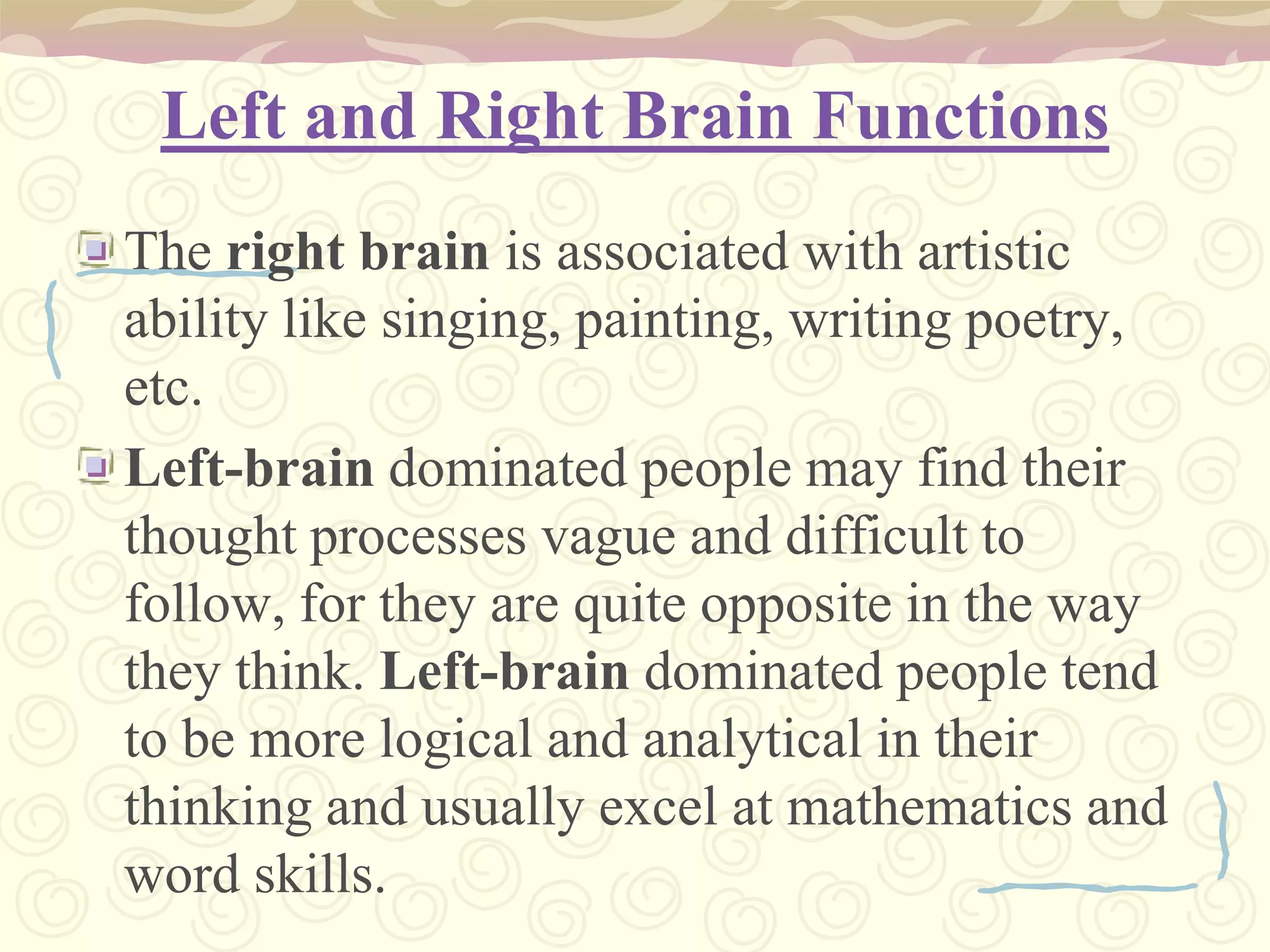
Brain:
Left and Right Brain Functions The right brain is associated with artistic ability like singing, painting, writing poetry, etc. Left-brain dominated people may find their thought processes vague and difficult to follow, for they are quite opposite in the way they think. Left-brain dominated people tend to be more logical and analytical in their thinking and usually excel at mathematics and word skills.
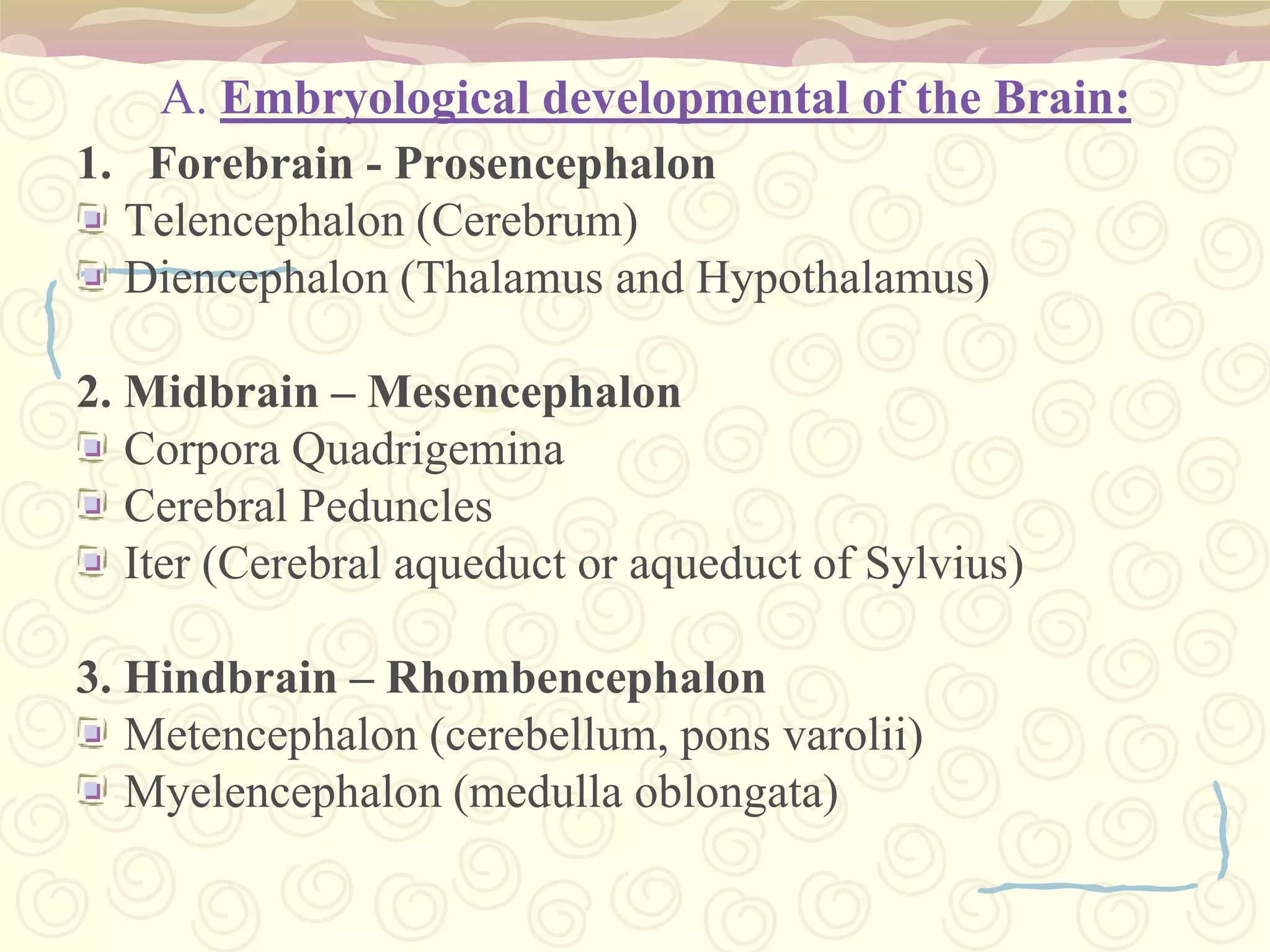
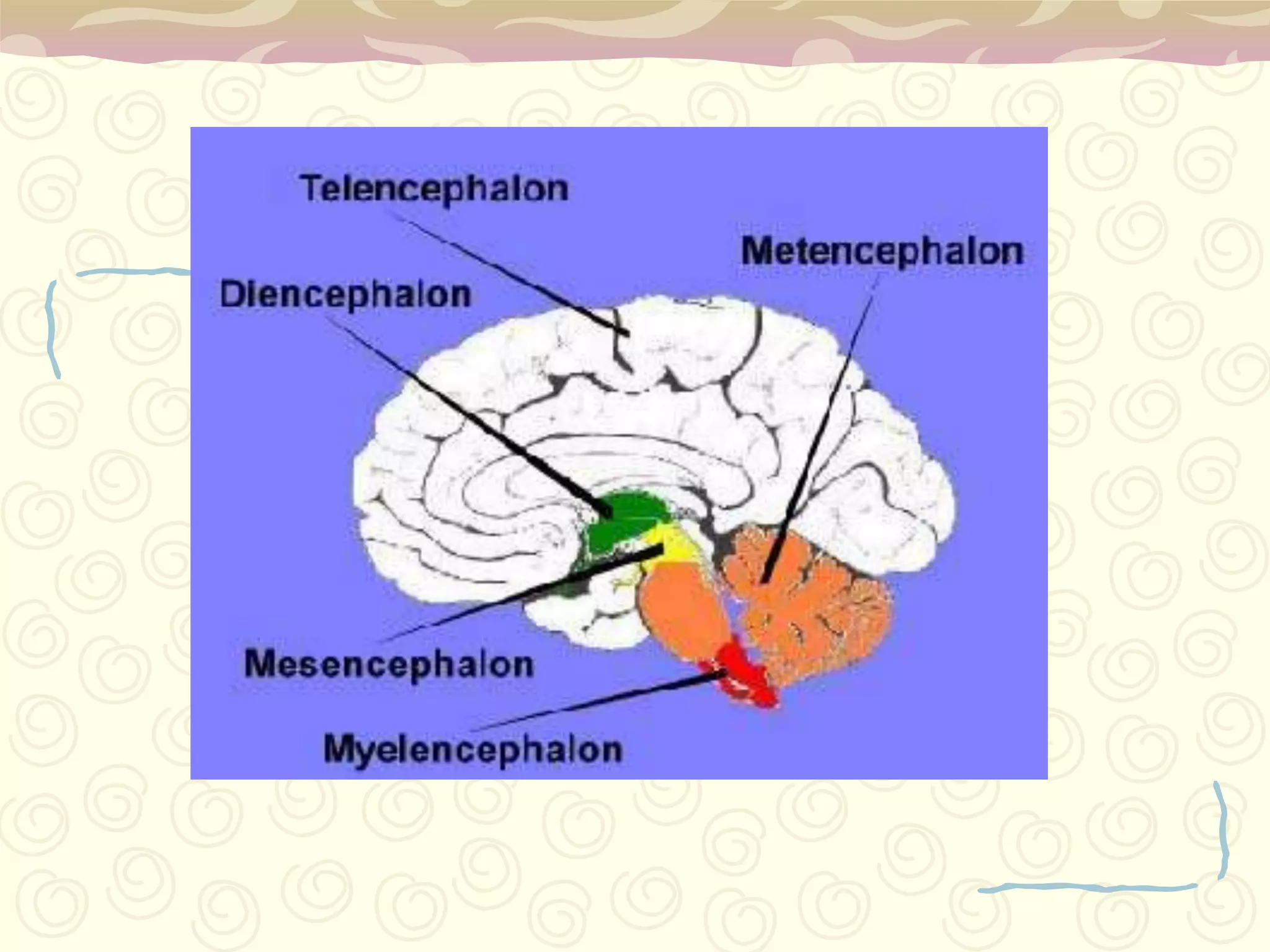
A. Embryological developmental of the Brain:Forebrain - ProsencephalonTelencephalon (Cerebrum)Diencephalon (Thalamus and Hypothalamus) 2. Midbrain – MesencephalonCorpora QuadrigeminaCerebral PedunclesIter (Cerebral aqueduct or aqueduct of Sylvius)3. Hindbrain – RhombencephalonMetencephalon (cerebellum, ponsvarolii)Myelencephalon (medulla oblongata)
5 Main Parts of the BrainCerebrum (Telencephalon)Pons and Cerebellum (Metencephalon) Midbrain (Mesencephalon) Thalamus and Hypothalamus (Diencephalon) Medulla Oblongata (Myelencephalon) 
1. ForebrainCerebrum (Telencephalon)
Cerebrum(the Latin word for brain)a.k.a “cerebral cortex” two large dome-shaped, almost symmetrical hemispheresintelligence, memory and reasonComposed of gray matter thrown into infoldings: shallow; gyrus or gyri, deep; fissuresInnermost part is made of white matterGreat longitudinal fissure (or longitudinal cerebral fissure, or longitudinal fissure, or interhemispheric fissure) is the deep groove which separates the two hemispheres of the vertebrate brain.
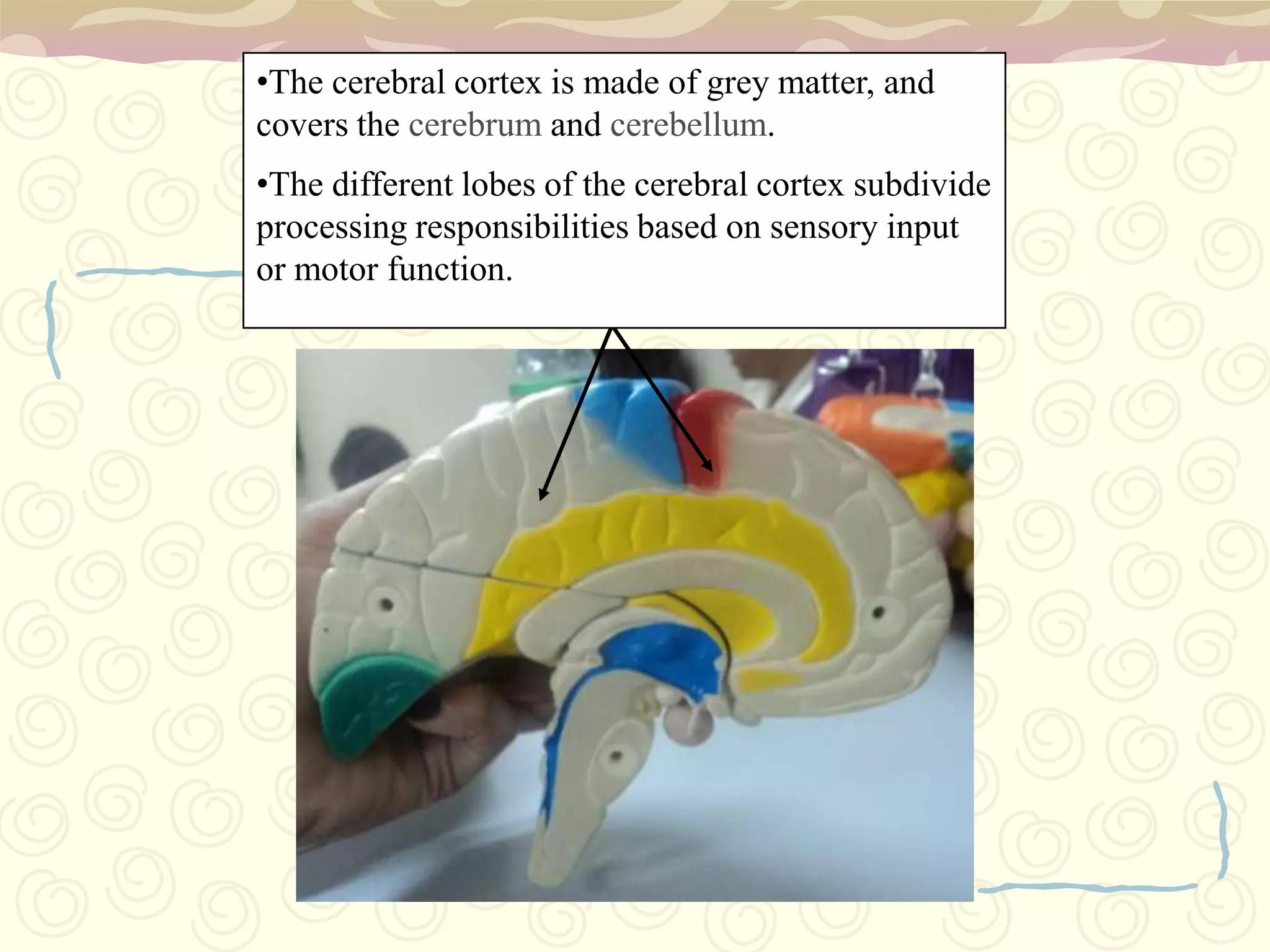
The cerebral cortex is made of grey matter, and covers the cerebrum and cerebellum.
The different lobes of the cerebral cortex subdivide processing responsibilities based on sensory input or motor function.Fissures the Cerebrum:Longitudinal Fissure – They are mirror twins for motor and sensory activities of the body. 		*Connected in the midline by corpus callosum – allows the two cerebral hemispheres to share learning and memory. Lateral Fissure (Sylvian Fissure) – located between frontal and parietal lobes. For speech and hearing.
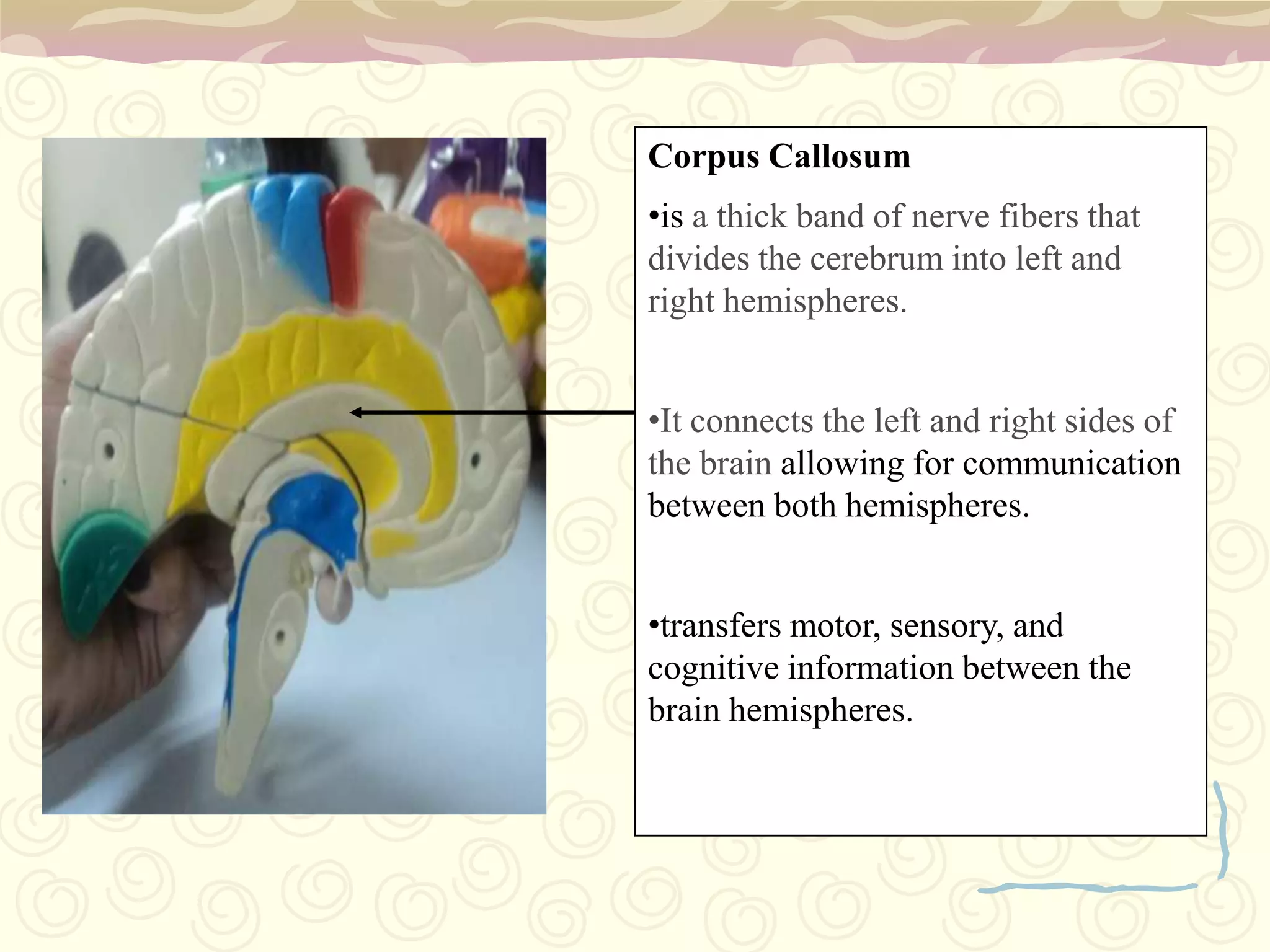
Corpus Callosumis a thick band of nerve fibers that divides the cerebrum into left and right hemispheres.
It connects the left and right sides of the brain allowing for communication between both hemispheres.
transfers motor, sensory, and cognitive information between the brain hemispheres.Central Fissure (Rolandic Fissure) – Between the frontal and parietal lobes; for both motor and sensory functions. 4. Transverse Fissure – found between the cerebrum and cerebellum.5. Palate Occipital Fissure – between occipital and parietal lobes.
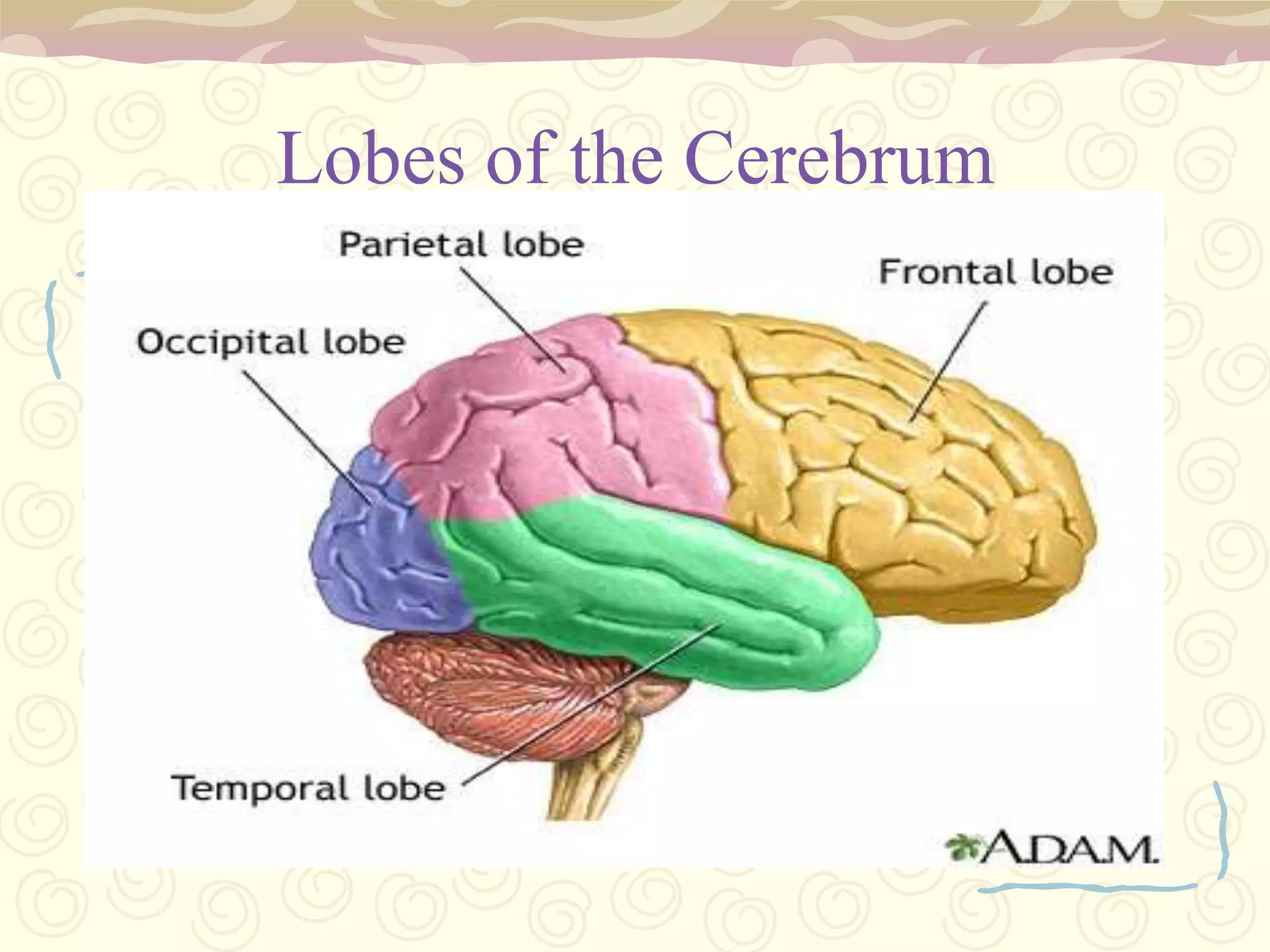
Lobes of the Cerebrum
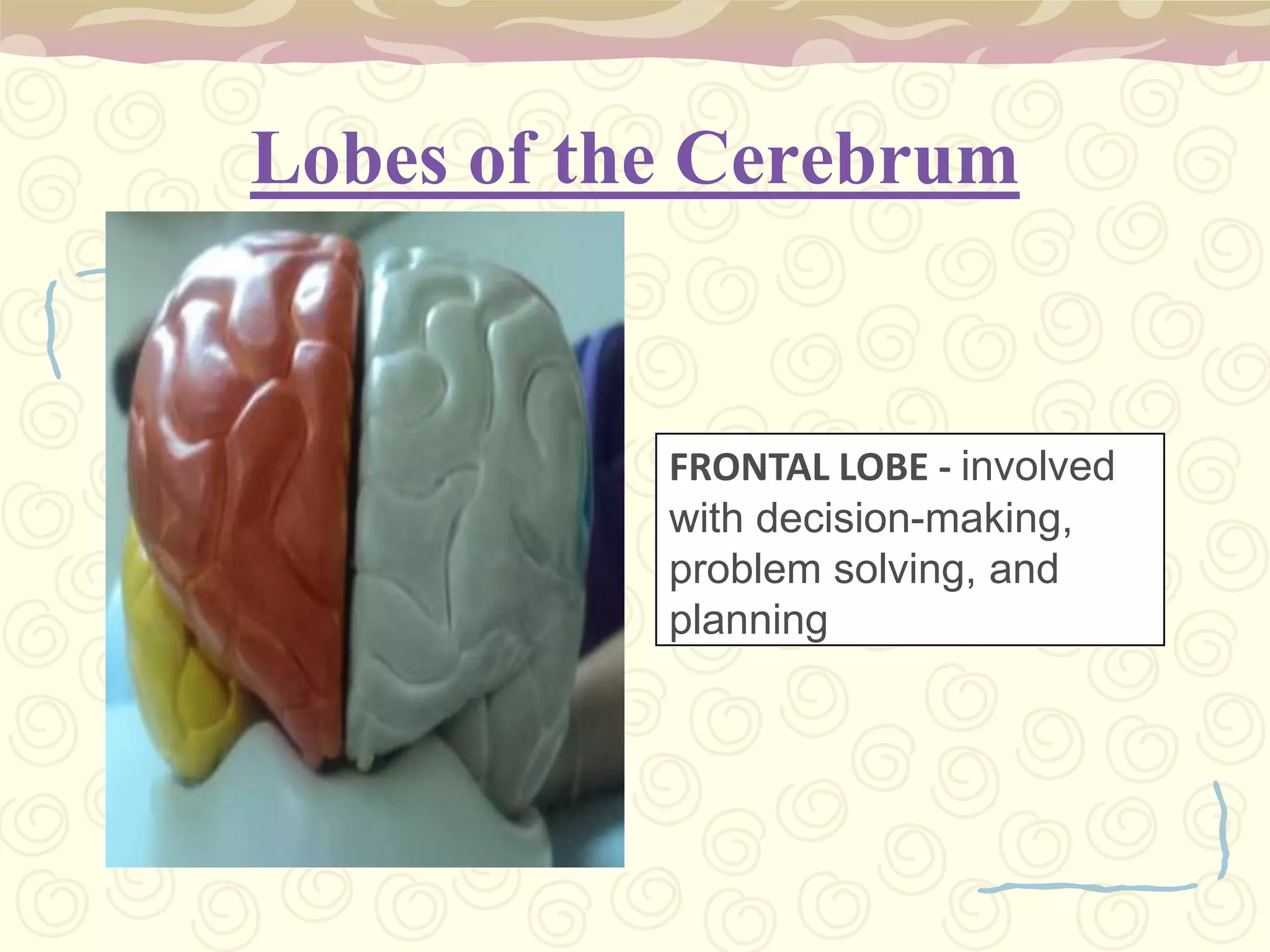
FRONTAL LOBE - involved with decision-making, problem solving, and planning Lobes of the Cerebrum
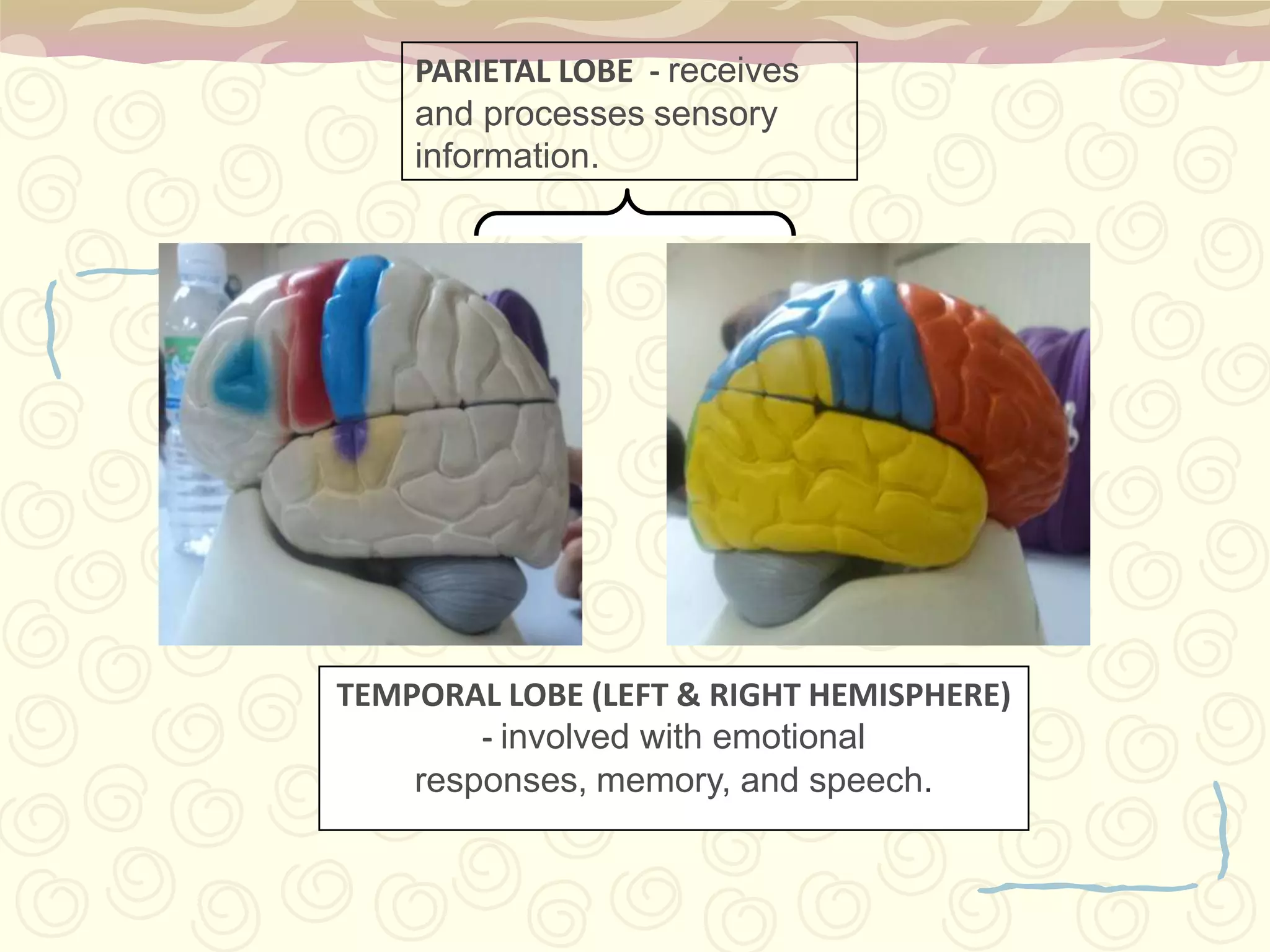
PARIETAL LOBE  - receives and processes sensory information.TEMPORAL LOBE (LEFT & RIGHT HEMISPHERE) - involved with emotional responses, memory, and speech.
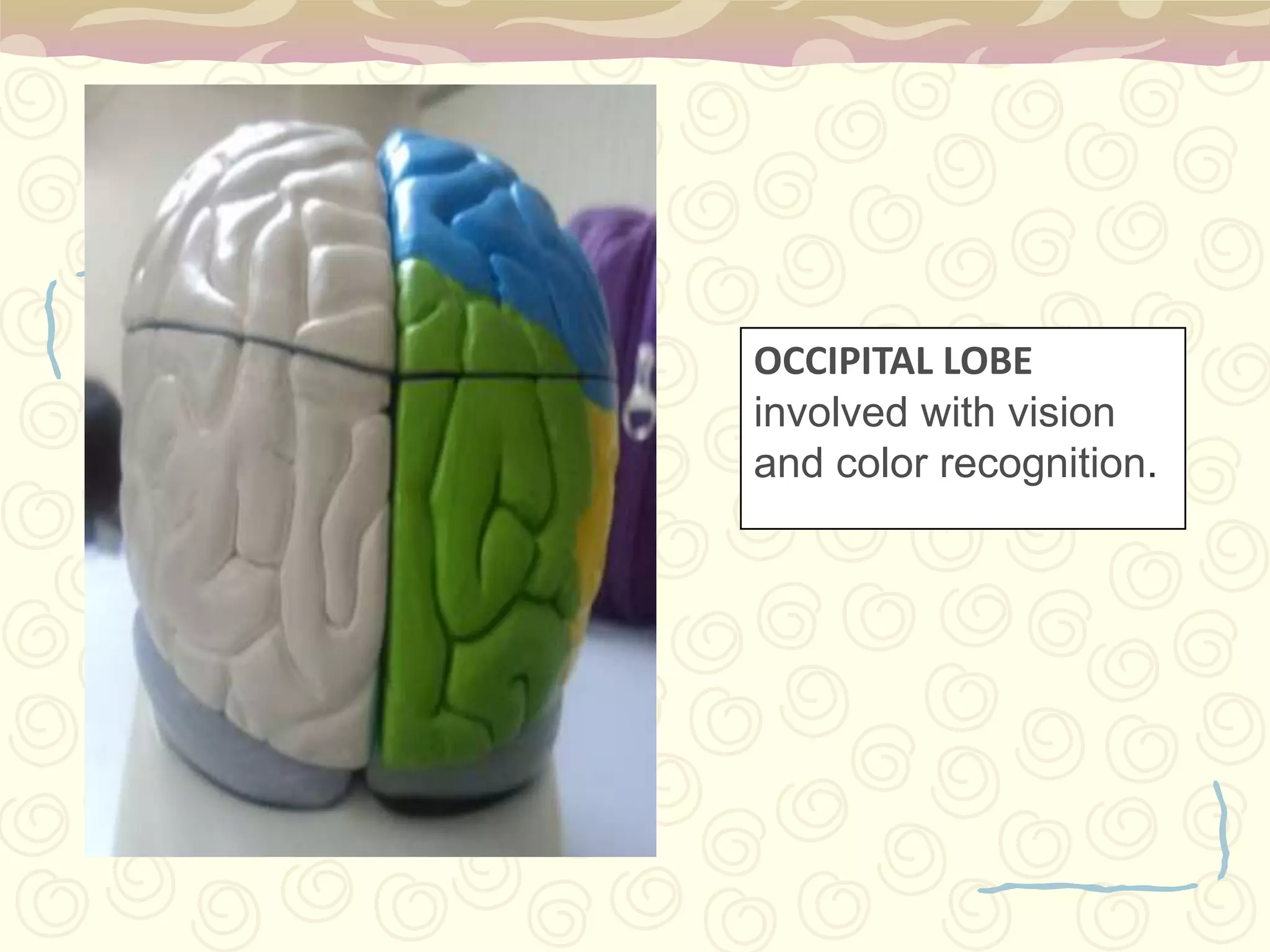
OCCIPITAL LOBE involved with vision and color recognition.
Functions of the Cerebral Cortex Determining IntelligenceDetermining PersonalityThinkingPerceivingProducing and Understanding LanguageInterpretation of Sensory ImpulsesMotor FunctionPlanning and OrganizationTouch Sensation 
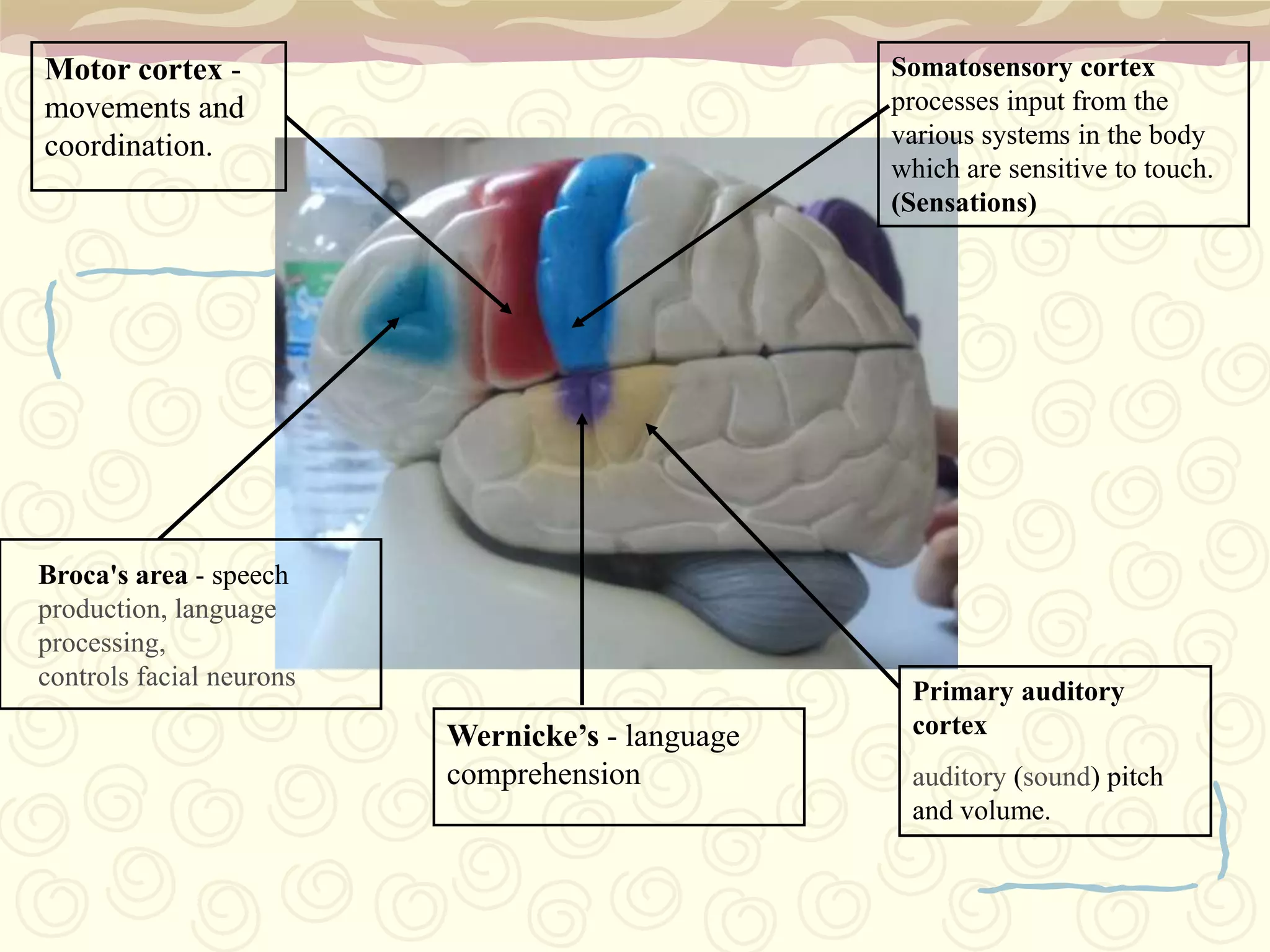
Motor cortex - movements and coordination. Somatosensory cortex processes input from the various systems in the body which are sensitive to touch. (Sensations)Broca's area - speech production, language processing, controls facial neuronsPrimary auditory cortexauditory (sound) pitch and volume. Wernicke’s - language comprehension
The cerebral cortex is made of grey matter, and covers the cerebrum and cerebellum.
The different lobes of the cerebral cortex subdivide processing responsibilities based on sensory input or motor function.Visual
Amygdala It is a limbic system: Emotions
Motivations
Survival.
Fear
Anger
Pleasure.
Hormonal Secretions
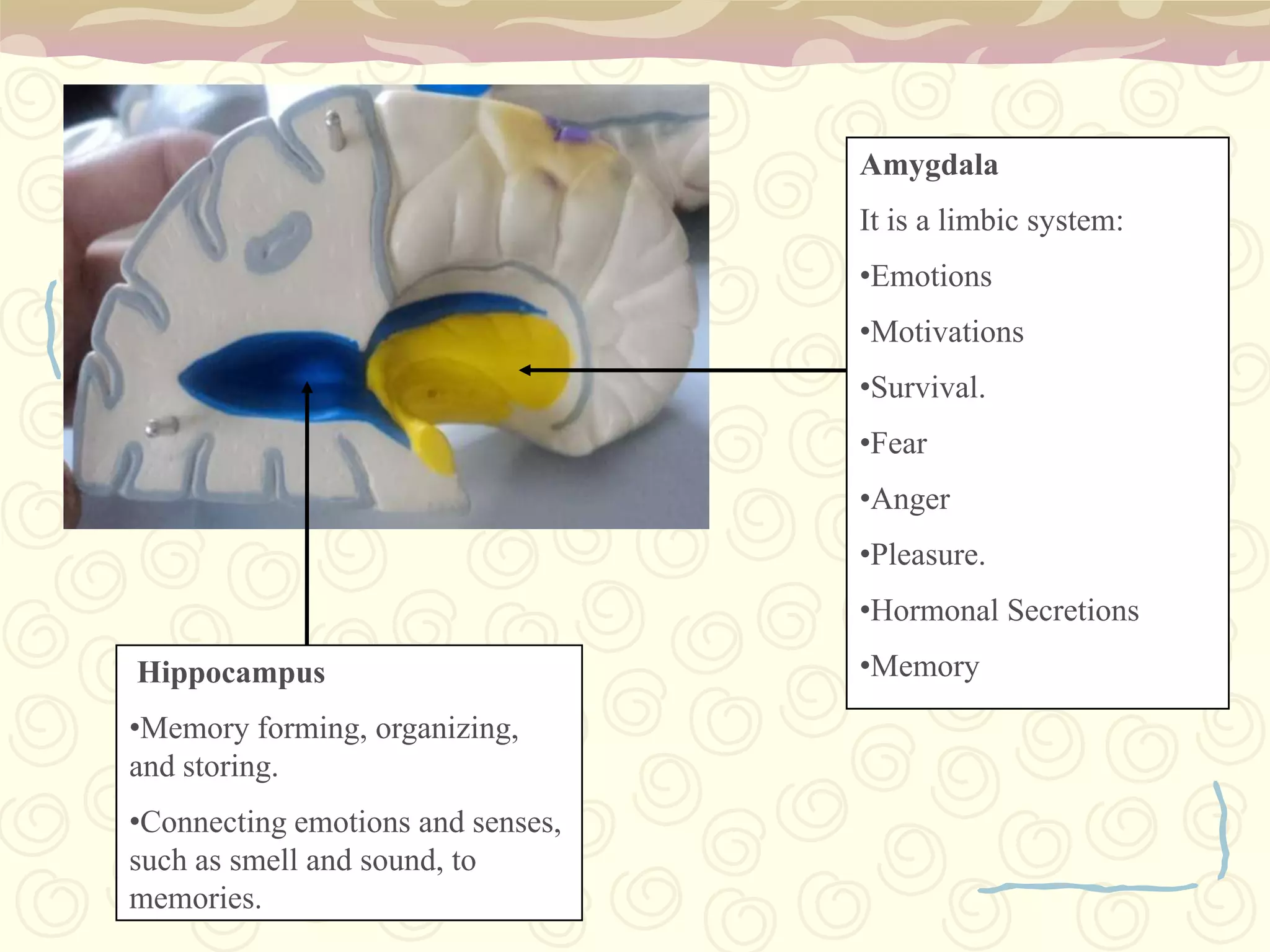
Memory HippocampusMemory forming, organizing, and storing.
Connecting emotions and senses, such as smell and sound, to memories.2. HindbrainMetencephalon: A. CerebellumB. Pons Varolli
2. A Cerebellum“little brain”two smaller hemispheres located at the back of the cerebrumOval in shapeOccupies the posterior cranial fossaSeperated from the cerebrum by the tentoriumcerbelliThe outer layer of the cerebellum consists of fine folds called folia. the outer layer of cortical gray matter surrounds a deeper layer of white matter and nuclei (groups of nerve cells). Three fiber bundles called cerebellar peduncles connect the cerebellum to the three parts of the brain stem.
Anterior Lobe – posturePosterior Lobe – coordination of movementFlocculonodular Lobe – equilibrium
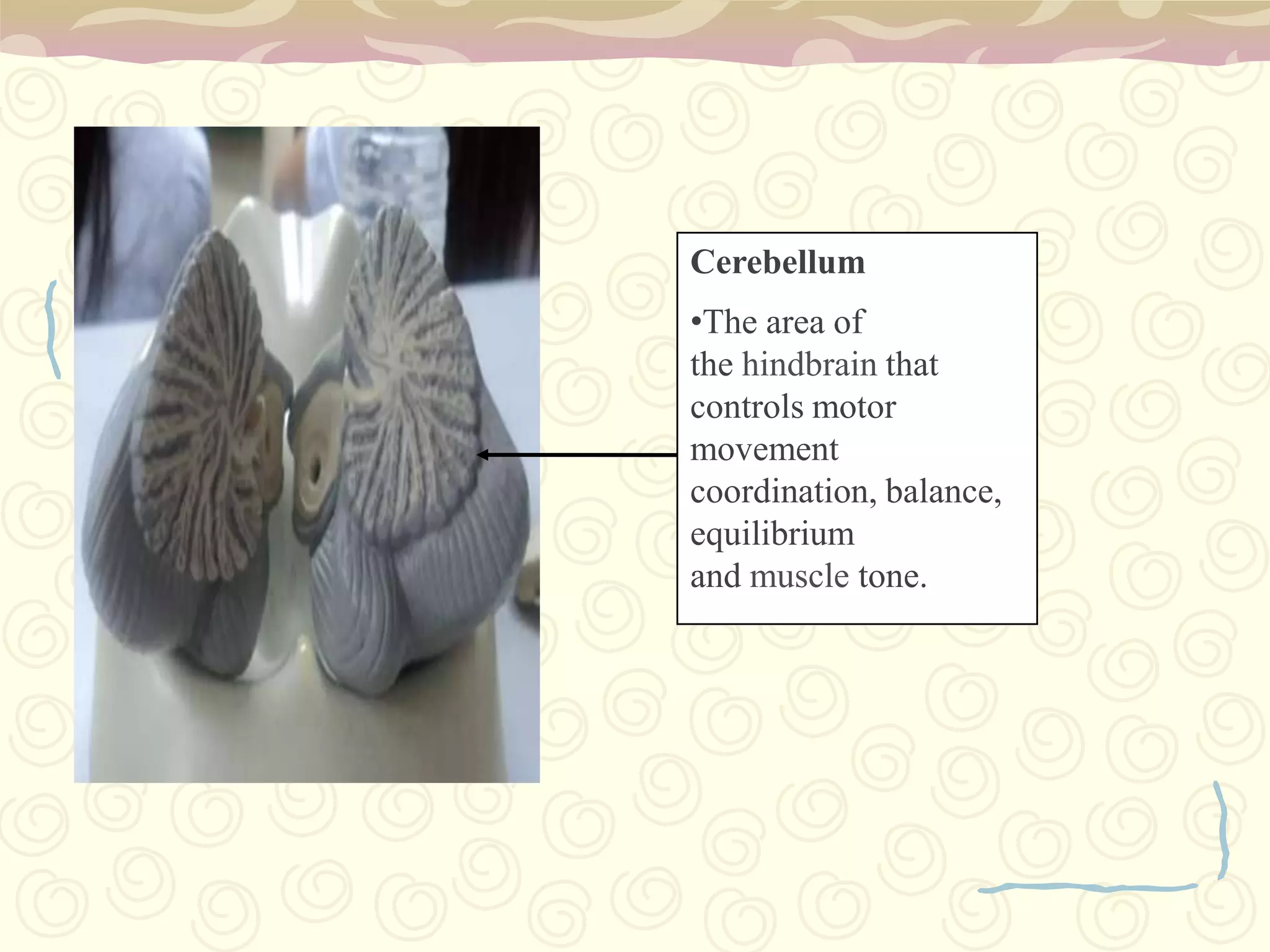
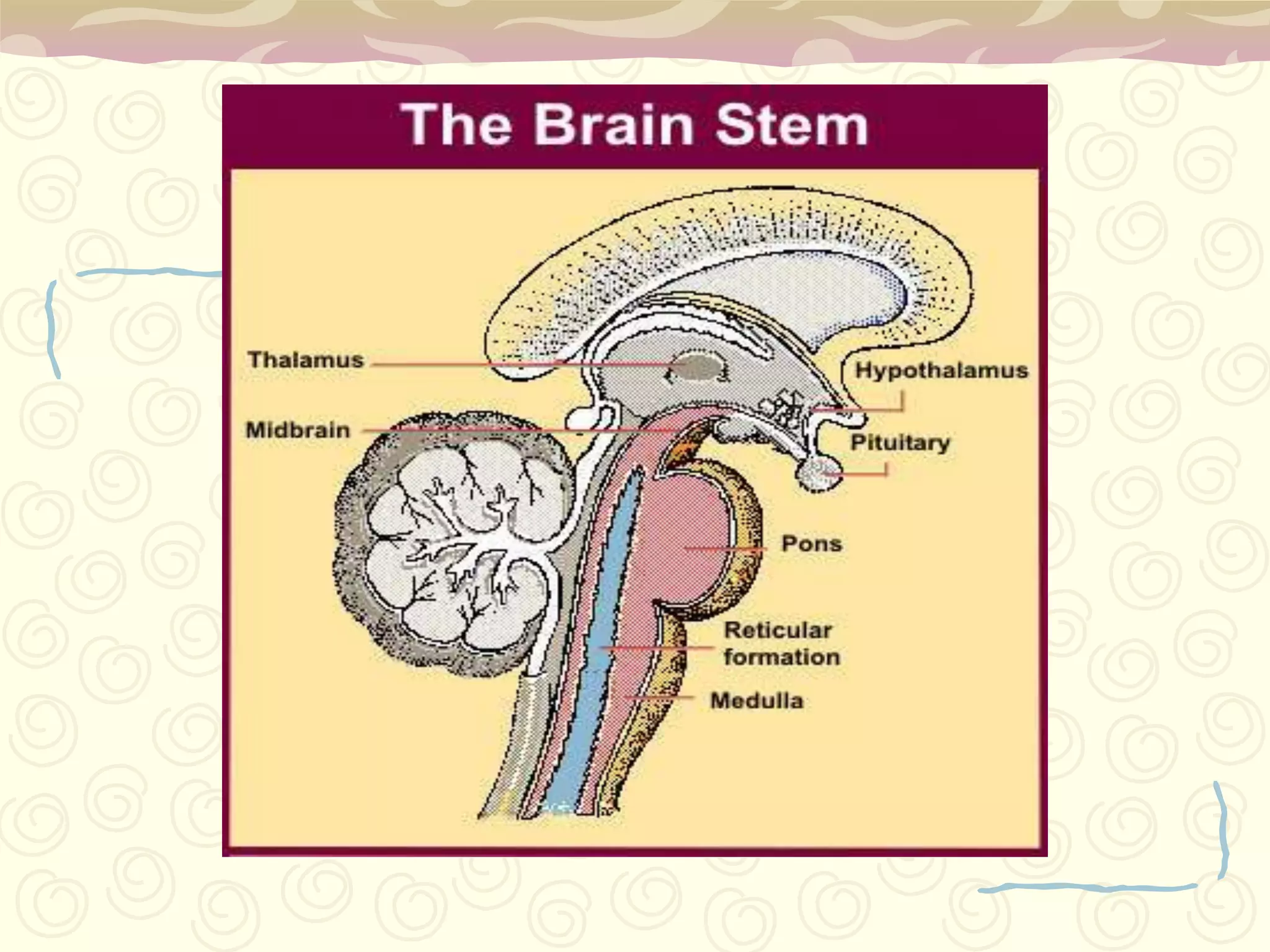
CerebellumThe area of the hindbrain that controls motor movement coordination, balance, equilibrium and muscle tone.The Brainstem
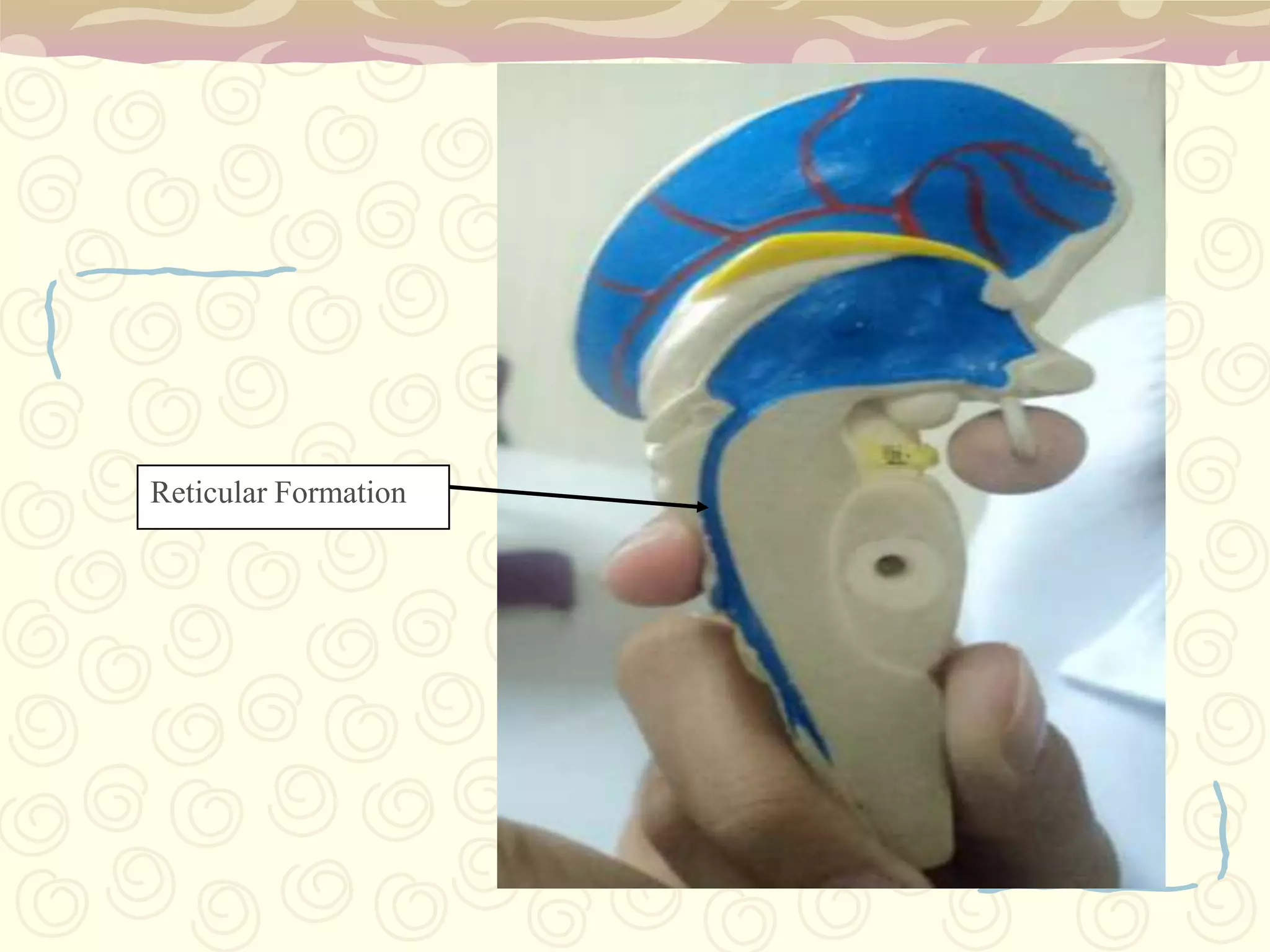
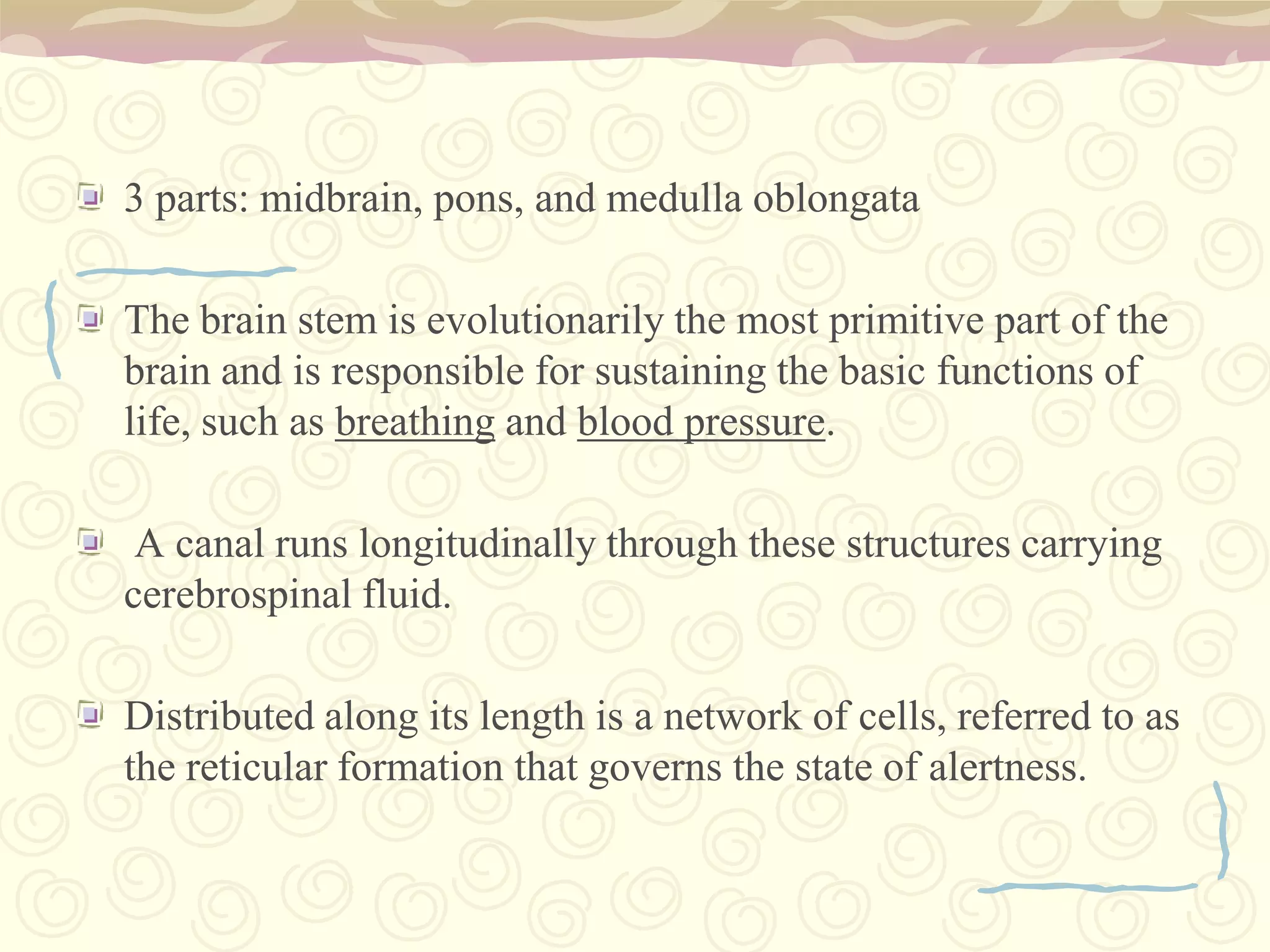
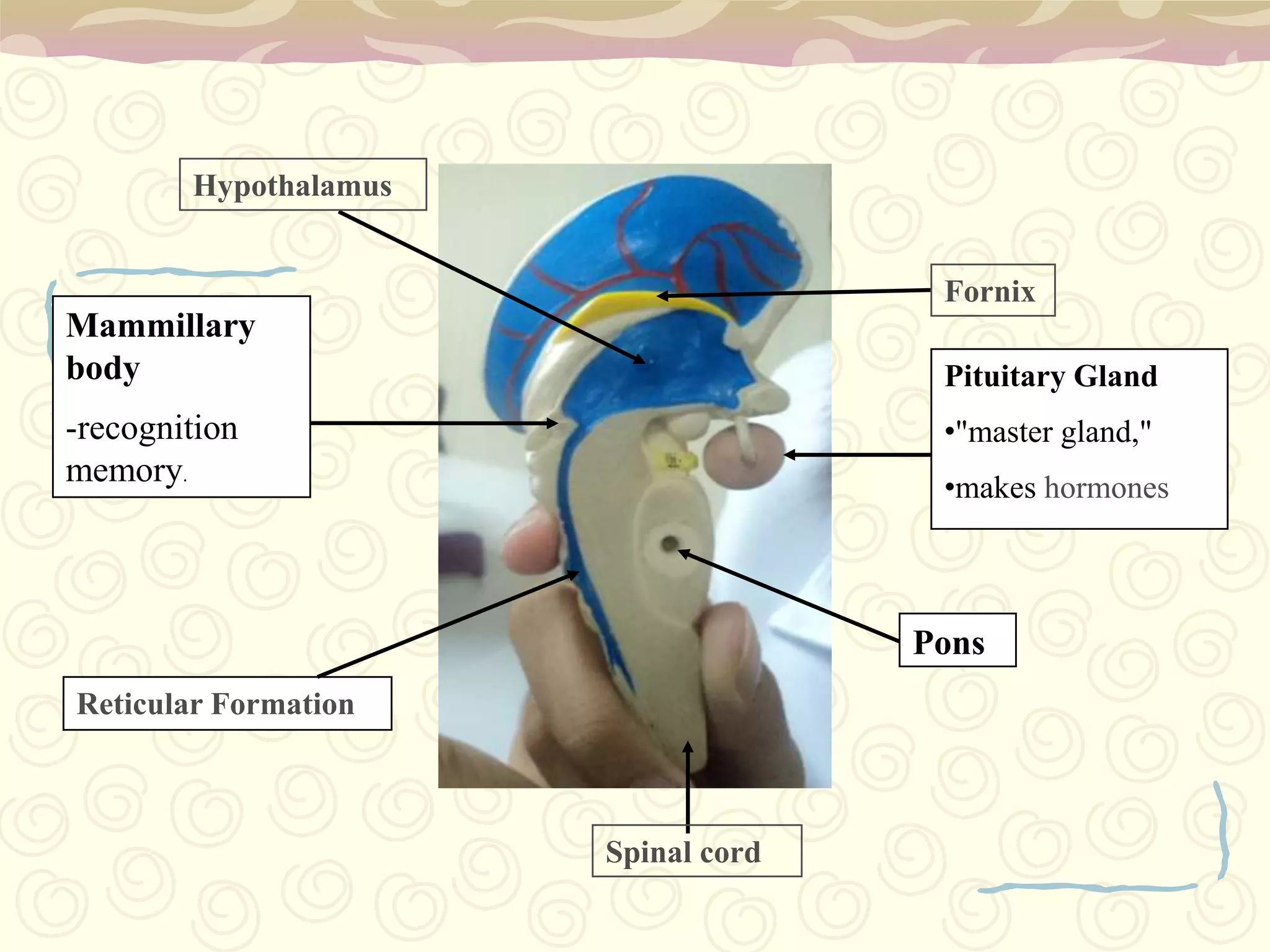
3 parts: midbrain, pons, and medulla oblongataThe brain stem is evolutionarily the most primitive part of the brain and is responsible for sustaining the basic functions of life, such as breathing and blood pressure.  A canal runs longitudinally through these structures carrying cerebrospinal fluid. Distributed along its length is a network of cells, referred to as the reticular formation that governs the state of alertness.
HypothalamusFornixMammillary body-recognition memory.Pituitary Gland"master gland,"
makes hormonesPonsReticular FormationSpinal cord
Functions:path for messages traveling between the upper brain and spinal cord
the seat of basic and vital functions such as breathing, blood pressure, and heart rate, as well as reflexes like eye movement and vomiting. Reticular Formationis a netlike formation of nuclei known as the reticular formation. The reticular formation controls respiration, cardiovascular function, digestion, levels of alertness, and patterns of sleep. It also determines which parts of the constant flow of sensory information into the body are received by the cerebrum.
Reticular Formation
Functions:SleepWalkingSexEatingEliminationBehavioral motivationBreathingBeating of the heartControl of Consciousness – most important
2.B Pons Varolli slunted in front of the cerebellum between the midbrain and the medulla oblongata. A bridge-like structure composed entirely of white matterIt joins the two haves of the cerebellumTrigeminal Nerve (Cranial Nerve 5) emerges from pons
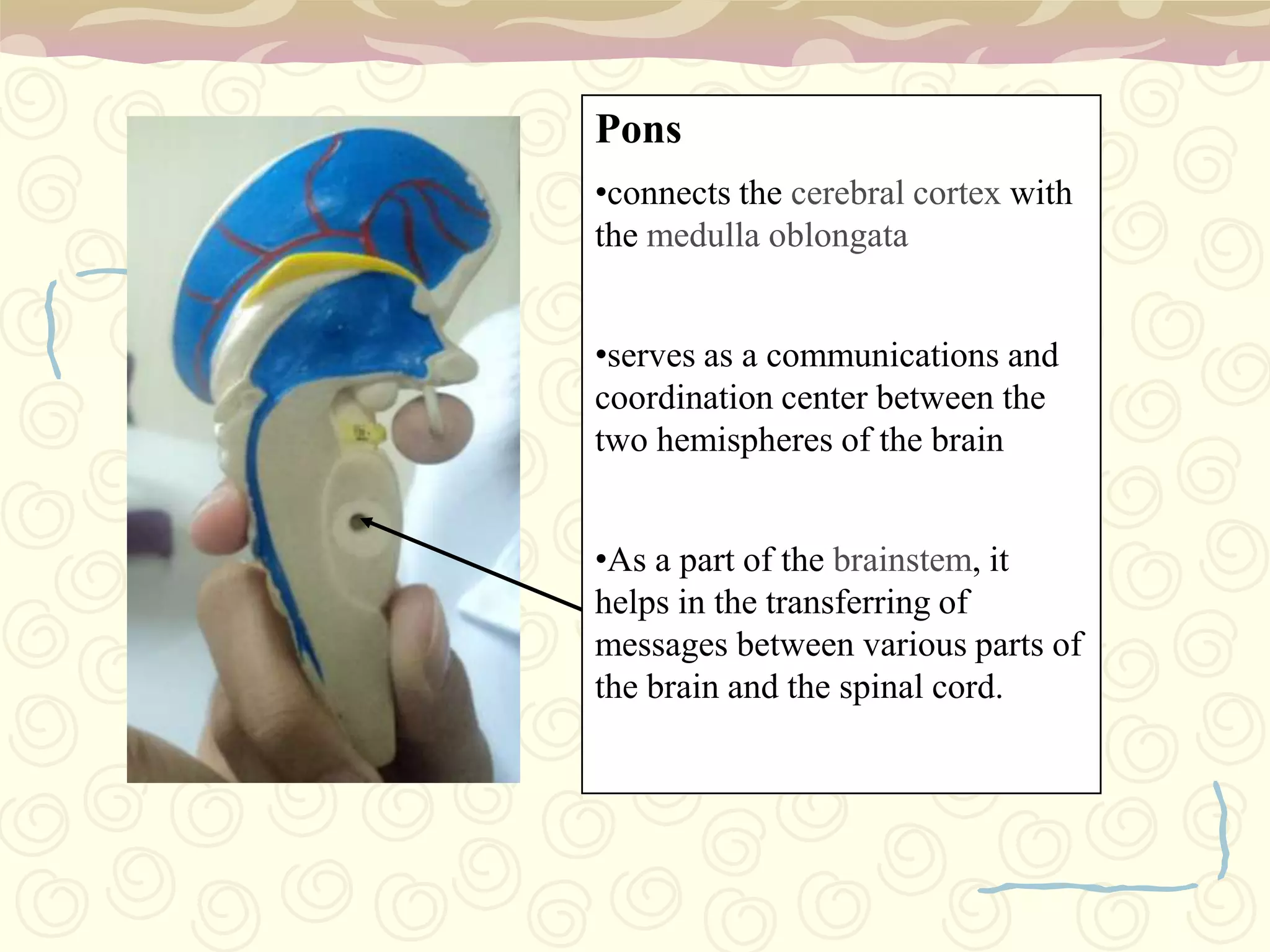
FUNCTION: The pons serves mainly as a relay station linking the cerebral cortex and the medulla oblongata.
Ponsconnects the cerebral cortex with the medulla oblongata
serves as a communications and coordination center between the two hemispheres of the brain
As a part of the brainstem, it helps in the transferring of messages between various parts of the brain and the spinal cord.3. MidbrainMesencephalon
also called mesencephalon,  region of the developing vertebrate brain containing cranial nerves that stimulate the muscles controlling eye movement, between the forebrain and hindbrainConcerned with motor coordinationConnects the cerebellum with the cerebrum
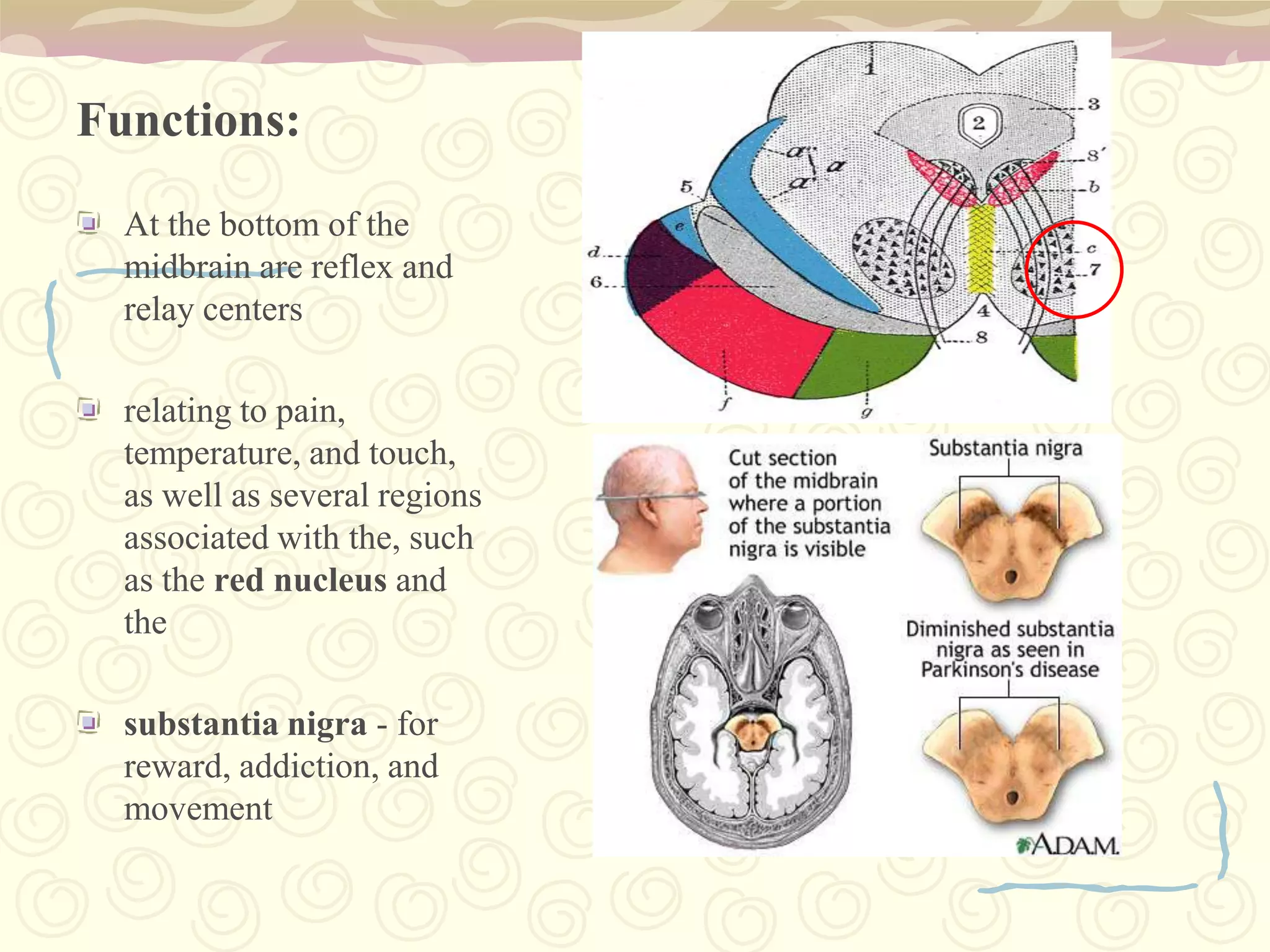
Functions:At the bottom of the midbrain are reflex and relay centers relating to pain, temperature, and touch, as well as several regions associated with the, such as the red nucleus and thesubstantia nigra - for reward, addiction, and movement
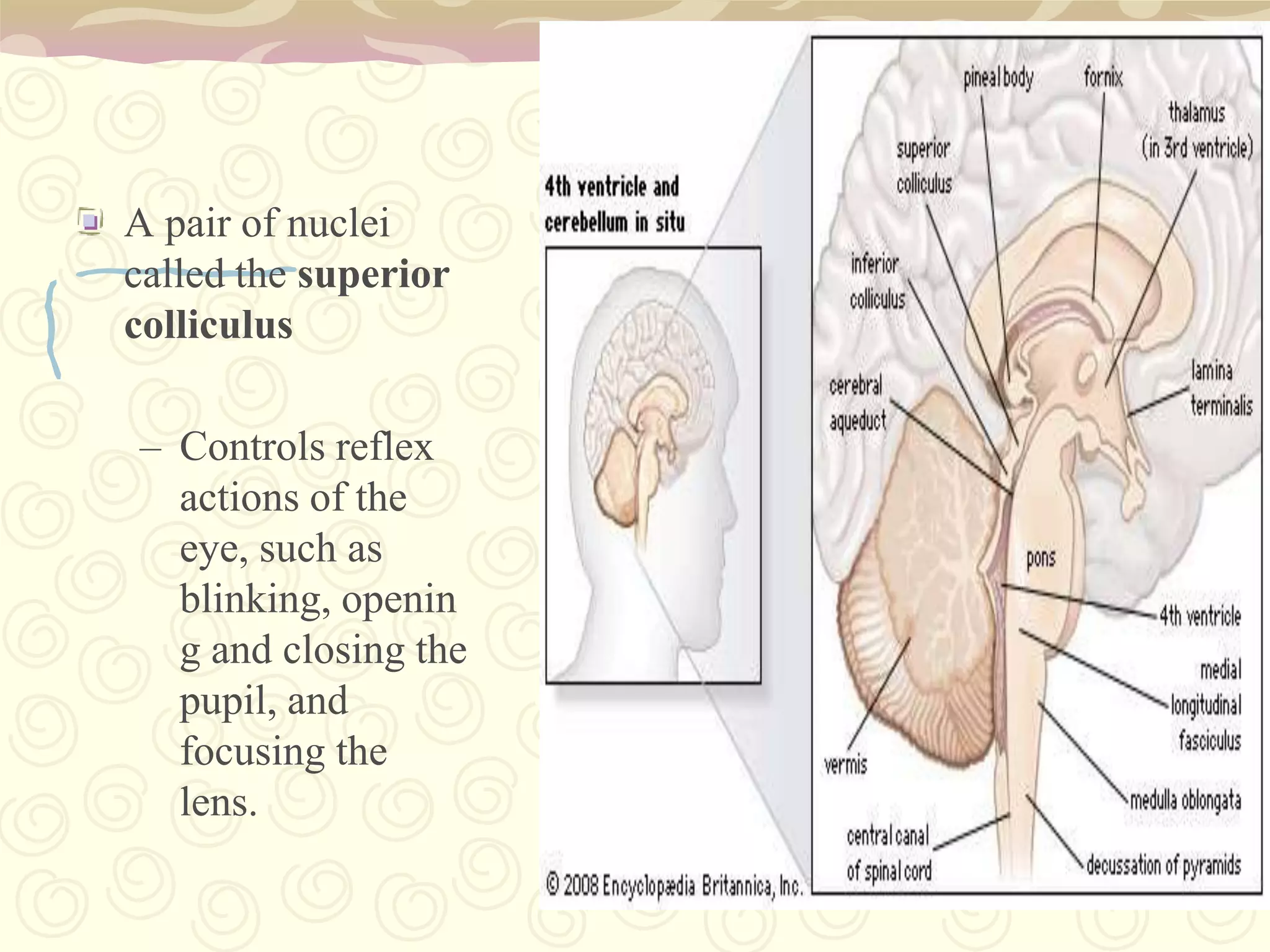
A pair of nuclei called the superior colliculusControls reflex actions of the eye, such as blinking, opening and closing the pupil, and focusing the lens.
A second pair of nuclei, called the inferior colliculus, controls auditory reflexes, such as adjusting the ear to the volume of sound.
Sylvian/Cerebral aqueduct/Iter – canal that connects the 3rd and 4th ventricles of the brain.
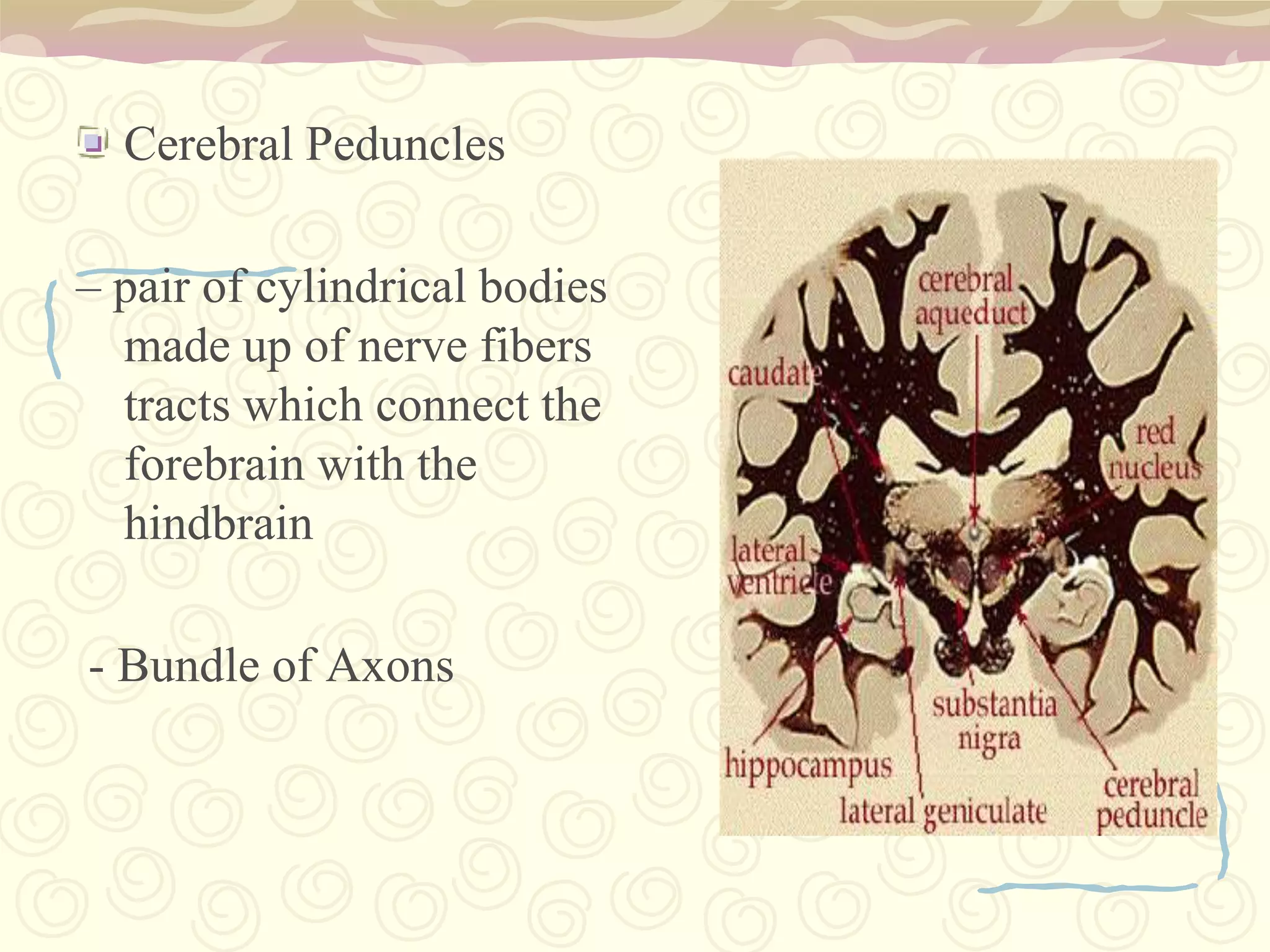
Cerebral Peduncles – pair of cylindrical bodies made up of nerve fibers tracts which connect the forebrain with the hindbrain - Bundle of Axons
Corpora Quadrigemina 	– 4 rounded nuclear masses
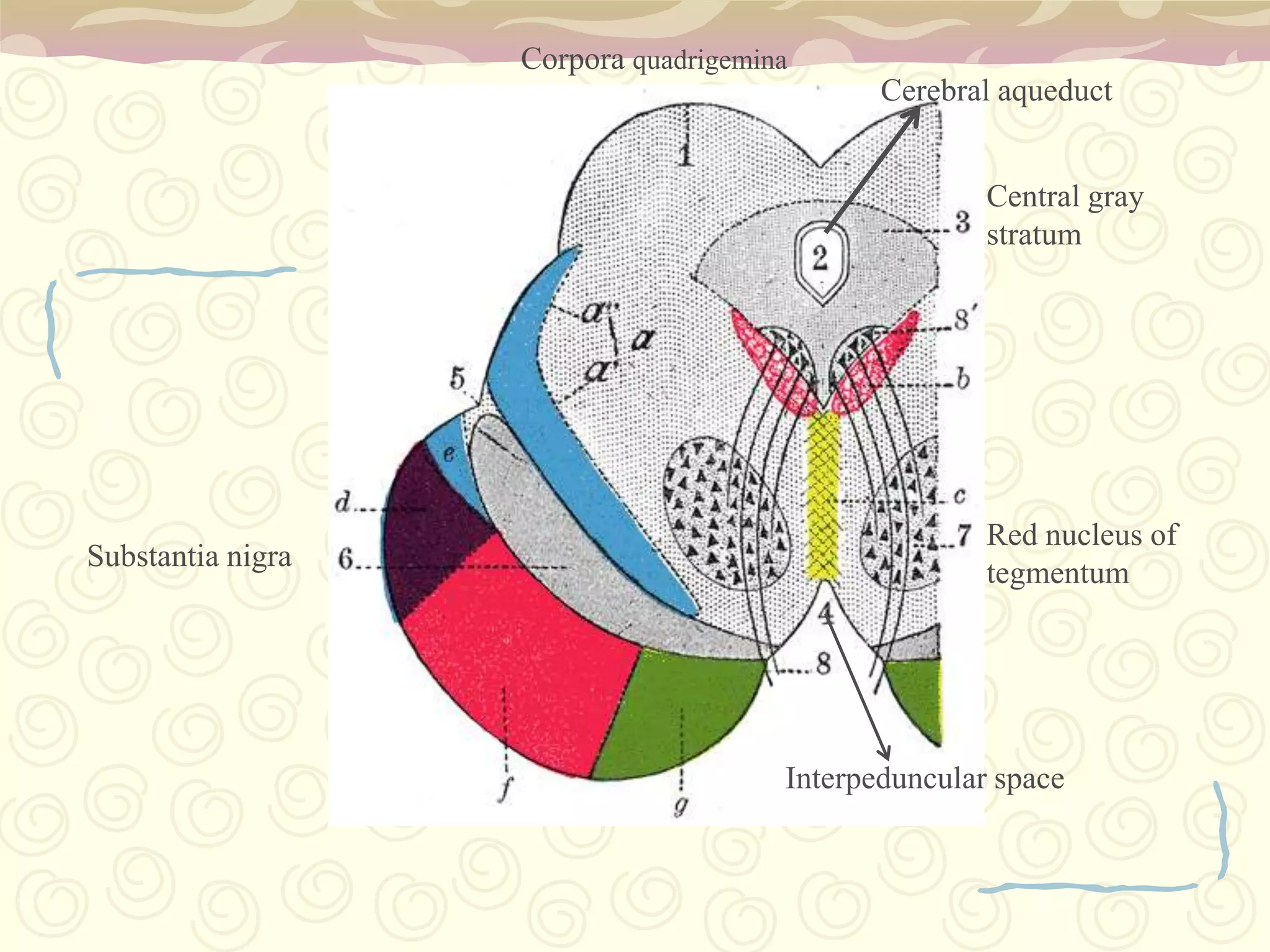
Corpora quadrigeminaCerebral aqueductCentral gray stratumRed nucleus of tegmentumSubstantia nigraInterpeduncular space
Myelencephalon4. Medulla Oblongata  
lowest portion of the brainstemAt the top, it is continuous with the pons and the midbrain;at the bottom, it makes a gradual transition into the spinal cord at the foramen magnum. extends from the pons above and is continuous with the spinal cord below. Pyramidal in shape  (broad above and narrow below)The nerve cells of the medulla are grouped to form “nuclei” out of which emerge cranial nerves 6-12.
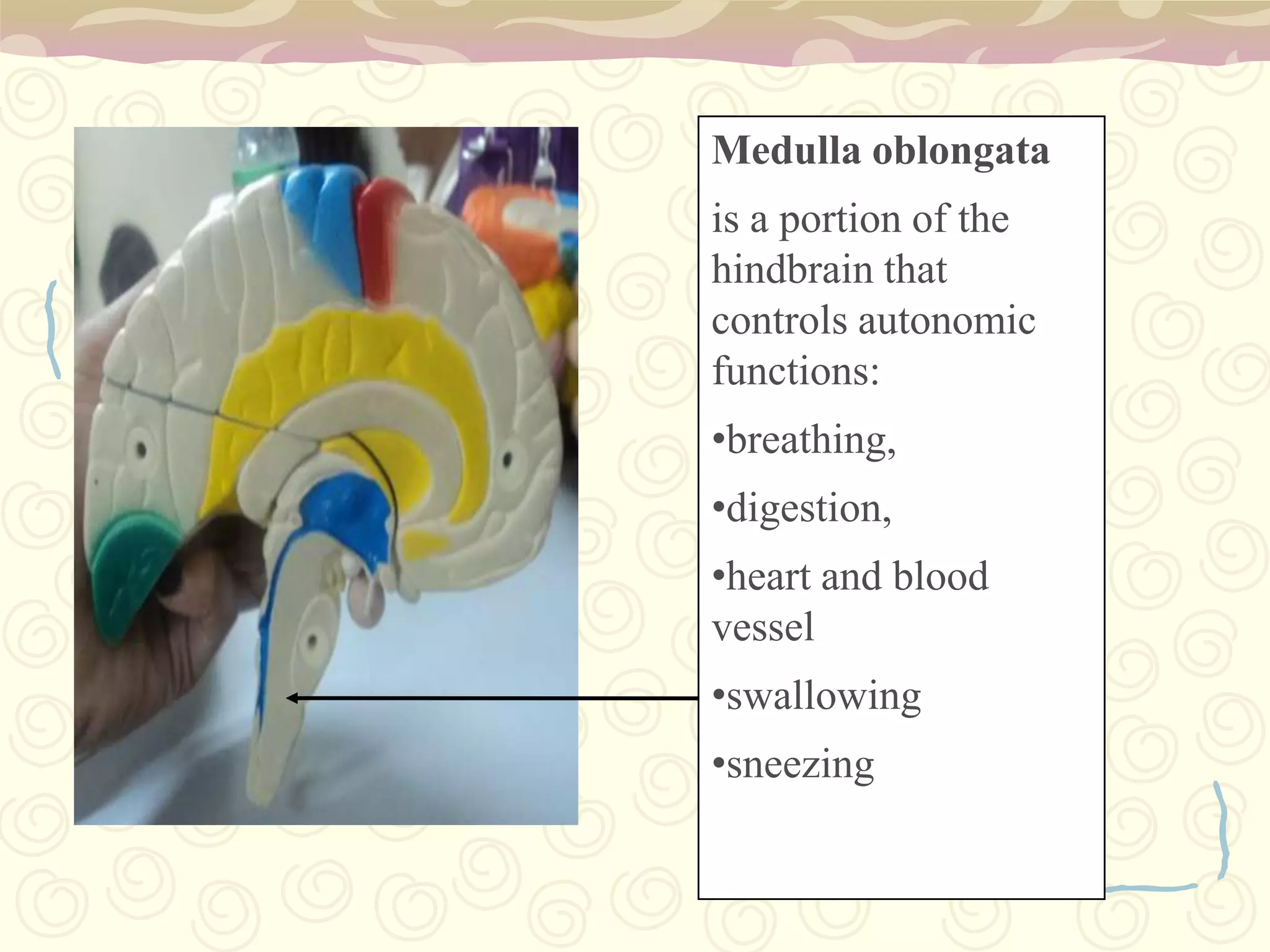
Medulla oblongatais a portion of the hindbrain that controls autonomic functions: breathing,
digestion, 
heart and blood vessel 
swallowing
sneezingFunctions: Organ of conduction for the passage of impulses between brain and spinal cordContains center for control of bodily functions:Cardiac Inhibitory Center – holds heart rate to slower rate through cranial nerve 10 or Vagus Nerve.
Vasoconstrictor Center – narrowing of lumen of the arteries
Respiratory Center – controls rate and depth  of respiration
Reflex Center – sneezing, coughing, vomiting, winking and the movements and secretions of the alimentary canal.5. Diencephalon Thalamus and Hypothalamus
Diencephalon A. Thalamus large mass of gray matter located in the cerebral hemisphere.acts as a relay station between the cerebrum and the rest of the brain and spinal cord. B. Hypothalamus lies below the thalamuscontains temperature-regulating mechanisms and relations with the pituitary gland. hunger, thirst, defense reactions; fear, rage and satiety.
ThalamusIt is involved in sensory perception and regulation of motor functions.
is a limbic systemstructure
it connects areas of the cerebral cortex that are involved in sensory perception and movement
 controls sleep and awake states of consciousness.Limbic SystemThe limbic system is a group of brain structures that plays a role in emotion,memory, and motivation.
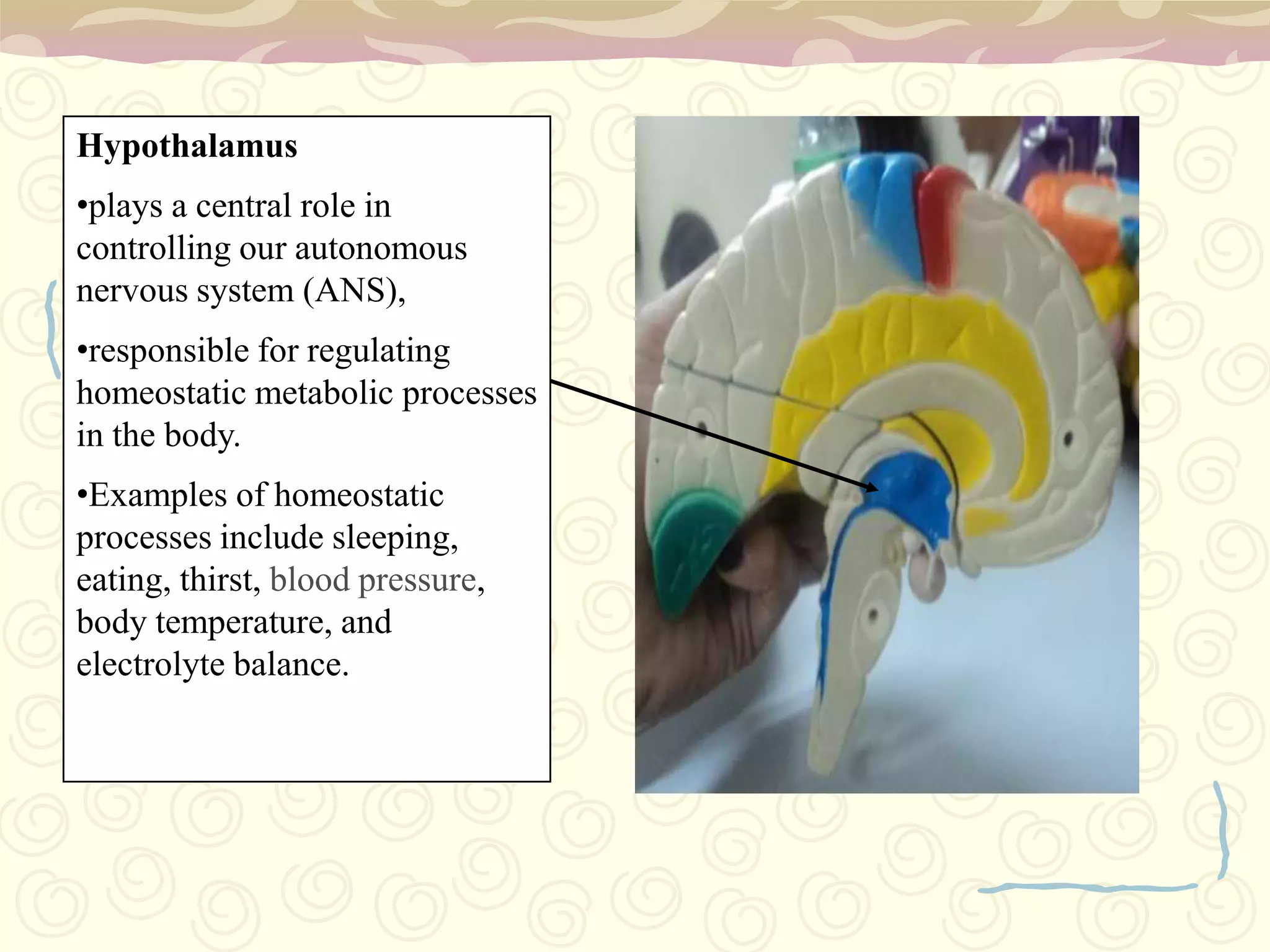
Hypothalamusplays a central role in controlling our autonomous nervous system (ANS),
responsible for regulating homeostatic metabolic processes in the body.
Examples of homeostatic processes include sleeping, eating, thirst, blood pressure, body temperature, and electrolyte balance.Hypothalamus		-regulates hunger, thirst, sleep, body temperature, sexual drive, and other functions.
Fornix connects the Hippocampus to the Hypothalamus
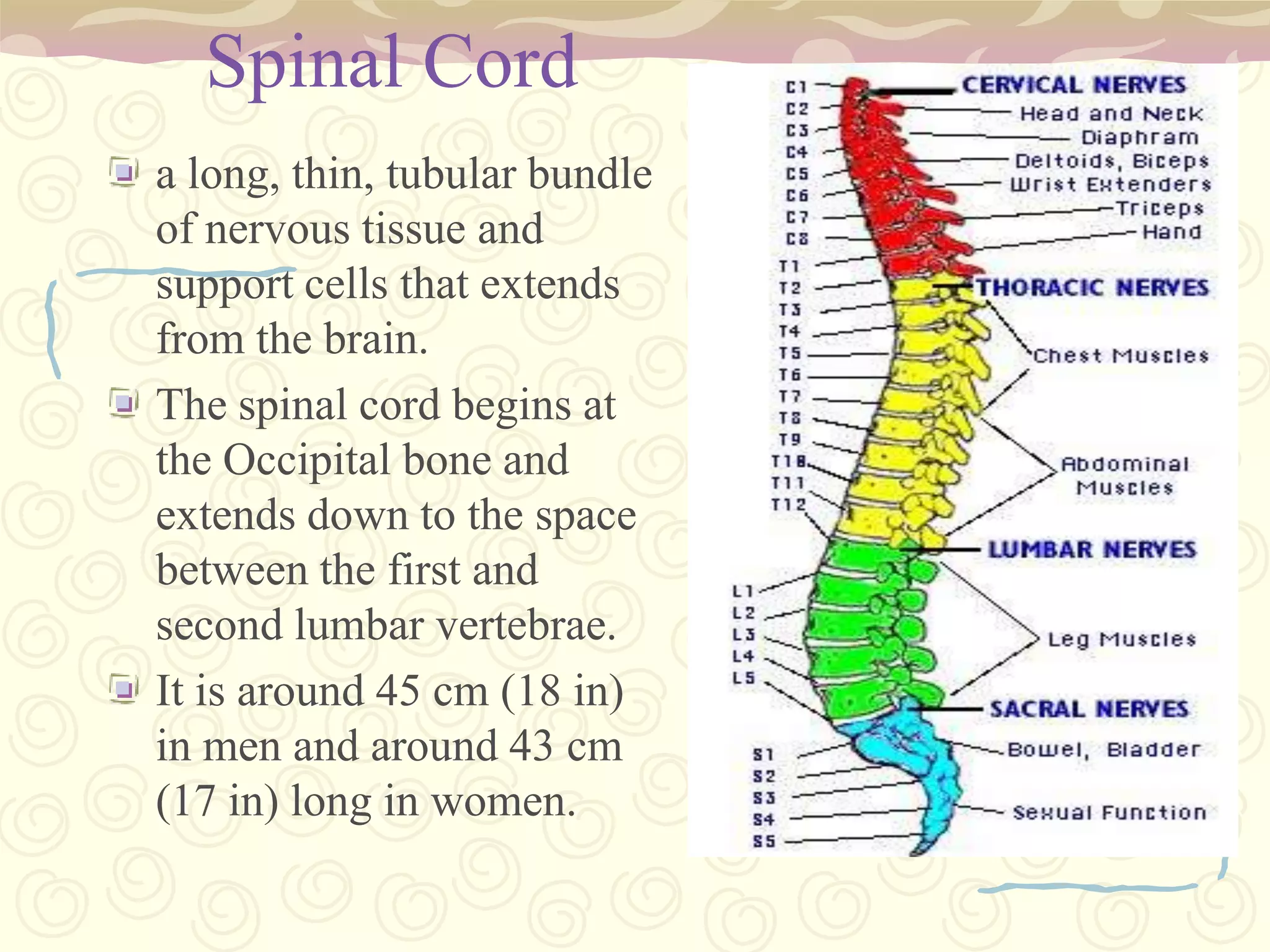
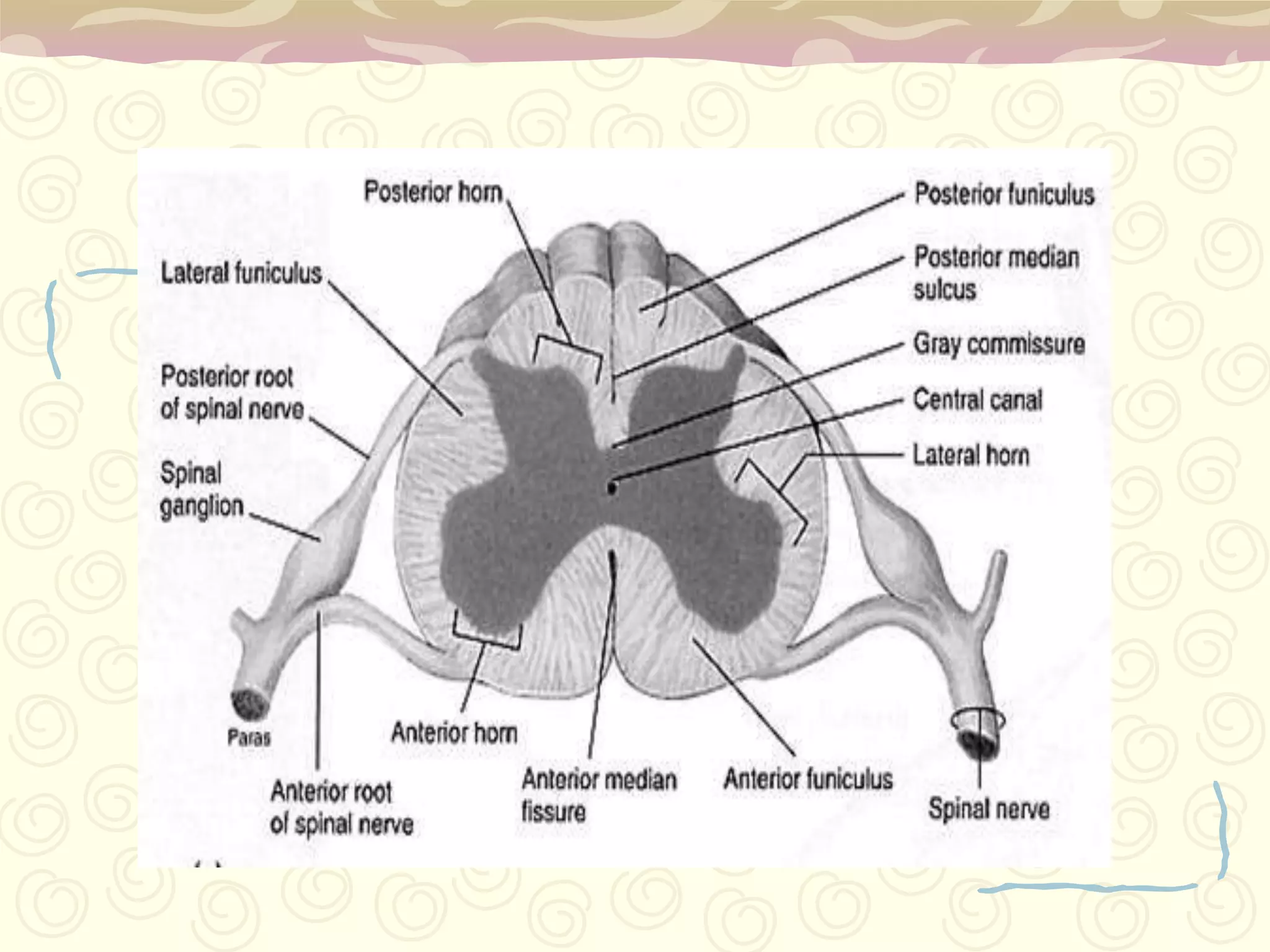
Spinal Corda long, thin, tubular bundle of nervous tissue and support cells that extends from the brain.The spinal cord begins at the Occipital bone and extends down to the space between the first and second lumbar vertebrae.It is around 45 cm (18 in) in men and around 43 cm (17 in) long in women.
Functions of Spinal Cord Serve as a conduit for motor information, which travels down the spinal cord Serve as a conduit for sensory information, which travels up the spinal cord. Serve as a center for coordinating certain reflexes.
Cervical Spinal CordDivided into eight levels. Each level contributes into different functions in the neck and arms.Sensations from the body are similarly transported from the skin and other areas of the body from the neck, shoulders, and arms up to the brain.
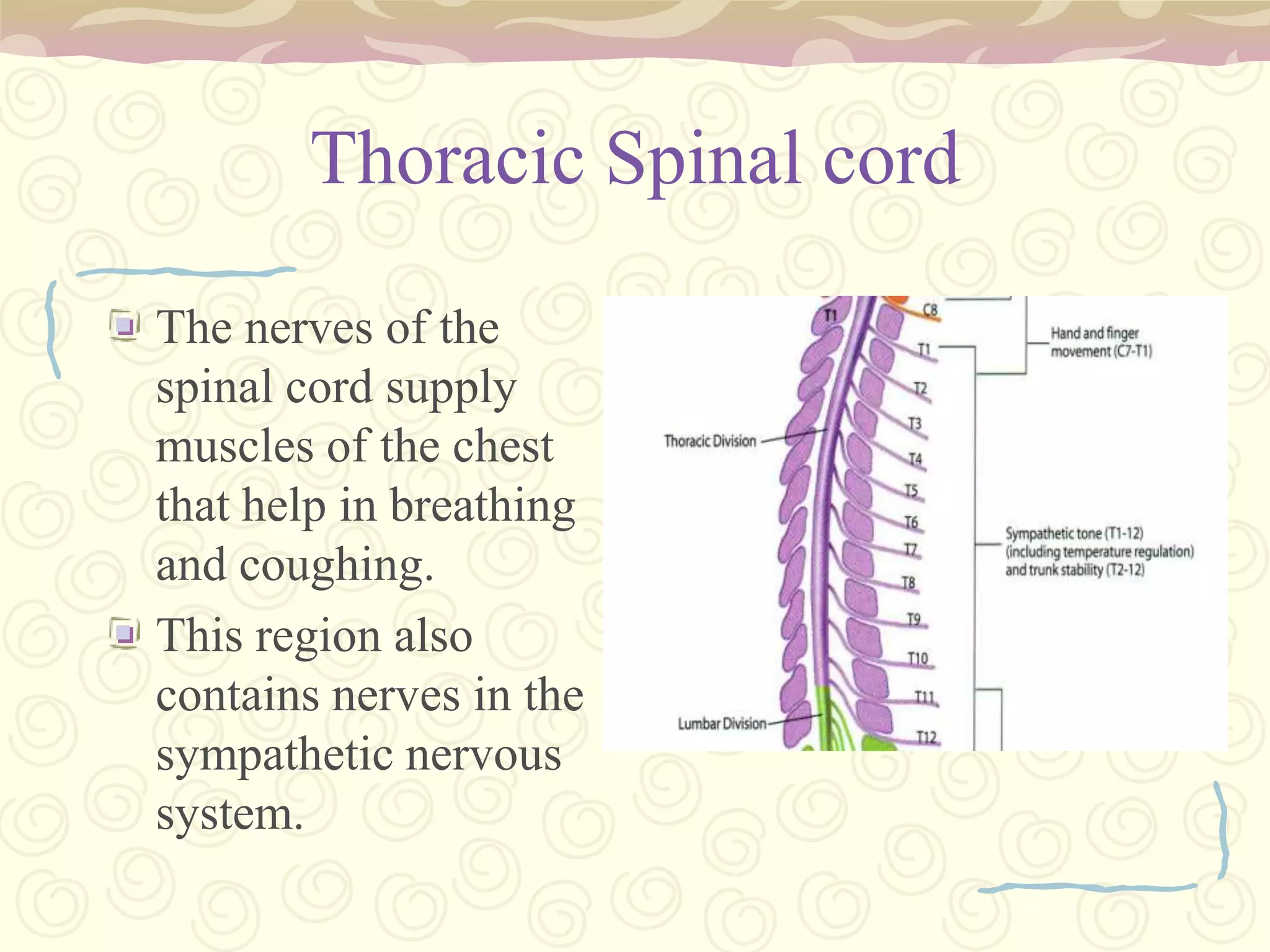
Thoracic Spinal cordThe nerves of the spinal cord supply muscles of the chest that help in breathing and coughing.This region also contains nerves in the sympathetic nervous system.
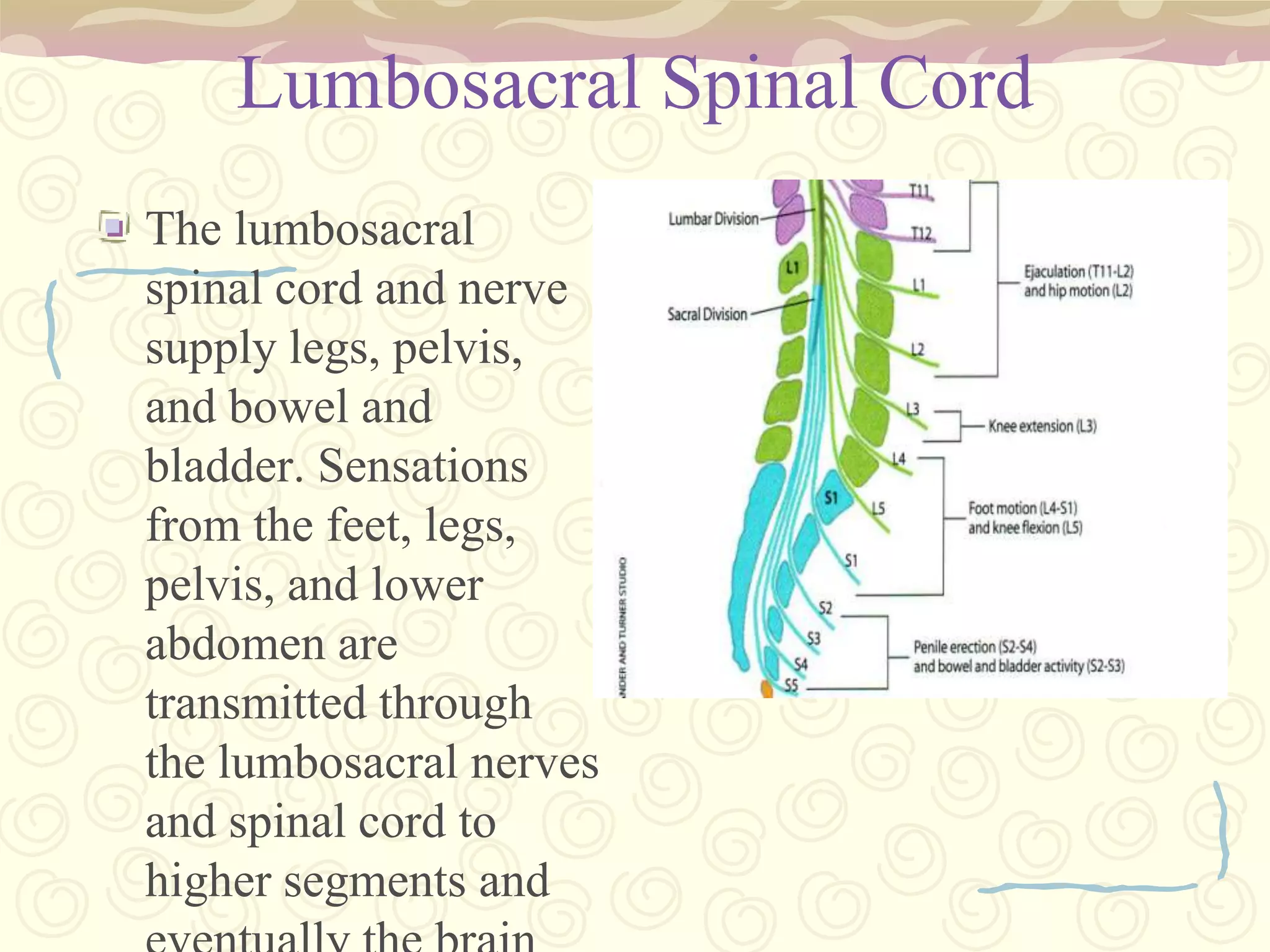
Lumbosacral Spinal CordThe lumbosacral spinal cord and nerve supply legs, pelvis, and bowel and bladder. Sensations from the feet, legs, pelvis, and lower abdomen are transmitted through the lumbosacral nerves and spinal cord to higher segments and eventually the brain
Peripheral Nervous Systemmain function of the PNS is to connect the central nervous system (CNS) to the limbs and organs.
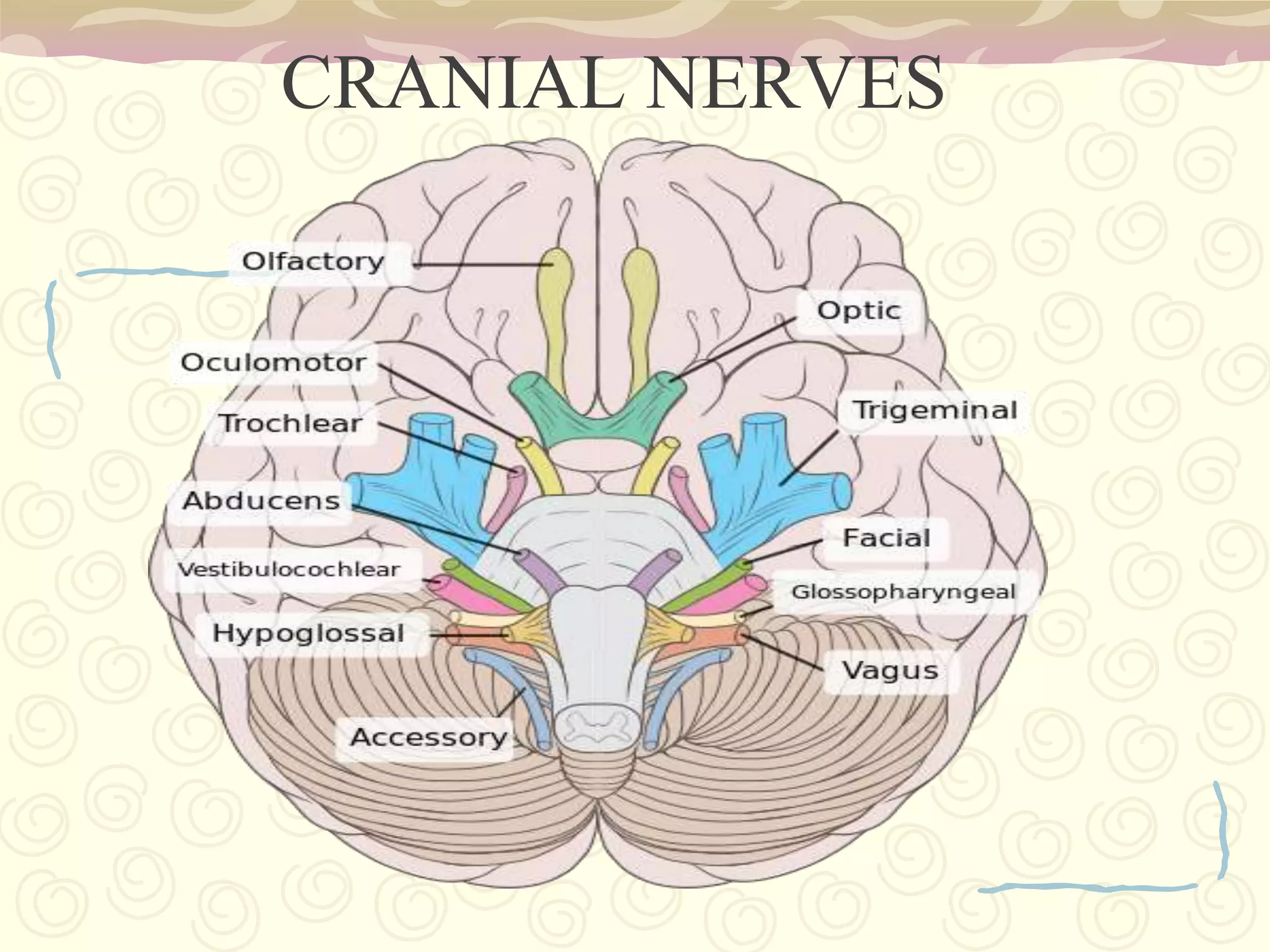
peripheral nervous system of humans has thirty-one pairs of spinal nerves, CRANIAL NERVES
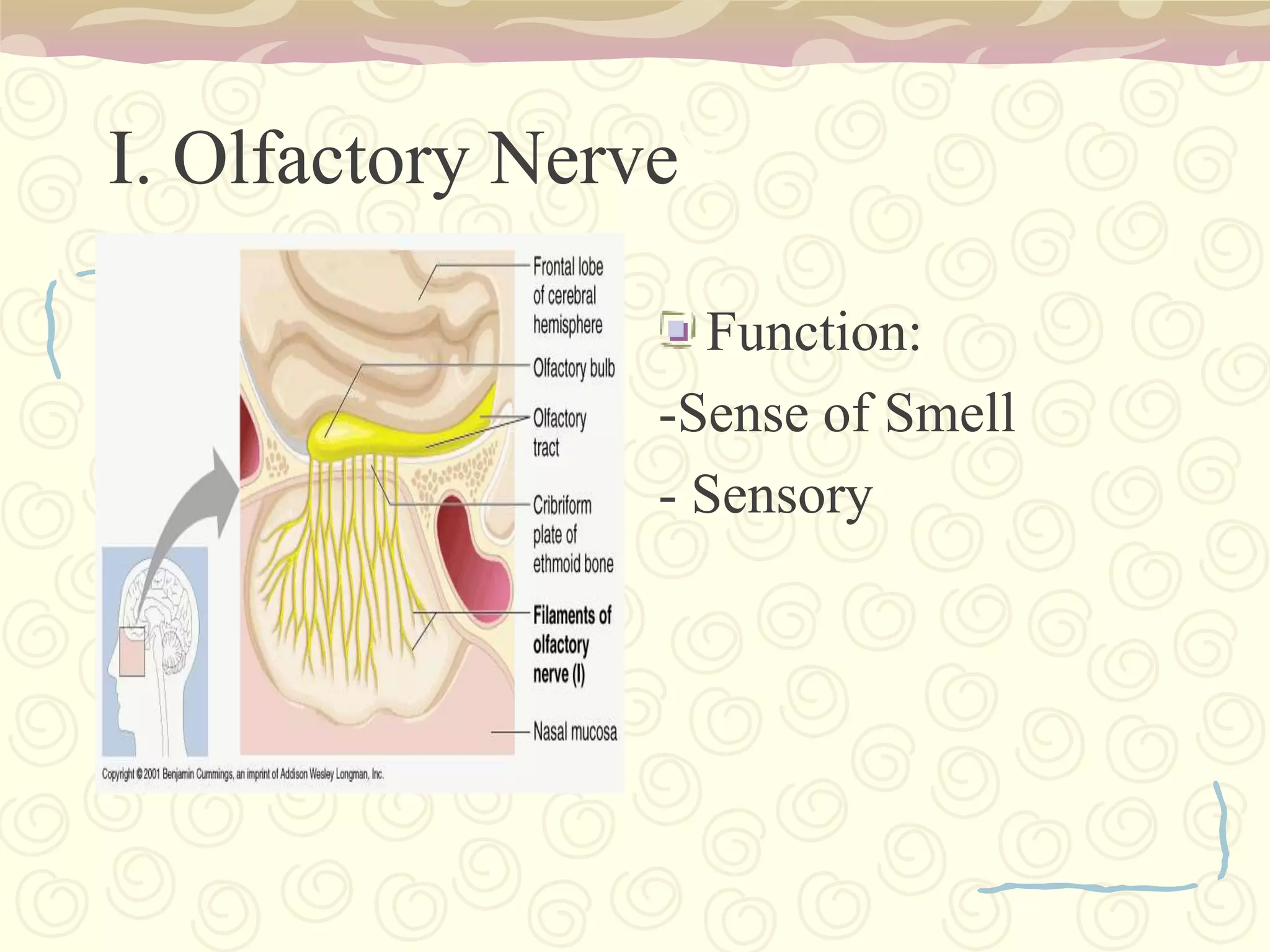
I. Olfactory NerveYFunction:-Sense of Smell- Sensory
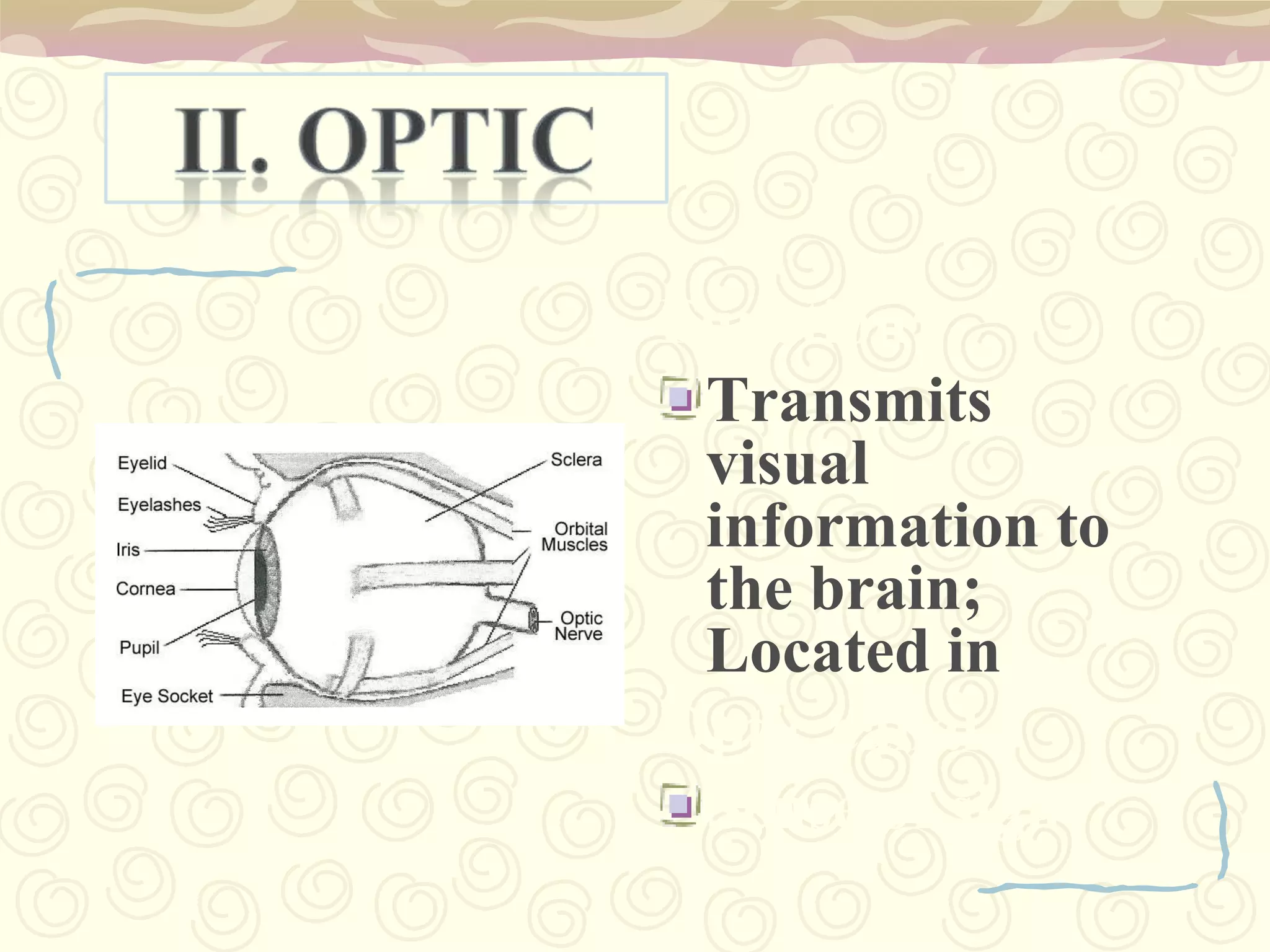
Function:Transmits visual information to the brain; Located in Optic canal.Sense of sightII. optic
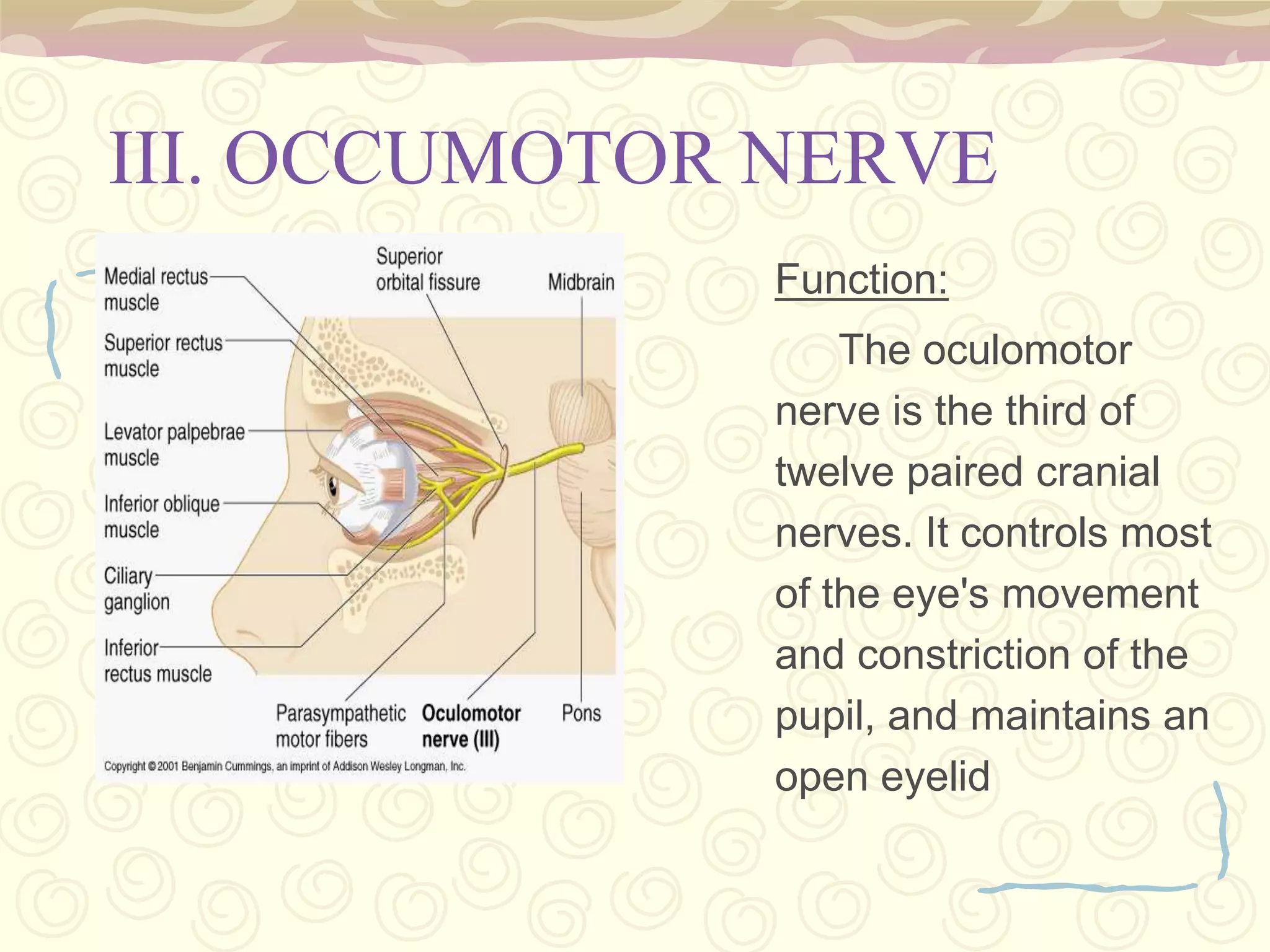
III. OCCUMOTOR NERVEFunction:	The oculomotor nerve is the third of twelve paired cranial nerves. It controls most of the eye's movement and constriction of the pupil, and maintains an open eyelid
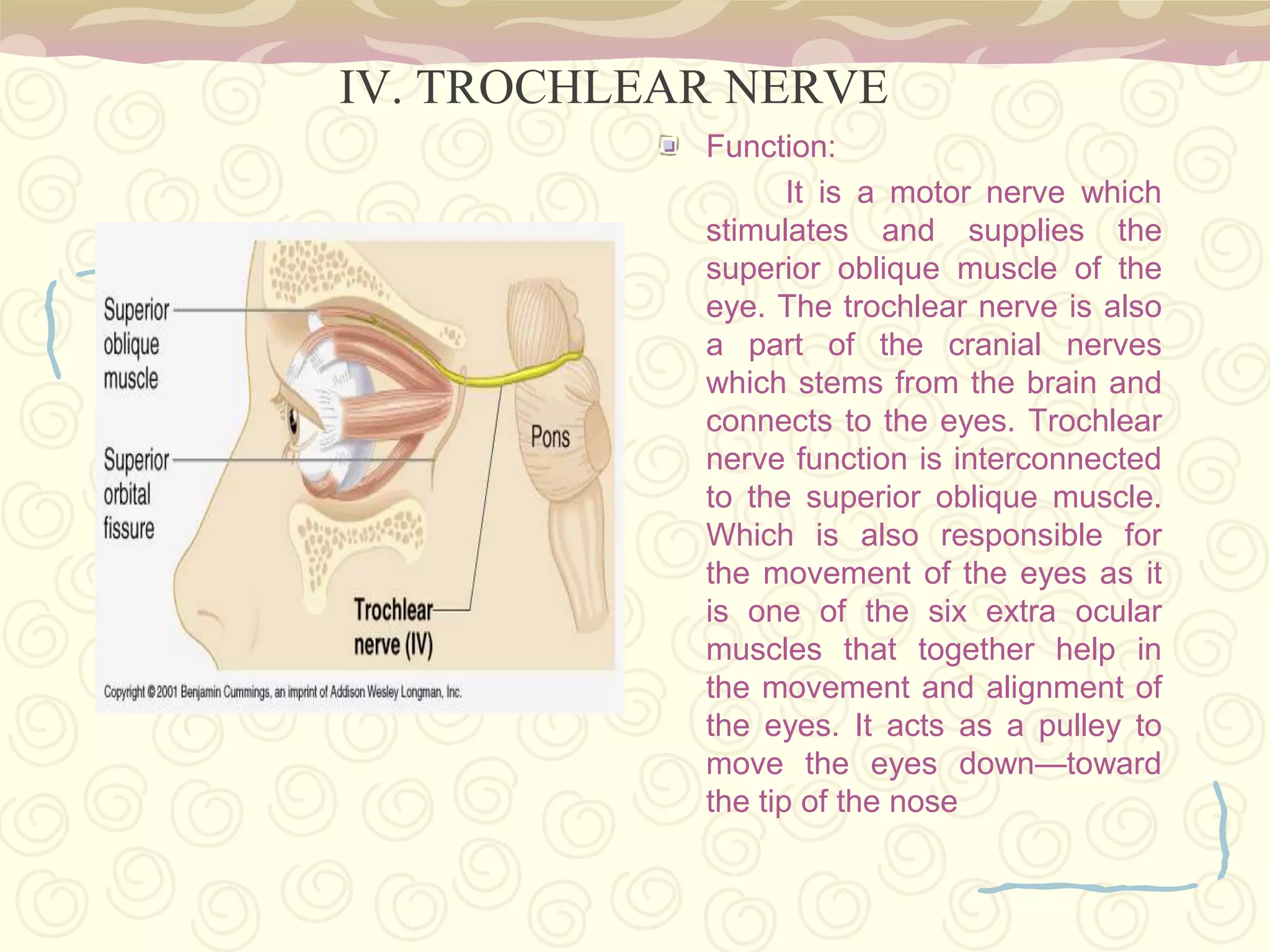
IV. TROCHLEAR NERVEFunction:		It is a motor nerve which stimulates and supplies the superior oblique muscle of the eye. The trochlear nerve is also a part of the cranial nerves which stems from the brain and connects to the eyes. Trochlear nerve function is interconnected to the superior oblique muscle. Which is also responsible for the movement of the eyes as it is one of the six extra ocular muscles that together help in the movement and alignment of the eyes. It acts as a pulley to move the eyes down—toward the tip of the nose
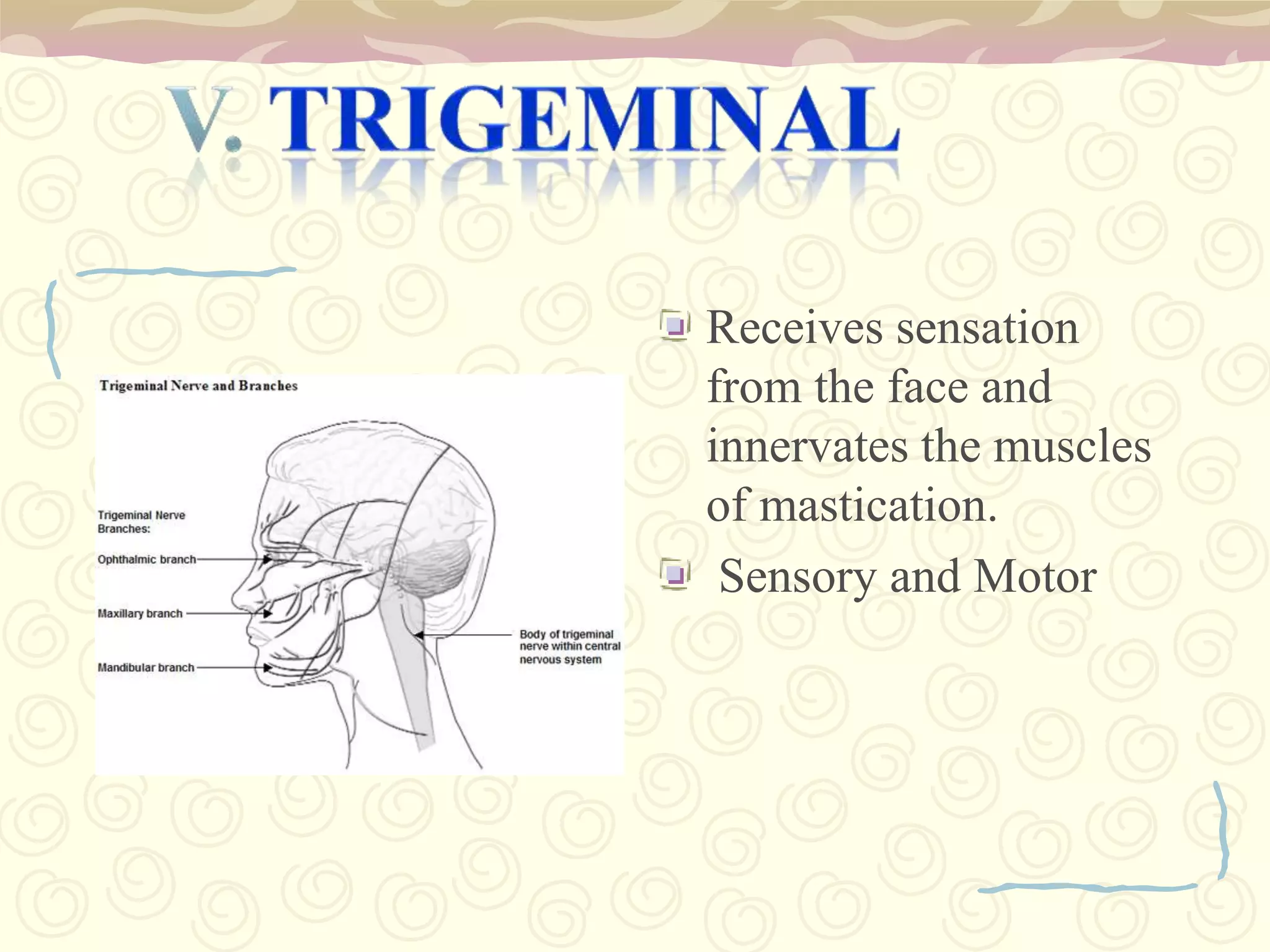
Receives sensation from the face and innervates the muscles of mastication. Sensory and MotorV. TRIGEMINAL
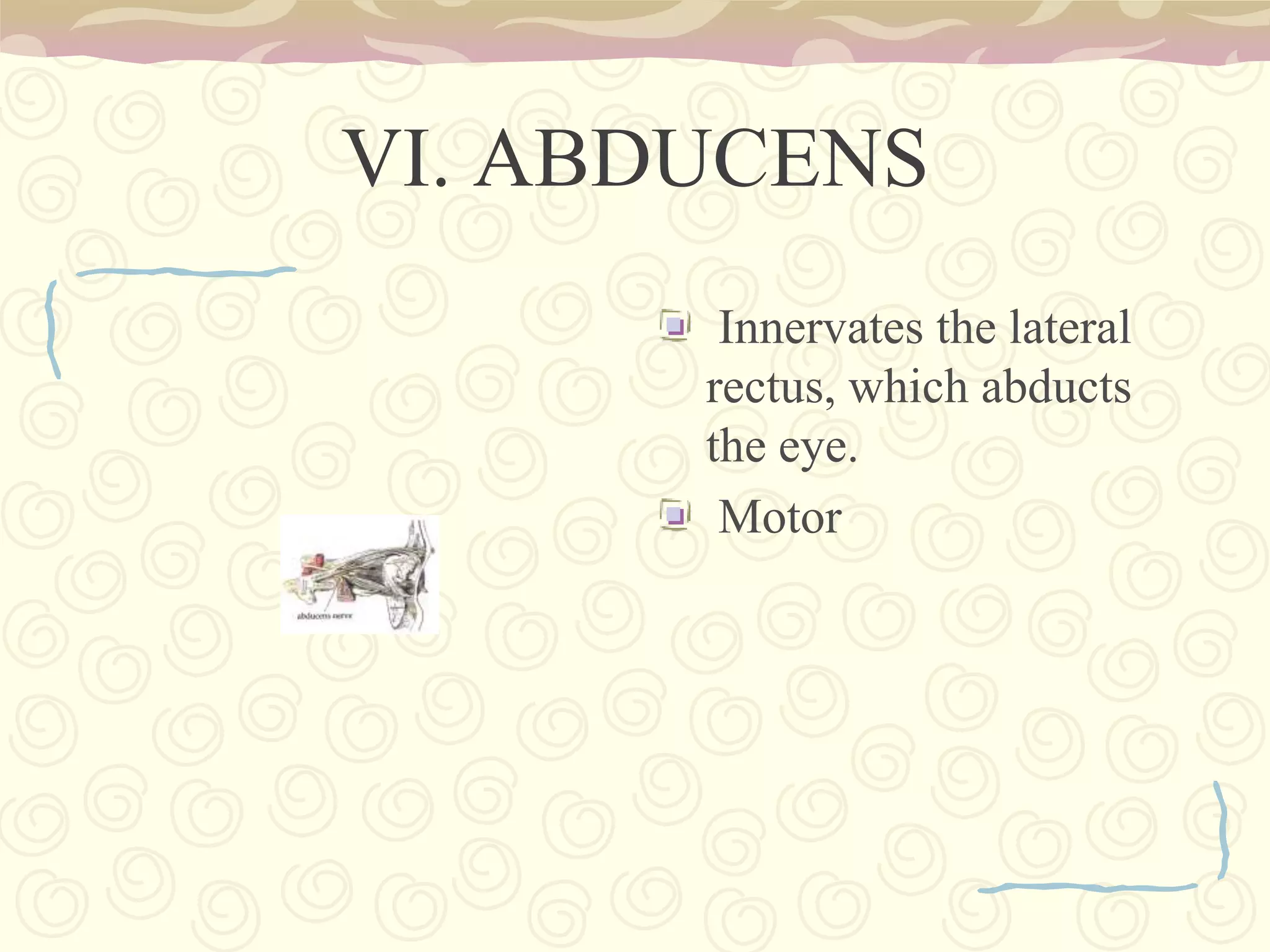
VI. ABDUCENS Innervates the lateral rectus, which abducts the eye. Motor
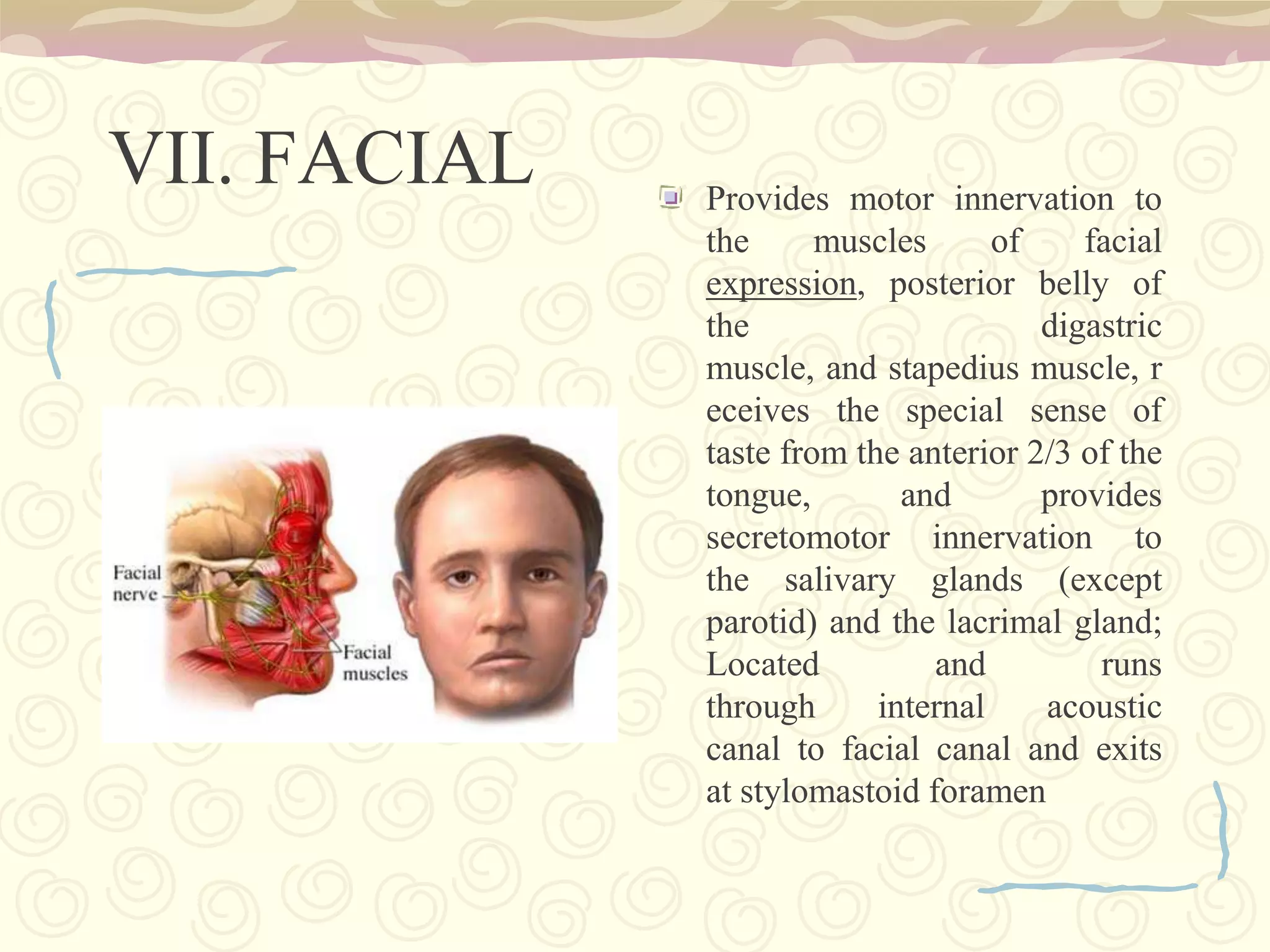
VII. FACIALProvides motor innervation to the muscles of facial expression, posterior belly of the digastric muscle, and stapedius muscle, receives the special sense of taste from the anterior 2/3 of the tongue, and provides secretomotor innervation to the salivary glands (except parotid) and the lacrimal gland; Located and runs through internal acoustic canal to facial canal and exits at stylomastoid foramen
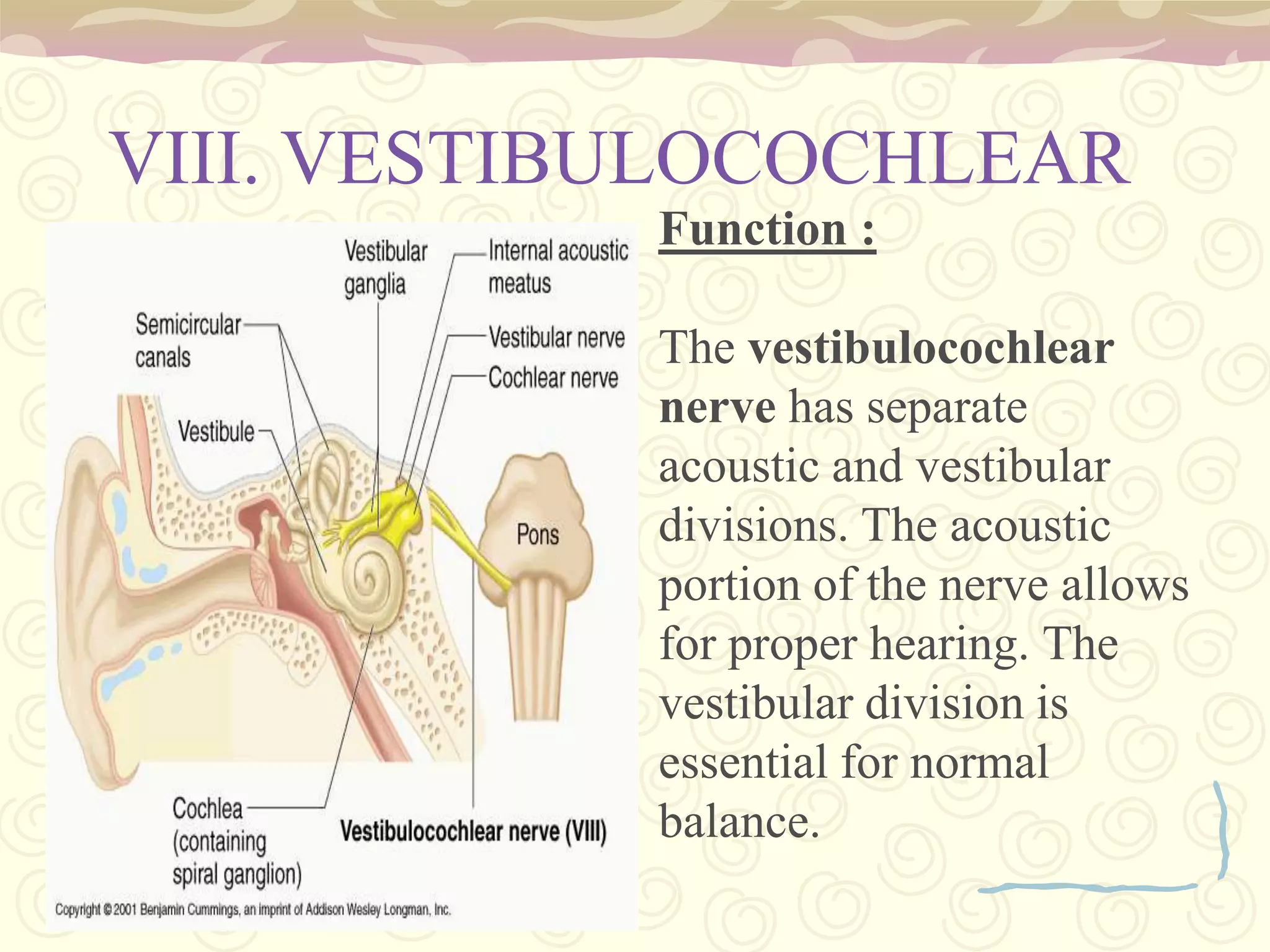
VIII. VESTIBULOCOCHLEARFunction :The vestibulocochlear nerve has separate acoustic and vestibular divisions. The acoustic portion of the nerve allows for proper hearing. The vestibular division is essential for normal balance.
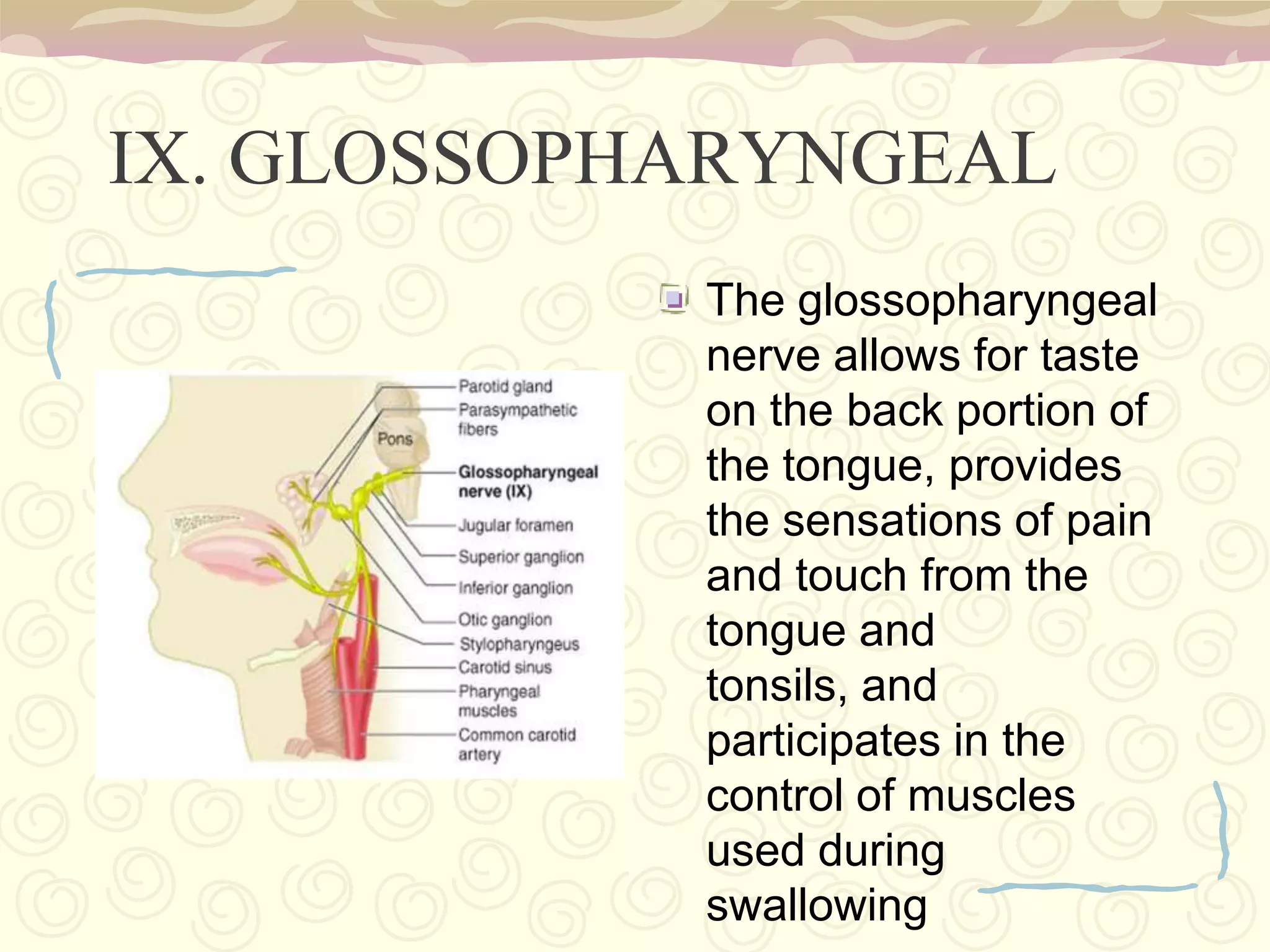
IX. GLOSSOPHARYNGEALThe glossopharyngeal nerve allows for taste on the back portion of the tongue, provides the sensations of pain and touch from the tongue and tonsils, and participates in the control of muscles used during swallowing
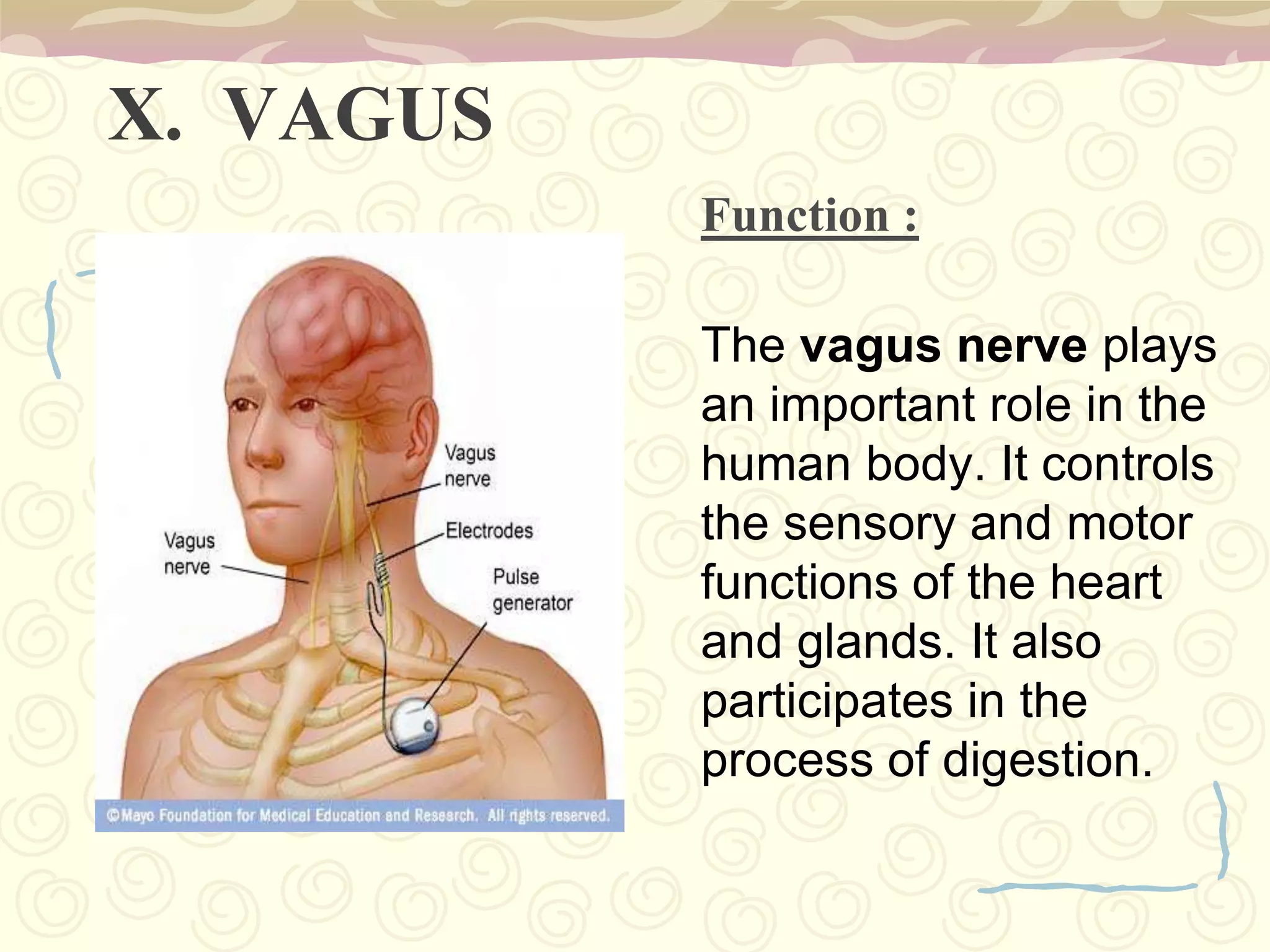
X.  VAGUSFunction :The vagus nerve plays an important role in the human body. It controls the sensory and motor functions of the heart and glands. It also participates in the process of digestion.
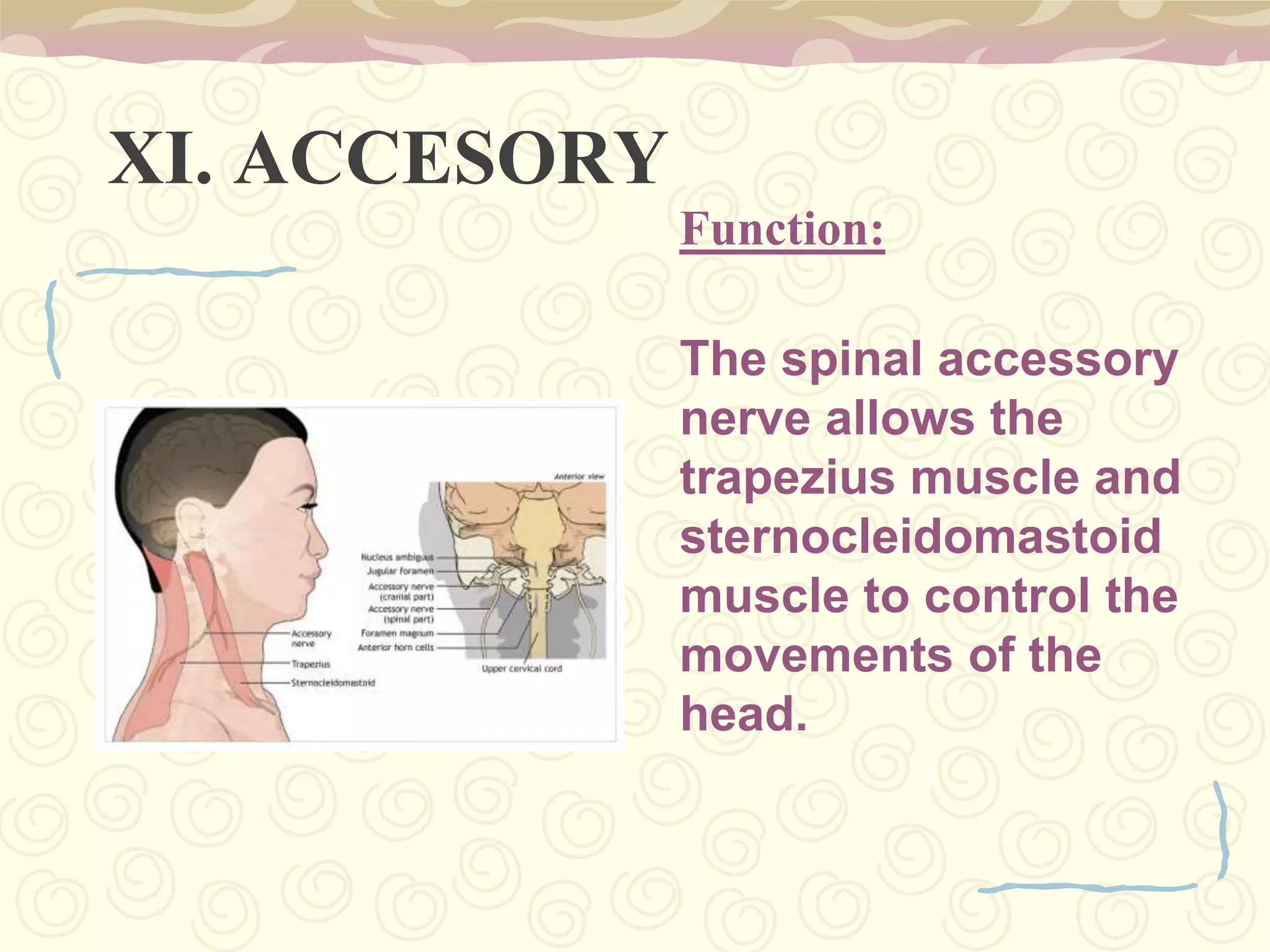
XI. ACCESORYFunction:The spinal accessory nerve allows the trapezius muscle and sternocleidomastoid muscle to control the movements of the head.
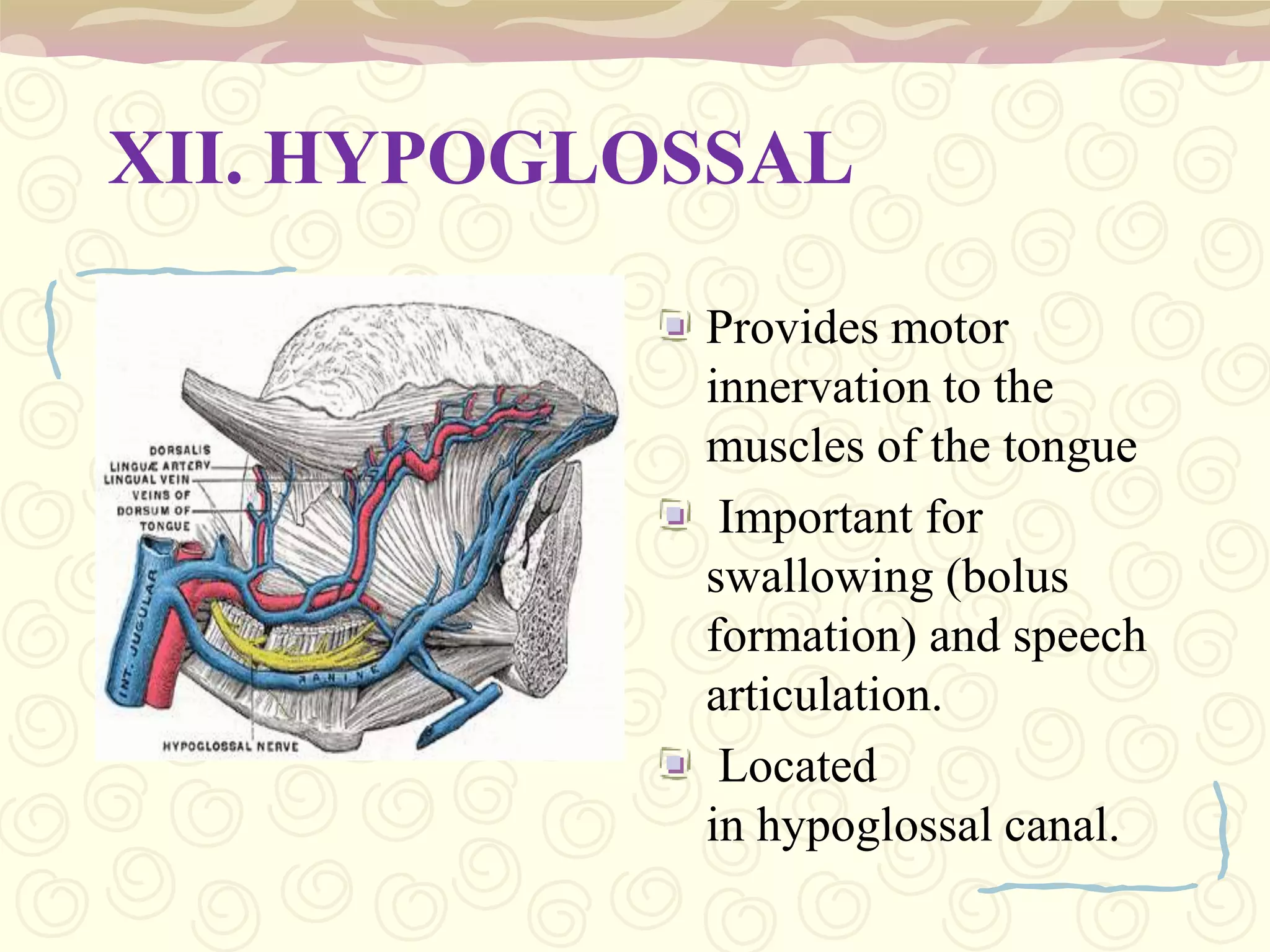
XII. HYPOGLOSSALProvides motor innervation to the muscles of the tongueImportant for swallowing (bolus formation) and speech articulation. Located in hypoglossal canal.
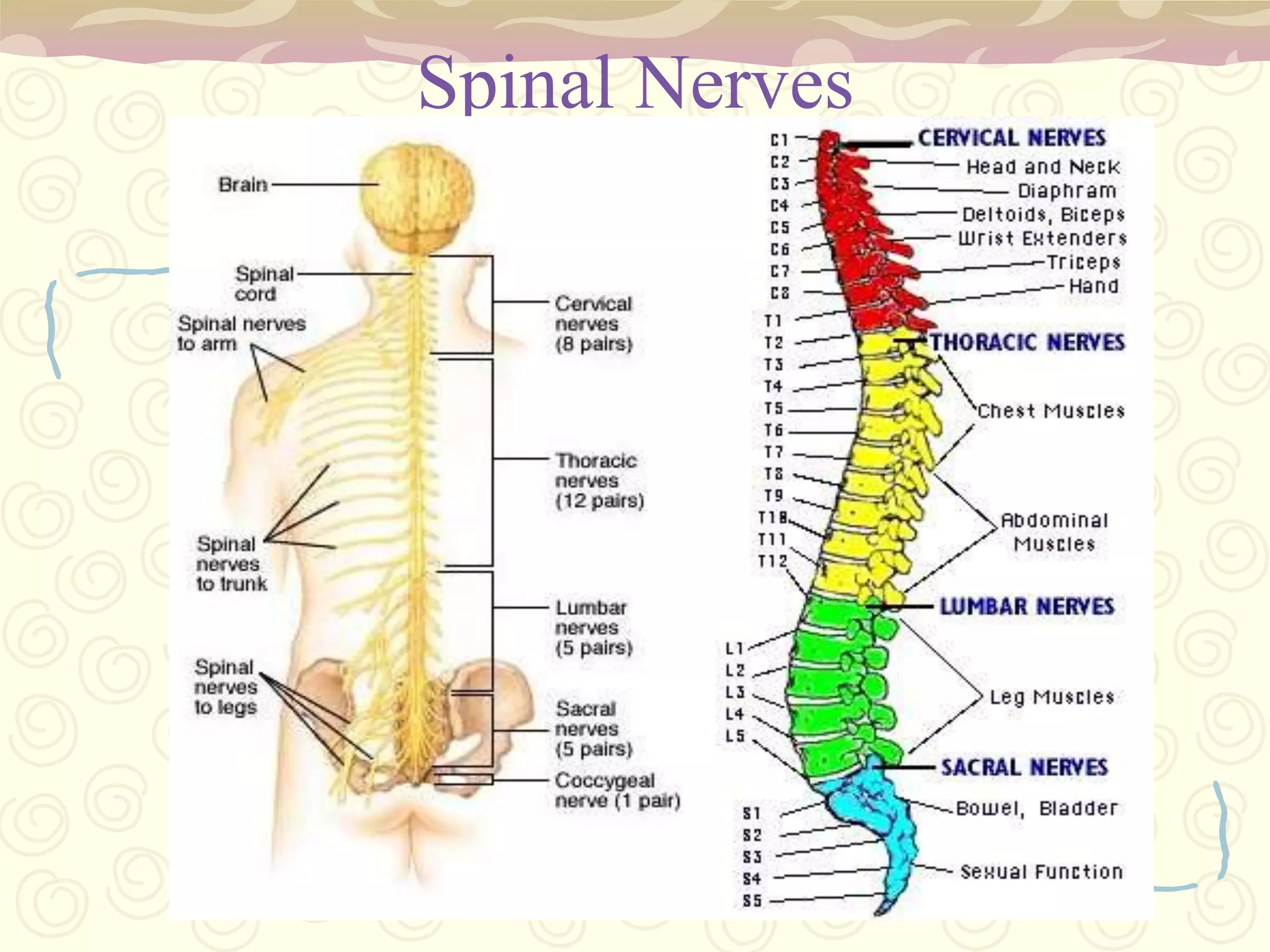
Spinal Nerves
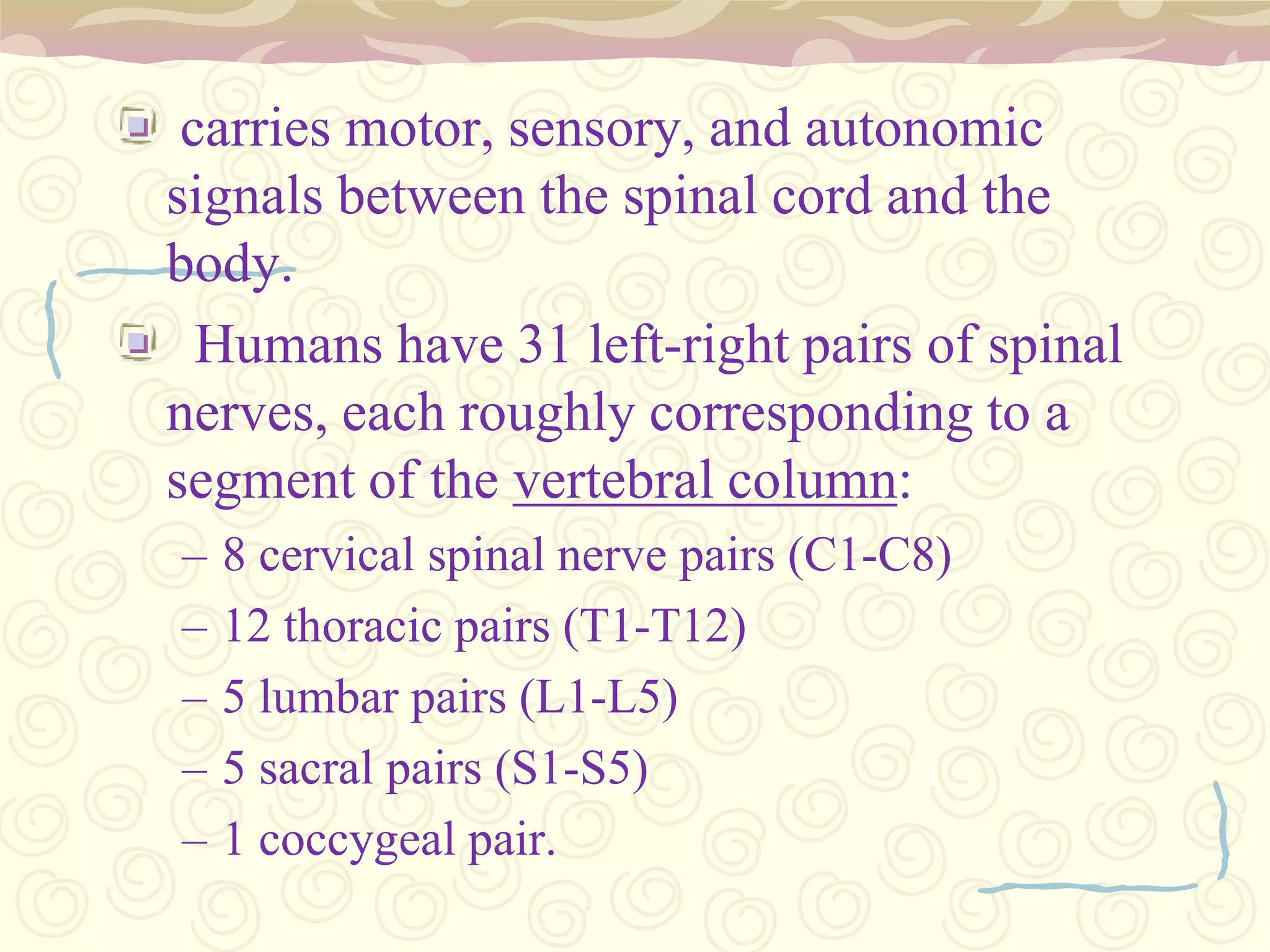
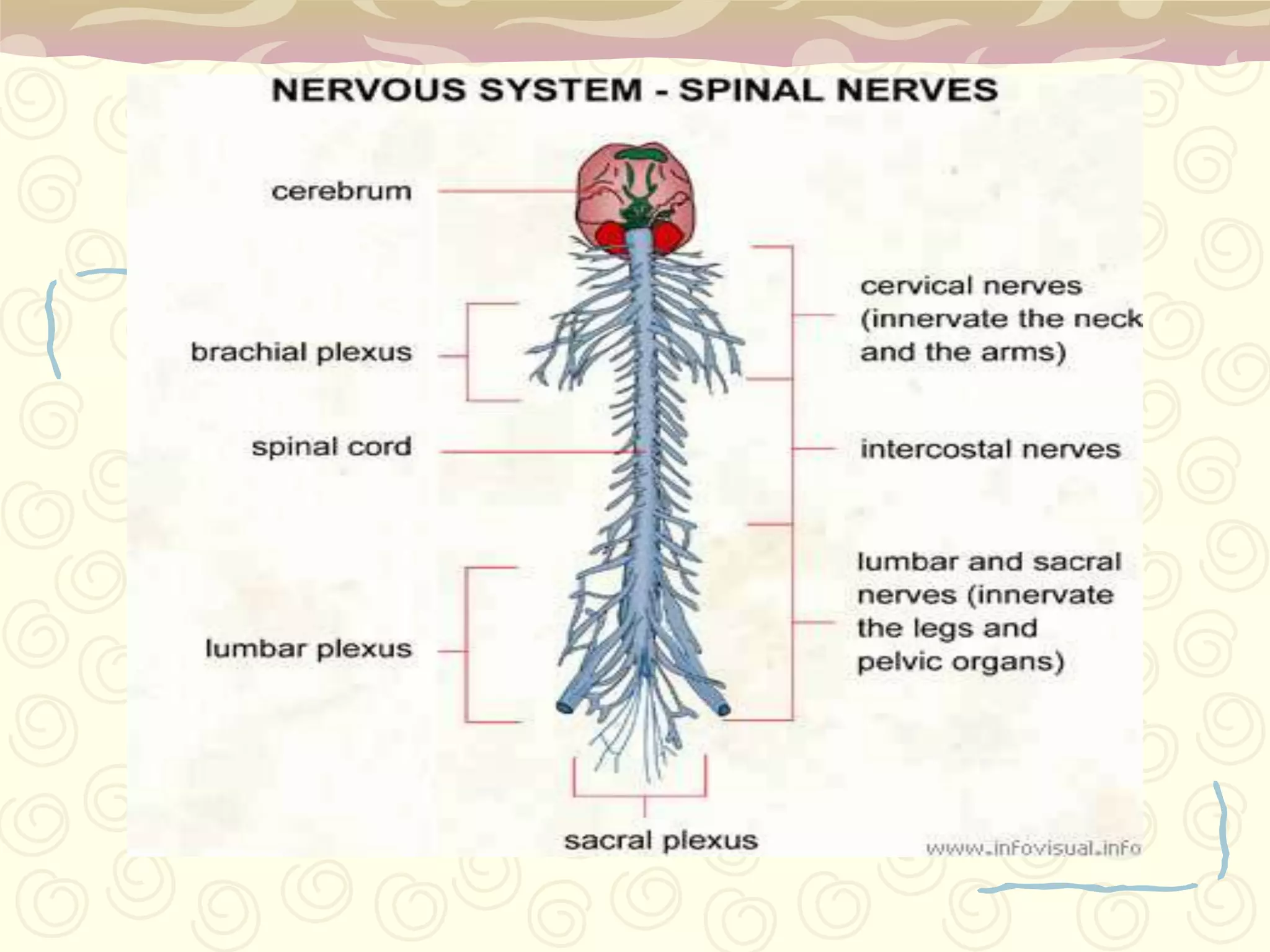
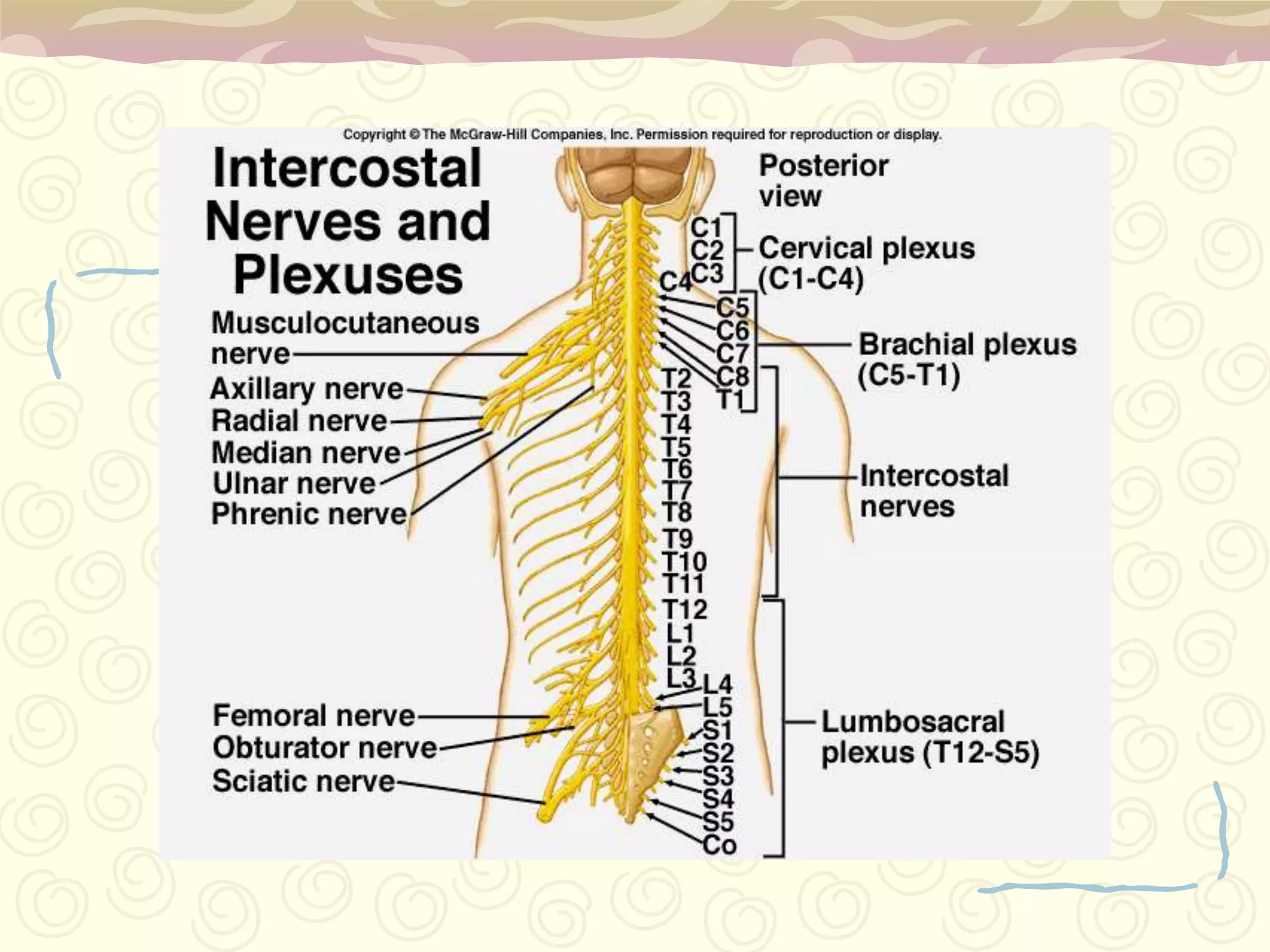
 carries motor, sensory, and autonomic signals between the spinal cord and the body.  Humans have 31 left-right pairs of spinal nerves, each roughly corresponding to a segment of the vertebral column: 8 cervical spinal nerve pairs (C1-C8)12 thoracic pairs (T1-T12)5 lumbar pairs (L1-L5)5 sacral pairs (S1-S5)1 coccygeal pair.
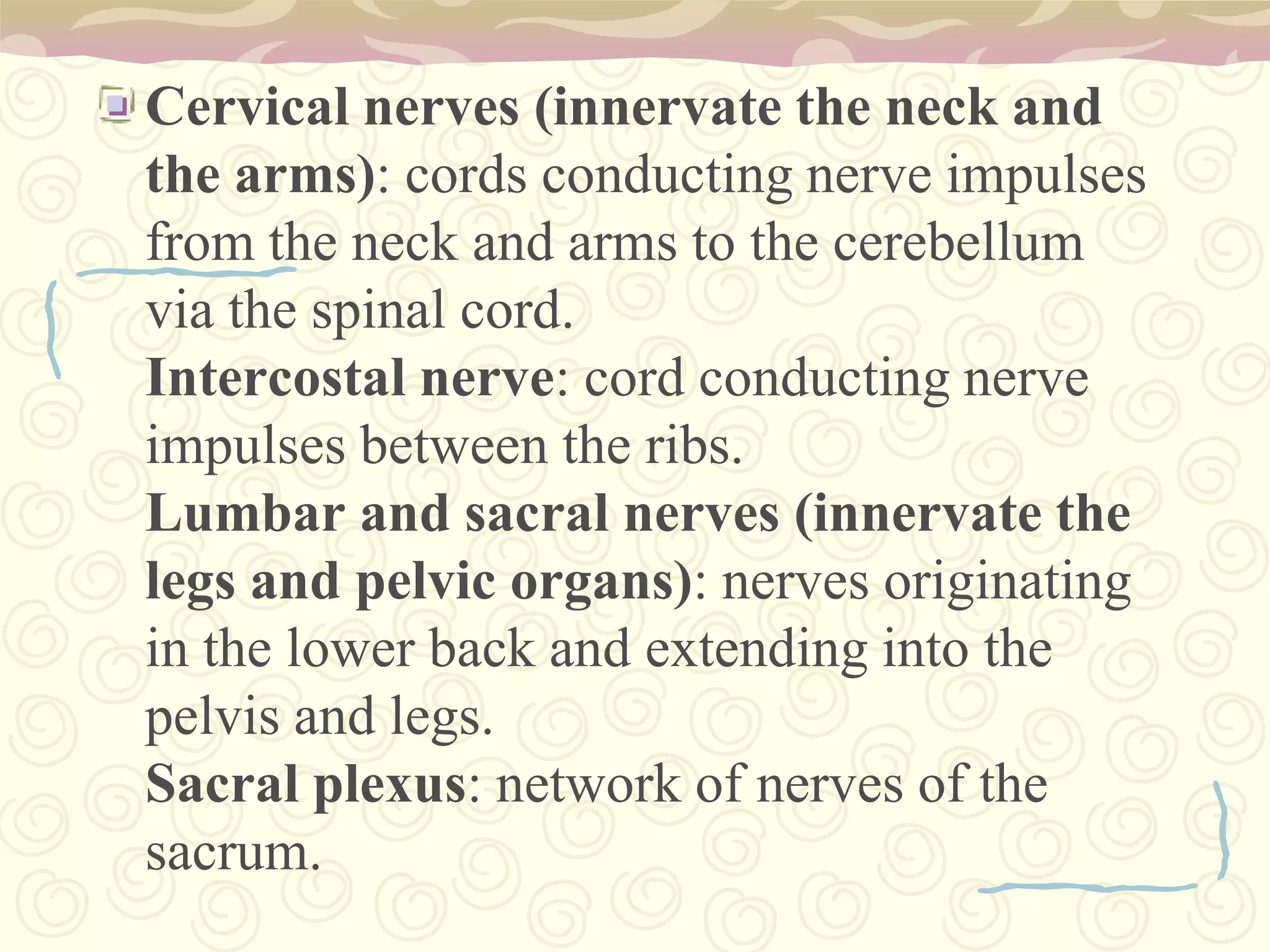
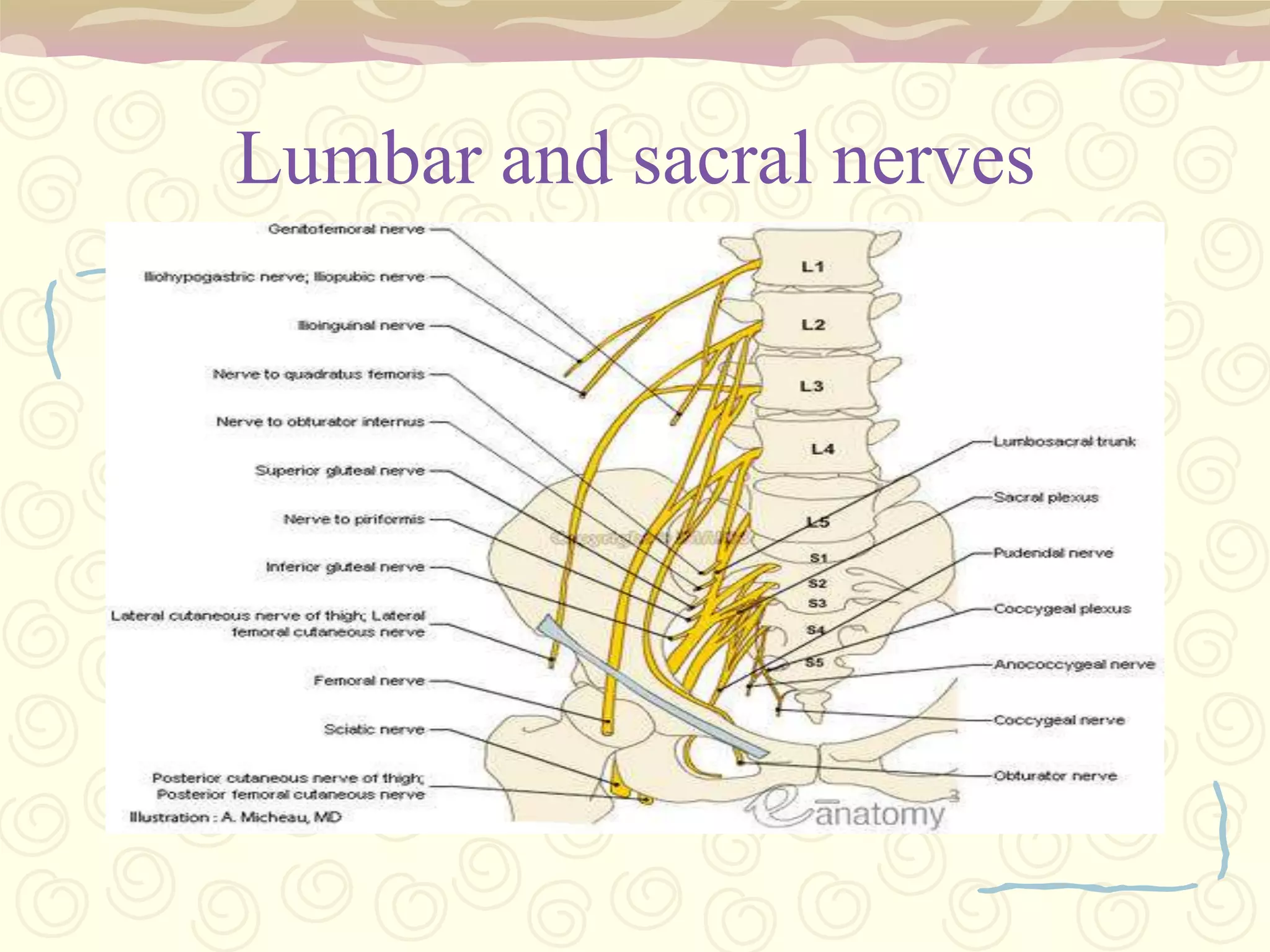
Cervical nerves (innervate the neck and the arms): cords conducting nerve impulses from the neck and arms to the cerebellum via the spinal cord.Intercostal nerve: cord conducting nerve impulses between the ribs.Lumbar and sacral nerves (innervate the legs and pelvic organs): nerves originating in the lower back and extending into the pelvis and legs.Sacral plexus: network of nerves of the sacrum.
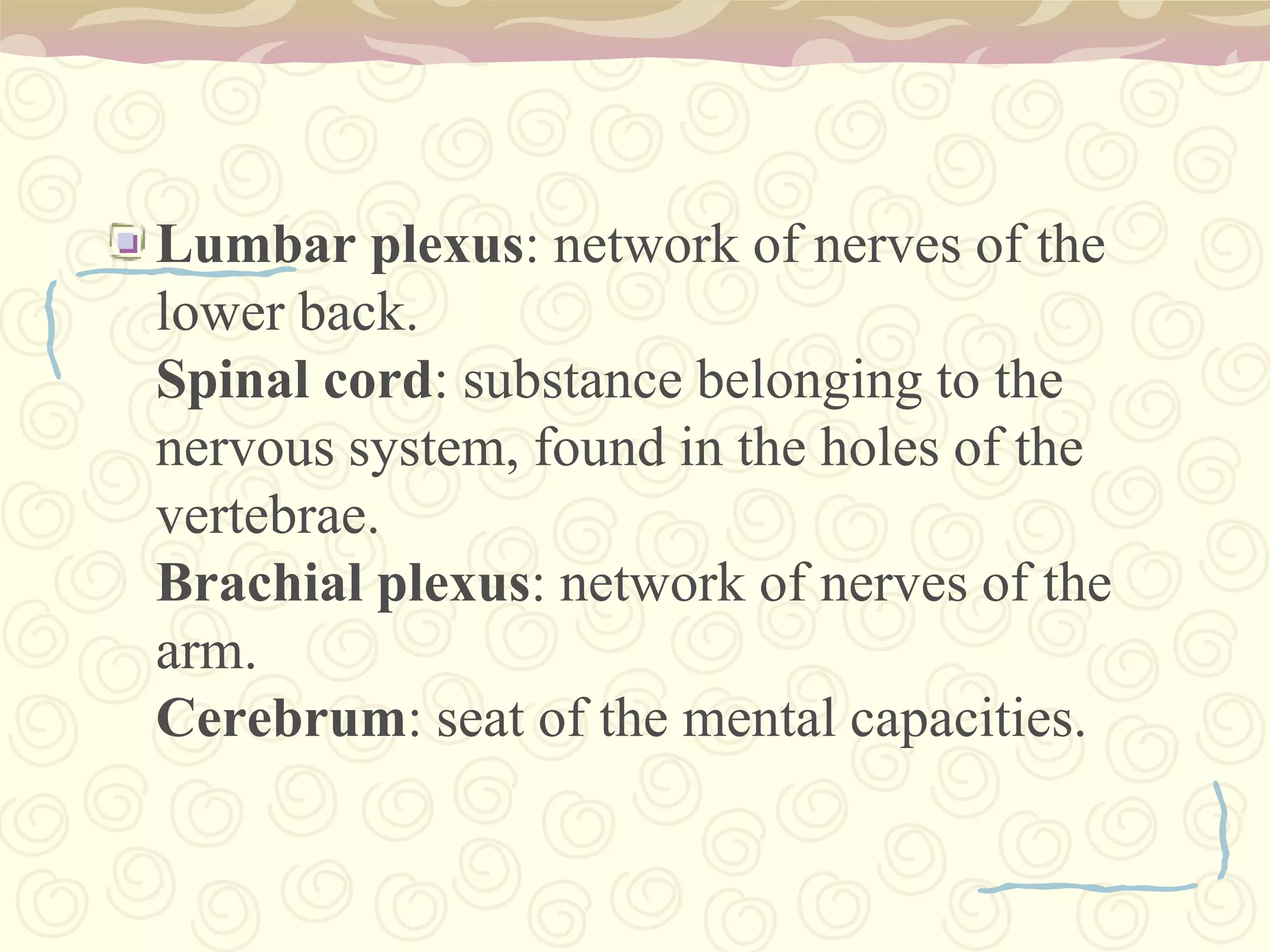
Lumbar plexus: network of nerves of the lower back.Spinal cord: substance belonging to the nervous system, found in the holes of the vertebrae.Brachial plexus: network of nerves of the arm.Cerebrum: seat of the mental capacities.
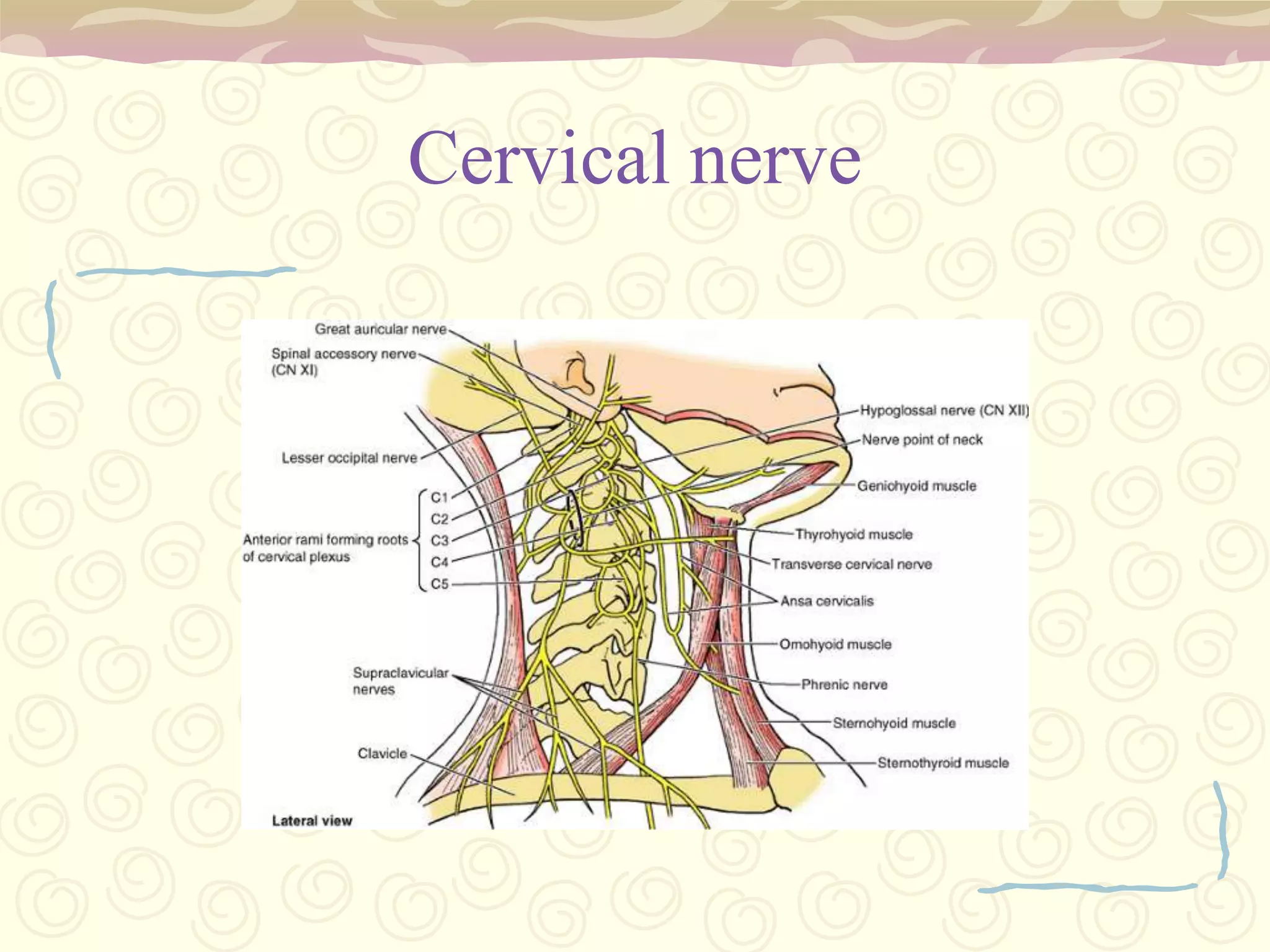
Cervical nerve
Lumbar and sacral nerves
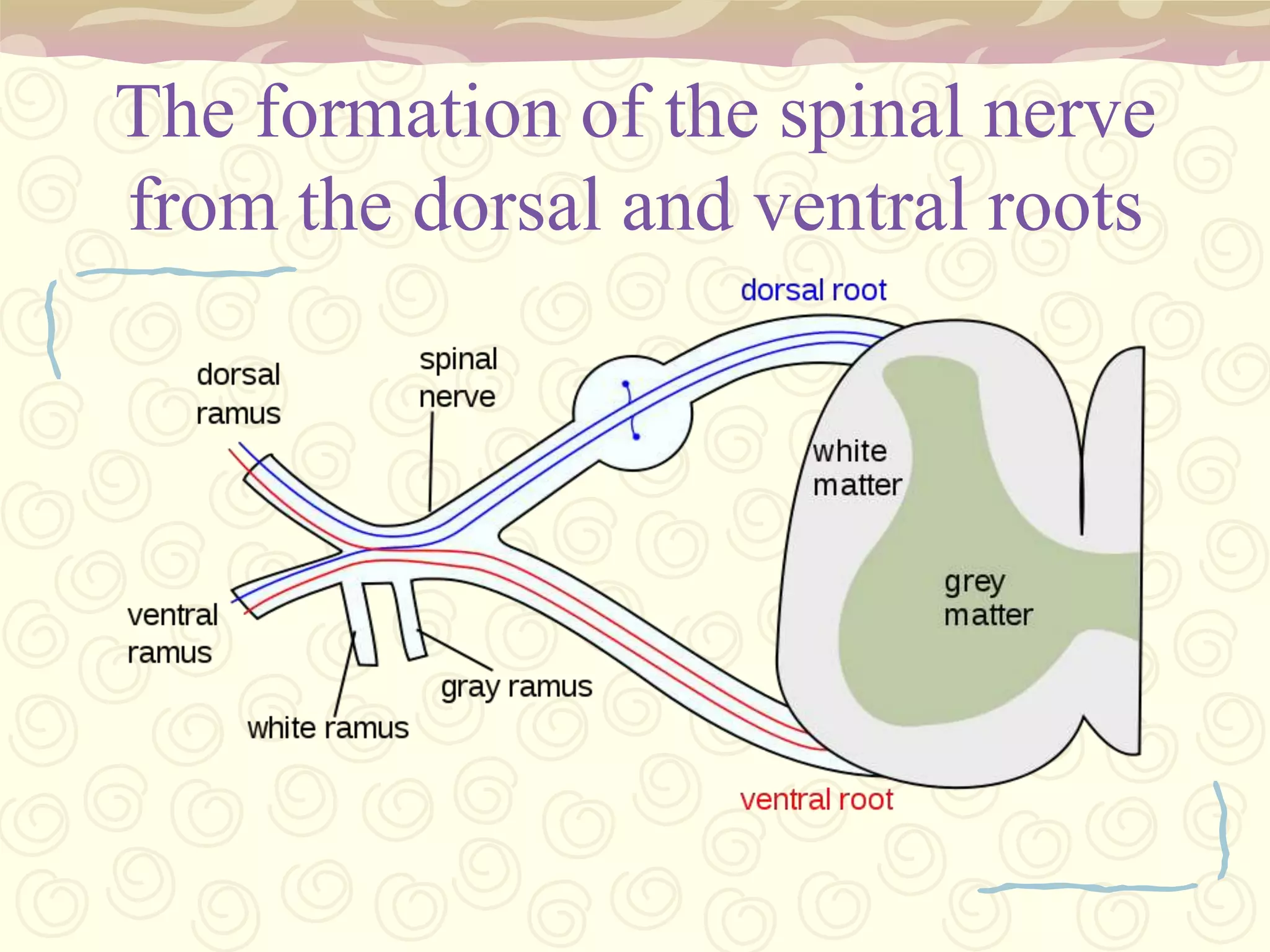
The formation of the spinal nerve from the dorsal and ventral roots
 dorsal roots carry afferent sensory axons, while the ventral roots carry efferent motor axons.
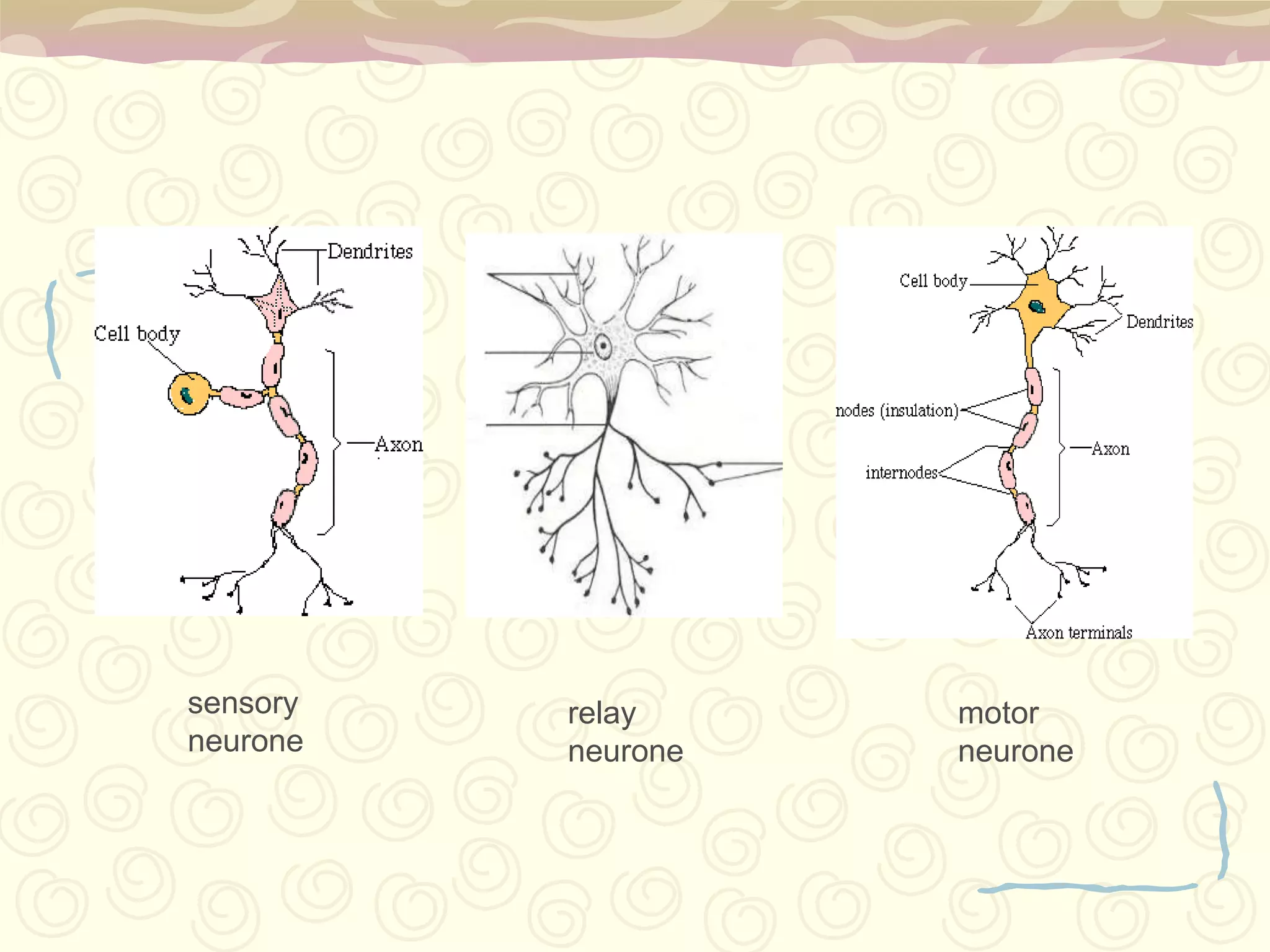
Neuronalso known as neurone or nerve cellbasic unit of nervous systemIs an electircally excitable cell that processes and transmits information by electrical and chemical signaling.there are billions neurons in the body. In fact, there are 12 - 14 billlions of neurons in one partof the brain alone. 
Basic nerve cell structure
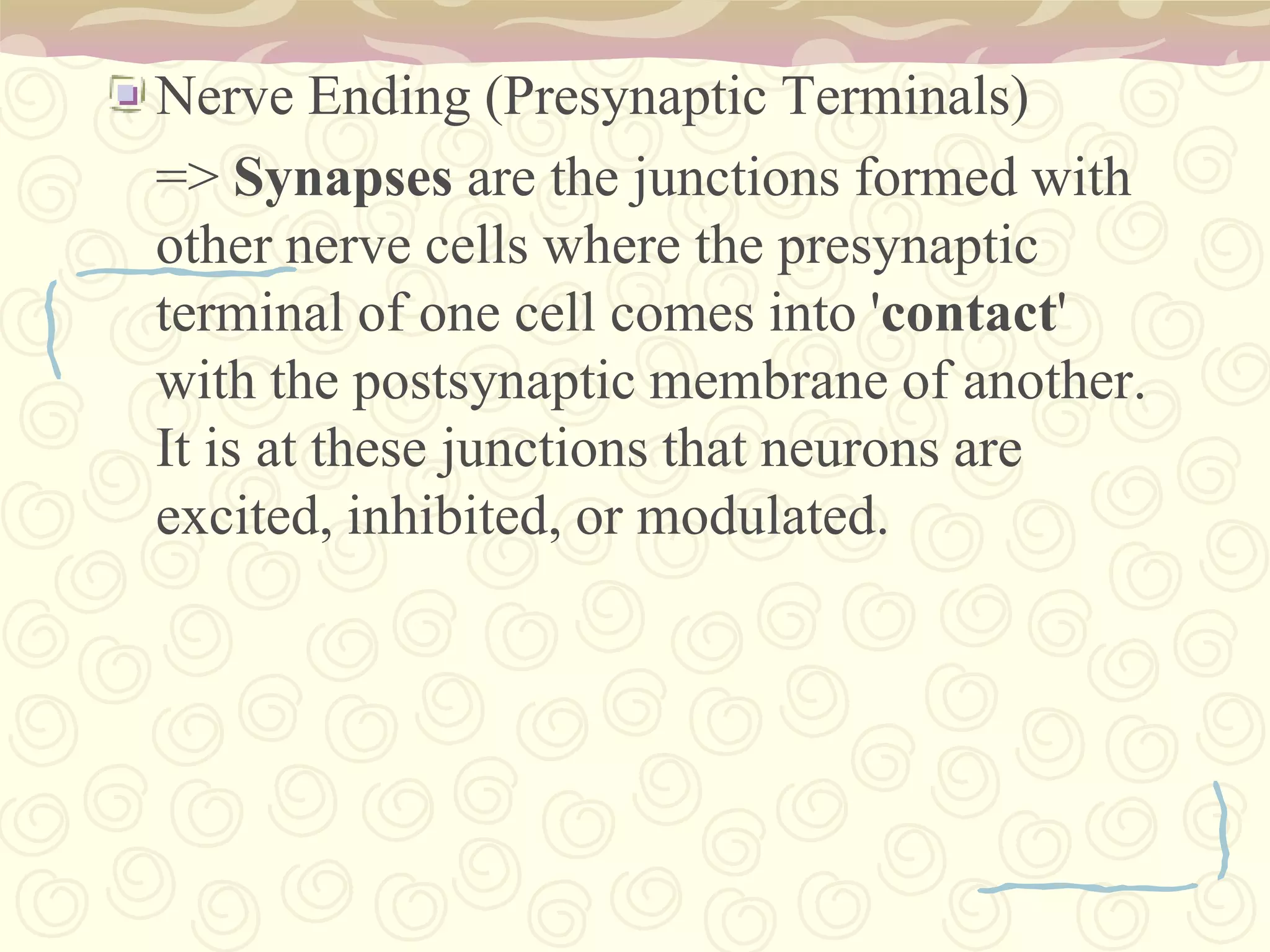
PARTS:Cell Body/ soma / perikaryon	=> the factory of the neuron. It produces all the proteins for the dendrites, axons and synaptic terminals.Neuronal membrane	=> serves as a barrier to enclose the cytoplasm inside the neuron, and to exclude certain substances that float in the fluid that bathes the neuron. Nodes of Ranvier	=>  gaps between myelinated segmentMyelin Sheath	=> protects the axon, and prevents interference between axons as they pass along in bundles, sometimes thousands at time. 
Axon=>  transmit impulses away from the cell body. 	=>The main conducting unit of the neuron. 	=>Conduct nerve impulses thru another cells. 	=>Capable of conveying electrical signals along distances that range from as short as 0.1 mm to as long as 2 m.
Dendritesthe main apparatus for receiving signals from other nerve cells.
The “ antennae” of the neuron.
They transmit impulses towards the cell body.
covered by thousands of synapses
200 000 axon terminals make contact with dendrites of Purkinje neurons in cerebellum.

NERVOUS SYSTEM

  • 1.
    NERVOUS SYSTEMAbalos, AilynJuatas,KennethLlorin, PatriciaMansibang, RaniaSunio, LeslieDMD 1-F
  • 2.
    Functions Of NervousSystemCommunication and coordination- Adapt and respond to changes from both inside and outside the bodysends messages to the rest of the bodycontrols all of the body functionsSite of reasoning
  • 3.
    The Organization ofNervous System
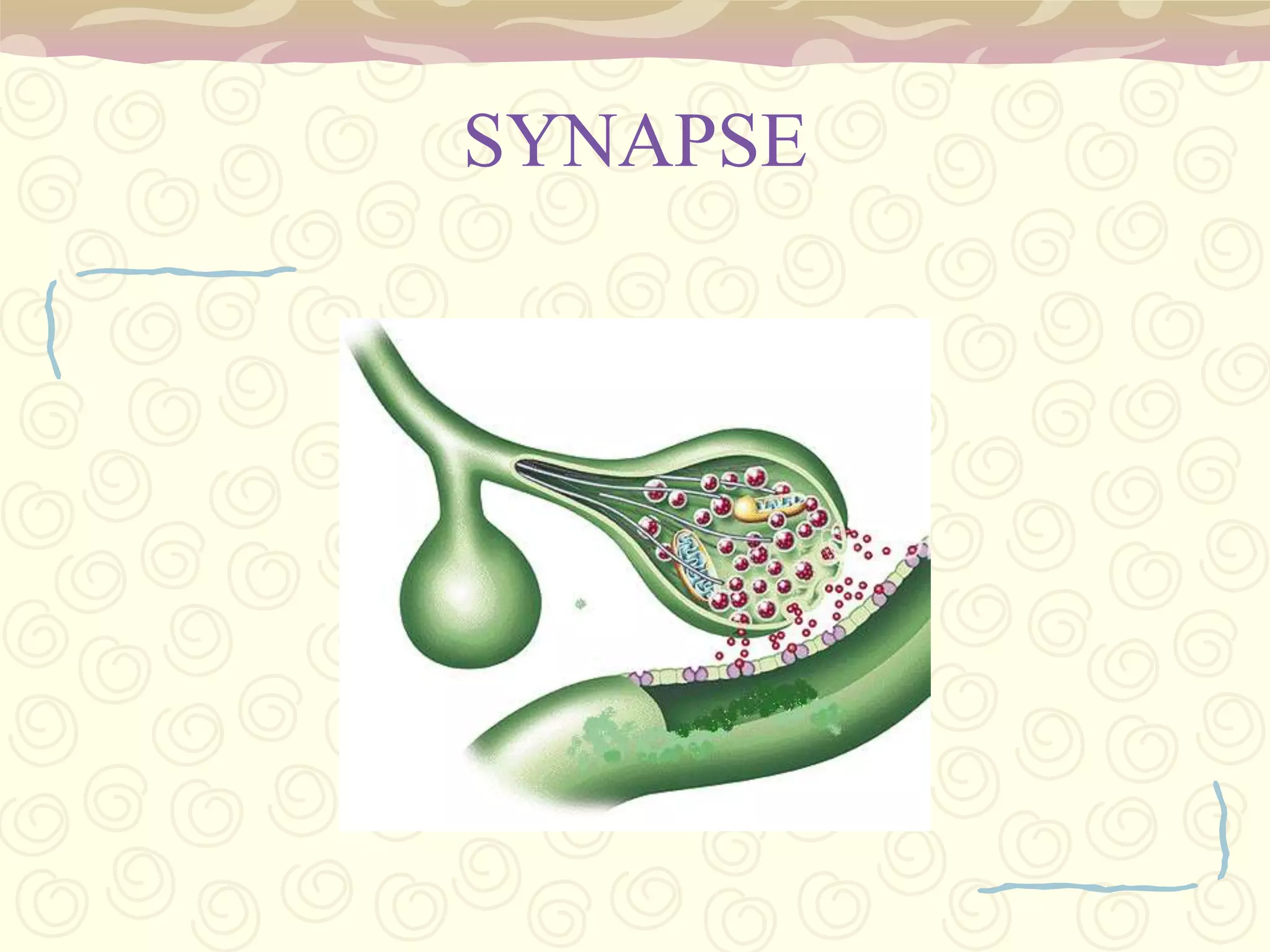
  • 4.
    Your nervous systemhas three components… Brain- control center Nerves-carry messages Spinal cord-a thick bundle of nerves
  • 5.
  • 6.
    Characteristics of theBrainWeight: 1.3-kg (3-lb) mass of pinkish-gray jellylike tissue Varies in gender: Male: 1380 grams Female: 1250 gramsWith 100 billion nerve cell: NeuronsNeuroglia (supporting-tissue) cells
  • 7.
    4 types ofMemory:Short-term memory – when we say things over and over again so you remember them.Long term memory – we remember important events or things that we do over and over again.Ancestral Memory – We remember things right when we were born. Example is when humans remember how to get milk from their mom or feeding bottles.Eidetic Memory – a.k.a photographic memory
  • 8.
  • 9.
    1. MeningesDura Mater- outermost membrane. The toughest and thickest.Arachnoid Layer - middle membrane.Pia Mater - innermost membrane. Consists of small blood vessels.
  • 10.
    Cerebrospinal Fluid –A clear liquid that bathes the entire brain and fills a series of four cavities called ventricles Gray Matter – Composed of Nerve cell bodiesWhite Matter – Composed of myelinated nerve fibersNucleus – Mass of nerve cells in any part of the brain and spinal cord.Ganglion – Mass of nerve cell outside of the brain and spinal cord.Commisure – Band of fibers joining corresponding opposite parts of the brain and spinal cord.
  • 11.
  • 12.
    Left and RightBrain Functions The right brain is associated with artistic ability like singing, painting, writing poetry, etc. Left-brain dominated people may find their thought processes vague and difficult to follow, for they are quite opposite in the way they think. Left-brain dominated people tend to be more logical and analytical in their thinking and usually excel at mathematics and word skills.
  • 13.
    A. Embryological developmentalof the Brain:Forebrain - ProsencephalonTelencephalon (Cerebrum)Diencephalon (Thalamus and Hypothalamus) 2. Midbrain – MesencephalonCorpora QuadrigeminaCerebral PedunclesIter (Cerebral aqueduct or aqueduct of Sylvius)3. Hindbrain – RhombencephalonMetencephalon (cerebellum, ponsvarolii)Myelencephalon (medulla oblongata)
  • 14.
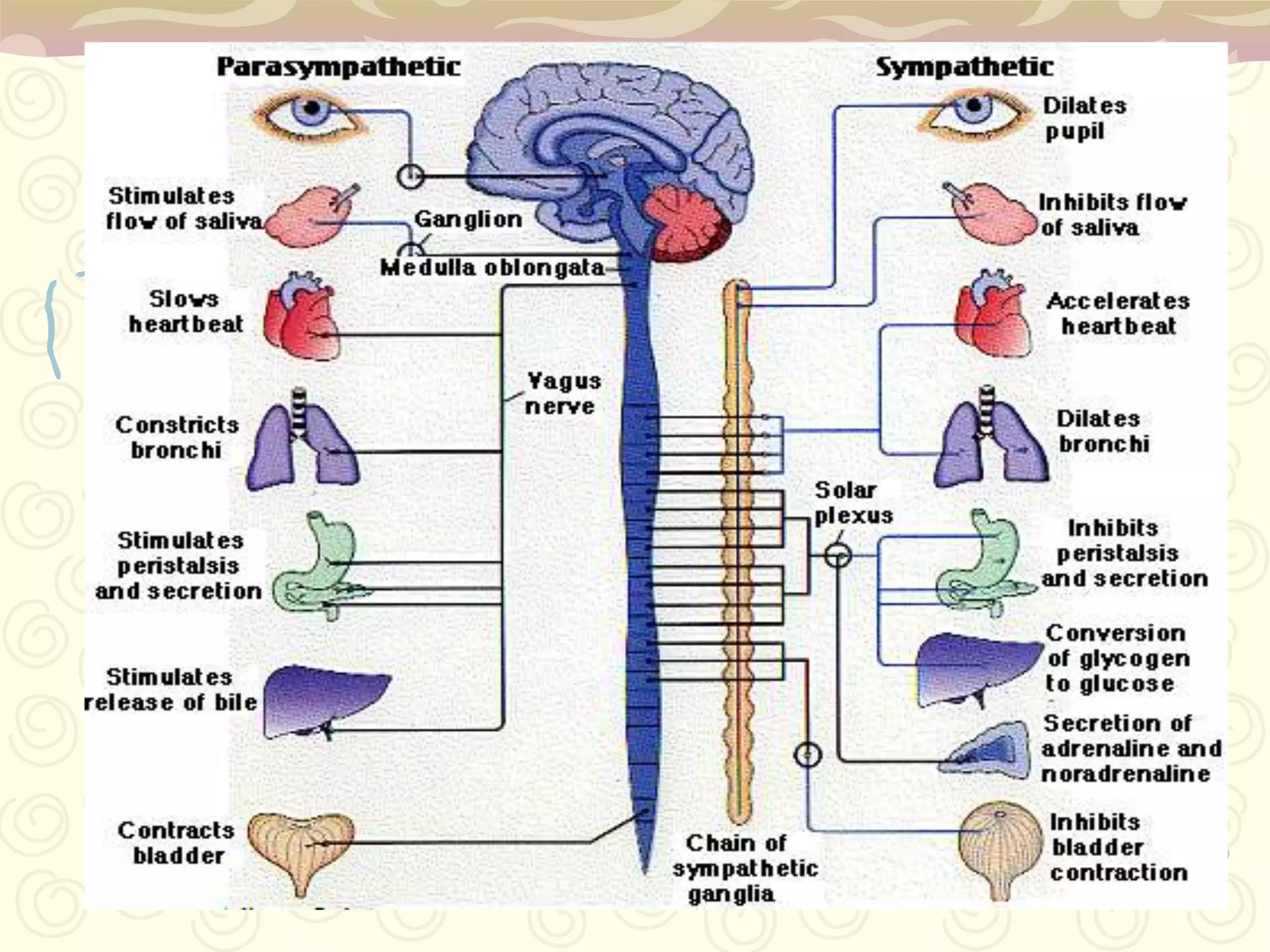
    5 Main Partsof the BrainCerebrum (Telencephalon)Pons and Cerebellum (Metencephalon) Midbrain (Mesencephalon) Thalamus and Hypothalamus (Diencephalon) Medulla Oblongata (Myelencephalon) 
  • 16.
  • 17.
    Cerebrum(the Latin wordfor brain)a.k.a “cerebral cortex” two large dome-shaped, almost symmetrical hemispheresintelligence, memory and reasonComposed of gray matter thrown into infoldings: shallow; gyrus or gyri, deep; fissuresInnermost part is made of white matterGreat longitudinal fissure (or longitudinal cerebral fissure, or longitudinal fissure, or interhemispheric fissure) is the deep groove which separates the two hemispheres of the vertebrate brain.
  • 18.
    The cerebral cortex is made ofgrey matter, and covers the cerebrum and cerebellum.
  • 19.
    The different lobesof the cerebral cortex subdivide processing responsibilities based on sensory input or motor function.Fissures the Cerebrum:Longitudinal Fissure – They are mirror twins for motor and sensory activities of the body. *Connected in the midline by corpus callosum – allows the two cerebral hemispheres to share learning and memory. Lateral Fissure (Sylvian Fissure) – located between frontal and parietal lobes. For speech and hearing.
  • 20.
    Corpus Callosumis athick band of nerve fibers that divides the cerebrum into left and right hemispheres.
  • 21.
    It connects theleft and right sides of the brain allowing for communication between both hemispheres.
  • 22.
    transfers motor, sensory,and cognitive information between the brain hemispheres.Central Fissure (Rolandic Fissure) – Between the frontal and parietal lobes; for both motor and sensory functions. 4. Transverse Fissure – found between the cerebrum and cerebellum.5. Palate Occipital Fissure – between occipital and parietal lobes.
  • 23.
    Lobes of theCerebrum
  • 24.
    FRONTAL LOBE -involved with decision-making, problem solving, and planning Lobes of the Cerebrum
  • 25.
    PARIETAL LOBE - receives and processes sensory information.TEMPORAL LOBE (LEFT & RIGHT HEMISPHERE) - involved with emotional responses, memory, and speech.
  • 26.
    OCCIPITAL LOBE involvedwith vision and color recognition.
  • 27.
    Functions of theCerebral Cortex Determining IntelligenceDetermining PersonalityThinkingPerceivingProducing and Understanding LanguageInterpretation of Sensory ImpulsesMotor FunctionPlanning and OrganizationTouch Sensation 
  • 28.
    Motor cortex - movements andcoordination. Somatosensory cortex processes input from the various systems in the body which are sensitive to touch. (Sensations)Broca's area - speech production, language processing, controls facial neuronsPrimary auditory cortexauditory (sound) pitch and volume. Wernicke’s - language comprehension
  • 29.
    The cerebral cortex is made ofgrey matter, and covers the cerebrum and cerebellum.
  • 30.
    The different lobesof the cerebral cortex subdivide processing responsibilities based on sensory input or motor function.Visual
  • 31.
    Amygdala It isa limbic system: Emotions
  • 32.
  • 33.
  • 34.
  • 35.
  • 36.
  • 37.
  • 38.
  • 39.
    Connecting emotions andsenses, such as smell and sound, to memories.2. HindbrainMetencephalon: A. CerebellumB. Pons Varolli
  • 40.
    2. A Cerebellum“littlebrain”two smaller hemispheres located at the back of the cerebrumOval in shapeOccupies the posterior cranial fossaSeperated from the cerebrum by the tentoriumcerbelliThe outer layer of the cerebellum consists of fine folds called folia. the outer layer of cortical gray matter surrounds a deeper layer of white matter and nuclei (groups of nerve cells). Three fiber bundles called cerebellar peduncles connect the cerebellum to the three parts of the brain stem.
  • 41.
    Anterior Lobe –posturePosterior Lobe – coordination of movementFlocculonodular Lobe – equilibrium
  • 42.
    CerebellumThe area ofthe hindbrain that controls motor movement coordination, balance, equilibrium and muscle tone.The Brainstem
  • 44.
    3 parts: midbrain,pons, and medulla oblongataThe brain stem is evolutionarily the most primitive part of the brain and is responsible for sustaining the basic functions of life, such as breathing and blood pressure.  A canal runs longitudinally through these structures carrying cerebrospinal fluid. Distributed along its length is a network of cells, referred to as the reticular formation that governs the state of alertness.
  • 45.
  • 46.
  • 47.
    Functions:path for messagestraveling between the upper brain and spinal cord
  • 48.
    the seat ofbasic and vital functions such as breathing, blood pressure, and heart rate, as well as reflexes like eye movement and vomiting. Reticular Formationis a netlike formation of nuclei known as the reticular formation. The reticular formation controls respiration, cardiovascular function, digestion, levels of alertness, and patterns of sleep. It also determines which parts of the constant flow of sensory information into the body are received by the cerebrum.
  • 49.
  • 50.
  • 51.
    2.B Pons Varollislunted in front of the cerebellum between the midbrain and the medulla oblongata. A bridge-like structure composed entirely of white matterIt joins the two haves of the cerebellumTrigeminal Nerve (Cranial Nerve 5) emerges from pons
  • 52.
    FUNCTION: The ponsserves mainly as a relay station linking the cerebral cortex and the medulla oblongata.
  • 53.
    Ponsconnects the cerebral cortexwith the medulla oblongata
  • 54.
    serves as acommunications and coordination center between the two hemispheres of the brain
  • 55.
    As a partof the brainstem, it helps in the transferring of messages between various parts of the brain and the spinal cord.3. MidbrainMesencephalon
  • 56.
    also called mesencephalon,  region ofthe developing vertebrate brain containing cranial nerves that stimulate the muscles controlling eye movement, between the forebrain and hindbrainConcerned with motor coordinationConnects the cerebellum with the cerebrum
  • 57.
    Functions:At the bottomof the midbrain are reflex and relay centers relating to pain, temperature, and touch, as well as several regions associated with the, such as the red nucleus and thesubstantia nigra - for reward, addiction, and movement
  • 58.
    A pair ofnuclei called the superior colliculusControls reflex actions of the eye, such as blinking, opening and closing the pupil, and focusing the lens.
  • 59.
    A second pairof nuclei, called the inferior colliculus, controls auditory reflexes, such as adjusting the ear to the volume of sound.
  • 60.
    Sylvian/Cerebral aqueduct/Iter –canal that connects the 3rd and 4th ventricles of the brain.
  • 61.
    Cerebral Peduncles –pair of cylindrical bodies made up of nerve fibers tracts which connect the forebrain with the hindbrain - Bundle of Axons
  • 62.
    Corpora Quadrigemina –4 rounded nuclear masses
  • 63.
    Corpora quadrigeminaCerebral aqueductCentralgray stratumRed nucleus of tegmentumSubstantia nigraInterpeduncular space
  • 64.
  • 65.
    lowest portion ofthe brainstemAt the top, it is continuous with the pons and the midbrain;at the bottom, it makes a gradual transition into the spinal cord at the foramen magnum. extends from the pons above and is continuous with the spinal cord below. Pyramidal in shape (broad above and narrow below)The nerve cells of the medulla are grouped to form “nuclei” out of which emerge cranial nerves 6-12.
  • 66.
    Medulla oblongatais aportion of the hindbrain that controls autonomic functions: breathing,
  • 67.
  • 68.
  • 69.
  • 70.
    sneezingFunctions: Organ ofconduction for the passage of impulses between brain and spinal cordContains center for control of bodily functions:Cardiac Inhibitory Center – holds heart rate to slower rate through cranial nerve 10 or Vagus Nerve.
  • 71.
    Vasoconstrictor Center –narrowing of lumen of the arteries
  • 72.
    Respiratory Center –controls rate and depth of respiration
  • 73.
    Reflex Center –sneezing, coughing, vomiting, winking and the movements and secretions of the alimentary canal.5. Diencephalon Thalamus and Hypothalamus
  • 74.
    Diencephalon A. Thalamuslarge mass of gray matter located in the cerebral hemisphere.acts as a relay station between the cerebrum and the rest of the brain and spinal cord. B. Hypothalamus lies below the thalamuscontains temperature-regulating mechanisms and relations with the pituitary gland. hunger, thirst, defense reactions; fear, rage and satiety.
  • 75.
    ThalamusIt is involvedin sensory perception and regulation of motor functions.
  • 76.
  • 77.
    it connects areasof the cerebral cortex that are involved in sensory perception and movement
  • 78.
    controls sleepand awake states of consciousness.Limbic SystemThe limbic system is a group of brain structures that plays a role in emotion,memory, and motivation.
  • 79.
    Hypothalamusplays a centralrole in controlling our autonomous nervous system (ANS),
  • 80.
    responsible for regulatinghomeostatic metabolic processes in the body.
  • 81.
    Examples of homeostaticprocesses include sleeping, eating, thirst, blood pressure, body temperature, and electrolyte balance.Hypothalamus -regulates hunger, thirst, sleep, body temperature, sexual drive, and other functions.
  • 82.
  • 83.
    Spinal Corda long,thin, tubular bundle of nervous tissue and support cells that extends from the brain.The spinal cord begins at the Occipital bone and extends down to the space between the first and second lumbar vertebrae.It is around 45 cm (18 in) in men and around 43 cm (17 in) long in women.
  • 84.
    Functions of SpinalCord Serve as a conduit for motor information, which travels down the spinal cord Serve as a conduit for sensory information, which travels up the spinal cord. Serve as a center for coordinating certain reflexes.
  • 86.
    Cervical Spinal CordDividedinto eight levels. Each level contributes into different functions in the neck and arms.Sensations from the body are similarly transported from the skin and other areas of the body from the neck, shoulders, and arms up to the brain.
  • 87.
    Thoracic Spinal cordThenerves of the spinal cord supply muscles of the chest that help in breathing and coughing.This region also contains nerves in the sympathetic nervous system.
  • 88.
    Lumbosacral Spinal CordThelumbosacral spinal cord and nerve supply legs, pelvis, and bowel and bladder. Sensations from the feet, legs, pelvis, and lower abdomen are transmitted through the lumbosacral nerves and spinal cord to higher segments and eventually the brain
  • 89.
    Peripheral Nervous Systemmainfunction of the PNS is to connect the central nervous system (CNS) to the limbs and organs.
  • 90.
    peripheral nervous systemof humans has thirty-one pairs of spinal nerves, CRANIAL NERVES
  • 91.
  • 92.
    Function:Transmits visual informationto the brain; Located in Optic canal.Sense of sightII. optic
  • 93.
    III. OCCUMOTOR NERVEFunction: The oculomotornerve is the third of twelve paired cranial nerves. It controls most of the eye's movement and constriction of the pupil, and maintains an open eyelid
  • 94.
    IV. TROCHLEAR NERVEFunction: Itis a motor nerve which stimulates and supplies the superior oblique muscle of the eye. The trochlear nerve is also a part of the cranial nerves which stems from the brain and connects to the eyes. Trochlear nerve function is interconnected to the superior oblique muscle. Which is also responsible for the movement of the eyes as it is one of the six extra ocular muscles that together help in the movement and alignment of the eyes. It acts as a pulley to move the eyes down—toward the tip of the nose
  • 95.
    Receives sensation fromthe face and innervates the muscles of mastication. Sensory and MotorV. TRIGEMINAL
  • 96.
    VI. ABDUCENS Innervatesthe lateral rectus, which abducts the eye. Motor
  • 97.
    VII. FACIALProvides motorinnervation to the muscles of facial expression, posterior belly of the digastric muscle, and stapedius muscle, receives the special sense of taste from the anterior 2/3 of the tongue, and provides secretomotor innervation to the salivary glands (except parotid) and the lacrimal gland; Located and runs through internal acoustic canal to facial canal and exits at stylomastoid foramen
  • 98.
    VIII. VESTIBULOCOCHLEARFunction :The vestibulocochlearnerve has separate acoustic and vestibular divisions. The acoustic portion of the nerve allows for proper hearing. The vestibular division is essential for normal balance.
  • 99.
    IX. GLOSSOPHARYNGEALThe glossopharyngeal nerve allowsfor taste on the back portion of the tongue, provides the sensations of pain and touch from the tongue and tonsils, and participates in the control of muscles used during swallowing
  • 100.
    X. VAGUSFunction:The vagus nerve plays an important role in the human body. It controls the sensory and motor functions of the heart and glands. It also participates in the process of digestion.
  • 101.
    XI. ACCESORYFunction:The spinal accessorynerve allows the trapezius muscle and sternocleidomastoid muscle to control the movements of the head.
  • 102.
    XII. HYPOGLOSSALProvides motorinnervation to the muscles of the tongueImportant for swallowing (bolus formation) and speech articulation. Located in hypoglossal canal.
  • 103.
  • 104.
     carries motor, sensory,and autonomic signals between the spinal cord and the body.  Humans have 31 left-right pairs of spinal nerves, each roughly corresponding to a segment of the vertebral column: 8 cervical spinal nerve pairs (C1-C8)12 thoracic pairs (T1-T12)5 lumbar pairs (L1-L5)5 sacral pairs (S1-S5)1 coccygeal pair.
  • 106.
    Cervical nerves (innervatethe neck and the arms): cords conducting nerve impulses from the neck and arms to the cerebellum via the spinal cord.Intercostal nerve: cord conducting nerve impulses between the ribs.Lumbar and sacral nerves (innervate the legs and pelvic organs): nerves originating in the lower back and extending into the pelvis and legs.Sacral plexus: network of nerves of the sacrum.
  • 107.
    Lumbar plexus: networkof nerves of the lower back.Spinal cord: substance belonging to the nervous system, found in the holes of the vertebrae.Brachial plexus: network of nerves of the arm.Cerebrum: seat of the mental capacities.
  • 108.
  • 110.
  • 111.
    The formation ofthe spinal nerve from the dorsal and ventral roots
  • 112.
     dorsal roots carry afferent sensory axons,while the ventral roots carry efferent motor axons.
  • 113.
    Neuronalso known asneurone or nerve cellbasic unit of nervous systemIs an electircally excitable cell that processes and transmits information by electrical and chemical signaling.there are billions neurons in the body. In fact, there are 12 - 14 billlions of neurons in one partof the brain alone. 
  • 114.
  • 115.
    PARTS:Cell Body/ soma/ perikaryon => the factory of the neuron. It produces all the proteins for the dendrites, axons and synaptic terminals.Neuronal membrane => serves as a barrier to enclose the cytoplasm inside the neuron, and to exclude certain substances that float in the fluid that bathes the neuron. Nodes of Ranvier => gaps between myelinated segmentMyelin Sheath => protects the axon, and prevents interference between axons as they pass along in bundles, sometimes thousands at time. 
  • 116.
    Axon=> transmitimpulses away from the cell body. =>The main conducting unit of the neuron. =>Conduct nerve impulses thru another cells. =>Capable of conveying electrical signals along distances that range from as short as 0.1 mm to as long as 2 m.
  • 117.
    Dendritesthe main apparatusfor receiving signals from other nerve cells.
  • 118.
    The “ antennae”of the neuron.
  • 119.
    They transmit impulsestowards the cell body.
  • 120.
  • 121.
    200 000 axonterminals make contact with dendrites of Purkinje neurons in cerebellum.
  • 122.
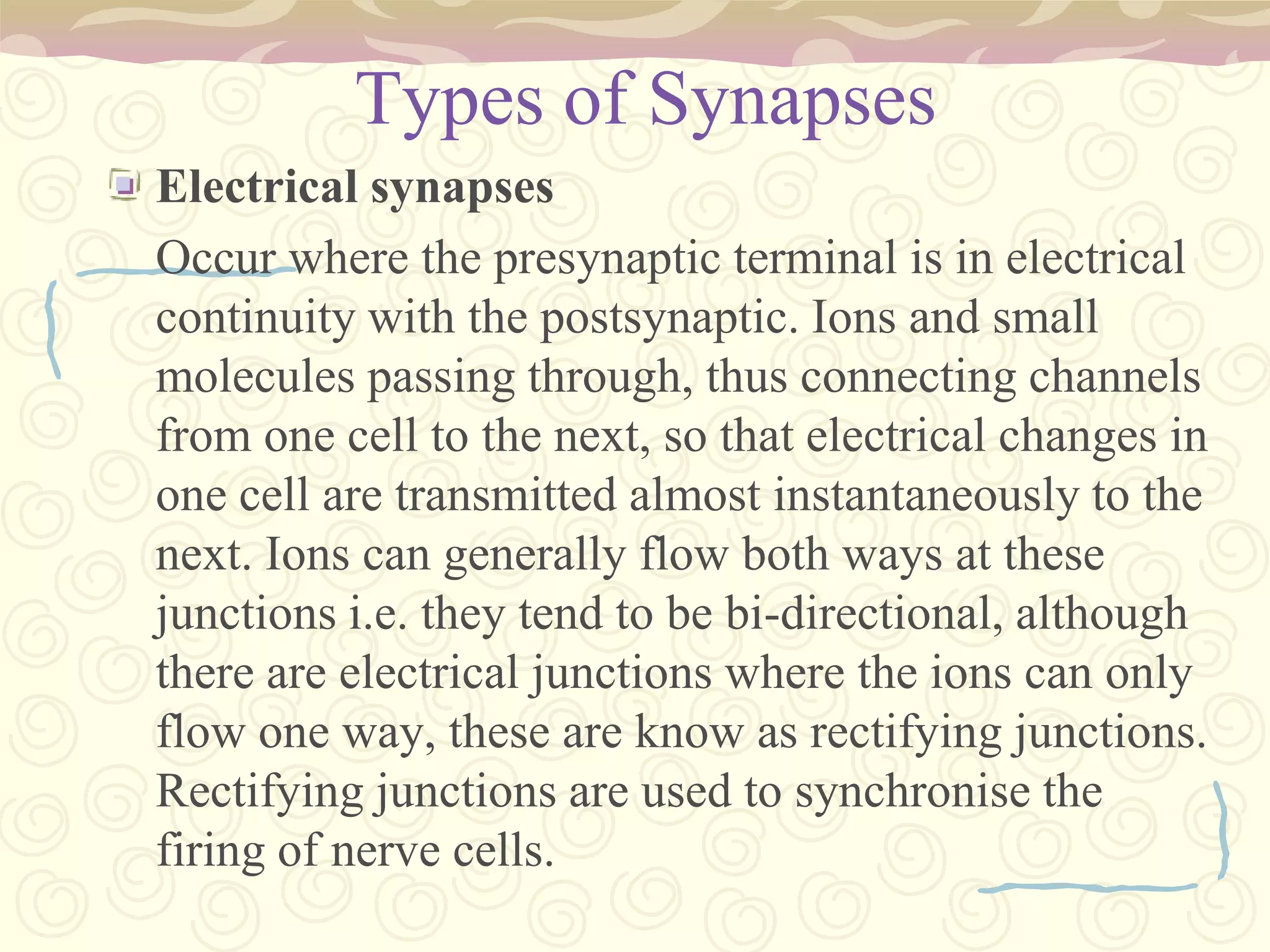
    diameter decrease fromproximal to distal end.Nerve Ending (Presynaptic Terminals) => Synapses are the junctions formed with other nerve cells where the presynaptic terminal of one cell comes into 'contact' with the postsynaptic membrane of another. It is at these junctions that neurons are excited, inhibited, or modulated. 
  • 123.
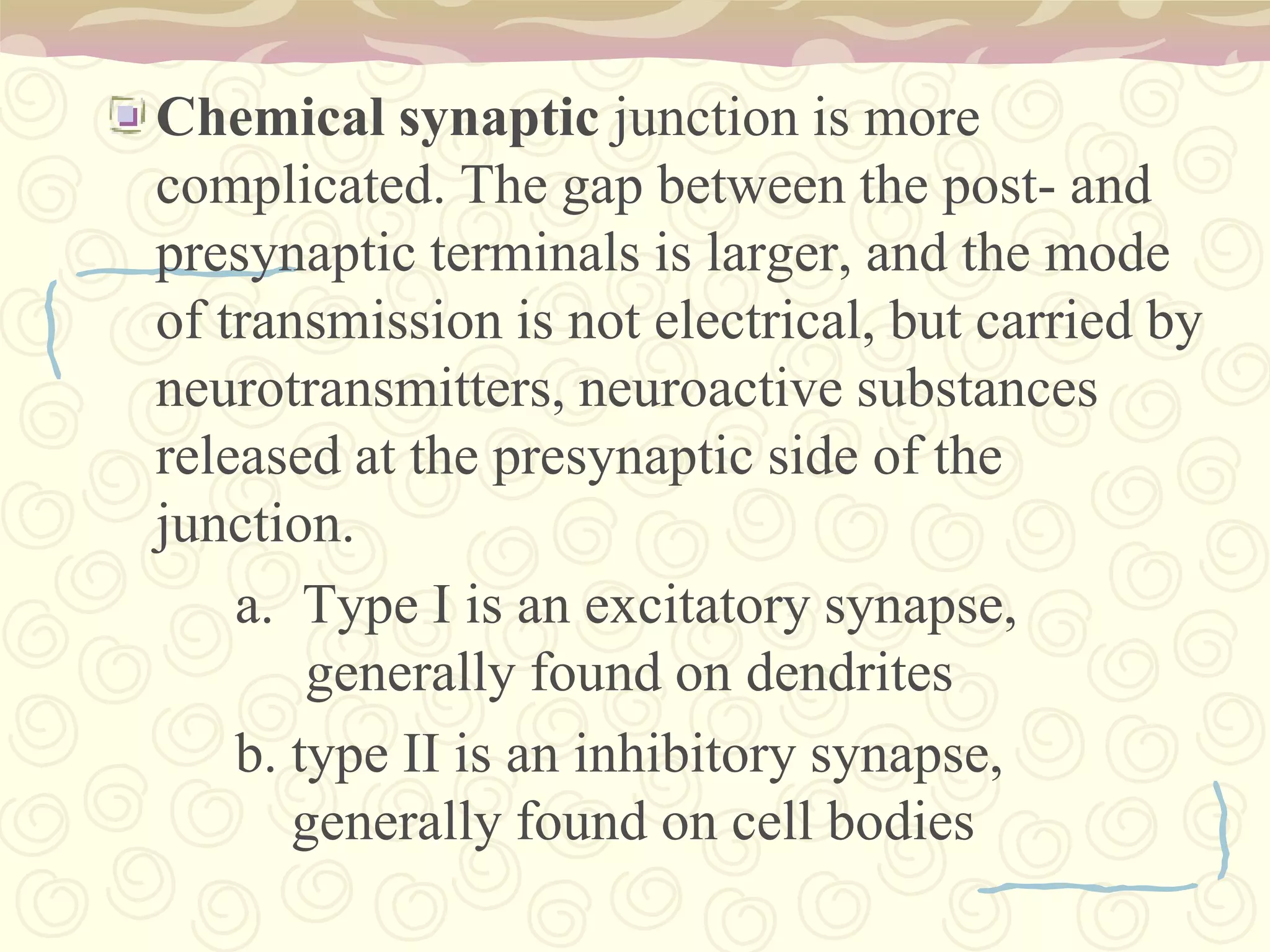
    Types of SynapsesElectricalsynapses Occur where the presynaptic terminal is in electrical continuity with the postsynaptic. Ions and small molecules passing through, thus connecting channels from one cell to the next, so that electrical changes in one cell are transmitted almost instantaneously to the next. Ions can generally flow both ways at these junctions i.e. they tend to be bi-directional, although there are electrical junctions where the ions can only flow one way, these are know as rectifying junctions. Rectifying junctions are used to synchronise the firing of nerve cells. 
  • 124.
    Chemical synaptic junction ismore complicated. The gap between the post- and presynaptic terminals is larger, and the mode of transmission is not electrical, but carried by neurotransmitters, neuroactive substances released at the presynaptic side of the junction. a. Type I is an excitatory synapse, generally found on dendrites b. type II is an inhibitory synapse, generally found on cell bodies
  • 125.
    Transmission of signals…SYNAPSEAlsoknown as the neuromuscular junction A structure that permits a neuron to pass an electrical or chemical signal to another cell. a place in the body where the axons of motor nerves meet the muscle, thus transmitting messages from the brain which cause the muscle to contract and relax.neuromuscular junctions control the movements of the body and cause the heart to beat.
  • 126.
  • 127.
    Classification of neuronaccording to the Direction:Afferent neurons convey information from tissues and organs into the central nervous system and are sometimes also called sensory neurons.Efferent neurons transmit signals from the central nervous system to the effector cells and are sometimes called motor neurons.Interneurons connect neurons within specific regions of the central nervous system.
  • 128.
    Classification of neuronsaccording to their functions: motor neurons : control muscle fibers or effecteral organs eg: endocrine.sensory neurons : receive sensory stimuli.
  • 129.
  • 130.
    Sensory neuronsCarries impulsesfrom receptors e.g pain receptors in skin to the CNS( brain or spinal cord)
  • 131.
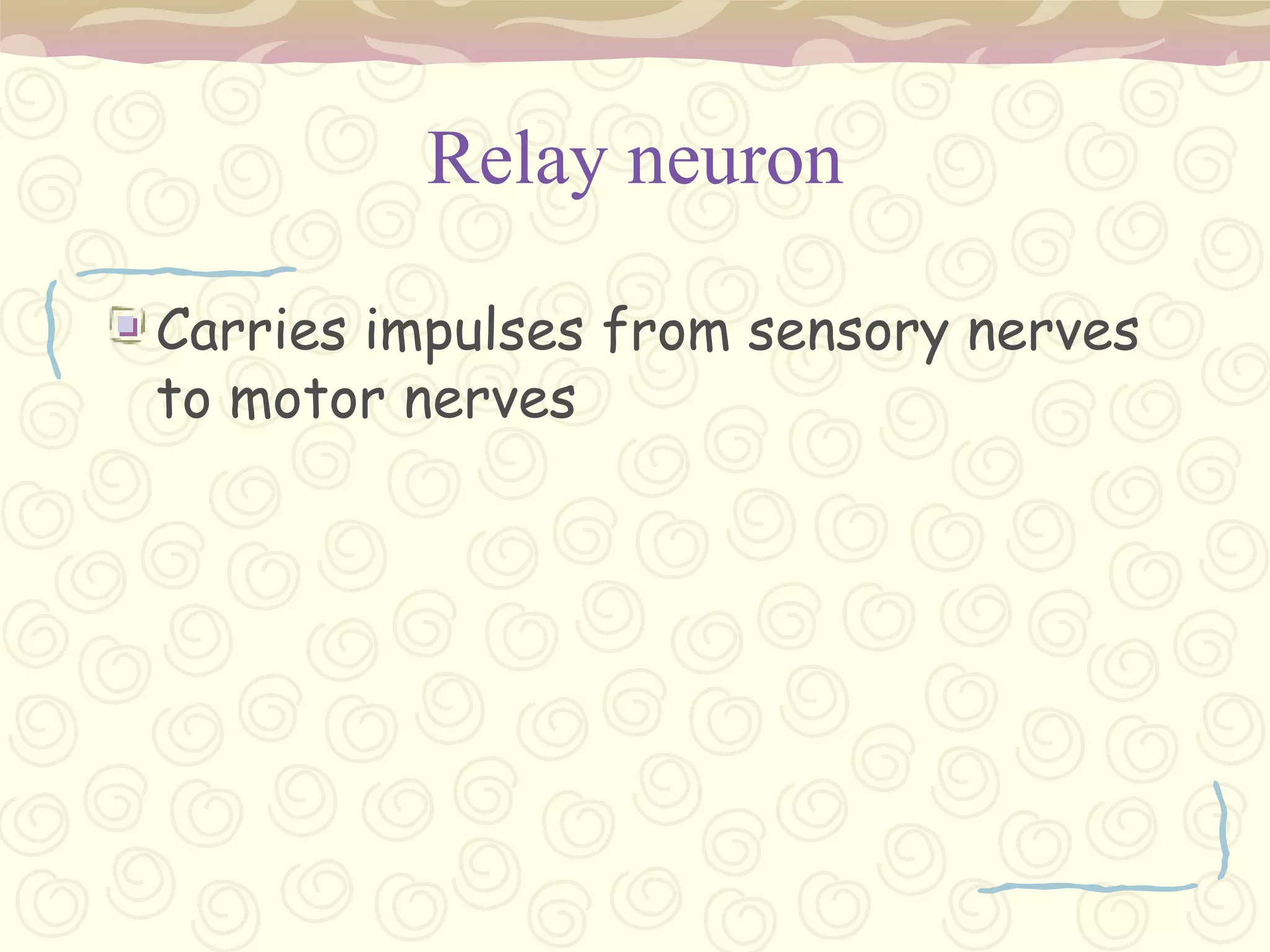
    Relay neuronCarries impulsesfrom sensory nerves to motor nerves
  • 132.
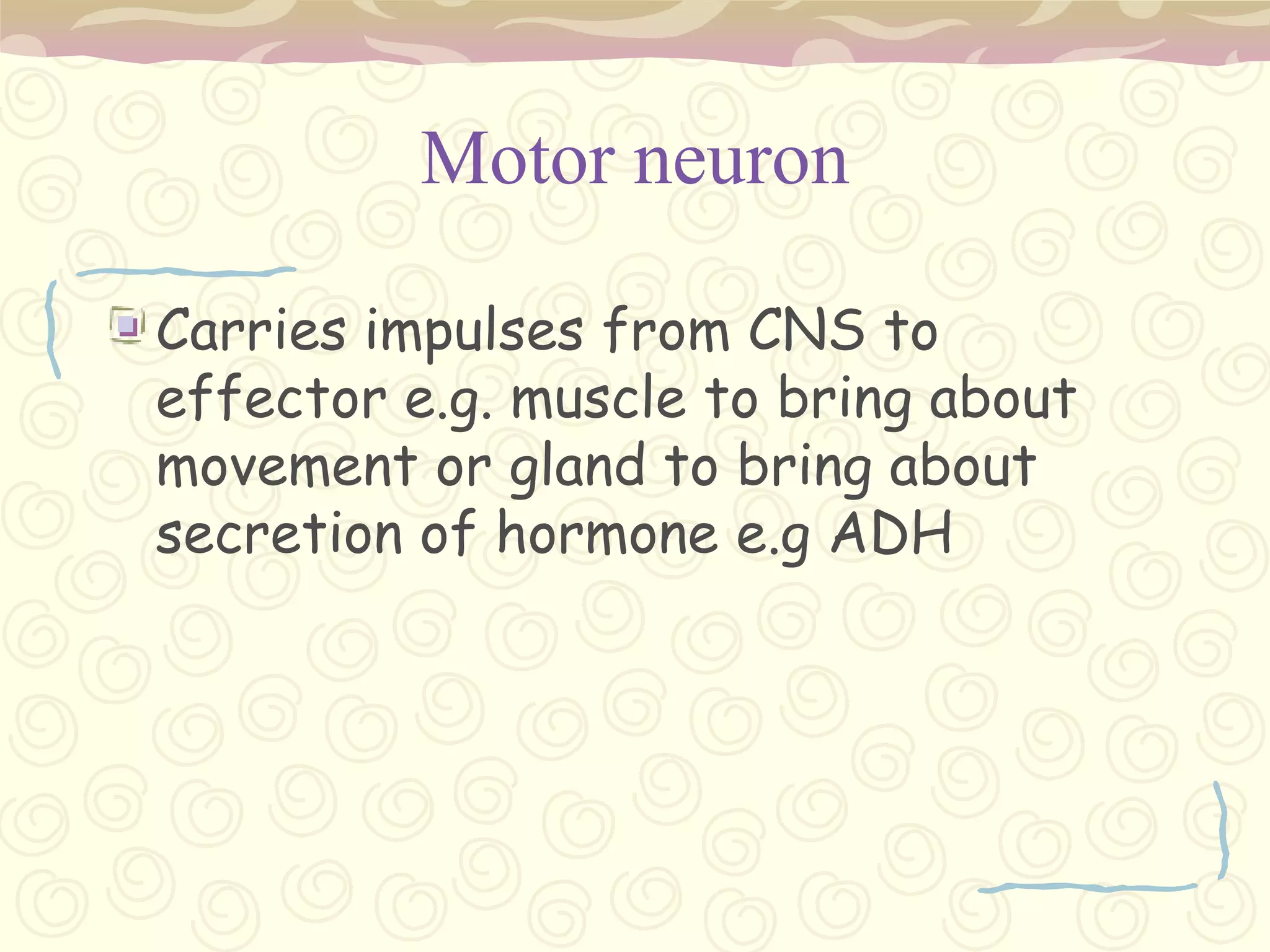
    Motor neuronCarries impulsesfrom CNS to effector e.g. muscle to bring about movement or gland to bring about secretion of hormone e.g ADH
  • 133.
    NEUROGLIAsmallest cells ofnervous tissueFunction : metabolic, support, n protection.
  • 134.
    2 typesNeuroglial Cells1. Macroglial2. Microglial
  • 135.
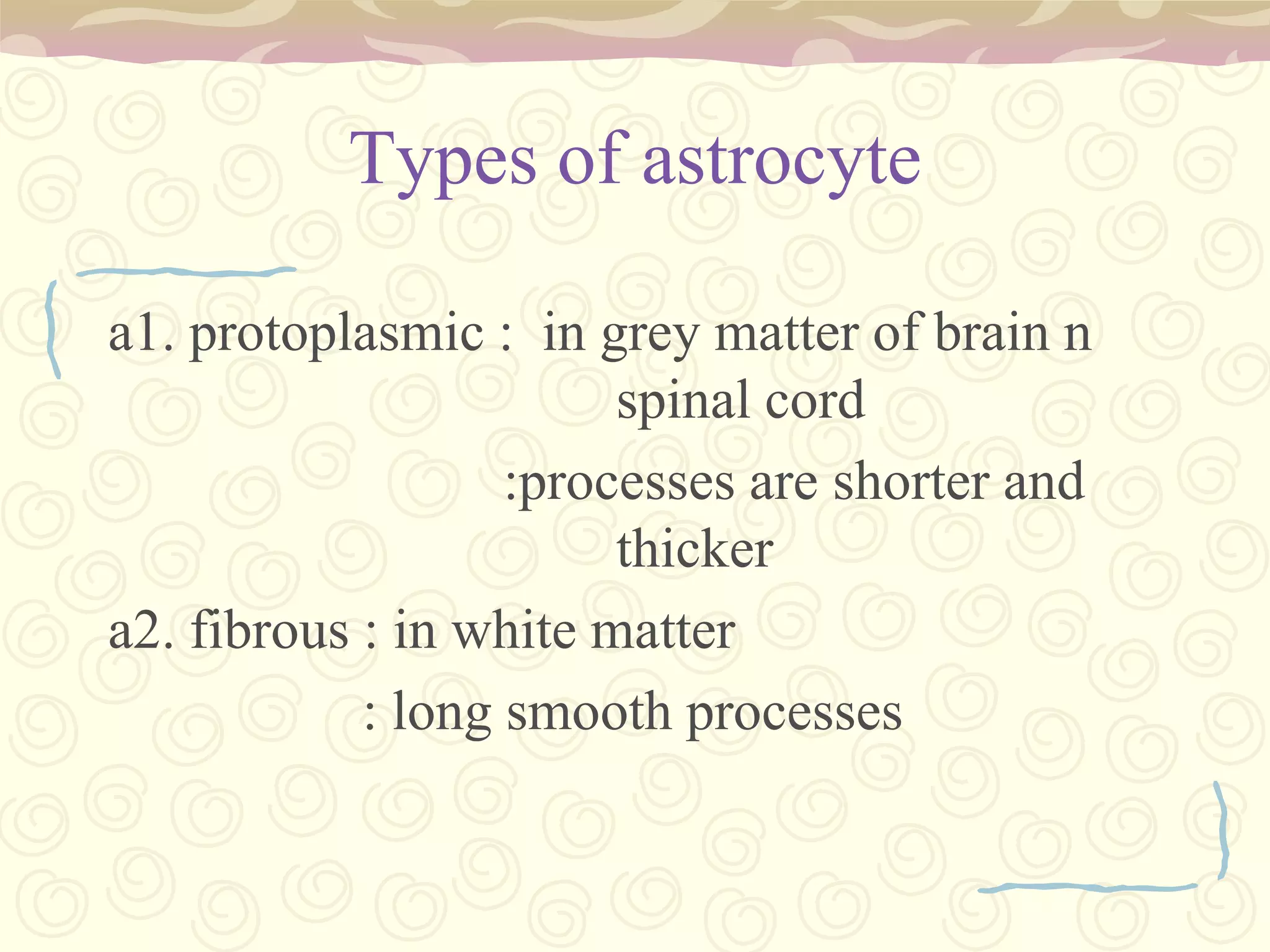
    1. Macroglial A. Astrocyte – largest - long processes - processes of the astrocytes are also present at the periphery of the brain and spinal cord forming a layer under pia mater : separates conn. Tissue of pia mater from the nerve cells.
  • 136.
    Types of astrocytea1.protoplasmic : in grey matter of brain n spinal cord :processes are shorter and thickera2. fibrous : in white matter : long smooth processes
  • 137.
    B.  Oligodendrocytes – smallerthan astrocytes - lesser processes n shorter - can be found both in grey n white matter. Function:1. take part in metabolism of neurons2. form protective barrier around neurons.
  • 138.
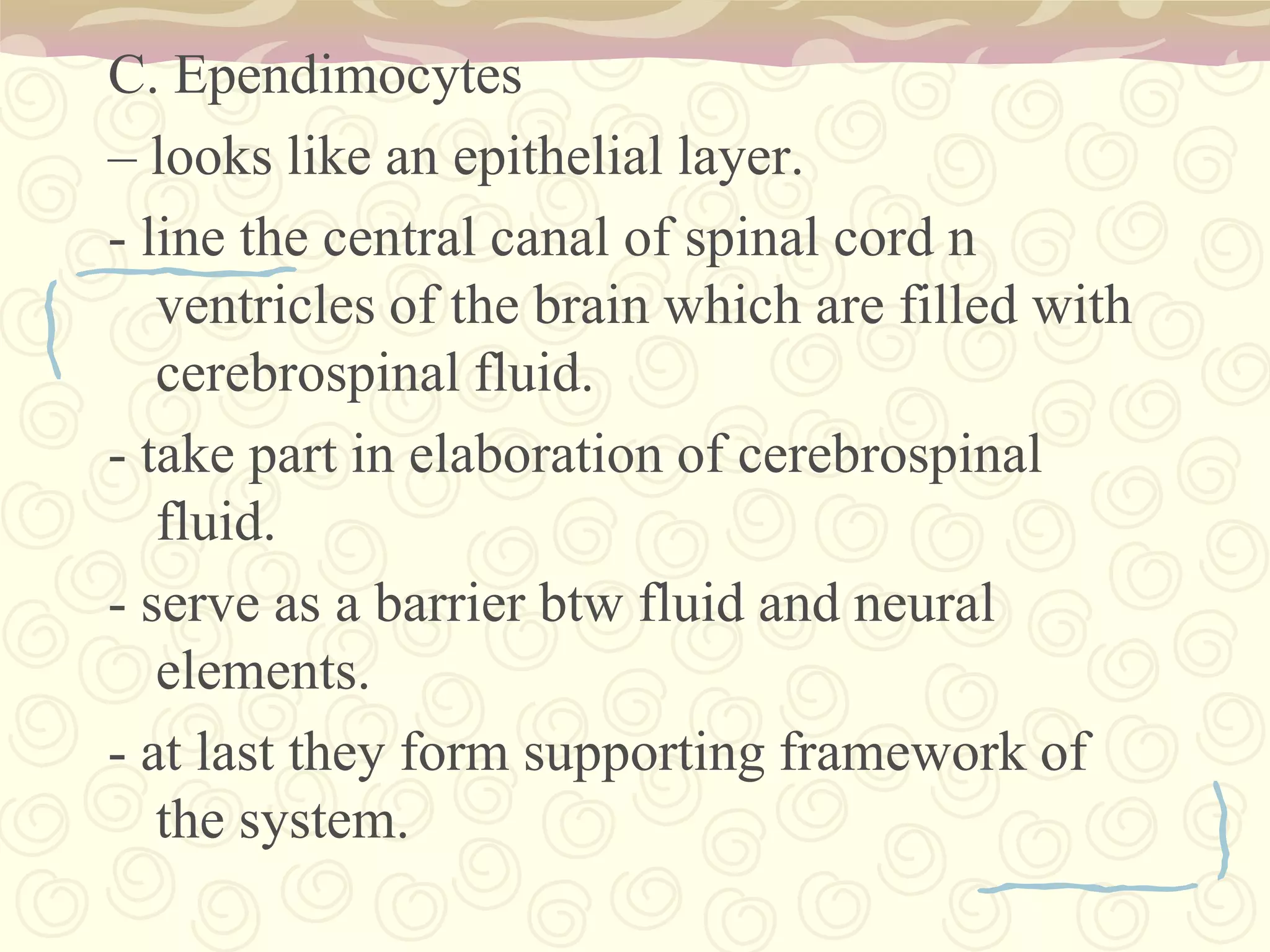
    C. Ependimocytes– lookslike an epithelial layer.- line the central canal of spinal cord n ventricles of the brain which are filled with cerebrospinal fluid.- take part in elaboration of cerebrospinal fluid.- serve as a barrier btw fluid and neural elements.- at last they form supporting framework of the system.
  • 139.
    2. Microglia– smallcells, highly-densed elongated bodies n short processes with numerous small branches.- condensed, elongated nucleus.- in adults, microglia are derived from monocytes of the bone marrow blood n they are phagocytes.
  • 140.
    Somatic Nervous System >part of the PNS associated with the voluntary control of body movements via skeletal muscles. > It is consists of efferent nerves responsible for stimulating muscle contraction, including all the non sensory neurons connected with skeletal muscles and skin. > Its Sensory axon carries signals inward from receptors in the skin, skeletal muscles, and tendons while its motor axons carries signals out to the body’s skeletal muscles.
  • 141.
    Autonomic Nervous System thepart of the PNS that acts as a control system functioning largely below the level of consciousness.It controls visceral functions.The ANS affects heart rate, digestion, respiration rate, salivation, perspiration, diameter of the pupils, micturition (urination), and sexual arousal. Whereas most of its actions are involuntary, some, such as breathing, work in tandem with the conscious mind.Its sensory and motor axon carry signals from and to smooth muscles, cardiac (heart) muscle, and the different regions inside the body.
  • 142.
    Division of AutonomicNervous SystemParasympathetic Nervous SystemThe parasympathetic system specifically is responsible for stimulation of "rest-and-digest" activities that occur when the body is at rest, including sexual arousal, salivation, lacrimation (tears), urination, digestion, and defecationSympathetic Nervous System Its general action is to mobilize the body's resources under stress; to induce the fight-or-flight response. It is, however, constantly active at a basal level to maintain homeostasis.