Cell Organelles

     Biology
    Neistadt
An organelle is a membrane-
bound structure that carries out
 specific activities for the cell.
You will need to know the following organelles and their
function:
                      Cell Membrane
                          Nucleus
                        Cytoplasm
                       Mitochondria
                      Golgi Complex
                        Ribosomes
                 Smooth Endoplasmic Reticulum
                 Rough Endoplasmic Reticulum
                         Cell Wall
                        Chloroplast
                      Central Vacuole
                         Lysosome
Cell Membrane
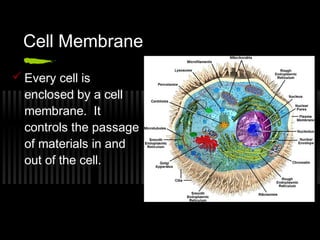
 Every cell is
  enclosed by a cell
  membrane. It
  controls the passage
  of materials in and
  out of the cell.
The cell membrane is sometimes called the
plasma membrane.

A. True
B. False
Nucleus

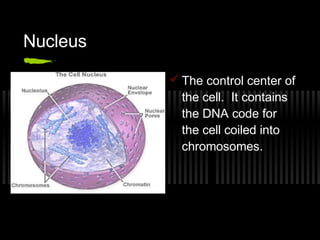
           The control center of
            the cell. It contains
            the DNA code for
            the cell coiled into
            chromosomes.
The nucleus is often called the
powerhouse of the cell.
A. True
B. False
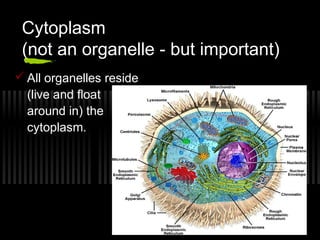
Cytoplasm
 (not an organelle - but important)
 All organelles reside
  (live and float
  around in) the
  cytoplasm.
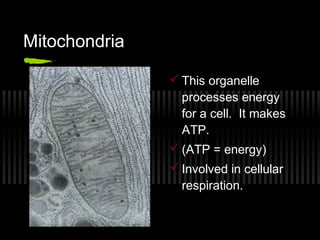
Mitochondria

                This organelle
                 processes energy
                 for a cell. It makes
                 ATP.
                (ATP = energy)
                Involved in cellular
                 respiration.
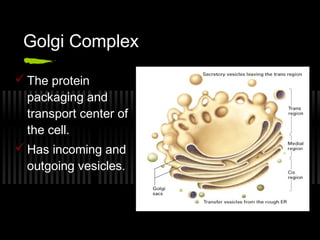
Golgi Complex

 The protein
  packaging and
  transport center of
  the cell.
 Has incoming and
  outgoing vesicles.
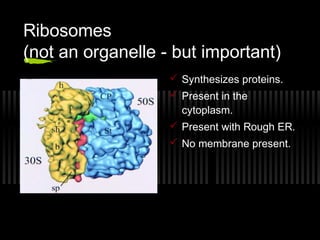
Ribosomes
(not an organelle - but important)
                    Synthesizes proteins.
                    Present in the
                     cytoplasm.
                    Present with Rough ER.
                    No membrane present.
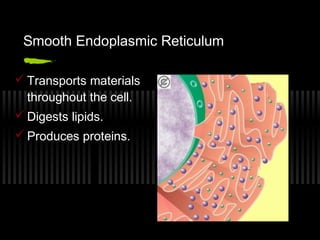
Smooth Endoplasmic Reticulum

 Transports materials
  throughout the cell.
 Digests lipids.
 Produces proteins.
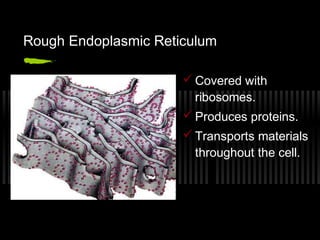
Rough Endoplasmic Reticulum

                       Covered with
                        ribosomes.
                       Produces proteins.
                       Transports materials
                        throughout the cell.
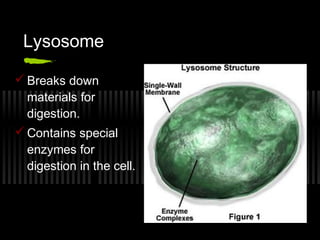
Lysosome

 Breaks down
  materials for
  digestion.
 Contains special
  enzymes for
  digestion in the cell.
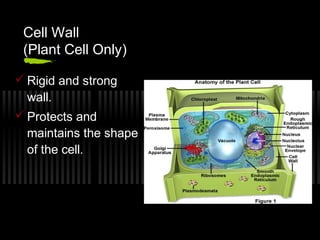
Cell Wall
 (Plant Cell Only)

 Rigid and strong
  wall.
 Protects and
  maintains the shape
  of the cell.
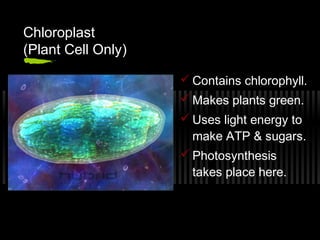
Chloroplast
(Plant Cell Only)

                     Contains chlorophyll.
                     Makes plants green.
                     Uses light energy to
                      make ATP & sugars.
                     Photosynthesis
                      takes place here.
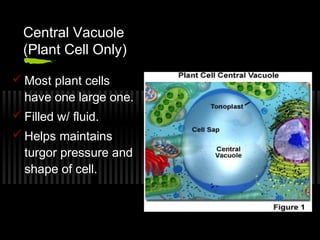
Central Vacuole
 (Plant Cell Only)

 Most plant cells
  have one large one.
 Filled w/ fluid.
 Helps maintains
  turgor pressure and
  shape of cell.
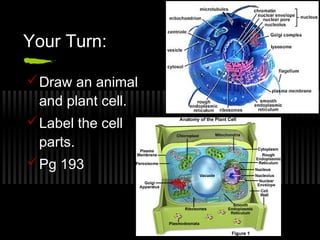
Your Turn:

 Draw an animal
  and plant cell.
 Label the cell
  parts.
 Pg 193
Your Turn…
 On your paper write the name of the organelle and
  decorate it in a way that helps you remember what it
  does:
 Nucleus
 Endoplasmic Reticulum (smooth and rough)
 Golgi Complex
 Chloroplasts
 Cell Wall
 Mitochondria
 Cytoplasm
 Ribosomes
 Lysosomes
 Central vacuole

Cell organelles

  • 1.
    Cell Organelles Biology Neistadt
  • 2.
    An organelle isa membrane- bound structure that carries out specific activities for the cell.
  • 3.
    You will needto know the following organelles and their function:  Cell Membrane  Nucleus  Cytoplasm  Mitochondria  Golgi Complex  Ribosomes  Smooth Endoplasmic Reticulum  Rough Endoplasmic Reticulum  Cell Wall  Chloroplast  Central Vacuole  Lysosome
  • 4.
    Cell Membrane  Everycell is enclosed by a cell membrane. It controls the passage of materials in and out of the cell.
  • 5.
    The cell membraneis sometimes called the plasma membrane. A. True B. False
  • 6.
    Nucleus  The control center of the cell. It contains the DNA code for the cell coiled into chromosomes.
  • 7.
    The nucleus isoften called the powerhouse of the cell. A. True B. False
  • 8.
    Cytoplasm (not anorganelle - but important)  All organelles reside (live and float around in) the cytoplasm.
  • 9.
    Mitochondria  This organelle processes energy for a cell. It makes ATP.  (ATP = energy)  Involved in cellular respiration.
  • 10.
    Golgi Complex  Theprotein packaging and transport center of the cell.  Has incoming and outgoing vesicles.
  • 11.
    Ribosomes (not an organelle- but important)  Synthesizes proteins.  Present in the cytoplasm.  Present with Rough ER.  No membrane present.
  • 12.
    Smooth Endoplasmic Reticulum Transports materials throughout the cell.  Digests lipids.  Produces proteins.
  • 13.
    Rough Endoplasmic Reticulum  Covered with ribosomes.  Produces proteins.  Transports materials throughout the cell.
  • 14.
    Lysosome  Breaks down materials for digestion.  Contains special enzymes for digestion in the cell.
  • 15.
    Cell Wall (PlantCell Only)  Rigid and strong wall.  Protects and maintains the shape of the cell.
  • 16.
    Chloroplast (Plant Cell Only)  Contains chlorophyll.  Makes plants green.  Uses light energy to make ATP & sugars.  Photosynthesis takes place here.
  • 17.
    Central Vacuole (PlantCell Only)  Most plant cells have one large one.  Filled w/ fluid.  Helps maintains turgor pressure and shape of cell.
  • 18.
    Your Turn:  Drawan animal and plant cell.  Label the cell parts.  Pg 193
  • 19.
    Your Turn…  Onyour paper write the name of the organelle and decorate it in a way that helps you remember what it does:  Nucleus  Endoplasmic Reticulum (smooth and rough)  Golgi Complex  Chloroplasts  Cell Wall  Mitochondria  Cytoplasm  Ribosomes  Lysosomes  Central vacuole