

Comparing Atoms
        &
The Periodic Table

 Chapter 18.2 and 18.3
       Neistadt
   Physical Science
How do you tell atoms apart?
• All atoms have neutrons, protons and
  electrons.
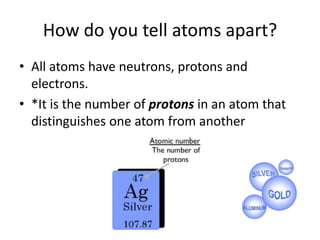
• *It is the number of protons in an atom that
  distinguishes one atom from another
Atomic Number
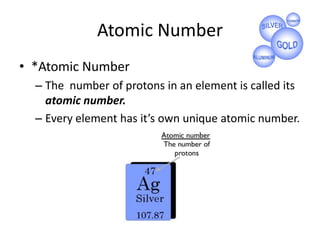
• *Atomic Number
  – The number of protons in an element is called its
    atomic number.
  – Every element has it’s own unique atomic number.
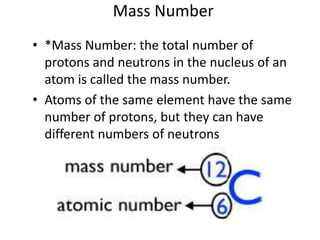
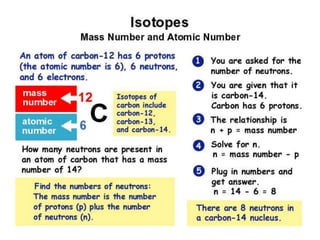
Mass Number
• *Mass Number: the total number of
  protons and neutrons in the nucleus of an
  atom is called the mass number.
• Atoms of the same element have the same
  number of protons, but they can have
  different numbers of neutrons
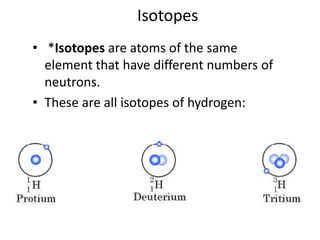
Isotopes
• *Isotopes are atoms of the same
  element that have different numbers of
  neutrons.
• These are all isotopes of hydrogen:
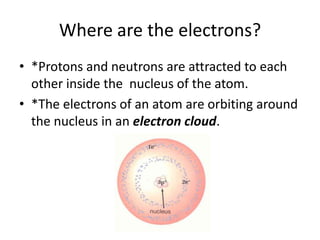
Where are the electrons?
• *Protons and neutrons are attracted to each
  other inside the nucleus of the atom.
• *The electrons of an atom are orbiting around
  the nucleus in an electron cloud.
Where are the electrons?
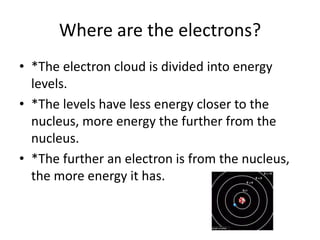
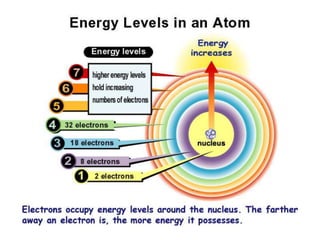
• *The electron cloud is divided into energy
  levels.
• *The levels have less energy closer to the
  nucleus, more energy the further from the
  nucleus.
• *The further an electron is from the nucleus,
  the more energy it has.
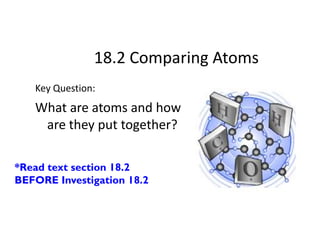
18.2 Comparing Atoms
   Key Question:
   What are atoms and how
    are they put together?

*Read text section 18.2
BEFORE Investigation 18.2
18.3 The Periodic Table of Elements

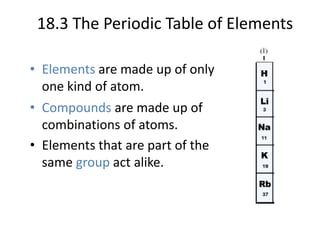
• Elements are made up of only
  one kind of atom.
• Compounds are made up of
  combinations of atoms.
• Elements that are part of the
  same group act alike.
18.3 The Periodic Table of Elements
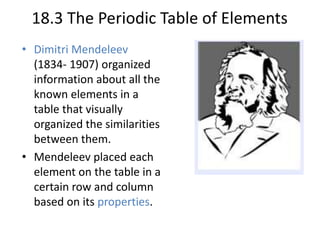
• Dimitri Mendeleev
  (1834- 1907) organized
  information about all the
  known elements in a
  table that visually
  organized the similarities
  between them.
• Mendeleev placed each
  element on the table in a
  certain row and column
  based on its properties.
18.3 The Periodic Table of Elements
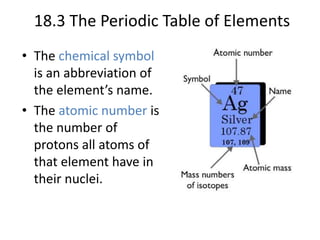
• The chemical symbol
  is an abbreviation of
  the element’s name.
• The atomic number is
  the number of
  protons all atoms of
  that element have in
  their nuclei.
18.3 The Periodic Table of Elements
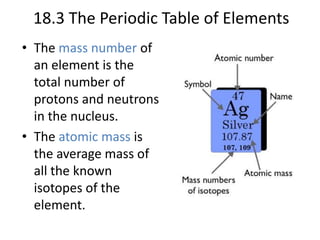
• The mass number of
  an element is the
  total number of
  protons and neutrons
  in the nucleus.
• The atomic mass is
  the average mass of
  all the known
  isotopes of the
  element.
18.3 The Periodic Table of Elements
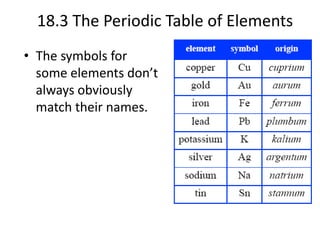
• The symbols for
  some elements don’t
  always obviously
  match their names.
18.3 The Periodic Table of Elements
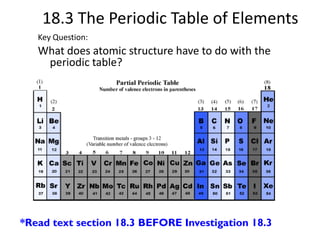
   Key Question:
   What does atomic structure have to do with the
    periodic table?


*Read text section 18.3 BEFORE Investigation 18.3
Comparing Atoms and Periodic Table

Comparing Atoms and Periodic Table

  • 1.
    Comparing Atoms & The Periodic Table Chapter 18.2 and 18.3 Neistadt Physical Science
  • 2.
    How do youtell atoms apart? • All atoms have neutrons, protons and electrons. • *It is the number of protons in an atom that distinguishes one atom from another
  • 3.
    Atomic Number • *AtomicNumber – The number of protons in an element is called its atomic number. – Every element has it’s own unique atomic number.
  • 4.
    Mass Number • *MassNumber: the total number of protons and neutrons in the nucleus of an atom is called the mass number. • Atoms of the same element have the same number of protons, but they can have different numbers of neutrons
  • 5.
    Isotopes • *Isotopes areatoms of the same element that have different numbers of neutrons. • These are all isotopes of hydrogen:
  • 7.
    Where are theelectrons? • *Protons and neutrons are attracted to each other inside the nucleus of the atom. • *The electrons of an atom are orbiting around the nucleus in an electron cloud.
  • 8.
    Where are theelectrons? • *The electron cloud is divided into energy levels. • *The levels have less energy closer to the nucleus, more energy the further from the nucleus. • *The further an electron is from the nucleus, the more energy it has.
  • 10.
    18.2 Comparing Atoms Key Question: What are atoms and how are they put together? *Read text section 18.2 BEFORE Investigation 18.2
  • 12.
    18.3 The PeriodicTable of Elements • Elements are made up of only one kind of atom. • Compounds are made up of combinations of atoms. • Elements that are part of the same group act alike.
  • 13.
    18.3 The PeriodicTable of Elements • Dimitri Mendeleev (1834- 1907) organized information about all the known elements in a table that visually organized the similarities between them. • Mendeleev placed each element on the table in a certain row and column based on its properties.
  • 16.
    18.3 The PeriodicTable of Elements • The chemical symbol is an abbreviation of the element’s name. • The atomic number is the number of protons all atoms of that element have in their nuclei.
  • 17.
    18.3 The PeriodicTable of Elements • The mass number of an element is the total number of protons and neutrons in the nucleus. • The atomic mass is the average mass of all the known isotopes of the element.
  • 18.
    18.3 The PeriodicTable of Elements • The symbols for some elements don’t always obviously match their names.
  • 19.
    18.3 The PeriodicTable of Elements Key Question: What does atomic structure have to do with the periodic table? *Read text section 18.3 BEFORE Investigation 18.3