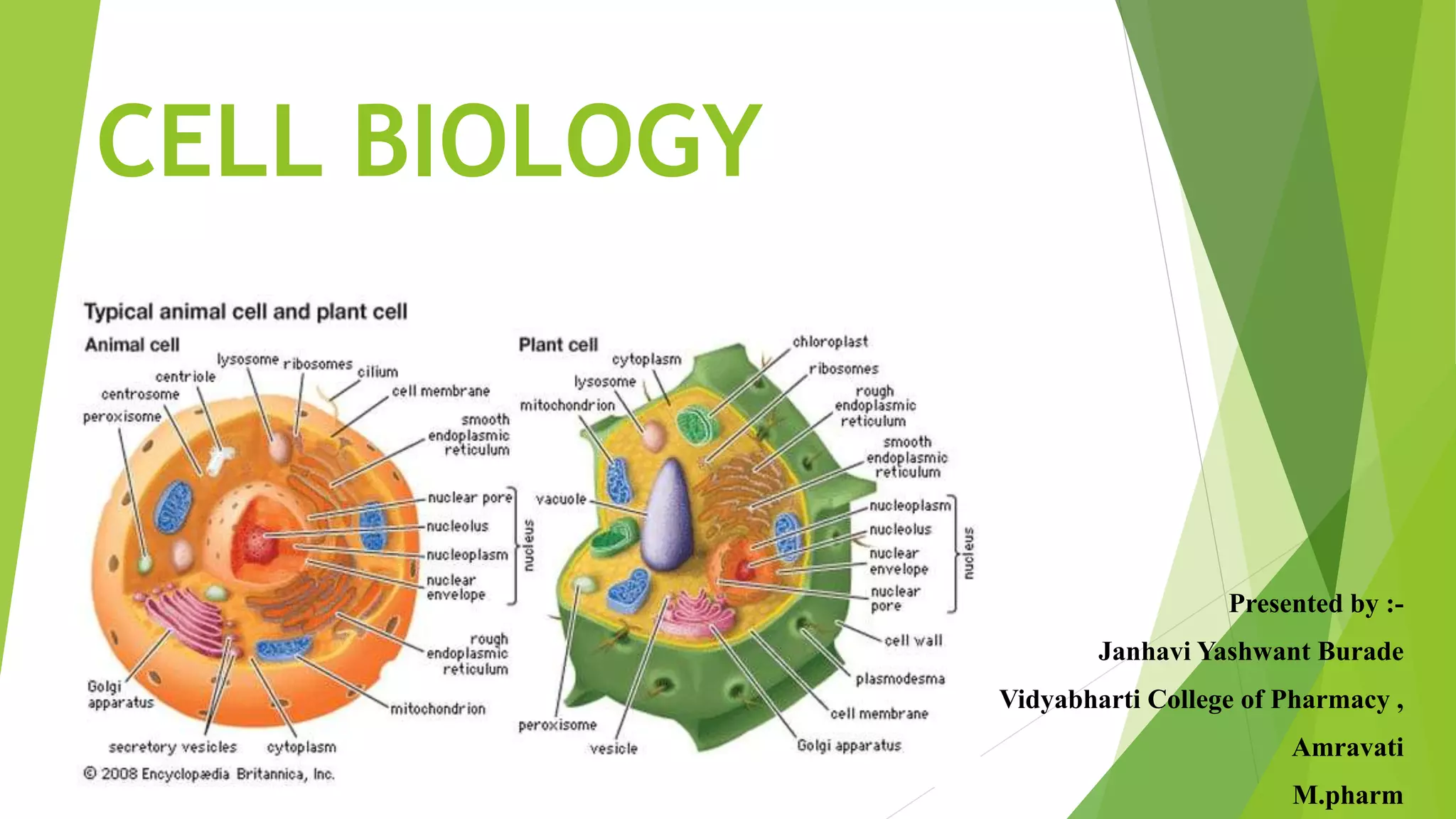
CELL BIOLOGY
Presented by :-
Janhavi Yashwant Burade
Vidyabharti College of Pharmacy ,
Amravati
M.pharm
Content
 Introduction
 Structure of cell and it’s organelles
 Function of cell and it’s organelles
Introduction
Cell :-
 The cell (from Latin cella, meaning "small room") is the basic structural, functional,
and biological unit of all known organisms.
 A cell is the smallest unit of life.
 Cells are often called the "building blocks of life".
 The study of cells is called cell biology, cellular biology, or cytology.
 Self replicating structure.
 First cell were observed and named by Robert Hooke in 1665 from slice of cork.
 Some organisms consists of a unicellular organism,other are multicellular.
 Diameter:- 2-120um.
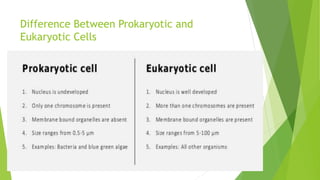
 There are two type of cell :- prokaryotic cell and eukaryotic cells.
 A prokaryotic cell is a type of cell that does not have a true nucleus or membrane-
bound organelles. Organisms within the domains Bacteria and Archaea are based on
the prokaryotic cell, while all other forms of life are eukaryotic.
Difference Between Prokaryotic and
Eukaryotic Cells
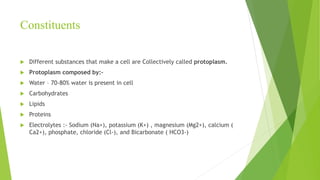
Constituents
 Different substances that make a cell are Collectively called protoplasm.
 Protoplasm composed by:-
 Water – 70-80% water is present in cell
 Carbohydrates
 Lipids
 Proteins
 Electrolytes :- Sodium (Na+), potassium (K+) , magnesium (Mg2+), calcium (
Ca2+), phosphate, chloride (Cl-), and Bicarbonate ( HCO3-)
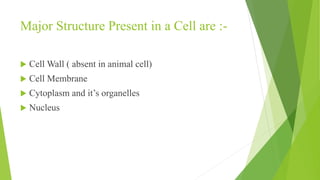
Major Structure Present in a Cell are :-
 Cell Wall ( absent in animal cell)
 Cell Membrane
 Cytoplasm and it’s organelles
 Nucleus
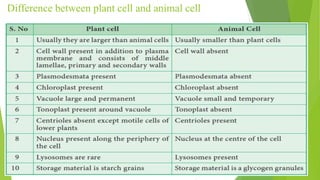
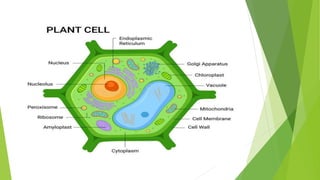
Difference between plant cell and animal cell
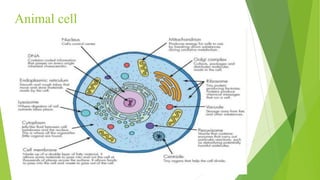
Animal cell
Structure and function of cell organelles
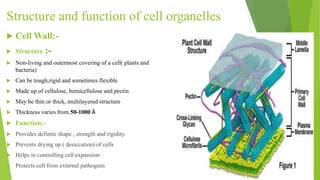
 Cell Wall:-
 Structure :-
 Non-living and outermost covering of a cell( plants and
bacteria)
 Can be tough,rigid and sometimes flexible
 Made up of cellulose, hemicellulose and pectin
 May be thin or thick, multilayered structure
 Thickness varies from 50-1000 Å
 Function:-
 Provides definite shape , strength and rigidity
 Prevents drying up ( desiccation) of cells
 Helps in controlling cell expansion
 Protects cell from external pathogens
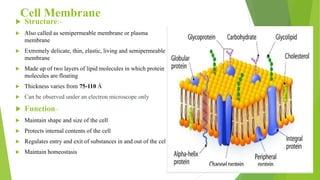
Cell Membrane
 Structure:-
 Also called as semipermeable membrane or plasma
membrane
 Extremely delicate, thin, elastic, living and semipermeable
membrane
 Made up of two layers of lipid molecules in which protein
molecules are floating
 Thickness varies from 75-110 Å
 Can be observed under an electron microscope only
 Function:-
 Maintain shape and size of the cell
 Protects internal contents of the cell
 Regulates entry and exit of substances in and out of the cell
 Maintain homeostasis
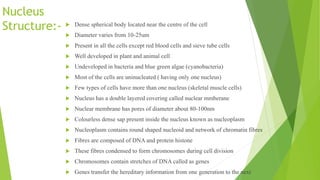
Nucleus
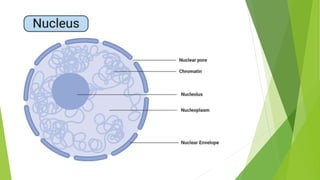
Structure:-  Dense spherical body located near the centre of the cell
 Diameter varies from 10-25um
 Present in all the cells except red blood cells and sieve tube cells
 Well developed in plant and animal cell
 Undeveloped in bacteria and blue green algae (cyanobacteria)
 Most of the cells are uninucleated ( having only one nucleus)
 Few types of cells have more than one nucleus (skeletal muscle cells)
 Nucleus has a double layered covering called nuclear mmberane
 Nuclear membrane has pores of diameter about 80-100nm
 Colourless dense sap present inside the nucleus known as nucleoplasm
 Nucleoplasm contains round shaped nucleoid and network of chromatin fibres
 Fibres are composed of DNA and protein histone
 These fibres condensed to form chromosomes during cell division
 Chromosomes contain stretches of DNA called as genes
 Genes transfer the hereditary information from one generation to the next
Function:-
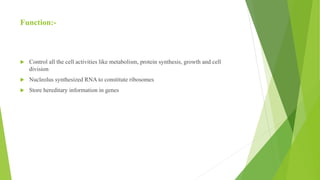
 Control all the cell activities like metabolism, protein synthesis, growth and cell
division
 Nucleolus synthesized RNA to constitute ribosomes
 Store hereditary information in genes
Cytoplasm
Structure:-
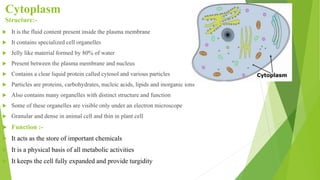
 It is the fluid content present inside the plasma membrane
 It contains specialized cell organelles
 Jelly like material formed by 80% of water
 Present between the plasma membrane and nucleus
 Contains a clear liquid protein called cytosol and various particles
 Particles are proteins, carbohydrates, nucleic acids, lipids and inorganic ions
 Also contains many organelles with distinct structure and function
 Some of these organelles are visible only under an electron microscope
 Granular and dense in animal cell and thin in plant cell
 Function :-
 It acts as the store of important chemicals
 It is a physical basis of all metabolic activities
 It keeps the cell fully expanded and provide turgidity
Endoplasmic Reticulum
Structure:-
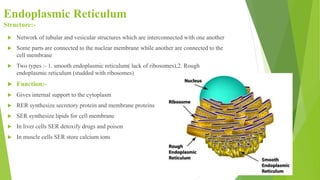
 Network of tubular and vesicular structures which are interconnected with one another
 Some parts are connected to the nuclear membrane while another are connected to the
cell membrane
 Two types :- 1. smooth endoplasmic reticulum( lack of ribosomes),2. Rough
endoplasmic reticulum (studded with ribosomes)
 Function:-
 Gives internal support to the cytoplasm
 RER synthesize secretory protein and membrane proteins
 SER synthesize lipids for cell membrane
 In liver cells SER detoxify drugs and poison
 In muscle cells SER store calcium ions
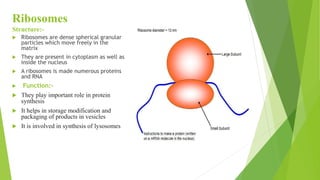
Ribosomes
Structure:-
 Ribosomes are dense spherical granular
particles which move freely in the
matrix
 They are present in cytoplasm as well as
inside the nucleus
 A ribosomes is made numerous proteins
and RNA
 Function:-
 They play important role in protein
synthesis
 It helps in storage modification and
packaging of products in vesicles
 It is involved in synthesis of lysosomes
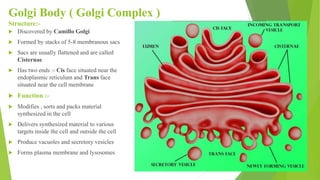
Golgi Body ( Golgi Complex )
Structure:-
 Discovered by Camillo Golgi
 Formed by stacks of 5-8 membranous sacs
 Sacs are usually flattened and are called
Cisternae
 Has two ends :- Cis face situated near the
endoplasmic reticulum and Trans face
situated near the cell membrane
 Function :-
 Modifies , sorts and packs material
synthesized in the cell
 Delivers synthesized material to various
targets inside the cell and outside the cell
 Produce vacuoles and secretory vesicles
 Forms plasma membrane and lysosomes
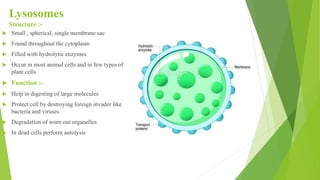
Lysosomes
Structure :-
 Small , spherical, single membrane sac
 Found throughout the cytoplasm
 Filled with hydrolytic enzymes
 Occur in most animal cells and in few types of
plant cells
 Function :-
 Help in digesting of large molecules
 Protect cell by destroying foreign invader like
bacteria and viruses
 Degradation of worn out organelles
 In dead cells perform autolysis
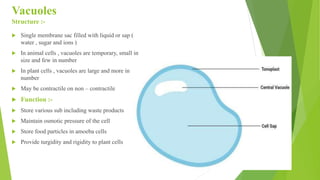
Vacuoles
Structure :-
 Single membrane sac filled with liquid or sap (
water , sugar and ions )
 In animal cells , vacuoles are temporary, small in
size and few in number
 In plant cells , vacuoles are large and more in
number
 May be contractile on non – contractile
 Function :-
 Store various sub including waste products
 Maintain osmotic pressure of the cell
 Store food particles in amoeba cells
 Provide turgidity and rigidity to plant cells
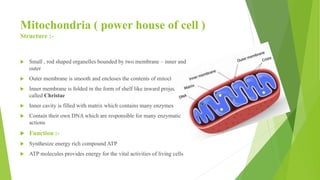
Mitochondria ( power house of cell )
Structure :-
 Small , rod shaped organelles bounded by two membrane – inner and
outer
 Outer membrane is smooth and encloses the contents of mitochondria
 Inner membrane is folded in the form of shelf like inward projection
called Christae
 Inner cavity is filled with matrix which contains many enzymes
 Contain their own DNA which are responsible for many enzymatic
actions
 Function :-
 Synthesize energy rich compound ATP
 ATP molecules provides energy for the vital activities of living cells
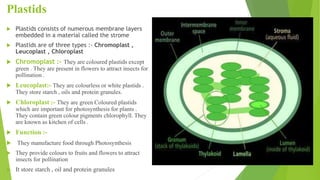
Plastids
 Plastids consists of numerous membrane layers
embedded in a material called the strome
 Plastids are of three types :- Chromoplast ,
Leucoplast , Chloroplast
 Chromoplast :- They are coloured plastids except
green . They are present in flowers to attract insects for
pollination .
 Leucoplast:- They are colourless or white plastids .
They store starch , oils and protein granules.
 Chloroplast :- They are green Coloured plastids
which are important for photosynthesis for plants .
They contain green colour pigments chlorophyll. They
are known as kitchen of cells .
 Function :-
 They manufacture food through Photosynthesis
 They provide colours to fruits and flowers to attract
insects for pollination
 It store starch , oil and protein granules
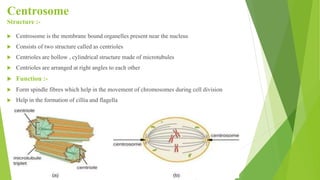
Centrosome
Structure :-
 Centrosome is the membrane bound organelles present near the nucleus
 Consists of two structure called as centrioles
 Centrioles are hollow , cylindrical structure made of microtubules
 Centrioles are arranged at right angles to each other
 Function :-
 Form spindle fibres which help in the movement of chromosomes during cell division
 Help in the formation of cillia and flagella
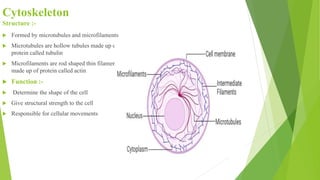
Cytoskeleton
Structure :-
 Formed by microtubules and microfilaments
 Microtubules are hollow tubules made up of
protein called tubulin
 Microfilaments are rod shaped thin filaments
made up of protein called actin
 Function :-
 Determine the shape of the cell
 Give structural strength to the cell
 Responsible for cellular movements
Thank you !

Cell biology

  • 1.
    CELL BIOLOGY Presented by:- Janhavi Yashwant Burade Vidyabharti College of Pharmacy , Amravati M.pharm
  • 2.
    Content  Introduction  Structureof cell and it’s organelles  Function of cell and it’s organelles
  • 3.
    Introduction Cell :-  Thecell (from Latin cella, meaning "small room") is the basic structural, functional, and biological unit of all known organisms.  A cell is the smallest unit of life.  Cells are often called the "building blocks of life".  The study of cells is called cell biology, cellular biology, or cytology.  Self replicating structure.  First cell were observed and named by Robert Hooke in 1665 from slice of cork.  Some organisms consists of a unicellular organism,other are multicellular.  Diameter:- 2-120um.  There are two type of cell :- prokaryotic cell and eukaryotic cells.  A prokaryotic cell is a type of cell that does not have a true nucleus or membrane- bound organelles. Organisms within the domains Bacteria and Archaea are based on the prokaryotic cell, while all other forms of life are eukaryotic.
  • 4.
    Difference Between Prokaryoticand Eukaryotic Cells
  • 5.
    Constituents  Different substancesthat make a cell are Collectively called protoplasm.  Protoplasm composed by:-  Water – 70-80% water is present in cell  Carbohydrates  Lipids  Proteins  Electrolytes :- Sodium (Na+), potassium (K+) , magnesium (Mg2+), calcium ( Ca2+), phosphate, chloride (Cl-), and Bicarbonate ( HCO3-)
  • 6.
    Major Structure Presentin a Cell are :-  Cell Wall ( absent in animal cell)  Cell Membrane  Cytoplasm and it’s organelles  Nucleus
  • 7.
    Difference between plantcell and animal cell
  • 9.
  • 10.
    Structure and functionof cell organelles  Cell Wall:-  Structure :-  Non-living and outermost covering of a cell( plants and bacteria)  Can be tough,rigid and sometimes flexible  Made up of cellulose, hemicellulose and pectin  May be thin or thick, multilayered structure  Thickness varies from 50-1000 Å  Function:-  Provides definite shape , strength and rigidity  Prevents drying up ( desiccation) of cells  Helps in controlling cell expansion  Protects cell from external pathogens
  • 11.
    Cell Membrane  Structure:- Also called as semipermeable membrane or plasma membrane  Extremely delicate, thin, elastic, living and semipermeable membrane  Made up of two layers of lipid molecules in which protein molecules are floating  Thickness varies from 75-110 Å  Can be observed under an electron microscope only  Function:-  Maintain shape and size of the cell  Protects internal contents of the cell  Regulates entry and exit of substances in and out of the cell  Maintain homeostasis
  • 12.
    Nucleus Structure:-  Densespherical body located near the centre of the cell  Diameter varies from 10-25um  Present in all the cells except red blood cells and sieve tube cells  Well developed in plant and animal cell  Undeveloped in bacteria and blue green algae (cyanobacteria)  Most of the cells are uninucleated ( having only one nucleus)  Few types of cells have more than one nucleus (skeletal muscle cells)  Nucleus has a double layered covering called nuclear mmberane  Nuclear membrane has pores of diameter about 80-100nm  Colourless dense sap present inside the nucleus known as nucleoplasm  Nucleoplasm contains round shaped nucleoid and network of chromatin fibres  Fibres are composed of DNA and protein histone  These fibres condensed to form chromosomes during cell division  Chromosomes contain stretches of DNA called as genes  Genes transfer the hereditary information from one generation to the next
  • 14.
    Function:-  Control allthe cell activities like metabolism, protein synthesis, growth and cell division  Nucleolus synthesized RNA to constitute ribosomes  Store hereditary information in genes
  • 15.
    Cytoplasm Structure:-  It isthe fluid content present inside the plasma membrane  It contains specialized cell organelles  Jelly like material formed by 80% of water  Present between the plasma membrane and nucleus  Contains a clear liquid protein called cytosol and various particles  Particles are proteins, carbohydrates, nucleic acids, lipids and inorganic ions  Also contains many organelles with distinct structure and function  Some of these organelles are visible only under an electron microscope  Granular and dense in animal cell and thin in plant cell  Function :-  It acts as the store of important chemicals  It is a physical basis of all metabolic activities  It keeps the cell fully expanded and provide turgidity
  • 16.
    Endoplasmic Reticulum Structure:-  Networkof tubular and vesicular structures which are interconnected with one another  Some parts are connected to the nuclear membrane while another are connected to the cell membrane  Two types :- 1. smooth endoplasmic reticulum( lack of ribosomes),2. Rough endoplasmic reticulum (studded with ribosomes)  Function:-  Gives internal support to the cytoplasm  RER synthesize secretory protein and membrane proteins  SER synthesize lipids for cell membrane  In liver cells SER detoxify drugs and poison  In muscle cells SER store calcium ions
  • 17.
    Ribosomes Structure:-  Ribosomes aredense spherical granular particles which move freely in the matrix  They are present in cytoplasm as well as inside the nucleus  A ribosomes is made numerous proteins and RNA  Function:-  They play important role in protein synthesis  It helps in storage modification and packaging of products in vesicles  It is involved in synthesis of lysosomes
  • 18.
    Golgi Body (Golgi Complex ) Structure:-  Discovered by Camillo Golgi  Formed by stacks of 5-8 membranous sacs  Sacs are usually flattened and are called Cisternae  Has two ends :- Cis face situated near the endoplasmic reticulum and Trans face situated near the cell membrane  Function :-  Modifies , sorts and packs material synthesized in the cell  Delivers synthesized material to various targets inside the cell and outside the cell  Produce vacuoles and secretory vesicles  Forms plasma membrane and lysosomes
  • 19.
    Lysosomes Structure :-  Small, spherical, single membrane sac  Found throughout the cytoplasm  Filled with hydrolytic enzymes  Occur in most animal cells and in few types of plant cells  Function :-  Help in digesting of large molecules  Protect cell by destroying foreign invader like bacteria and viruses  Degradation of worn out organelles  In dead cells perform autolysis
  • 20.
    Vacuoles Structure :-  Singlemembrane sac filled with liquid or sap ( water , sugar and ions )  In animal cells , vacuoles are temporary, small in size and few in number  In plant cells , vacuoles are large and more in number  May be contractile on non – contractile  Function :-  Store various sub including waste products  Maintain osmotic pressure of the cell  Store food particles in amoeba cells  Provide turgidity and rigidity to plant cells
  • 21.
    Mitochondria ( powerhouse of cell ) Structure :-  Small , rod shaped organelles bounded by two membrane – inner and outer  Outer membrane is smooth and encloses the contents of mitochondria  Inner membrane is folded in the form of shelf like inward projection called Christae  Inner cavity is filled with matrix which contains many enzymes  Contain their own DNA which are responsible for many enzymatic actions  Function :-  Synthesize energy rich compound ATP  ATP molecules provides energy for the vital activities of living cells
  • 22.
    Plastids  Plastids consistsof numerous membrane layers embedded in a material called the strome  Plastids are of three types :- Chromoplast , Leucoplast , Chloroplast  Chromoplast :- They are coloured plastids except green . They are present in flowers to attract insects for pollination .  Leucoplast:- They are colourless or white plastids . They store starch , oils and protein granules.  Chloroplast :- They are green Coloured plastids which are important for photosynthesis for plants . They contain green colour pigments chlorophyll. They are known as kitchen of cells .  Function :-  They manufacture food through Photosynthesis  They provide colours to fruits and flowers to attract insects for pollination  It store starch , oil and protein granules
  • 23.
    Centrosome Structure :-  Centrosomeis the membrane bound organelles present near the nucleus  Consists of two structure called as centrioles  Centrioles are hollow , cylindrical structure made of microtubules  Centrioles are arranged at right angles to each other  Function :-  Form spindle fibres which help in the movement of chromosomes during cell division  Help in the formation of cillia and flagella
  • 24.
    Cytoskeleton Structure :-  Formedby microtubules and microfilaments  Microtubules are hollow tubules made up of protein called tubulin  Microfilaments are rod shaped thin filaments made up of protein called actin  Function :-  Determine the shape of the cell  Give structural strength to the cell  Responsible for cellular movements
  • 25.