Chapter 28.1
Understanding Earth
     CPO Science
      Neistadt
Integrated Science


 Unit 10, Chapter 28
28.1 Understanding Earth
 *Geologyis the study of
 rocks and materials that
 make up Earth and the
 processes that shape it.

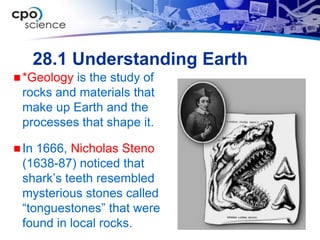
 In1666, Nicholas Steno
 (1638-87) noticed that
 shark’s teeth resembled
 mysterious stones called
 “tonguestones” that were
 found in local rocks.
28.1 Understanding Earth
 Steno’sexplanation helped
 him develop ideas about how
 rocks and fossils form.
 These  ideas are used in a
 technique called relative
 dating.
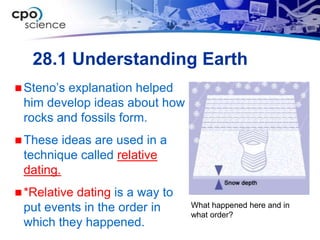
 *Relative
          dating is a way to
 put events in the order in    What happened here and in
                               what order?
 which they happened.
28.1 Understanding Earth
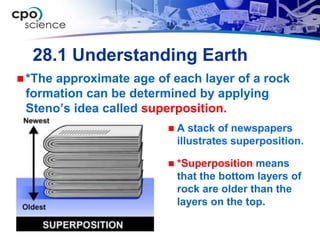
 *The
     approximate age of each layer of a rock
 formation can be determined by applying
 Steno’s idea called superposition.
                           A stack of newspapers
                            illustrates superposition.

                           *Superposition means
                            that the bottom layers of
                            rock are older than the
                            layers on the top.
28.1 Understanding Earth
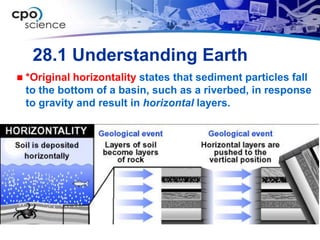
   *Original horizontality states that sediment particles fall
    to the bottom of a basin, such as a riverbed, in response
    to gravity and result in horizontal layers.
28.1 Understanding Earth
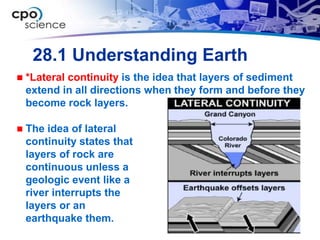
   *Lateral continuity is the idea that layers of sediment
    extend in all directions when they form and before they
    become rock layers.

   The idea of lateral
    continuity states that
    layers of rock are
    continuous unless a
    geologic event like a
    river interrupts the
    layers or an
    earthquake them.
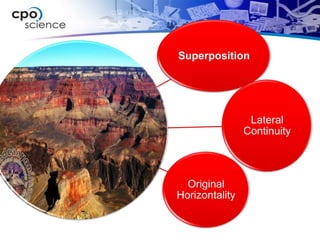
Superposition


                 Lateral
                Continuity


  Original
Horizontality
28.1 Understanding Earth
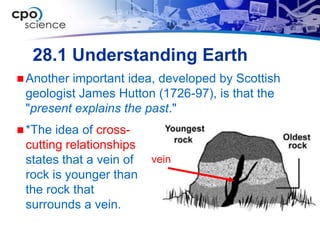
 Anotherimportant idea, developed by Scottish
 geologist James Hutton (1726-97), is that the
 "present explains the past."
 *The idea of cross-
 cutting relationships
 states that a vein of   vein
 rock is younger than
 the rock that
 surrounds a vein.
28.1 Understanding Earth
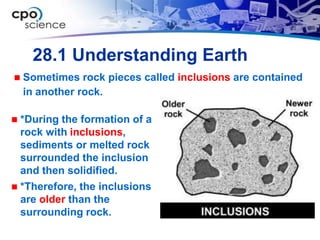
   Sometimes rock pieces called inclusions are contained
    in another rock.

 *During the formation of a
  rock with inclusions,
  sediments or melted rock
  surrounded the inclusion
  and then solidified.
 *Therefore, the inclusions
  are older than the
  surrounding rock.
28.1 Understanding Earth
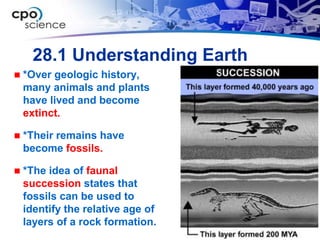
   *Over geologic history,
    many animals and plants
    have lived and become
    extinct.

   *Their remains have
    become fossils.

   *The idea of faunal
    succession states that
    fossils can be used to
    identify the relative age of
    layers of a rock formation.
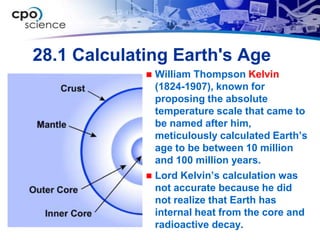
28.1 Calculating Earth's Age
              William Thompson Kelvin
               (1824-1907), known for
               proposing the absolute
               temperature scale that came to
               be named after him,
               meticulously calculated Earth’s
               age to be between 10 million
               and 100 million years.
              Lord Kelvin’s calculation was
               not accurate because he did
               not realize that Earth has
               internal heat from the core and
               radioactive decay.
28.1 Calculating Earth's Age
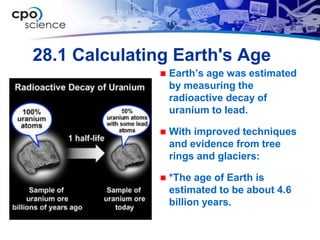
                 Earth’s age was estimated
                  by measuring the
                  radioactive decay of
                  uranium to lead.

                 With improved techniques
                  and evidence from tree
                  rings and glaciers:

                 *The age of Earth is
                  estimated to be about 4.6
                  billion years.
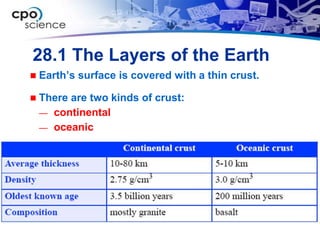
28.1 The Layers of the Earth
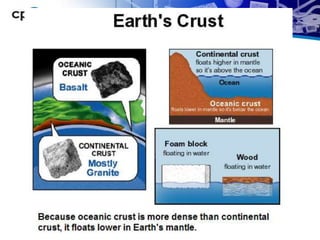
   Earth’s surface is covered with a thin crust.

   There are two kinds of crust:
    — continental
    — oceanic
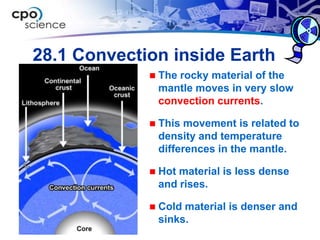
28.1 Convection inside Earth
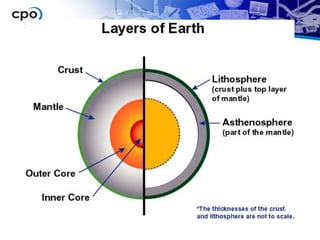
                The rocky material of the
                 mantle moves in very slow
                 convection currents.

                This movement is related to
                 density and temperature
                 differences in the mantle.

                Hot material is less dense
                 and rises.

                Cold material is denser and
                 sinks.
Structure of the Earth:
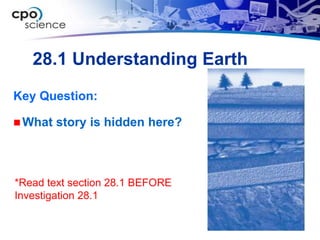
28.1 Understanding Earth
Key Question:

 What   story is hidden here?


*Read text section 28.1 BEFORE
Investigation 28.1

Chapter 28.1 modern geology

  • 1.
  • 2.
  • 3.
    28.1 Understanding Earth *Geologyis the study of rocks and materials that make up Earth and the processes that shape it.  In1666, Nicholas Steno (1638-87) noticed that shark’s teeth resembled mysterious stones called “tonguestones” that were found in local rocks.
  • 4.
    28.1 Understanding Earth Steno’sexplanation helped him develop ideas about how rocks and fossils form.  These ideas are used in a technique called relative dating.  *Relative dating is a way to put events in the order in What happened here and in what order? which they happened.
  • 5.
    28.1 Understanding Earth *The approximate age of each layer of a rock formation can be determined by applying Steno’s idea called superposition.  A stack of newspapers illustrates superposition.  *Superposition means that the bottom layers of rock are older than the layers on the top.
  • 6.
    28.1 Understanding Earth  *Original horizontality states that sediment particles fall to the bottom of a basin, such as a riverbed, in response to gravity and result in horizontal layers.
  • 7.
    28.1 Understanding Earth  *Lateral continuity is the idea that layers of sediment extend in all directions when they form and before they become rock layers.  The idea of lateral continuity states that layers of rock are continuous unless a geologic event like a river interrupts the layers or an earthquake them.
  • 8.
    Superposition Lateral Continuity Original Horizontality
  • 9.
    28.1 Understanding Earth Anotherimportant idea, developed by Scottish geologist James Hutton (1726-97), is that the "present explains the past."  *The idea of cross- cutting relationships states that a vein of vein rock is younger than the rock that surrounds a vein.
  • 10.
    28.1 Understanding Earth  Sometimes rock pieces called inclusions are contained in another rock.  *During the formation of a rock with inclusions, sediments or melted rock surrounded the inclusion and then solidified.  *Therefore, the inclusions are older than the surrounding rock.
  • 11.
    28.1 Understanding Earth  *Over geologic history, many animals and plants have lived and become extinct.  *Their remains have become fossils.  *The idea of faunal succession states that fossils can be used to identify the relative age of layers of a rock formation.
  • 12.
    28.1 Calculating Earth'sAge  William Thompson Kelvin (1824-1907), known for proposing the absolute temperature scale that came to be named after him, meticulously calculated Earth’s age to be between 10 million and 100 million years.  Lord Kelvin’s calculation was not accurate because he did not realize that Earth has internal heat from the core and radioactive decay.
  • 13.
    28.1 Calculating Earth'sAge  Earth’s age was estimated by measuring the radioactive decay of uranium to lead.  With improved techniques and evidence from tree rings and glaciers:  *The age of Earth is estimated to be about 4.6 billion years.
  • 16.
    28.1 The Layersof the Earth  Earth’s surface is covered with a thin crust.  There are two kinds of crust: — continental — oceanic
  • 18.
    28.1 Convection insideEarth  The rocky material of the mantle moves in very slow convection currents.  This movement is related to density and temperature differences in the mantle.  Hot material is less dense and rises.  Cold material is denser and sinks.
  • 19.
  • 20.
    28.1 Understanding Earth KeyQuestion:  What story is hidden here? *Read text section 28.1 BEFORE Investigation 28.1