Cells
● The basic unit of all living organisms
● Its surrounded by a cell surface
membrane
● Contains genetic material(DNA)
● Contains cytoplasm and organelles
Cells
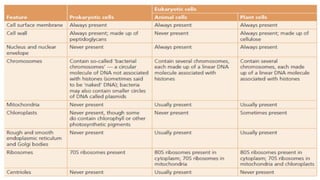
There are two types of cells-
❖ Complex cells
➢ Contains a nucleus surrounded by two
membranes
➢ Nucleus contains the DNA inside
➢ Organisms that have a complex cell
structure is known as Eukaryotes
➢ Cells of eg-animals,plants,fungi
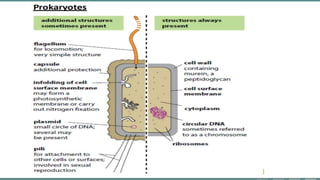
❖ Simple cells
➢ No nucleus
➢ DNA is free in the cytoplasm
➢ Organisms that have a simple cell
structure is known as Prokaryotes
➢ Cells of eg-Bacteria
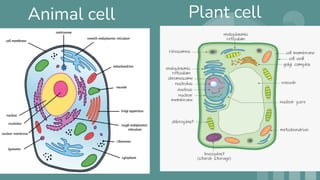
Animal cell Plant cell
Cell membrane
● Also known as Plasma membrane
● Both Eukaryotic cells and
Prokaryotic cells are surrounded by
cell surface membrane
● Its about 7nm in size
● Its partially permeable
● Controls the exchange of materials
between cell and its environment
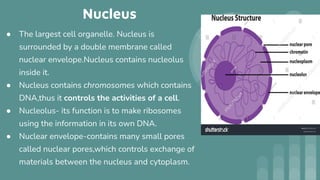
Nucleus
● The largest cell organelle. Nucleus is
surrounded by a double membrane called
nuclear envelope.Nucleus contains nucleolus
inside it.
● Nucleus contains chromosomes which contains
DNA,thus it controls the activities of a cell.
● Nucleolus- its function is to make ribosomes
using the information in its own DNA.
● Nuclear envelope-contains many small pores
called nuclear pores,which controls exchange of
materials between the nucleus and cytoplasm.
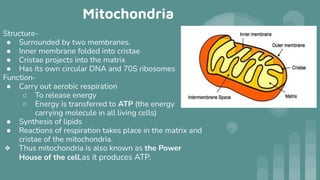
Mitochondria
Structure-
● Surrounded by two membranes.
● Inner membrane folded into cristae
● Cristae projects into the matrix
● Has its own circular DNA and 70S ribosomes
Function-
● Carry out aerobic respiration
○ To release energy
○ Energy is transferred to ATP (the energy
carrying molecule in all living cells)
● Synthesis of lipids
● Reactions of respiration takes place in the matrix and
cristae of the mitochondria.
❖ Thus mitochondria is also known as the Power
House of the cell,as it produces ATP.
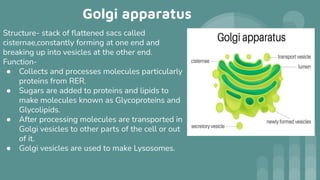
Golgi apparatus
Structure- stack of flattened sacs called
cisternae,constantly forming at one end and
breaking up into vesicles at the other end.
Function-
● Collects and processes molecules particularly
proteins from RER.
● Sugars are added to proteins and lipids to
make molecules known as Glycoproteins and
Glycolipids.
● After processing molecules are transported in
Golgi vesicles to other parts of the cell or out
of it.
● Golgi vesicles are used to make Lysosomes.
Lysosomes
Structure- spherical organelle,surrounded by a single
membrane.Contains digestive enzymes.Present in eukaryotes.
Function-
● It contains enzymes called hydrlases
● Lysosomes engulf and destroy unwanted cell components.
● May fuse with the Endocytic vacuoles formed and digest it.
● Release enzymes from cell for extracellular digestion
(Exocytotis)
● Contents of lysosomes are sometimes released into the
cytoplasm to digest the whole cell.
Endoplasmic reticulum(ER)
and Ribosomes
● ER are A network of flattened sacs running through cytoplasm.
● Its Present in Eukaryotes.
➔ Two types of ER: 1.Rough ER 2.Smooth ER
◆ RoughER: Covered with Ribosomes.
Continuous with the nucleus.
Synthesises and Packages secretory
proteins.
◆ SmoothER: Lacks ribosomes
Makes lipids,cholesterol,reproductive hormones.
Storage site for Calcium ions.
Ribosomes:
● Are found in all cells
● Involved in protein synthesis
● Eukaryotic ribosomes are 80S and Prokaryotic ribosomes are
70S.
● Mitochondria and chloroplasts contain their own 70S
ribosomes.
Cell wall
● Present in plant cells and prokaryotes
● Plant cell walls are made up of Cellulose running parallel
in different directions.
● Its fully permeable.
Functions-
● Provides mechanical strength and support
● Prevents cells from bursting by osmosis
● Arrangement of the cellulose fibres determines the shape
of cell
● Control of water and minerals uptaken by the plant
● Reduces waterloss due to the presence of waxy cuticle on
their outerwalls in epidermal cells
Vacuoles and Chloroplasts
Vacuoles: Plant cell have a Large central vacuole. Has a
single membrane called tonoplast. Vacuole functions are:-
● Support the cell due to its turgidity
● Lysosomal activity
● Food reservers,such as sucrose or mineral salts.
● May Store waste products.
● Growth in size
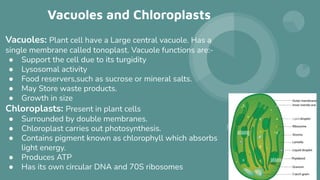
Chloroplasts: Present in plant cells
● Surrounded by double membranes.
● Chloroplast carries out photosynthesis.
● Contains pigment known as chlorophyll which absorbs
light energy.
● Produces ATP
● Has its own circular DNA and 70S ribosomes
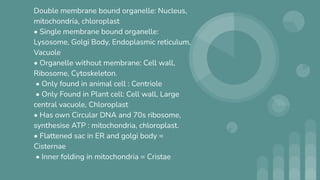
Double membrane bound organelle: Nucleus,
mitochondria, chloroplast
• Single membrane bound organelle:
Lysosome, Golgi Body, Endoplasmic reticulum,
Vacuole
• Organelle without membrane: Cell wall,
Ribosome, Cytoskeleton.
• Only found in animal cell : Centriole
• Only Found in Plant cell: Cell wall, Large
central vacuole, Chloroplast
• Has own Circular DNA and 70s ribosome,
synthesise ATP : mitochondria, chloroplast.
• Flattened sac in ER and golgi body =
Cisternae
• Inner folding in mitochondria = Cristae
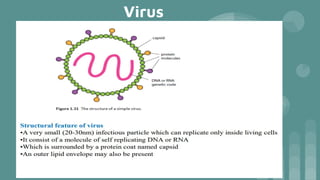
Virus
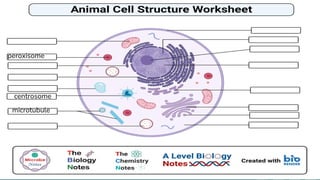
peroxisome
centrosome
microtubule
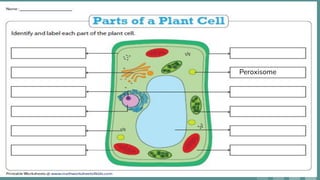
Peroxisome

Cells_juniorcategory_forcgrade-from 6.pdf

  • 1.
    Cells ● The basicunit of all living organisms ● Its surrounded by a cell surface membrane ● Contains genetic material(DNA) ● Contains cytoplasm and organelles
  • 2.
    Cells There are twotypes of cells- ❖ Complex cells ➢ Contains a nucleus surrounded by two membranes ➢ Nucleus contains the DNA inside ➢ Organisms that have a complex cell structure is known as Eukaryotes ➢ Cells of eg-animals,plants,fungi ❖ Simple cells ➢ No nucleus ➢ DNA is free in the cytoplasm ➢ Organisms that have a simple cell structure is known as Prokaryotes ➢ Cells of eg-Bacteria
  • 3.
  • 4.
    Cell membrane ● Alsoknown as Plasma membrane ● Both Eukaryotic cells and Prokaryotic cells are surrounded by cell surface membrane ● Its about 7nm in size ● Its partially permeable ● Controls the exchange of materials between cell and its environment
  • 5.
    Nucleus ● The largestcell organelle. Nucleus is surrounded by a double membrane called nuclear envelope.Nucleus contains nucleolus inside it. ● Nucleus contains chromosomes which contains DNA,thus it controls the activities of a cell. ● Nucleolus- its function is to make ribosomes using the information in its own DNA. ● Nuclear envelope-contains many small pores called nuclear pores,which controls exchange of materials between the nucleus and cytoplasm.
  • 6.
    Mitochondria Structure- ● Surrounded bytwo membranes. ● Inner membrane folded into cristae ● Cristae projects into the matrix ● Has its own circular DNA and 70S ribosomes Function- ● Carry out aerobic respiration ○ To release energy ○ Energy is transferred to ATP (the energy carrying molecule in all living cells) ● Synthesis of lipids ● Reactions of respiration takes place in the matrix and cristae of the mitochondria. ❖ Thus mitochondria is also known as the Power House of the cell,as it produces ATP.
  • 7.
    Golgi apparatus Structure- stackof flattened sacs called cisternae,constantly forming at one end and breaking up into vesicles at the other end. Function- ● Collects and processes molecules particularly proteins from RER. ● Sugars are added to proteins and lipids to make molecules known as Glycoproteins and Glycolipids. ● After processing molecules are transported in Golgi vesicles to other parts of the cell or out of it. ● Golgi vesicles are used to make Lysosomes.
  • 8.
    Lysosomes Structure- spherical organelle,surroundedby a single membrane.Contains digestive enzymes.Present in eukaryotes. Function- ● It contains enzymes called hydrlases ● Lysosomes engulf and destroy unwanted cell components. ● May fuse with the Endocytic vacuoles formed and digest it. ● Release enzymes from cell for extracellular digestion (Exocytotis) ● Contents of lysosomes are sometimes released into the cytoplasm to digest the whole cell.
  • 9.
    Endoplasmic reticulum(ER) and Ribosomes ●ER are A network of flattened sacs running through cytoplasm. ● Its Present in Eukaryotes. ➔ Two types of ER: 1.Rough ER 2.Smooth ER ◆ RoughER: Covered with Ribosomes. Continuous with the nucleus. Synthesises and Packages secretory proteins. ◆ SmoothER: Lacks ribosomes Makes lipids,cholesterol,reproductive hormones. Storage site for Calcium ions. Ribosomes: ● Are found in all cells ● Involved in protein synthesis ● Eukaryotic ribosomes are 80S and Prokaryotic ribosomes are 70S. ● Mitochondria and chloroplasts contain their own 70S ribosomes.
  • 10.
    Cell wall ● Presentin plant cells and prokaryotes ● Plant cell walls are made up of Cellulose running parallel in different directions. ● Its fully permeable. Functions- ● Provides mechanical strength and support ● Prevents cells from bursting by osmosis ● Arrangement of the cellulose fibres determines the shape of cell ● Control of water and minerals uptaken by the plant ● Reduces waterloss due to the presence of waxy cuticle on their outerwalls in epidermal cells
  • 11.
    Vacuoles and Chloroplasts Vacuoles:Plant cell have a Large central vacuole. Has a single membrane called tonoplast. Vacuole functions are:- ● Support the cell due to its turgidity ● Lysosomal activity ● Food reservers,such as sucrose or mineral salts. ● May Store waste products. ● Growth in size Chloroplasts: Present in plant cells ● Surrounded by double membranes. ● Chloroplast carries out photosynthesis. ● Contains pigment known as chlorophyll which absorbs light energy. ● Produces ATP ● Has its own circular DNA and 70S ribosomes
  • 12.
    Double membrane boundorganelle: Nucleus, mitochondria, chloroplast • Single membrane bound organelle: Lysosome, Golgi Body, Endoplasmic reticulum, Vacuole • Organelle without membrane: Cell wall, Ribosome, Cytoskeleton. • Only found in animal cell : Centriole • Only Found in Plant cell: Cell wall, Large central vacuole, Chloroplast • Has own Circular DNA and 70s ribosome, synthesise ATP : mitochondria, chloroplast. • Flattened sac in ER and golgi body = Cisternae • Inner folding in mitochondria = Cristae
  • 14.
  • 16.
  • 17.