Causes of Settlement, Foundation Loading
   and Computation of Design Loads
SETTLEMENT UNDER LOADS
Occurs immediately after the construction of
structure.

Also known as ‘Distortion Settlement’, it occurs
due to distortion in foundation soil.

Although its not truly elastic, it is computed
using elasticity theory. It is denoted by Si.
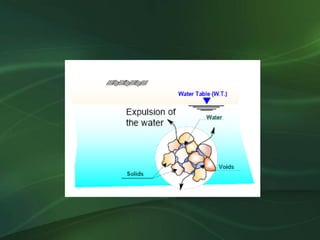
Occurs due to gradual dissipation of pore
pressure induced by external loading and
consequently expulsion of water from the soil
mass, hence volume change.

Important for Inorganic clays. This component is
determined using Terzaghi’s theory of
consolidation.

It is denoted as Sc.
This settlement occurs after completion of the
primary consolidation
Occurs at constant settlement effective stress
with volume change due to rearrangement of
particles.
This component of the settlement is due to
secondary consolidation. It is significant for
organic soils.

Determined from the coefficient of secondary
consolidation. Denoted as Ss
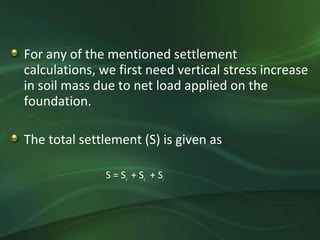
For any of the mentioned settlement
calculations, we first need vertical stress increase
in soil mass due to net load applied on the
foundation.

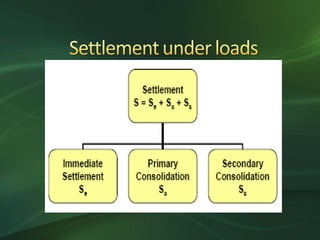
The total settlement (S) is given as

              S = S s + Sc + Si
Underground erosion may cause formation of
cavities in the subsoil which when collapse cause
settlement.

Structural collapse of soil may cause to
dissolution of material responsible for the inter-
granular bond of grains.

Temperature change causes shrinkage in
expansive soils due to which settlement occurs.
Frost heave occurs if the structure is not
founded below the depth of frost penetration.
When thaw occurs, settlement occurs.

Vibrations and Shocks cause large settlement,
especially in loose and cohesionless soils.

Mining subsidence of ground may occur due to
removal of minerals and other materials from
mines below.
Land slides occur on unstable slopes, there may
be serious settlement problem.


If there are changes due to construction of a new
building near the existing foundation, the
settlement may occur due to increase in the
stress.
Dead load
Live load
Wind load
Snow load
Earth pressure
Water pressure
Earthquake load
Dead load :
   The dead load include the weight of materials
   permanently fixed to the structure, such as beam,
   column, floors,walls and fixed service equipment.

   Can be calculated if sizes and types of structural
   materials are known.

   There is a problem in estimating the self weight of
   the structure because self weight is initially assumed
   and the structure is designed.

   Then weight is calculated from the designed
   dimension and compared with the assumed weight.
Live load :
   The live loads are the movable loads that are not
   permanently attached to the structure.

   These loads are applied during a part of its useful
   life.

   Loads due to people, goods, furniture, equipment
   etc. are considered in live loads.

   It is difficult to estimate the live load accurately.
   These are specified by local building codes.
Wind load :
   Wind loads acts on all exposed surfaces of the
   structure.
   This loads depends on the velocity of wind and type
   of the structure.
   Wind loads are specified by building codes.

Snow loads :
   Snow loads are occur due to accumulation of snow
   on roofs and exterior flat surfaces in cold climates.
   The unit weight of snow load is usually taken as
   1kN/sq m
Earth pressure :
   Earth pressure produce lateral force against the
   structure below the ground surface or fill surface.
   The earth pressure is normally treated as dead load.

Water pressure :
   Like earth pressure water, water pressure also
   produces a lateral force against the structure below
   the water level.

Earthquake pressure :
   The force due to earthquake may be vertical, lateral
   or torsional on a structure in any direction.
Dead load and live load are computed by
tributary area method.
In tributary area method, it is assumed that a
column carries all the load in the floor area
enclosed by lines equidistant from its adjacent
columns.
Live loads are temporary and transient. A part of
it may act for a duration that may induced
settlement, especially for cohesive soil.
Live loads are referred from IS-875.
It is assumed that wind load and earthquake load
do not act simultaneously.

According to IS 1904-1978 foundation should be
proportioned for the combination
dead load + live load and
dead load + live load + wind load or seismic
load
If the wind load is less than 25% of the total Dead
load + Live Load, then it may be neglected and it
is designed for the combination of Dead load and
live load only.

The Foundation pressure should not the exceed
the safe bearing capacity by more than 25% for
the combination of dead load, live load and wind
load.
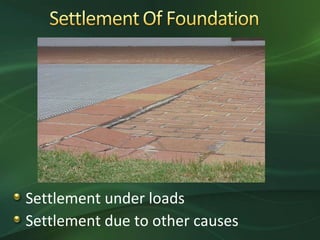
Settlement under loads
Settlement due to other causes

Causes of settlement, foundation loading and computation

  • 1.
    Causes of Settlement,Foundation Loading and Computation of Design Loads
  • 2.
  • 4.
    Occurs immediately afterthe construction of structure. Also known as ‘Distortion Settlement’, it occurs due to distortion in foundation soil. Although its not truly elastic, it is computed using elasticity theory. It is denoted by Si.
  • 5.
    Occurs due togradual dissipation of pore pressure induced by external loading and consequently expulsion of water from the soil mass, hence volume change. Important for Inorganic clays. This component is determined using Terzaghi’s theory of consolidation. It is denoted as Sc.
  • 7.
    This settlement occursafter completion of the primary consolidation Occurs at constant settlement effective stress with volume change due to rearrangement of particles. This component of the settlement is due to secondary consolidation. It is significant for organic soils. Determined from the coefficient of secondary consolidation. Denoted as Ss
  • 8.
    For any ofthe mentioned settlement calculations, we first need vertical stress increase in soil mass due to net load applied on the foundation. The total settlement (S) is given as S = S s + Sc + Si
  • 9.
    Underground erosion maycause formation of cavities in the subsoil which when collapse cause settlement. Structural collapse of soil may cause to dissolution of material responsible for the inter- granular bond of grains. Temperature change causes shrinkage in expansive soils due to which settlement occurs.
  • 10.
    Frost heave occursif the structure is not founded below the depth of frost penetration. When thaw occurs, settlement occurs. Vibrations and Shocks cause large settlement, especially in loose and cohesionless soils. Mining subsidence of ground may occur due to removal of minerals and other materials from mines below.
  • 11.
    Land slides occuron unstable slopes, there may be serious settlement problem. If there are changes due to construction of a new building near the existing foundation, the settlement may occur due to increase in the stress.
  • 12.
    Dead load Live load Windload Snow load Earth pressure Water pressure Earthquake load
  • 13.
    Dead load : The dead load include the weight of materials permanently fixed to the structure, such as beam, column, floors,walls and fixed service equipment. Can be calculated if sizes and types of structural materials are known. There is a problem in estimating the self weight of the structure because self weight is initially assumed and the structure is designed. Then weight is calculated from the designed dimension and compared with the assumed weight.
  • 14.
    Live load : The live loads are the movable loads that are not permanently attached to the structure. These loads are applied during a part of its useful life. Loads due to people, goods, furniture, equipment etc. are considered in live loads. It is difficult to estimate the live load accurately. These are specified by local building codes.
  • 15.
    Wind load : Wind loads acts on all exposed surfaces of the structure. This loads depends on the velocity of wind and type of the structure. Wind loads are specified by building codes. Snow loads : Snow loads are occur due to accumulation of snow on roofs and exterior flat surfaces in cold climates. The unit weight of snow load is usually taken as 1kN/sq m
  • 16.
    Earth pressure : Earth pressure produce lateral force against the structure below the ground surface or fill surface. The earth pressure is normally treated as dead load. Water pressure : Like earth pressure water, water pressure also produces a lateral force against the structure below the water level. Earthquake pressure : The force due to earthquake may be vertical, lateral or torsional on a structure in any direction.
  • 17.
    Dead load andlive load are computed by tributary area method. In tributary area method, it is assumed that a column carries all the load in the floor area enclosed by lines equidistant from its adjacent columns. Live loads are temporary and transient. A part of it may act for a duration that may induced settlement, especially for cohesive soil. Live loads are referred from IS-875.
  • 18.
    It is assumedthat wind load and earthquake load do not act simultaneously. According to IS 1904-1978 foundation should be proportioned for the combination dead load + live load and dead load + live load + wind load or seismic load
  • 19.
    If the windload is less than 25% of the total Dead load + Live Load, then it may be neglected and it is designed for the combination of Dead load and live load only. The Foundation pressure should not the exceed the safe bearing capacity by more than 25% for the combination of dead load, live load and wind load.
  • 20.