SATYAPAL SINGH
ASSISTANT
PROFESSOR
BADDI UNIVERSITY
PAVEMENT FAILURES AND
MAINTENANCE
Introduction
 Road maintenance is the one of the most
important component of the road system.
 It involves the assessment of road condition,
diagnosis of the problems and adopting the most
appropriate maintenance step.
 Even if the highway are well designed, they may
require maintenance due to its less design life.
 Various types of failures occurs in the pavement
which ranges from minor to major distresses.
General causes of pavement failure
1. Poor soil:- It is the most common problem in the
pavement design.
The most common soil problem in the Southeast is
a high water table. If not accounted for at the time of
construction, a high water table will erode the soil
and eventually lead to pavement failure.
2. Inferior material quality:- If the material laid on
the ground is not good enough, will be leads to
severe defects and failures.
3. Improper geometry:- Due to improper geometry of
road, lot of factors may arise which keeps the
pavement deformation.
Continue..
4. Overloading of vehicles:- A vehicle is said to
be heavy loaded when it is being loaded more
than its carrying capacity. Acc. to IRC, the max.
wheel load for standard axle is 80 KN. Due to
heavy movement of vehicles or overloaded
vehicles or increase traffic volume, severe
distresses takes place.
5. Environmental Factors:- It includes heavy
rainfall, soil erosion, high water table, snow fall,
frost action etc.
6. inadequate drainage:- Due to improper
drainage resulting in stagnation of water in the
subgrade which could be the main reason
pavement failure in future.
Flexible Pavement failures
 i. Surface deformation
 Corrugations
 Rutting
 Shoving
 Settlement and Upheaval
 ii. Cracking
 Fatigue Cracking
 Transverse Cracking
 Longitudinal Cracking
 Edge Cracking
 iii. Disintegration
 Potholes
 Patches
 iv. Surface defects
 Raveling
 Bleeding
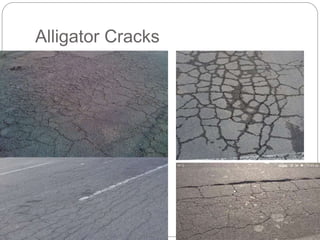
Flexible Pavement Failures
Alligator cracks:- known as map cracking or
crocodile cracking or Fatigue failure. Since it
appears similar as alligator skin so it is called
as alligator cracks.
 The failure can be due to weakness in the
surface, base or sub grade; a surface or base
that is too thin; poor drainage or the
combination of all three.
 The main reason of this type of failure is the
repetitive application of heavy movement of
traffic.
Alligator Cracks
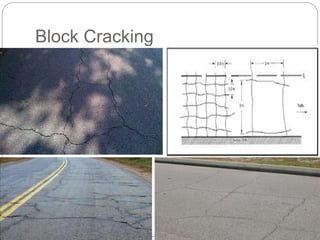
Block Cracks
 Block cracks look like large interconnected
rectangles (roughly).
 Generally it is caused by shrinkage of the asphalt
pavement due to an inability of asphalt binder to
expand and contract with temperature cycles.
 This can be because the mix was mixed and
placed too dry.
 The size of each rectangle may vary from one
foot by one foot to ten foot by ten foot.
 It spreads over a larger area of ground.
Block Cracking
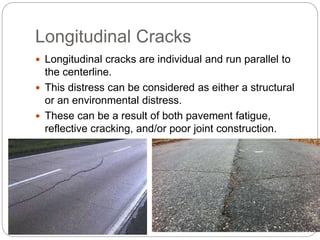
Longitudinal Cracks
 Longitudinal cracks are individual and run parallel to
the centerline.
 This distress can be considered as either a structural
or an environmental distress.
 These can be a result of both pavement fatigue,
reflective cracking, and/or poor joint construction.
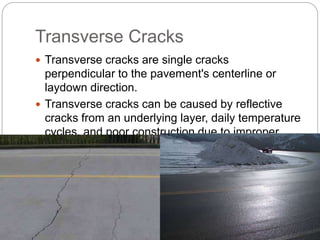
Transverse Cracks
 Transverse cracks are single cracks
perpendicular to the pavement's centerline or
laydown direction.
 Transverse cracks can be caused by reflective
cracks from an underlying layer, daily temperature
cycles, and poor construction due to improper
operation of the paver.
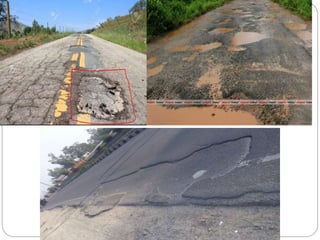
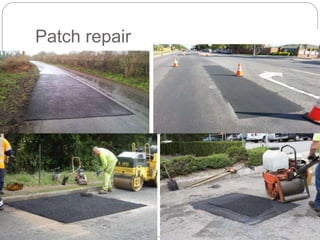
Patch
 A patch is an area or portion of pavement greater
than 0.1 sq.m that has been removed or replaced
with new material to repair the existing pavement.
 A patch is considered a defect no matter how well
it is performing (a patched area or adjacent area
usually does not perform as well as an original
pavement section).
 These defects can be improved by taking the
measurement in ft^2 or m^2. and filling it with a
fresh layer of the bitumen.
Patch repair
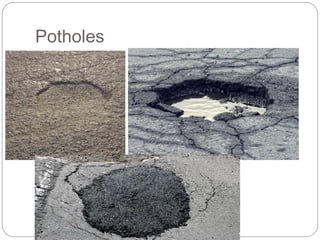
Potholes
 These are small, bowl-shaped depressions in the
pavement surface that penetrate all the way through
the asphalt layer down to the base course.
 In the Western United States, these are known as
chuckhole.
 The pothole can expand to several feet in width and
later it leads to the formation of patches. They don’t
develop too much in depth.
 The vehicle tires are damaged due to large potholes.
 In cold temperatures, the water trapped in the pothole
will carry out the freezing and thawing action that
leads to additional stresses and crack propagation.
 Potholes are also repaired by patchwork.
Potholes
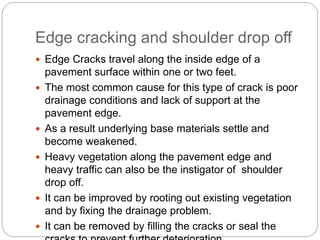
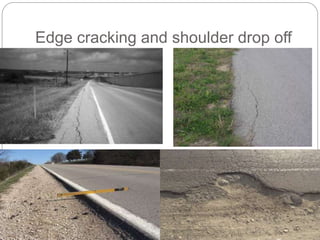
Edge cracking and shoulder drop off
 Edge Cracks travel along the inside edge of a
pavement surface within one or two feet.
 The most common cause for this type of crack is poor
drainage conditions and lack of support at the
pavement edge.
 As a result underlying base materials settle and
become weakened.
 Heavy vegetation along the pavement edge and
heavy traffic can also be the instigator of shoulder
drop off.
 It can be improved by rooting out existing vegetation
and by fixing the drainage problem.
 It can be removed by filling the cracks or seal the
Edge cracking and shoulder drop off
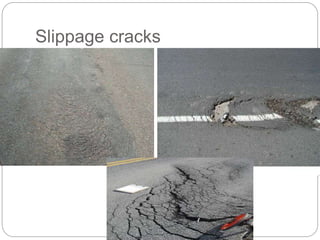
Slippage cracks
 Slippage cracks are crescent-shaped or horse
shoe shaped cracks or tears in the surface layer.
 It is the asphalt where the new material has
slipped over the underlying course.
 It is caused by a lack of bonding between layers.
 Acceleration, deceleration and sudden brakes on
the road are leads to slippage cracks.
 Mostly these cracks show on intersections due to
stopping.
Slippage cracks
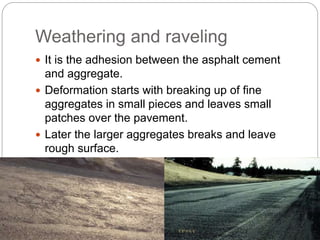
Weathering and raveling
 It is the adhesion between the asphalt cement
and aggregate.
 Deformation starts with breaking up of fine
aggregates in small pieces and leaves small
patches over the pavement.
 Later the larger aggregates breaks and leave
rough surface.
 There are many reasons why raveling can occur,
but one common cause is placing asphalt too late
in the season.
 Traffic loading is also one of the reason of
raveling.
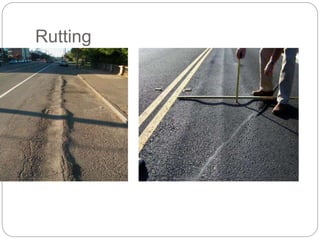
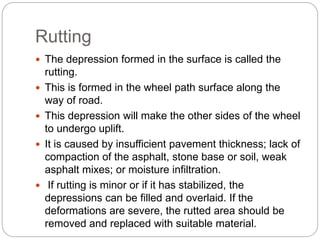
Rutting
 The depression formed in the surface is called the
rutting.
 This is formed in the wheel path surface along the
way of road.
 This depression will make the other sides of the wheel
to undergo uplift.
 It is caused by insufficient pavement thickness; lack of
compaction of the asphalt, stone base or soil, weak
asphalt mixes; or moisture infiltration.
 If rutting is minor or if it has stabilized, the
depressions can be filled and overlaid. If the
deformations are severe, the rutted area should be
removed and replaced with suitable material.
Rutting
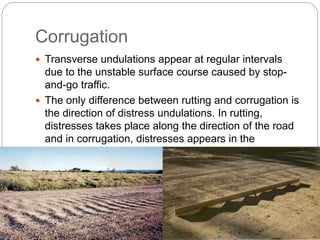
Corrugation
 Transverse undulations appear at regular intervals
due to the unstable surface course caused by stop-
and-go traffic.
 The only difference between rutting and corrugation is
the direction of distress undulations. In rutting,
distresses takes place along the direction of the road
and in corrugation, distresses appears in the
transverse direction.
 Where the traffic starts and stops, these distress are
observed.
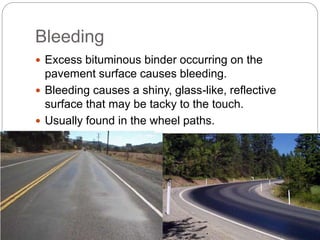
Bleeding
 Excess bituminous binder occurring on the
pavement surface causes bleeding.
 Bleeding causes a shiny, glass-like, reflective
surface that may be tacky to the touch.
 Usually found in the wheel paths.
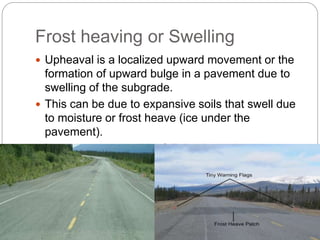
Frost heaving or Swelling
 Upheaval is a localized upward movement or the
formation of upward bulge in a pavement due to
swelling of the subgrade.
 This can be due to expansive soils that swell due
to moisture or frost heave (ice under the
pavement).
 It can be recovered by full depth patch.
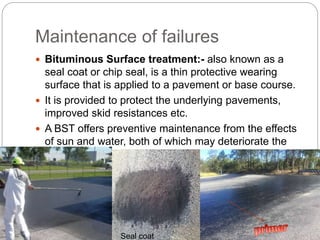
Maintenance of failures
 Bituminous Surface treatment:- also known as a
seal coat or chip seal, is a thin protective wearing
surface that is applied to a pavement or base course.
 It is provided to protect the underlying pavements,
improved skid resistances etc.
 A BST offers preventive maintenance from the effects
of sun and water, both of which may deteriorate the
pavement structure.
Seal coat
Continue…
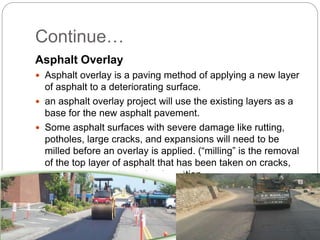
Asphalt Overlay
 Asphalt overlay is a paving method of applying a new layer
of asphalt to a deteriorating surface.
 an asphalt overlay project will use the existing layers as a
base for the new asphalt pavement.
 Some asphalt surfaces with severe damage like rutting,
potholes, large cracks, and expansions will need to be
milled before an overlay is applied. (“milling” is the removal
of the top layer of asphalt that has been taken on cracks,
raveling or other kind of deformation.
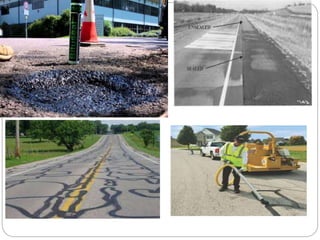
Slurry Seals, Crack Seals
 Slurry seals is a homogenous mixture of emulsified asphalt,
water, well-graded fine aggregate and mineral filler that has a
creamy fluid-like appearance when applied.
 Slurry seals are used to fill existing pavement surface defects as
either a preparatory treatment for other maintenance treatments
or as a wearing course.
 Crack seal products are used to fill individual pavement
cracks.
 It is used to prevent entry of water or other non-
compressible substances such as sand, dirt, rocks or
weeds.
 Crack sealant is typically used on early stage longitudinal
cracks, transverse cracks, reflection cracks and block
cracks.
 Crack filler material is typically some form of rubberized
asphalt or sand slurry
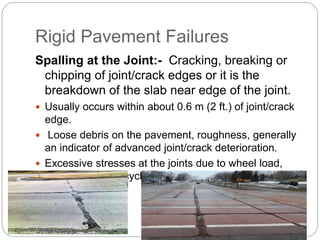
Rigid Pavement Failures
Spalling at the Joint:- Cracking, breaking or
chipping of joint/crack edges or it is the
breakdown of the slab near edge of the joint.
 Usually occurs within about 0.6 m (2 ft.) of joint/crack
edge.
 Loose debris on the pavement, roughness, generally
an indicator of advanced joint/crack deterioration.
 Excessive stresses at the joints due to wheel load,
freeze and thaw cycle and insufficient strength are the
main reasons.
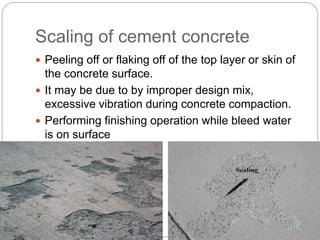
Scaling of cement concrete
 Peeling off or flaking off of the top layer or skin of
the concrete surface.
 It may be due to by improper design mix,
excessive vibration during concrete compaction.
 Performing finishing operation while bleed water
is on surface
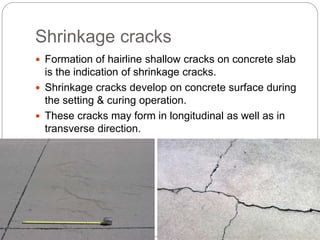
Shrinkage cracks
 Formation of hairline shallow cracks on concrete slab
is the indication of shrinkage cracks.
 Shrinkage cracks develop on concrete surface during
the setting & curing operation.
 These cracks may form in longitudinal as well as in
transverse direction.
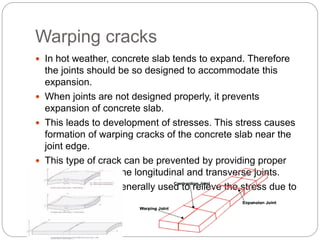
Warping cracks
 In hot weather, concrete slab tends to expand. Therefore
the joints should be so designed to accommodate this
expansion.
 When joints are not designed properly, it prevents
expansion of concrete slab.
 This leads to development of stresses. This stress causes
formation of warping cracks of the concrete slab near the
joint edge.
 This type of crack can be prevented by providing proper
reinforcement at the longitudinal and transverse joints.
 Hinge joints are generally used to relieve the stress due to
warping.
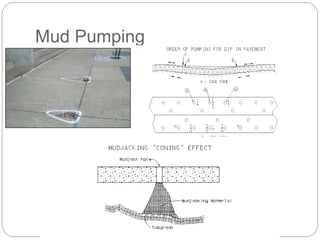
Mud pumping
 When material present below the road slab ejects out
through the joints or cracks, it is called pumping.
 When soil slurry comes out it is called mud pumping.
Common reasons are:-
 Infiltration of water through the joints, cracks or edge
of the pavement forms soil slurry.
 Movement of heavy vehicles on pavement forces this
soil slurry to come out causing mud pumping.
 When there is void space between slab and the
underlying base of sub-grade layer.
 When traffic load occurs, it fails to resist the bending
and hence cracks formation takes place.
Mud Pumping
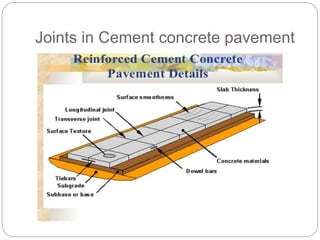
Joints in Cement concrete pavement
Pavement failures and maintenance

Pavement failures and maintenance

  • 1.
  • 2.
    Introduction  Road maintenanceis the one of the most important component of the road system.  It involves the assessment of road condition, diagnosis of the problems and adopting the most appropriate maintenance step.  Even if the highway are well designed, they may require maintenance due to its less design life.  Various types of failures occurs in the pavement which ranges from minor to major distresses.
  • 3.
    General causes ofpavement failure 1. Poor soil:- It is the most common problem in the pavement design. The most common soil problem in the Southeast is a high water table. If not accounted for at the time of construction, a high water table will erode the soil and eventually lead to pavement failure. 2. Inferior material quality:- If the material laid on the ground is not good enough, will be leads to severe defects and failures. 3. Improper geometry:- Due to improper geometry of road, lot of factors may arise which keeps the pavement deformation.
  • 4.
    Continue.. 4. Overloading ofvehicles:- A vehicle is said to be heavy loaded when it is being loaded more than its carrying capacity. Acc. to IRC, the max. wheel load for standard axle is 80 KN. Due to heavy movement of vehicles or overloaded vehicles or increase traffic volume, severe distresses takes place. 5. Environmental Factors:- It includes heavy rainfall, soil erosion, high water table, snow fall, frost action etc. 6. inadequate drainage:- Due to improper drainage resulting in stagnation of water in the subgrade which could be the main reason pavement failure in future.
  • 5.
    Flexible Pavement failures i. Surface deformation  Corrugations  Rutting  Shoving  Settlement and Upheaval  ii. Cracking  Fatigue Cracking  Transverse Cracking  Longitudinal Cracking  Edge Cracking  iii. Disintegration  Potholes  Patches  iv. Surface defects  Raveling  Bleeding
  • 6.
    Flexible Pavement Failures Alligatorcracks:- known as map cracking or crocodile cracking or Fatigue failure. Since it appears similar as alligator skin so it is called as alligator cracks.  The failure can be due to weakness in the surface, base or sub grade; a surface or base that is too thin; poor drainage or the combination of all three.  The main reason of this type of failure is the repetitive application of heavy movement of traffic.
  • 7.
  • 8.
    Block Cracks  Blockcracks look like large interconnected rectangles (roughly).  Generally it is caused by shrinkage of the asphalt pavement due to an inability of asphalt binder to expand and contract with temperature cycles.  This can be because the mix was mixed and placed too dry.  The size of each rectangle may vary from one foot by one foot to ten foot by ten foot.  It spreads over a larger area of ground.
  • 9.
  • 10.
    Longitudinal Cracks  Longitudinalcracks are individual and run parallel to the centerline.  This distress can be considered as either a structural or an environmental distress.  These can be a result of both pavement fatigue, reflective cracking, and/or poor joint construction.
  • 11.
    Transverse Cracks  Transversecracks are single cracks perpendicular to the pavement's centerline or laydown direction.  Transverse cracks can be caused by reflective cracks from an underlying layer, daily temperature cycles, and poor construction due to improper operation of the paver.
  • 12.
    Patch  A patchis an area or portion of pavement greater than 0.1 sq.m that has been removed or replaced with new material to repair the existing pavement.  A patch is considered a defect no matter how well it is performing (a patched area or adjacent area usually does not perform as well as an original pavement section).  These defects can be improved by taking the measurement in ft^2 or m^2. and filling it with a fresh layer of the bitumen.
  • 14.
  • 15.
    Potholes  These aresmall, bowl-shaped depressions in the pavement surface that penetrate all the way through the asphalt layer down to the base course.  In the Western United States, these are known as chuckhole.  The pothole can expand to several feet in width and later it leads to the formation of patches. They don’t develop too much in depth.  The vehicle tires are damaged due to large potholes.  In cold temperatures, the water trapped in the pothole will carry out the freezing and thawing action that leads to additional stresses and crack propagation.  Potholes are also repaired by patchwork.
  • 16.
  • 17.
    Edge cracking andshoulder drop off  Edge Cracks travel along the inside edge of a pavement surface within one or two feet.  The most common cause for this type of crack is poor drainage conditions and lack of support at the pavement edge.  As a result underlying base materials settle and become weakened.  Heavy vegetation along the pavement edge and heavy traffic can also be the instigator of shoulder drop off.  It can be improved by rooting out existing vegetation and by fixing the drainage problem.  It can be removed by filling the cracks or seal the
  • 18.
    Edge cracking andshoulder drop off
  • 19.
    Slippage cracks  Slippagecracks are crescent-shaped or horse shoe shaped cracks or tears in the surface layer.  It is the asphalt where the new material has slipped over the underlying course.  It is caused by a lack of bonding between layers.  Acceleration, deceleration and sudden brakes on the road are leads to slippage cracks.  Mostly these cracks show on intersections due to stopping.
  • 20.
  • 21.
    Weathering and raveling It is the adhesion between the asphalt cement and aggregate.  Deformation starts with breaking up of fine aggregates in small pieces and leaves small patches over the pavement.  Later the larger aggregates breaks and leave rough surface.  There are many reasons why raveling can occur, but one common cause is placing asphalt too late in the season.  Traffic loading is also one of the reason of raveling.
  • 22.
    Rutting  The depressionformed in the surface is called the rutting.  This is formed in the wheel path surface along the way of road.  This depression will make the other sides of the wheel to undergo uplift.  It is caused by insufficient pavement thickness; lack of compaction of the asphalt, stone base or soil, weak asphalt mixes; or moisture infiltration.  If rutting is minor or if it has stabilized, the depressions can be filled and overlaid. If the deformations are severe, the rutted area should be removed and replaced with suitable material.
  • 23.
  • 24.
    Corrugation  Transverse undulationsappear at regular intervals due to the unstable surface course caused by stop- and-go traffic.  The only difference between rutting and corrugation is the direction of distress undulations. In rutting, distresses takes place along the direction of the road and in corrugation, distresses appears in the transverse direction.  Where the traffic starts and stops, these distress are observed.
  • 25.
    Bleeding  Excess bituminousbinder occurring on the pavement surface causes bleeding.  Bleeding causes a shiny, glass-like, reflective surface that may be tacky to the touch.  Usually found in the wheel paths.
  • 26.
    Frost heaving orSwelling  Upheaval is a localized upward movement or the formation of upward bulge in a pavement due to swelling of the subgrade.  This can be due to expansive soils that swell due to moisture or frost heave (ice under the pavement).  It can be recovered by full depth patch.
  • 27.
    Maintenance of failures Bituminous Surface treatment:- also known as a seal coat or chip seal, is a thin protective wearing surface that is applied to a pavement or base course.  It is provided to protect the underlying pavements, improved skid resistances etc.  A BST offers preventive maintenance from the effects of sun and water, both of which may deteriorate the pavement structure. Seal coat
  • 28.
    Continue… Asphalt Overlay  Asphaltoverlay is a paving method of applying a new layer of asphalt to a deteriorating surface.  an asphalt overlay project will use the existing layers as a base for the new asphalt pavement.  Some asphalt surfaces with severe damage like rutting, potholes, large cracks, and expansions will need to be milled before an overlay is applied. (“milling” is the removal of the top layer of asphalt that has been taken on cracks, raveling or other kind of deformation.
  • 29.
    Slurry Seals, CrackSeals  Slurry seals is a homogenous mixture of emulsified asphalt, water, well-graded fine aggregate and mineral filler that has a creamy fluid-like appearance when applied.  Slurry seals are used to fill existing pavement surface defects as either a preparatory treatment for other maintenance treatments or as a wearing course.  Crack seal products are used to fill individual pavement cracks.  It is used to prevent entry of water or other non- compressible substances such as sand, dirt, rocks or weeds.  Crack sealant is typically used on early stage longitudinal cracks, transverse cracks, reflection cracks and block cracks.  Crack filler material is typically some form of rubberized asphalt or sand slurry
  • 31.
    Rigid Pavement Failures Spallingat the Joint:- Cracking, breaking or chipping of joint/crack edges or it is the breakdown of the slab near edge of the joint.  Usually occurs within about 0.6 m (2 ft.) of joint/crack edge.  Loose debris on the pavement, roughness, generally an indicator of advanced joint/crack deterioration.  Excessive stresses at the joints due to wheel load, freeze and thaw cycle and insufficient strength are the main reasons.
  • 32.
    Scaling of cementconcrete  Peeling off or flaking off of the top layer or skin of the concrete surface.  It may be due to by improper design mix, excessive vibration during concrete compaction.  Performing finishing operation while bleed water is on surface
  • 33.
    Shrinkage cracks  Formationof hairline shallow cracks on concrete slab is the indication of shrinkage cracks.  Shrinkage cracks develop on concrete surface during the setting & curing operation.  These cracks may form in longitudinal as well as in transverse direction.
  • 34.
    Warping cracks  Inhot weather, concrete slab tends to expand. Therefore the joints should be so designed to accommodate this expansion.  When joints are not designed properly, it prevents expansion of concrete slab.  This leads to development of stresses. This stress causes formation of warping cracks of the concrete slab near the joint edge.  This type of crack can be prevented by providing proper reinforcement at the longitudinal and transverse joints.  Hinge joints are generally used to relieve the stress due to warping.

  • 35.
    Mud pumping  Whenmaterial present below the road slab ejects out through the joints or cracks, it is called pumping.  When soil slurry comes out it is called mud pumping. Common reasons are:-  Infiltration of water through the joints, cracks or edge of the pavement forms soil slurry.  Movement of heavy vehicles on pavement forces this soil slurry to come out causing mud pumping.  When there is void space between slab and the underlying base of sub-grade layer.  When traffic load occurs, it fails to resist the bending and hence cracks formation takes place.
  • 36.
  • 37.
    Joints in Cementconcrete pavement