Water Resource Engineering
By
Mr.Hole G.R.
Civil Engineering Department
J.S. Polytechnic, Hadapsar, Pune
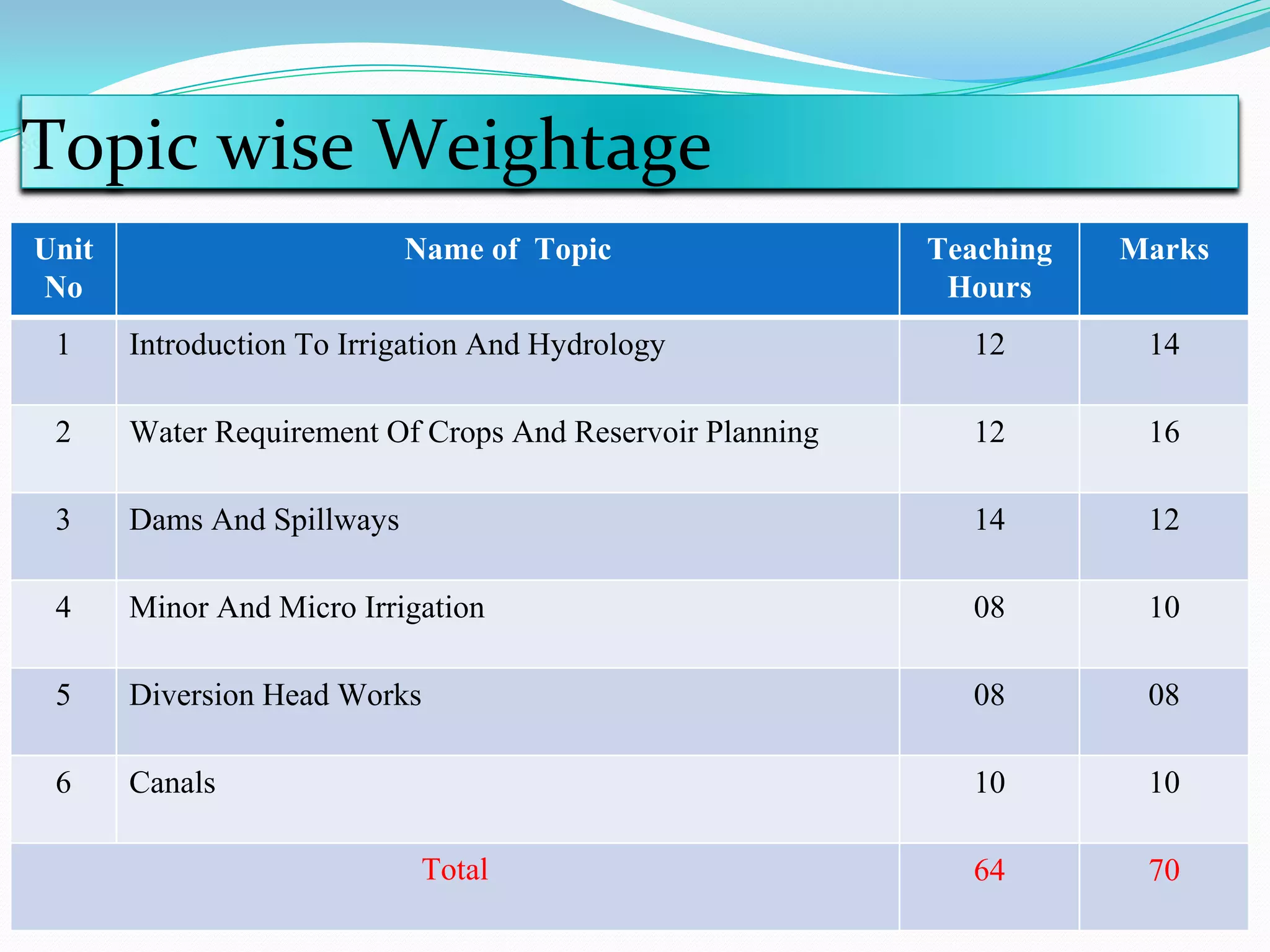
Topic wise Weightage
Unit
No
Name of Topic Teaching
Hours
Marks
1 Introduction To Irrigation And Hydrology 12 14
2 Water Requirement Of Crops And Reservoir Planning 12 16
3 Dams And Spillways 14 12
4 Minor And Micro Irrigation 08 10
5 Diversion Head Works 08 08
6 Canals 10 10
Total 64 70
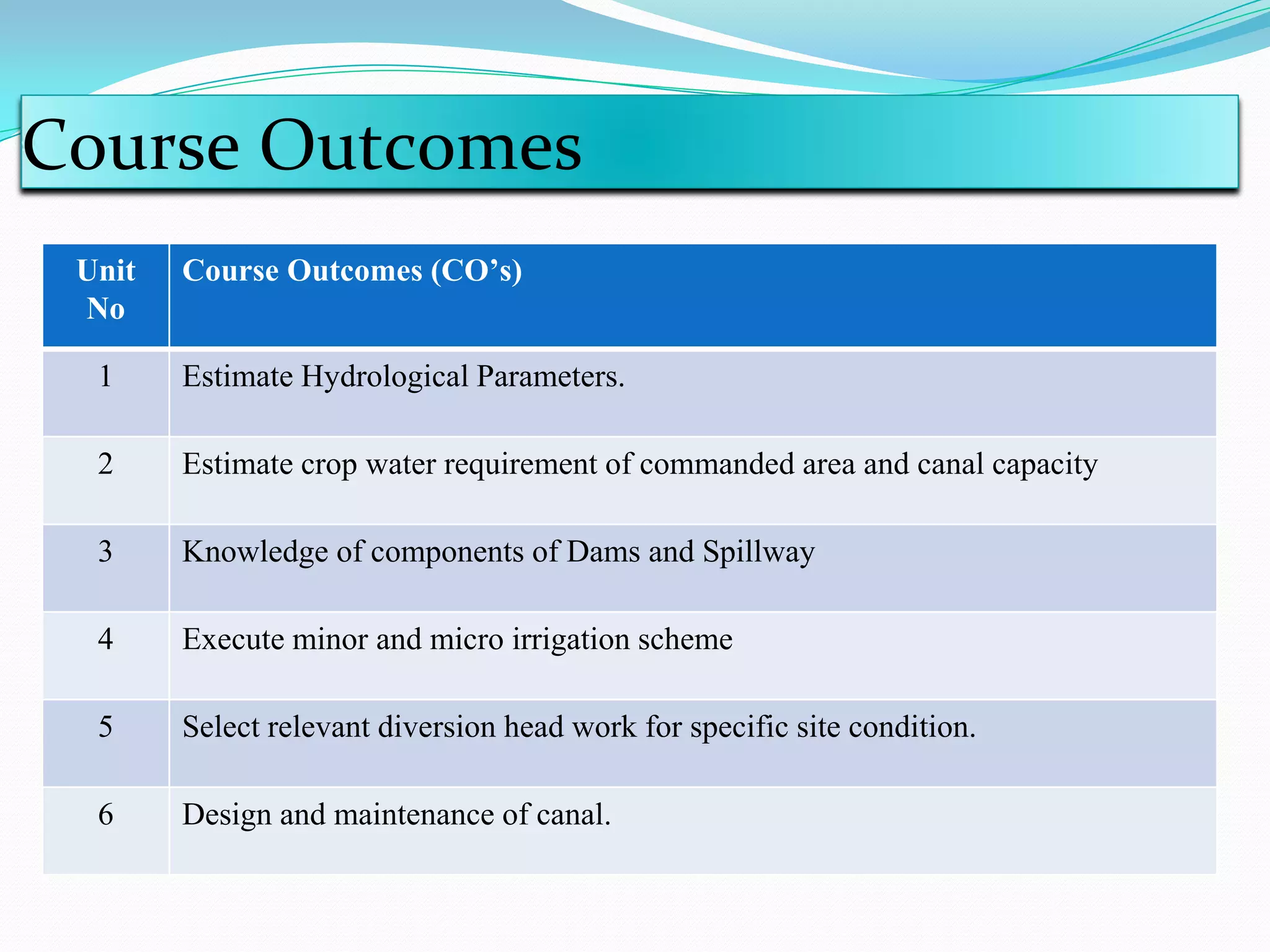
Course Outcomes
Unit
No
Course Outcomes (CO’s)
1 Estimate Hydrological Parameters.
2 Estimate crop water requirement of commanded area and canal capacity
3 Knowledge of components of Dams and Spillway
4 Execute minor and micro irrigation scheme
5 Select relevant diversion head work for specific site condition.
6 Design and maintenance of canal.
Unit No. 01
Introduction to Irrigation
Engineering
and Hydrology
Content
➔Definition Of Irrigation
➔Necessity of Irrigation in India.
➔Advantages and Dis-Advantages of Irrigation
➔Classification of Irrigation.
➔Concept of Hydrology And Imp Definitions.
➔Rain Gauge and Rainfall Calculation.
➔Runoff ,Factors Affecting Runoff and Runoff computation.
➔Concept of MFD
➔Yield and Dependable Yield of catchment.
Definition Of Irrigation
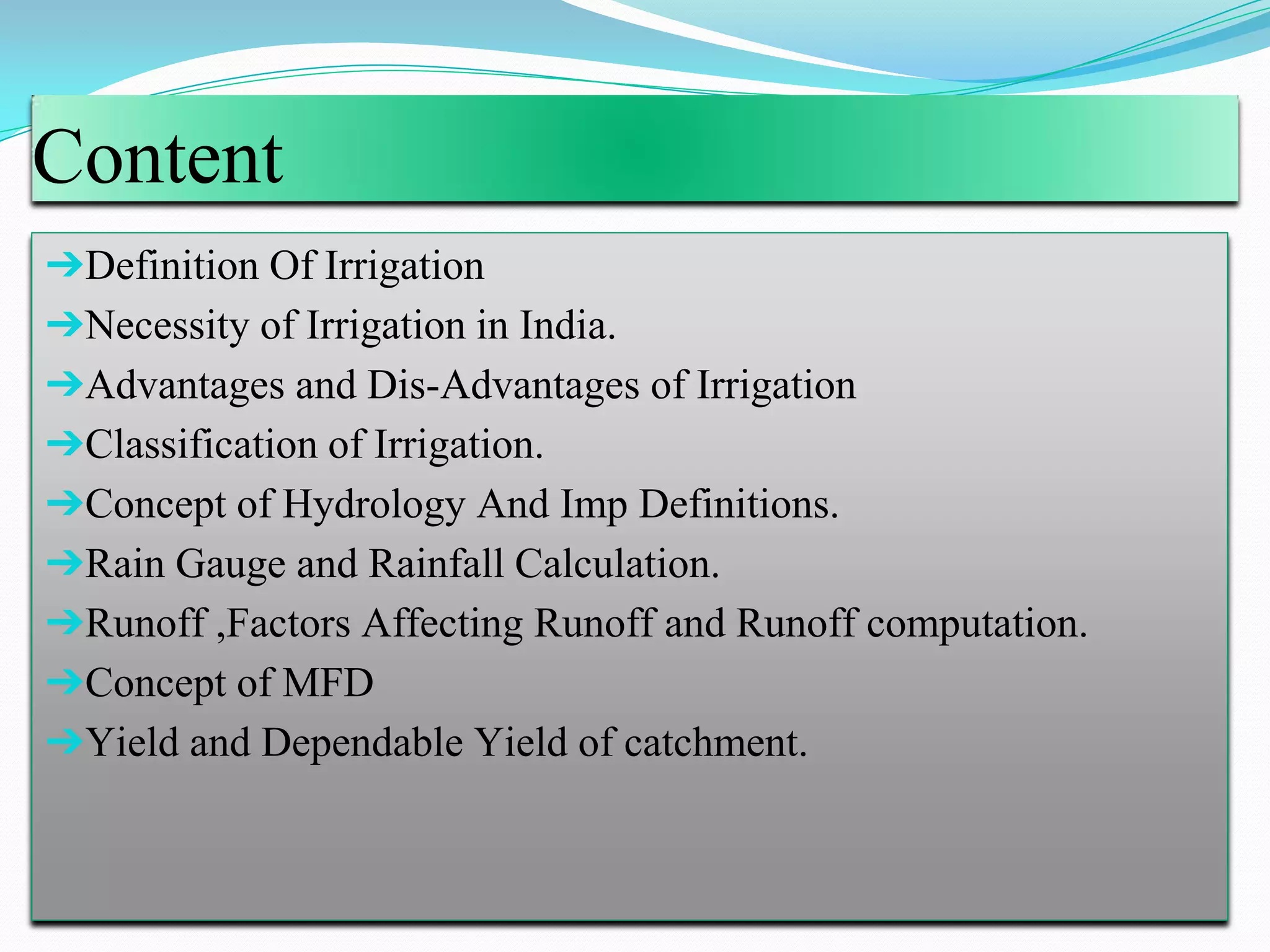
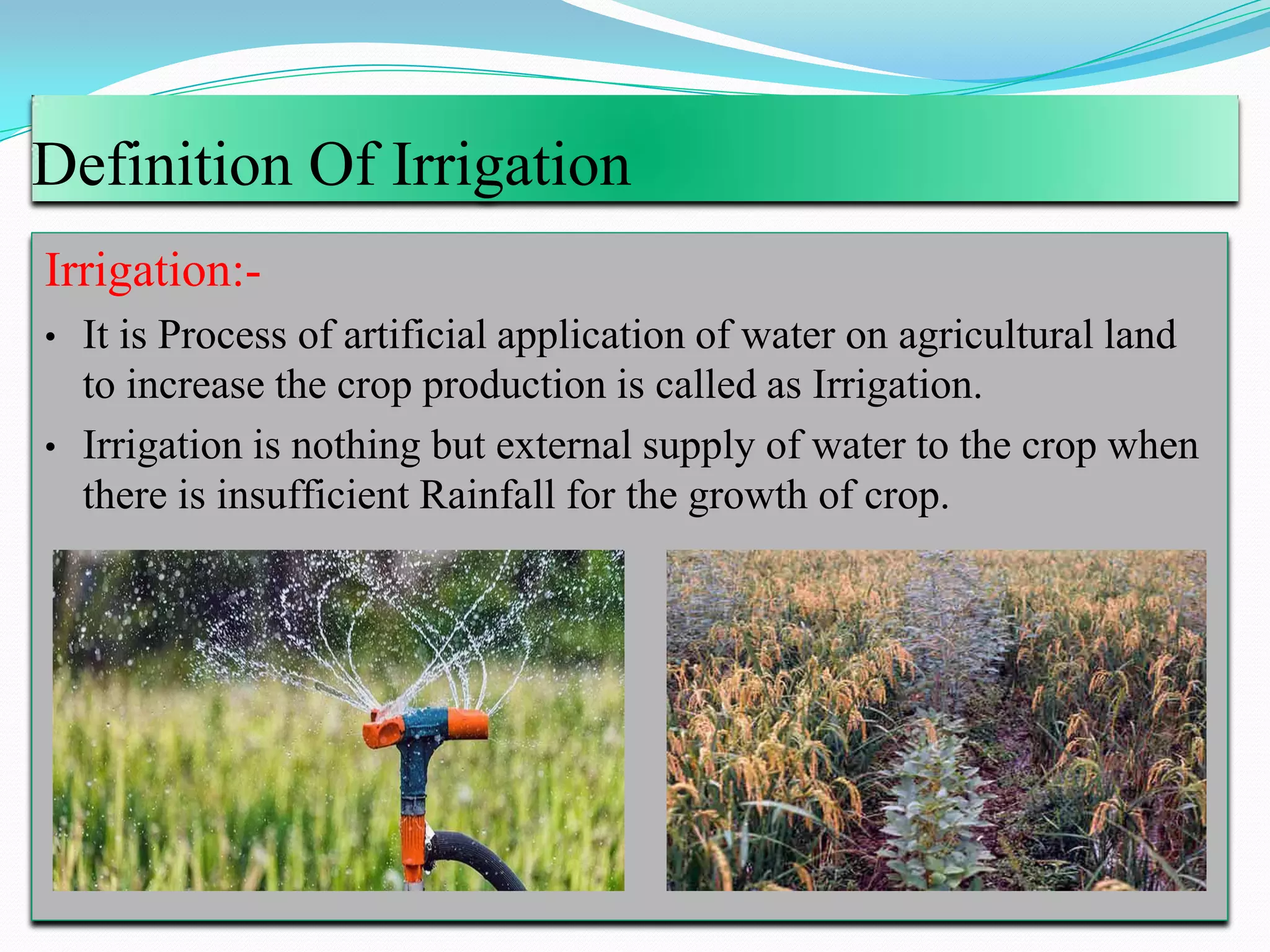
Irrigation:-
• It is Process of artificial application of water on agricultural land
to increase the crop production is called as Irrigation.
• Irrigation is nothing but external supply of water to the crop when
there is insufficient Rainfall for the growth of crop.
Necessity of Irrigation in India.
1) Inadequate rainfall.
2) Non-uniform rainfall.
3) Growing a number of crops during a year.
4) Growing perennial crops.
5) Growing superior crops.
6) Increasing the yield of crops.
7) Protection against drought.
Advantages of Irrigation
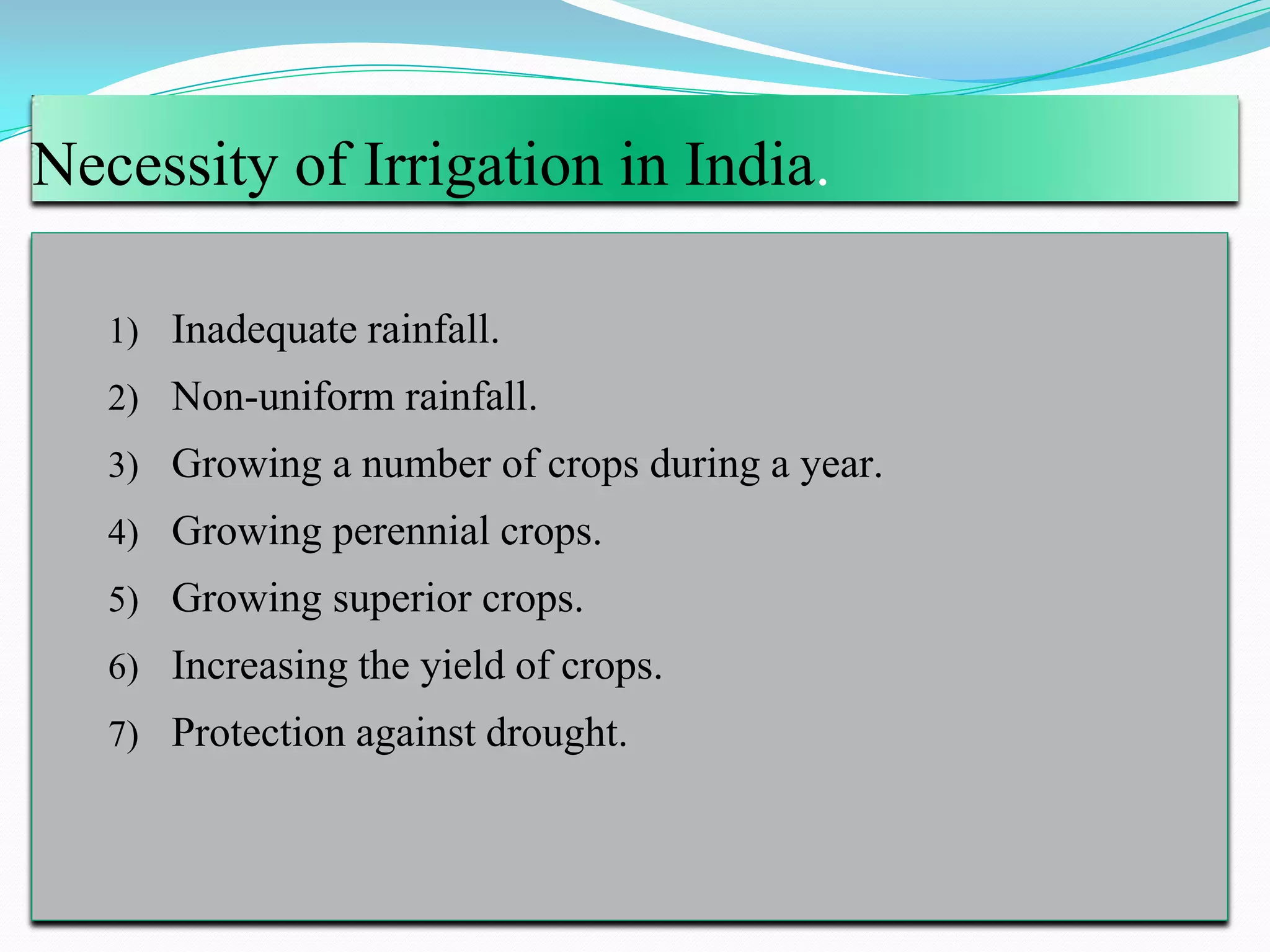
▪ Protection from Famine:
Food production is increased due to
irrigation by producing more crops
used as food. This protects a
country from famine situation.
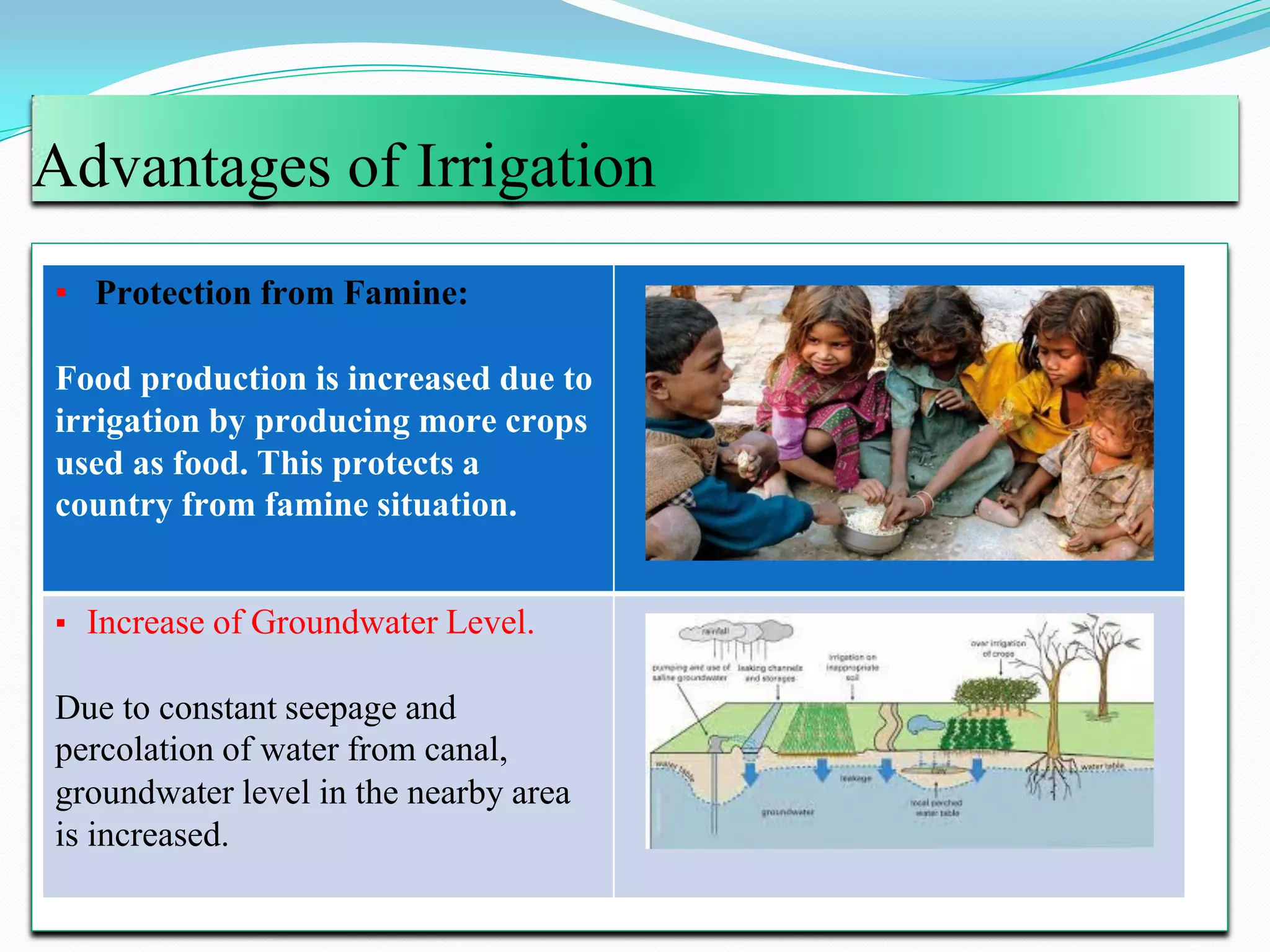
▪ Increase of Groundwater Level.
Due to constant seepage and
percolation of water from canal,
groundwater level in the nearby area
is increased.
Advantages of Irrigation Continue.
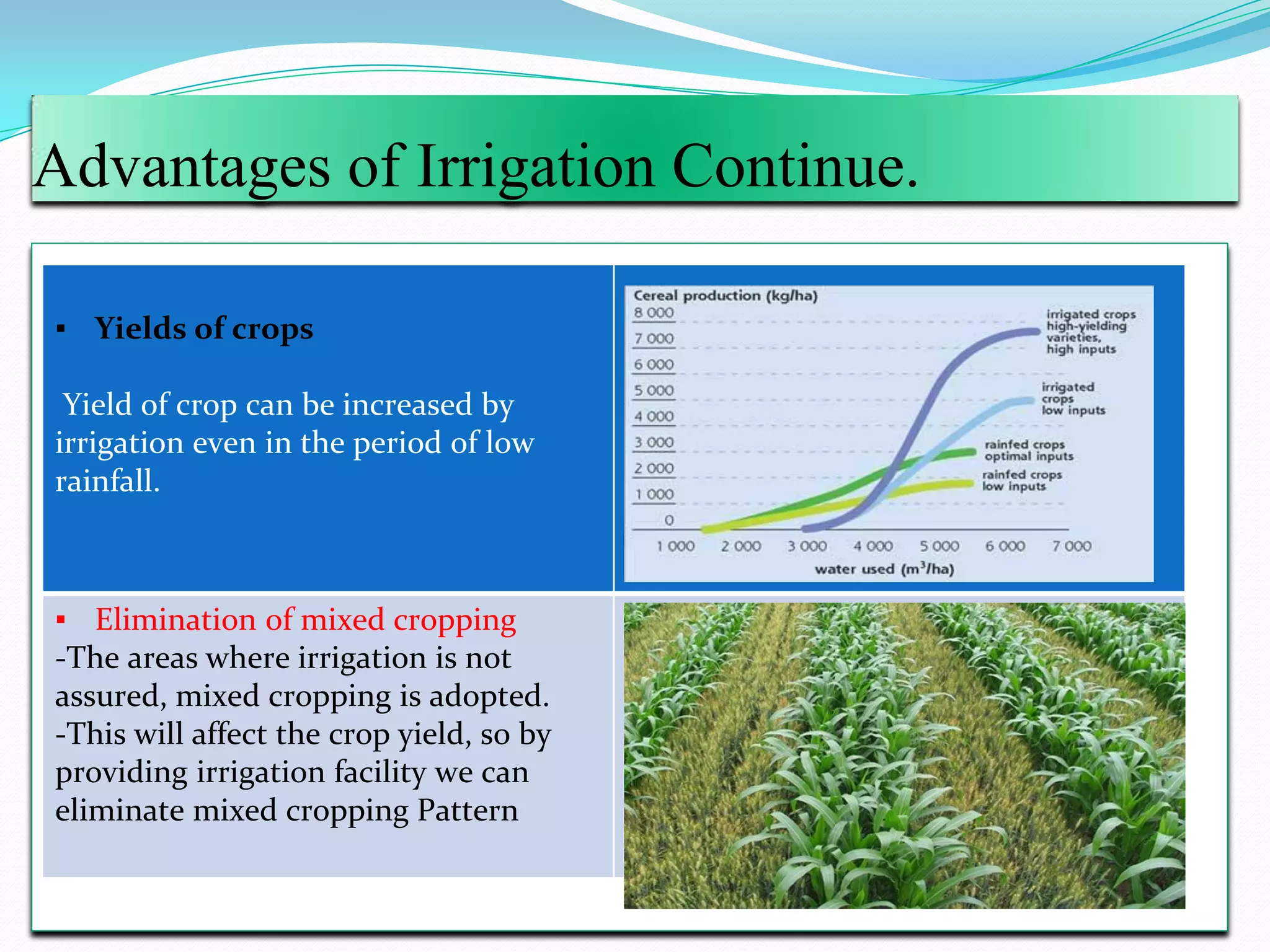
▪ Yields of crops
Yield of crop can be increased by
irrigation even in the period of low
rainfall.
▪ Elimination of mixed cropping
-The areas where irrigation is not
assured, mixed cropping is adopted.
-This will affect the crop yield, so by
providing irrigation facility we can
eliminate mixed cropping Pattern
Advantages of Irrigation Continue.
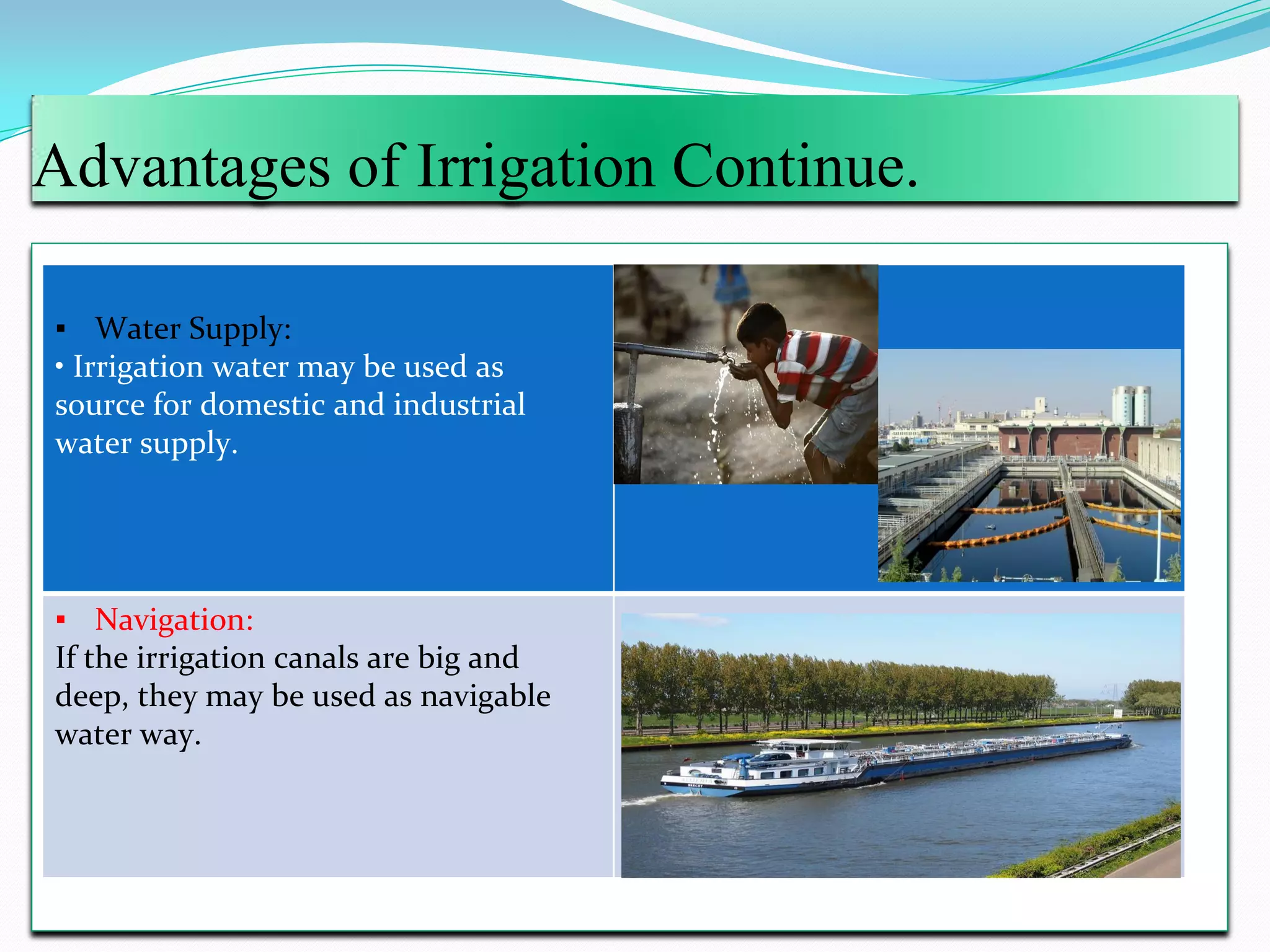
▪ Water Supply:
• Irrigation water may be used as
source for domestic and industrial
water supply.
▪ Navigation:
If the irrigation canals are big and
deep, they may be used as navigable
water way.
Advantages of Irrigation Continue.
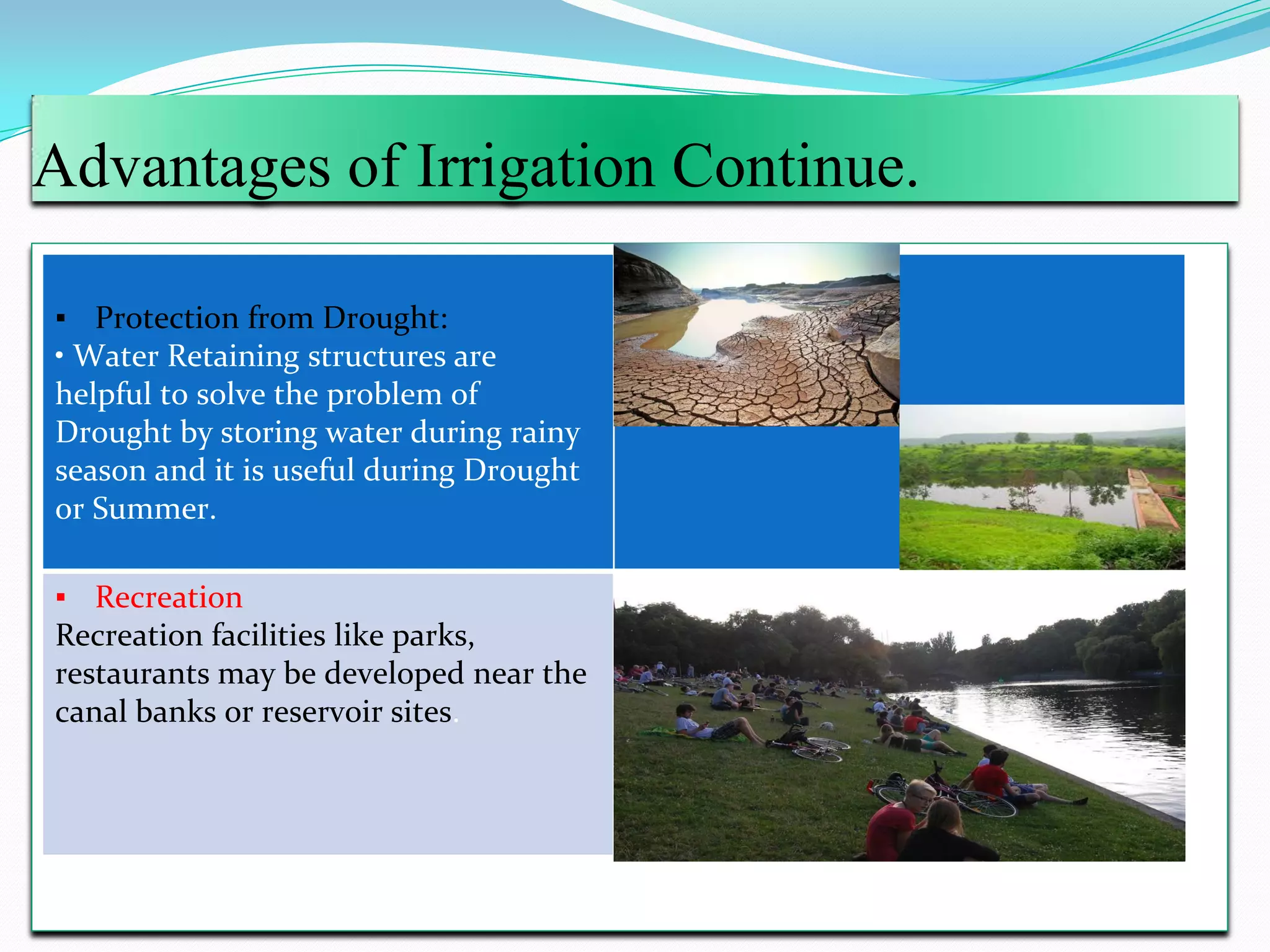
▪ Protection from Drought:
• Water Retaining structures are
helpful to solve the problem of
Drought by storing water during rainy
season and it is useful during Drought
or Summer.
▪ Recreation
Recreation facilities like parks,
restaurants may be developed near the
canal banks or reservoir sites.
Disadvantages of Irrigation
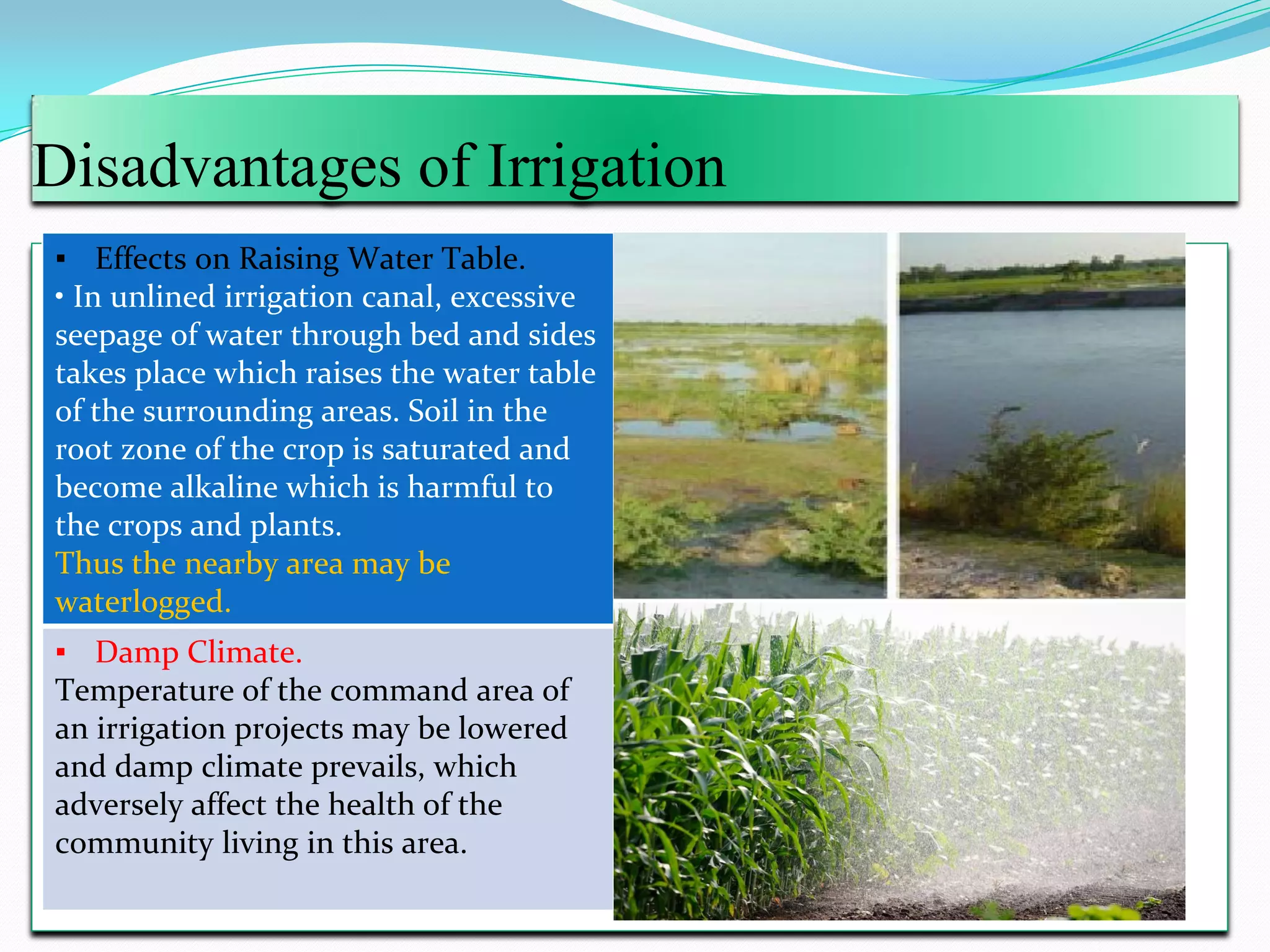
▪ Effects on Raising Water Table.
• In unlined irrigation canal, excessive
seepage of water through bed and sides
takes place which raises the water table
of the surrounding areas. Soil in the
root zone of the crop is saturated and
become alkaline which is harmful to
the crops and plants.
Thus the nearby area may be
waterlogged.
▪ Damp Climate.
Temperature of the command area of
an irrigation projects may be lowered
and damp climate prevails, which
adversely affect the health of the
community living in this area.
Disadvantages of Irrigation
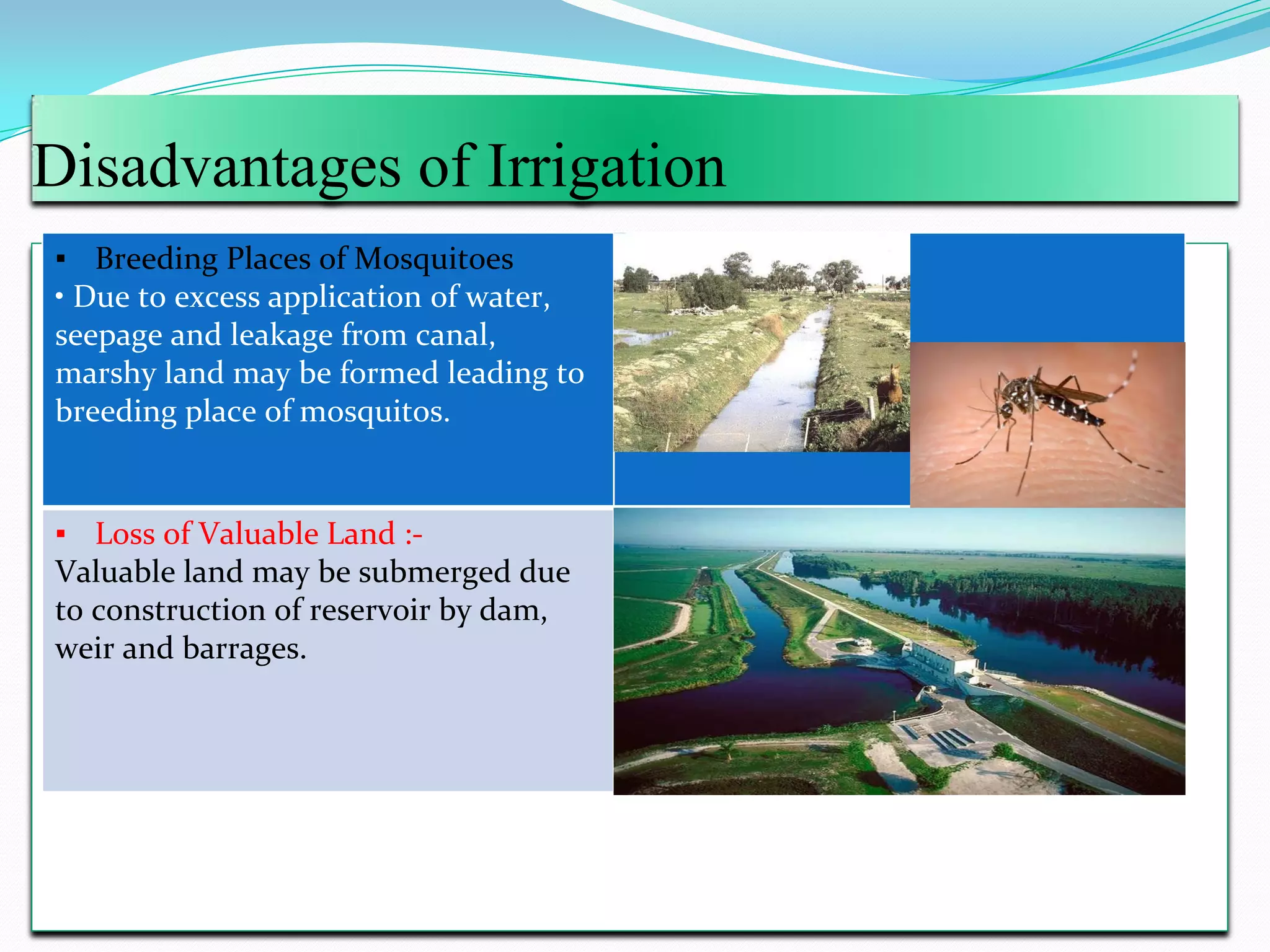
▪ Breeding Places of Mosquitoes
• Due to excess application of water,
seepage and leakage from canal,
marshy land may be formed leading to
breeding place of mosquitos.
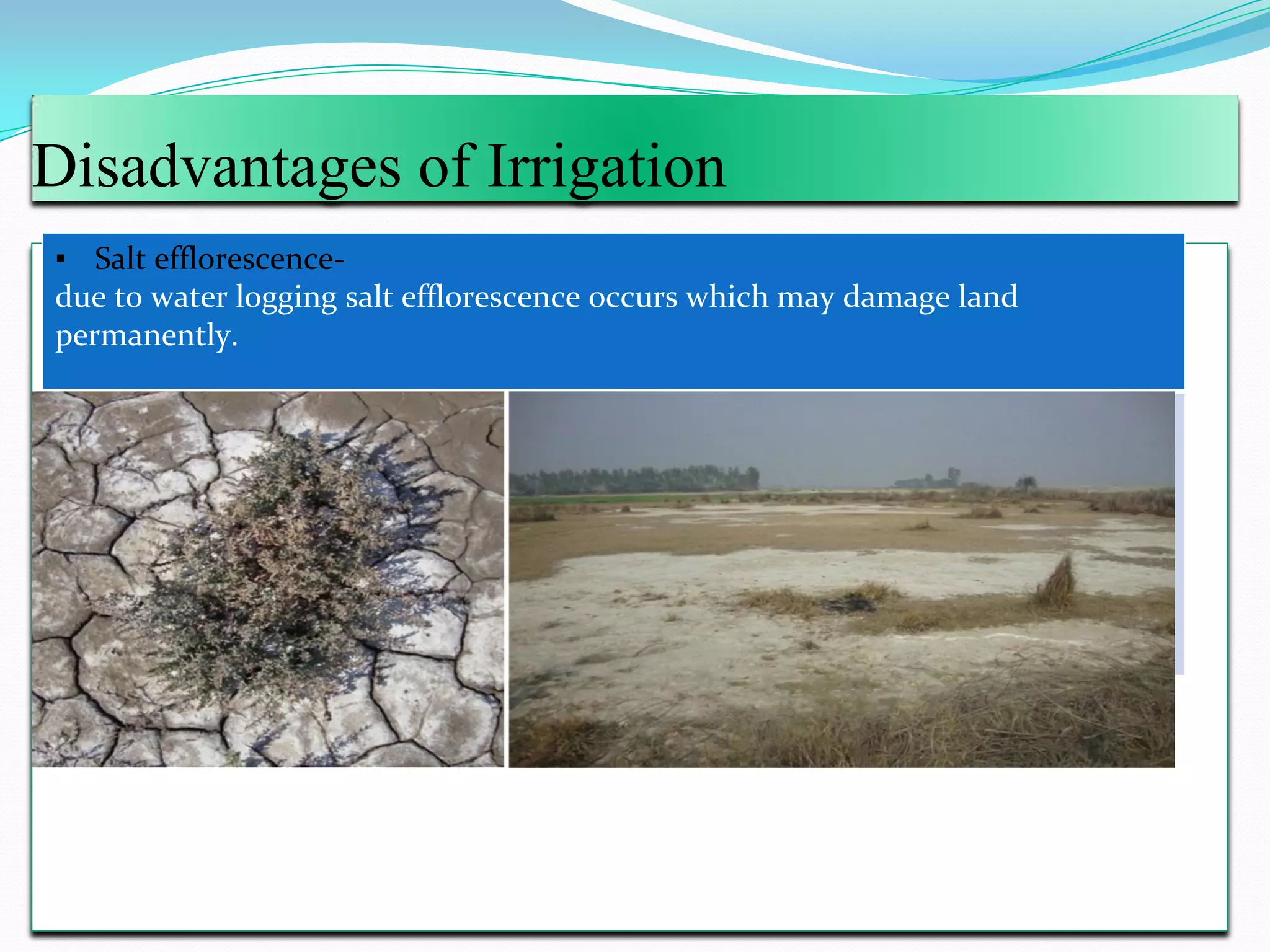
▪ Loss of Valuable Land :-
Valuable land may be submerged due
to construction of reservoir by dam,
weir and barrages.
Disadvantages of Irrigation
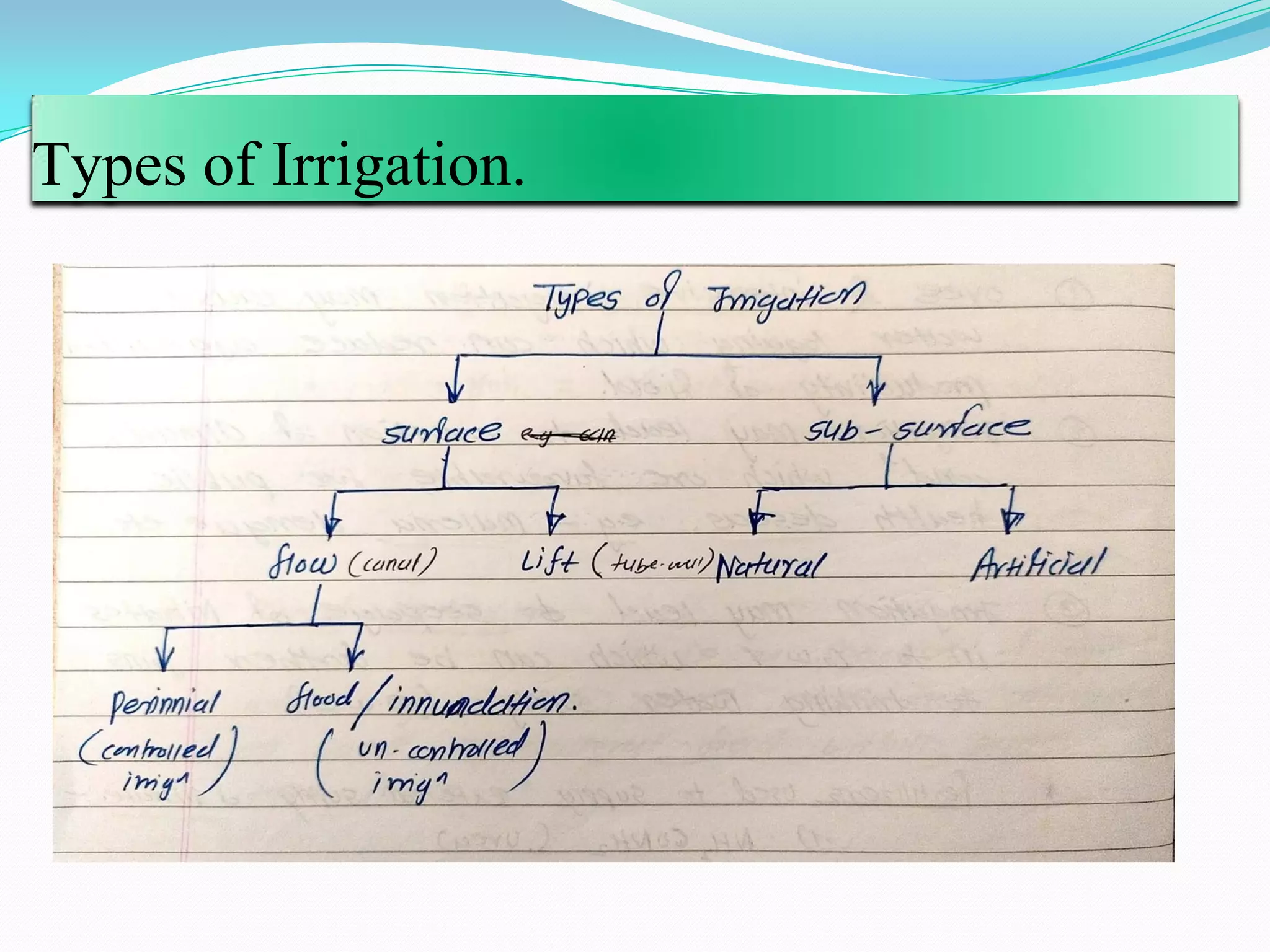
▪ Salt efflorescence-
due to water logging salt efflorescence occurs which may damage land
permanently.
Types of Irrigation.
Types of Irrigation
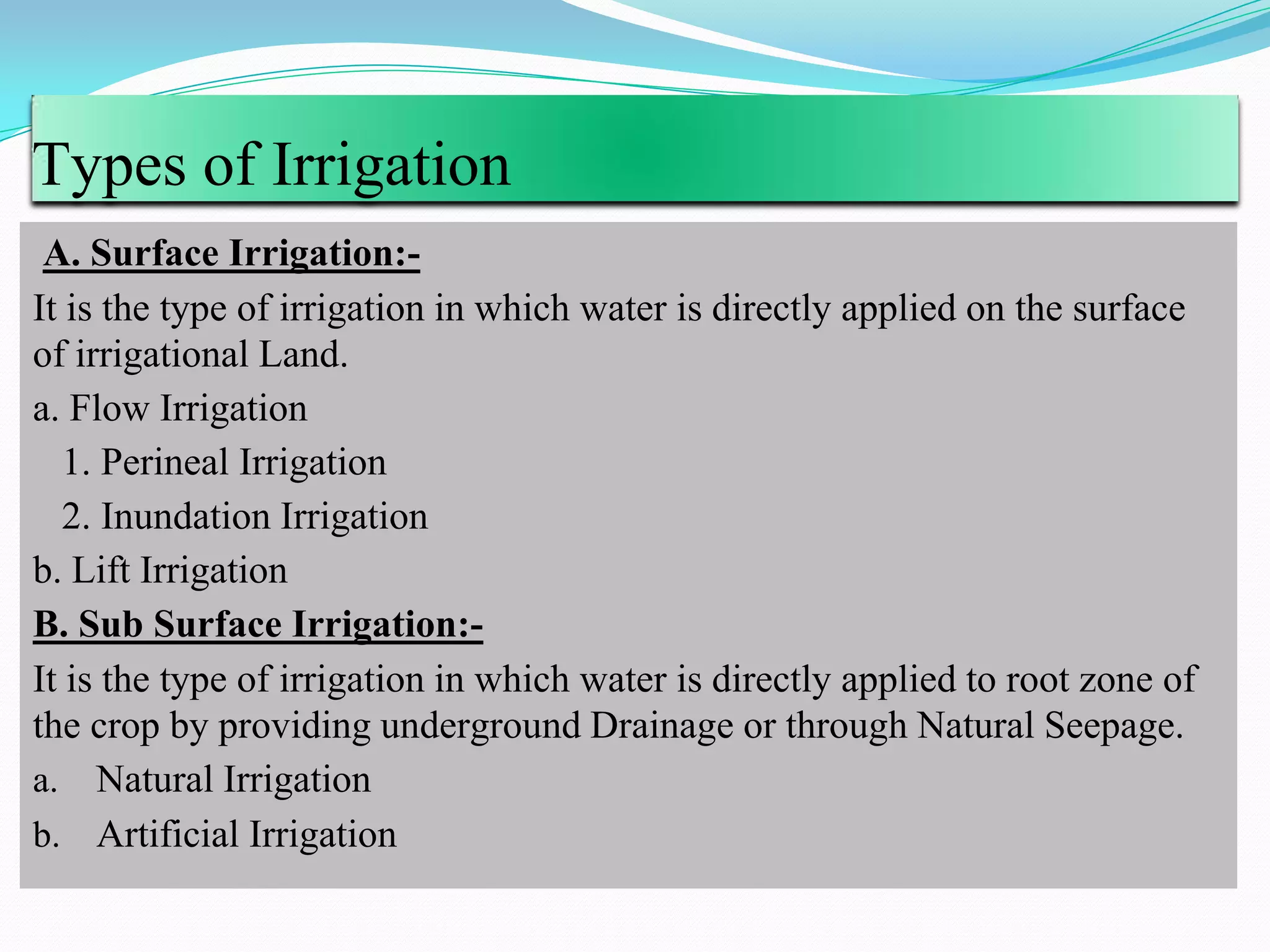
A. Surface Irrigation:-
It is the type of irrigation in which water is directly applied on the surface
of irrigational Land.
a. Flow Irrigation
1. Perineal Irrigation
2. Inundation Irrigation
b. Lift Irrigation
B. Sub Surface Irrigation:-
It is the type of irrigation in which water is directly applied to root zone of
the crop by providing underground Drainage or through Natural Seepage.
a. Natural Irrigation
b. Artificial Irrigation
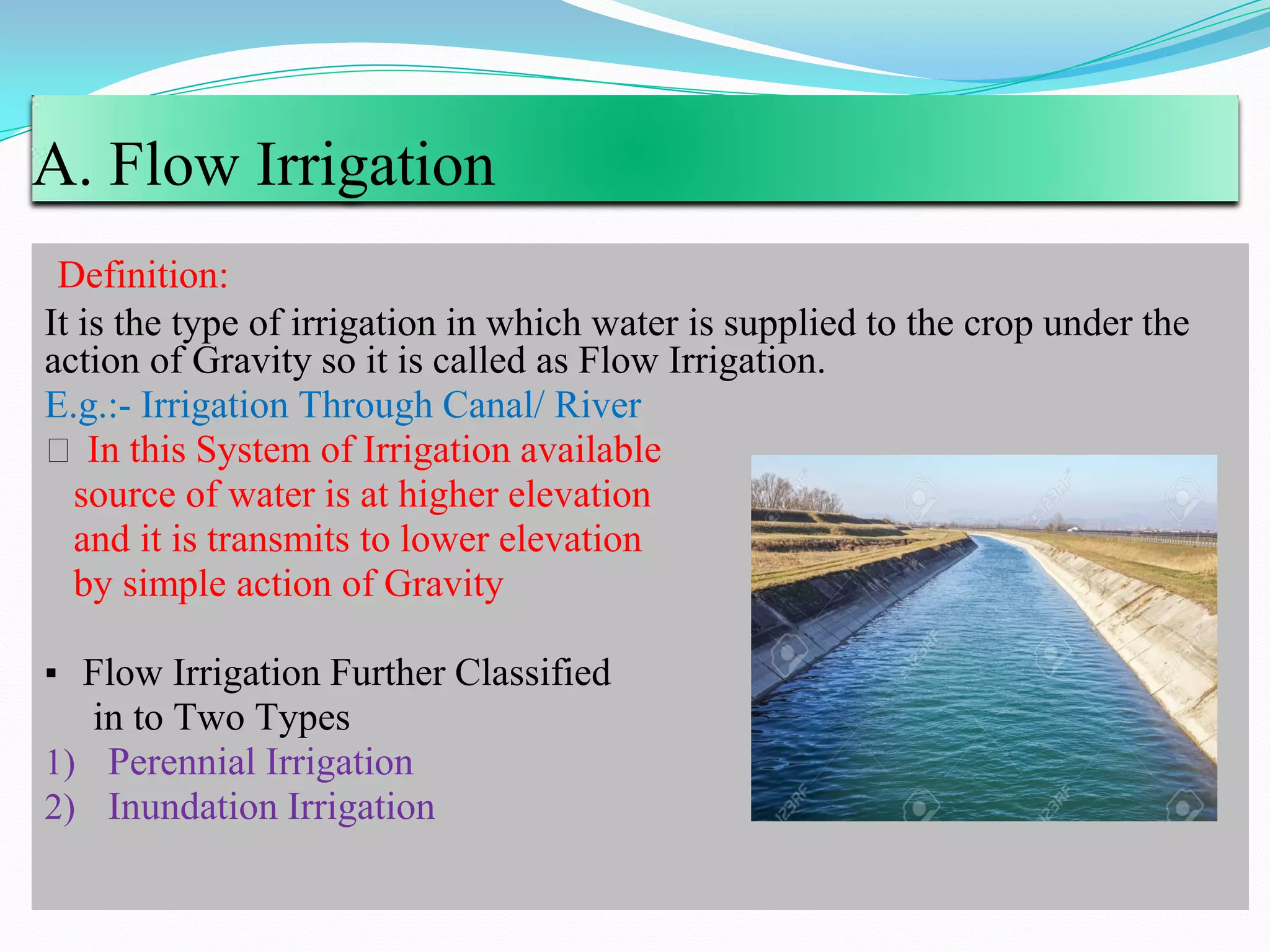
A. Flow Irrigation
Definition:
It is the type of irrigation in which water is supplied to the crop under the
action of Gravity so it is called as Flow Irrigation.
E.g.:- Irrigation Through Canal/ River
⚫ In this System of Irrigation available
source of water is at higher elevation
and it is transmits to lower elevation
by simple action of Gravity
▪ Flow Irrigation Further Classified
in to Two Types
1) Perennial Irrigation
2) Inundation Irrigation
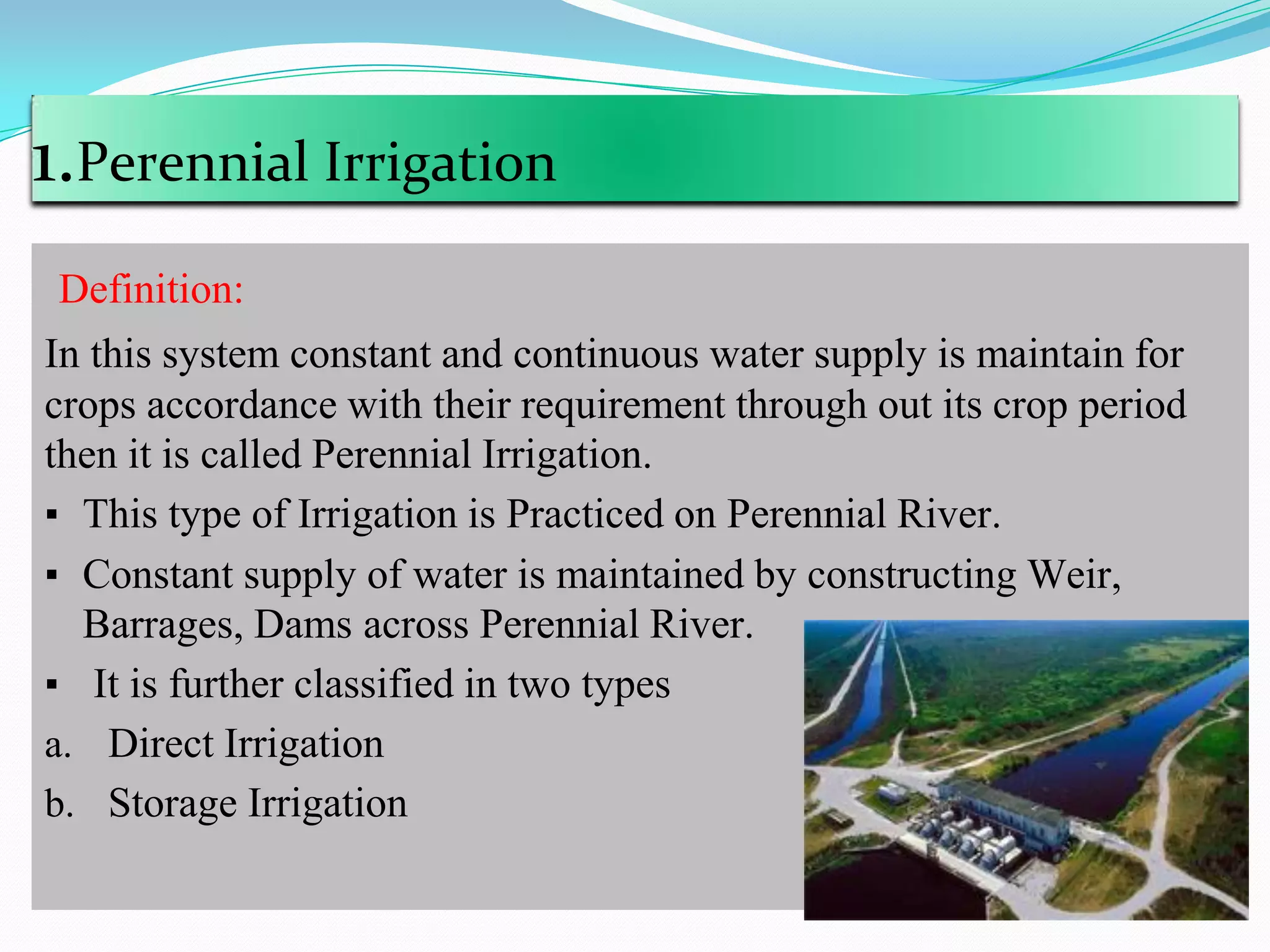
1.Perennial Irrigation
Definition:
In this system constant and continuous water supply is maintain for
crops accordance with their requirement through out its crop period
then it is called Perennial Irrigation.
▪ This type of Irrigation is Practiced on Perennial River.
▪ Constant supply of water is maintained by constructing Weir,
Barrages, Dams across Perennial River.
▪ It is further classified in two types
a. Direct Irrigation
b. Storage Irrigation
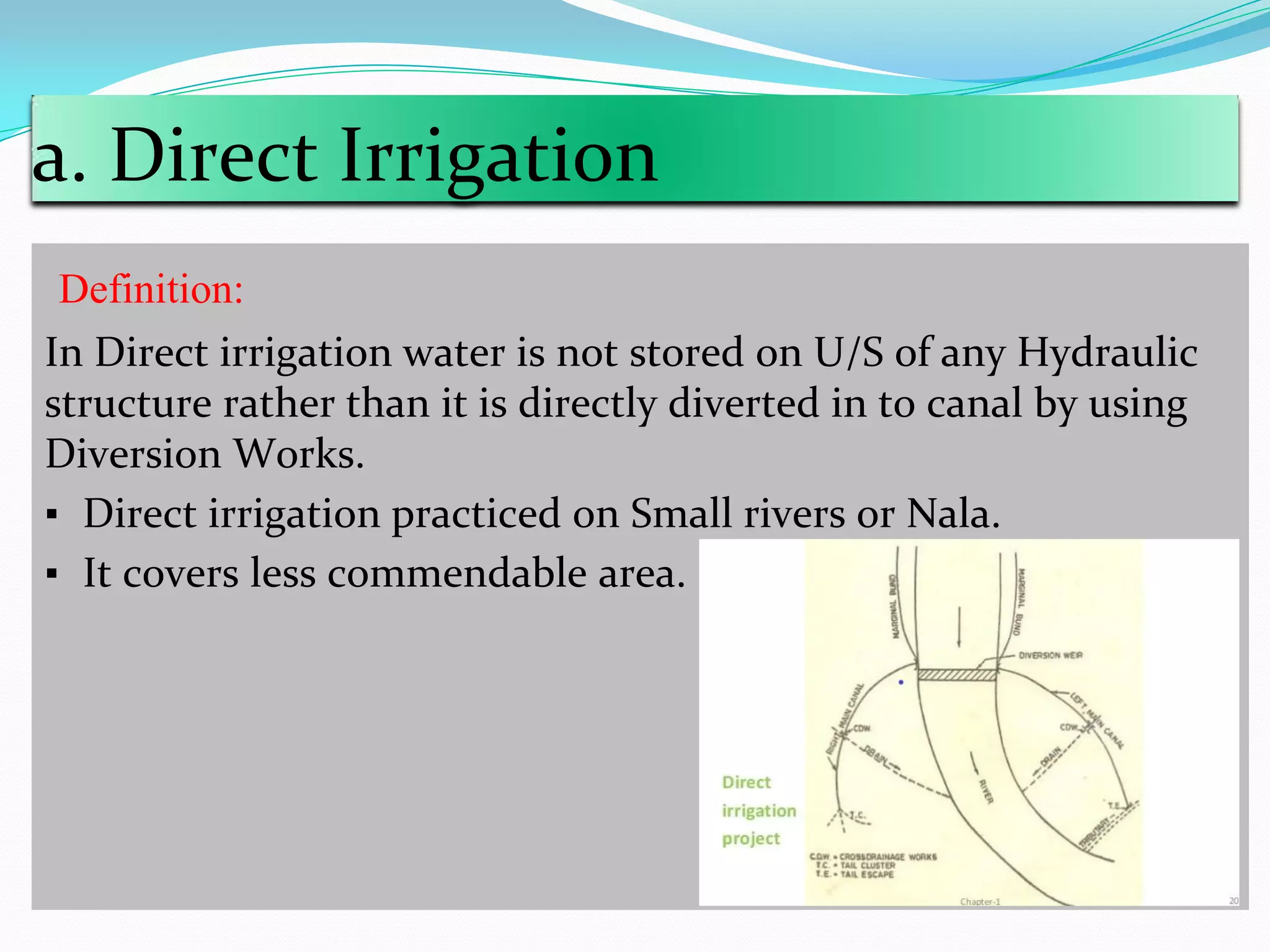
a. Direct Irrigation
Definition:
In Direct irrigation water is not stored on U/S of any Hydraulic
structure rather than it is directly diverted in to canal by using
Diversion Works.
▪ Direct irrigation practiced on Small rivers or Nala.
▪ It covers less commendable area.
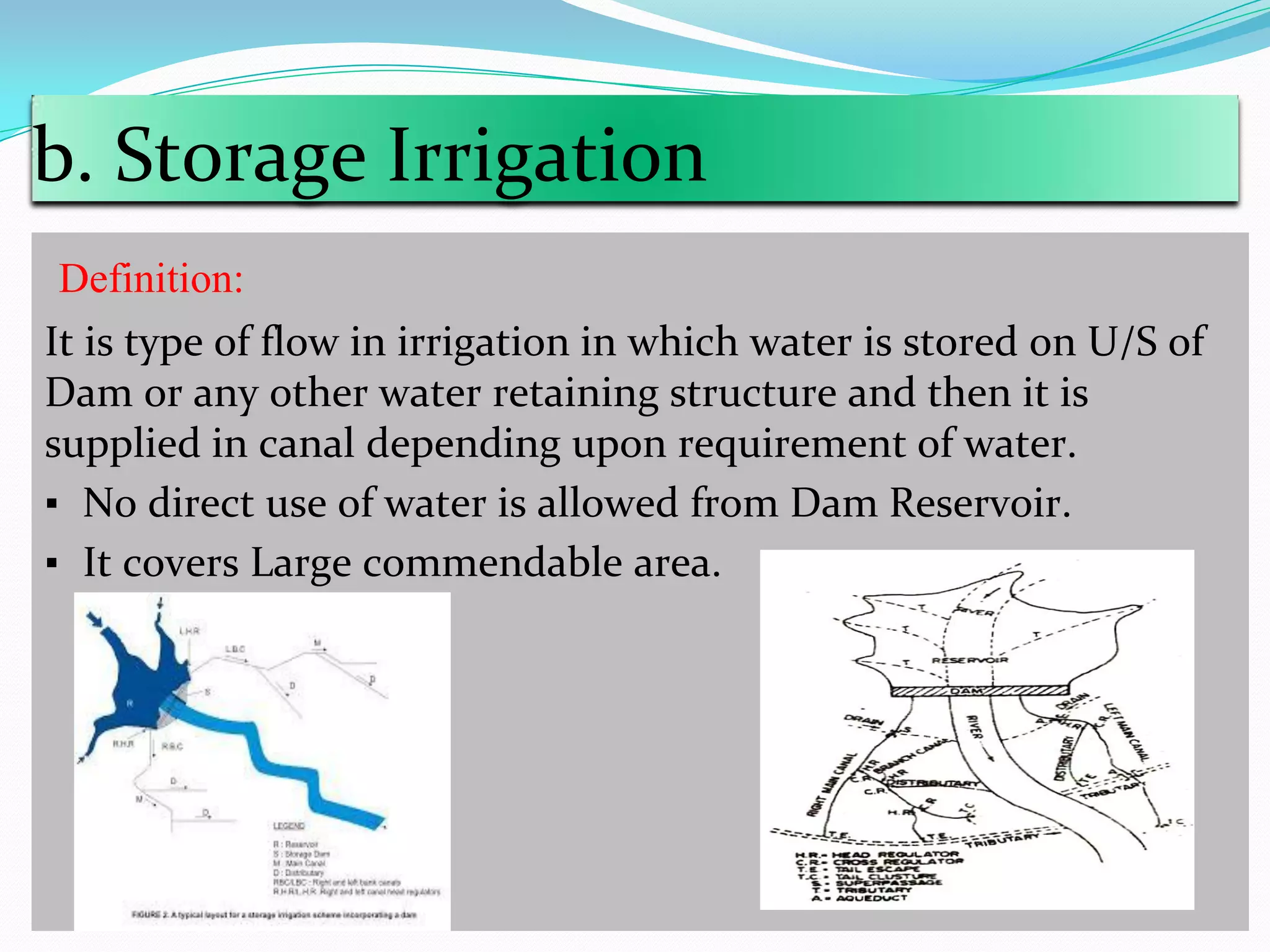
b. Storage Irrigation
Definition:
It is type of flow in irrigation in which water is stored on U/S of
Dam or any other water retaining structure and then it is
supplied in canal depending upon requirement of water.
▪ No direct use of water is allowed from Dam Reservoir.
▪ It covers Large commendable area.
2. Inundation Irrigation
Definition:
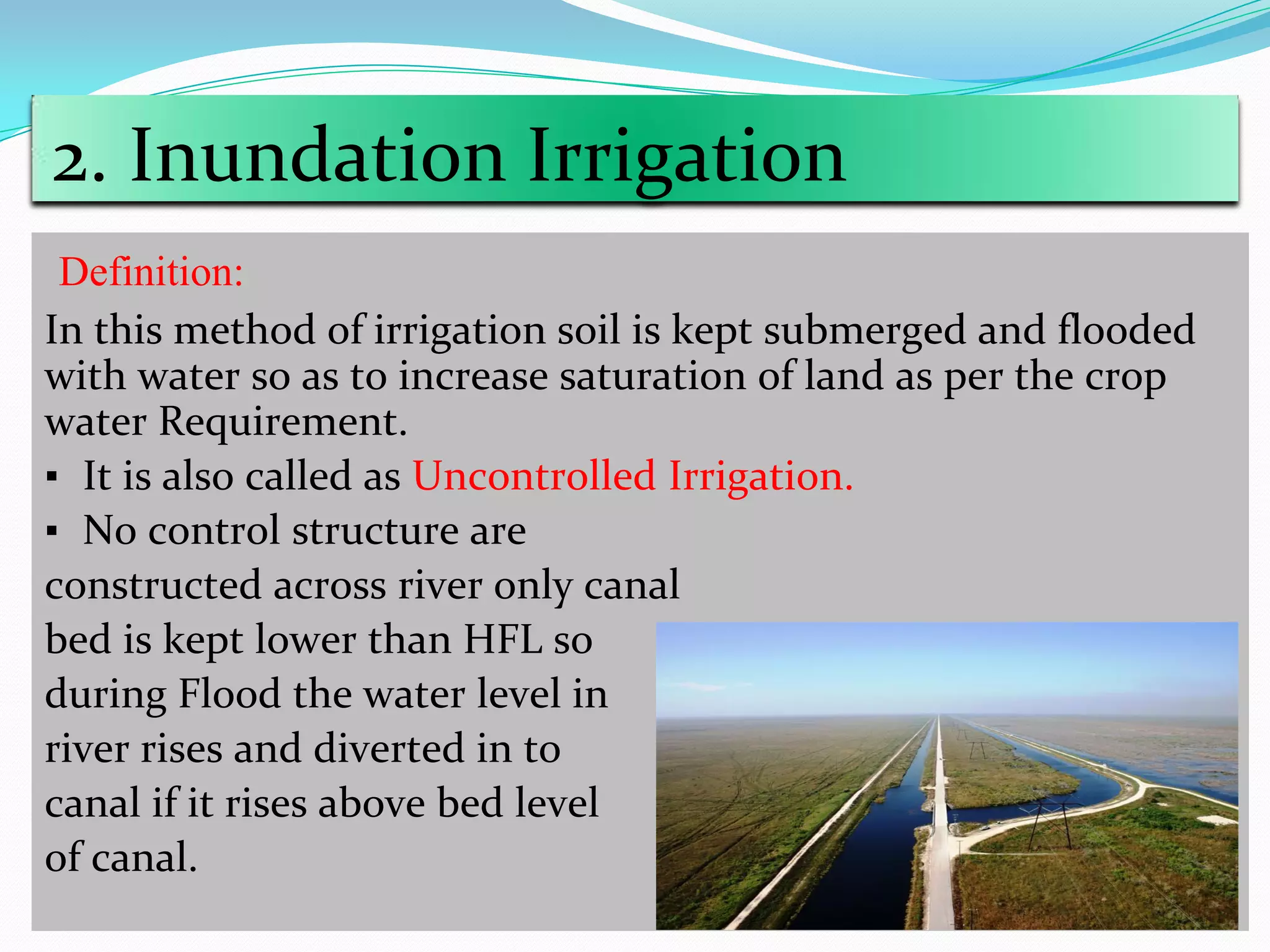
In this method of irrigation soil is kept submerged and flooded
with water so as to increase saturation of land as per the crop
water Requirement.
▪ It is also called as Uncontrolled Irrigation.
▪ No control structure are
constructed across river only canal
bed is kept lower than HFL so
during Flood the water level in
river rises and diverted in to
canal if it rises above bed level
of canal.
Subsurface Irrgation
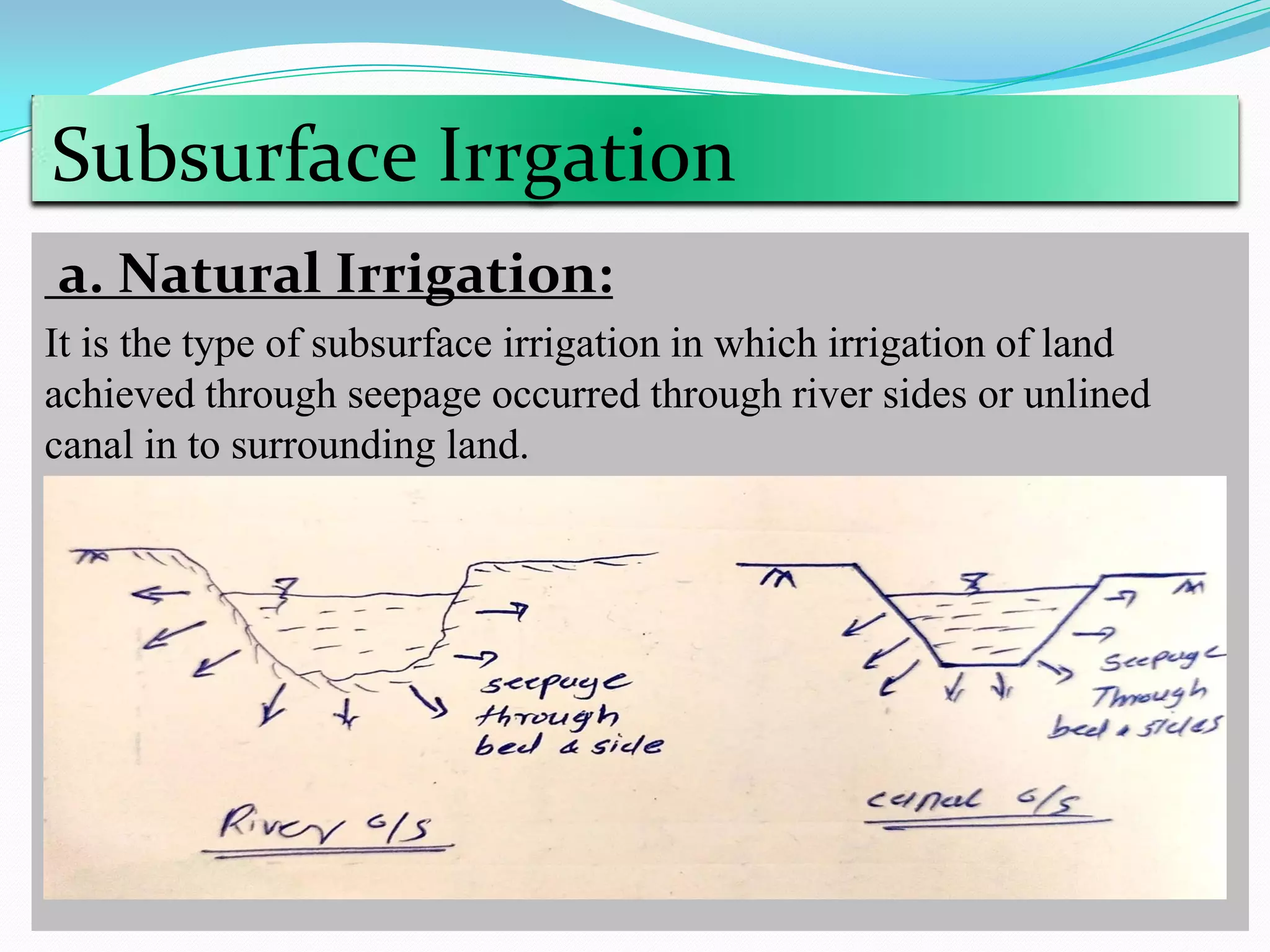
a. Natural Irrigation:
It is the type of subsurface irrigation in which irrigation of land
achieved through seepage occurred through river sides or unlined
canal in to surrounding land.
Subsurface Irrgation
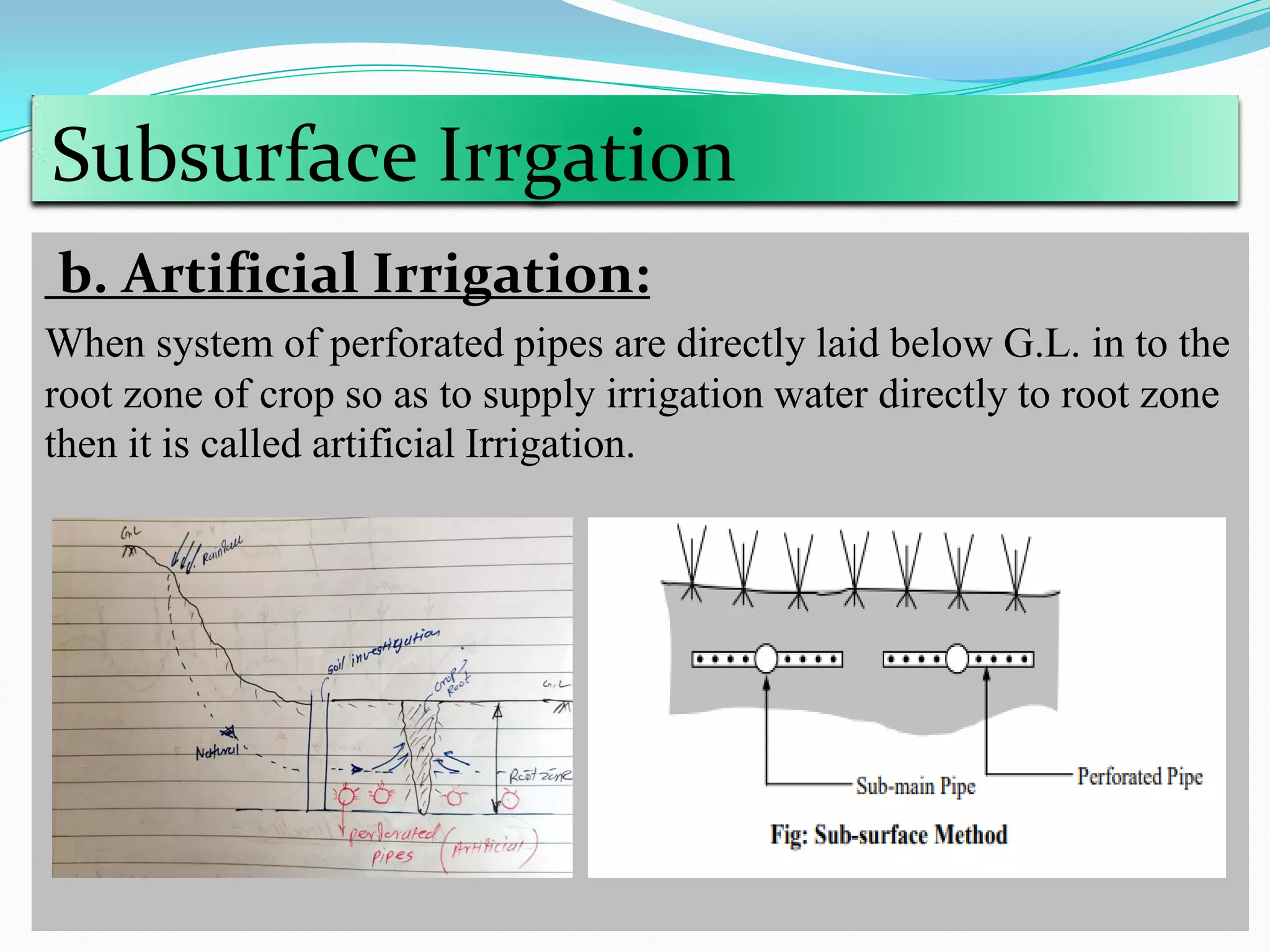
b. Artificial Irrigation:
When system of perforated pipes are directly laid below G.L. in to the
root zone of crop so as to supply irrigation water directly to root zone
then it is called artificial Irrigation.
Methods of Irrigation
Factors Affecting Selection of Irrigation Method
Following are the factors which affects the selection
of method of surface irrigation:
1. Soil characteristics of the land to be irrigated.
2. Topography of the area.
3. The available water supply.
4. Type of crop and its requirements.
5. Size of the stream supplying irrigation water.
6. Local Climate.
7. Local Tradition and skill
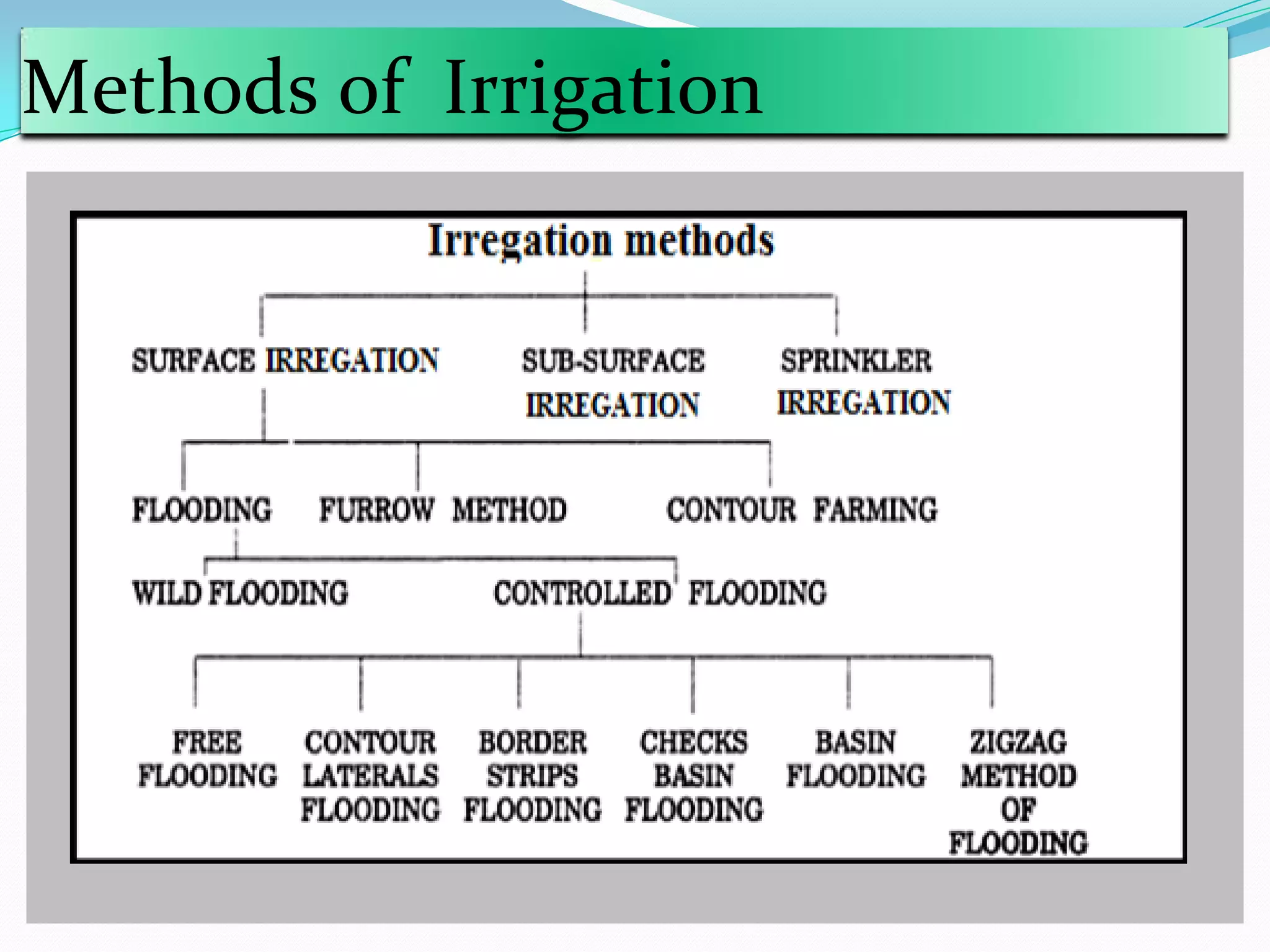
A.Flooding Method
Introduction:
▪ It is the type of surface irrigation in which water is directly
applied in the surface of irrigational land.
▪ In this method water is flowing along the slope
▪ It one of the oldest method of irrigation.
▪ Water use and application efficiencies are very low.
▪ It is further classified in to following types:
1. Wild Flooding
2. Controlled Flooding.
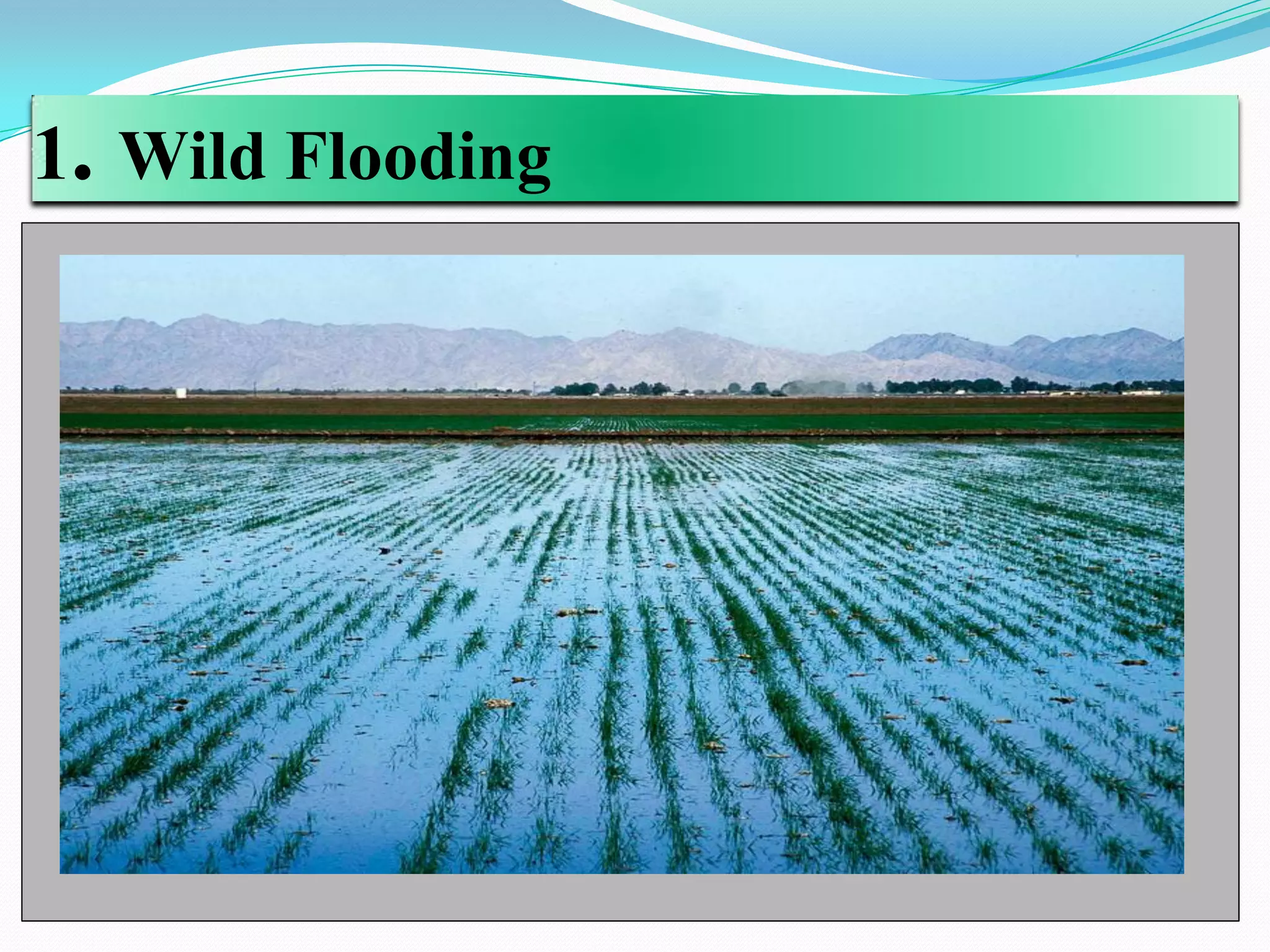
1. Wild Flooding
Introduction:
➔Wild flooding method is the earliest and the primitive
method of application of water to the land.
➔In this method the water is applied by spreading it over
the land prior to the application of water, no land
preparations is done in the form of border or field
ditches.
➔In this method water is flowing along the Natural
slope.
➔Water Distribution is not uniform.
1. Wild Flooding
2. Controlled Flooding
Introduction:
▪ In controlled flooding methods irrigation water is applied by
spreading it over the land to be irrigated with proper control
on the flow of water as well as the quantity of water applied.
▪ All the methods of control flooding require prior preparation
of the land.
▪ The land is properly graded & agricultural fields are divided
into small units by levees .
2. Controlled Flooding
Following are the Controlled flooding methods:
1. Free flooding.
2. Contour laterals.
3. Border strips.
4. Check basins.
5. Basin flooding.
6. Zig-zag method.
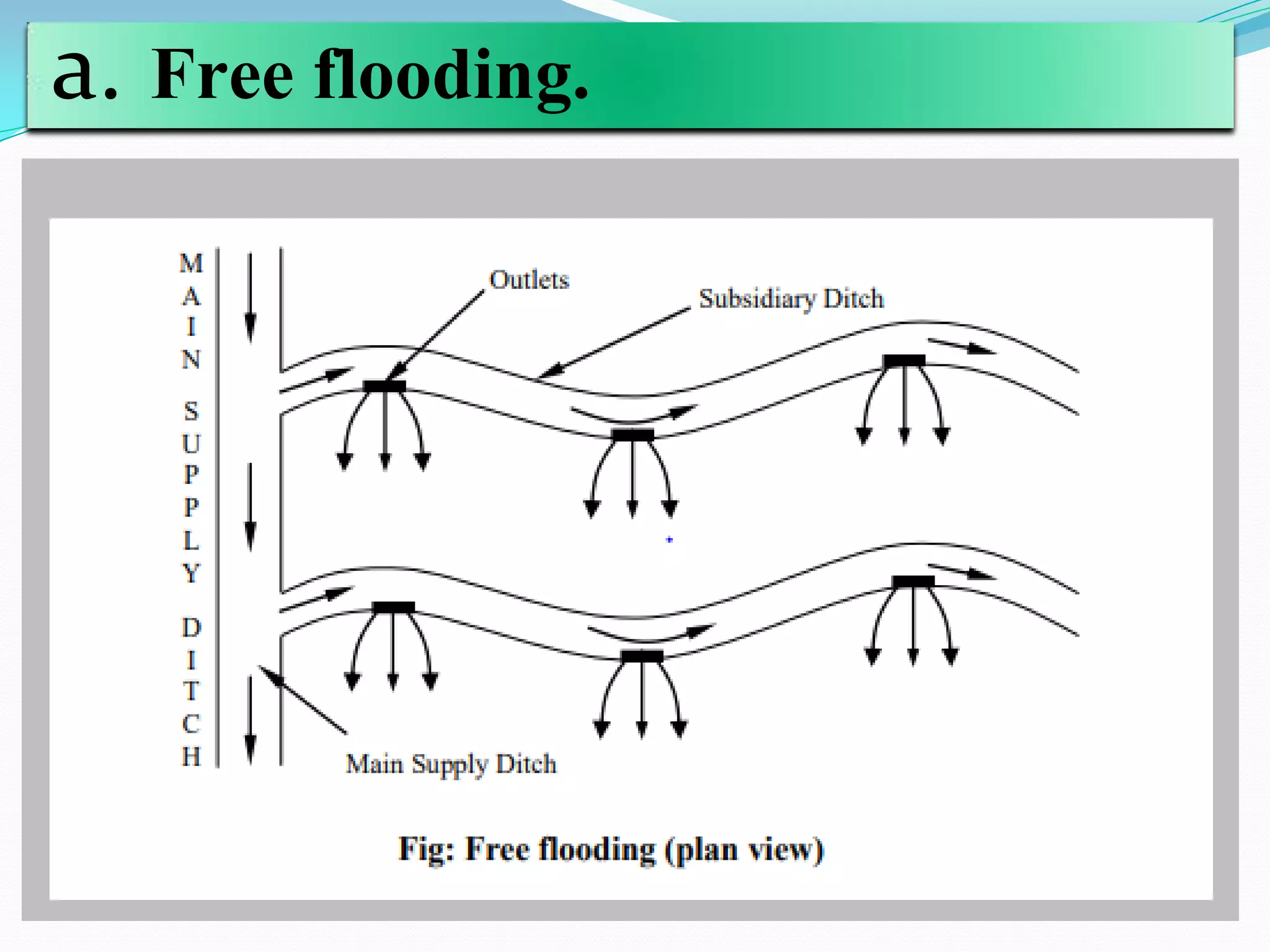
a. Free flooding.
1. Ditches are excavated in the field.
2. Water is applied from field ditches without any levee to guide
its flow.
3. Movement of water is not restricted, it is sometimes called
“wild flooding”
4. It is suitable for close growing crops, pastures etc.
5. It is practiced large where irrigation water is abundant and
inexpensive.
6. It involves low initial cost of land preparation, extra labour cost
in the application of water
7. This method may be used on rolling land (topography
irregular) where borders, checks, basins and furrows are not
feasible.
a. Free flooding.
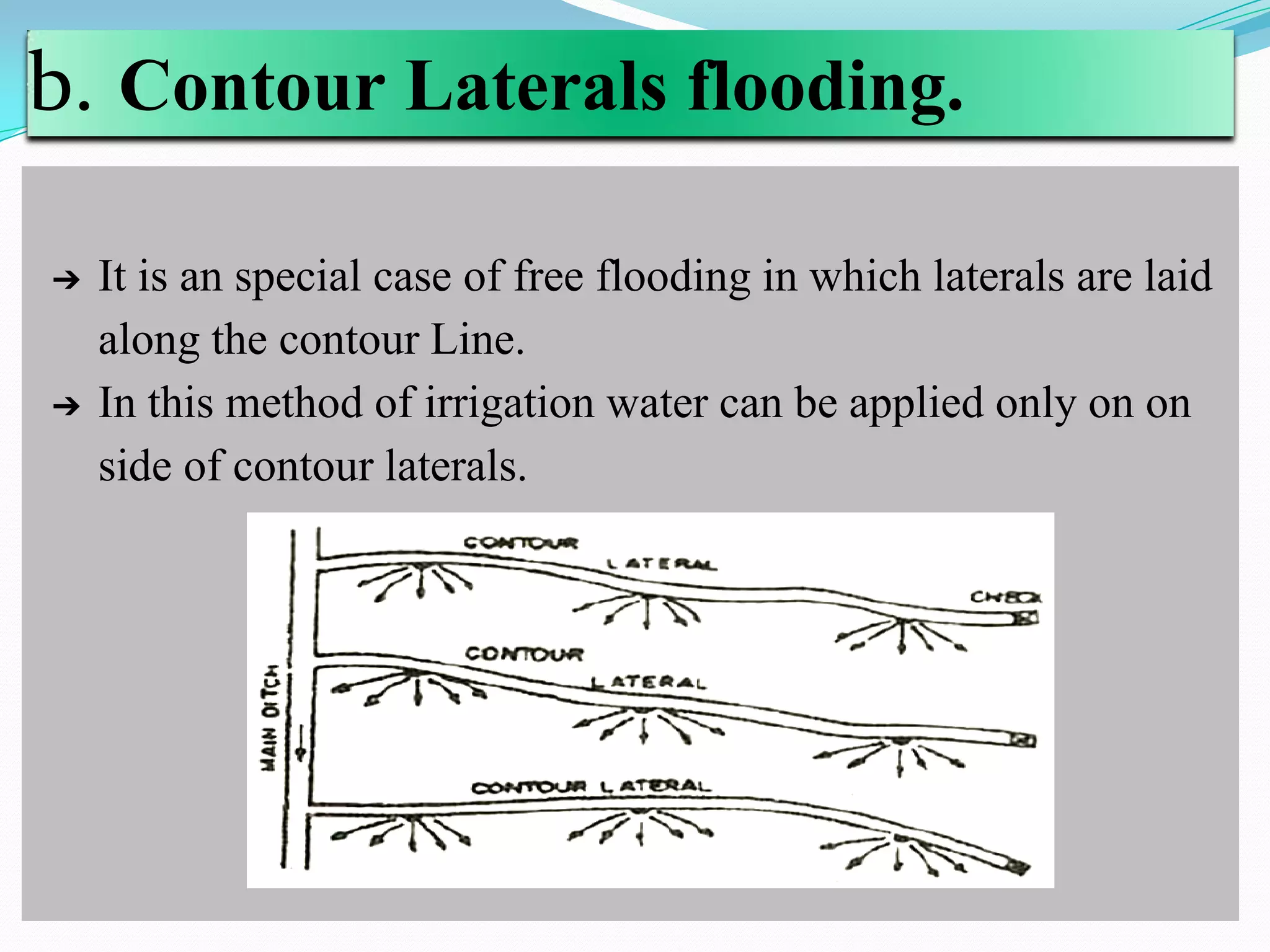
b. Contour Laterals flooding.
➔ It is an special case of free flooding in which laterals are laid
along the contour Line.
➔ In this method of irrigation water can be applied only on on
side of contour laterals.
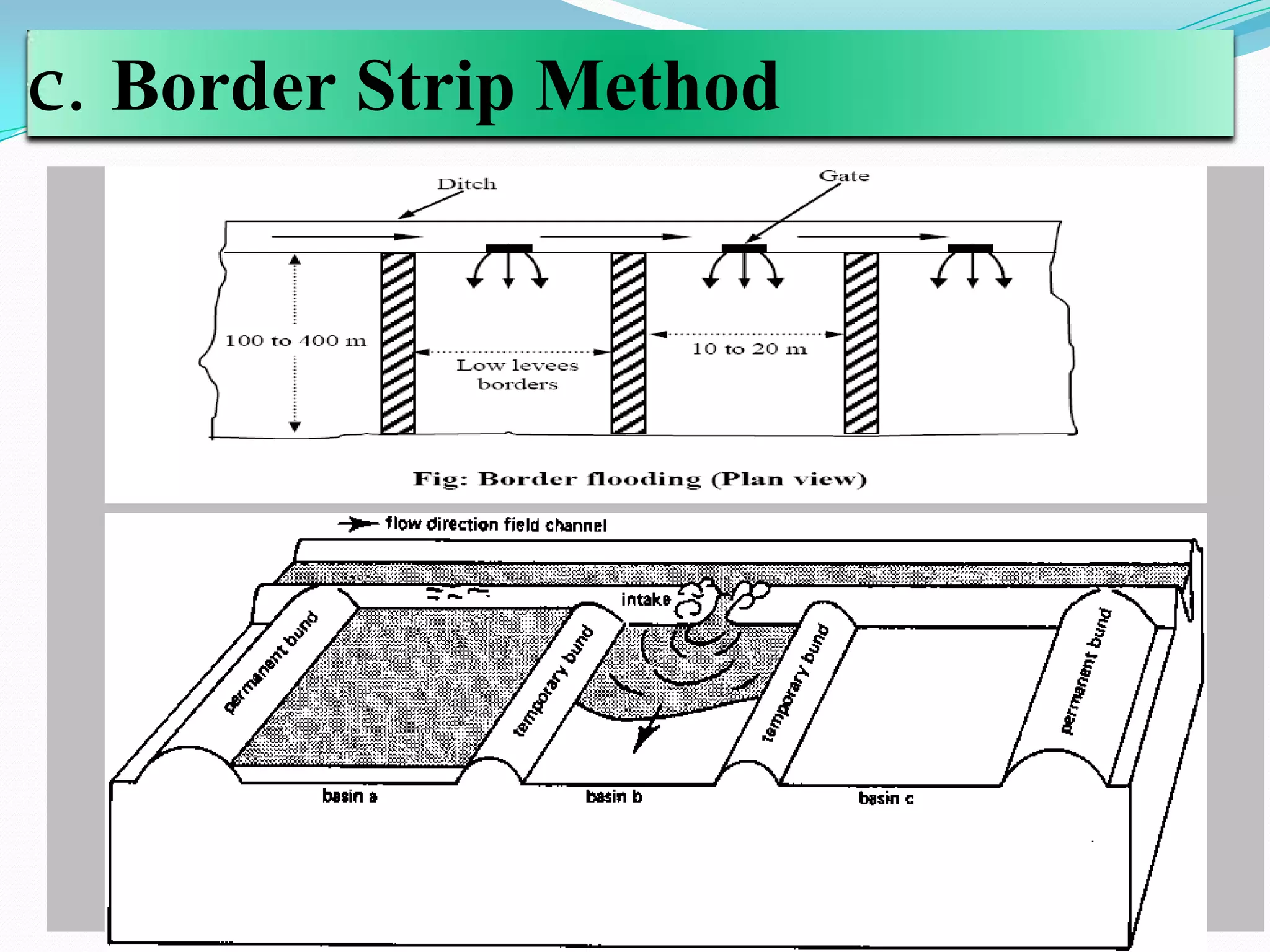
c. Border Strip Method
➔ In this Method The farm is divided into a number of strips
(width 10 ~ 20 m and length 100 ~ 400 m) separated by low
levees or borders.
➔ Water is turned from the supply ditch into these strips along
which a flow slowly toward the lower end, wetting the soil as
it advances. When the advancing water front reaches the
lower end, the stream turned off.
➔ It is suitable to soils having moderately low to moderately
high infiltration rates and to all closely growing crops.
➔ Uniform distribution and high water application efficiencies
are possible.
c. Border Strip Method
d. Check Flooding
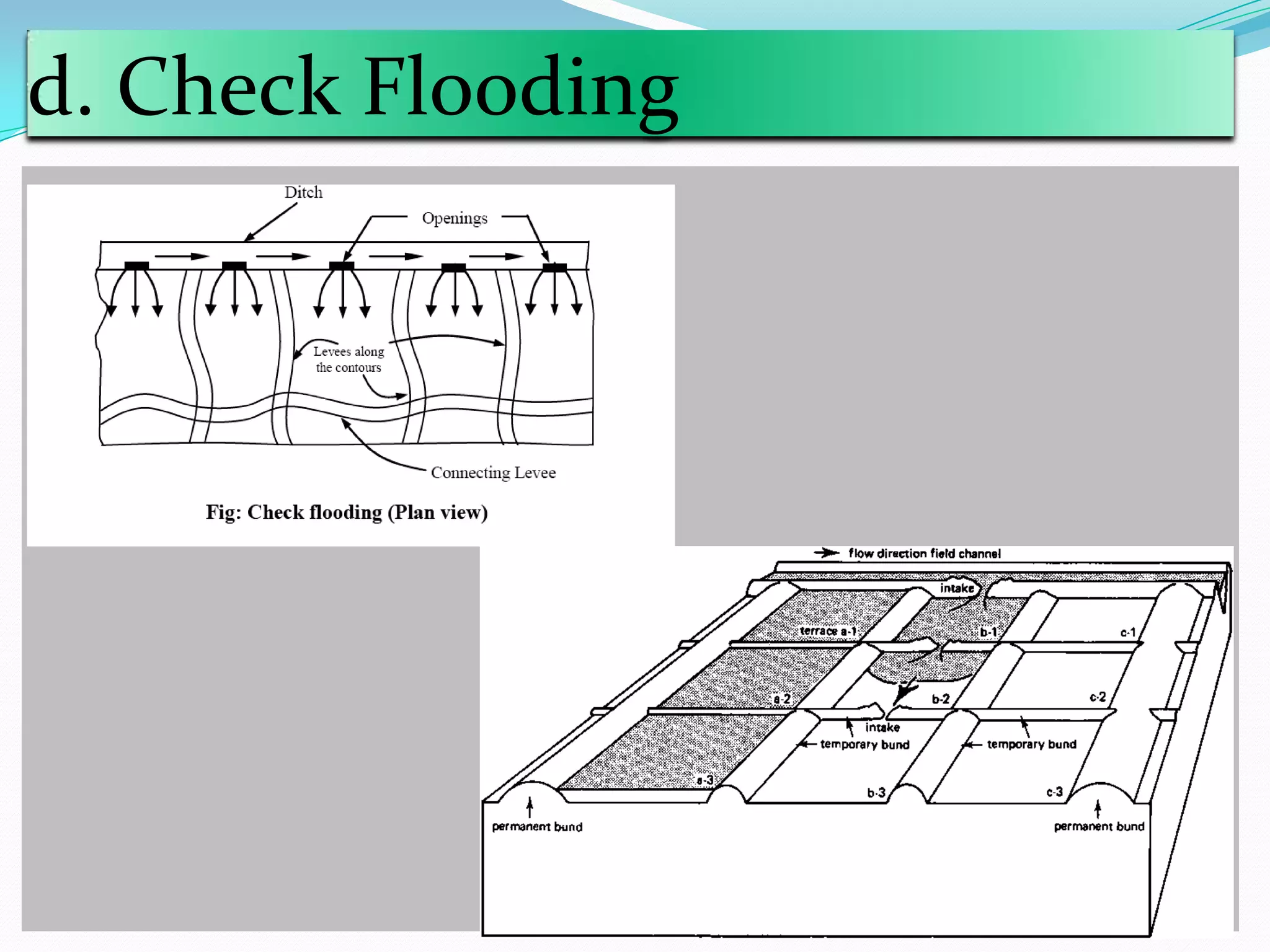
➔ In this Method The farm is divided in to plots and which are
levelled by constructing levees and Bunds.
➔ Water is controlled by surrounding the check area with low
and flat levees.
➔ The check is filled with water at a fairly high rate and
allowed to stand until the water infiltrates.
➔ It is suitable for low as well as high intake soils and for rice
or other crops which can withstand temporary flooding.
d. Check Flooding
➔.
e. Basin Flooding
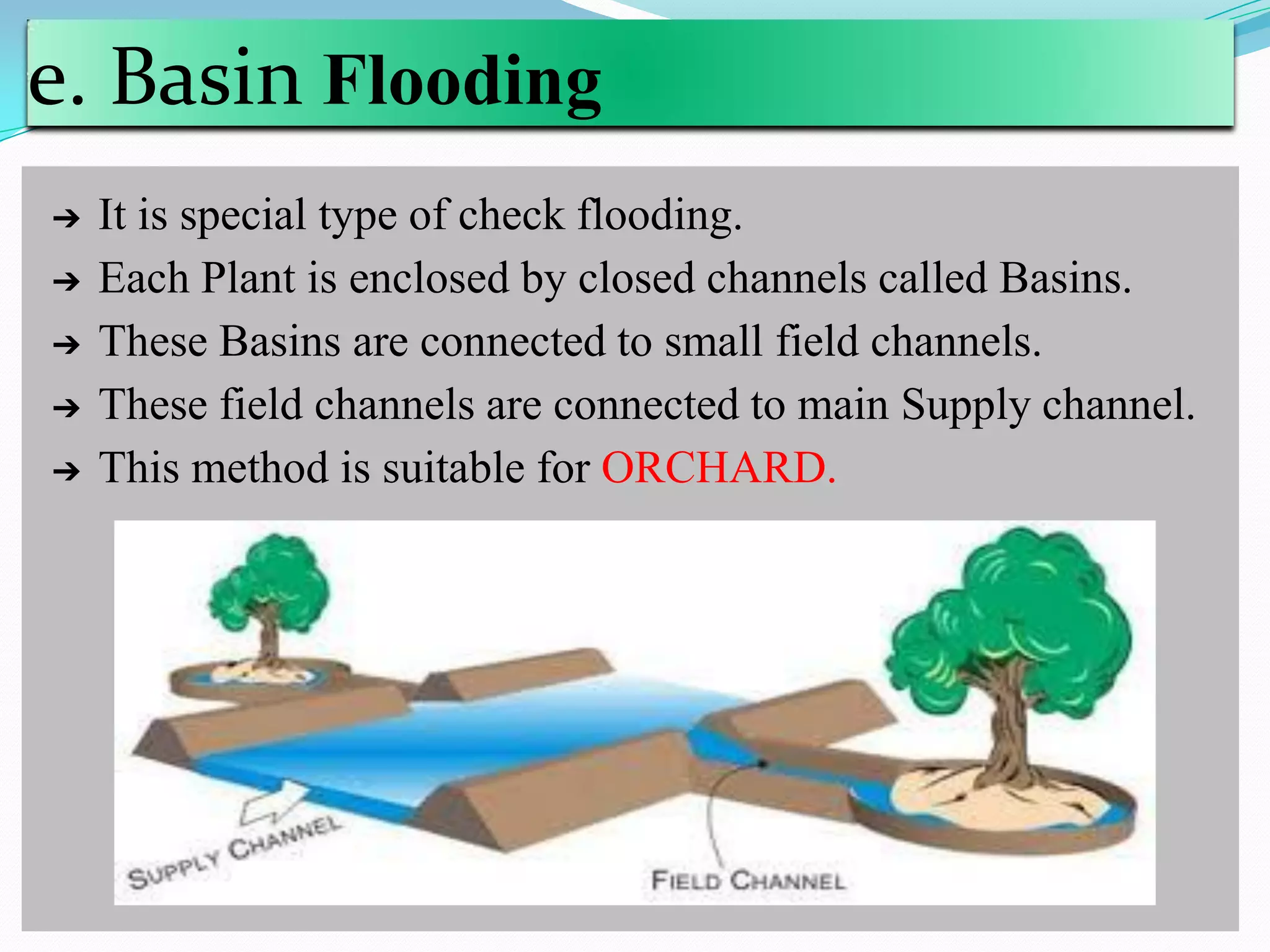
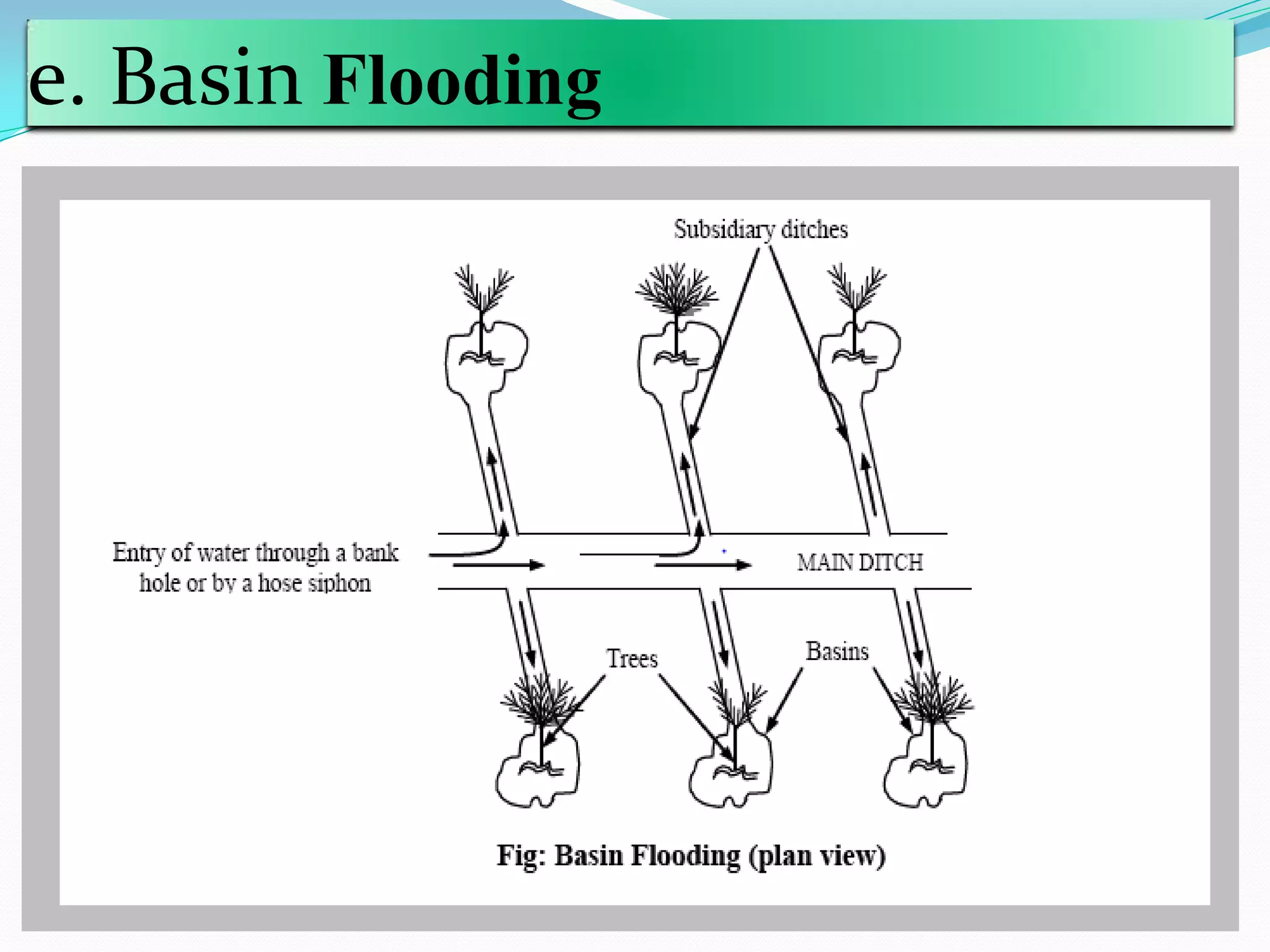
➔ It is special type of check flooding.
➔ Each Plant is enclosed by closed channels called Basins.
➔ These Basins are connected to small field channels.
➔ These field channels are connected to main Supply channel.
➔ This method is suitable for ORCHARD.
e. Basin Flooding
f. Zig-Zag Flooding
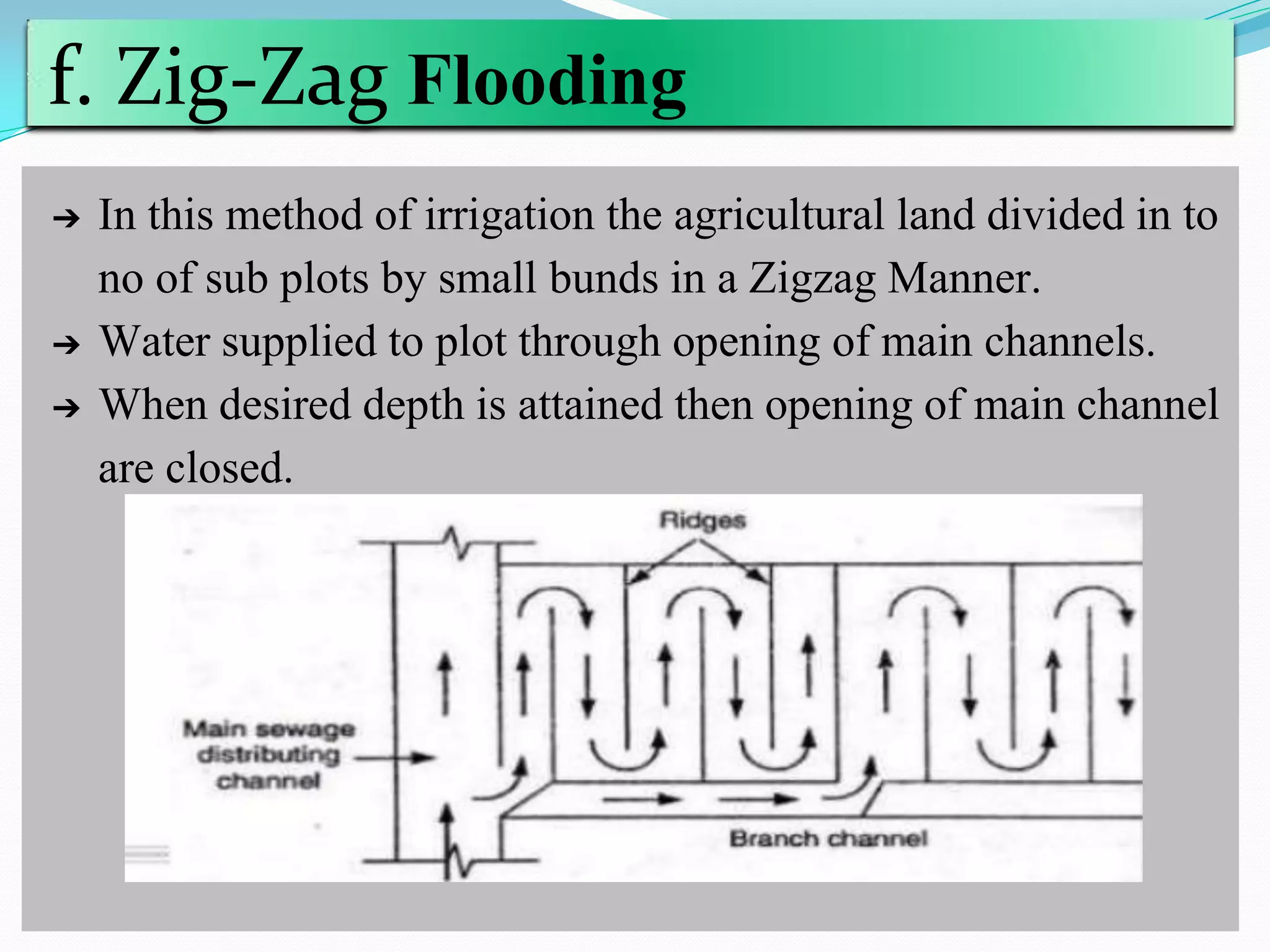
➔ In this method of irrigation the agricultural land divided in to
no of sub plots by small bunds in a Zigzag Manner.
➔ Water supplied to plot through opening of main channels.
➔ When desired depth is attained then opening of main channel
are closed.
B. Forrow Irrigation
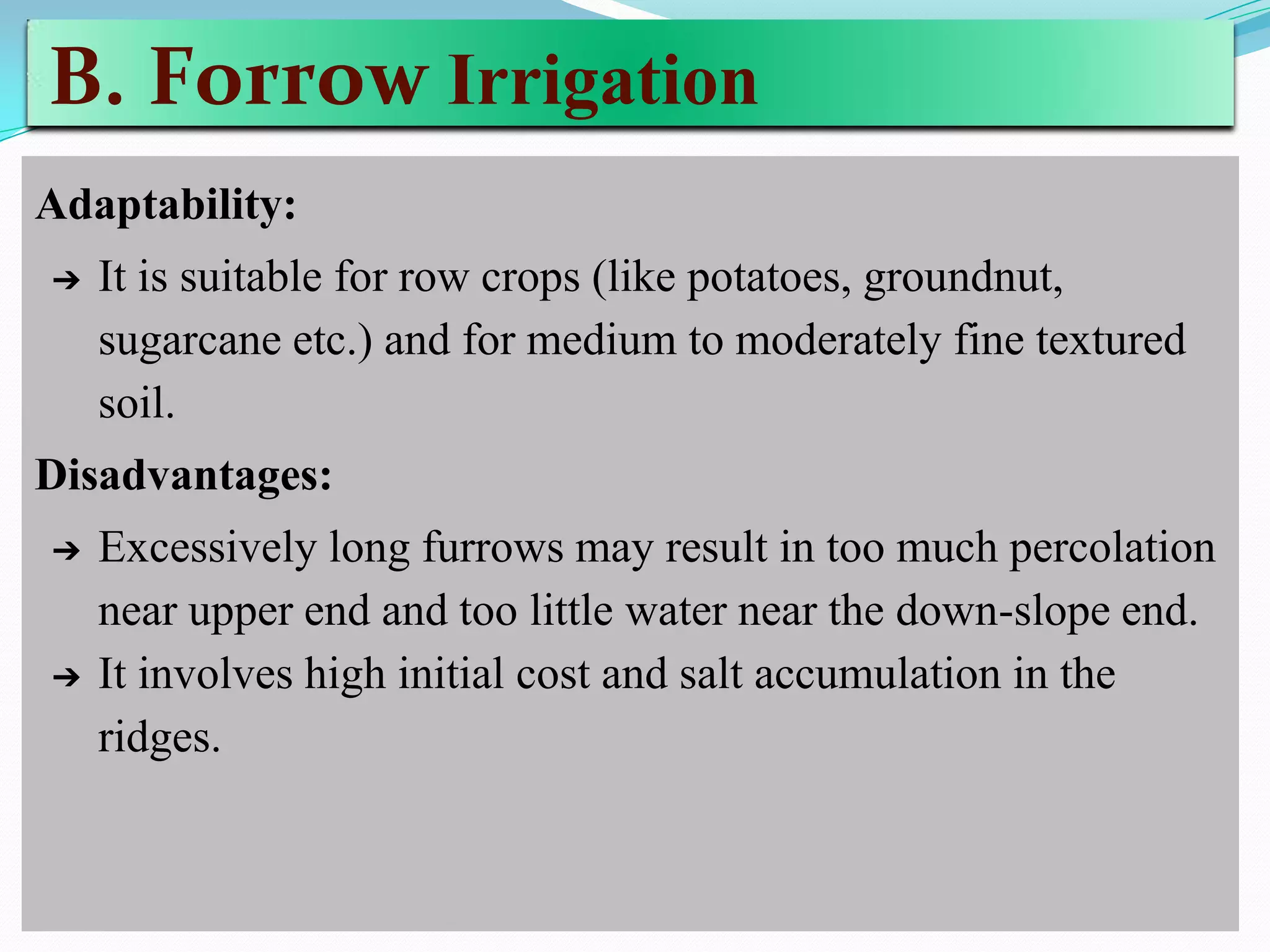
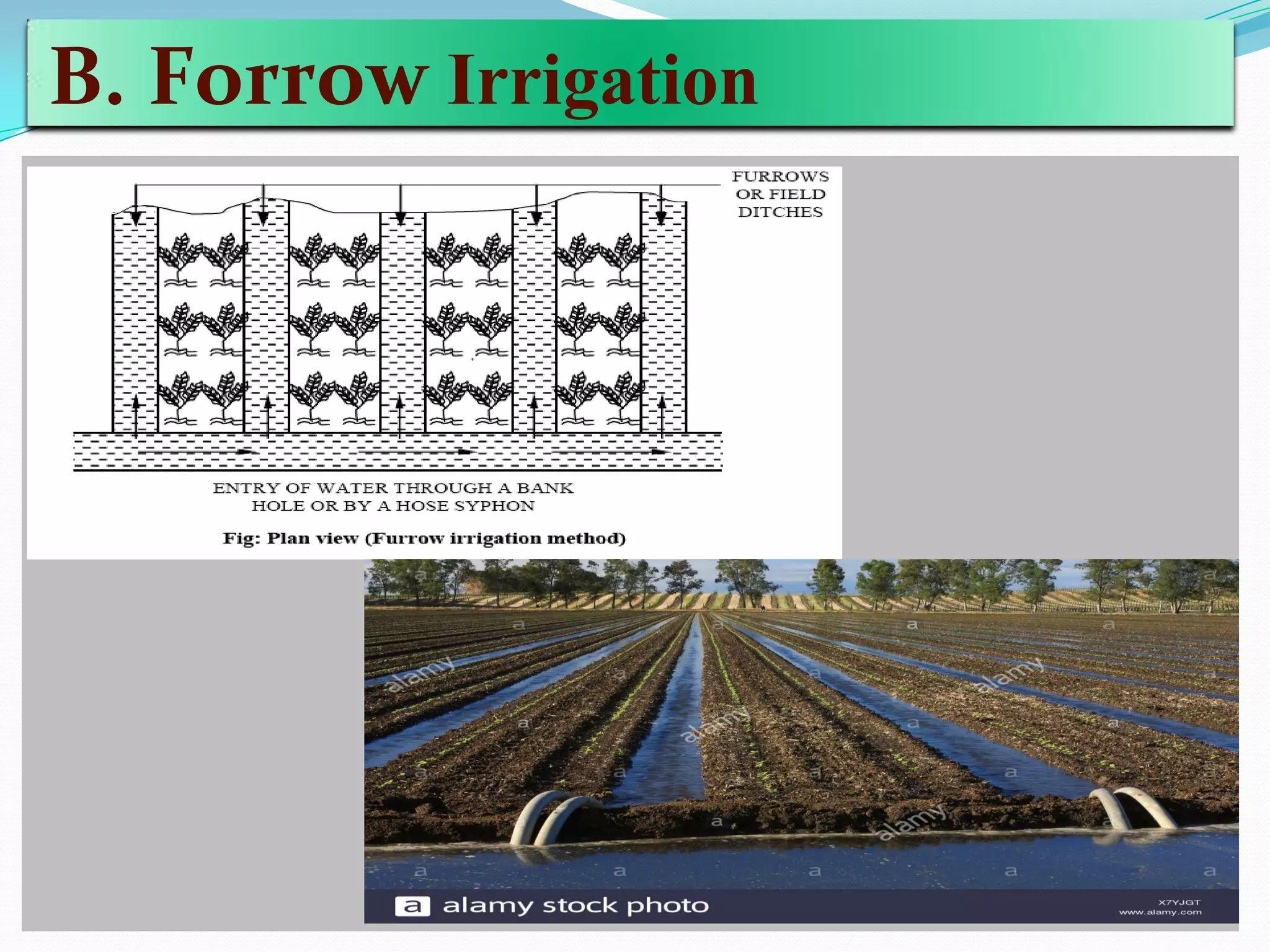
➔ Furrow are narrow field ditches, excavated between rows of
plants and carry water through them.
➔ Spacing of furrows is determined by proper spacing of the
plants.
➔ Furrows vary from 8 to 30 cm deep and may be as much as
400 meters long.
➔ Deep furrows are widely used for row crops.
➔ Water diverted into the furrows by using rubber hose tubing.
➔ Hose prevents the necessity of breaking of the ditch bank and
provides a uniform flow into the furrow.
B. Forrow Irrigation
Adaptability:
➔ It is suitable for row crops (like potatoes, groundnut,
sugarcane etc.) and for medium to moderately fine textured
soil.
Disadvantages:
➔ Excessively long furrows may result in too much percolation
near upper end and too little water near the down-slope end.
➔ It involves high initial cost and salt accumulation in the
ridges.
B. Forrow Irrigation
C. Contour Farming
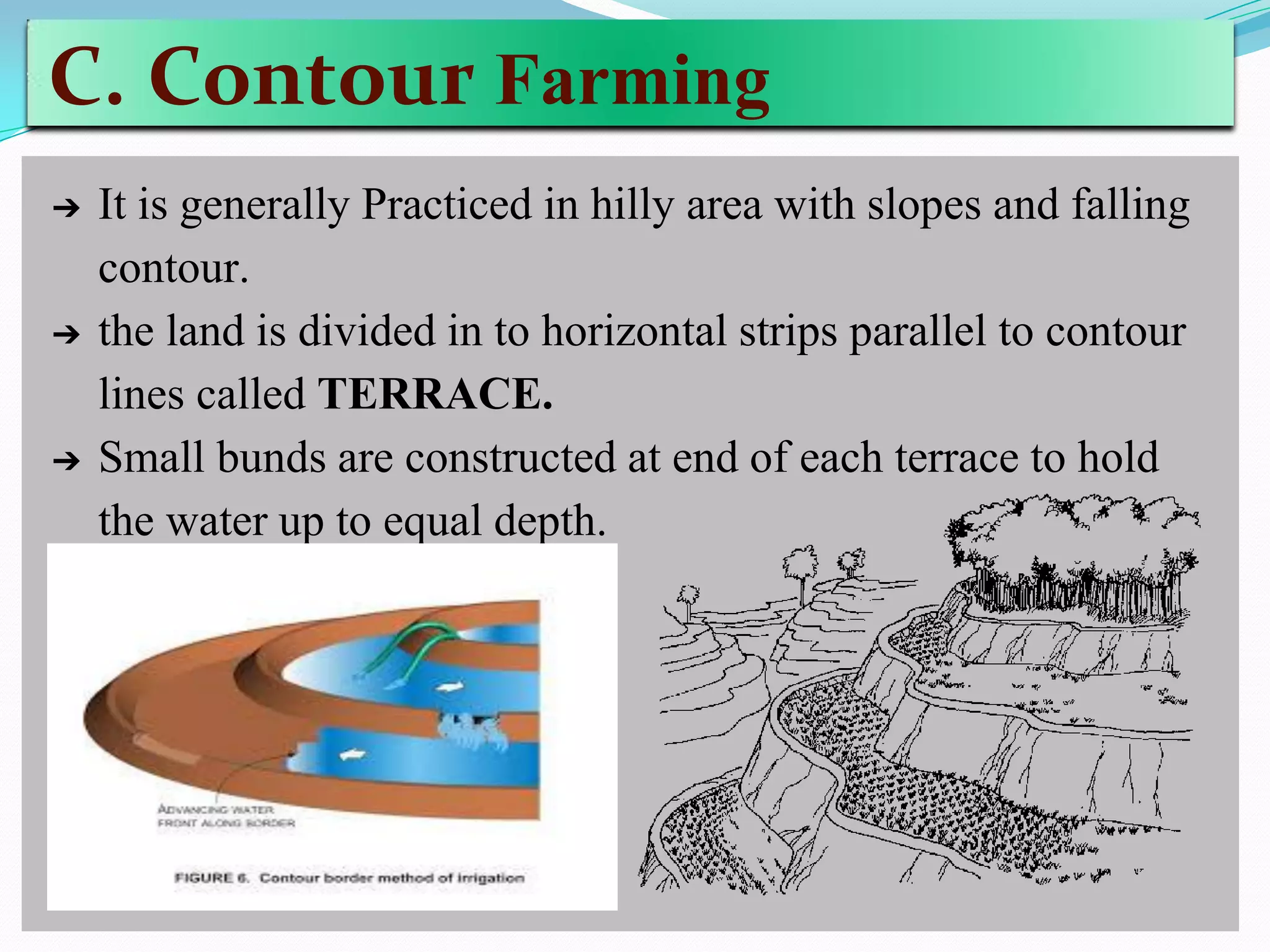
➔ It is generally Practiced in hilly area with slopes and falling
contour.
➔ the land is divided in to horizontal strips parallel to contour
lines called TERRACE.
➔ Small bunds are constructed at end of each terrace to hold
the water up to equal depth.
Sprinkler Irrigation
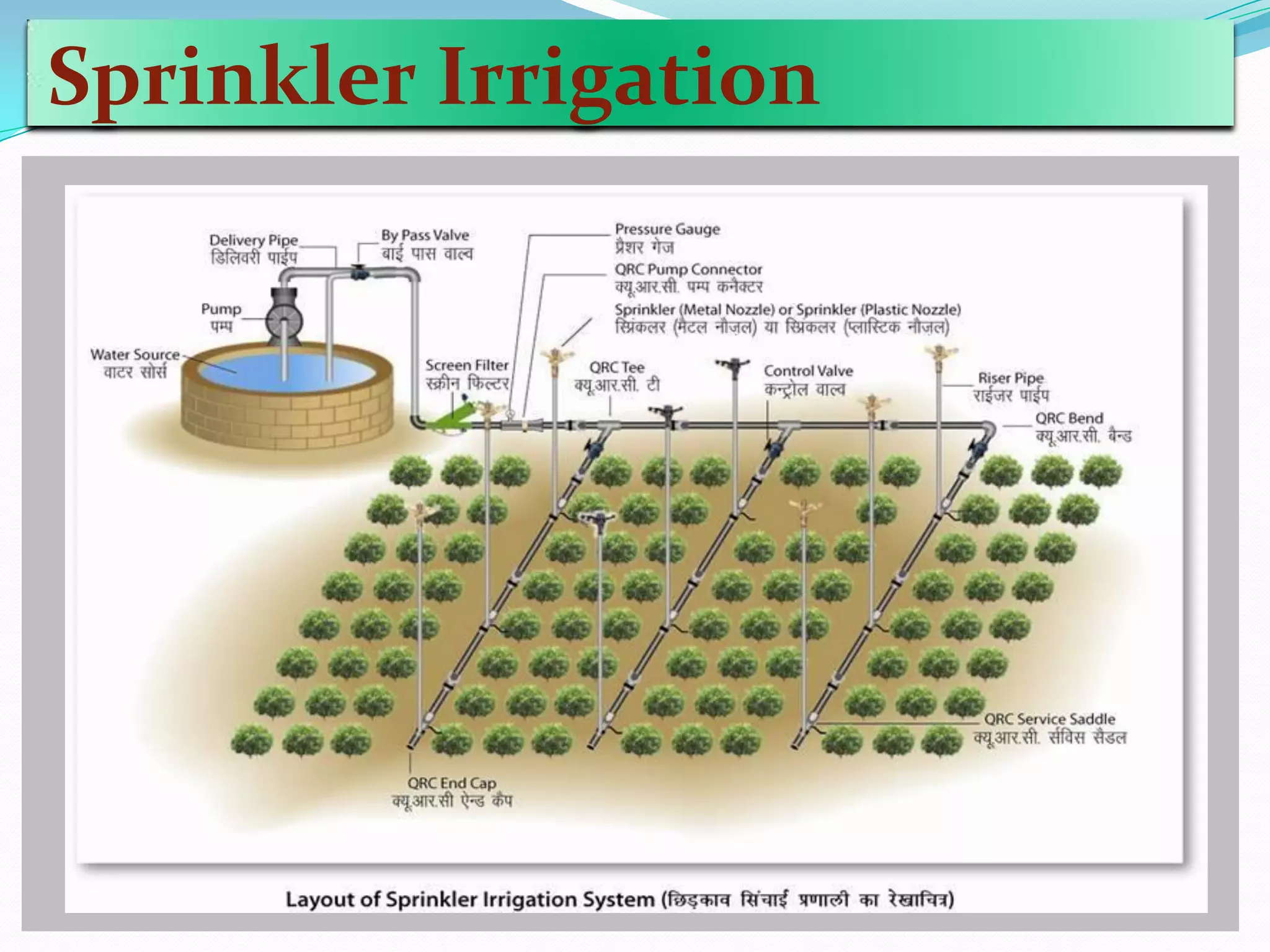
➔ Water is applied to the soil in the form of a spray through a
network of pipes and pumps.
➔ It is kind of an artificial rain and gives good results.
➔ It is a costly process.
➔ It can be used for all types of soils and for widely different
topographies and slopes.
Adaptability:
➔ This method can be used for almost all crops (except rice and
jute) and on most soils.
➔ It is best suited to sandy soils that have a high infiltration
rate.
Sprinkler Irrigation
Advantages of sprinkler irrigation:
➔Seepage losses, which occur in earthen channels of
surface irrigation methods, are completely eliminated.
Moreover.
➔Land leveling is not required.
➔No cultivation area is lost for making ditches.
➔avoided surface runoff.
➔prevents water-logging or salinity.
➔It is less labor oriented and hence useful where labor is
costly and scarce.
Sprinkler Irrigation
Limitations of sprinkler irrigation:
➔High winds may distort sprinkler pattern.
➔non-uniform spreading of water on the crops..
➔In areas of high temperature and high wind velocity,
considerable evaporation losses.
➔They are not suited to crops requiring frequent and
larger depths of irrigation.
➔Initial cost of the system is very high.
➔Only sand and silt free water can be used
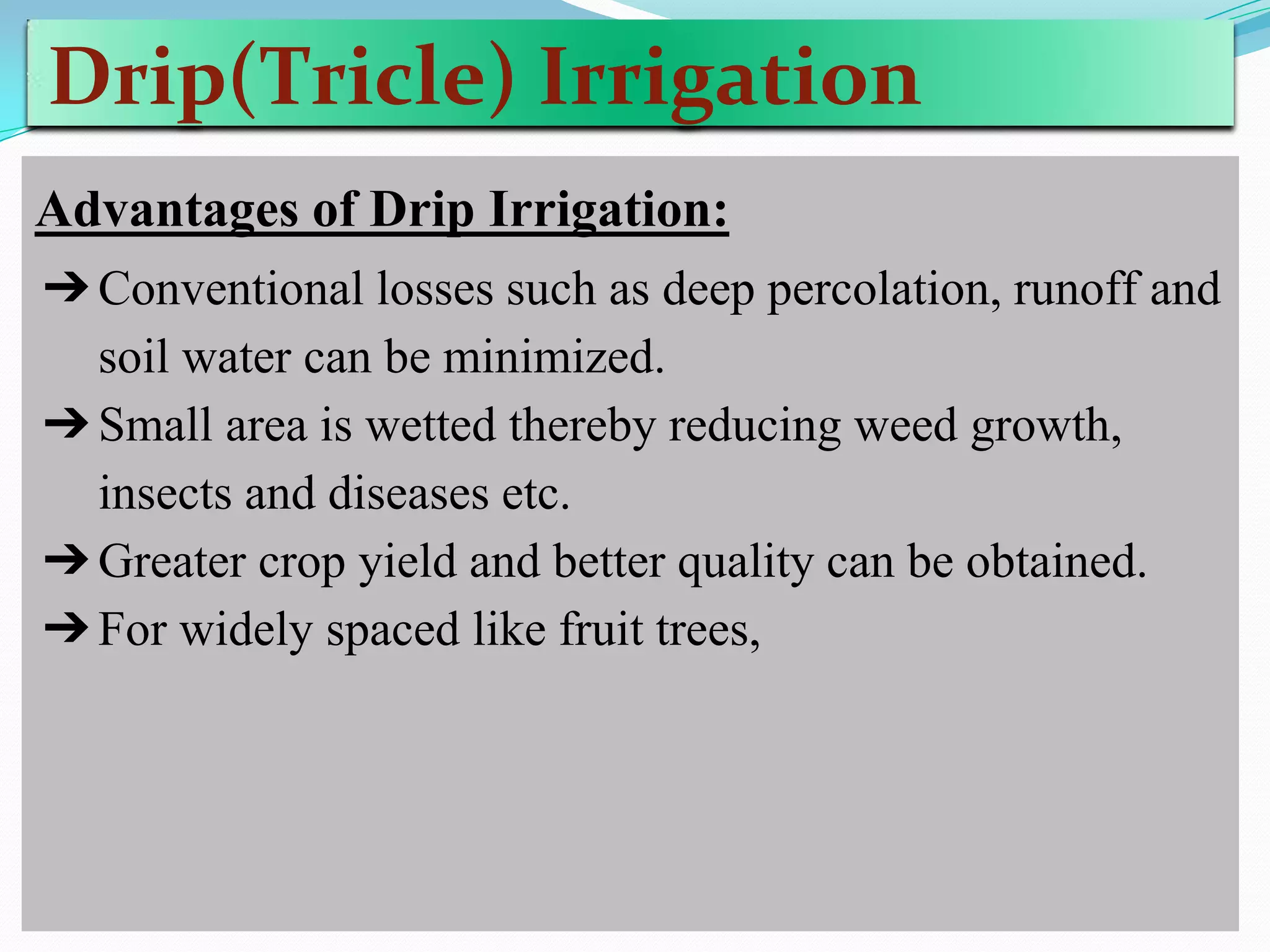
Drip(Tricle) Irrigation
➔It is the latest field irrigation technique (also called
trickle irrigation)
➔Irrigation water is applied by using small diameter (12 to
32 mm) plastic lateral lines.
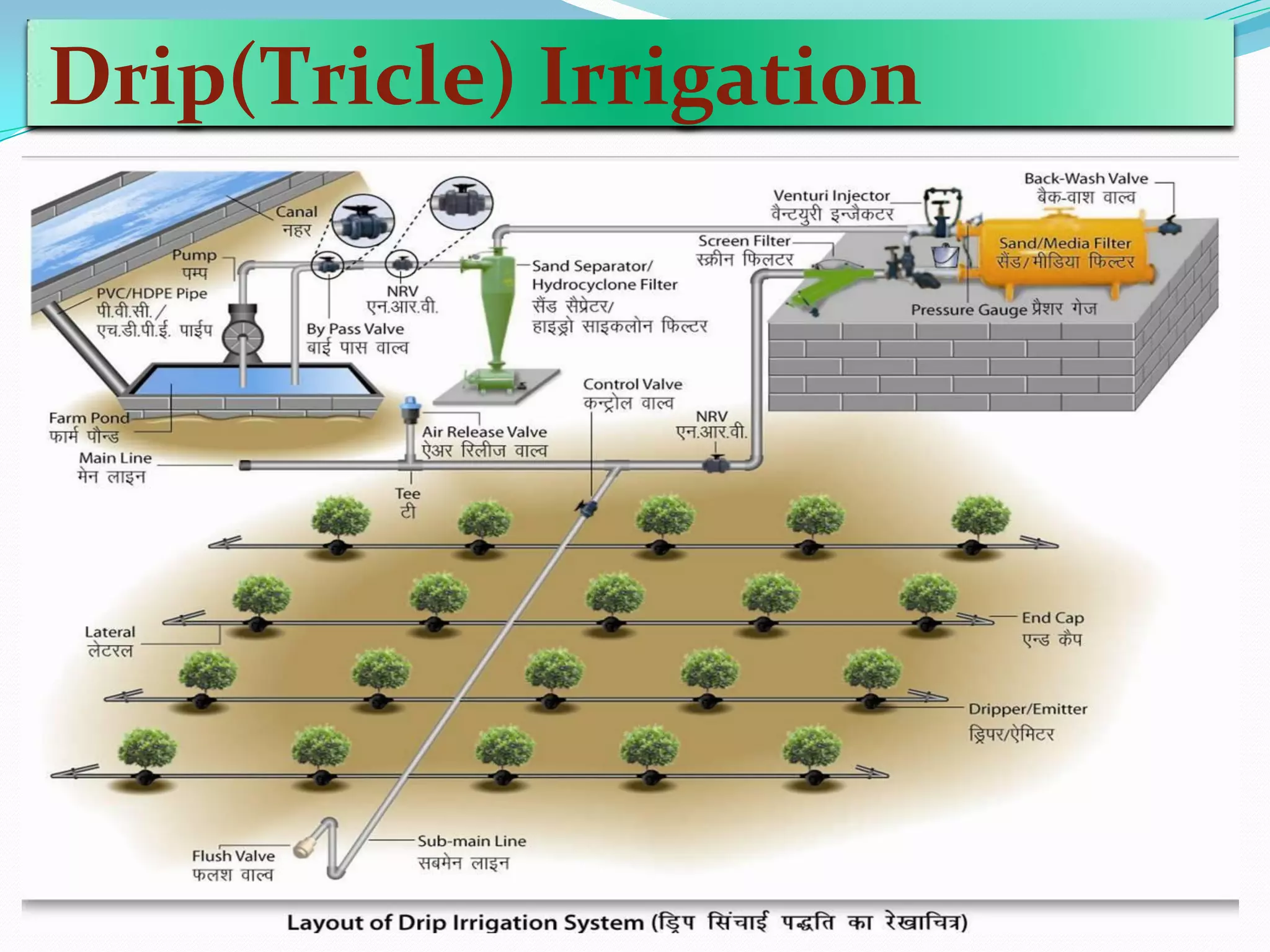
➔The lateral lines contains some devices called emitters
at selected spacing to deliver water to the soil surface
near the base of the plants.
➔It is best suited for widely spaced plants.
➔water is slowly and directly applied to the root zone of
the plants for minimizing the losses by evaporation and
percolation
Drip(Tricle) Irrigation
Advantages of Drip Irrigation:
➔Conventional losses such as deep percolation, runoff and
soil water can be minimized.
➔Small area is wetted thereby reducing weed growth,
insects and diseases etc.
➔Greater crop yield and better quality can be obtained.
➔For widely spaced like fruit trees,
Drip(Tricle) Irrigation
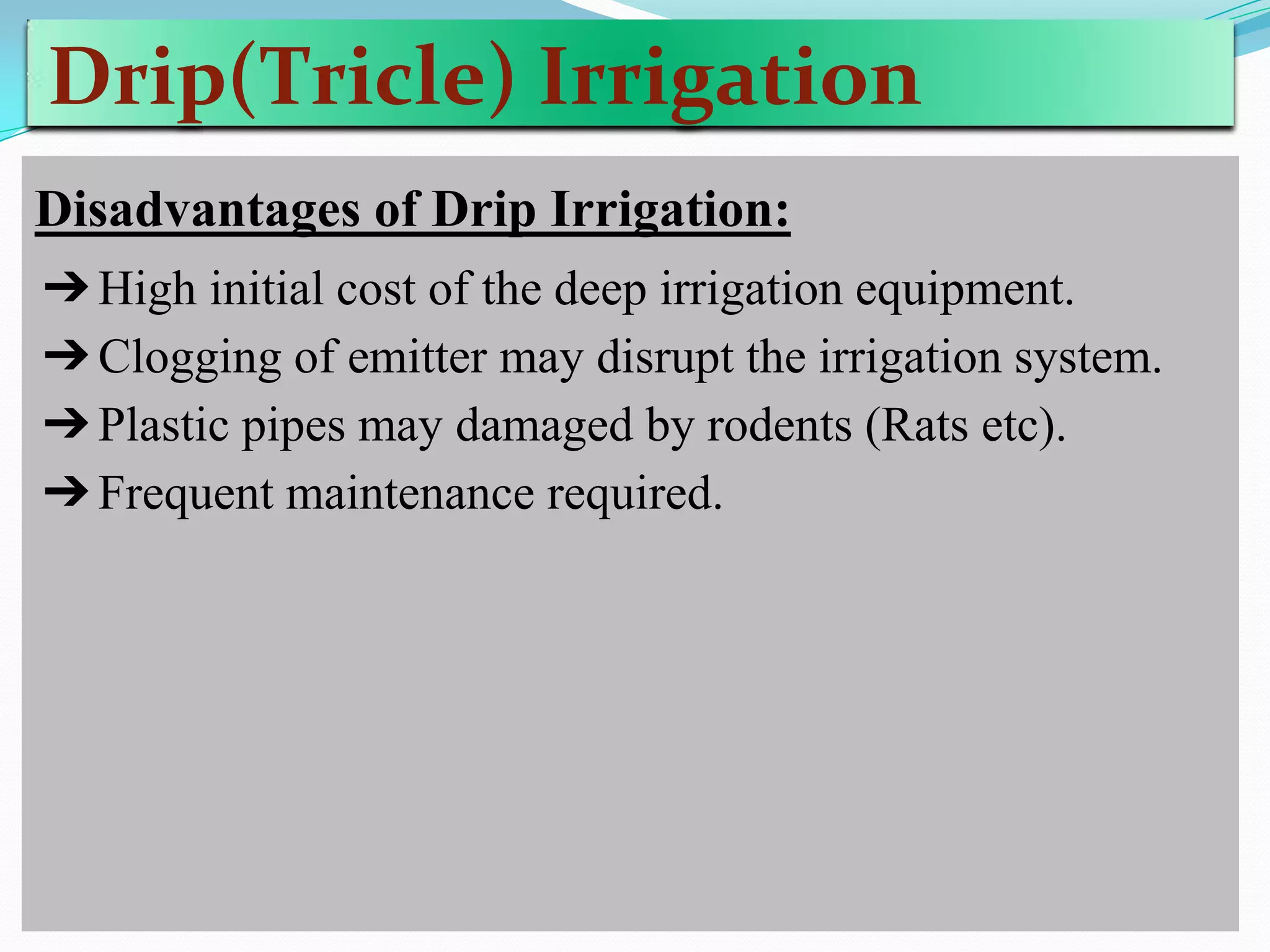
Disadvantages of Drip Irrigation:
➔High initial cost of the deep irrigation equipment.
➔Clogging of emitter may disrupt the irrigation system.
➔Plastic pipes may damaged by rodents (Rats etc).
➔Frequent maintenance required.
Drip(Tricle) Irrigation
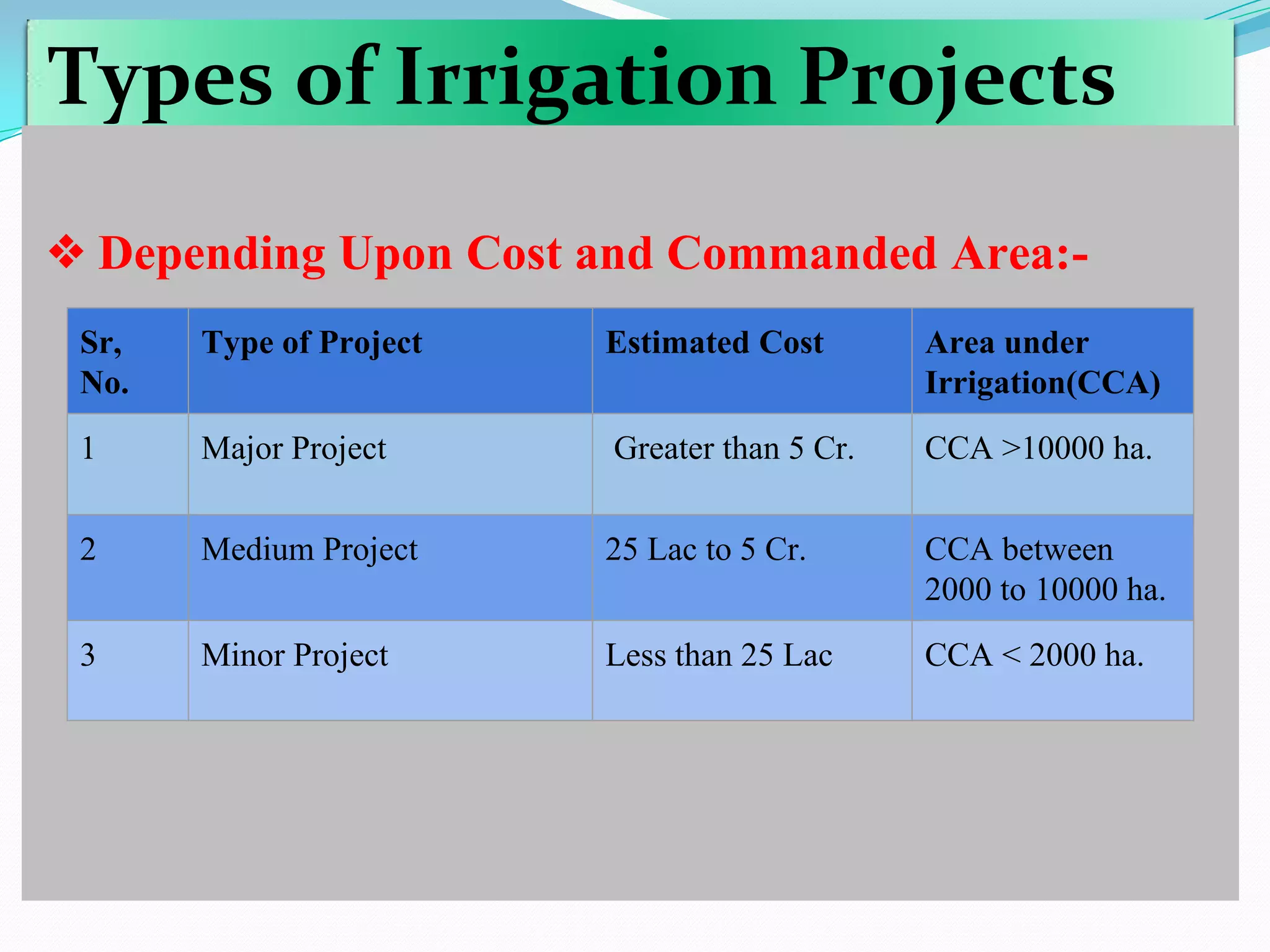
Types of Irrigation Projects
❖Depending Upon Cost and Commanded Area:-
Sr,
No.
Type of Project Estimated Cost Area under
Irrigation(CCA)
1 Major Project Greater than 5 Cr. CCA >10000 ha.
2 Medium Project 25 Lac to 5 Cr. CCA between
2000 to 10000 ha.
3 Minor Project Less than 25 Lac CCA < 2000 ha.
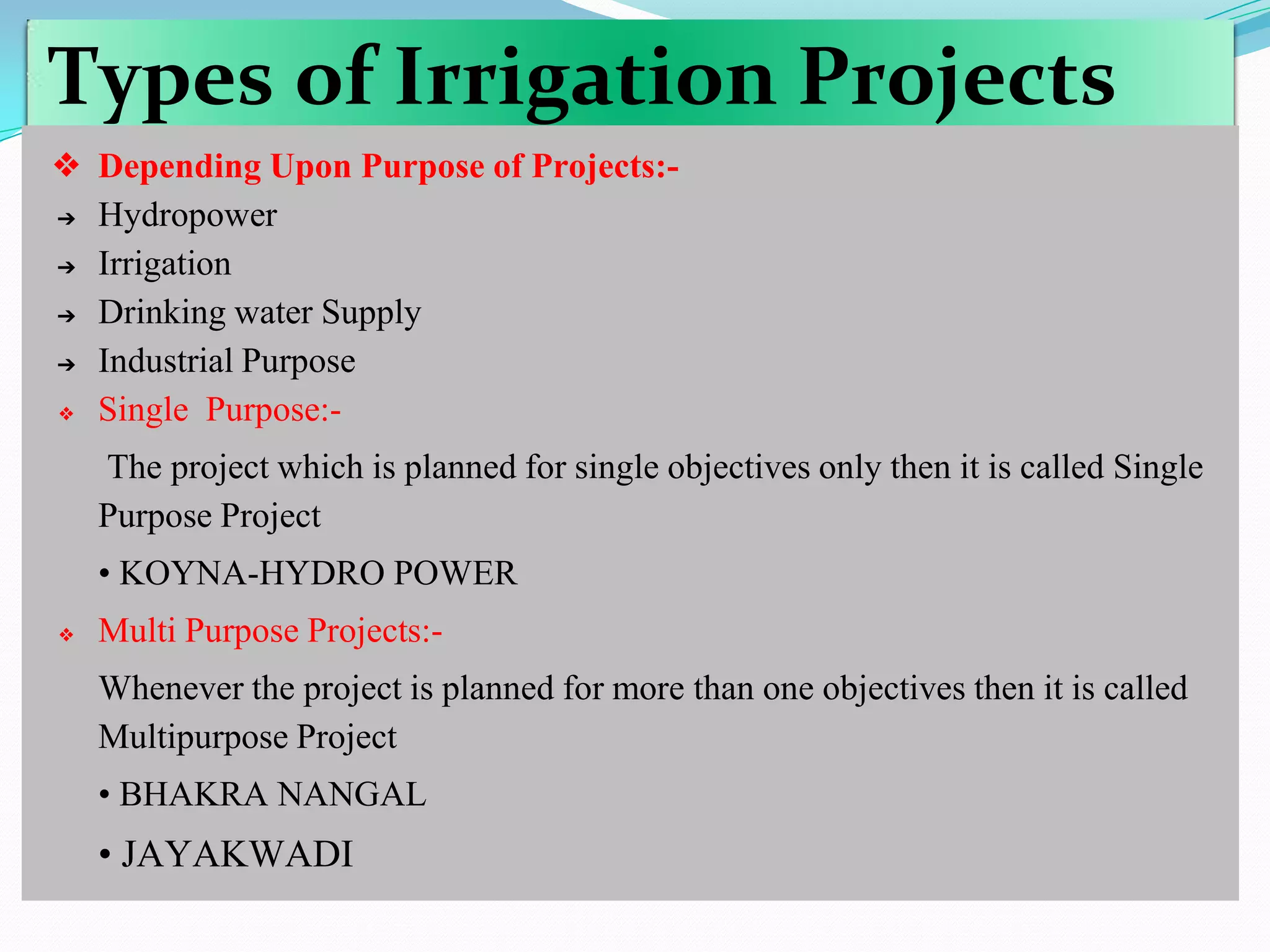
Types of Irrigation Projects
❖ Depending Upon Purpose of Projects:-
➔ Hydropower
➔ Irrigation
➔ Drinking water Supply
➔ Industrial Purpose
❖ Single Purpose:-
The project which is planned for single objectives only then it is called Single
Purpose Project
• KOYNA-HYDRO POWER
❖ Multi Purpose Projects:-
Whenever the project is planned for more than one objectives then it is called
Multipurpose Project
• BHAKRA NANGAL
• JAYAKWADI
Introduction to irrigation engineering 19 07 1 (1)

Introduction to irrigation engineering 19 07 1 (1)

  • 1.
    Water Resource Engineering By Mr.HoleG.R. Civil Engineering Department J.S. Polytechnic, Hadapsar, Pune
  • 2.
    Topic wise Weightage Unit No Nameof Topic Teaching Hours Marks 1 Introduction To Irrigation And Hydrology 12 14 2 Water Requirement Of Crops And Reservoir Planning 12 16 3 Dams And Spillways 14 12 4 Minor And Micro Irrigation 08 10 5 Diversion Head Works 08 08 6 Canals 10 10 Total 64 70
  • 3.
    Course Outcomes Unit No Course Outcomes(CO’s) 1 Estimate Hydrological Parameters. 2 Estimate crop water requirement of commanded area and canal capacity 3 Knowledge of components of Dams and Spillway 4 Execute minor and micro irrigation scheme 5 Select relevant diversion head work for specific site condition. 6 Design and maintenance of canal.
  • 4.
    Unit No. 01 Introductionto Irrigation Engineering and Hydrology
  • 5.
    Content ➔Definition Of Irrigation ➔Necessityof Irrigation in India. ➔Advantages and Dis-Advantages of Irrigation ➔Classification of Irrigation. ➔Concept of Hydrology And Imp Definitions. ➔Rain Gauge and Rainfall Calculation. ➔Runoff ,Factors Affecting Runoff and Runoff computation. ➔Concept of MFD ➔Yield and Dependable Yield of catchment.
  • 6.
    Definition Of Irrigation Irrigation:- •It is Process of artificial application of water on agricultural land to increase the crop production is called as Irrigation. • Irrigation is nothing but external supply of water to the crop when there is insufficient Rainfall for the growth of crop.
  • 7.
    Necessity of Irrigationin India. 1) Inadequate rainfall. 2) Non-uniform rainfall. 3) Growing a number of crops during a year. 4) Growing perennial crops. 5) Growing superior crops. 6) Increasing the yield of crops. 7) Protection against drought.
  • 8.
    Advantages of Irrigation ▪Protection from Famine: Food production is increased due to irrigation by producing more crops used as food. This protects a country from famine situation. ▪ Increase of Groundwater Level. Due to constant seepage and percolation of water from canal, groundwater level in the nearby area is increased.
  • 9.
    Advantages of IrrigationContinue. ▪ Yields of crops Yield of crop can be increased by irrigation even in the period of low rainfall. ▪ Elimination of mixed cropping -The areas where irrigation is not assured, mixed cropping is adopted. -This will affect the crop yield, so by providing irrigation facility we can eliminate mixed cropping Pattern
  • 10.
    Advantages of IrrigationContinue. ▪ Water Supply: • Irrigation water may be used as source for domestic and industrial water supply. ▪ Navigation: If the irrigation canals are big and deep, they may be used as navigable water way.
  • 11.
    Advantages of IrrigationContinue. ▪ Protection from Drought: • Water Retaining structures are helpful to solve the problem of Drought by storing water during rainy season and it is useful during Drought or Summer. ▪ Recreation Recreation facilities like parks, restaurants may be developed near the canal banks or reservoir sites.
  • 12.
    Disadvantages of Irrigation ▪Effects on Raising Water Table. • In unlined irrigation canal, excessive seepage of water through bed and sides takes place which raises the water table of the surrounding areas. Soil in the root zone of the crop is saturated and become alkaline which is harmful to the crops and plants. Thus the nearby area may be waterlogged. ▪ Damp Climate. Temperature of the command area of an irrigation projects may be lowered and damp climate prevails, which adversely affect the health of the community living in this area.
  • 13.
    Disadvantages of Irrigation ▪Breeding Places of Mosquitoes • Due to excess application of water, seepage and leakage from canal, marshy land may be formed leading to breeding place of mosquitos. ▪ Loss of Valuable Land :- Valuable land may be submerged due to construction of reservoir by dam, weir and barrages.
  • 14.
    Disadvantages of Irrigation ▪Salt efflorescence- due to water logging salt efflorescence occurs which may damage land permanently.
  • 15.
  • 16.
    Types of Irrigation A.Surface Irrigation:- It is the type of irrigation in which water is directly applied on the surface of irrigational Land. a. Flow Irrigation 1. Perineal Irrigation 2. Inundation Irrigation b. Lift Irrigation B. Sub Surface Irrigation:- It is the type of irrigation in which water is directly applied to root zone of the crop by providing underground Drainage or through Natural Seepage. a. Natural Irrigation b. Artificial Irrigation
  • 17.
    A. Flow Irrigation Definition: Itis the type of irrigation in which water is supplied to the crop under the action of Gravity so it is called as Flow Irrigation. E.g.:- Irrigation Through Canal/ River ⚫ In this System of Irrigation available source of water is at higher elevation and it is transmits to lower elevation by simple action of Gravity ▪ Flow Irrigation Further Classified in to Two Types 1) Perennial Irrigation 2) Inundation Irrigation
  • 18.
    1.Perennial Irrigation Definition: In thissystem constant and continuous water supply is maintain for crops accordance with their requirement through out its crop period then it is called Perennial Irrigation. ▪ This type of Irrigation is Practiced on Perennial River. ▪ Constant supply of water is maintained by constructing Weir, Barrages, Dams across Perennial River. ▪ It is further classified in two types a. Direct Irrigation b. Storage Irrigation
  • 19.
    a. Direct Irrigation Definition: InDirect irrigation water is not stored on U/S of any Hydraulic structure rather than it is directly diverted in to canal by using Diversion Works. ▪ Direct irrigation practiced on Small rivers or Nala. ▪ It covers less commendable area.
  • 20.
    b. Storage Irrigation Definition: Itis type of flow in irrigation in which water is stored on U/S of Dam or any other water retaining structure and then it is supplied in canal depending upon requirement of water. ▪ No direct use of water is allowed from Dam Reservoir. ▪ It covers Large commendable area.
  • 21.
    2. Inundation Irrigation Definition: Inthis method of irrigation soil is kept submerged and flooded with water so as to increase saturation of land as per the crop water Requirement. ▪ It is also called as Uncontrolled Irrigation. ▪ No control structure are constructed across river only canal bed is kept lower than HFL so during Flood the water level in river rises and diverted in to canal if it rises above bed level of canal.
  • 22.
    Subsurface Irrgation a. NaturalIrrigation: It is the type of subsurface irrigation in which irrigation of land achieved through seepage occurred through river sides or unlined canal in to surrounding land.
  • 23.
    Subsurface Irrgation b. ArtificialIrrigation: When system of perforated pipes are directly laid below G.L. in to the root zone of crop so as to supply irrigation water directly to root zone then it is called artificial Irrigation.
  • 24.
  • 25.
    Factors Affecting Selectionof Irrigation Method Following are the factors which affects the selection of method of surface irrigation: 1. Soil characteristics of the land to be irrigated. 2. Topography of the area. 3. The available water supply. 4. Type of crop and its requirements. 5. Size of the stream supplying irrigation water. 6. Local Climate. 7. Local Tradition and skill
  • 26.
    A.Flooding Method Introduction: ▪ Itis the type of surface irrigation in which water is directly applied in the surface of irrigational land. ▪ In this method water is flowing along the slope ▪ It one of the oldest method of irrigation. ▪ Water use and application efficiencies are very low. ▪ It is further classified in to following types: 1. Wild Flooding 2. Controlled Flooding.
  • 27.
    1. Wild Flooding Introduction: ➔Wildflooding method is the earliest and the primitive method of application of water to the land. ➔In this method the water is applied by spreading it over the land prior to the application of water, no land preparations is done in the form of border or field ditches. ➔In this method water is flowing along the Natural slope. ➔Water Distribution is not uniform.
  • 28.
  • 29.
    2. Controlled Flooding Introduction: ▪In controlled flooding methods irrigation water is applied by spreading it over the land to be irrigated with proper control on the flow of water as well as the quantity of water applied. ▪ All the methods of control flooding require prior preparation of the land. ▪ The land is properly graded & agricultural fields are divided into small units by levees .
  • 30.
    2. Controlled Flooding Followingare the Controlled flooding methods: 1. Free flooding. 2. Contour laterals. 3. Border strips. 4. Check basins. 5. Basin flooding. 6. Zig-zag method.
  • 31.
    a. Free flooding. 1.Ditches are excavated in the field. 2. Water is applied from field ditches without any levee to guide its flow. 3. Movement of water is not restricted, it is sometimes called “wild flooding” 4. It is suitable for close growing crops, pastures etc. 5. It is practiced large where irrigation water is abundant and inexpensive. 6. It involves low initial cost of land preparation, extra labour cost in the application of water 7. This method may be used on rolling land (topography irregular) where borders, checks, basins and furrows are not feasible.
  • 32.
  • 33.
    b. Contour Lateralsflooding. ➔ It is an special case of free flooding in which laterals are laid along the contour Line. ➔ In this method of irrigation water can be applied only on on side of contour laterals.
  • 34.
    c. Border StripMethod ➔ In this Method The farm is divided into a number of strips (width 10 ~ 20 m and length 100 ~ 400 m) separated by low levees or borders. ➔ Water is turned from the supply ditch into these strips along which a flow slowly toward the lower end, wetting the soil as it advances. When the advancing water front reaches the lower end, the stream turned off. ➔ It is suitable to soils having moderately low to moderately high infiltration rates and to all closely growing crops. ➔ Uniform distribution and high water application efficiencies are possible.
  • 35.
  • 36.
    d. Check Flooding ➔In this Method The farm is divided in to plots and which are levelled by constructing levees and Bunds. ➔ Water is controlled by surrounding the check area with low and flat levees. ➔ The check is filled with water at a fairly high rate and allowed to stand until the water infiltrates. ➔ It is suitable for low as well as high intake soils and for rice or other crops which can withstand temporary flooding.
  • 37.
  • 38.
    e. Basin Flooding ➔It is special type of check flooding. ➔ Each Plant is enclosed by closed channels called Basins. ➔ These Basins are connected to small field channels. ➔ These field channels are connected to main Supply channel. ➔ This method is suitable for ORCHARD.
  • 39.
  • 40.
    f. Zig-Zag Flooding ➔In this method of irrigation the agricultural land divided in to no of sub plots by small bunds in a Zigzag Manner. ➔ Water supplied to plot through opening of main channels. ➔ When desired depth is attained then opening of main channel are closed.
  • 41.
    B. Forrow Irrigation ➔Furrow are narrow field ditches, excavated between rows of plants and carry water through them. ➔ Spacing of furrows is determined by proper spacing of the plants. ➔ Furrows vary from 8 to 30 cm deep and may be as much as 400 meters long. ➔ Deep furrows are widely used for row crops. ➔ Water diverted into the furrows by using rubber hose tubing. ➔ Hose prevents the necessity of breaking of the ditch bank and provides a uniform flow into the furrow.
  • 42.
    B. Forrow Irrigation Adaptability: ➔It is suitable for row crops (like potatoes, groundnut, sugarcane etc.) and for medium to moderately fine textured soil. Disadvantages: ➔ Excessively long furrows may result in too much percolation near upper end and too little water near the down-slope end. ➔ It involves high initial cost and salt accumulation in the ridges.
  • 43.
  • 44.
    C. Contour Farming ➔It is generally Practiced in hilly area with slopes and falling contour. ➔ the land is divided in to horizontal strips parallel to contour lines called TERRACE. ➔ Small bunds are constructed at end of each terrace to hold the water up to equal depth.
  • 45.
    Sprinkler Irrigation ➔ Wateris applied to the soil in the form of a spray through a network of pipes and pumps. ➔ It is kind of an artificial rain and gives good results. ➔ It is a costly process. ➔ It can be used for all types of soils and for widely different topographies and slopes. Adaptability: ➔ This method can be used for almost all crops (except rice and jute) and on most soils. ➔ It is best suited to sandy soils that have a high infiltration rate.
  • 46.
  • 47.
    Sprinkler Irrigation Advantages ofsprinkler irrigation: ➔Seepage losses, which occur in earthen channels of surface irrigation methods, are completely eliminated. Moreover. ➔Land leveling is not required. ➔No cultivation area is lost for making ditches. ➔avoided surface runoff. ➔prevents water-logging or salinity. ➔It is less labor oriented and hence useful where labor is costly and scarce.
  • 48.
    Sprinkler Irrigation Limitations ofsprinkler irrigation: ➔High winds may distort sprinkler pattern. ➔non-uniform spreading of water on the crops.. ➔In areas of high temperature and high wind velocity, considerable evaporation losses. ➔They are not suited to crops requiring frequent and larger depths of irrigation. ➔Initial cost of the system is very high. ➔Only sand and silt free water can be used
  • 49.
    Drip(Tricle) Irrigation ➔It isthe latest field irrigation technique (also called trickle irrigation) ➔Irrigation water is applied by using small diameter (12 to 32 mm) plastic lateral lines. ➔The lateral lines contains some devices called emitters at selected spacing to deliver water to the soil surface near the base of the plants. ➔It is best suited for widely spaced plants. ➔water is slowly and directly applied to the root zone of the plants for minimizing the losses by evaporation and percolation
  • 50.
    Drip(Tricle) Irrigation Advantages ofDrip Irrigation: ➔Conventional losses such as deep percolation, runoff and soil water can be minimized. ➔Small area is wetted thereby reducing weed growth, insects and diseases etc. ➔Greater crop yield and better quality can be obtained. ➔For widely spaced like fruit trees,
  • 51.
    Drip(Tricle) Irrigation Disadvantages ofDrip Irrigation: ➔High initial cost of the deep irrigation equipment. ➔Clogging of emitter may disrupt the irrigation system. ➔Plastic pipes may damaged by rodents (Rats etc). ➔Frequent maintenance required.
  • 52.
  • 53.
    Types of IrrigationProjects ❖Depending Upon Cost and Commanded Area:- Sr, No. Type of Project Estimated Cost Area under Irrigation(CCA) 1 Major Project Greater than 5 Cr. CCA >10000 ha. 2 Medium Project 25 Lac to 5 Cr. CCA between 2000 to 10000 ha. 3 Minor Project Less than 25 Lac CCA < 2000 ha.
  • 54.
    Types of IrrigationProjects ❖ Depending Upon Purpose of Projects:- ➔ Hydropower ➔ Irrigation ➔ Drinking water Supply ➔ Industrial Purpose ❖ Single Purpose:- The project which is planned for single objectives only then it is called Single Purpose Project • KOYNA-HYDRO POWER ❖ Multi Purpose Projects:- Whenever the project is planned for more than one objectives then it is called Multipurpose Project • BHAKRA NANGAL • JAYAKWADI