Lecture
2
INTERNATIONAL UNIVERSITY
FOR SCIENCE & TECHNOLOGY
‫وا‬ ‫م‬ ‫ا‬ ‫و‬ ‫ا‬ ‫ا‬
Dr. Abdulmannan Orabi
Civil Engineering and Environmental
Department
303421: Foundation Engineering
Bearing Capacity of Foundation
References
ACI 318M-14 Building Code Requirements for Structural
Concrete ( ACI 318M -14) and Commentary, American
Concrete Institute, ISBN 978-0-87031-283-0.
Bowles , J.,E.,(1996) “Foundation Analysis and Design” -5th
ed. McGraw-Hill, ISBN 0-07-912247-7.
Das, B., M. (2012), “ Principles of Foundation Engineering ”
Eighth Edition, CENGAGE Learning,
ISBN-13: 978-1-305-08155-0.
Syrian Arab Code for Construction 2012
Dr. Abdulmannan Orabi IUST 2
Bearing Capacity of Foundation
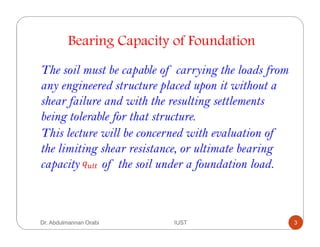
The soil must be capable of carrying the loads from
any engineered structure placed upon it without a
shear failure and with the resulting settlements
being tolerable for that structure.
This lecture will be concerned with evaluation of
the limiting shear resistance, or ultimate bearing
capacity of the soil under a foundation load.
3Dr. Abdulmannan Orabi IUST
It is necessary to investigate both base shear
resistance and settlements for any structure.
Bearing Capacity of Foundation
In many cases settlement criteria will control
the allowable bearing capacity; however, there
are also a number of cases where base shear (in
which a base punches into the ground - usually
with a simultaneous rotation) dictates the
recommended bearing capacity.
Dr. Abdulmannan Orabi IUST 4
Bearing Capacity of Foundation
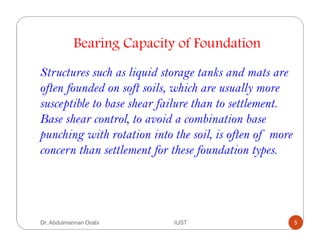
Structures such as liquid storage tanks and mats are
often founded on soft soils, which are usually more
susceptible to base shear failure than to settlement.
Base shear control, to avoid a combination base
punching with rotation into the soil, is often of more
concern than settlement for these foundation types.
Dr. Abdulmannan Orabi IUST 5
Allowable Bearing Capacity
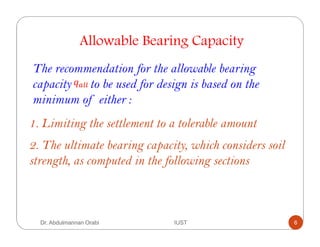
The recommendation for the allowable bearing
capacity to be used for design is based on the
minimum of either :
1. Limiting the settlement to a tolerable amount
2. The ultimate bearing capacity, which considers soil
strength, as computed in the following sections
Dr. Abdulmannan Orabi IUST 6
Allowable Bearing Capacity
The allowable bearing capacity based on shear
control is obtained by reducing (or dividing)
the ultimate bearing capacity (based on soil
strength) by a safety factor SF that is deemed
adequate to avoid a base shear failure to obtain
	=
.
(2-1)
The safety factor is based on the type of soil (cohesive or cohesionless),
reliability of the soil parameters, structural information (importance,
use, etc.), and consultant caution.
Dr. Abdulmannan Orabi IUST 7
Dr. Abdulmannan Orabi IUST
Allowable Bearing Capacity
Most building codes provide an allowable
settlement limit for a foundation, which
may be well below the settlement derived
corresponding to given by equations( 2-1).
Thus, the bearing capacity corresponding to the
allowable settlement must also be taken into
consideration.
8
BEARING-CAPACITY EQUATIONS
Terzaghi’s Bearing Capacity Theory
Terzaghi (1943) was the first to present a comprehensive
theory for the evaluation of the ultimate bearing capacity
of rough shallow foundations. According to this theory, a
foundation is shallow if its depth, Df (Figure slid 11), is
less than or equal to its width. Later investigators,
however, have suggested that foundations with Df equal
to 3 to 4 times their width may be defined as shallow
foundations.
Dr. Abdulmannan Orabi IUST 9
BEARING-CAPACITY EQUATIONS
Terzaghi’s Bearing Capacity Theory
The effect of soil above the bottom of the foundation may also
be assumed to be replaced by an equivalent surcharge,
(where is the unit weight of soil).
= 	 	∗
Terzaghi suggested that for a continuous, or strip, foundation
(i.e., one whose width-to-length ratio approaches zero), the
failure surface in soil at ultimate load may be assumed to be
similar to that shown in Figure on Slide 11.
Dr. Abdulmannan Orabi IUST 10
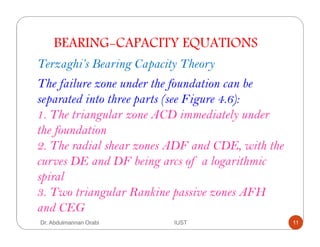
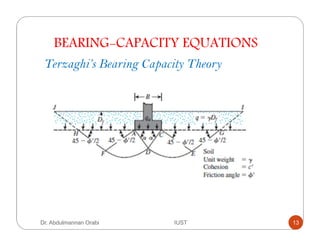
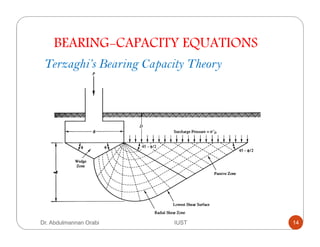
The failure zone under the foundation can be
separated into three parts (see Figure 4.6):
1. The triangular zone ACD immediately under
the foundation
2. The radial shear zones ADF and CDE, with the
curves DE and DF being arcs of a logarithmic
spiral
3. Two triangular Rankine passive zones AFH
and CEG
BEARING-CAPACITY EQUATIONS
Terzaghi’s Bearing Capacity Theory
Dr. Abdulmannan Orabi IUST 11
BEARING-CAPACITY EQUATIONS
Terzaghi’s Bearing Capacity Theory
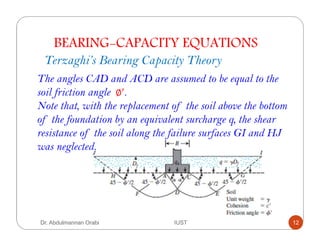
The angles CAD and ACD are assumed to be equal to the
soil friction angle .
Note that, with the replacement of the soil above the bottom
of the foundation by an equivalent surcharge q, the shear
resistance of the soil along the failure surfaces GI and HJ
was neglected.
∅
Dr. Abdulmannan Orabi IUST 12
BEARING-CAPACITY EQUATIONS
Terzaghi’s Bearing Capacity Theory
Dr. Abdulmannan Orabi IUST 13
BEARING-CAPACITY EQUATIONS
Terzaghi’s Bearing Capacity Theory
Dr. Abdulmannan Orabi IUST 14
BEARING-CAPACITY EQUATIONS
Terzaghi’s Bearing Capacity Theory
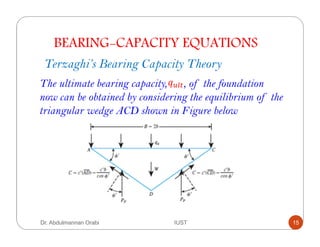
The ultimate bearing capacity, , of the foundation
now can be obtained by considering the equilibrium of the
triangular wedge ACD shown in Figure below
Dr. Abdulmannan Orabi IUST 15
BEARING-CAPACITY EQUATIONS
Terzaghi’s Bearing Capacity Equation
= 0.5	 	 	 + 	 +
, , !	 	 "#	 # "$ %	& ' &$()	* &(+",	
and depends on angle of shearing resistance (ø)
(	. /. 4 − 1	, ,)
4ℎ#"#:
= 4$!(ℎ	+*	(ℎ#	*++($ %	
= 7 $(	4#$%ℎ(	+*	(ℎ#	,+$8	/#8+4	(ℎ#	*+7 ! ($+ 	8#9#8
= ∗
= 0	, = 1		 !		 : = 1.5	; + 1 = 5.71				*+"	∅ = 0
Dr. Abdulmannan Orabi IUST 16
BEARING-CAPACITY EQUATIONS
Terzaghi’s Bearing Capacity Equation
= 0.5	 	 	 + 	 +
, , !	 = ℎ '	* &(+",
Shape factors for the Terzaghi equations
Sγ Sq SC
Square 0.8 1 1.3
Circular 0.6 1 1.3
Rectangular 1-0.2 B/L 1 1+0.3 B/L
Dr. Abdulmannan Orabi IUST 17
BEARING-CAPACITY EQUATIONS
Terzaghi’s Bearing Capacity Theory
for Local Shear Failure
Terzaghi suggested the following relationships for
local shear failure in soil:
where
, 	 , !	 	 "#	=+!$*$#!	/# "$ %	* &(+",	
= 0.5	 	 	 + 	 +
=	
2
3
	 tan ∅ = tan	(	
2
3
∅)
Dr. Abdulmannan Orabi IUST 18
BEARING-CAPACITY EQUATIONS
Meyerhof ’s Bearing Capacity Equation
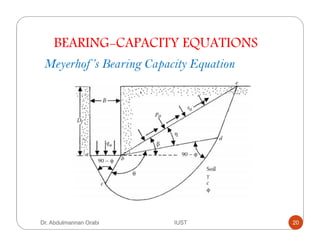
In 1951, Meyerhof published a bearing capacity theory
that could be applied to rough, shallow, and deep
foundations. The failure surface at ultimate load under a
continuous shallow foundation assumed by Meyerhof is
shown in Figure below.
Dr. Abdulmannan Orabi IUST 19
BEARING-CAPACITY EQUATIONS
Meyerhof ’s Bearing Capacity Equation
Dr. Abdulmannan Orabi IUST 20
BEARING-CAPACITY EQUATIONS
Meyerhof ’s Bearing Capacity Equation
In this figure abc is the elastic triangular, bcd is the
radial shear zone with cd being an arc of a log spiral,
and bde is a mixed shear zone in which the shear varies
between the limits of radial and plane shears depending
on the depth and roughness of the foundation.
The plane be is called an equivalent free surface.
Dr. Abdulmannan Orabi IUST 21
BEARING-CAPACITY EQUATIONS
Meyerhof ’s Bearing Capacity Equation
Vertical load:
= 0.5	 	 	 ! + 	 ! + !
= 0.5	 	 	 $ ! + 	 $ ! + $ !
Inclined load:
Dr. Abdulmannan Orabi IUST 22
BEARING-CAPACITY EQUATIONS
Meyerhof ’s Bearing Capacity Equation
tan 2
( ) tan (45 )
2
qN eπ φ φ
= +
( 1)cotC qN N φ= −
( 1) tan(1.4 )qN Nγ φ= −
where
, , !	 	 "#	 # "$ %	& ' &$()	* &(+",	
= 0	, = 1		 !		 : = ; + 2 = 5.14				*+"	∅ = 0
Dr. Abdulmannan Orabi IUST 23
BEARING-CAPACITY EQUATIONS
Meyerhof ’s Bearing Capacity Equation
where
	 , , !	 = ℎ '#		* &(+",	
1 0.1 .......... 10q p
B
S S K for
L
γ φ= = + × ≥
1 0.2c p
B
S K
L
= + ×
CD = ( E
(45 +
∅
2
)
=	 = 1			*+"	∅ = 0	
24Dr. Abdulmannan Orabi IUST
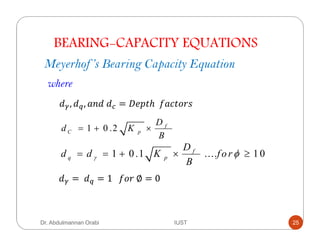
! , ! , !	! = #'(ℎ		* &(+",
BEARING-CAPACITY EQUATIONS
Meyerhof ’s Bearing Capacity Equation
where
1 0 .2 f
C p
D
d K
B
= + ×
1 0.1 .... 10f
q p
D
d d K for
B
γ φ= = + × ≥
! =	! = 1			*+"	∅ = 0
Dr. Abdulmannan Orabi IUST 25
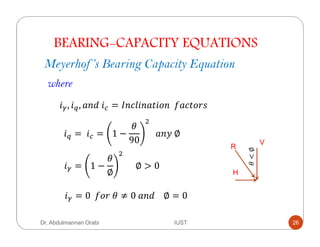
$ , $ , !	$ = F &8$ ($+ 		* &(+",
BEARING-CAPACITY EQUATIONS
Meyerhof ’s Bearing Capacity Equation
where
$ =	$ = 1 −
G
90
E
		 )	∅
$ = 1 −
G
∅
E
					∅ > 0
$ = 0		*+"	G ≠ 0	 !				∅ = 0
G<∅
V
H
R
Dr. Abdulmannan Orabi IUST 26
BEARING-CAPACITY EQUATIONS
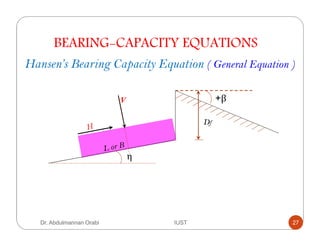
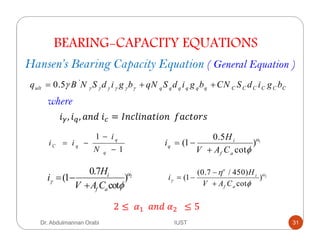
Hansen’s Bearing Capacity Equation ( General Equation )
Df
V
η
+β
Dr. Abdulmannan Orabi IUST 27
BEARING-CAPACITY EQUATIONS
Hansen’s Bearing Capacity Equation ( General Equation )
'
0.5ult q q q q q q C C C C C Cq B N S d i g b qN S d i g b CN S d i g bγ γ γ γ γ γγ= + +
tan 2
( ) tan (45 )
2
qN eπ φ φ
= +
( 1)cotC qN N φ= −
( 1) tan(1.4 )qN Nγ φ= −
where
, , !	 	 "#	 # "$ %	& ' &$()	* &(+",	
= 0	, = 1		 !		 : = ; + 2 = 5.14				*+"	∅ = 0
Dr. Abdulmannan Orabi IUST 28
BEARING-CAPACITY EQUATIONS
Hansen’s Bearing Capacity Equation ( General Equation )
'
0.5ult q q q q q q C C C C C Cq B N S d i g b qN S d i g b CN S d i g bγ γ γ γ γ γγ= + +
where
	 , , !	 = ℎ '#		* &(+",	
'
'
1
q
C
C
N B
S
N L
= + ×
'
'
1 sinq
B
S
L
φ= +
'
'
1 0.4
B
S
L
γ = − ≥ 	0.6
Dr. Abdulmannan Orabi IUST 29
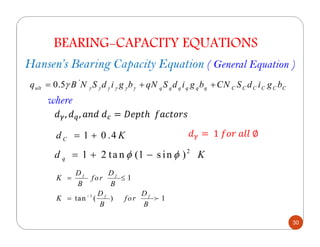
! , ! , !	! = #'(ℎ		* &(+",
where
BEARING-CAPACITY EQUATIONS
Hansen’s Bearing Capacity Equation ( General Equation )
'
0.5ult q q q q q q C C C C C Cq B N S d i g b qN S d i g b CN S d i g bγ γ γ γ γ γγ= + +
1 0 .4Cd K= +
2
1 2 ta n (1 s in )qd Kφ φ= + −
1
1
tan ( ) 1
f f
f f
D D
K for
B B
D D
K for
B B
−
= ≤
= f
! = 	1	*+"	 88	∅
30
BEARING-CAPACITY EQUATIONS
Hansen’s Bearing Capacity Equation ( General Equation )
'
0.5ult q q q q q q C C C C C Cq B N S d i g b qN S d i g b CN S d i g bγ γ γ γ γ γγ= + +
$ , $ , !	$ = F &8$ ($+ 		* &(+",
where
1
1
q
C q
q
i
i i
N
−
= −
−
1
0.5
(1 )
cot
i
q
f a
H
i
V A C
α
φ
= −
+
2
0.7
(1 )
cot
i
f a
H
i
V A C
α
γ
φ
= −
+
2
(0.7 / 450)
(1 )
cot
o
i
f a
H
i
V A C
α
γ
η
φ
−
= −
+
2 ≤	OP		 !	OE 		≤ 5
Dr. Abdulmannan Orabi IUST 31
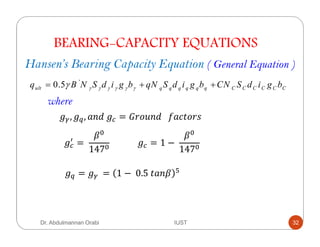
BEARING-CAPACITY EQUATIONS
Hansen’s Bearing Capacity Equation ( General Equation )
'
0.5ult q q q q q q C C C C C Cq B N S d i g b qN S d i g b CN S d i g bγ γ γ γ γ γγ= + +
where
% , % , !	% = Q"+7 !			* &(+",
% =	
RS
147S
% = 1 −	
RS
147S
% = % 	 = 1 − 	0.5	( R T
Dr. Abdulmannan Orabi IUST 32
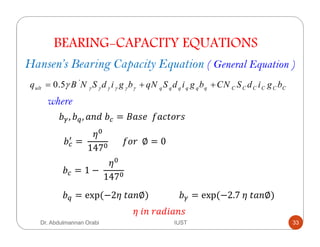
BEARING-CAPACITY EQUATIONS
Hansen’s Bearing Capacity Equation ( General Equation )
'
0.5ult q q q q q q C C C C C Cq B N S d i g b qN S d i g b CN S d i g bγ γ γ γ γ γγ= + +
where
/ , / , !	/ = ,#		* &(+",
/ =	
US
147S
						*+"		∅ = 0
/ = 1 −	
US
147S
/ = exp	(−2U	( ∅) / = exp	(−2.7	U	( ∅)	
U	$ 	" !$ ,
Dr. Abdulmannan Orabi IUST 33
BEARING-CAPACITY EQUATIONS
Hansen’s Bearing Capacity Equation ( General Equation )
= 5.14		 	 1 +	 + ! − $ − % − / 	 + 								*+"	∅ = 0
Where :
= 	0.2	
Y
! = 	0.4	Z	
$ = 	0.5 − 1 −	
[
]
	
/ =	
US
147S
						*+"		∅ = 0
% =	
RS
147S
Dr. Abdulmannan Orabi IUST 34
The equation for ultimate bearing capacity by Terzaghi
has been developed based on assumption that water table
is located at a great depth .
If the water table is located close to foundation ; the
equation needs modification.
The effective unit weight of the soil is used in the
bearing-capacity equations for computing the ultimate
capacity.
BEARING-CAPACITY EQUATIONS
Effect of Water Table on Bearing Capacity
Dr. Abdulmannan Orabi IUST 35
BEARING-CAPACITY EQUATIONS
Effect of Water Table on Bearing Capacity
The water table is seldom above the base of the footing,
as this would, at the very least, cause construction
problems. If it is, however, the q term requires
adjusting so that the surcharge pressure is an effective
value and an effective unit weight must be used in the
0.5 ϒB Nϒ term.
Water table above the base of footing
Water table below the base of footing
!^
G.W.T.
G.W.T.
Dr. Abdulmannan Orabi IUST 36
BEARING-CAPACITY EQUATIONS
Effect of Water Table on Bearing Capacity
= 2	[ − !^
!^
[E
	 +	
[E
[ − !^
E
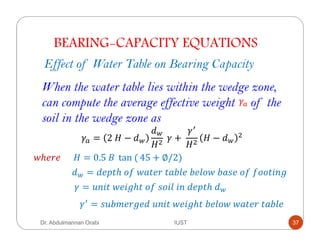
4ℎ#"#						[ = 0.5	 	 tan	( 45 + ∅/2)
!^ = !#'(ℎ	+*	4 (#"	( /8#	/#8+4	/ ,#	+*	*++($ %
= 7 $(	4#$%ℎ(	+*	,+$8	$ 	!#'(ℎ	!^
	 = ,7/=#"%#!	7 $(	4#$%ℎ(	/#8+4	4 (#"	( /8#
When the water table lies within the wedge zone,
can compute the average effective weight of the
soil in the wedge zone as
Dr. Abdulmannan Orabi IUST 37
When the water table is below the wedge zone [depth
approximately ], the water table effects
can be ignored for computing the bearing capacity.
BEARING-CAPACITY EQUATIONS
Effect of Water Table on Bearing Capacity
[ = 0.5	 	 tan	( 45 + ∅/2)
Water table below the
base of the footing
!^ > [
G.W.T.
Dr. Abdulmannan Orabi IUST 38
BEARING-CAPACITY EQUATIONS
Effect of Soil Compressibility
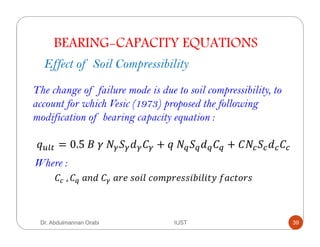
The change of failure mode is due to soil compressibility, to
account for which Vesic (1973) proposed the following
modification of bearing capacity equation :
= 0.5	 	 	 ! + 	 ! + !
	, 	 !	 	 "#	,+$8	&+='"#,,$/$8$()	* &(+",
Where :
Dr. Abdulmannan Orabi IUST 39
BEARING-CAPACITY EQUATIONS
Effect of Soil Compressibility
The soil compressibility factors were derived by Vesic
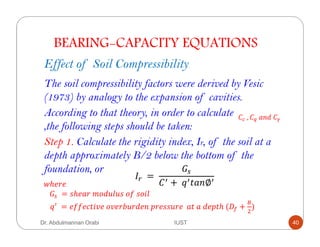
(1973) by analogy to the expansion of cavities.
According to that theory, in order to calculate
,the following steps should be taken:
	, 	 !	
Step 1. Calculate the rigidity index, Ir, of the soil at a
depth approximately B/2 below the bottom of the
foundation, or
F`	 =	
Qa
+	 ( ∅4ℎ#"#						
		Qa 	= ,ℎ# "	=+!787,	+*	,+$8	
	= #**#&($9#	+9#"/7"!# 	'"#,,7"#		 (	 	!#'(ℎ	( +
b
E
)
Dr. Abdulmannan Orabi IUST 40
BEARING-CAPACITY EQUATIONS
Effect of Soil Compressibility
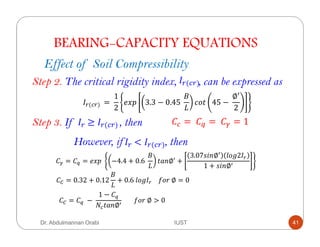
Step 2. The critical rigidity index, , can be expressed asF`( `)	
F`( `)	 =	
1
2
#c' 3.3 − 0.45	
Y
&+( 45 −	
∅
2
Step 3. If , then	F`	≥ F`( `)	 =	 =	 = 1	
However, if , then	F`	< F`( `)	
= = #c'	 −4.4 + 0.6	
Y
( ∅ +
3.07,$ ∅ 8+%2F`
1 + ,$ ∅
: = 0.32 + 0.12
Y
+ 0.6	8+%F`				*+"	∅ = 0
: = 	−	
1 −
( ∅
							*+"	∅ > 0
Dr. Abdulmannan Orabi IUST 41
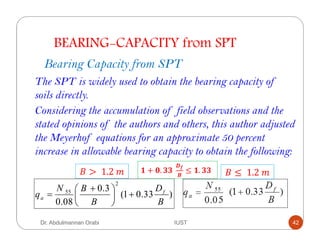
BEARING-CAPACITY from SPT
Bearing Capacity from SPT
The SPT is widely used to obtain the bearing capacity of
soils directly.
Considering the accumulation of field observations and the
stated opinions of the authors and others, this author adjusted
the Meyerhof equations for an approximate 50 percent
increase in allowable bearing capacity to obtain the following:
2
55 0.3
(1 0.33 )
0.08
f
a
N DB
q
B B
+ 
= + 
 
> 	1.2	= ≤ 	1.2	=d + e. ff	
gh
i
≤ d. ff
Dr. Abdulmannan Orabi IUST 42
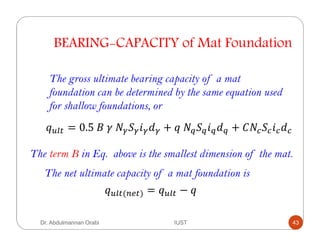
BEARING-CAPACITY of Mat Foundation
The gross ultimate bearing capacity of a mat
foundation can be determined by the same equation used
for shallow foundations, or
= 0.5	 	 	 $ ! + 	 $ ! + $ !
The term B in Eq. above is the smallest dimension of the mat.
The net ultimate capacity of a mat foundation is
(jk ) = −
Dr. Abdulmannan Orabi IUST 43
BEARING-CAPACITY of Mat Foundation
The net allowable soil bearing capacity
	(jk ) =
(jk )
. l
For mats on clay, the factor of safety should not be less
than 3 under dead load or maximum live load.
Under most working conditions, the factor of safety
against bearing capacity failure of mats on sand is
very large.
Dr. Abdulmannan Orabi IUST 44
Dr. Abdulmannan Orabi IUST
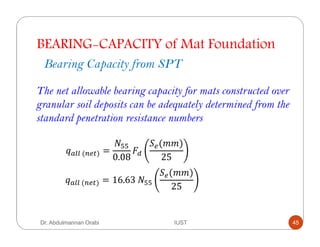
BEARING-CAPACITY of Mat Foundation
Bearing Capacity from SPT
The net allowable bearing capacity for mats constructed over
granular soil deposits can be adequately determined from the
standard penetration resistance numbers
	(jk ) =
TT
0.08
ln
k(==)
25
	(jk ) = 16.63	 TT
k(==)
25
45
Lecture 2 bearing capacity

Lecture 2 bearing capacity

  • 1.
    Lecture 2 INTERNATIONAL UNIVERSITY FOR SCIENCE& TECHNOLOGY ‫وا‬ ‫م‬ ‫ا‬ ‫و‬ ‫ا‬ ‫ا‬ Dr. Abdulmannan Orabi Civil Engineering and Environmental Department 303421: Foundation Engineering Bearing Capacity of Foundation
  • 2.
    References ACI 318M-14 BuildingCode Requirements for Structural Concrete ( ACI 318M -14) and Commentary, American Concrete Institute, ISBN 978-0-87031-283-0. Bowles , J.,E.,(1996) “Foundation Analysis and Design” -5th ed. McGraw-Hill, ISBN 0-07-912247-7. Das, B., M. (2012), “ Principles of Foundation Engineering ” Eighth Edition, CENGAGE Learning, ISBN-13: 978-1-305-08155-0. Syrian Arab Code for Construction 2012 Dr. Abdulmannan Orabi IUST 2
  • 3.
    Bearing Capacity ofFoundation The soil must be capable of carrying the loads from any engineered structure placed upon it without a shear failure and with the resulting settlements being tolerable for that structure. This lecture will be concerned with evaluation of the limiting shear resistance, or ultimate bearing capacity of the soil under a foundation load. 3Dr. Abdulmannan Orabi IUST
  • 4.
    It is necessaryto investigate both base shear resistance and settlements for any structure. Bearing Capacity of Foundation In many cases settlement criteria will control the allowable bearing capacity; however, there are also a number of cases where base shear (in which a base punches into the ground - usually with a simultaneous rotation) dictates the recommended bearing capacity. Dr. Abdulmannan Orabi IUST 4
  • 5.
    Bearing Capacity ofFoundation Structures such as liquid storage tanks and mats are often founded on soft soils, which are usually more susceptible to base shear failure than to settlement. Base shear control, to avoid a combination base punching with rotation into the soil, is often of more concern than settlement for these foundation types. Dr. Abdulmannan Orabi IUST 5
  • 6.
    Allowable Bearing Capacity Therecommendation for the allowable bearing capacity to be used for design is based on the minimum of either : 1. Limiting the settlement to a tolerable amount 2. The ultimate bearing capacity, which considers soil strength, as computed in the following sections Dr. Abdulmannan Orabi IUST 6
  • 7.
    Allowable Bearing Capacity Theallowable bearing capacity based on shear control is obtained by reducing (or dividing) the ultimate bearing capacity (based on soil strength) by a safety factor SF that is deemed adequate to avoid a base shear failure to obtain = . (2-1) The safety factor is based on the type of soil (cohesive or cohesionless), reliability of the soil parameters, structural information (importance, use, etc.), and consultant caution. Dr. Abdulmannan Orabi IUST 7
  • 8.
    Dr. Abdulmannan OrabiIUST Allowable Bearing Capacity Most building codes provide an allowable settlement limit for a foundation, which may be well below the settlement derived corresponding to given by equations( 2-1). Thus, the bearing capacity corresponding to the allowable settlement must also be taken into consideration. 8
  • 9.
    BEARING-CAPACITY EQUATIONS Terzaghi’s BearingCapacity Theory Terzaghi (1943) was the first to present a comprehensive theory for the evaluation of the ultimate bearing capacity of rough shallow foundations. According to this theory, a foundation is shallow if its depth, Df (Figure slid 11), is less than or equal to its width. Later investigators, however, have suggested that foundations with Df equal to 3 to 4 times their width may be defined as shallow foundations. Dr. Abdulmannan Orabi IUST 9
  • 10.
    BEARING-CAPACITY EQUATIONS Terzaghi’s BearingCapacity Theory The effect of soil above the bottom of the foundation may also be assumed to be replaced by an equivalent surcharge, (where is the unit weight of soil). = ∗ Terzaghi suggested that for a continuous, or strip, foundation (i.e., one whose width-to-length ratio approaches zero), the failure surface in soil at ultimate load may be assumed to be similar to that shown in Figure on Slide 11. Dr. Abdulmannan Orabi IUST 10
  • 11.
    The failure zoneunder the foundation can be separated into three parts (see Figure 4.6): 1. The triangular zone ACD immediately under the foundation 2. The radial shear zones ADF and CDE, with the curves DE and DF being arcs of a logarithmic spiral 3. Two triangular Rankine passive zones AFH and CEG BEARING-CAPACITY EQUATIONS Terzaghi’s Bearing Capacity Theory Dr. Abdulmannan Orabi IUST 11
  • 12.
    BEARING-CAPACITY EQUATIONS Terzaghi’s BearingCapacity Theory The angles CAD and ACD are assumed to be equal to the soil friction angle . Note that, with the replacement of the soil above the bottom of the foundation by an equivalent surcharge q, the shear resistance of the soil along the failure surfaces GI and HJ was neglected. ∅ Dr. Abdulmannan Orabi IUST 12
  • 13.
    BEARING-CAPACITY EQUATIONS Terzaghi’s BearingCapacity Theory Dr. Abdulmannan Orabi IUST 13
  • 14.
    BEARING-CAPACITY EQUATIONS Terzaghi’s BearingCapacity Theory Dr. Abdulmannan Orabi IUST 14
  • 15.
    BEARING-CAPACITY EQUATIONS Terzaghi’s BearingCapacity Theory The ultimate bearing capacity, , of the foundation now can be obtained by considering the equilibrium of the triangular wedge ACD shown in Figure below Dr. Abdulmannan Orabi IUST 15
  • 16.
    BEARING-CAPACITY EQUATIONS Terzaghi’s BearingCapacity Equation = 0.5 + + , , ! "# # "$ % & ' &$() * &(+", and depends on angle of shearing resistance (ø) ( . /. 4 − 1 , ,) 4ℎ#"#: = 4$!(ℎ +* (ℎ# *++($ % = 7 $( 4#$%ℎ( +* (ℎ# ,+$8 /#8+4 (ℎ# *+7 ! ($+ 8#9#8 = ∗ = 0 , = 1 ! : = 1.5 ; + 1 = 5.71 *+" ∅ = 0 Dr. Abdulmannan Orabi IUST 16
  • 17.
    BEARING-CAPACITY EQUATIONS Terzaghi’s BearingCapacity Equation = 0.5 + + , , ! = ℎ ' * &(+", Shape factors for the Terzaghi equations Sγ Sq SC Square 0.8 1 1.3 Circular 0.6 1 1.3 Rectangular 1-0.2 B/L 1 1+0.3 B/L Dr. Abdulmannan Orabi IUST 17
  • 18.
    BEARING-CAPACITY EQUATIONS Terzaghi’s BearingCapacity Theory for Local Shear Failure Terzaghi suggested the following relationships for local shear failure in soil: where , , ! "# =+!$*$#! /# "$ % * &(+", = 0.5 + + = 2 3 tan ∅ = tan ( 2 3 ∅) Dr. Abdulmannan Orabi IUST 18
  • 19.
    BEARING-CAPACITY EQUATIONS Meyerhof ’sBearing Capacity Equation In 1951, Meyerhof published a bearing capacity theory that could be applied to rough, shallow, and deep foundations. The failure surface at ultimate load under a continuous shallow foundation assumed by Meyerhof is shown in Figure below. Dr. Abdulmannan Orabi IUST 19
  • 20.
    BEARING-CAPACITY EQUATIONS Meyerhof ’sBearing Capacity Equation Dr. Abdulmannan Orabi IUST 20
  • 21.
    BEARING-CAPACITY EQUATIONS Meyerhof ’sBearing Capacity Equation In this figure abc is the elastic triangular, bcd is the radial shear zone with cd being an arc of a log spiral, and bde is a mixed shear zone in which the shear varies between the limits of radial and plane shears depending on the depth and roughness of the foundation. The plane be is called an equivalent free surface. Dr. Abdulmannan Orabi IUST 21
  • 22.
    BEARING-CAPACITY EQUATIONS Meyerhof ’sBearing Capacity Equation Vertical load: = 0.5 ! + ! + ! = 0.5 $ ! + $ ! + $ ! Inclined load: Dr. Abdulmannan Orabi IUST 22
  • 23.
    BEARING-CAPACITY EQUATIONS Meyerhof ’sBearing Capacity Equation tan 2 ( ) tan (45 ) 2 qN eπ φ φ = + ( 1)cotC qN N φ= − ( 1) tan(1.4 )qN Nγ φ= − where , , ! "# # "$ % & ' &$() * &(+", = 0 , = 1 ! : = ; + 2 = 5.14 *+" ∅ = 0 Dr. Abdulmannan Orabi IUST 23
  • 24.
    BEARING-CAPACITY EQUATIONS Meyerhof ’sBearing Capacity Equation where , , ! = ℎ '# * &(+", 1 0.1 .......... 10q p B S S K for L γ φ= = + × ≥ 1 0.2c p B S K L = + × CD = ( E (45 + ∅ 2 ) = = 1 *+" ∅ = 0 24Dr. Abdulmannan Orabi IUST
  • 25.
    ! , !, ! ! = #'(ℎ * &(+", BEARING-CAPACITY EQUATIONS Meyerhof ’s Bearing Capacity Equation where 1 0 .2 f C p D d K B = + × 1 0.1 .... 10f q p D d d K for B γ φ= = + × ≥ ! = ! = 1 *+" ∅ = 0 Dr. Abdulmannan Orabi IUST 25
  • 26.
    $ , $, ! $ = F &8$ ($+ * &(+", BEARING-CAPACITY EQUATIONS Meyerhof ’s Bearing Capacity Equation where $ = $ = 1 − G 90 E ) ∅ $ = 1 − G ∅ E ∅ > 0 $ = 0 *+" G ≠ 0 ! ∅ = 0 G<∅ V H R Dr. Abdulmannan Orabi IUST 26
  • 27.
    BEARING-CAPACITY EQUATIONS Hansen’s BearingCapacity Equation ( General Equation ) Df V η +β Dr. Abdulmannan Orabi IUST 27
  • 28.
    BEARING-CAPACITY EQUATIONS Hansen’s BearingCapacity Equation ( General Equation ) ' 0.5ult q q q q q q C C C C C Cq B N S d i g b qN S d i g b CN S d i g bγ γ γ γ γ γγ= + + tan 2 ( ) tan (45 ) 2 qN eπ φ φ = + ( 1)cotC qN N φ= − ( 1) tan(1.4 )qN Nγ φ= − where , , ! "# # "$ % & ' &$() * &(+", = 0 , = 1 ! : = ; + 2 = 5.14 *+" ∅ = 0 Dr. Abdulmannan Orabi IUST 28
  • 29.
    BEARING-CAPACITY EQUATIONS Hansen’s BearingCapacity Equation ( General Equation ) ' 0.5ult q q q q q q C C C C C Cq B N S d i g b qN S d i g b CN S d i g bγ γ γ γ γ γγ= + + where , , ! = ℎ '# * &(+", ' ' 1 q C C N B S N L = + × ' ' 1 sinq B S L φ= + ' ' 1 0.4 B S L γ = − ≥ 0.6 Dr. Abdulmannan Orabi IUST 29
  • 30.
    ! , !, ! ! = #'(ℎ * &(+", where BEARING-CAPACITY EQUATIONS Hansen’s Bearing Capacity Equation ( General Equation ) ' 0.5ult q q q q q q C C C C C Cq B N S d i g b qN S d i g b CN S d i g bγ γ γ γ γ γγ= + + 1 0 .4Cd K= + 2 1 2 ta n (1 s in )qd Kφ φ= + − 1 1 tan ( ) 1 f f f f D D K for B B D D K for B B − = ≤ = f ! = 1 *+" 88 ∅ 30
  • 31.
    BEARING-CAPACITY EQUATIONS Hansen’s BearingCapacity Equation ( General Equation ) ' 0.5ult q q q q q q C C C C C Cq B N S d i g b qN S d i g b CN S d i g bγ γ γ γ γ γγ= + + $ , $ , ! $ = F &8$ ($+ * &(+", where 1 1 q C q q i i i N − = − − 1 0.5 (1 ) cot i q f a H i V A C α φ = − + 2 0.7 (1 ) cot i f a H i V A C α γ φ = − + 2 (0.7 / 450) (1 ) cot o i f a H i V A C α γ η φ − = − + 2 ≤ OP ! OE ≤ 5 Dr. Abdulmannan Orabi IUST 31
  • 32.
    BEARING-CAPACITY EQUATIONS Hansen’s BearingCapacity Equation ( General Equation ) ' 0.5ult q q q q q q C C C C C Cq B N S d i g b qN S d i g b CN S d i g bγ γ γ γ γ γγ= + + where % , % , ! % = Q"+7 ! * &(+", % = RS 147S % = 1 − RS 147S % = % = 1 − 0.5 ( R T Dr. Abdulmannan Orabi IUST 32
  • 33.
    BEARING-CAPACITY EQUATIONS Hansen’s BearingCapacity Equation ( General Equation ) ' 0.5ult q q q q q q C C C C C Cq B N S d i g b qN S d i g b CN S d i g bγ γ γ γ γ γγ= + + where / , / , ! / = ,# * &(+", / = US 147S *+" ∅ = 0 / = 1 − US 147S / = exp (−2U ( ∅) / = exp (−2.7 U ( ∅) U $ " !$ , Dr. Abdulmannan Orabi IUST 33
  • 34.
    BEARING-CAPACITY EQUATIONS Hansen’s BearingCapacity Equation ( General Equation ) = 5.14 1 + + ! − $ − % − / + *+" ∅ = 0 Where : = 0.2 Y ! = 0.4 Z $ = 0.5 − 1 − [ ] / = US 147S *+" ∅ = 0 % = RS 147S Dr. Abdulmannan Orabi IUST 34
  • 35.
    The equation forultimate bearing capacity by Terzaghi has been developed based on assumption that water table is located at a great depth . If the water table is located close to foundation ; the equation needs modification. The effective unit weight of the soil is used in the bearing-capacity equations for computing the ultimate capacity. BEARING-CAPACITY EQUATIONS Effect of Water Table on Bearing Capacity Dr. Abdulmannan Orabi IUST 35
  • 36.
    BEARING-CAPACITY EQUATIONS Effect ofWater Table on Bearing Capacity The water table is seldom above the base of the footing, as this would, at the very least, cause construction problems. If it is, however, the q term requires adjusting so that the surcharge pressure is an effective value and an effective unit weight must be used in the 0.5 ϒB Nϒ term. Water table above the base of footing Water table below the base of footing !^ G.W.T. G.W.T. Dr. Abdulmannan Orabi IUST 36
  • 37.
    BEARING-CAPACITY EQUATIONS Effect ofWater Table on Bearing Capacity = 2 [ − !^ !^ [E + [E [ − !^ E 4ℎ#"# [ = 0.5 tan ( 45 + ∅/2) !^ = !#'(ℎ +* 4 (#" ( /8# /#8+4 / ,# +* *++($ % = 7 $( 4#$%ℎ( +* ,+$8 $ !#'(ℎ !^ = ,7/=#"%#! 7 $( 4#$%ℎ( /#8+4 4 (#" ( /8# When the water table lies within the wedge zone, can compute the average effective weight of the soil in the wedge zone as Dr. Abdulmannan Orabi IUST 37
  • 38.
    When the watertable is below the wedge zone [depth approximately ], the water table effects can be ignored for computing the bearing capacity. BEARING-CAPACITY EQUATIONS Effect of Water Table on Bearing Capacity [ = 0.5 tan ( 45 + ∅/2) Water table below the base of the footing !^ > [ G.W.T. Dr. Abdulmannan Orabi IUST 38
  • 39.
    BEARING-CAPACITY EQUATIONS Effect ofSoil Compressibility The change of failure mode is due to soil compressibility, to account for which Vesic (1973) proposed the following modification of bearing capacity equation : = 0.5 ! + ! + ! , ! "# ,+$8 &+='"#,,$/$8$() * &(+", Where : Dr. Abdulmannan Orabi IUST 39
  • 40.
    BEARING-CAPACITY EQUATIONS Effect ofSoil Compressibility The soil compressibility factors were derived by Vesic (1973) by analogy to the expansion of cavities. According to that theory, in order to calculate ,the following steps should be taken: , ! Step 1. Calculate the rigidity index, Ir, of the soil at a depth approximately B/2 below the bottom of the foundation, or F` = Qa + ( ∅4ℎ#"# Qa = ,ℎ# " =+!787, +* ,+$8 = #**#&($9# +9#"/7"!# '"#,,7"# ( !#'(ℎ ( + b E ) Dr. Abdulmannan Orabi IUST 40
  • 41.
    BEARING-CAPACITY EQUATIONS Effect ofSoil Compressibility Step 2. The critical rigidity index, , can be expressed asF`( `) F`( `) = 1 2 #c' 3.3 − 0.45 Y &+( 45 − ∅ 2 Step 3. If , then F` ≥ F`( `) = = = 1 However, if , then F` < F`( `) = = #c' −4.4 + 0.6 Y ( ∅ + 3.07,$ ∅ 8+%2F` 1 + ,$ ∅ : = 0.32 + 0.12 Y + 0.6 8+%F` *+" ∅ = 0 : = − 1 − ( ∅ *+" ∅ > 0 Dr. Abdulmannan Orabi IUST 41
  • 42.
    BEARING-CAPACITY from SPT BearingCapacity from SPT The SPT is widely used to obtain the bearing capacity of soils directly. Considering the accumulation of field observations and the stated opinions of the authors and others, this author adjusted the Meyerhof equations for an approximate 50 percent increase in allowable bearing capacity to obtain the following: 2 55 0.3 (1 0.33 ) 0.08 f a N DB q B B +  = +    > 1.2 = ≤ 1.2 =d + e. ff gh i ≤ d. ff Dr. Abdulmannan Orabi IUST 42
  • 43.
    BEARING-CAPACITY of MatFoundation The gross ultimate bearing capacity of a mat foundation can be determined by the same equation used for shallow foundations, or = 0.5 $ ! + $ ! + $ ! The term B in Eq. above is the smallest dimension of the mat. The net ultimate capacity of a mat foundation is (jk ) = − Dr. Abdulmannan Orabi IUST 43
  • 44.
    BEARING-CAPACITY of MatFoundation The net allowable soil bearing capacity (jk ) = (jk ) . l For mats on clay, the factor of safety should not be less than 3 under dead load or maximum live load. Under most working conditions, the factor of safety against bearing capacity failure of mats on sand is very large. Dr. Abdulmannan Orabi IUST 44
  • 45.
    Dr. Abdulmannan OrabiIUST BEARING-CAPACITY of Mat Foundation Bearing Capacity from SPT The net allowable bearing capacity for mats constructed over granular soil deposits can be adequately determined from the standard penetration resistance numbers (jk ) = TT 0.08 ln k(==) 25 (jk ) = 16.63 TT k(==) 25 45