Irrigation Engineering
“Weir & Barrage”
GANDHINAGAR INSTITUTE
OF TECHNOLOGY
What is WEIR ?
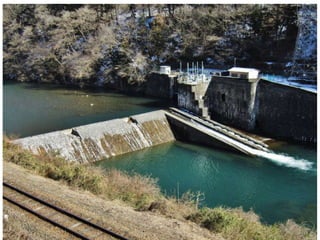
• Weir is a solid obstruction put across the river to raise
water level and divert the water into canal .
• If water is store for a small period of short supplies it is
called storage weir.
• The main difference between a storage weir and a dam
I only in height and duration for which the supply is
stored.
• A dam stores the supply for comparatively longer
duration.
• It is a one type of structure, constructed
across the river to raise water level in river
and divert the required quantity to the canal.
What is diversion head work ?
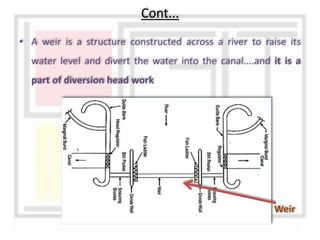
• A weir is a structure constructed across a river to raise its
water level and divert the water into the canal....and it is a
part of diversion head work
Cont...
Weir
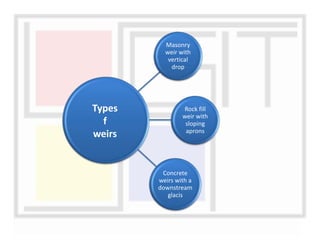
Masonry
weir with
vertical
drop
Rock fill
weir with
sloping
aprons
Concrete
weirs with a
downstream
glacis
Types
f
weirs
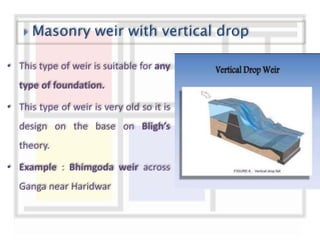
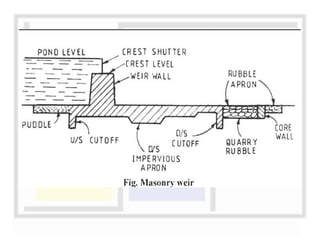
• This type of weir is suitable for any
type of foundation.
• This type of weir is very old so it is
design on the base on Bligh’s
theory.
• Example : Bhimgoda weir across
Ganga near Haridwar
 Masonry weir with vertical drop
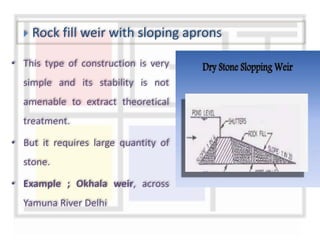
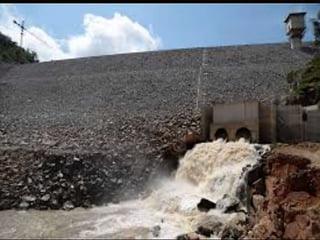
 Rock fill weir with sloping aprons
• This type of construction is very
simple and its stability is not
amenable to extract theoretical
treatment.
• But it requires large quantity of
stone.
• Example ; Okhala weir, across
Yamuna River Delhi
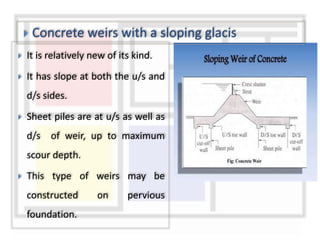
 It is relatively new of its kind.
 It has slope at both the u/s and
d/s sides.
 Sheet piles are at u/s as well as
d/s of weir, up to maximum
scour depth.
 This type of weirs may be
constructed on pervious
foundation.
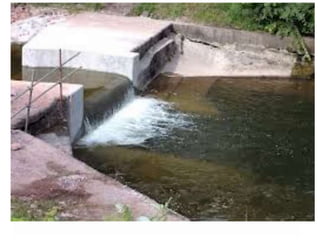
 Concrete weirs with a sloping glacis
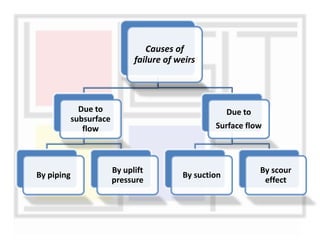
Causes of
failure of weirs
Due to
subsurface
flow
By piping
By uplift
pressure
Due to
Surface flow
By suction
By scour
effect
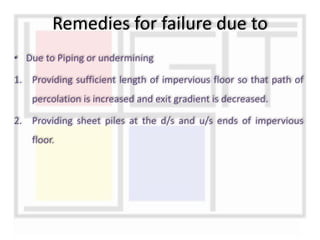
• Due to Piping or undermining
1. Providing sufficient length of impervious floor so that path of
percolation is increased and exit gradient is decreased.
2. Providing sheet piles at the d/s and u/s ends of impervious
floor.
Remedies for failure due to
• Due to uplift pressure
1. Providing sufficient thickness of the impervious floor.
2. Providing sufficient length of impervious floor
3. Providing pile at u/s end of impervious floor so as to reduce
uplift pressure at d/s.
Cont...
• Due to surface flow
1. Providing additional thickness of impervious floor to counter
balance the suction pressure due to standing wave.
2. Constructing floor as monolithic concrete mass instead of
different layers of masonry.
Cont...
• Due to scour
1. Providing deep piles at u/s &d/s end of imperious floor up to a
depth much below calculated scour depth.
2. Providing launching aprons of suitable length and thickness at
u/s & d/s end of impervious floor.
Cont...
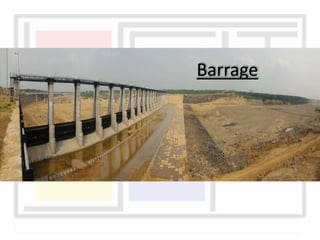
• The function of barrage is similar to that of weir but the heading up
of water is effected by the gate alone.
• No solid obstruction is put across the river. The crest level in the
barrage is kept at low level.
• During the floods the gates are raised to clear off the high flood
level, enabling the high flood to pass downstream with minimum
afflux.
Barrage
Barrage
• When flood recedes the gates are lowered and flow is obstructed,
thus raising water level to upstream of barrage.
• Due to this less silting and better control over the levels.
• How ever barrage are more costlier then weir.
Cont...
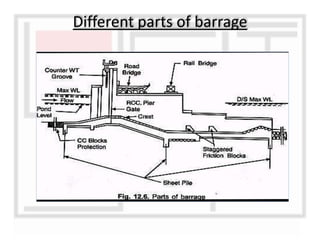
Different parts of barrage
• An artificial barrier across a river to prevent flooding ,aid irrigation or
navigation or to generate electricity by tidal power.
• A barrage is a type of low head , diversion work which consist of
number of large gates that can be opened or closed to control the
amount of water passing through it, thus regulates elevation of water
in irrigation system.
• Barrage word is borrowed from French word meaning dam.
Cont...
• Key difference between barrage and dam is that a dam is built for
water storage in a reservoir, which raise the level of water
significantly.
• A barrage is built for diverting water and raise its level for few feet,
they are generally built on flat terrain across wide rivers.
Cont...
Thank you

weir & barrage

  • 1.
    Irrigation Engineering “Weir &Barrage” GANDHINAGAR INSTITUTE OF TECHNOLOGY
  • 2.
  • 4.
    • Weir isa solid obstruction put across the river to raise water level and divert the water into canal . • If water is store for a small period of short supplies it is called storage weir. • The main difference between a storage weir and a dam I only in height and duration for which the supply is stored. • A dam stores the supply for comparatively longer duration.
  • 5.
    • It isa one type of structure, constructed across the river to raise water level in river and divert the required quantity to the canal. What is diversion head work ?
  • 8.
    • A weiris a structure constructed across a river to raise its water level and divert the water into the canal....and it is a part of diversion head work Cont... Weir
  • 9.
    Masonry weir with vertical drop Rock fill weirwith sloping aprons Concrete weirs with a downstream glacis Types f weirs
  • 10.
    • This typeof weir is suitable for any type of foundation. • This type of weir is very old so it is design on the base on Bligh’s theory. • Example : Bhimgoda weir across Ganga near Haridwar  Masonry weir with vertical drop
  • 12.
     Rock fillweir with sloping aprons • This type of construction is very simple and its stability is not amenable to extract theoretical treatment. • But it requires large quantity of stone. • Example ; Okhala weir, across Yamuna River Delhi
  • 14.
     It isrelatively new of its kind.  It has slope at both the u/s and d/s sides.  Sheet piles are at u/s as well as d/s of weir, up to maximum scour depth.  This type of weirs may be constructed on pervious foundation.  Concrete weirs with a sloping glacis
  • 16.
    Causes of failure ofweirs Due to subsurface flow By piping By uplift pressure Due to Surface flow By suction By scour effect
  • 17.
    • Due toPiping or undermining 1. Providing sufficient length of impervious floor so that path of percolation is increased and exit gradient is decreased. 2. Providing sheet piles at the d/s and u/s ends of impervious floor. Remedies for failure due to
  • 18.
    • Due touplift pressure 1. Providing sufficient thickness of the impervious floor. 2. Providing sufficient length of impervious floor 3. Providing pile at u/s end of impervious floor so as to reduce uplift pressure at d/s. Cont...
  • 19.
    • Due tosurface flow 1. Providing additional thickness of impervious floor to counter balance the suction pressure due to standing wave. 2. Constructing floor as monolithic concrete mass instead of different layers of masonry. Cont...
  • 20.
    • Due toscour 1. Providing deep piles at u/s &d/s end of imperious floor up to a depth much below calculated scour depth. 2. Providing launching aprons of suitable length and thickness at u/s & d/s end of impervious floor. Cont...
  • 21.
    • The functionof barrage is similar to that of weir but the heading up of water is effected by the gate alone. • No solid obstruction is put across the river. The crest level in the barrage is kept at low level. • During the floods the gates are raised to clear off the high flood level, enabling the high flood to pass downstream with minimum afflux. Barrage
  • 22.
  • 23.
    • When floodrecedes the gates are lowered and flow is obstructed, thus raising water level to upstream of barrage. • Due to this less silting and better control over the levels. • How ever barrage are more costlier then weir. Cont...
  • 24.
  • 25.
    • An artificialbarrier across a river to prevent flooding ,aid irrigation or navigation or to generate electricity by tidal power. • A barrage is a type of low head , diversion work which consist of number of large gates that can be opened or closed to control the amount of water passing through it, thus regulates elevation of water in irrigation system. • Barrage word is borrowed from French word meaning dam. Cont...
  • 26.
    • Key differencebetween barrage and dam is that a dam is built for water storage in a reservoir, which raise the level of water significantly. • A barrage is built for diverting water and raise its level for few feet, they are generally built on flat terrain across wide rivers. Cont...
  • 27.