Unit-IVUnit-IV
Hill Roads And DrainageHill Roads And Drainage
ByBy
Mr. Hole G.R.Mr. Hole G.R.
(Lecturer in Civil Department)(Lecturer in Civil Department)
Jayawantrao Sawant PolytechnicJayawantrao Sawant Polytechnic
1
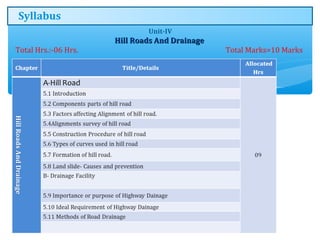
Unit-IV
Hill Roads And DrainageHill Roads And Drainage
Total Hrs.:-06 Hrs. Total Marks=10 Marks
2
Syllabus
∗ Roads constructed in mountainous region is called Hill roads.
∗ There are different considerations while designing hill roads as
compare to plain area roads.
∗ Types of curve used in hill roads is of different than plain road.
∗ All Geometric parameters will gets changes while designing hill roads
such as- Curves , Superelevation,SSD,OSD,Extra Widening etc.
3
5.1 Introduction
4
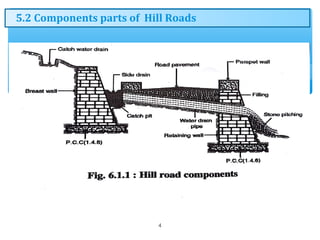
5.2 Components parts of Hill Roads
∗ Road Bed
∗ Side Drain
∗ Parapet wall
∗ Catch Water Drains
∗ Brest wall
∗ Retaining wall
∗ Cross Drains
A) Road Bed:-
The pavement potion of hill road is called Road bed.
Function: To Resist stresses developed due to moving traffic.
B) Side Drain :-
-Drain Provided on the sides of road is called side drain
- Side Drains Runs Parallel to the length of road.
Function: To collect and drain off rain water collected from camber o of road.
5
Continue.
C) Parapet Wall:
wall which is provided above the formation level in the down side slope is called
parapet wall.
Function: Protection to the traffic against falling down the hill slope.
D) Catch Water Drain:
It is drain provided on higher slope running parallel to the length of road.
Function : To make intercept for runoff coming from top of hill and divert water in to
near by cross drains.
E) Brest wall :
The wall constructed to up side slope is called Brest wall.
Function: Protect road from sliding of up side slope.
F) Retaining Wall:
The wall constructed to down side slope of road is called retaining wall.
Function: -To Protect down side slope from sliding.
-To Resist pressure of earth fill .
6
Continue.
G) Cross Drains:
The drains which is laid along width of road is called cross drains.
Function: To drain off rain water collected in side drains and catch drains.
7
Continue.
1.Length of Road:
Alignment of road should be short as possible bcoz cost will be increased as length of
road increases.
2.Geometrical Standards:
-Alignment of road should have proper geometrical standards such as
Gradient,Curves,SD,Radious of curves.
- Min. Radius of curve for hill road is allowed to 50m.
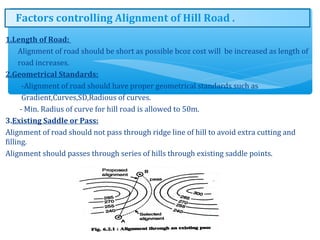
3.Existing Saddle or Pass:
Alignment of road should not pass through ridge line of hill to avoid extra cutting and
filling.
Alignment should passes through series of hills through existing saddle points.
8
Factors controlling Alignment of Hill Road .
4.Drainage Line:
Alignment of road should be parallel to drainage line to avoid no of cross
drainage drains.
5. Stability:
Alignment of road should passes along the stable and side having mild slope of
hill road.
6.Altitude:
-Altitude of road should not be passes through high altitude as well as low
altitude .
-High Altitude causes problem of snow falling and low altitude will increase no.
of cross drains.
-Alignment of road passes through altitude between 900 to 1500m.
-Alignment of road should faces sun and not located in windward side of hill
9
Factors controlling Alignment of Hill Road .
7.Cutting through Rocks:
Alignment of road should not passes through solid rocks to avoid cost of
cutting.
10
Factors controlling Alignment of Hill Road .
Alignment of Hill roads is fixed in three stages:
1. Reconnaissance
2. Trace out
3. Detailed Survey.
1.1.Reconnaissance:Reconnaissance:
-The temporary alignment of road is fixed during reconnaissance
survey by studying topographical, geographical and metrological
maps of the area .
-Arial survey is carried out for remote area.
2.Trace out :.Trace out :
-The route selected during reconnaissance survey is translated on
ground so as to collect details from actual site.
11
Alignment Survey Of Hill Road:-
- 1 to 1.5 m wide track is constructed so as to collect details.
3.Detailed Survey:3.Detailed Survey:
--During Detailed survey BM are fixed on ground.
-Prepare c/s Along length and along width.
-Mark the center line and boundary line of highway.
-Hydrological and soil investigation is carried out.
12
Cont.
1.Rock Cutting
2. Vertical Cutting (Precipice work)
3.Retaining wall
4. Foundation of Retaining wall
5.Revetment wall
6.Pavement Construction
13
Construction procedure of Hill Road
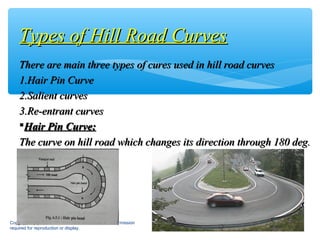
There are main three types of cures used in hill road curvesThere are main three types of cures used in hill road curves
1.1.Hair Pin CurveHair Pin Curve
2.2.Salient curvesSalient curves
3.3.Re-entrant curvesRe-entrant curves
Hair Pin Curve:Hair Pin Curve:
The curve on hill road which changes its direction through 180 deg.The curve on hill road which changes its direction through 180 deg.
Copyright © 2013 The McGraw-Hill Companies, Inc. Permission
required for reproduction or display.
14
Types of Hill Road CurvesTypes of Hill Road Curves
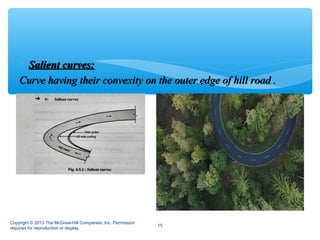
 Salient curves:Salient curves:
Curve having their convexity on the outer edge of hill road .Curve having their convexity on the outer edge of hill road .
Copyright © 2013 The McGraw-Hill Companies, Inc. Permission
required for reproduction or display.
15
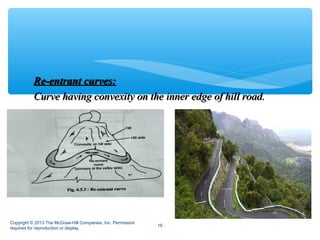
Re-entrant curves:Re-entrant curves:
Curve having convexity on the inner edge of hill road.Curve having convexity on the inner edge of hill road.
Copyright © 2013 The McGraw-Hill Companies, Inc. Permission
required for reproduction or display.
16
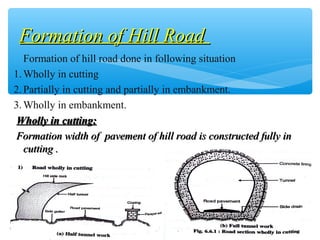
∗ Formation of hill road done in following situation
1.Wholly in cutting
2.Partially in cutting and partially in embankment.
3.Wholly in embankment.
Wholly in cutting:Wholly in cutting:
Formation width of pavement of hill road is constructed fully inFormation width of pavement of hill road is constructed fully in
cutting .cutting .
Copyright © 2013 The McGraw-Hill Companies, Inc. Permission
required for reproduction or display.
17
Formation of Hill RoadFormation of Hill Road
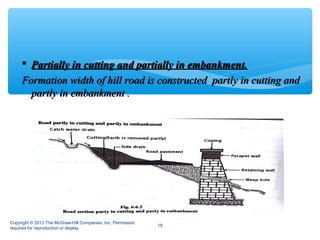
 Partially in cutting and partially in embankment.Partially in cutting and partially in embankment.
Formation width of hill road is constructed partly in cutting andFormation width of hill road is constructed partly in cutting and
partly in embankment .partly in embankment .
Copyright © 2013 The McGraw-Hill Companies, Inc. Permission
required for reproduction or display.
18
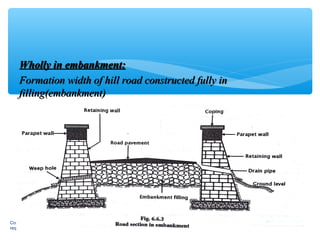
Wholly in embankment:Wholly in embankment:
Formation width of hill road constructed fully inFormation width of hill road constructed fully in
filling(embankment)filling(embankment)
Copyright © 2013 The McGraw-Hill Companies, Inc. Permission
required for reproduction or display.
19
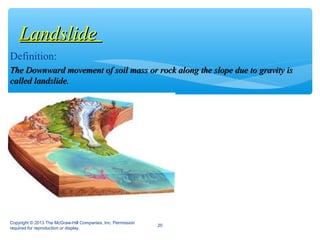
Definition:
The Downward movement of soil mass or rock along the slope due to gravity isThe Downward movement of soil mass or rock along the slope due to gravity is
called landslide.called landslide.
Copyright © 2013 The McGraw-Hill Companies, Inc. Permission
required for reproduction or display.
20
LandslideLandslide
 Free Fall Landslide
 Toppled Landslide
 Slide Landslide
 Flow Landslide
 Complex Landslides
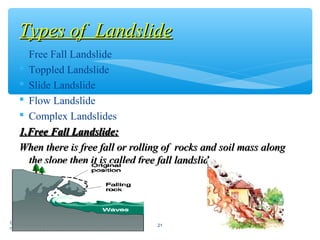
1.Free Fall Landslide:1.Free Fall Landslide:
When there is free fall or rolling of rocks and soil mass alongWhen there is free fall or rolling of rocks and soil mass along
the slope then it is called free fall landslide.the slope then it is called free fall landslide.
Types of LandslideTypes of Landslide
Copyright © 2013 The McGraw-Hill Companies, Inc. Permission
required for reproduction or display.
21
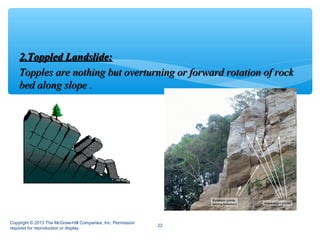
2.Toppled Landslide:2.Toppled Landslide:
Topples are nothing but overturning or forward rotation of rockTopples are nothing but overturning or forward rotation of rock
bed along slope .bed along slope .
Copyright © 2013 The McGraw-Hill Companies, Inc. Permission
required for reproduction or display.
22
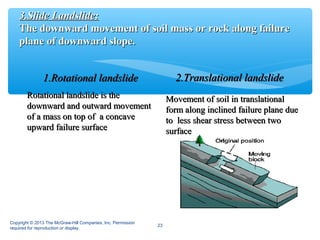
3.Slide Landslide:3.Slide Landslide:
The downward movement of soil mass or rock along failureThe downward movement of soil mass or rock along failure
plane of downward slope.plane of downward slope.
1.Rotational landslide1.Rotational landslide
Rotational landslide is theRotational landslide is the
downward and outward movementdownward and outward movement
of a mass on top of a concaveof a mass on top of a concave
upward failure surfaceupward failure surface
2.Translational landslide2.Translational landslide
Movement of soil in translationalMovement of soil in translational
form along inclined failure plane dueform along inclined failure plane due
to less shear stress between twoto less shear stress between two
surfacesurface
Copyright © 2013 The McGraw-Hill Companies, Inc. Permission
required for reproduction or display.
23
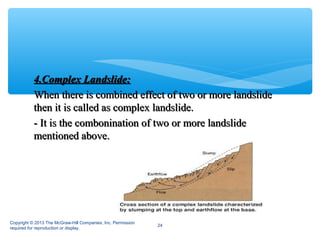
4.Complex Landslide:4.Complex Landslide:
When there is combined effect of two or more landslideWhen there is combined effect of two or more landslide
then it is called as complex landslide.then it is called as complex landslide.
- It is the combonination of two or more landslide- It is the combonination of two or more landslide
mentioned above.mentioned above.
Copyright © 2013 The McGraw-Hill Companies, Inc. Permission
required for reproduction or display.
24
Natural Causes of Landslides
Climate- Heavy Rainfall.
Geology and topography
Earthquakes
Weathering of rock
Erosion of soil and rock
Volcanoes
Forest fires
Human causes of landslides
Mining
Blasting
Increase in traffic load.
Causes of LandslideCauses of Landslide
Copyright © 2013 The McGraw-Hill Companies, Inc. Permission
required for reproduction or display.
25
Lead to economic declination or loss
Damage of infrastructure
Loss of life
Affects beauty of landscapes
Impacts on river ecosystems
Effect of LandslideEffect of Landslide
Copyright © 2013 The McGraw-Hill Companies, Inc. Permission
required for reproduction or display.
26
 Provide benching on side slope
 By providing proper drainage system.
 By constructing retaining wall and breast wall.
 By Soil stabilization techniques.
 By cement grouting or concrete lining.
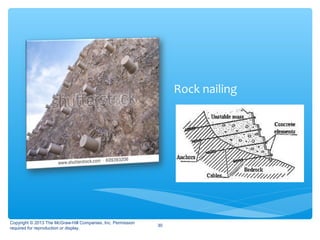
 By rock nailing.
 By increasing vegetation on side slope.
 By fixing geosynthetic net on sloping side.
Prevention of LandslidePrevention of Landslide
Copyright © 2013 The McGraw-Hill Companies, Inc. Permission
required for reproduction or display.
27
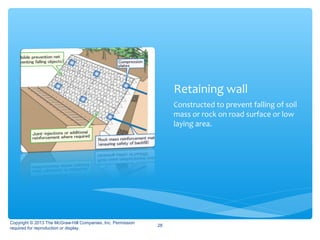
Retaining wall
Constructed to prevent falling of soil
mass or rock on road surface or low
laying area.
Copyright © 2013 The McGraw-Hill Companies, Inc. Permission
required for reproduction or display.
28
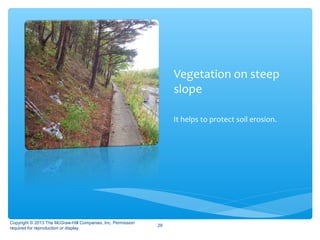
Vegetation on steep
slope
It helps to protect soil erosion.
Copyright © 2013 The McGraw-Hill Companies, Inc. Permission
required for reproduction or display.
29
Rock nailing
Copyright © 2013 The McGraw-Hill Companies, Inc. Permission
required for reproduction or display.
30
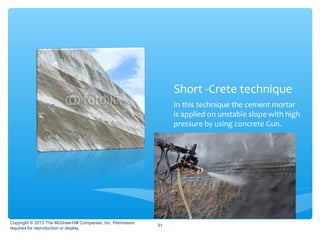
Short -Crete technique
In this technique the cement mortar
is applied on unstable slope with high
pressure by using concrete Gun.
Copyright © 2013 The McGraw-Hill Companies, Inc. Permission
required for reproduction or display.
31
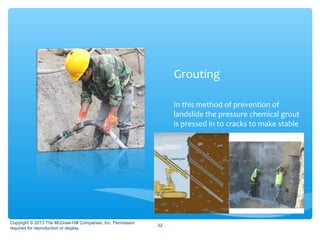
Grouting
In this method of prevention of
landslide the pressure chemical grout
is pressed in to cracks to make stable
Copyright © 2013 The McGraw-Hill Companies, Inc. Permission
required for reproduction or display.
32

Hill roads and Drainage

  • 1.
    Unit-IVUnit-IV Hill Roads AndDrainageHill Roads And Drainage ByBy Mr. Hole G.R.Mr. Hole G.R. (Lecturer in Civil Department)(Lecturer in Civil Department) Jayawantrao Sawant PolytechnicJayawantrao Sawant Polytechnic 1
  • 2.
    Unit-IV Hill Roads AndDrainageHill Roads And Drainage Total Hrs.:-06 Hrs. Total Marks=10 Marks 2 Syllabus
  • 3.
    ∗ Roads constructedin mountainous region is called Hill roads. ∗ There are different considerations while designing hill roads as compare to plain area roads. ∗ Types of curve used in hill roads is of different than plain road. ∗ All Geometric parameters will gets changes while designing hill roads such as- Curves , Superelevation,SSD,OSD,Extra Widening etc. 3 5.1 Introduction
  • 4.
  • 5.
    ∗ Road Bed ∗Side Drain ∗ Parapet wall ∗ Catch Water Drains ∗ Brest wall ∗ Retaining wall ∗ Cross Drains A) Road Bed:- The pavement potion of hill road is called Road bed. Function: To Resist stresses developed due to moving traffic. B) Side Drain :- -Drain Provided on the sides of road is called side drain - Side Drains Runs Parallel to the length of road. Function: To collect and drain off rain water collected from camber o of road. 5 Continue.
  • 6.
    C) Parapet Wall: wallwhich is provided above the formation level in the down side slope is called parapet wall. Function: Protection to the traffic against falling down the hill slope. D) Catch Water Drain: It is drain provided on higher slope running parallel to the length of road. Function : To make intercept for runoff coming from top of hill and divert water in to near by cross drains. E) Brest wall : The wall constructed to up side slope is called Brest wall. Function: Protect road from sliding of up side slope. F) Retaining Wall: The wall constructed to down side slope of road is called retaining wall. Function: -To Protect down side slope from sliding. -To Resist pressure of earth fill . 6 Continue.
  • 7.
    G) Cross Drains: Thedrains which is laid along width of road is called cross drains. Function: To drain off rain water collected in side drains and catch drains. 7 Continue.
  • 8.
    1.Length of Road: Alignmentof road should be short as possible bcoz cost will be increased as length of road increases. 2.Geometrical Standards: -Alignment of road should have proper geometrical standards such as Gradient,Curves,SD,Radious of curves. - Min. Radius of curve for hill road is allowed to 50m. 3.Existing Saddle or Pass: Alignment of road should not pass through ridge line of hill to avoid extra cutting and filling. Alignment should passes through series of hills through existing saddle points. 8 Factors controlling Alignment of Hill Road .
  • 9.
    4.Drainage Line: Alignment ofroad should be parallel to drainage line to avoid no of cross drainage drains. 5. Stability: Alignment of road should passes along the stable and side having mild slope of hill road. 6.Altitude: -Altitude of road should not be passes through high altitude as well as low altitude . -High Altitude causes problem of snow falling and low altitude will increase no. of cross drains. -Alignment of road passes through altitude between 900 to 1500m. -Alignment of road should faces sun and not located in windward side of hill 9 Factors controlling Alignment of Hill Road .
  • 10.
    7.Cutting through Rocks: Alignmentof road should not passes through solid rocks to avoid cost of cutting. 10 Factors controlling Alignment of Hill Road .
  • 11.
    Alignment of Hillroads is fixed in three stages: 1. Reconnaissance 2. Trace out 3. Detailed Survey. 1.1.Reconnaissance:Reconnaissance: -The temporary alignment of road is fixed during reconnaissance survey by studying topographical, geographical and metrological maps of the area . -Arial survey is carried out for remote area. 2.Trace out :.Trace out : -The route selected during reconnaissance survey is translated on ground so as to collect details from actual site. 11 Alignment Survey Of Hill Road:-
  • 12.
    - 1 to1.5 m wide track is constructed so as to collect details. 3.Detailed Survey:3.Detailed Survey: --During Detailed survey BM are fixed on ground. -Prepare c/s Along length and along width. -Mark the center line and boundary line of highway. -Hydrological and soil investigation is carried out. 12 Cont.
  • 13.
    1.Rock Cutting 2. VerticalCutting (Precipice work) 3.Retaining wall 4. Foundation of Retaining wall 5.Revetment wall 6.Pavement Construction 13 Construction procedure of Hill Road
  • 14.
    There are mainthree types of cures used in hill road curvesThere are main three types of cures used in hill road curves 1.1.Hair Pin CurveHair Pin Curve 2.2.Salient curvesSalient curves 3.3.Re-entrant curvesRe-entrant curves Hair Pin Curve:Hair Pin Curve: The curve on hill road which changes its direction through 180 deg.The curve on hill road which changes its direction through 180 deg. Copyright © 2013 The McGraw-Hill Companies, Inc. Permission required for reproduction or display. 14 Types of Hill Road CurvesTypes of Hill Road Curves
  • 15.
     Salient curves:Salientcurves: Curve having their convexity on the outer edge of hill road .Curve having their convexity on the outer edge of hill road . Copyright © 2013 The McGraw-Hill Companies, Inc. Permission required for reproduction or display. 15
  • 16.
    Re-entrant curves:Re-entrant curves: Curvehaving convexity on the inner edge of hill road.Curve having convexity on the inner edge of hill road. Copyright © 2013 The McGraw-Hill Companies, Inc. Permission required for reproduction or display. 16
  • 17.
    ∗ Formation ofhill road done in following situation 1.Wholly in cutting 2.Partially in cutting and partially in embankment. 3.Wholly in embankment. Wholly in cutting:Wholly in cutting: Formation width of pavement of hill road is constructed fully inFormation width of pavement of hill road is constructed fully in cutting .cutting . Copyright © 2013 The McGraw-Hill Companies, Inc. Permission required for reproduction or display. 17 Formation of Hill RoadFormation of Hill Road
  • 18.
     Partially incutting and partially in embankment.Partially in cutting and partially in embankment. Formation width of hill road is constructed partly in cutting andFormation width of hill road is constructed partly in cutting and partly in embankment .partly in embankment . Copyright © 2013 The McGraw-Hill Companies, Inc. Permission required for reproduction or display. 18
  • 19.
    Wholly in embankment:Whollyin embankment: Formation width of hill road constructed fully inFormation width of hill road constructed fully in filling(embankment)filling(embankment) Copyright © 2013 The McGraw-Hill Companies, Inc. Permission required for reproduction or display. 19
  • 20.
    Definition: The Downward movementof soil mass or rock along the slope due to gravity isThe Downward movement of soil mass or rock along the slope due to gravity is called landslide.called landslide. Copyright © 2013 The McGraw-Hill Companies, Inc. Permission required for reproduction or display. 20 LandslideLandslide
  • 21.
     Free FallLandslide  Toppled Landslide  Slide Landslide  Flow Landslide  Complex Landslides 1.Free Fall Landslide:1.Free Fall Landslide: When there is free fall or rolling of rocks and soil mass alongWhen there is free fall or rolling of rocks and soil mass along the slope then it is called free fall landslide.the slope then it is called free fall landslide. Types of LandslideTypes of Landslide Copyright © 2013 The McGraw-Hill Companies, Inc. Permission required for reproduction or display. 21
  • 22.
    2.Toppled Landslide:2.Toppled Landslide: Topplesare nothing but overturning or forward rotation of rockTopples are nothing but overturning or forward rotation of rock bed along slope .bed along slope . Copyright © 2013 The McGraw-Hill Companies, Inc. Permission required for reproduction or display. 22
  • 23.
    3.Slide Landslide:3.Slide Landslide: Thedownward movement of soil mass or rock along failureThe downward movement of soil mass or rock along failure plane of downward slope.plane of downward slope. 1.Rotational landslide1.Rotational landslide Rotational landslide is theRotational landslide is the downward and outward movementdownward and outward movement of a mass on top of a concaveof a mass on top of a concave upward failure surfaceupward failure surface 2.Translational landslide2.Translational landslide Movement of soil in translationalMovement of soil in translational form along inclined failure plane dueform along inclined failure plane due to less shear stress between twoto less shear stress between two surfacesurface Copyright © 2013 The McGraw-Hill Companies, Inc. Permission required for reproduction or display. 23
  • 24.
    4.Complex Landslide:4.Complex Landslide: Whenthere is combined effect of two or more landslideWhen there is combined effect of two or more landslide then it is called as complex landslide.then it is called as complex landslide. - It is the combonination of two or more landslide- It is the combonination of two or more landslide mentioned above.mentioned above. Copyright © 2013 The McGraw-Hill Companies, Inc. Permission required for reproduction or display. 24
  • 25.
    Natural Causes ofLandslides Climate- Heavy Rainfall. Geology and topography Earthquakes Weathering of rock Erosion of soil and rock Volcanoes Forest fires Human causes of landslides Mining Blasting Increase in traffic load. Causes of LandslideCauses of Landslide Copyright © 2013 The McGraw-Hill Companies, Inc. Permission required for reproduction or display. 25
  • 26.
    Lead to economicdeclination or loss Damage of infrastructure Loss of life Affects beauty of landscapes Impacts on river ecosystems Effect of LandslideEffect of Landslide Copyright © 2013 The McGraw-Hill Companies, Inc. Permission required for reproduction or display. 26
  • 27.
     Provide benchingon side slope  By providing proper drainage system.  By constructing retaining wall and breast wall.  By Soil stabilization techniques.  By cement grouting or concrete lining.  By rock nailing.  By increasing vegetation on side slope.  By fixing geosynthetic net on sloping side. Prevention of LandslidePrevention of Landslide Copyright © 2013 The McGraw-Hill Companies, Inc. Permission required for reproduction or display. 27
  • 28.
    Retaining wall Constructed toprevent falling of soil mass or rock on road surface or low laying area. Copyright © 2013 The McGraw-Hill Companies, Inc. Permission required for reproduction or display. 28
  • 29.
    Vegetation on steep slope Ithelps to protect soil erosion. Copyright © 2013 The McGraw-Hill Companies, Inc. Permission required for reproduction or display. 29
  • 30.
    Rock nailing Copyright ©2013 The McGraw-Hill Companies, Inc. Permission required for reproduction or display. 30
  • 31.
    Short -Crete technique Inthis technique the cement mortar is applied on unstable slope with high pressure by using concrete Gun. Copyright © 2013 The McGraw-Hill Companies, Inc. Permission required for reproduction or display. 31
  • 32.
    Grouting In this methodof prevention of landslide the pressure chemical grout is pressed in to cracks to make stable Copyright © 2013 The McGraw-Hill Companies, Inc. Permission required for reproduction or display. 32