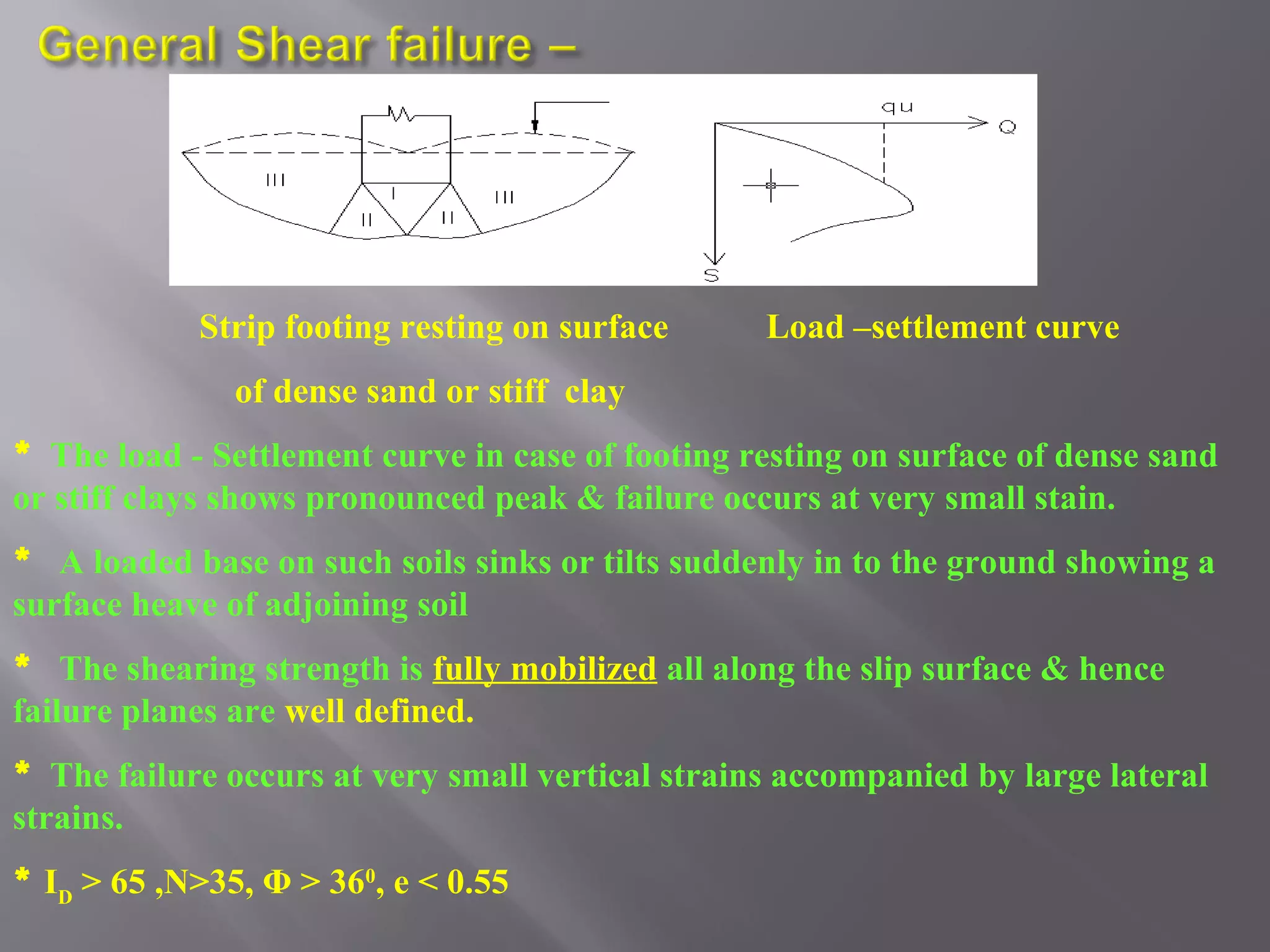
Strip footing resting on surface      Load –settlement curve
               of dense sand or stiff clay
* The load - Settlement curve in case of footing resting on surface of dense sand
or stiff clays shows pronounced peak & failure occurs at very small stain.
* A loaded base on such soils sinks or tilts suddenly in to the ground showing a
surface heave of adjoining soil
* The shearing strength is fully mobilized all along the slip surface & hence
failure planes are well defined.
* The failure occurs at very small vertical strains accompanied by large lateral
strains.
* ID > 65 ,N>35, Φ > 360, e < 0.55
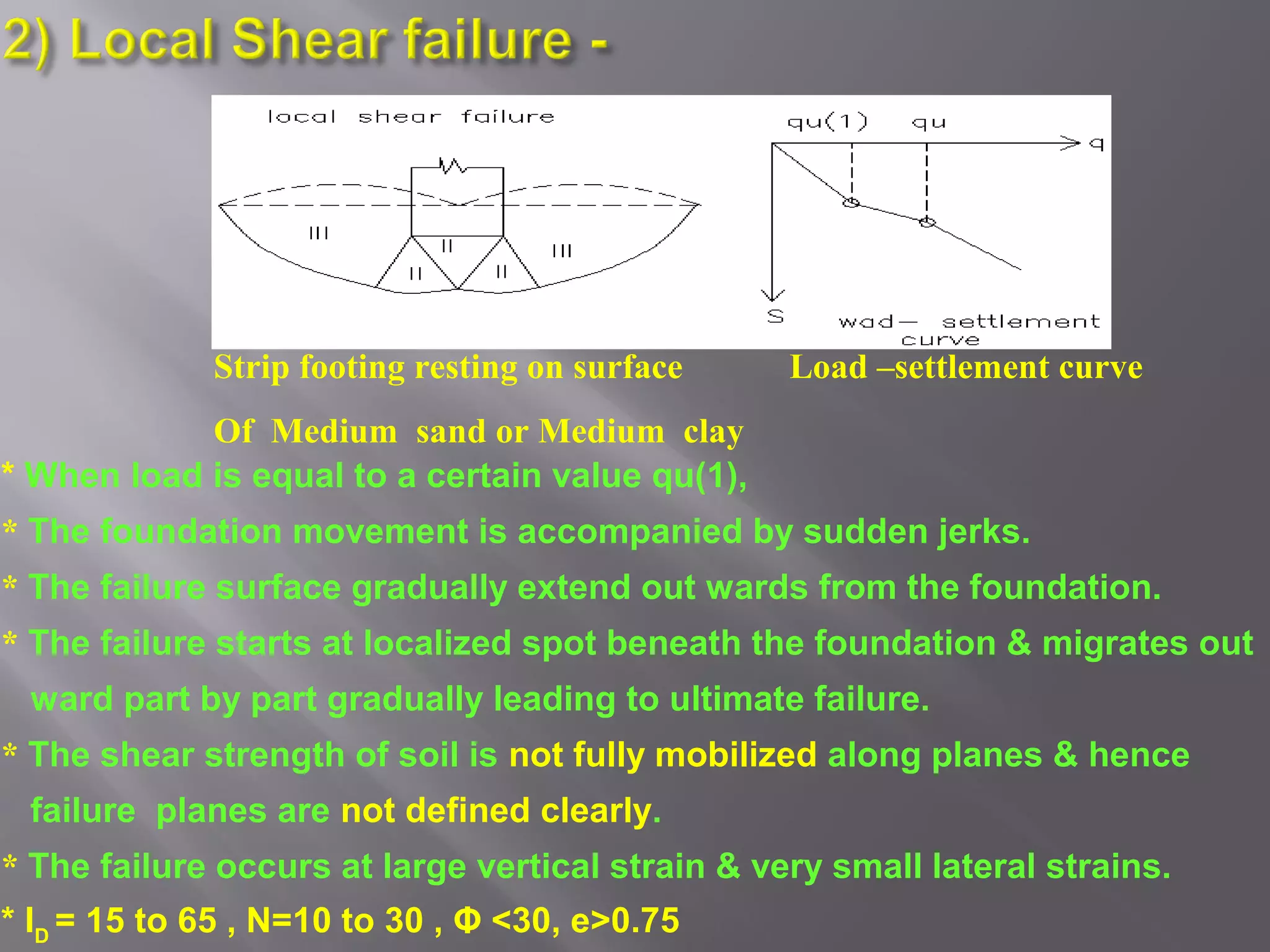
Strip footing resting on surface     Load –settlement curve
            Of Medium sand or Medium clay
* When load is equal to a certain value qu(1),
* The foundation movement is accompanied by sudden jerks.
* The failure surface gradually extend out wards from the foundation.
* The failure starts at localized spot beneath the foundation & migrates out
 ward part by part gradually leading to ultimate failure.
* The shear strength of soil is not fully mobilized along planes & hence
 failure planes are not defined clearly.
* The failure occurs at large vertical strain & very small lateral strains.
* ID = 15 to 65 , N=10 to 30 , Φ <30, e>0.75
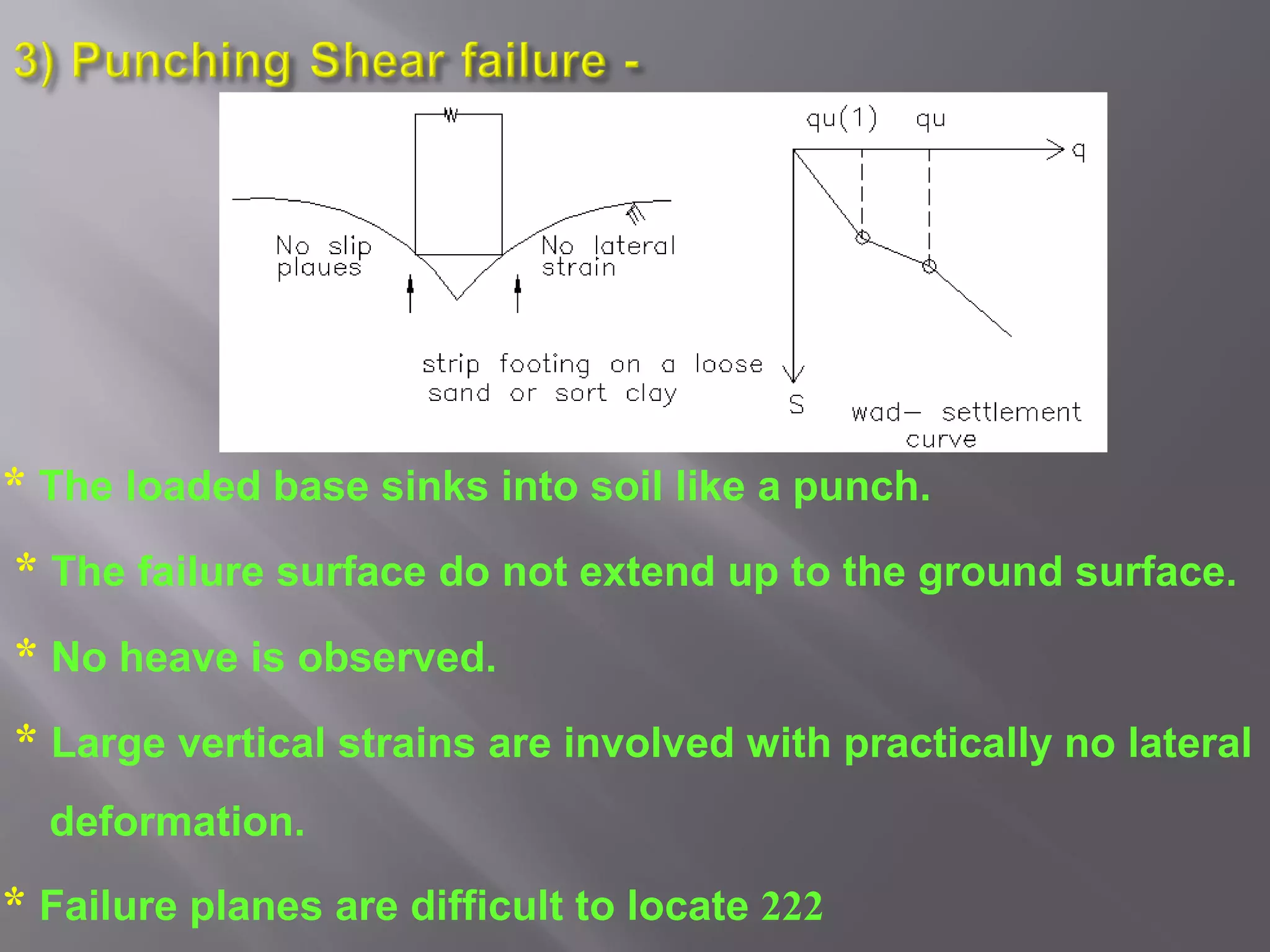
* The loaded base sinks into soil like a punch.
* The failure surface do not extend up to the ground surface.
* No heave is observed.
* Large vertical strains are involved with practically no lateral
  deformation.
* Failure planes are difficult to locate 222
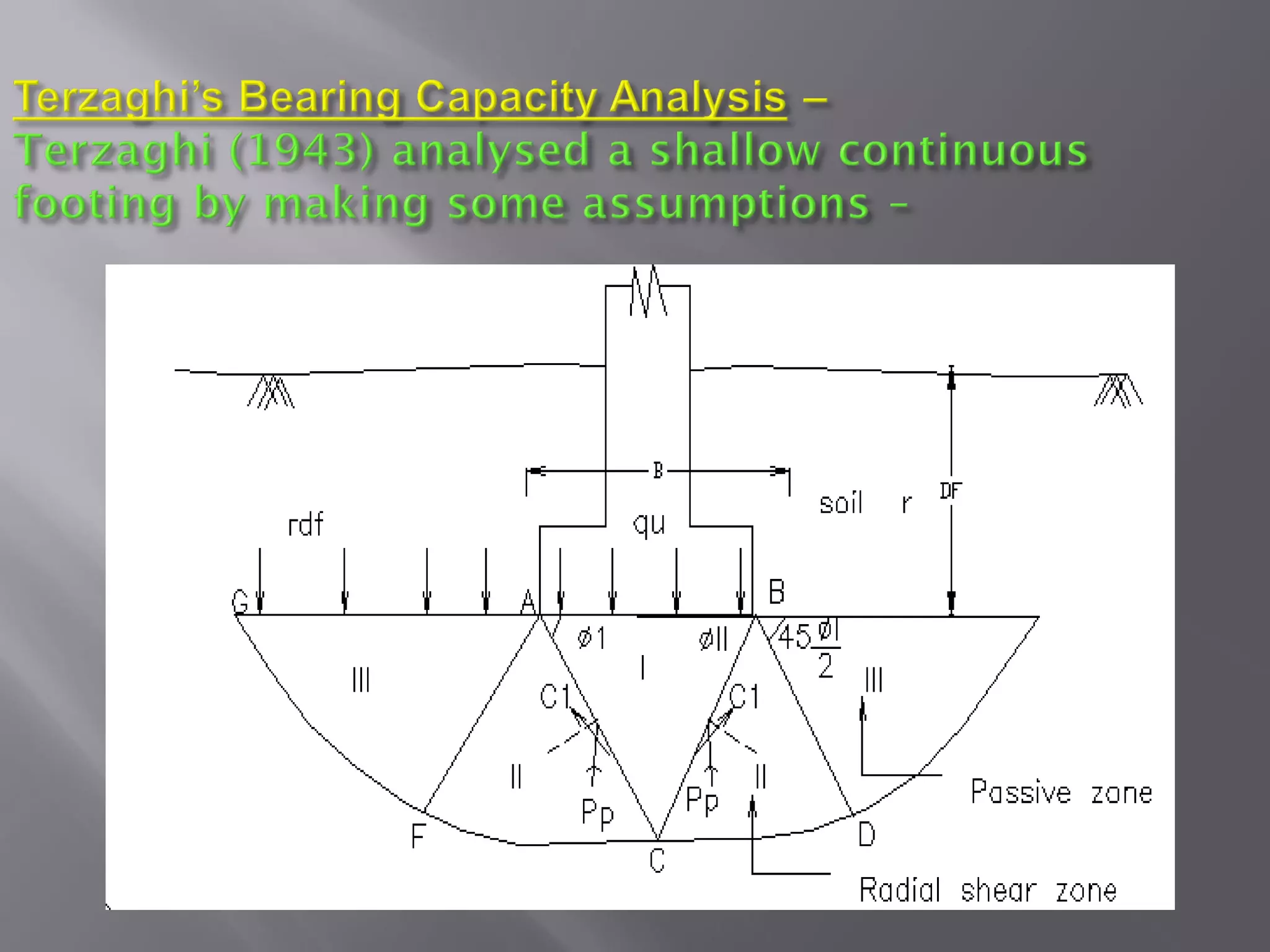
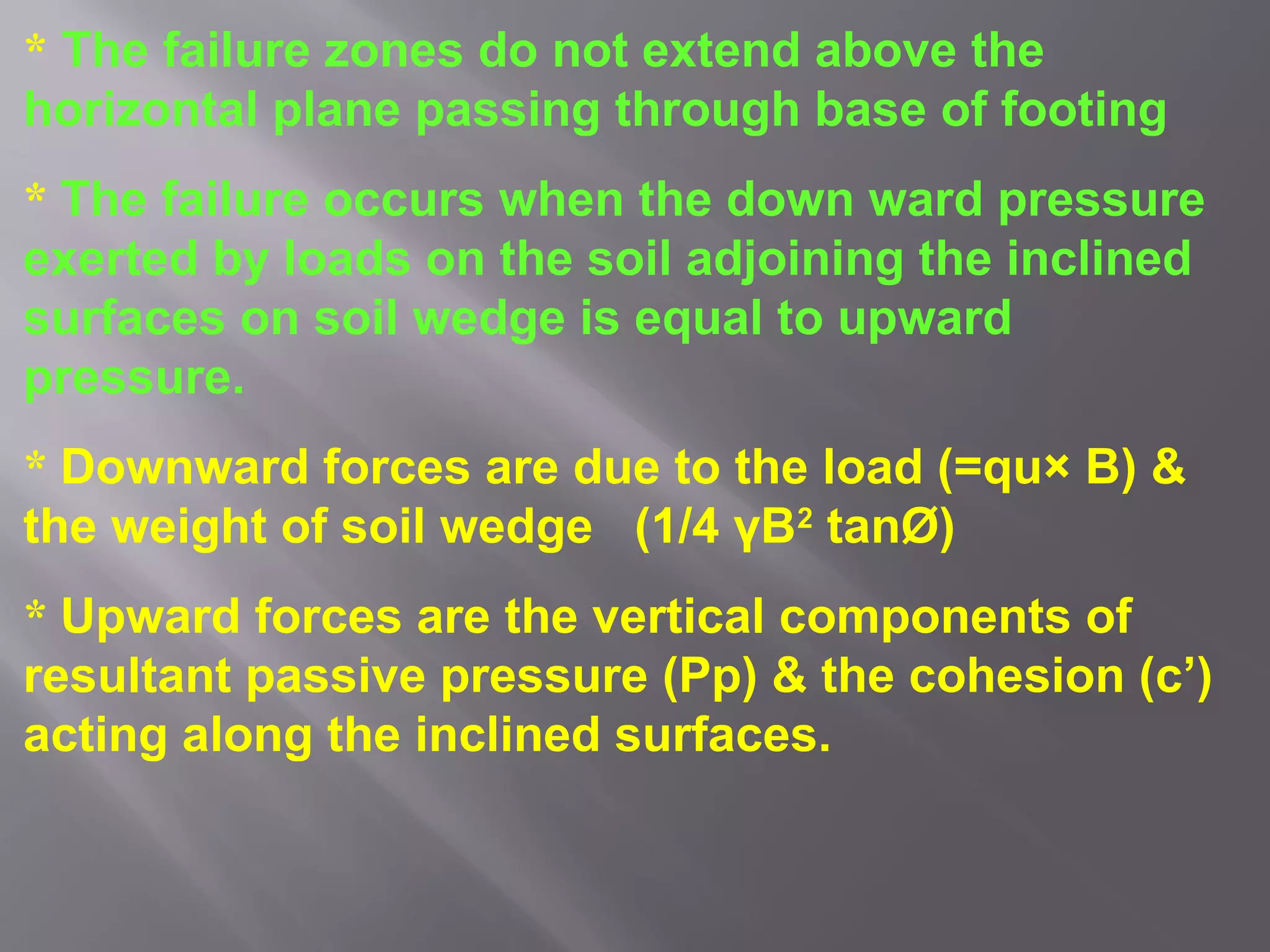
* The failure zones do not extend above the
horizontal plane passing through base of footing
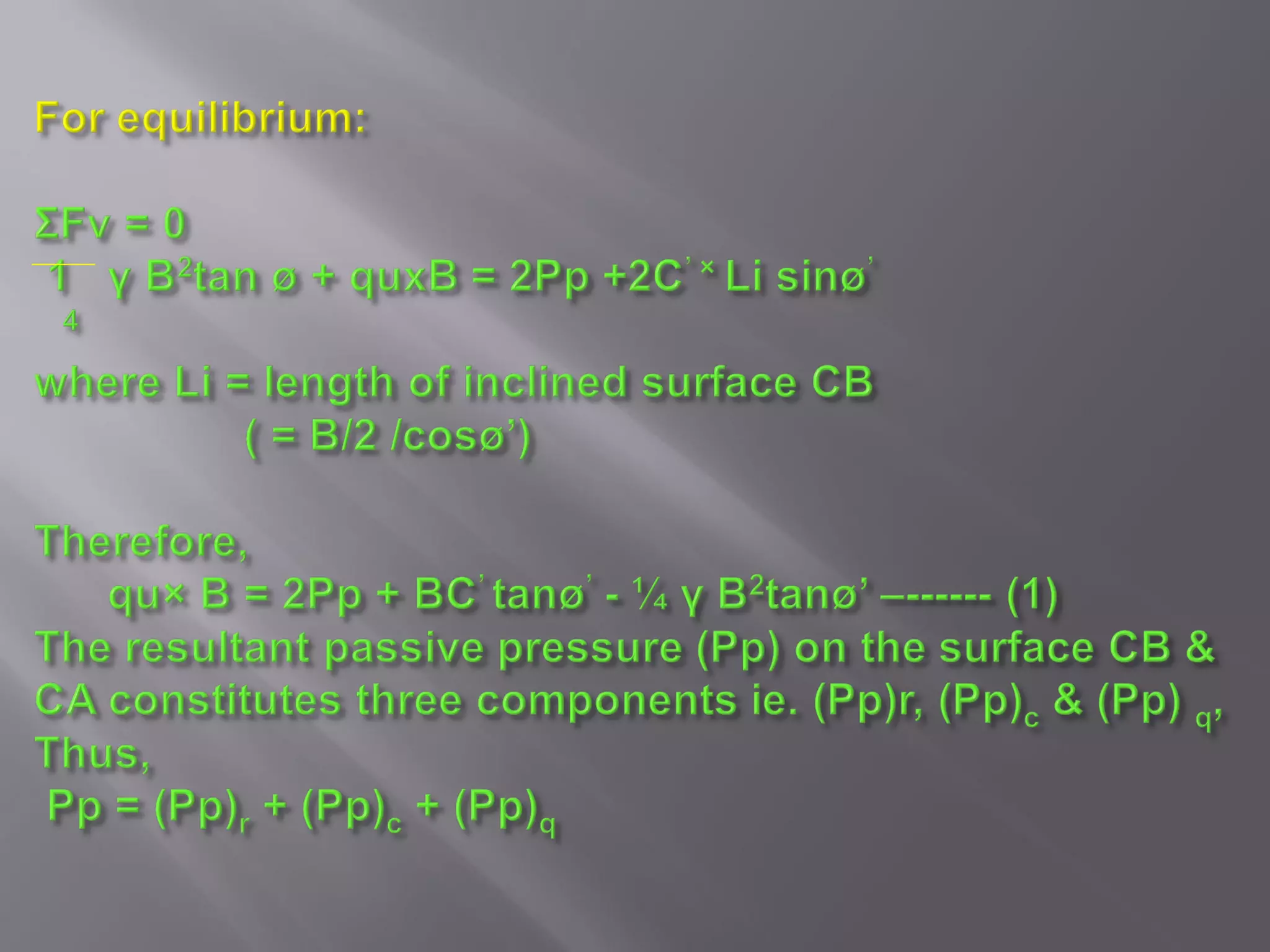
* The failure occurs when the down ward pressure
exerted by loads on the soil adjoining the inclined
surfaces on soil wedge is equal to upward
pressure.
* Downward forces are due to the load (=qu× B) &
the weight of soil wedge (1/4 γB2 tanØ)
* Upward forces are the vertical components of
resultant passive pressure (Pp) & the cohesion (c’)
acting along the inclined surfaces.
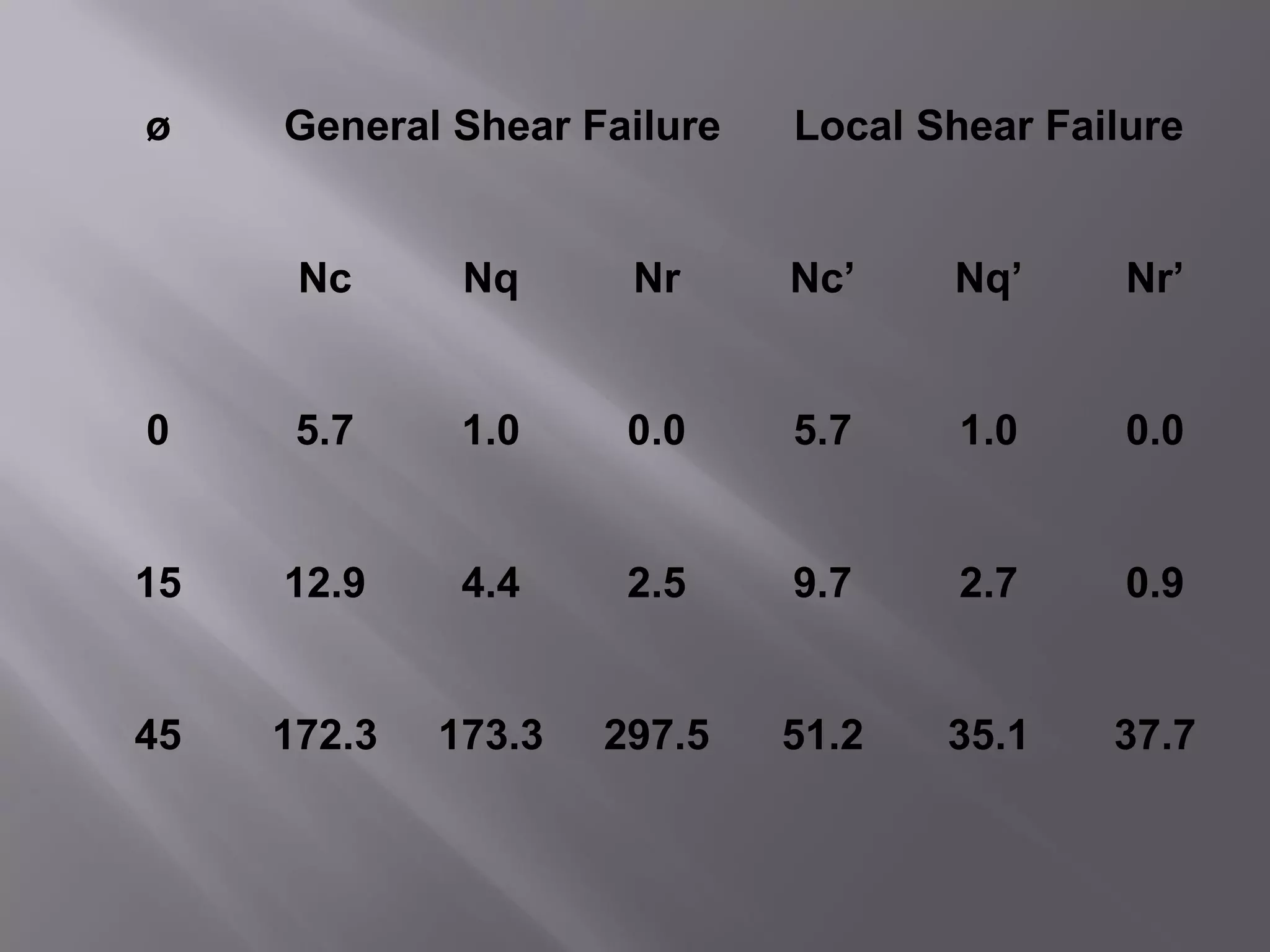
ø    General Shear Failure   Local Shear Failure


      Nc      Nq      Nr     Nc’    Nq’      Nr’


0     5.7     1.0     0.0    5.7     1.0     0.0


15   12.9     4.4     2.5    9.7     2.7     0.9


45   172.3   173.3   297.5   51.2   35.1    37.7
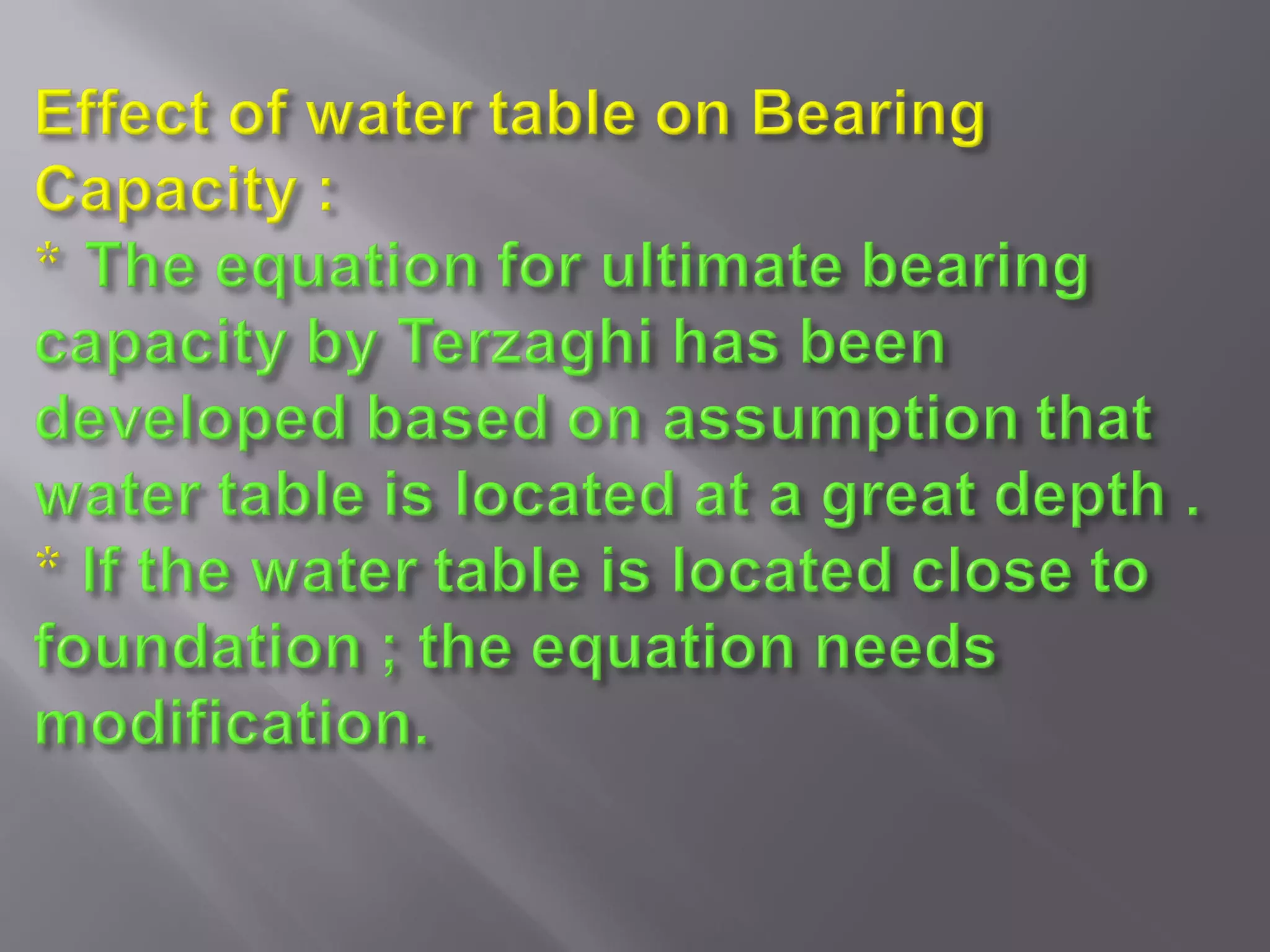
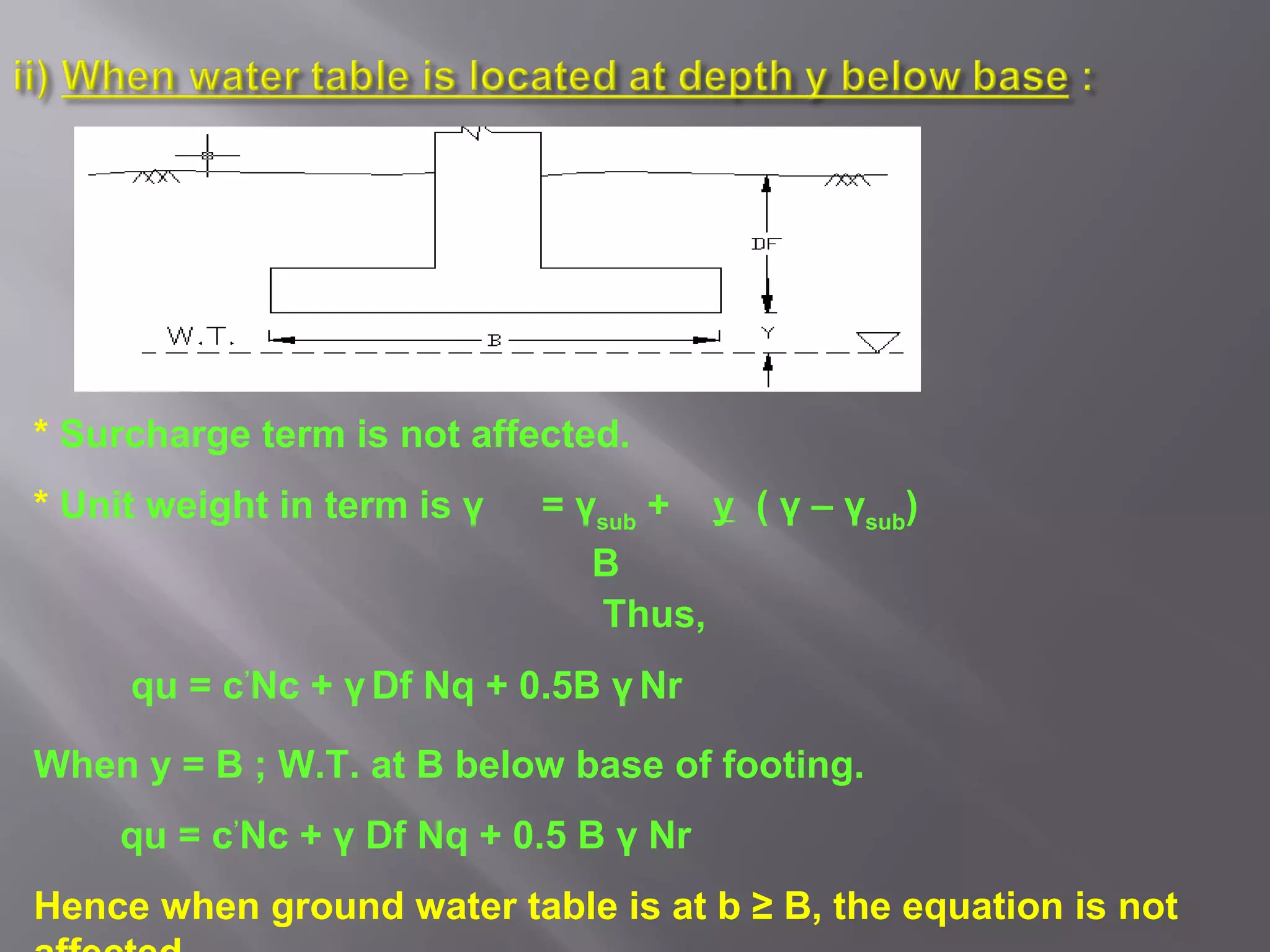
* Surcharge term is not affected.
* Unit weight in term is γ   = γsub +   y ( γ – γsub)
                                B
                                Thus,
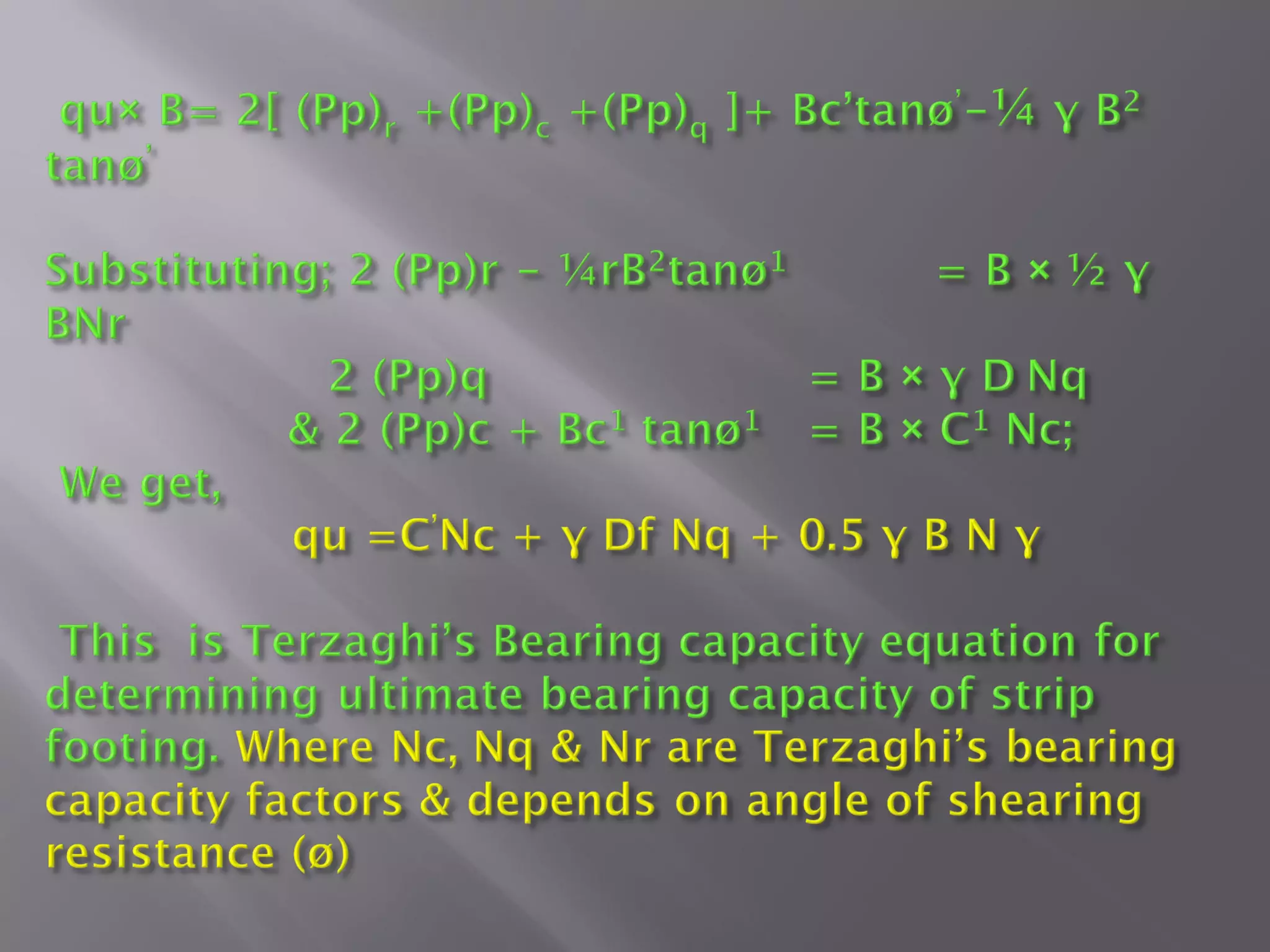
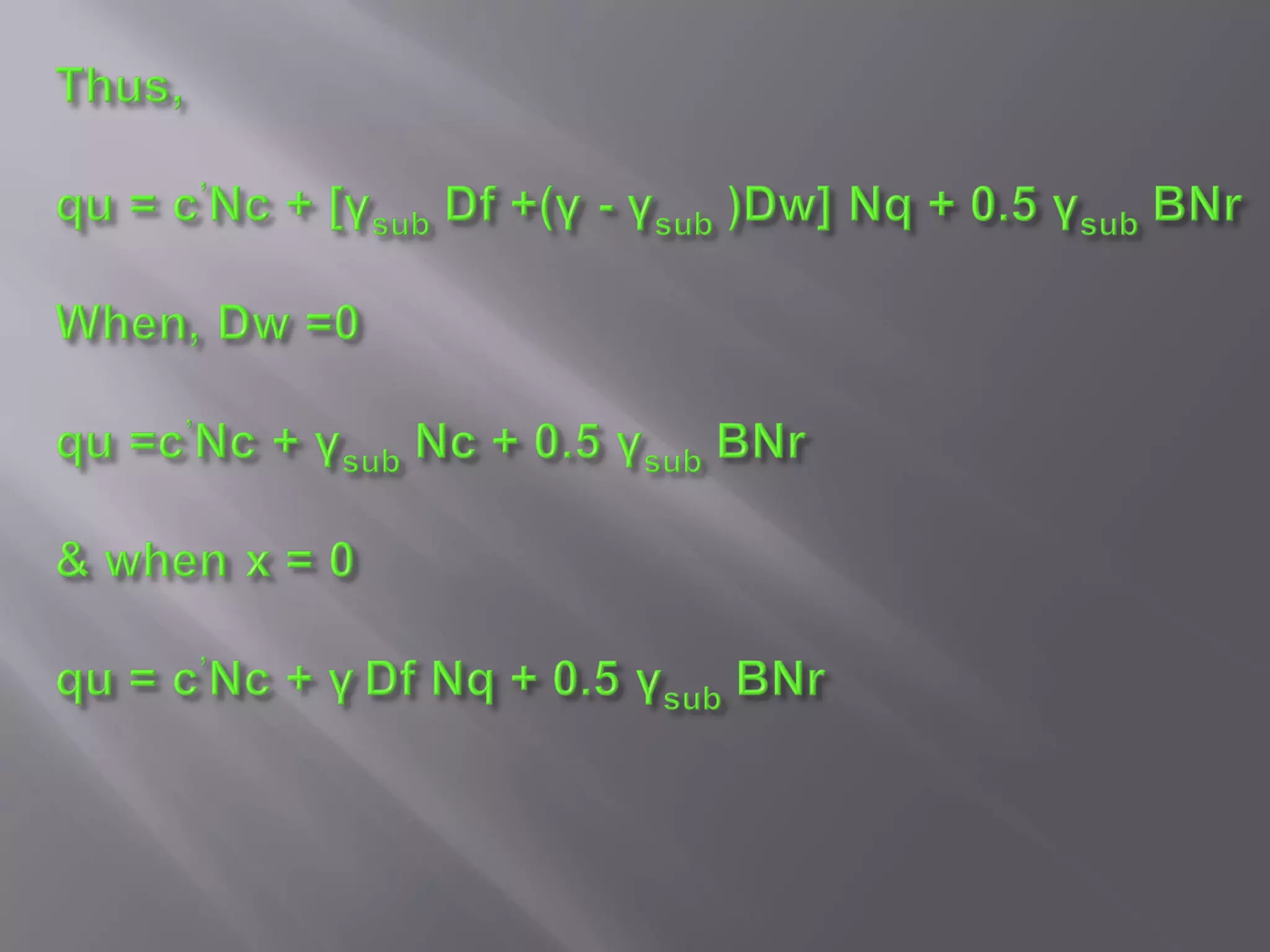
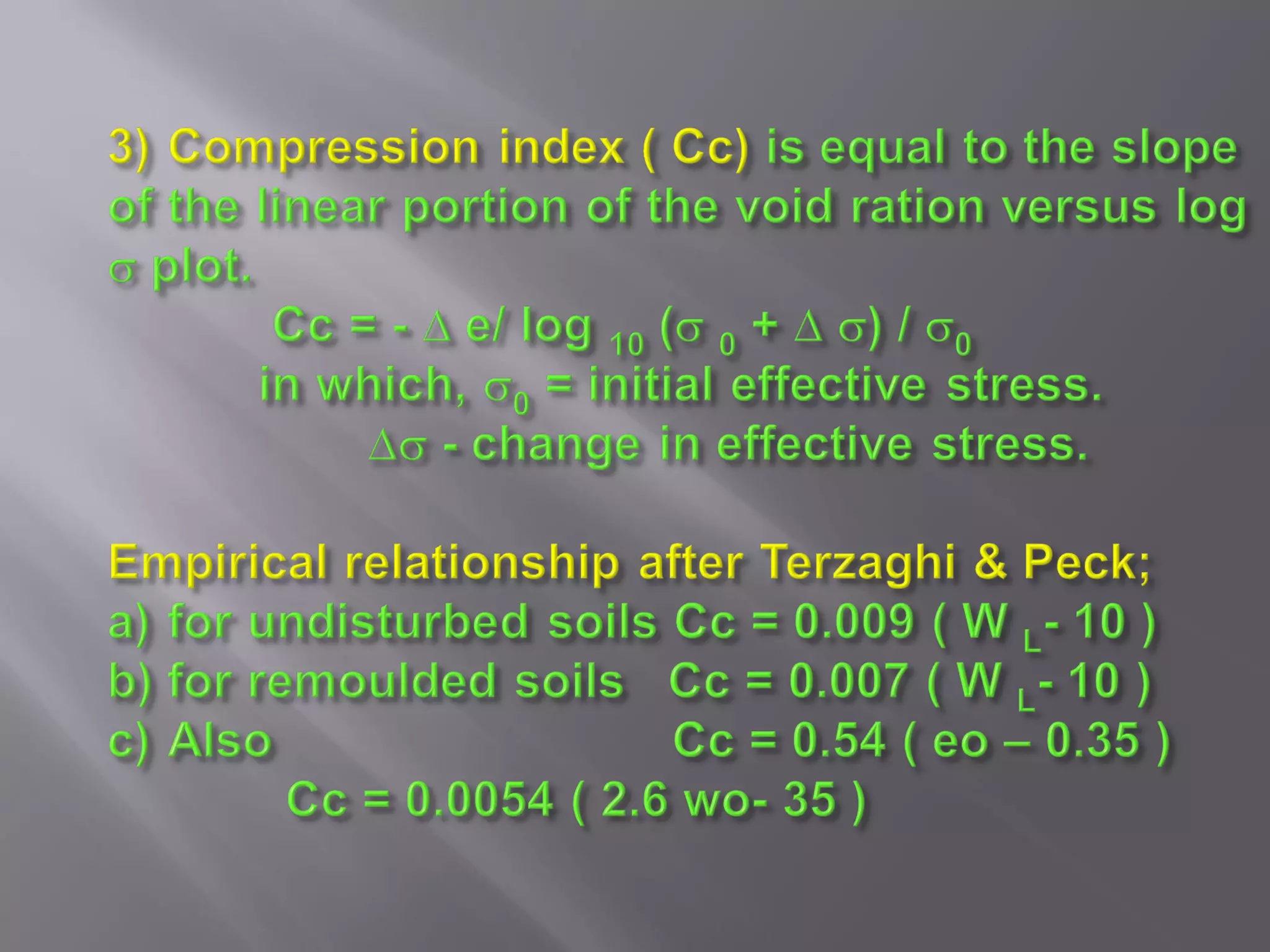
     qu = c’Nc + γ Df Nq + 0.5B γ Nr

When y = B ; W.T. at B below base of footing.
    qu = c’Nc + γ Df Nq + 0.5 B γ Nr
Hence when ground water table is at b ≥ B, the equation is not


ZB
                        I2
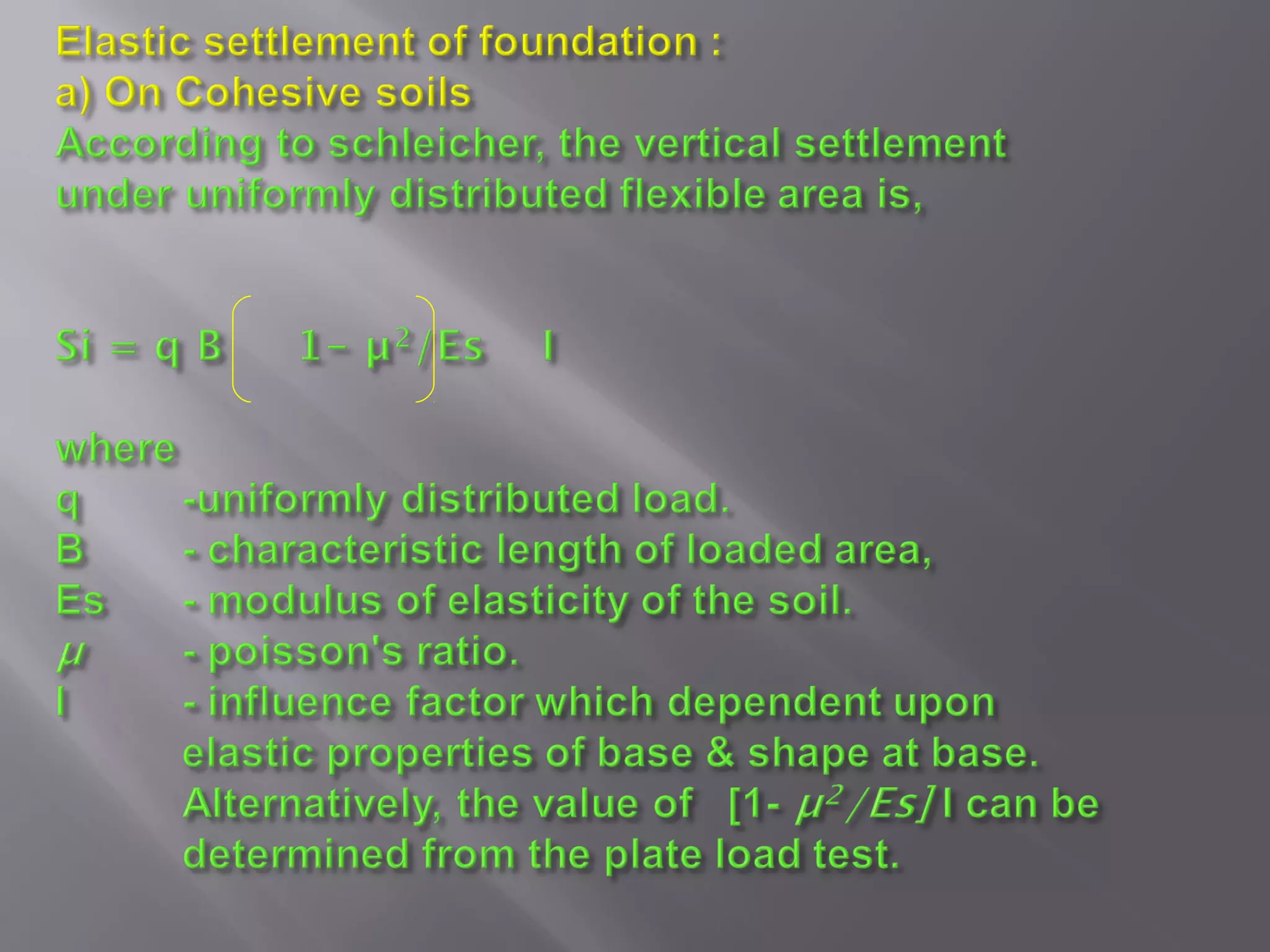
S i = C1C2 ( q − q ) ∫     ∆∈
                        E
                    Z =0 S
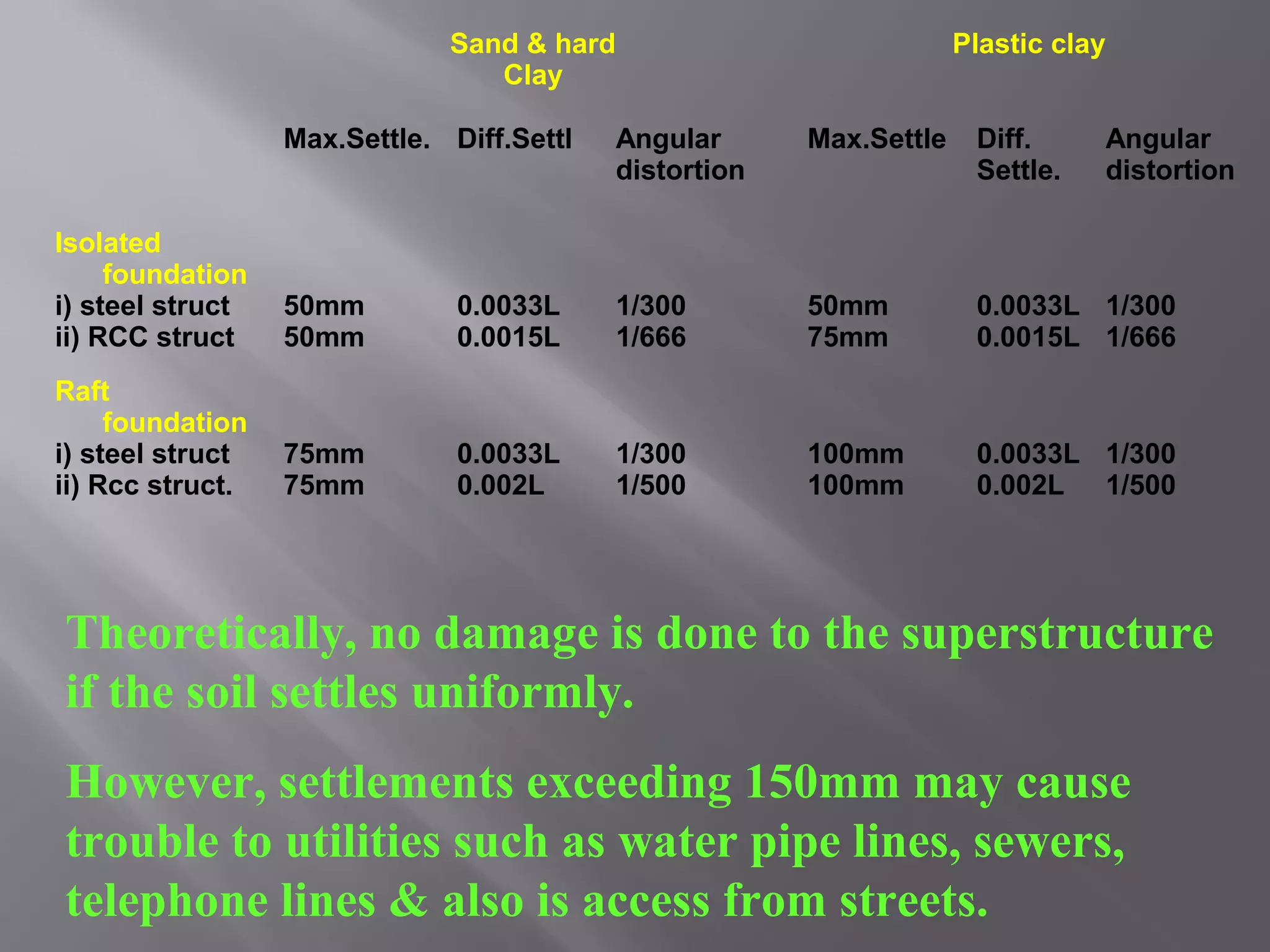
Sand & hard                             Plastic clay
                                 Clay

                  Max.Settle. Diff.Settl    Angular      Max.Settle    Diff.     Angular
                                            distortion                 Settle.   distortion

Isolated
     foundation
i) steel struct   50mm         0.0033L      1/300        50mm          0.0033L 1/300
ii) RCC struct    50mm         0.0015L      1/666        75mm          0.0015L 1/666
Raft
     foundation
i) steel struct   75mm         0.0033L      1/300        100mm         0.0033L 1/300
ii) Rcc struct.   75mm         0.002L       1/500        100mm         0.002L 1/500


Theoretically, no damage is done to the superstructure
if the soil settles uniformly.
However, settlements exceeding 150mm may cause
trouble to utilities such as water pipe lines, sewers,
telephone lines & also is access from streets.
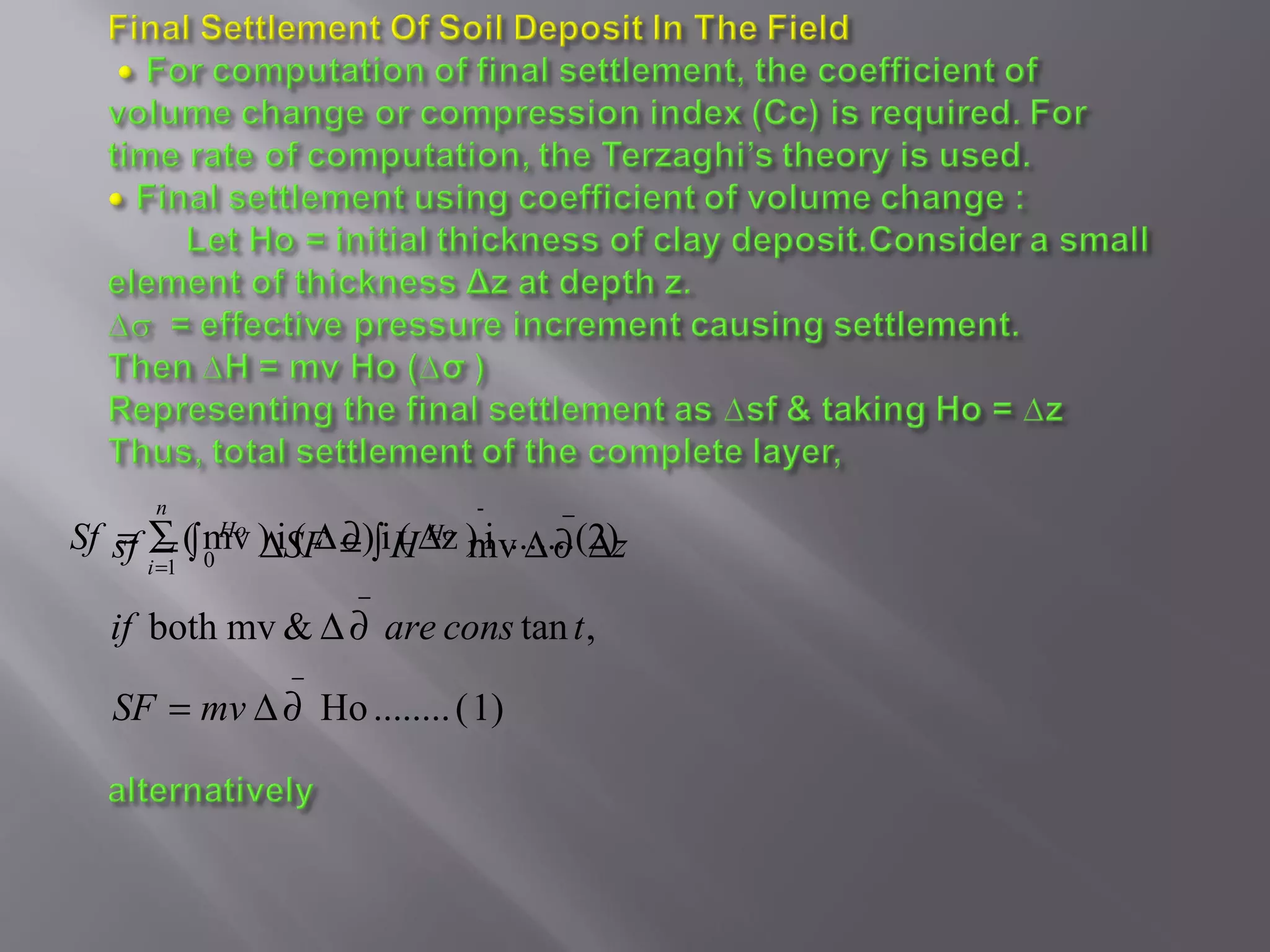
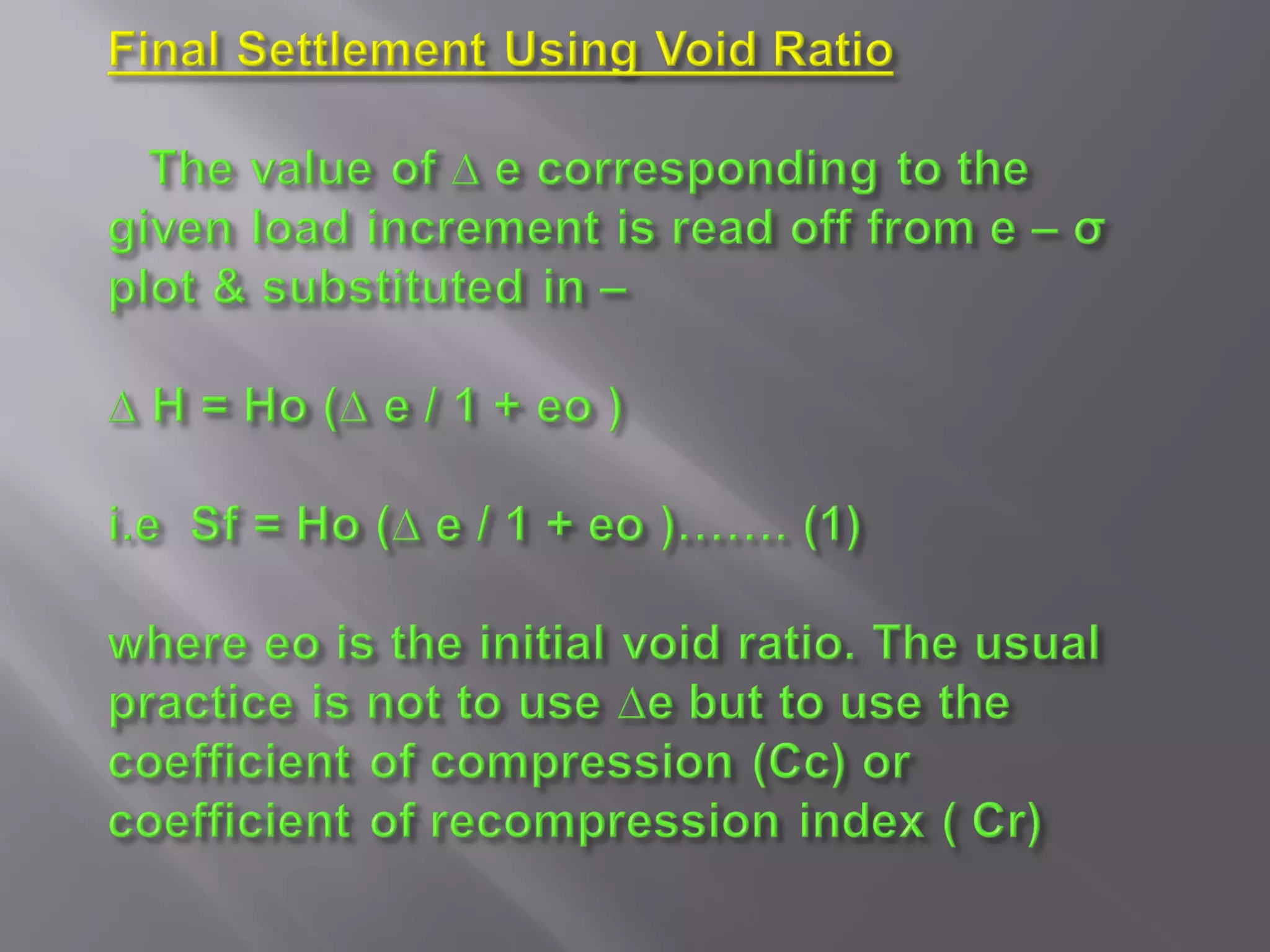
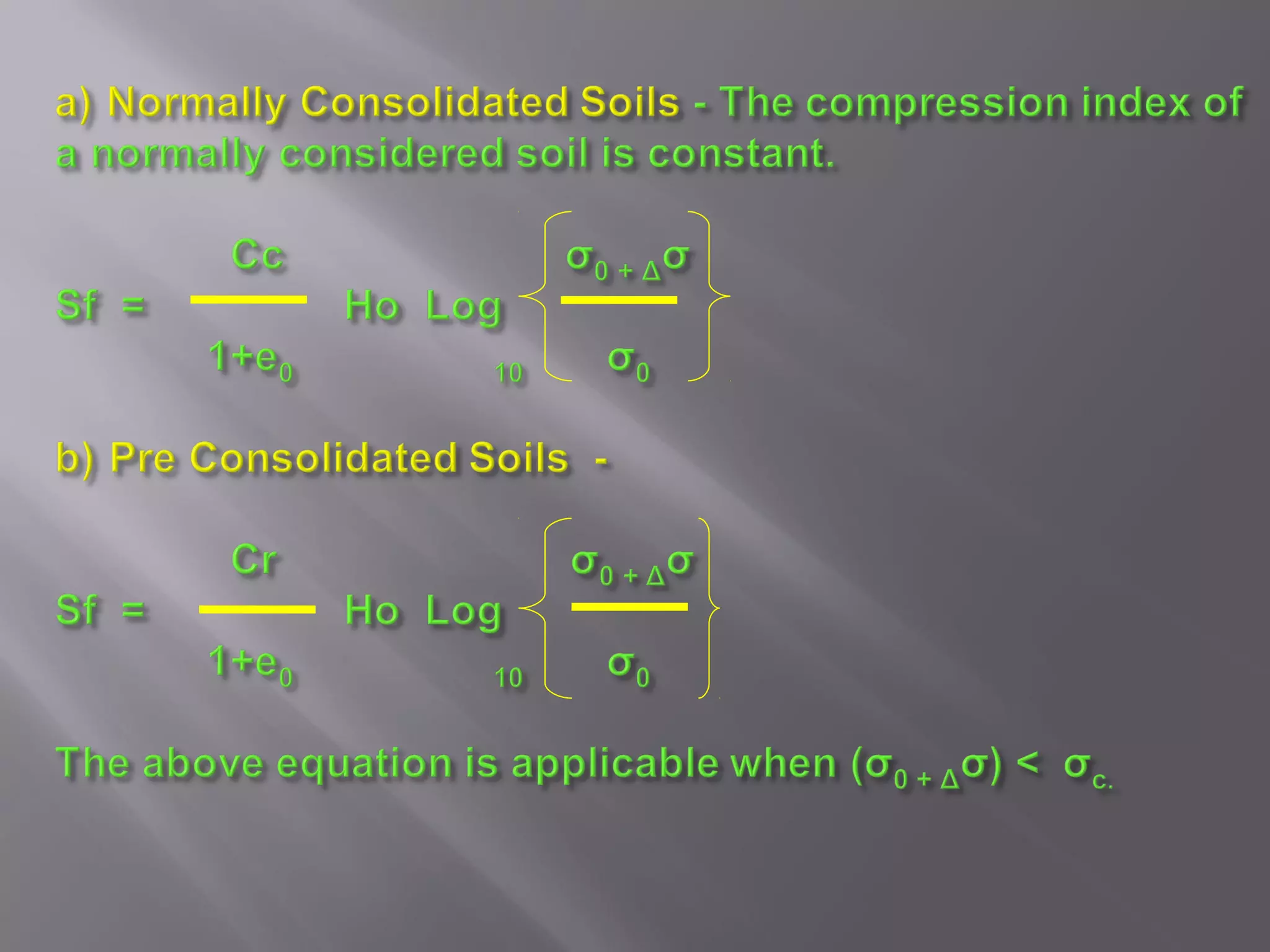
n                         -     −
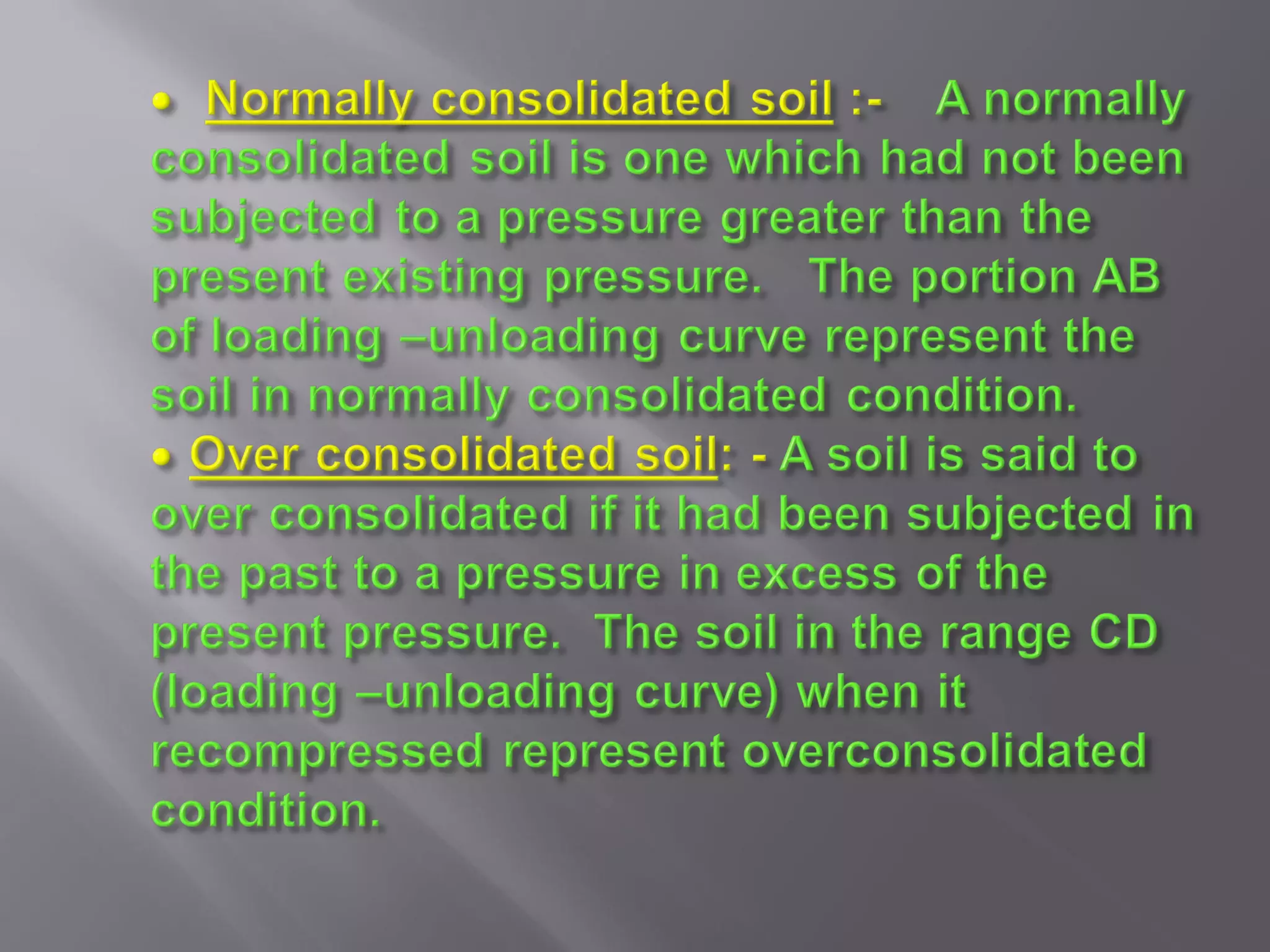
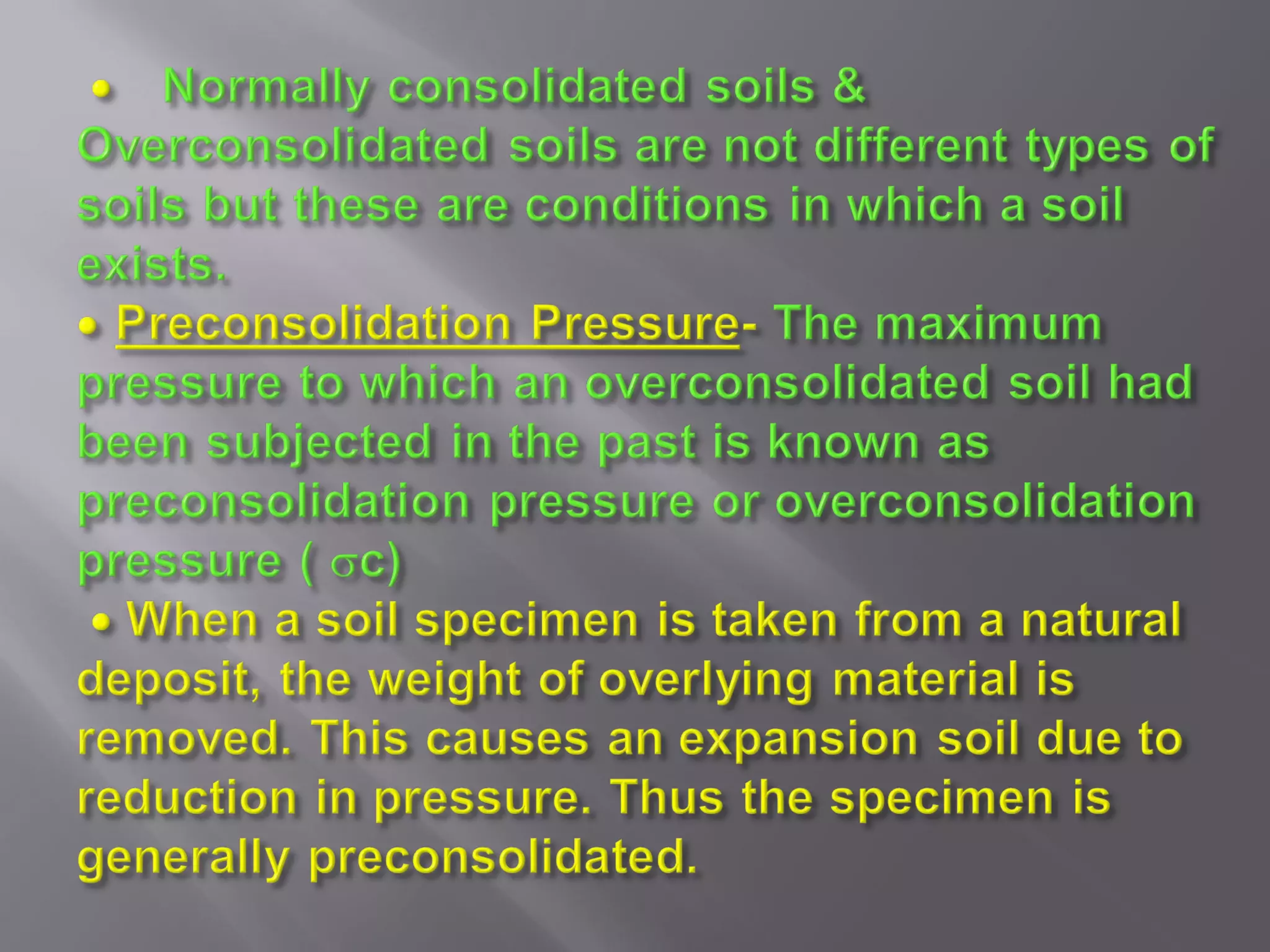
Sf sf ∑ (∫ mv ) iSF =)∫iH∆z ) i ........(2)z
   = = 0 Ho ∆ ( ∆ ∂ ( Ho mv ∆ ∂ ∆
      i =1
                      −
   if both mv & ∆ ∂ are cons tan t ,
                 −
   SF = mv ∆ ∂ Ho ........ ( 1)
Bearing capacity of Soil

Bearing capacity of Soil

  • 7.
    Strip footing restingon surface Load –settlement curve of dense sand or stiff clay * The load - Settlement curve in case of footing resting on surface of dense sand or stiff clays shows pronounced peak & failure occurs at very small stain. * A loaded base on such soils sinks or tilts suddenly in to the ground showing a surface heave of adjoining soil * The shearing strength is fully mobilized all along the slip surface & hence failure planes are well defined. * The failure occurs at very small vertical strains accompanied by large lateral strains. * ID > 65 ,N>35, Φ > 360, e < 0.55
  • 8.
    Strip footing restingon surface Load –settlement curve Of Medium sand or Medium clay * When load is equal to a certain value qu(1), * The foundation movement is accompanied by sudden jerks. * The failure surface gradually extend out wards from the foundation. * The failure starts at localized spot beneath the foundation & migrates out ward part by part gradually leading to ultimate failure. * The shear strength of soil is not fully mobilized along planes & hence failure planes are not defined clearly. * The failure occurs at large vertical strain & very small lateral strains. * ID = 15 to 65 , N=10 to 30 , Φ <30, e>0.75
  • 9.
    * The loadedbase sinks into soil like a punch. * The failure surface do not extend up to the ground surface. * No heave is observed. * Large vertical strains are involved with practically no lateral deformation. * Failure planes are difficult to locate 222
  • 11.
    * The failurezones do not extend above the horizontal plane passing through base of footing * The failure occurs when the down ward pressure exerted by loads on the soil adjoining the inclined surfaces on soil wedge is equal to upward pressure. * Downward forces are due to the load (=qu× B) & the weight of soil wedge (1/4 γB2 tanØ) * Upward forces are the vertical components of resultant passive pressure (Pp) & the cohesion (c’) acting along the inclined surfaces.
  • 14.
    ø General Shear Failure Local Shear Failure Nc Nq Nr Nc’ Nq’ Nr’ 0 5.7 1.0 0.0 5.7 1.0 0.0 15 12.9 4.4 2.5 9.7 2.7 0.9 45 172.3 173.3 297.5 51.2 35.1 37.7
  • 19.
    * Surcharge termis not affected. * Unit weight in term is γ = γsub + y ( γ – γsub) B Thus, qu = c’Nc + γ Df Nq + 0.5B γ Nr When y = B ; W.T. at B below base of footing. qu = c’Nc + γ Df Nq + 0.5 B γ Nr Hence when ground water table is at b ≥ B, the equation is not
  • 24.
  • 25.
    ZB I2 S i = C1C2 ( q − q ) ∫ ∆∈ E Z =0 S
  • 31.
    Sand & hard Plastic clay Clay Max.Settle. Diff.Settl Angular Max.Settle Diff. Angular distortion Settle. distortion Isolated foundation i) steel struct 50mm 0.0033L 1/300 50mm 0.0033L 1/300 ii) RCC struct 50mm 0.0015L 1/666 75mm 0.0015L 1/666 Raft foundation i) steel struct 75mm 0.0033L 1/300 100mm 0.0033L 1/300 ii) Rcc struct. 75mm 0.002L 1/500 100mm 0.002L 1/500 Theoretically, no damage is done to the superstructure if the soil settles uniformly. However, settlements exceeding 150mm may cause trouble to utilities such as water pipe lines, sewers, telephone lines & also is access from streets.
  • 44.
    n - − Sf sf ∑ (∫ mv ) iSF =)∫iH∆z ) i ........(2)z = = 0 Ho ∆ ( ∆ ∂ ( Ho mv ∆ ∂ ∆ i =1 − if both mv & ∆ ∂ are cons tan t , − SF = mv ∆ ∂ Ho ........ ( 1)