The document discusses the different types of loads that act on structures. It classifies loads as vertical loads (dead load, live load, impact load), horizontal loads (wind load, earthquake load), and longitudinal loads (tractive and braking forces). The main vertical loads are dead load from structural members and materials, live load from occupancy, and impact load from vibrations. The primary horizontal loads are wind load from air movement and earthquake load from seismic activity. Longitudinal loads apply specifically to bridges and gantries. The document provides further details on the characteristics and calculation of common load types like dead load, live load, snow load, impact load, wind load, and earthquake load.
The loads arebroadly classified as;
1. Vertical loads,
2. Horizontal loads, and
3. Longitudinal loads.
The vertical loads consist of dead load, live load and impact load.
The horizontal loads comprises of wind load and earthquake
load.
The longitudinal loads i.e. tractive and braking forces are
considered in special case of design of bridges, gantry girders etc.
Classification of Loads
3.
Structural loads
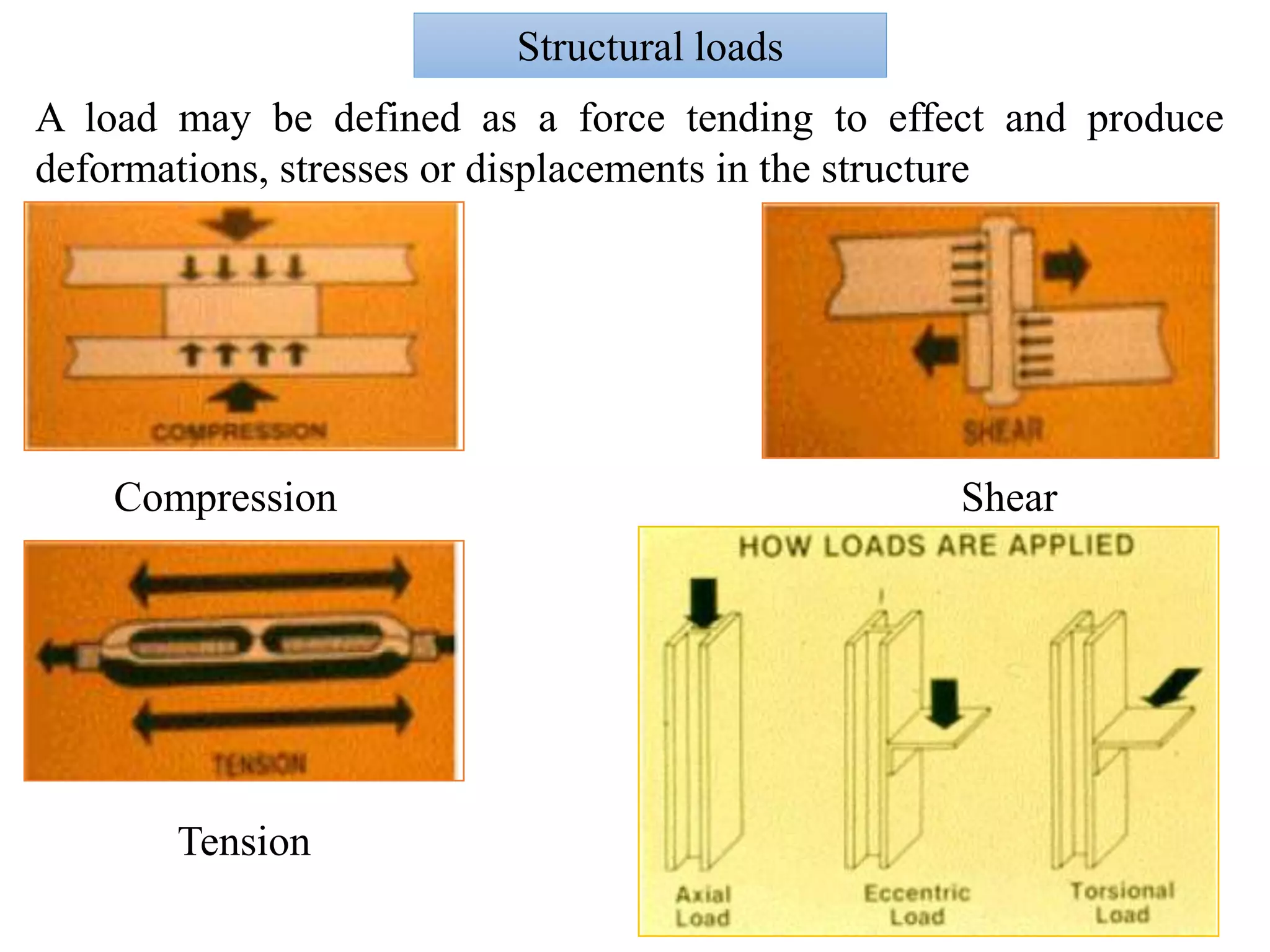
A loadmay be defined as a force tending to effect and produce
deformations, stresses or displacements in the structure
Compression
Tension
Shear
4.
Types of Loadsin Structures
1. Dead loads
2. Live loads
3. Dynamic loads
4. Wind loads
5. Earthquake loads
6. Snow loads
5.
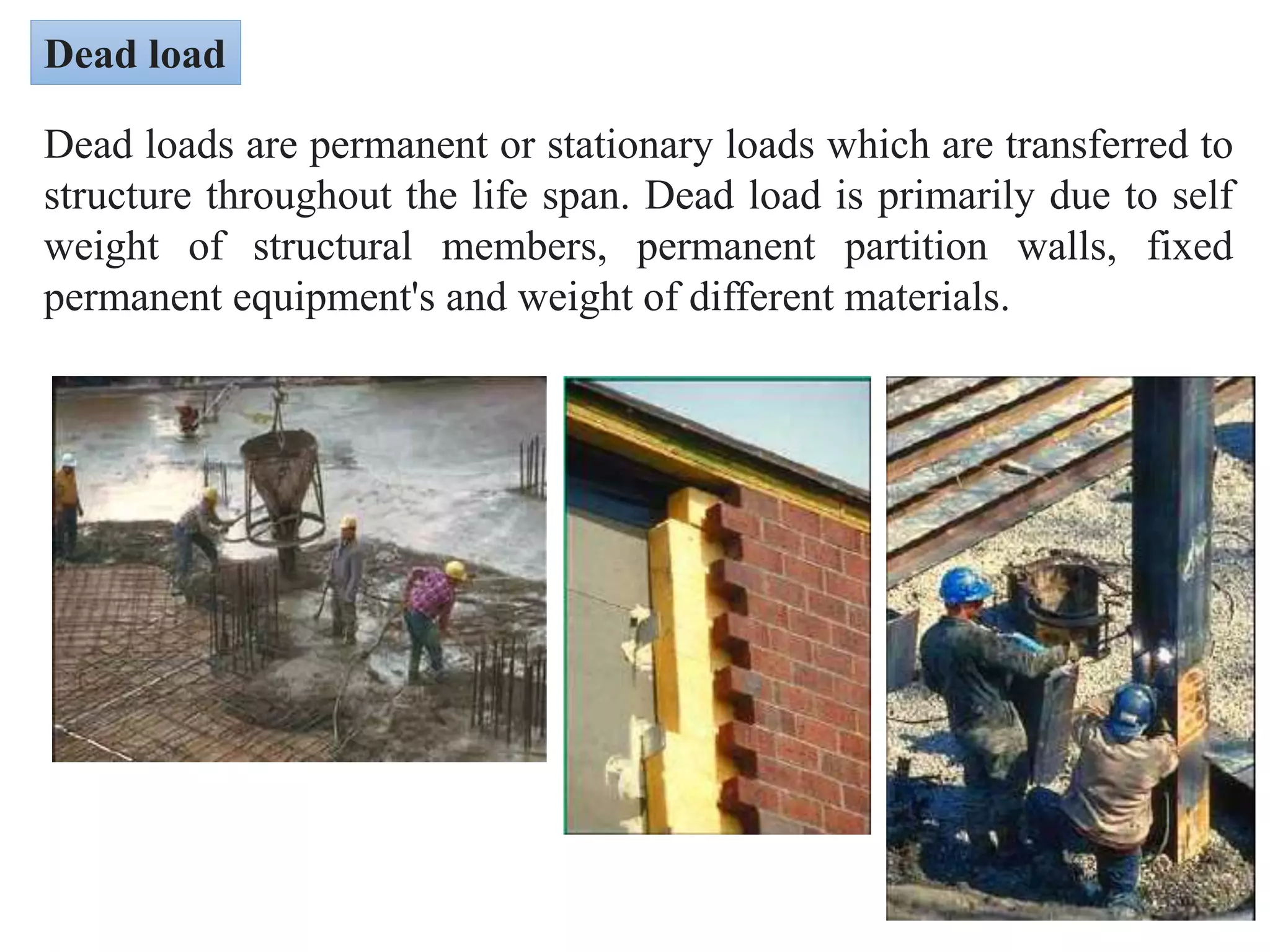
Dead load
Dead loadsare permanent or stationary loads which are transferred to
structure throughout the life span. Dead load is primarily due to self
weight of structural members, permanent partition walls, fixed
permanent equipment's and weight of different materials.
6.
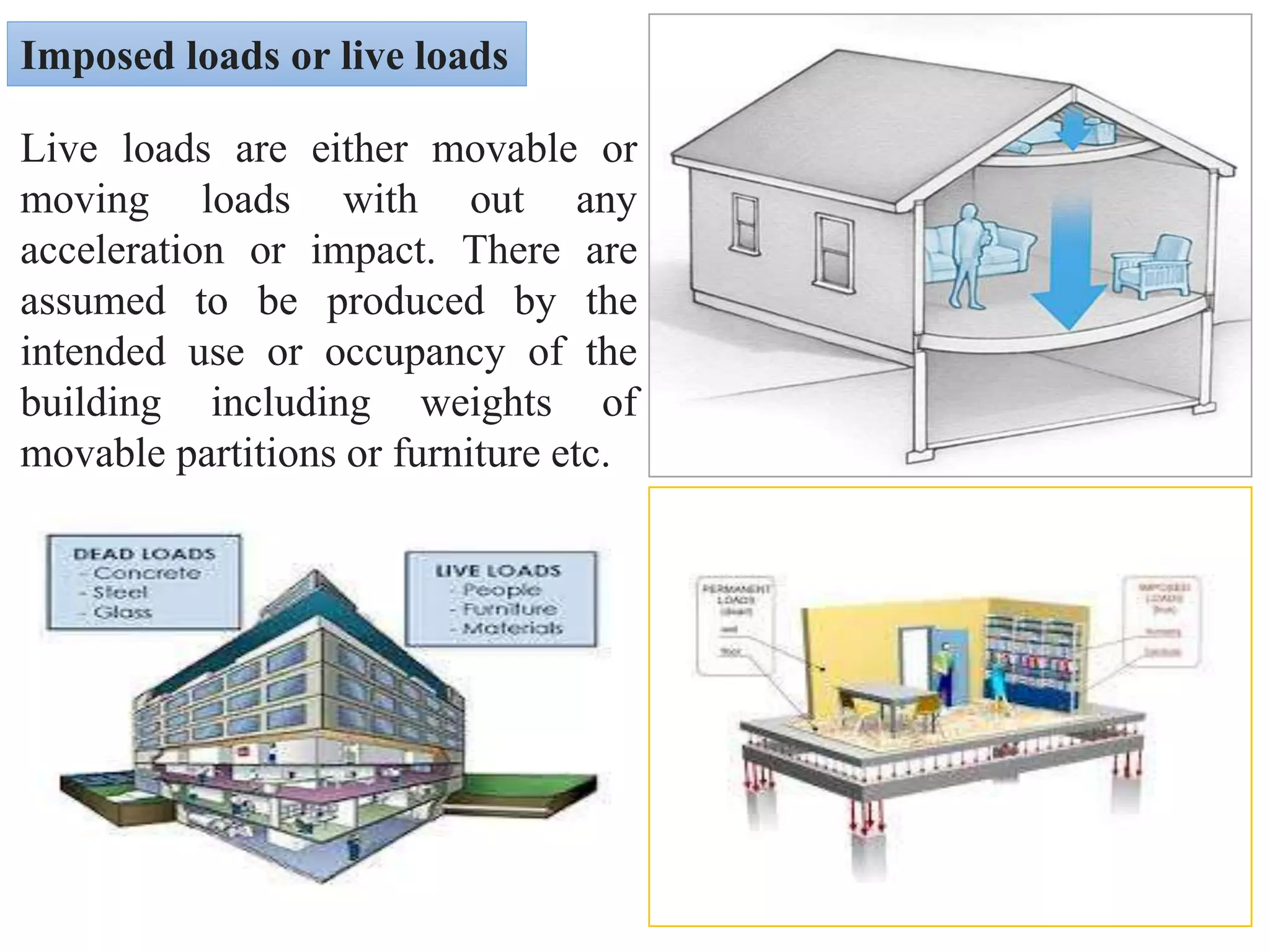
Imposed loads orlive loads
Live loads are either movable or
moving loads with out any
acceleration or impact. There are
assumed to be produced by the
intended use or occupancy of the
building including weights of
movable partitions or furniture etc.
7.
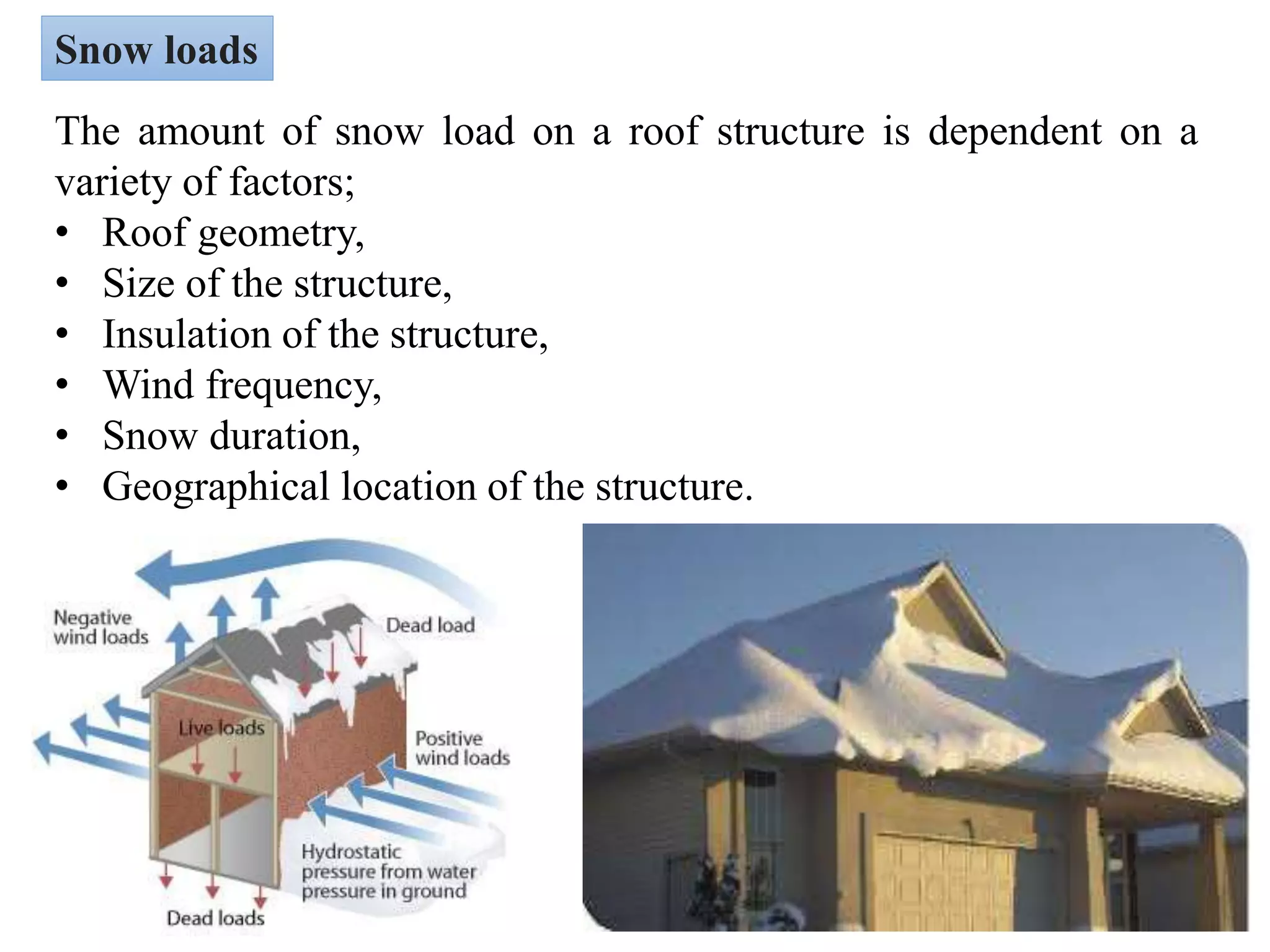
Snow loads
The amountof snow load on a roof structure is dependent on a
variety of factors;
• Roof geometry,
• Size of the structure,
• Insulation of the structure,
• Wind frequency,
• Snow duration,
• Geographical location of the structure.
8.
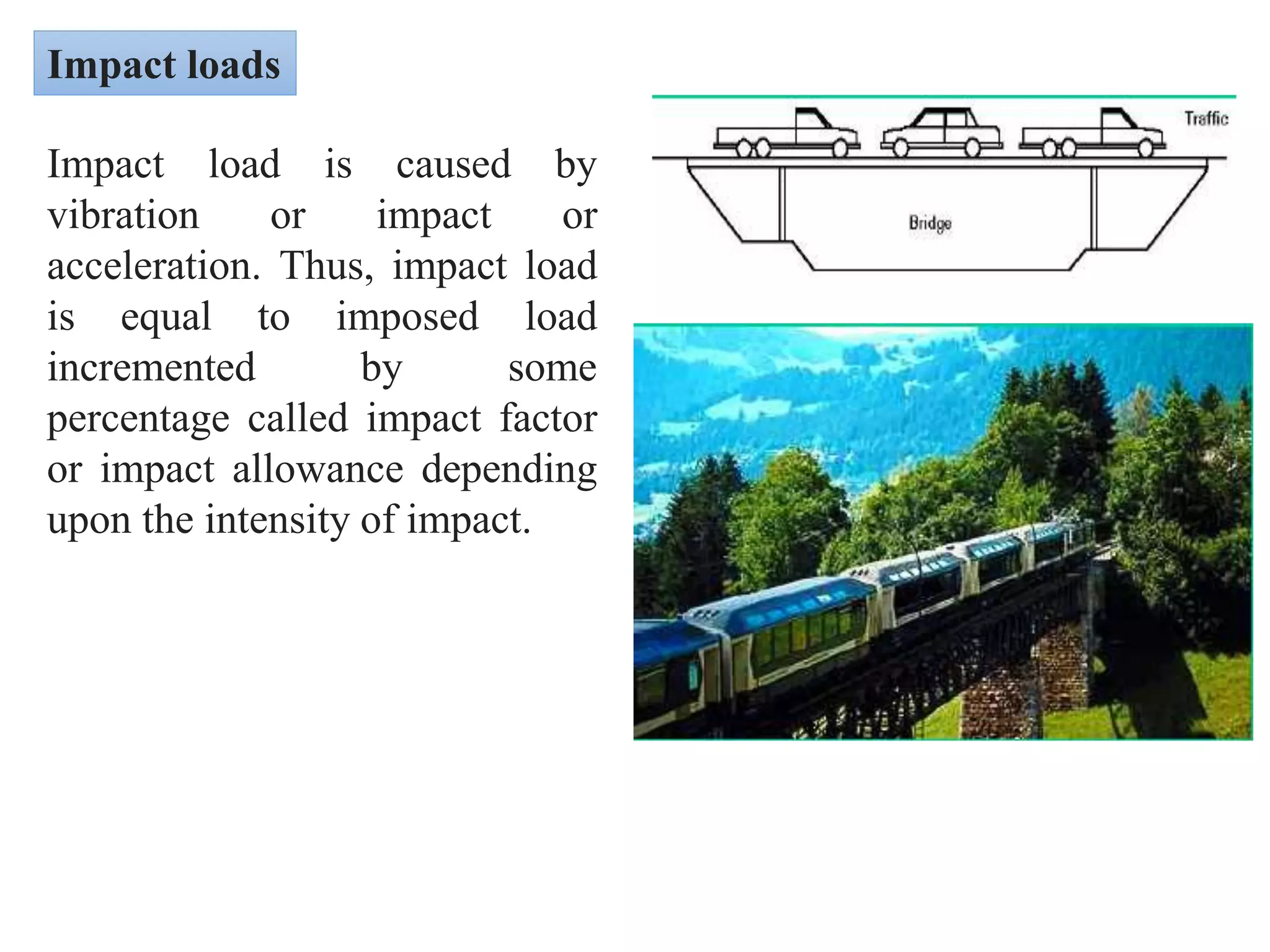
Impact loads
Impact loadis caused by
vibration or impact or
acceleration. Thus, impact load
is equal to imposed load
incremented by some
percentage called impact factor
or impact allowance depending
upon the intensity of impact.
9.
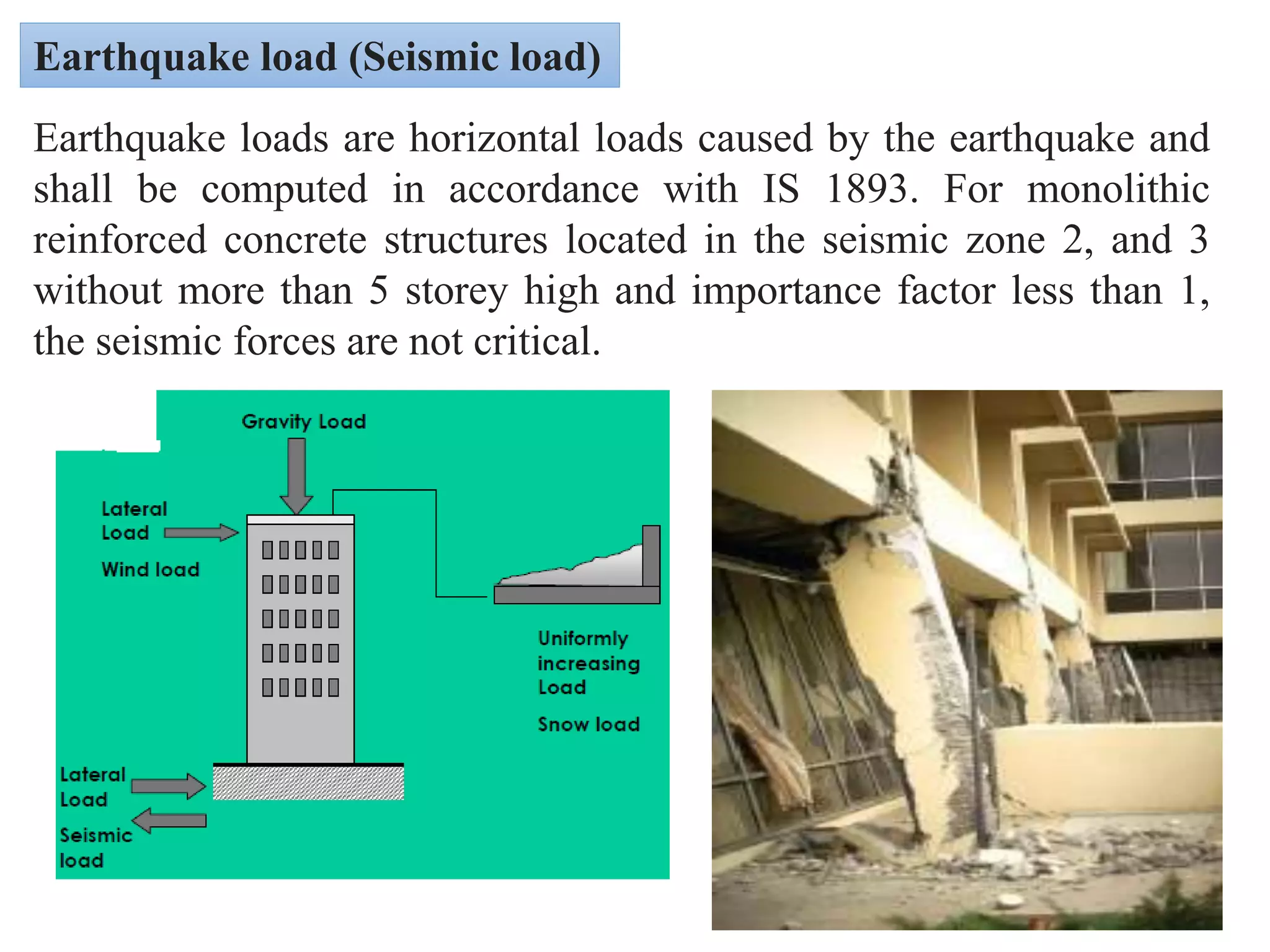
Earthquake load (Seismicload)
Earthquake loads are horizontal loads caused by the earthquake and
shall be computed in accordance with IS 1893. For monolithic
reinforced concrete structures located in the seismic zone 2, and 3
without more than 5 storey high and importance factor less than 1,
the seismic forces are not critical.
10.
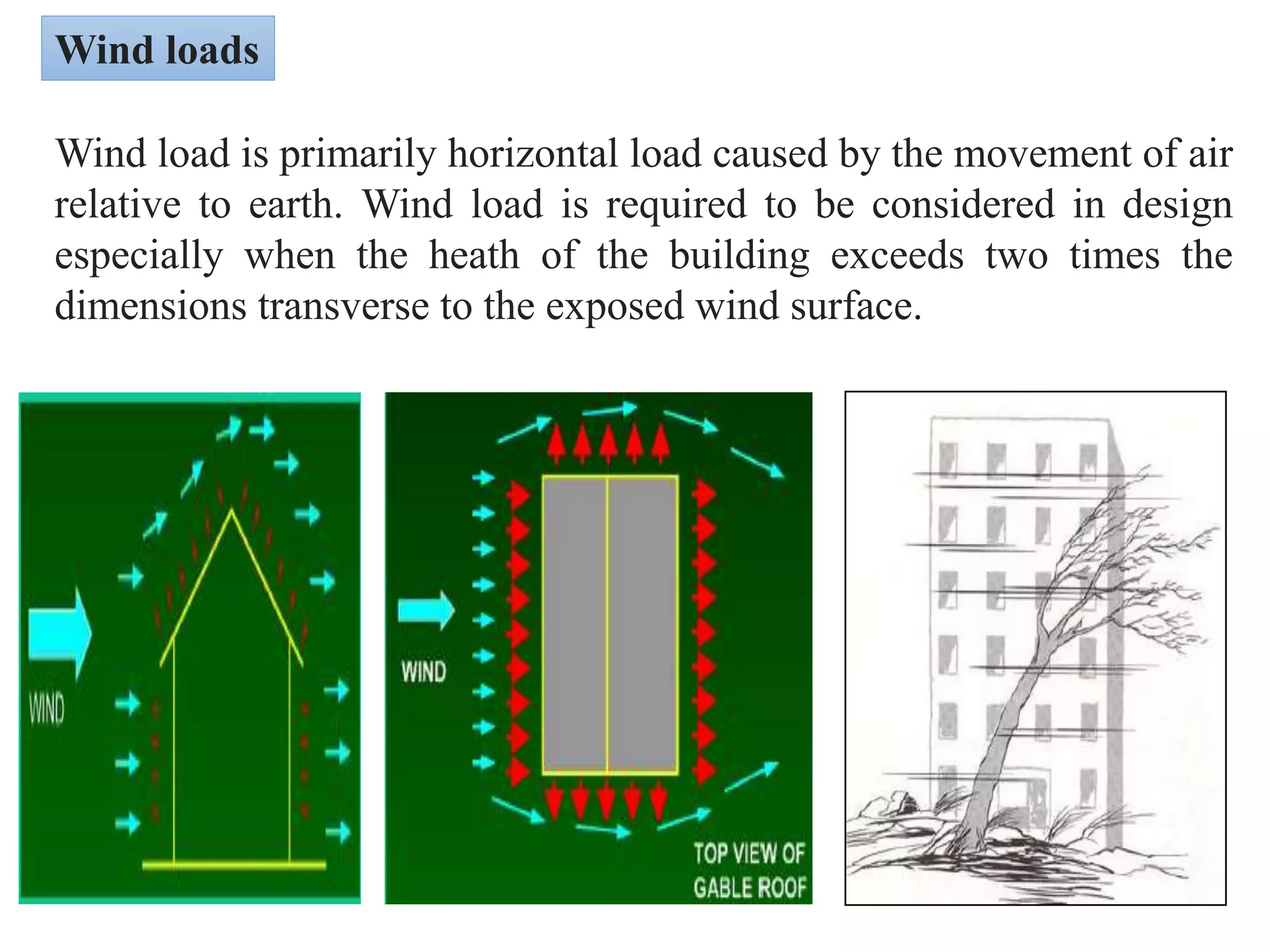
Wind loads
Wind loadis primarily horizontal load caused by the movement of air
relative to earth. Wind load is required to be considered in design
especially when the heath of the building exceeds two times the
dimensions transverse to the exposed wind surface.
11.
Wind loads
The amountof wind load is dependent on the following;
• Geographical location
• The height of structure
• Type of surrounding physical environment
• The shape of structure
• Size of the building