JOINTS IN CC PAVEMENTS
• Concrete slabs are subjected to volumetric
changes due to temperature variations,
shrinkage during setting and moisture changes
• If a long slab is built without any joints, cracks
may develop due this volumetric changes
• A concrete pavement reasonably free from
cracks can only be built if it is divided into slabs
by interposing joints
• Joints are provided in cc pavements at optimal
regular intervals to allow volumetric changes
– Shrinkage
– Contraction
– Expansion
– Warping in upward and downward directions
Types of Joints
• Based on function and purpose of joints
Transverse Joints
• Joints provided in transverse direction are
called transverse joints
– Expansion joints
– Contraction joints
– Construction joints
Expansion Joints
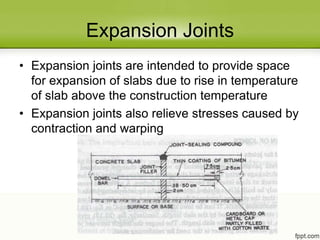
• Expansion joints are intended to provide space
for expansion of slabs due to rise in temperature
of slab above the construction temperature
• Expansion joints also relieve stresses caused by
contraction and warping
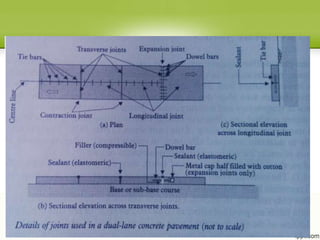
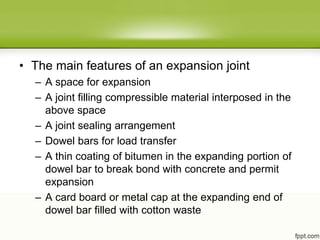
• The main features of an expansion joint
– A space for expansion
– A joint filling compressible material interposed in the
above space
– A joint sealing arrangement
– Dowel bars for load transfer
– A thin coating of bitumen in the expanding portion of
dowel bar to break bond with concrete and permit
expansion
– A card board or metal cap at the expanding end of
dowel bar filled with cotton waste
Contraction Joints
• When temperature of slab falls below the laying
temperature, slab contracts
• If long length of slab is laid, contraction induces
tensile stresses and slab cracks
• If contraction joints are provided at suitable
intervals transversely, cracks at places other
than the joints can be avoided
• Contraction joints also relieve warping stresses
to some extend
• These joints are placed closer than expansion
joints
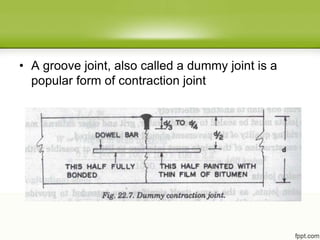
• A groove joint, also called a dummy joint is a
popular form of contraction joint
• The main features of contraction joint are
– A surface groove formed by driving a flat metal plate
when concrete is green. It is not less than 6 mm wide
and has a depth equal to 1/3 rd to ¼ th the depth of
pavement
– A sealing compound to prevent ingress of external
material
– A dowel bar arrangement to adequately transfer load
across joint. This is dispensed with if aggregate
interlock is able to transfer the load
Construction Joint
• A construction joint is necessary when work has
to be stopped at a point where there would be
otherwise no other joint
• A groove in the joint with a sealing compond is
desirable
• Reinforcement should be provided across the
joint
• It is advisable to plan a day’s work such that the
works stops at a contarction or expansion joint
such that separate construction joints can be
avoided
Longitudinal Joints
• When pavement width is more than 4.5 m, it is
necessary to provide longitudinal joint
• However as the lane width of pavements are
generally 3.5 m to 3.75 m, longitudinal joints are
provided between each traffic lane
• These joints mainly responsible for relieving
warping stresses
• To aid load transfer, tie bars are often used
across longitudinal joints. Tie bars are thinner
than dowels, and use deformed reinforcing bars
rather than smooth dowel bars.
Spacing of Joints
• Spacing of joints is governed by number of
factors such as
– Temperature variation
– Thickness of slab
– Amount of reinforcement provided
Spacing of expansion joints
• Spacing of expansion joint is decided based on
– maximum temperature variation expected and
– width of the joint
• Width/gap in expansion joint depends on the
length of slab
– Greater the length of slab, greater the width of gap
required for expansion
– Use of wide expansion joint gap should be avoided as
it is difficult to keep them properly filled in
– It is recommended a maximum gap width of 2.5 cm
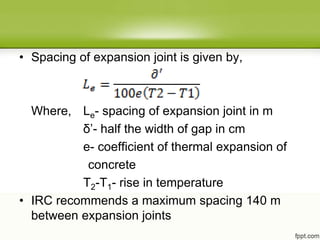
• Spacing of expansion joint is given by,
Where, Le- spacing of expansion joint in m
δ’- half the width of gap in cm
e- coefficient of thermal expansion of
concrete
T2-T1- rise in temperature
• IRC recommends a maximum spacing 140 m
between expansion joints
Spacing of Contraction Joints
• Slab contracts due to fall in temperature below
construction temperature
• Contraction also happens due to shrinkage
during initial curing period
• Contraction is resisted by the friction developed
at the interface
• Spacing of contraction joints depends on
– Coefficient of friction
– Allowable stress in in tension in cc
– Unit weight of concrete
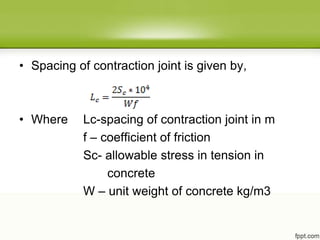
• Spacing of contraction joint is given by,
• Where Lc-spacing of contraction joint in m
f – coefficient of friction
Sc- allowable stress in tension in
concrete
W – unit weight of concrete kg/m3
• Spacing of contraction joint, when reinforcement
is provided
– It is assumed that the reinforcement takes the entire
tensile force in the slab caused by frictional resistance
of interface
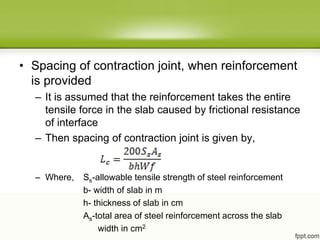
– Then spacing of contraction joint is given by,
– Where, Ss-allowable tensile strength of steel reinforcement
b- width of slab in m
h- thickness of slab in cm
As-total area of steel reinforcement across the slab
width in cm2

Joints in cc pavements

  • 1.
    JOINTS IN CCPAVEMENTS • Concrete slabs are subjected to volumetric changes due to temperature variations, shrinkage during setting and moisture changes • If a long slab is built without any joints, cracks may develop due this volumetric changes • A concrete pavement reasonably free from cracks can only be built if it is divided into slabs by interposing joints
  • 2.
    • Joints areprovided in cc pavements at optimal regular intervals to allow volumetric changes – Shrinkage – Contraction – Expansion – Warping in upward and downward directions
  • 3.
    Types of Joints •Based on function and purpose of joints
  • 5.
    Transverse Joints • Jointsprovided in transverse direction are called transverse joints – Expansion joints – Contraction joints – Construction joints
  • 6.
    Expansion Joints • Expansionjoints are intended to provide space for expansion of slabs due to rise in temperature of slab above the construction temperature • Expansion joints also relieve stresses caused by contraction and warping
  • 7.
    • The mainfeatures of an expansion joint – A space for expansion – A joint filling compressible material interposed in the above space – A joint sealing arrangement – Dowel bars for load transfer – A thin coating of bitumen in the expanding portion of dowel bar to break bond with concrete and permit expansion – A card board or metal cap at the expanding end of dowel bar filled with cotton waste
  • 8.
    Contraction Joints • Whentemperature of slab falls below the laying temperature, slab contracts • If long length of slab is laid, contraction induces tensile stresses and slab cracks • If contraction joints are provided at suitable intervals transversely, cracks at places other than the joints can be avoided • Contraction joints also relieve warping stresses to some extend • These joints are placed closer than expansion joints
  • 9.
    • A groovejoint, also called a dummy joint is a popular form of contraction joint
  • 10.
    • The mainfeatures of contraction joint are – A surface groove formed by driving a flat metal plate when concrete is green. It is not less than 6 mm wide and has a depth equal to 1/3 rd to ¼ th the depth of pavement – A sealing compound to prevent ingress of external material – A dowel bar arrangement to adequately transfer load across joint. This is dispensed with if aggregate interlock is able to transfer the load
  • 11.
    Construction Joint • Aconstruction joint is necessary when work has to be stopped at a point where there would be otherwise no other joint • A groove in the joint with a sealing compond is desirable • Reinforcement should be provided across the joint • It is advisable to plan a day’s work such that the works stops at a contarction or expansion joint such that separate construction joints can be avoided
  • 12.
    Longitudinal Joints • Whenpavement width is more than 4.5 m, it is necessary to provide longitudinal joint • However as the lane width of pavements are generally 3.5 m to 3.75 m, longitudinal joints are provided between each traffic lane • These joints mainly responsible for relieving warping stresses • To aid load transfer, tie bars are often used across longitudinal joints. Tie bars are thinner than dowels, and use deformed reinforcing bars rather than smooth dowel bars.
  • 13.
    Spacing of Joints •Spacing of joints is governed by number of factors such as – Temperature variation – Thickness of slab – Amount of reinforcement provided
  • 14.
    Spacing of expansionjoints • Spacing of expansion joint is decided based on – maximum temperature variation expected and – width of the joint • Width/gap in expansion joint depends on the length of slab – Greater the length of slab, greater the width of gap required for expansion – Use of wide expansion joint gap should be avoided as it is difficult to keep them properly filled in – It is recommended a maximum gap width of 2.5 cm
  • 15.
    • Spacing ofexpansion joint is given by, Where, Le- spacing of expansion joint in m δ’- half the width of gap in cm e- coefficient of thermal expansion of concrete T2-T1- rise in temperature • IRC recommends a maximum spacing 140 m between expansion joints
  • 16.
    Spacing of ContractionJoints • Slab contracts due to fall in temperature below construction temperature • Contraction also happens due to shrinkage during initial curing period • Contraction is resisted by the friction developed at the interface • Spacing of contraction joints depends on – Coefficient of friction – Allowable stress in in tension in cc – Unit weight of concrete
  • 17.
    • Spacing ofcontraction joint is given by, • Where Lc-spacing of contraction joint in m f – coefficient of friction Sc- allowable stress in tension in concrete W – unit weight of concrete kg/m3
  • 18.
    • Spacing ofcontraction joint, when reinforcement is provided – It is assumed that the reinforcement takes the entire tensile force in the slab caused by frictional resistance of interface – Then spacing of contraction joint is given by, – Where, Ss-allowable tensile strength of steel reinforcement b- width of slab in m h- thickness of slab in cm As-total area of steel reinforcement across the slab width in cm2