Case Study On Settlement Of
Foundation
Geotechnical Engineering - II
 
• PREPRADE BY
RADADIYA JAY 14SOECV11041
VASOYA DIVAYESH 14SOECV11054
SOJITRA FENIL 14SOECV11049
VAZA GAUTAM 14SOECV11055
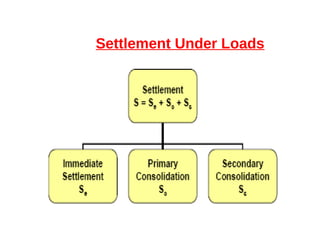
Settlement Under Loads
IMMEDIATE SETTLEMENT OR
ELASTIC SETTLEMENT
• Occurs immediately after the construction of structure.
• Also known as ‘Distortion Settlement’, it occurs due to distortion in
foundation soil.
• Although its not truly elastic, it is computed using elasticity theory. It is
denoted by Si.
PRIMARY CONSOLIDATION:OR
CONSOLIDATION SETTLRMENT
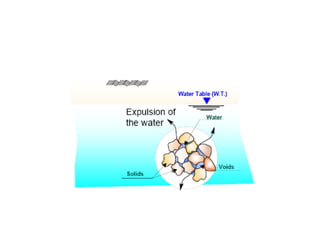
• Occurs due to gradual dissipation of pore pressure induced by external
loading and consequently expulsion of water from the soil mass, hence
volume change.
• Important for Inorganic clays. This component is determined using
Terzaghi’s theory of consolidation.
• It is denoted as Sc.
Secondary Consolidation Settlement
• This settlement occurs after completion of the primary consolidation
• Occurs at constant settlement effective stress with volume change due to
rearrangement of particles.
• This component of the settlement is due to secondary consolidation. It is
significant for organic soils.
• Determined from the coefficient of secondary consolidation. Denoted as
Ss.
• For any of the mentioned settlement calculations, we first need vertical
stress increase in soil mass due to net load applied on the foundation.
• The total settlement (S) is given as S = Ss + Sc + Si
Settlement Due To Other Causes
• Underground erosion may cause formation of cavities in the subsoil
which when collapse cause settlement.
• Structural collapse of soil may cause to dissolution of material responsible
for the inter-granular bond of grains.
• Temperature change causes shrinkage in expansive soils due to which
settlement occurs.
• Frost heave occurs if the structure is not founded below the depth of
frost penetration. When thaw occurs, settlement occurs.
• Vibrations and Shocks cause large settlement, especially in loose and
cohesion less soils.
• Mining subsidence of ground may occur due to removal of minerals and
other materials from mines below.
Foundations Loading :
1. Dead load
2. Live load
3. Wind load
4. Snow load
5. Earth pressure
6. Water pressure
7. Earthquake load
•Dead load :
• The dead load include the weight of materials permanently fixed to
the structure, such as beam, column, floors , walls and fixed service
equipment.
• Can be calculated if sizes and types of structural materials are known.
• There is a problem in estimating the self weight of the structure
because self weight is initially assumed and the structure is designed.
• Then weight is calculated from the designed dimension and compared
with the assumed weight.
• Live load :
• The live loads are the movable loads that are not permanently
attached to the structure.
• These loads are applied during a part of its useful life.
• Loads due to people, goods, furniture, equipment etc. are considered
in live loads.
• It is difficult to estimate the live load accurately. These are specified by
local building codes.
• Wind Load :
• Wind loads acts on all exposed surfaces of the structure.
• This loads depends on the velocity of wind and type of the structure.
• Wind loads are specified by building codes.
• Snow Loads :
• Snow loads are occur due to accumulation of snow on roofs and
exterior flat surfaces in cold climates.
• The unit weight of snow load is usually taken as 1kN/sq m
• Earth pressure :
• Earth pressure produce lateral force against the structure below the
ground surface or fill surface.
• The earth pressure is normally treated as dead load.
• Water pressure :
• Like earth pressure water, water pressure also produces a lateral force
against the structure below the water level.
• Earthquake pressure :
• The force due to earthquake may be vertical, lateral or tensional on a
structure in any direction.
Computation of Design Loads :
• Dead load and live load are computed by tributary area method.
• In tributary area method, it is assumed that a column carries all the
load in the floor area enclosed by lines equidistant from its adjacent
columns.
• Live loads are temporary and transient. A part of it may act for a
duration that may induced settlement, especially for cohesive soil.
• Live loads are referred from is-875.
• It is assumed that wind load and earthquake load do not act
simultaneously.
• According to is 1904-1978 foundation should be proportioned for the
combination
dead load + live load and
Dead load + live load + wind load or seismic load
• If the wind load is less than 25% of the total dead load + live load, then it
may be neglected and it is designed for the combination of dead load and
live load only.
• The foundation pressure should not the exceed the safe bearing capacity
by more than 25% for the combination of dead load, live load and wind
load.
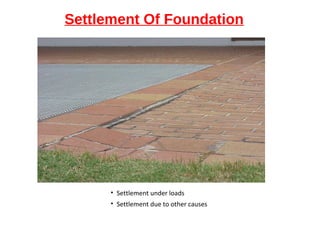
Settlement Of Foundation
• Settlement under loads
• Settlement due to other causes
CONCLUSION
• FORM THIS CASE STUDY WE CAN CONCLUDE THAT ALL THE FACTOR
RELATED TO SETTLEMENET OF FOUNDATION ARE CONSIDERED.
• ALL LOAD CALCULATE AND AFTER START THE UPWOED CONSTRUCTION.
References
• R.K.ARRORA
• B.C. PUNAMIA
• PROF. RETHALIYA
case study on settlement of foundation

case study on settlement of foundation

  • 1.
    Case Study OnSettlement Of Foundation Geotechnical Engineering - II   • PREPRADE BY RADADIYA JAY 14SOECV11041 VASOYA DIVAYESH 14SOECV11054 SOJITRA FENIL 14SOECV11049 VAZA GAUTAM 14SOECV11055
  • 2.
  • 3.
    IMMEDIATE SETTLEMENT OR ELASTICSETTLEMENT • Occurs immediately after the construction of structure. • Also known as ‘Distortion Settlement’, it occurs due to distortion in foundation soil. • Although its not truly elastic, it is computed using elasticity theory. It is denoted by Si.
  • 4.
    PRIMARY CONSOLIDATION:OR CONSOLIDATION SETTLRMENT •Occurs due to gradual dissipation of pore pressure induced by external loading and consequently expulsion of water from the soil mass, hence volume change. • Important for Inorganic clays. This component is determined using Terzaghi’s theory of consolidation. • It is denoted as Sc.
  • 6.
    Secondary Consolidation Settlement •This settlement occurs after completion of the primary consolidation • Occurs at constant settlement effective stress with volume change due to rearrangement of particles. • This component of the settlement is due to secondary consolidation. It is significant for organic soils. • Determined from the coefficient of secondary consolidation. Denoted as Ss. • For any of the mentioned settlement calculations, we first need vertical stress increase in soil mass due to net load applied on the foundation. • The total settlement (S) is given as S = Ss + Sc + Si
  • 7.
    Settlement Due ToOther Causes • Underground erosion may cause formation of cavities in the subsoil which when collapse cause settlement. • Structural collapse of soil may cause to dissolution of material responsible for the inter-granular bond of grains. • Temperature change causes shrinkage in expansive soils due to which settlement occurs. • Frost heave occurs if the structure is not founded below the depth of frost penetration. When thaw occurs, settlement occurs. • Vibrations and Shocks cause large settlement, especially in loose and cohesion less soils. • Mining subsidence of ground may occur due to removal of minerals and other materials from mines below.
  • 8.
    Foundations Loading : 1.Dead load 2. Live load 3. Wind load 4. Snow load 5. Earth pressure 6. Water pressure 7. Earthquake load
  • 9.
    •Dead load : •The dead load include the weight of materials permanently fixed to the structure, such as beam, column, floors , walls and fixed service equipment. • Can be calculated if sizes and types of structural materials are known. • There is a problem in estimating the self weight of the structure because self weight is initially assumed and the structure is designed. • Then weight is calculated from the designed dimension and compared with the assumed weight.
  • 10.
    • Live load: • The live loads are the movable loads that are not permanently attached to the structure. • These loads are applied during a part of its useful life. • Loads due to people, goods, furniture, equipment etc. are considered in live loads. • It is difficult to estimate the live load accurately. These are specified by local building codes.
  • 11.
    • Wind Load: • Wind loads acts on all exposed surfaces of the structure. • This loads depends on the velocity of wind and type of the structure. • Wind loads are specified by building codes. • Snow Loads : • Snow loads are occur due to accumulation of snow on roofs and exterior flat surfaces in cold climates. • The unit weight of snow load is usually taken as 1kN/sq m
  • 12.
    • Earth pressure: • Earth pressure produce lateral force against the structure below the ground surface or fill surface. • The earth pressure is normally treated as dead load. • Water pressure : • Like earth pressure water, water pressure also produces a lateral force against the structure below the water level. • Earthquake pressure : • The force due to earthquake may be vertical, lateral or tensional on a structure in any direction.
  • 13.
    Computation of DesignLoads : • Dead load and live load are computed by tributary area method. • In tributary area method, it is assumed that a column carries all the load in the floor area enclosed by lines equidistant from its adjacent columns. • Live loads are temporary and transient. A part of it may act for a duration that may induced settlement, especially for cohesive soil. • Live loads are referred from is-875.
  • 14.
    • It isassumed that wind load and earthquake load do not act simultaneously. • According to is 1904-1978 foundation should be proportioned for the combination dead load + live load and Dead load + live load + wind load or seismic load • If the wind load is less than 25% of the total dead load + live load, then it may be neglected and it is designed for the combination of dead load and live load only. • The foundation pressure should not the exceed the safe bearing capacity by more than 25% for the combination of dead load, live load and wind load.
  • 15.
    Settlement Of Foundation •Settlement under loads • Settlement due to other causes
  • 16.
    CONCLUSION • FORM THISCASE STUDY WE CAN CONCLUDE THAT ALL THE FACTOR RELATED TO SETTLEMENET OF FOUNDATION ARE CONSIDERED. • ALL LOAD CALCULATE AND AFTER START THE UPWOED CONSTRUCTION.
  • 17.
    References • R.K.ARRORA • B.C.PUNAMIA • PROF. RETHALIYA