INTRODUCTION TO COMPACTION
EFFECTS OF COMPACTION ON SOIL
PROPERTIES
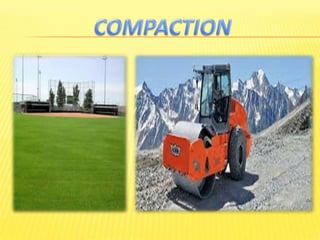
Compaction means pressing of the soil particles
close to each other by mechanical methods.
Air is expelled from soil mass and mass density is
increased.
It is done to improve the engineering properties
Like shear strength, stability etc…
Reduces compressibility and permeability.
Now we will discuss about effects of compaction
on the properties of soil. The following properties
are effected…
1) Soil structure
2) Permeability
3) Swelling
4) Pore Water Pressure
5) Shrinkage
6) Compressibility
7) Stress-Strain Relationship
8) Shear Strength
a) Shear strength at moulded water content
b) Shear strength after saturation
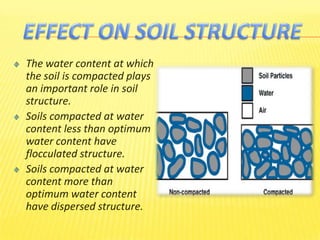
The water content at which
the soil is compacted plays
an important role in soil
structure.
Soils compacted at water
content less than optimum
water content have
flocculated structure.
Soils compacted at water
content more than
optimum water content
have dispersed structure.
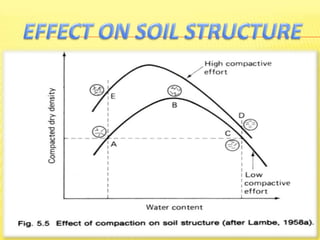
At Point A, the water content is low and
attractive forces are predominant, so results in
flocculated structure.
As the water content is increased beyond
optimum, the repulsive forces increase and
particles get oriented into a dispersed structure.
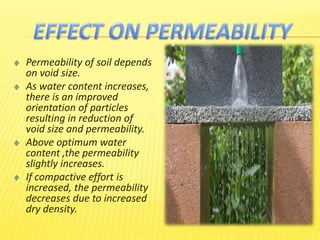
Permeability of soil depends
on void size.
As water content increases,
there is an improved
orientation of particles
resulting in reduction of
void size and permeability.
Above optimum water
content ,the permeability
slightly increases.
If compactive effort is
increased, the permeability
decreases due to increased
dry density.
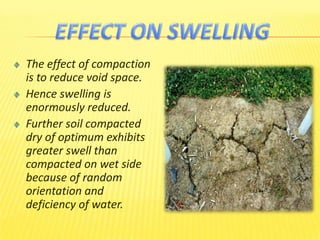
The effect of compaction
is to reduce void space.
Hence swelling is
enormously reduced.
Further soil compacted
dry of optimum exhibits
greater swell than
compacted on wet side
because of random
orientation and
deficiency of water.
It is defined as pressure of ground water held
within a rock or soil, in gaps between particles
(pores).
The pore water pressure for soil compacted dry
of optimum is therefore less than that for the
same soil compacted wet of optimum.
Soils compacted dry of optimum shrink less when
compared to compacted wet of optimum.
The soils compacted wet of optimum shrink more
because the soil particles in dispersed structure
can pack more efficiently.
The flocculated structure on the dry side of
optimum offers greater resistance to
compression than the dispersed structure on wet
side.
So, the soils compacted dry of optimum are less
compressible.
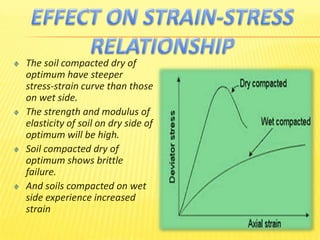
The soil compacted dry of
optimum have steeper
stress-strain curve than those
on wet side.
The strength and modulus of
elasticity of soil on dry side of
optimum will be high.
Soil compacted dry of
optimum shows brittle
failure.
And soils compacted on wet
side experience increased
strain
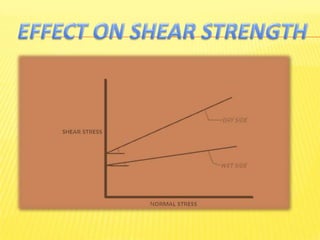
In general, the soils compacted dry of optimum
have a higher shear strength than wet of
optimum at lower strains.
However at large strains the flocculated structure
of soil is broken and ultimate strength will be
equal for both dry and wet sides.
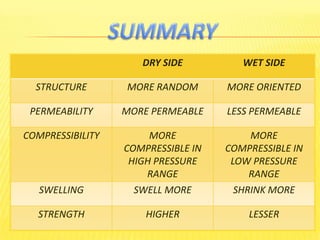
DRY SIDE WET SIDE
STRUCTURE MORE RANDOM MORE ORIENTED
PERMEABILITY MORE PERMEABLE LESS PERMEABLE
COMPRESSIBILITY MORE
COMPRESSIBLE IN
HIGH PRESSURE
RANGE
MORE
COMPRESSIBLE IN
LOW PRESSURE
RANGE
SWELLING SWELL MORE SHRINK MORE
STRENGTH HIGHER LESSER
.
BY
K.HEMANTH KUMAR
M.PREM SAI

Soil compaction and effects on soil properties

  • 2.
    INTRODUCTION TO COMPACTION EFFECTSOF COMPACTION ON SOIL PROPERTIES
  • 3.
    Compaction means pressingof the soil particles close to each other by mechanical methods. Air is expelled from soil mass and mass density is increased. It is done to improve the engineering properties Like shear strength, stability etc… Reduces compressibility and permeability.
  • 5.
    Now we willdiscuss about effects of compaction on the properties of soil. The following properties are effected… 1) Soil structure 2) Permeability 3) Swelling 4) Pore Water Pressure
  • 6.
    5) Shrinkage 6) Compressibility 7)Stress-Strain Relationship 8) Shear Strength a) Shear strength at moulded water content b) Shear strength after saturation
  • 7.
    The water contentat which the soil is compacted plays an important role in soil structure. Soils compacted at water content less than optimum water content have flocculated structure. Soils compacted at water content more than optimum water content have dispersed structure.
  • 9.
    At Point A,the water content is low and attractive forces are predominant, so results in flocculated structure. As the water content is increased beyond optimum, the repulsive forces increase and particles get oriented into a dispersed structure.
  • 10.
    Permeability of soildepends on void size. As water content increases, there is an improved orientation of particles resulting in reduction of void size and permeability. Above optimum water content ,the permeability slightly increases. If compactive effort is increased, the permeability decreases due to increased dry density.
  • 11.
    The effect ofcompaction is to reduce void space. Hence swelling is enormously reduced. Further soil compacted dry of optimum exhibits greater swell than compacted on wet side because of random orientation and deficiency of water.
  • 12.
    It is definedas pressure of ground water held within a rock or soil, in gaps between particles (pores). The pore water pressure for soil compacted dry of optimum is therefore less than that for the same soil compacted wet of optimum.
  • 13.
    Soils compacted dryof optimum shrink less when compared to compacted wet of optimum. The soils compacted wet of optimum shrink more because the soil particles in dispersed structure can pack more efficiently.
  • 14.
    The flocculated structureon the dry side of optimum offers greater resistance to compression than the dispersed structure on wet side. So, the soils compacted dry of optimum are less compressible.
  • 15.
    The soil compacteddry of optimum have steeper stress-strain curve than those on wet side. The strength and modulus of elasticity of soil on dry side of optimum will be high. Soil compacted dry of optimum shows brittle failure. And soils compacted on wet side experience increased strain
  • 16.
    In general, thesoils compacted dry of optimum have a higher shear strength than wet of optimum at lower strains. However at large strains the flocculated structure of soil is broken and ultimate strength will be equal for both dry and wet sides.
  • 18.
    DRY SIDE WETSIDE STRUCTURE MORE RANDOM MORE ORIENTED PERMEABILITY MORE PERMEABLE LESS PERMEABLE COMPRESSIBILITY MORE COMPRESSIBLE IN HIGH PRESSURE RANGE MORE COMPRESSIBLE IN LOW PRESSURE RANGE SWELLING SWELL MORE SHRINK MORE STRENGTH HIGHER LESSER
  • 19.