Supervisor: Dr.Ghazavi
Researcher: Amirmasoud Taghavi
Settlement of Shallow foundations
KNTU university of technology
Definitions
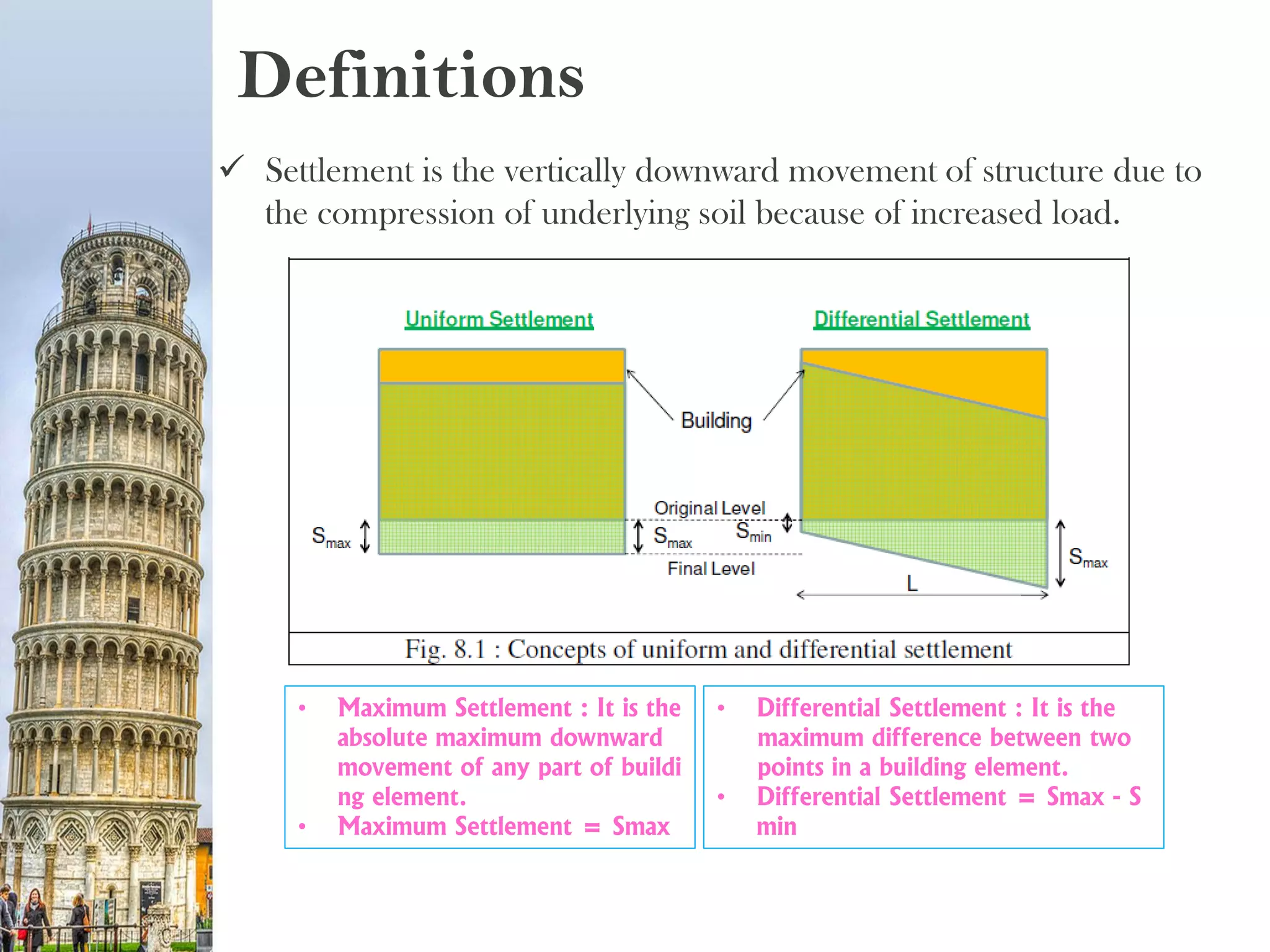
 Settlement is the vertically downward movement of structure due to
the compression of underlying soil because of increased load.
• Maximum Settlement : It is the
absolute maximum downward
movement of any part of buildi
ng element.
• Maximum Settlement = Smax
• Differential Settlement : It is the
maximum difference between two
points in a building element.
• Differential Settlement = Smax - S
min
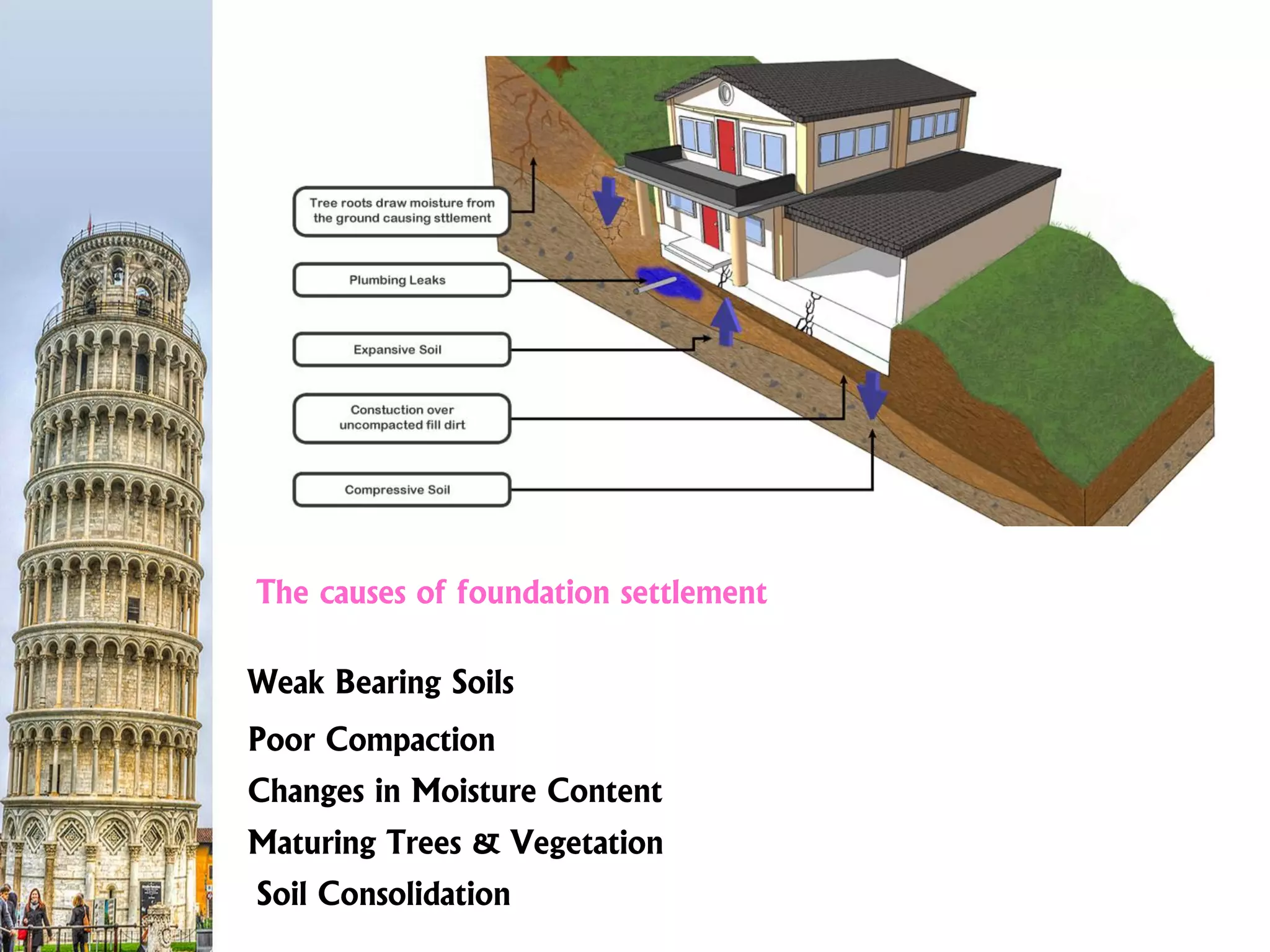
Weak Bearing Soils
Poor Compaction
Changes in Moisture Content
Maturing Trees & Vegetation
Soil Consolidation
The causes of foundation settlement
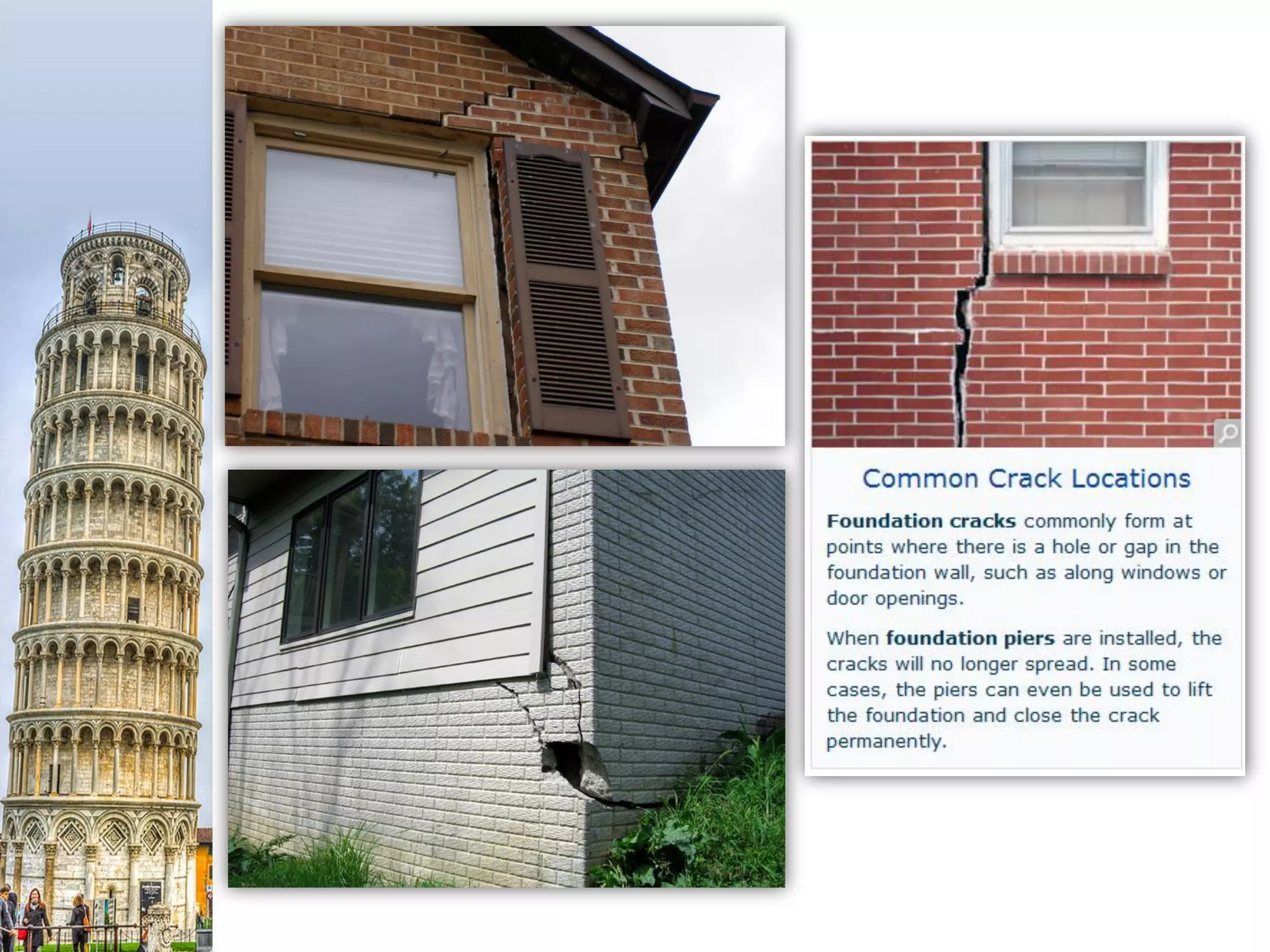
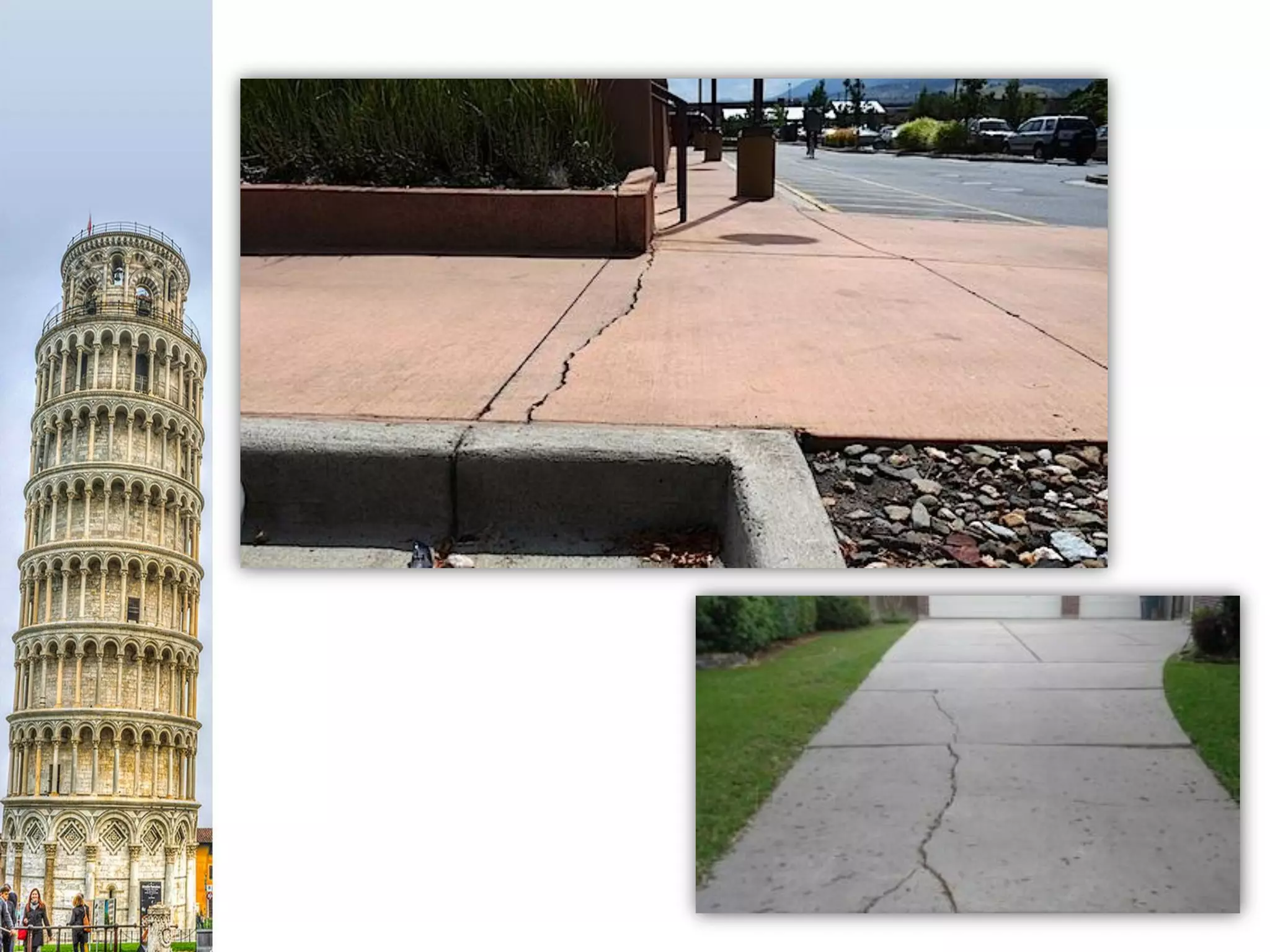
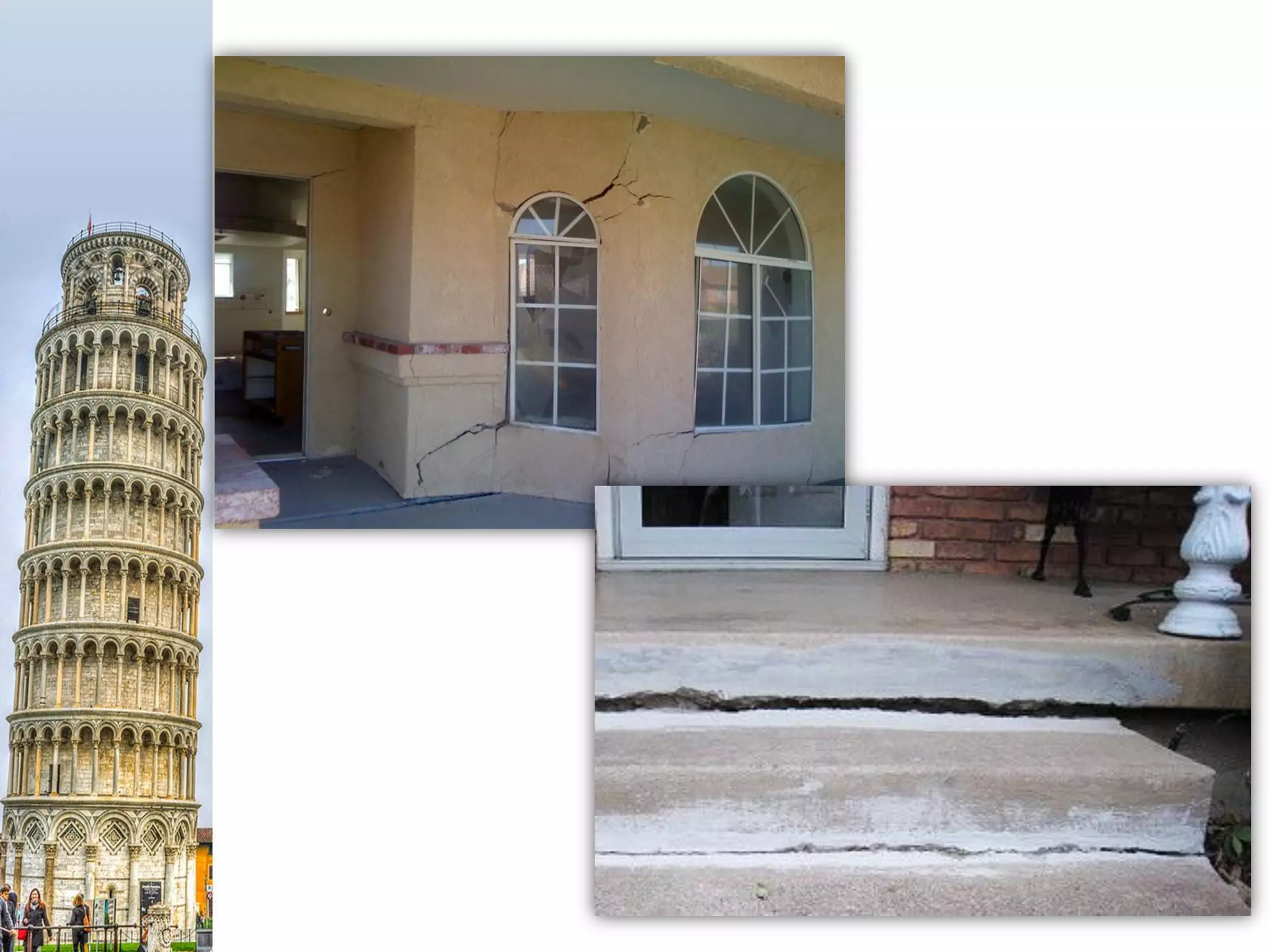
Settlement cracks tend to widen and worsen over time. As they
do, they will allow outside influences into your home, such as
cold air, humidity, rainwater, termites, rodents, and more. The
damage will have an enormous impact on the value and resale
value of your home.
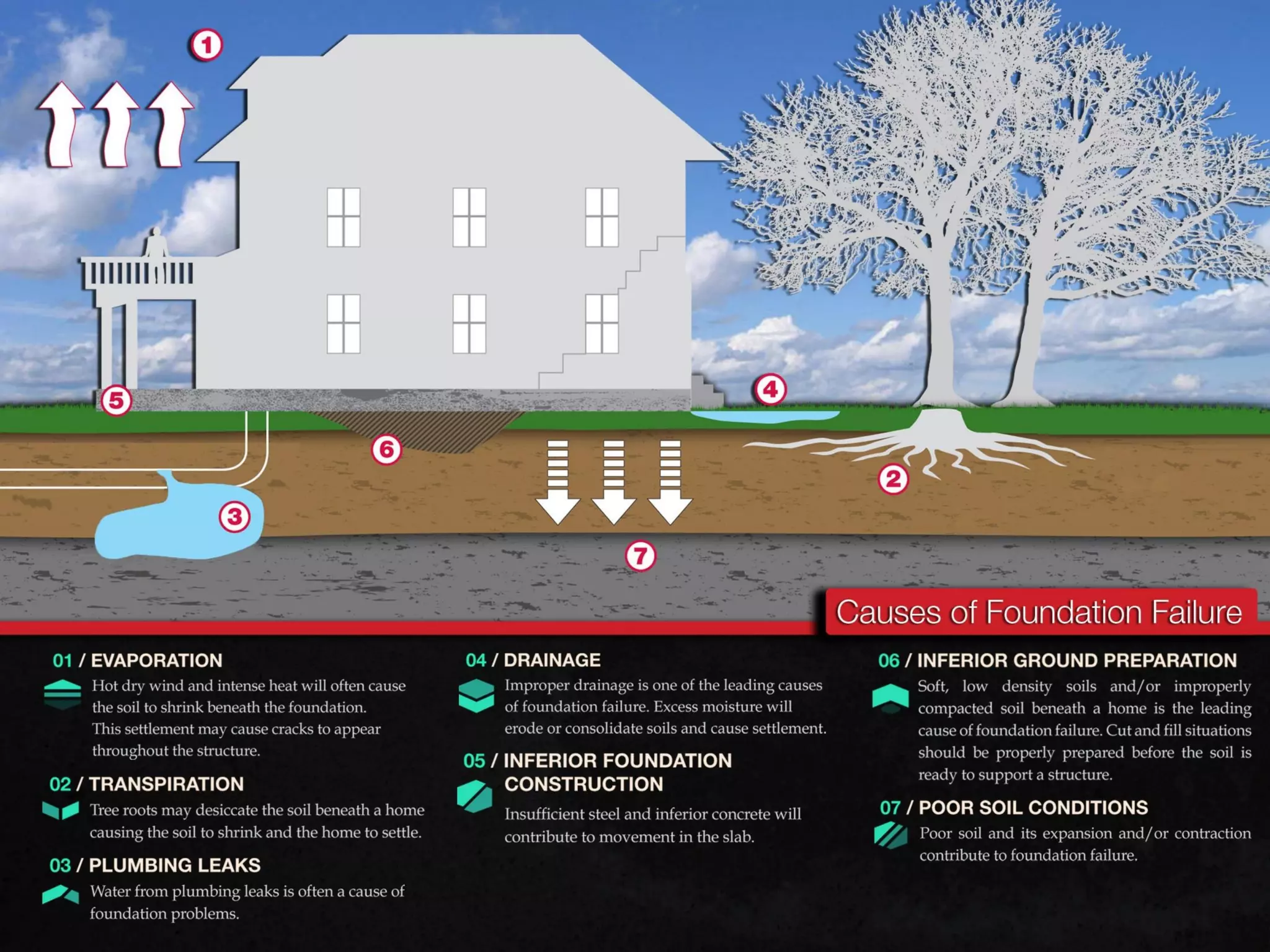
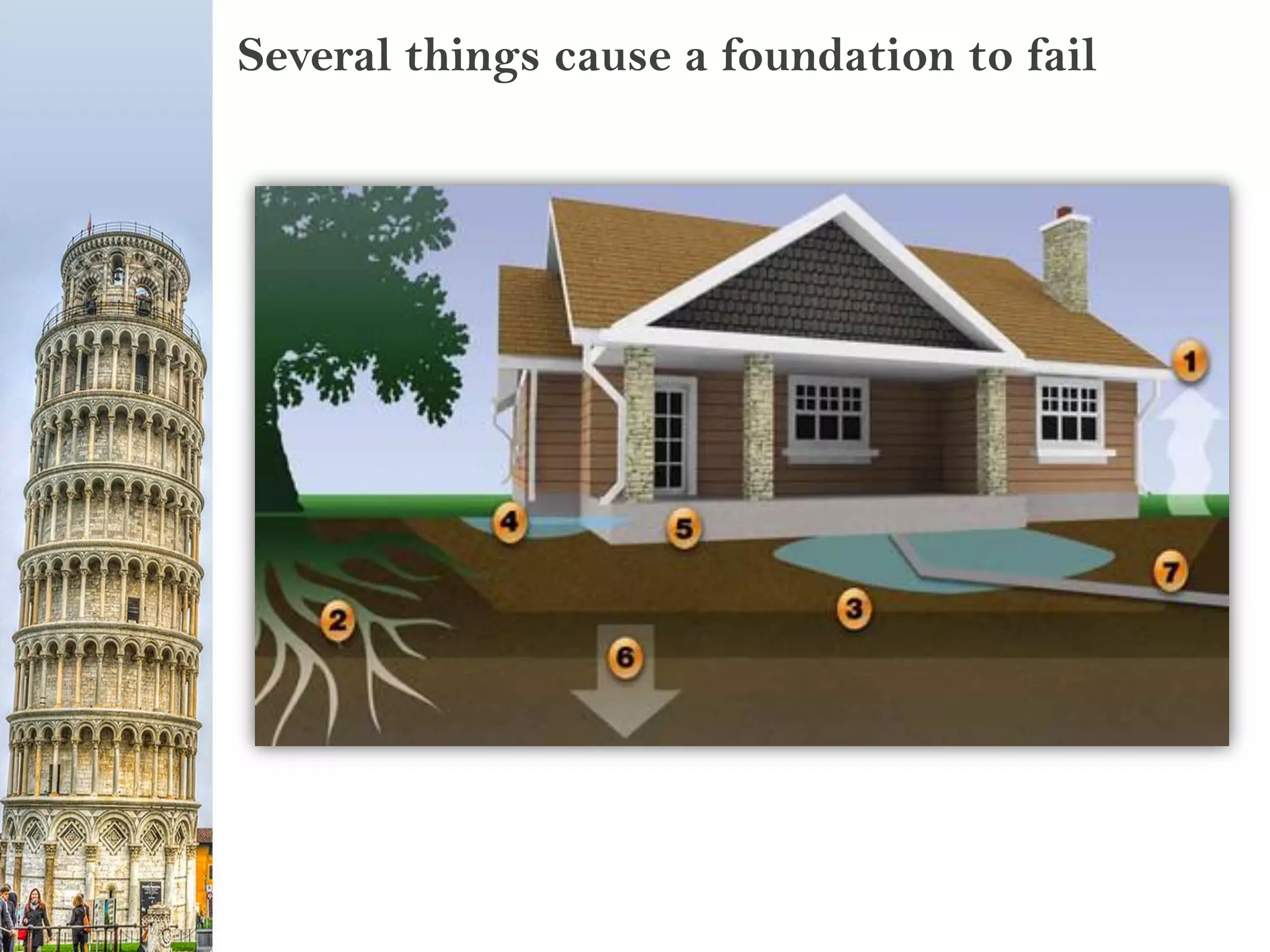
Several things cause a foundation to fail
1.Evaporation: Hot dry wind and intense heat will often
cause the soil to shrink beneath the foundation.
This settlement may cause cracks to appear throughout
the structure.
2.Transpiration: Tree roots may desiccate the soil beneath a
home causing the soil to shrink and the home to settle.
3.Plumbing Leaks: Water from plumbing leaks is often a
cause to foundation problems.
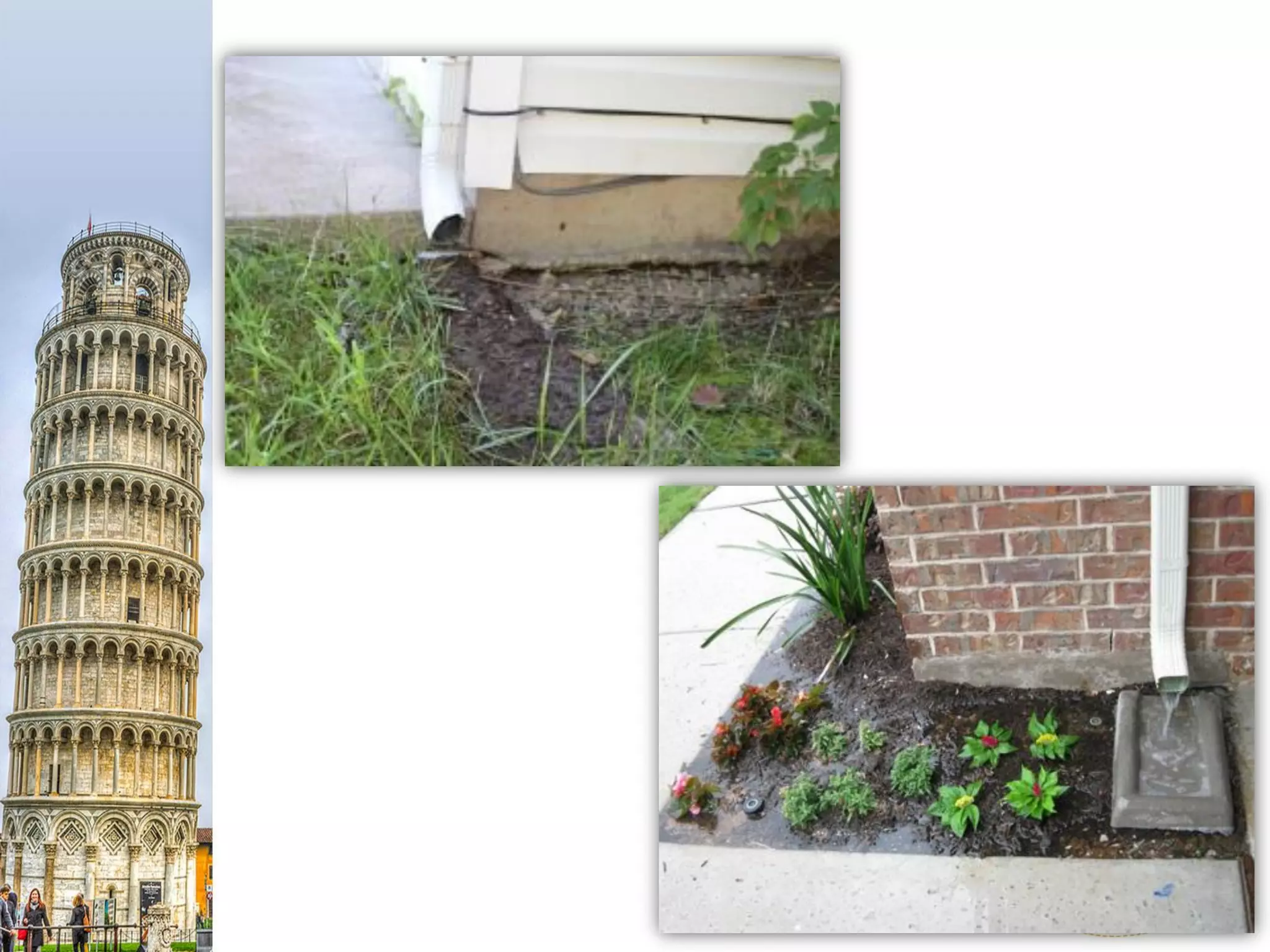
4.Drainage: Improper drainage is one of the leading causes to
foundation failure. Excess moisture will erode or consolidate
soils and cause settlement.
5.Inferior Foundation Construction: Insufficient steel and
inferior concrete will contribute to movement in the slab.
6.Inferior Ground Preparation: Soft, low density soils and/or
improperly compacted soil beneath a home is the leading
cause of foundation failure. Cut and fill methods are a leading cause of
foundation settlement.
7.Poor Soil conditions: Poor soil and its expansion and/or contraction
contribute to foundation failure.
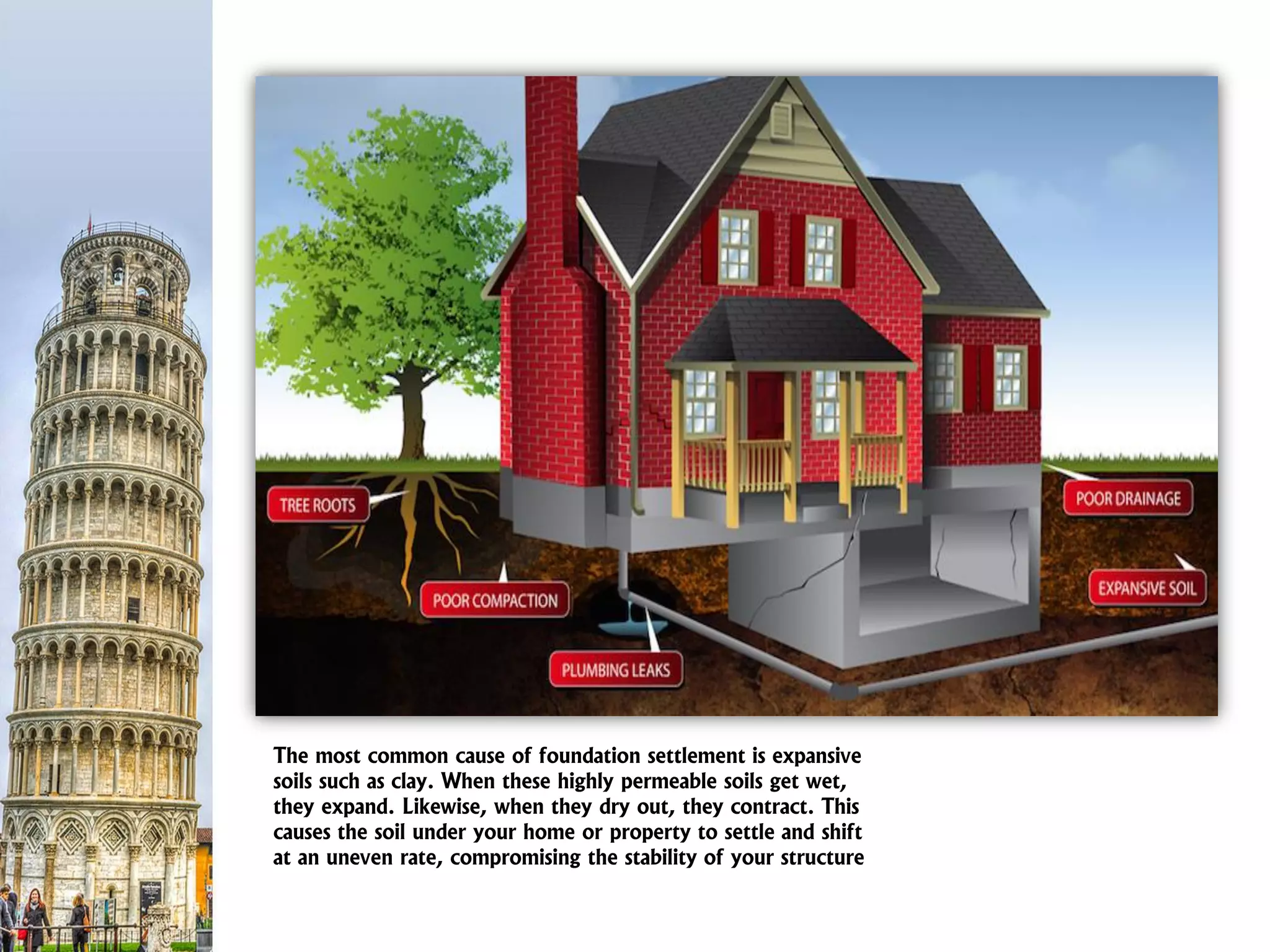
The most common cause of foundation settlement is expansive
soils such as clay. When these highly permeable soils get wet,
they expand. Likewise, when they dry out, they contract. This
causes the soil under your home or property to settle and shift
at an uneven rate, compromising the stability of your structure
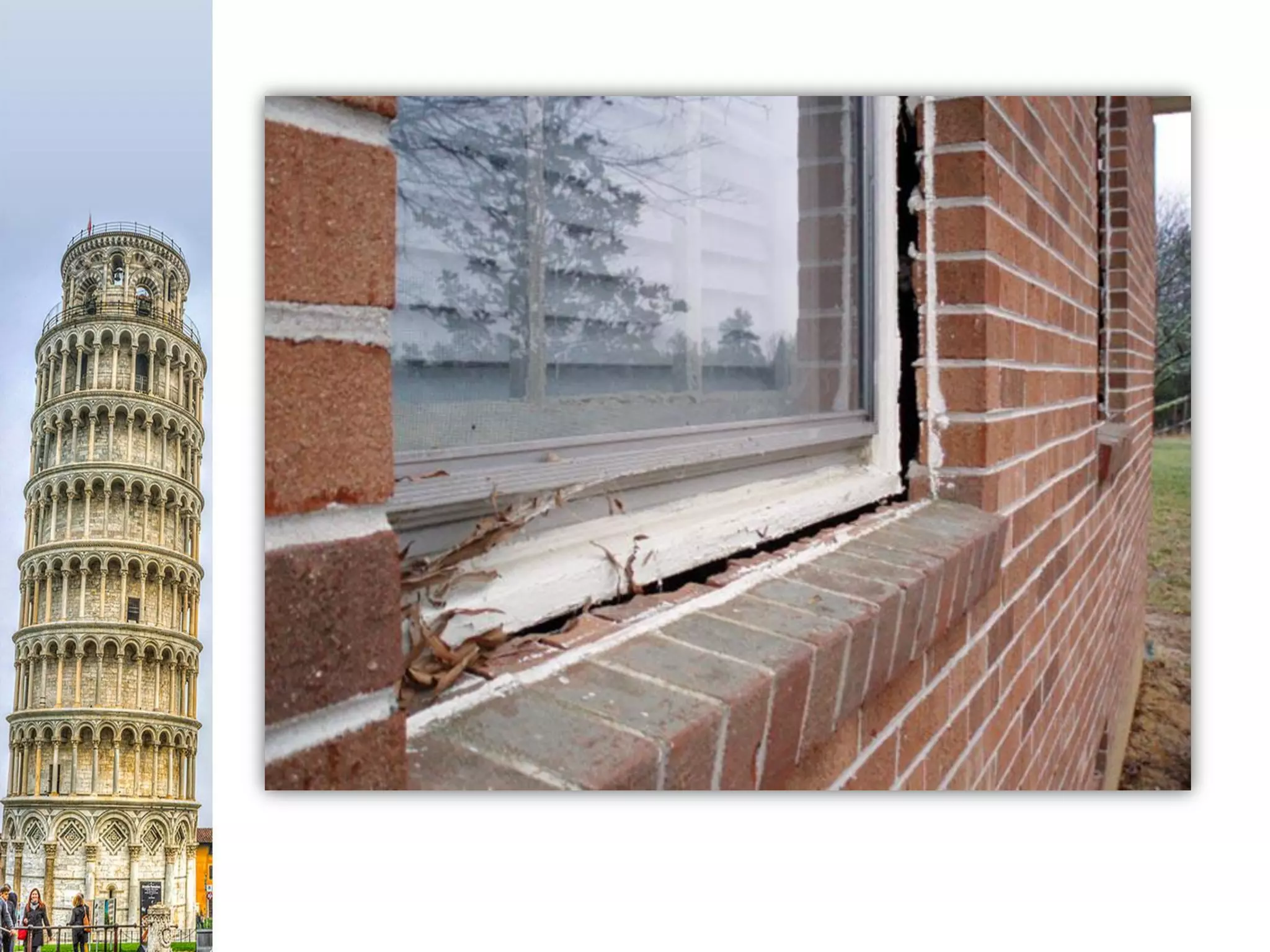
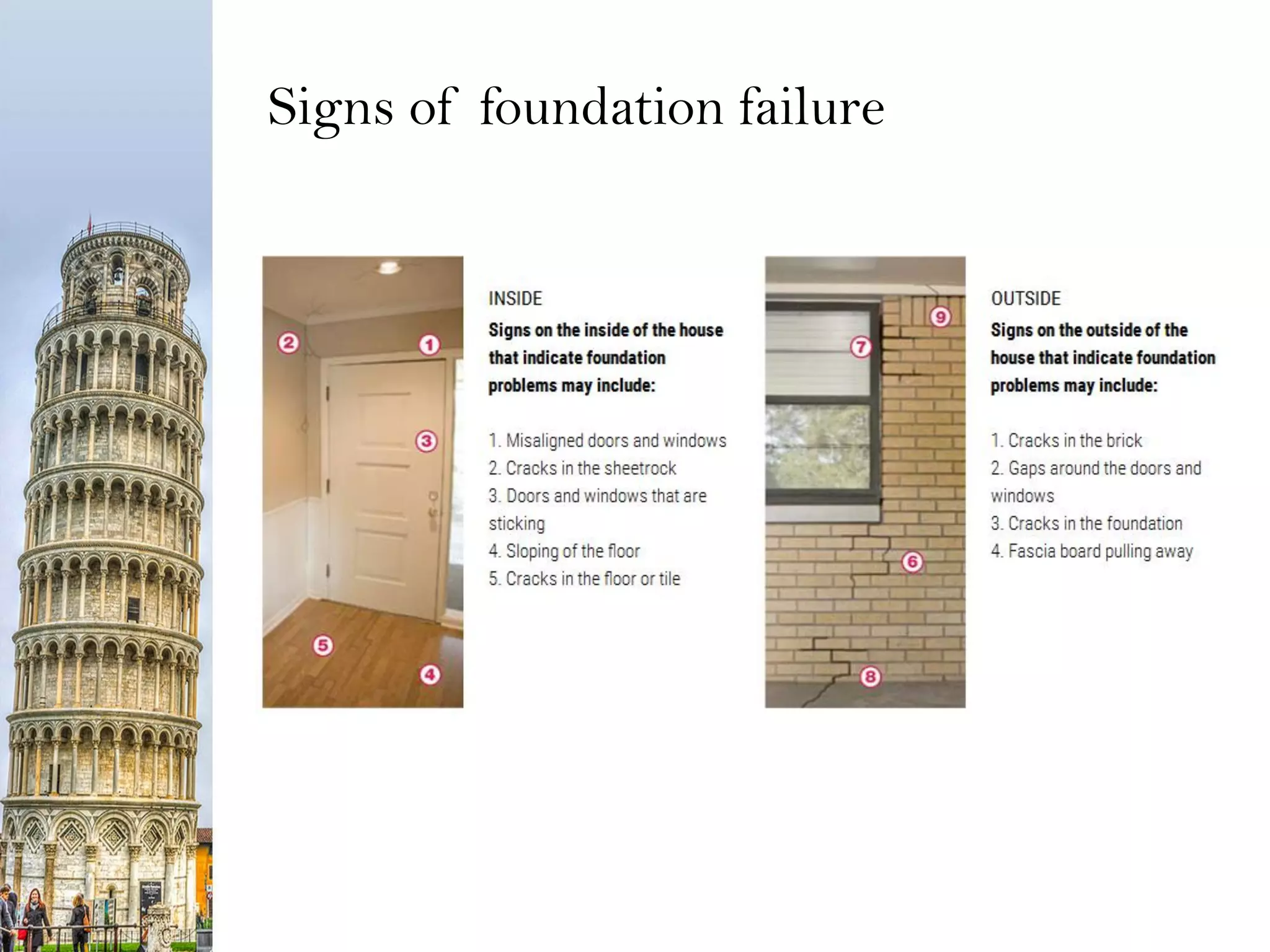
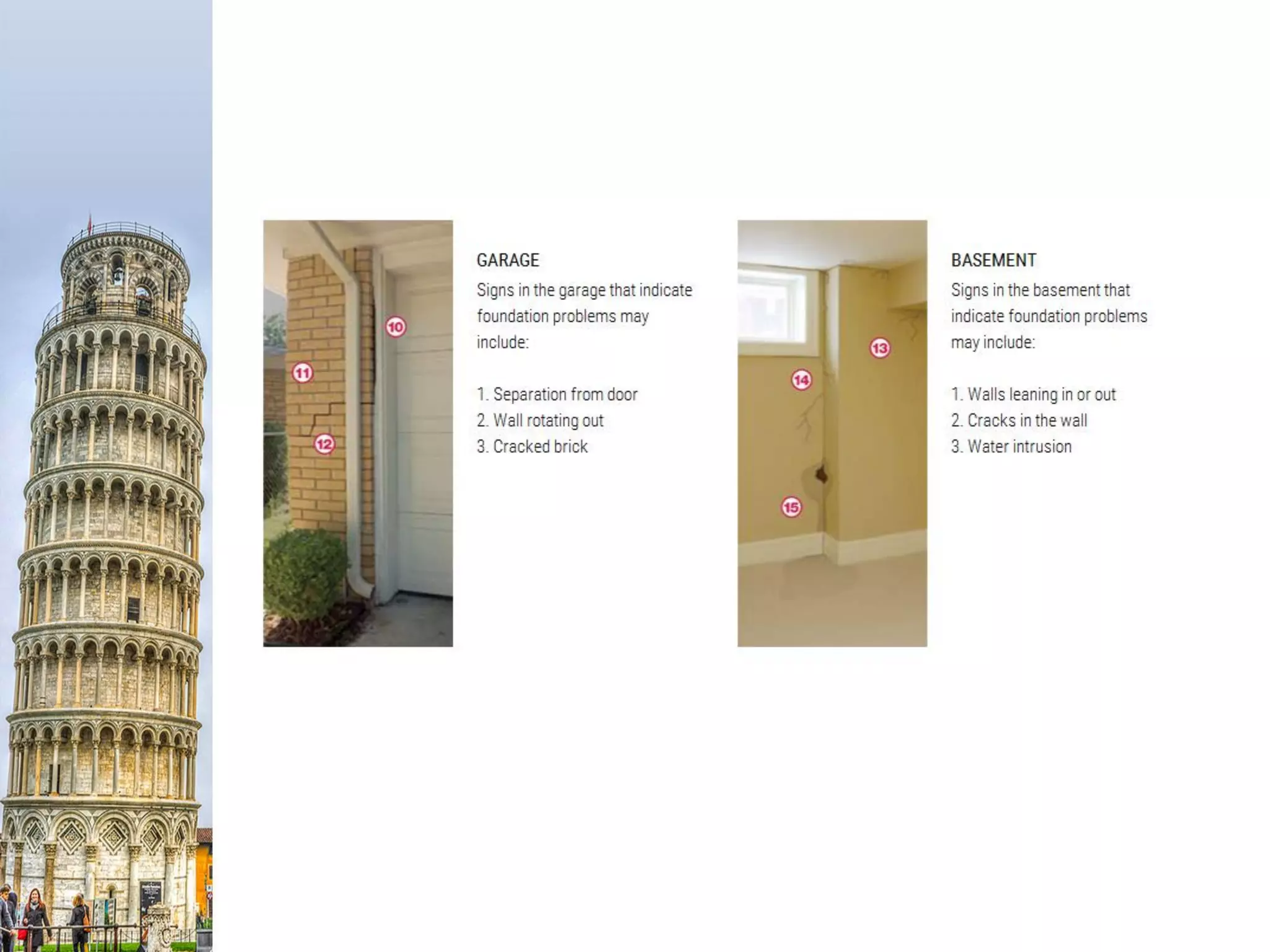
Signs of foundation failure
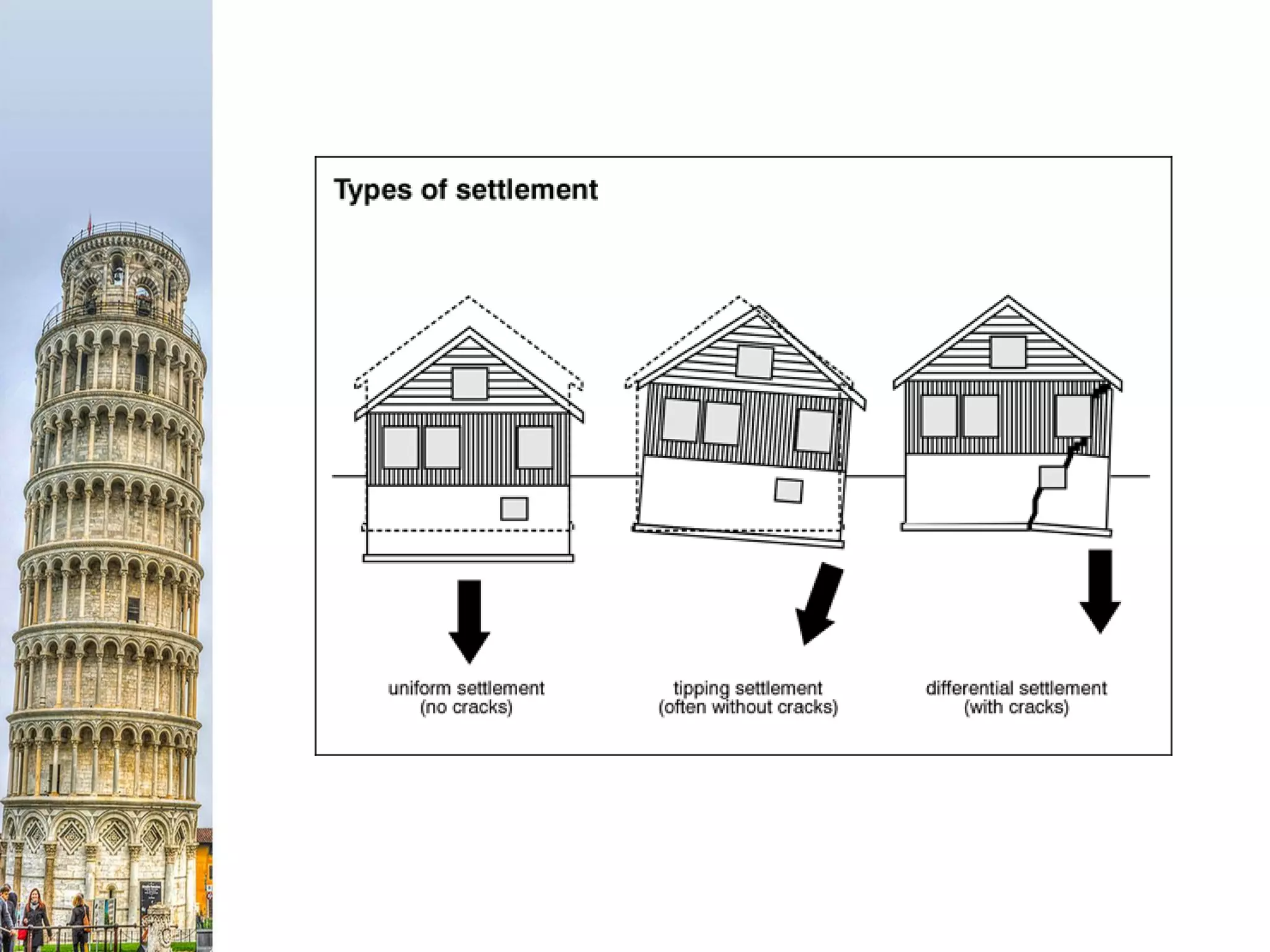
 When all parts of a building rest on the same kind of soil, and
the loads on the building and the design of its structural system
are uniform throughout, differential settlement is normally not a
concern. However where soils, loads, or structural systems differ
between parts of a building, different parts of the building structure
may settle by substantially different amounts, the frame of the
building may become distorted, floors may slope, walls and glass
may crack, and doors and windows may not work properly.
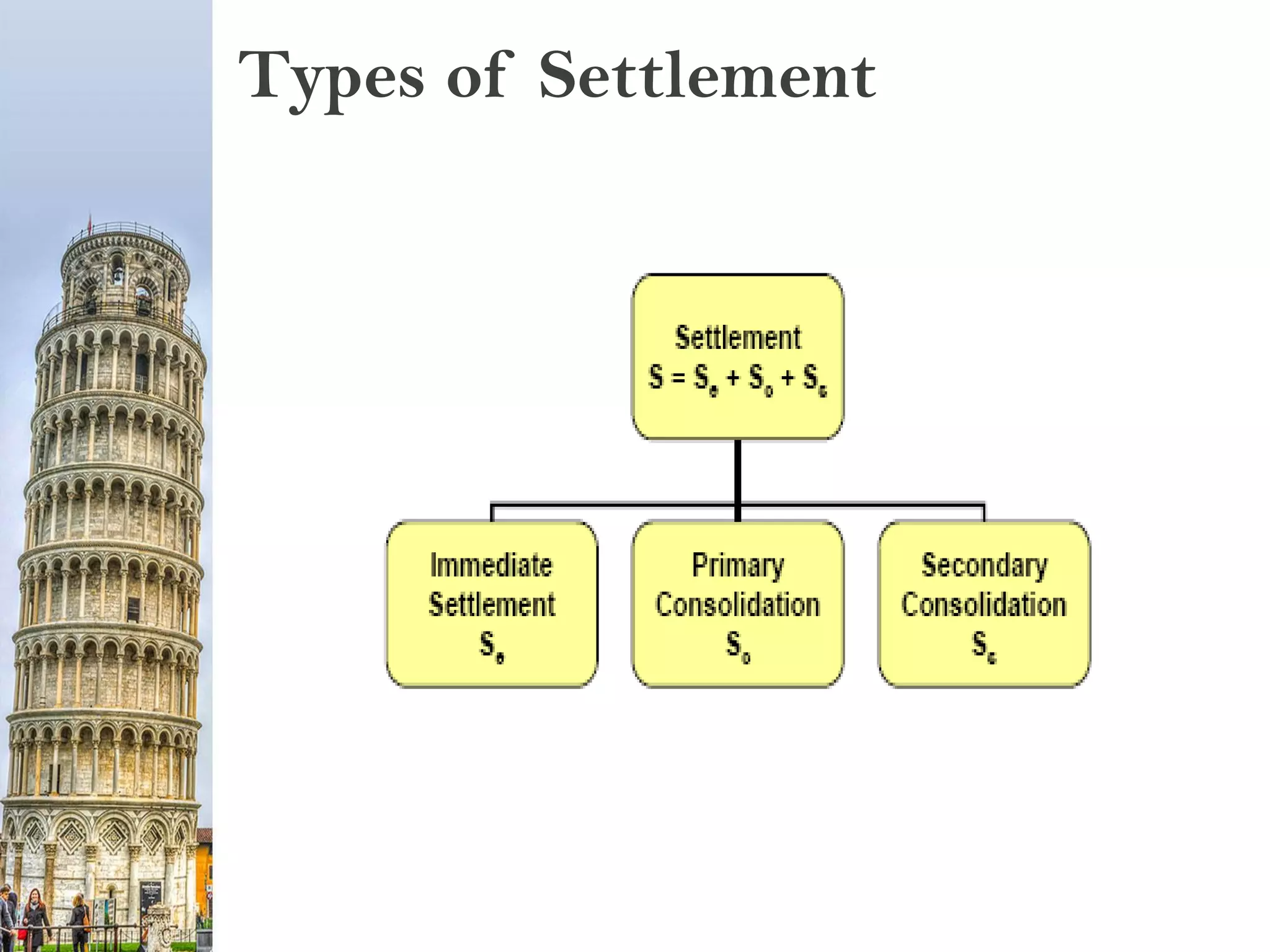
Types of Settlement
Immediate Settlement or Elastic settlement
 Occurs immediately during or after the construction of structure.
 Also known as ‘Distortion Settlement’, it occurs due to distortion in
foundation soil.
 Although its not truly elastic, it is computed using elasticity theory. It
is denoted by 𝑆𝑖.
 It occurs in all types of soil due to elastic compression.
 It occurs immediately after the application of load
 It depends on the elastic properties of foundation soil, rigidity, size
and shape of foundation.
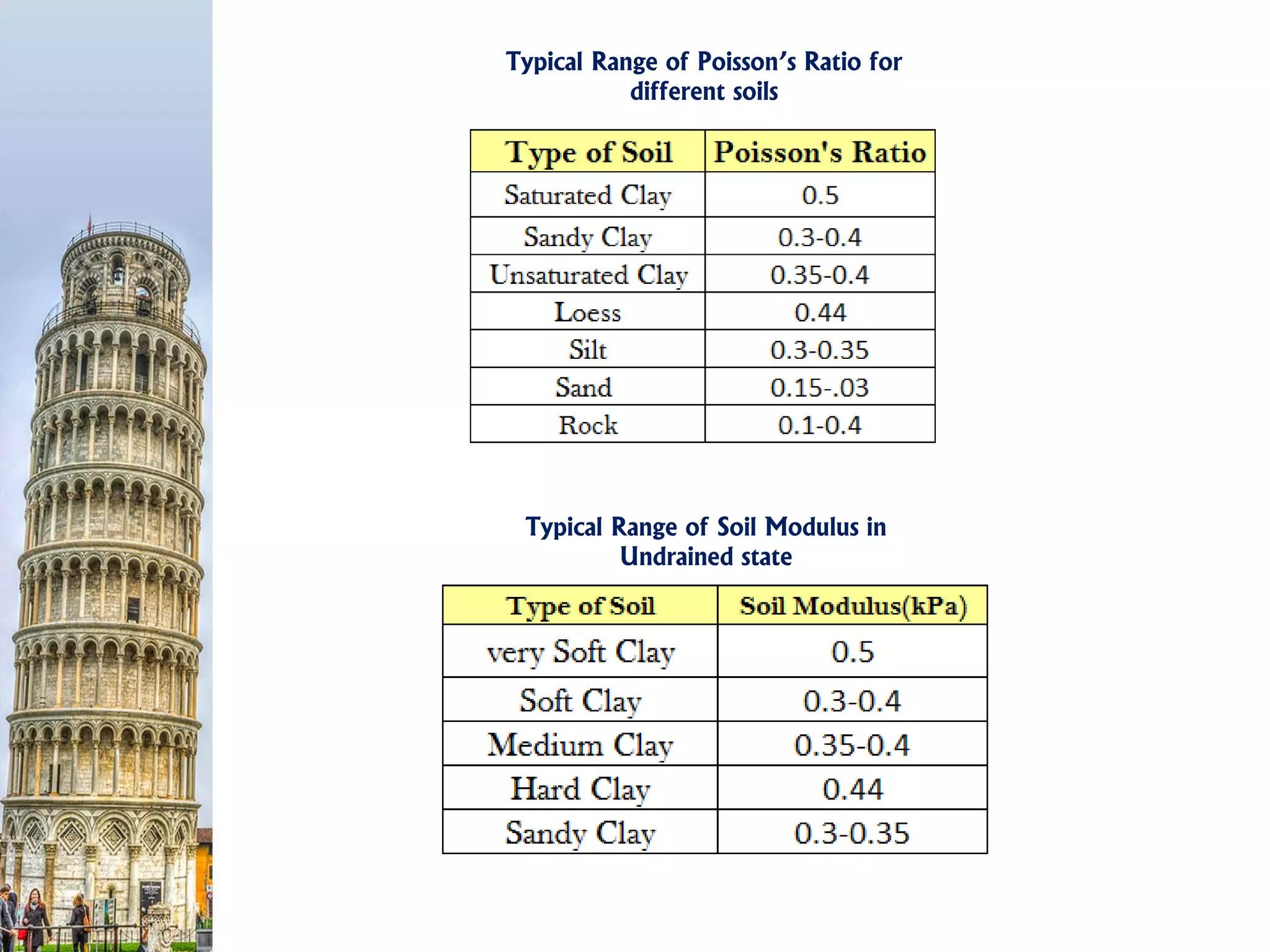
Typical Range of Poisson’s Ratio for
different soils
Typical Range of Soil Modulus in
Undrained state
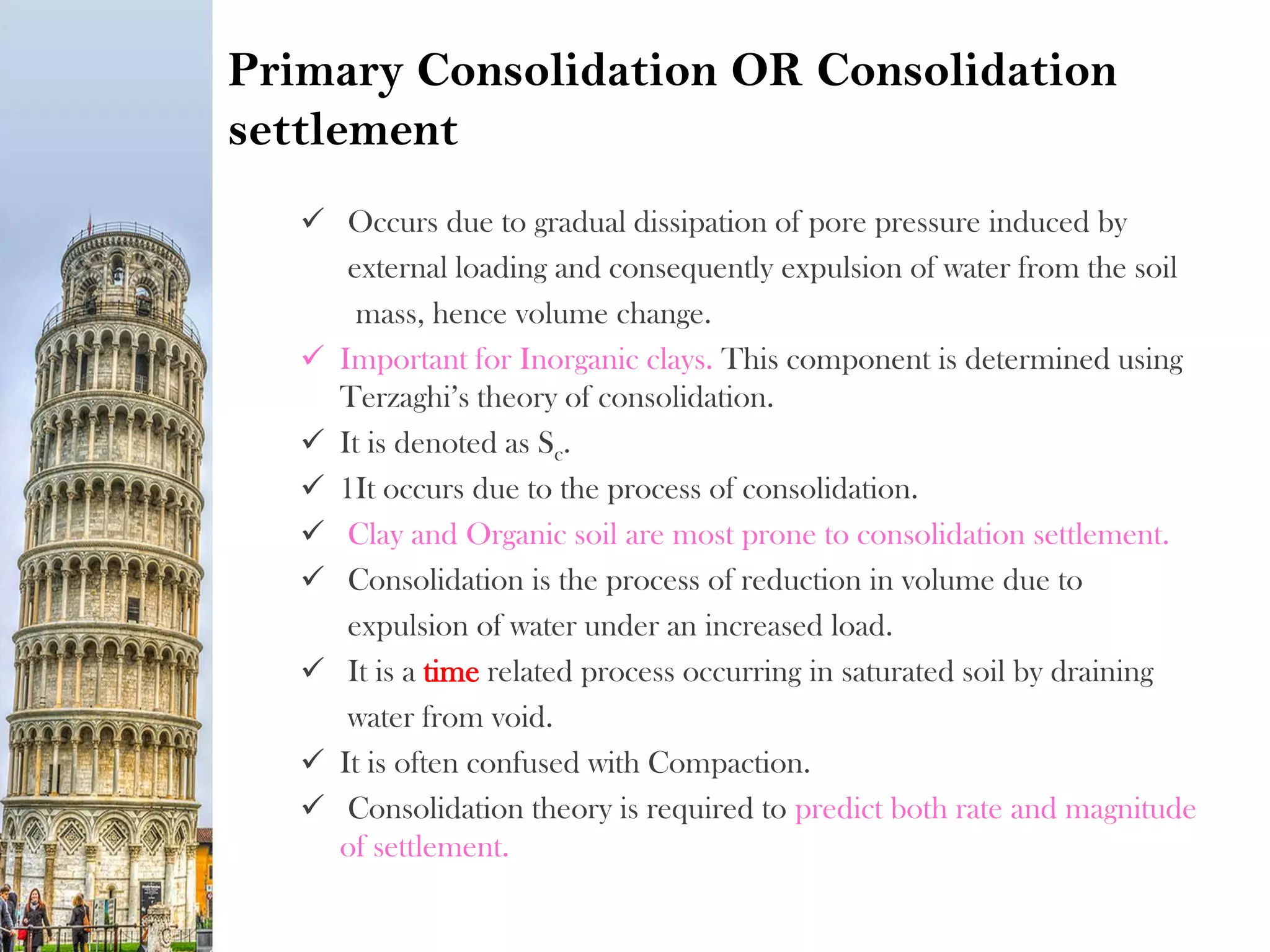
Primary Consolidation OR Consolidation
settlement
 Occurs due to gradual dissipation of pore pressure induced by
external loading and consequently expulsion of water from the soil
mass, hence volume change.
 Important for Inorganic clays. This component is determined using
Terzaghi’s theory of consolidation.
 It is denoted as Sc.
 1It occurs due to the process of consolidation.
 Clay and Organic soil are most prone to consolidation settlement.
 Consolidation is the process of reduction in volume due to
expulsion of water under an increased load.
 It is a time related process occurring in saturated soil by draining
water from void.
 It is often confused with Compaction.
 Consolidation theory is required to predict both rate and magnitude
of settlement.
Types of movement for different kind of soil’s
𝑆𝑟 > 90% → −
𝑆𝑟 < 90% → 𝑌𝑒𝑠
Stress Increase in Soil Due to Applied
Load
 For any of the mentioned settlement calculations, we first need
vertical stress increase in soil mass due to net load applied on
the foundation.
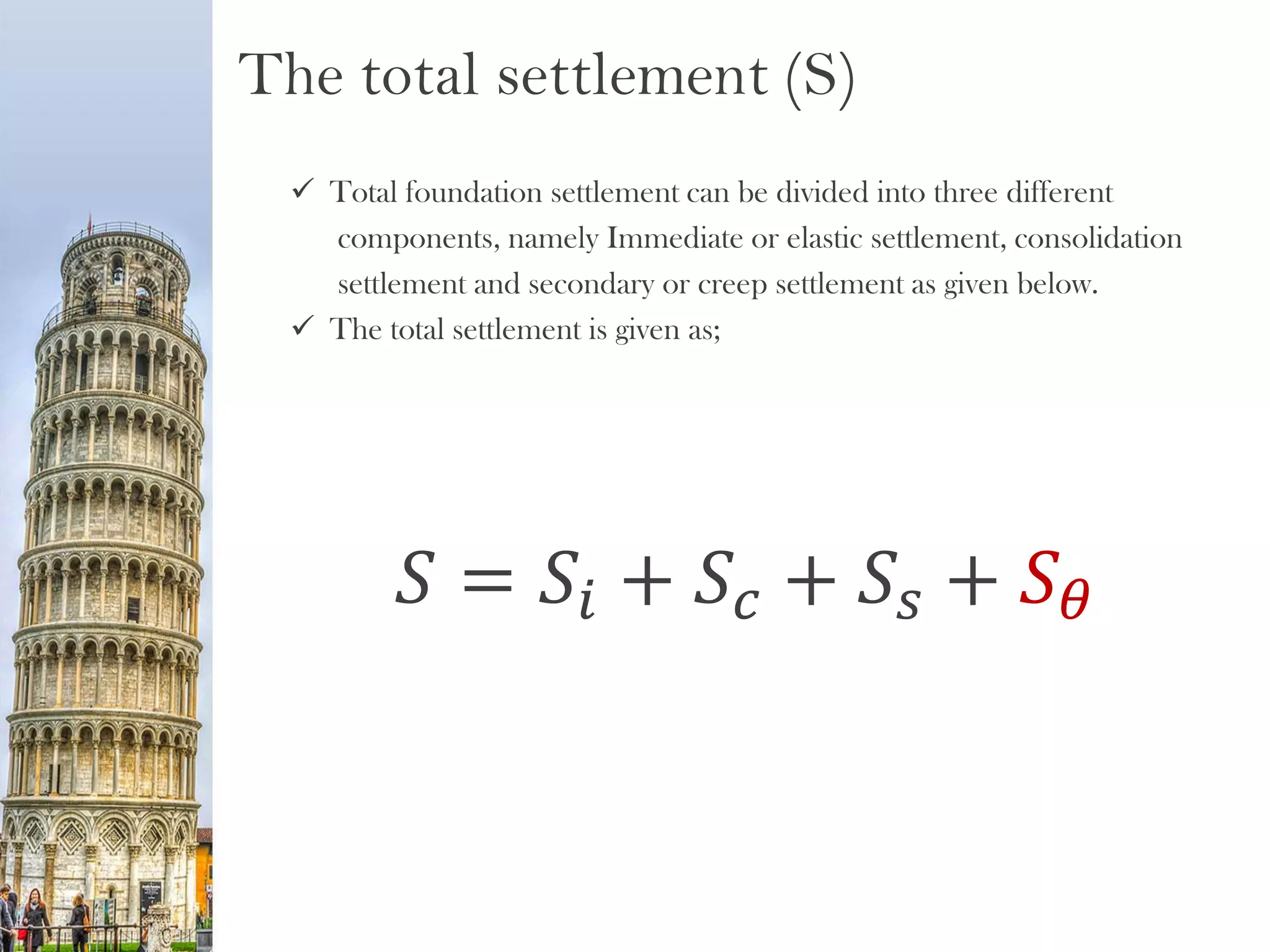
The total settlement (S)
 Total foundation settlement can be divided into three different
components, namely Immediate or elastic settlement, consolidation
settlement and secondary or creep settlement as given below.
 The total settlement is given as;
𝑆 = 𝑆𝑖 + 𝑆𝑐 + 𝑆𝑠 + 𝑆 𝜃
IMMEDIATE SETTLEMENT COMPUTATIONS
𝑆𝑖 = 𝑞0 𝐵′
1 − 𝜇2
𝐸𝑠
𝑚𝐼𝑠 𝐼 𝐹
• In practice, most foundations are flexible. Even very thick ones
deflect when loaded by the superstructure loads. Some theory
indicates that if the base is rigid the settlement will be uniform (but
may tilt), and the settlement factor Is will be about 7 percent less
than computed by Eq.
• On this basis if your base is "rigid" you should reduce the Is factor
by about 7 percent (that is, Isr=0.931Is)
𝐵 = 𝐵
2
𝐿′ = 𝐿
2
m=4
𝐵 = 𝐵
2
𝐿′ = 𝐿
m=2
𝐵 = min⁡( 𝐿
2 , 𝐵)
𝐿′ = 𝐿
2
m=4
𝐵 = 𝐵
𝐿′ = 𝐿
m=1
• least lateral dimension of contributing base ar
ea in units of ∆𝐻
B’
𝐼𝑖(𝐼𝑠, 𝐼𝑓)
• influence factors, which depend on(
𝐿′
𝐵′
)⁡ thickness of stratum ∆𝐻,
Poisson's ratio(𝜇), and base embedment Depth (𝐷 𝑓)
 𝐼𝑠 = 𝐼1 +
1−2𝜇
1−𝜇
𝐼2
𝑁 =
𝐻
𝐵′
𝑀 =
𝐿′
𝐵′
• Use linear interpolation when it needed.
 𝐼 𝐹
• Use linear interpolation when it needed.
𝑆𝑖 = 𝑞0 𝐵′
1 − 𝜇2
𝐸𝑠
𝑚𝐼𝑠 𝐼 𝐹
The equation should be used as follows
(Bowles method
1. Make your best estimate of base contact pressure (𝑞0)
2. For round bases, convert to an equivalent square.
3. Determine the point where the settlement is to be computed and divide
the base.(find B’, L’ and m)
4. Find depth actually causing settlement
𝐻 = min⁡(5𝐵⁡,⁡Depth to where a hard stratum is encountered)
5. Enter Table 5-2, obtain 𝐼1 and 𝐼2 with your best estimate for 𝜇, compute
𝐼𝑠⁡and obtain 𝐼 𝐹 from the figure.
6. Obtain the weighted average 𝐸𝑠 in the depth z = H
𝐸𝑠 𝑎𝑣𝑒
=
𝐻1 𝐸1 + 𝐻2 𝐸2 + 𝐻3 𝐸3 + ⋯ . +𝐻 𝑛 𝐸 𝑛
𝐻
7. Immediate Settlement→ 𝑆𝑖 = 𝑞0 𝐵′
1−𝜇2
𝐸𝑠
𝑚𝐼𝑠 𝐼 𝐹
THANKS
FOR YOUR
ATTENTION

Settlement of shallow foundations

  • 1.
    Supervisor: Dr.Ghazavi Researcher: AmirmasoudTaghavi Settlement of Shallow foundations KNTU university of technology
  • 2.
    Definitions  Settlement isthe vertically downward movement of structure due to the compression of underlying soil because of increased load. • Maximum Settlement : It is the absolute maximum downward movement of any part of buildi ng element. • Maximum Settlement = Smax • Differential Settlement : It is the maximum difference between two points in a building element. • Differential Settlement = Smax - S min
  • 5.
    Weak Bearing Soils PoorCompaction Changes in Moisture Content Maturing Trees & Vegetation Soil Consolidation The causes of foundation settlement
  • 6.
    Settlement cracks tendto widen and worsen over time. As they do, they will allow outside influences into your home, such as cold air, humidity, rainwater, termites, rodents, and more. The damage will have an enormous impact on the value and resale value of your home.
  • 10.
    Several things causea foundation to fail
  • 11.
    1.Evaporation: Hot drywind and intense heat will often cause the soil to shrink beneath the foundation. This settlement may cause cracks to appear throughout the structure. 2.Transpiration: Tree roots may desiccate the soil beneath a home causing the soil to shrink and the home to settle. 3.Plumbing Leaks: Water from plumbing leaks is often a cause to foundation problems. 4.Drainage: Improper drainage is one of the leading causes to foundation failure. Excess moisture will erode or consolidate soils and cause settlement. 5.Inferior Foundation Construction: Insufficient steel and inferior concrete will contribute to movement in the slab. 6.Inferior Ground Preparation: Soft, low density soils and/or improperly compacted soil beneath a home is the leading cause of foundation failure. Cut and fill methods are a leading cause of foundation settlement. 7.Poor Soil conditions: Poor soil and its expansion and/or contraction contribute to foundation failure.
  • 12.
    The most commoncause of foundation settlement is expansive soils such as clay. When these highly permeable soils get wet, they expand. Likewise, when they dry out, they contract. This causes the soil under your home or property to settle and shift at an uneven rate, compromising the stability of your structure
  • 16.
  • 18.
     When allparts of a building rest on the same kind of soil, and the loads on the building and the design of its structural system are uniform throughout, differential settlement is normally not a concern. However where soils, loads, or structural systems differ between parts of a building, different parts of the building structure may settle by substantially different amounts, the frame of the building may become distorted, floors may slope, walls and glass may crack, and doors and windows may not work properly.
  • 19.
  • 20.
    Immediate Settlement orElastic settlement  Occurs immediately during or after the construction of structure.  Also known as ‘Distortion Settlement’, it occurs due to distortion in foundation soil.  Although its not truly elastic, it is computed using elasticity theory. It is denoted by 𝑆𝑖.  It occurs in all types of soil due to elastic compression.  It occurs immediately after the application of load  It depends on the elastic properties of foundation soil, rigidity, size and shape of foundation.
  • 21.
    Typical Range ofPoisson’s Ratio for different soils Typical Range of Soil Modulus in Undrained state
  • 22.
    Primary Consolidation ORConsolidation settlement  Occurs due to gradual dissipation of pore pressure induced by external loading and consequently expulsion of water from the soil mass, hence volume change.  Important for Inorganic clays. This component is determined using Terzaghi’s theory of consolidation.  It is denoted as Sc.  1It occurs due to the process of consolidation.  Clay and Organic soil are most prone to consolidation settlement.  Consolidation is the process of reduction in volume due to expulsion of water under an increased load.  It is a time related process occurring in saturated soil by draining water from void.  It is often confused with Compaction.  Consolidation theory is required to predict both rate and magnitude of settlement.
  • 24.
    Types of movementfor different kind of soil’s 𝑆𝑟 > 90% → − 𝑆𝑟 < 90% → 𝑌𝑒𝑠
  • 25.
    Stress Increase inSoil Due to Applied Load  For any of the mentioned settlement calculations, we first need vertical stress increase in soil mass due to net load applied on the foundation.
  • 26.
    The total settlement(S)  Total foundation settlement can be divided into three different components, namely Immediate or elastic settlement, consolidation settlement and secondary or creep settlement as given below.  The total settlement is given as; 𝑆 = 𝑆𝑖 + 𝑆𝑐 + 𝑆𝑠 + 𝑆 𝜃
  • 27.
    IMMEDIATE SETTLEMENT COMPUTATIONS 𝑆𝑖= 𝑞0 𝐵′ 1 − 𝜇2 𝐸𝑠 𝑚𝐼𝑠 𝐼 𝐹 • In practice, most foundations are flexible. Even very thick ones deflect when loaded by the superstructure loads. Some theory indicates that if the base is rigid the settlement will be uniform (but may tilt), and the settlement factor Is will be about 7 percent less than computed by Eq. • On this basis if your base is "rigid" you should reduce the Is factor by about 7 percent (that is, Isr=0.931Is)
  • 28.
    𝐵 = 𝐵 2 𝐿′= 𝐿 2 m=4 𝐵 = 𝐵 2 𝐿′ = 𝐿 m=2 𝐵 = min⁡( 𝐿 2 , 𝐵) 𝐿′ = 𝐿 2 m=4 𝐵 = 𝐵 𝐿′ = 𝐿 m=1 • least lateral dimension of contributing base ar ea in units of ∆𝐻 B’
  • 29.
    𝐼𝑖(𝐼𝑠, 𝐼𝑓) • influencefactors, which depend on( 𝐿′ 𝐵′ )⁡ thickness of stratum ∆𝐻, Poisson's ratio(𝜇), and base embedment Depth (𝐷 𝑓)  𝐼𝑠 = 𝐼1 + 1−2𝜇 1−𝜇 𝐼2 𝑁 = 𝐻 𝐵′ 𝑀 = 𝐿′ 𝐵′ • Use linear interpolation when it needed.
  • 31.
     𝐼 𝐹 •Use linear interpolation when it needed.
  • 32.
    𝑆𝑖 = 𝑞0𝐵′ 1 − 𝜇2 𝐸𝑠 𝑚𝐼𝑠 𝐼 𝐹 The equation should be used as follows (Bowles method 1. Make your best estimate of base contact pressure (𝑞0) 2. For round bases, convert to an equivalent square. 3. Determine the point where the settlement is to be computed and divide the base.(find B’, L’ and m) 4. Find depth actually causing settlement 𝐻 = min⁡(5𝐵⁡,⁡Depth to where a hard stratum is encountered) 5. Enter Table 5-2, obtain 𝐼1 and 𝐼2 with your best estimate for 𝜇, compute 𝐼𝑠⁡and obtain 𝐼 𝐹 from the figure. 6. Obtain the weighted average 𝐸𝑠 in the depth z = H 𝐸𝑠 𝑎𝑣𝑒 = 𝐻1 𝐸1 + 𝐻2 𝐸2 + 𝐻3 𝐸3 + ⋯ . +𝐻 𝑛 𝐸 𝑛 𝐻 7. Immediate Settlement→ 𝑆𝑖 = 𝑞0 𝐵′ 1−𝜇2 𝐸𝑠 𝑚𝐼𝑠 𝐼 𝐹
  • 33.