1
CASTING DEFECTS
CASTING DEFECTS
 A casting defect is an irregularity in the metal casting process that is undesired.
 It can also be defined as conditions in a casting that must be corrected or removed,
or the casting must be rejected.
 It may sometimes be tolerated, sometimes eliminated with proper moulding
practice or repaired using methods such as welding, metallization etc.
 There are many types of defects which result from many different causes. Some of
the remedies to certain defects may be the cause for another type of defect.
2
CASTING DEFECTS
 Defects in castings occur due to various causes. Although it is quite difficult to
establish a relationship between defects & causes, casting defects are roughly
broken down into five main categories :
 Gas Defects
 Moulding Material Defects
 Pouring Metal Defects
 Metallurgical Defects
3
CASTING DEFECTS
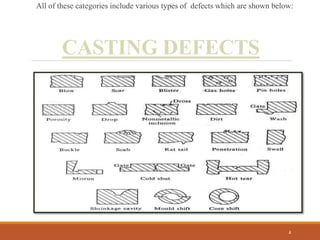
All of these categories include various types of defects which are shown below:
4
MISMATCH
 The casting that does not match at
the parting line is known as Mismatch
or Mould shift.
 Causes :
• Worn out or bent clamping pins.
• Misalignment of two
halves of pattern.
• Improper location &
support of core.
• Faulty core boxes.
• Loose dowels.
5
 Remedies :
• Increase strength of mould &
core.
• Provide adequate support to
core.
• Proper alignment of two halves
of
the pattern.
• Proper clamping of
mould box.
• Repair or replace dowels
& pin causing mismatch.
MISRUN & COLD SHUTS
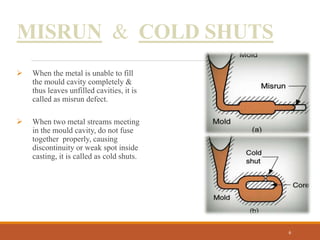
 When the metal is unable to fill
the mould cavity completely &
thus leaves unfilled cavities, it is
called as misrun defect.
 When two metal streams meeting
in the mould cavity, do not fuse
together properly, causing
discontinuity or weak spot inside
casting, it is called as cold shuts.
6
MISRUN & COLD SHUTS
 Causes :
• Low pouring temperature.
• Faulty gating system design.
• Too thin casting sections.
• Slow and intermitted
pouring.
• Improper alloy composition.
• Use of damaged pattern.
• Lack of fluidity in molten
metal.
7
 Remedies :
• Smooth pouring with the
help of monorail.
• Properly transport mould
during pouring.
• Providing appropriate pouring
temperature.
• Modifying the gating system
design.
SHRINKAGE CAVITY
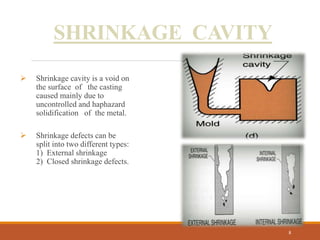
 Shrinkage cavity is a void on
the surface of the casting
caused mainly due to
uncontrolled and haphazard
solidification of the metal.
 Shrinkage defects can be
split into two different types:
1) External shrinkage
2) Closed shrinkage defects.
8
SHRINKAGE CAVITY
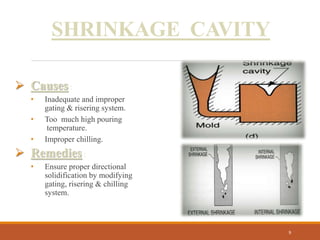
 Causes :
• Inadequate and improper
gating & risering system.
• Too much high pouring
temperature.
• Improper chilling.
 Remedies :
• Ensure proper directional
solidification by modifying
gating, risering & chilling
system.
9
BLOW HOLES
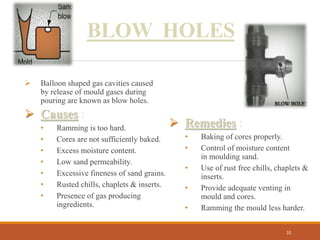
 Balloon shaped gas cavities caused
by release of mould gases during
pouring are known as blow holes.
 Causes :
• Ramming is too hard.
• Cores are not sufficiently baked.
• Excess moisture content.
• Low sand permeability.
• Excessive fineness of sand grains.
• Rusted chills, chaplets & inserts.
• Presence of gas producing
ingredients.
10
 Remedies :
• Baking of cores properly.
• Control of moisture content
in moulding sand.
• Use of rust free chills, chaplets &
inserts.
• Provide adequate venting in
mould and cores.
• Ramming the mould less harder.
POROSITY
 Porosity is in the form of cavities caused
due to gas entrapment during
solidification.
 Causes :
• High pouring temperature.
• Gas dissolved in metal charge.
• Less flux used.
• Molten metal not properly
degassed.
• Slow solidification of casting.
• High moisture and low
permeability of mould.
11
 Remedies :
• Regulate pouring temperature
• Control metal composition.
• Increase flux proportions.
• Ensure effective degassing.
• Modify gating and risering.
• Reduce moisture and increase
permeability of mould.
HOT TEARS or
HOT CRACKING
 Hot tears are ragged irregular
internal or external cracks
occurring immediately after the
metal have solidified.
 Causes :
• Lack of collapsibility of
core & mould.
• Hard ramming of mould.
• Faulty casting design.
 Remedies :
• Providing softer ramming.
• Improve casting design.
• Improve collapsibility of core
& mould.
12
METAL PENETRATION
 Penetration occurs when the
molten metal flows between the
sand particles in the mould.
 Causes :
• Low strength of moulding sand.
• Large size of moulding sand.
• High permeability of sand.
• Soft ramming.
 Remedies :
• Use of fine grain with low
permeability.
• Appropriate ramming.
13
PIN HOLES
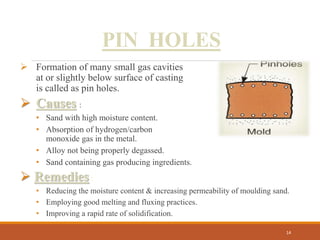
 Formation of many small gas cavities
at or slightly below surface of casting
is called as pin holes.
 Causes :
• Sand with high moisture content.
• Absorption of hydrogen/carbon
monoxide gas in the metal.
• Alloy not being properly degassed.
• Sand containing gas producing ingredients.
 Remedies :
• Reducing the moisture content & increasing permeability of moulding sand.
• Employing good melting and fluxing practices.
• Improving a rapid rate of solidification.
14
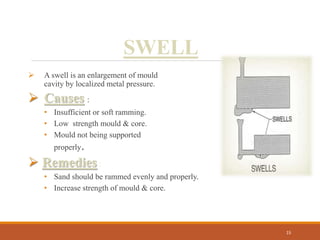
SWELL
 A swell is an enlargement of mould
cavity by localized metal pressure.
 Causes :
• Insufficient or soft ramming.
• Low strength mould & core.
• Mould not being supported
properly.
 Remedies :
• Sand should be rammed evenly and properly.
• Increase strength of mould & core.
15
DROP
 Drop is a projection on drag part of
casting due fall of its cope part.
 Causes :
• Low green strength of the moulding
sand.
• Low mould hardness.
• Insufficient reinforcement of sand projections in the cope.
 Remedies :
• Moulding sand should have sufficient green strength.
• Provide adequate reinforcement to sand projections and cope by using nails and
gaggers.
• Ramming should not be too soft.
16
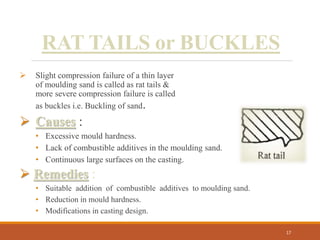
RAT TAILS or BUCKLES
 Slight compression failure of a thin layer
of moulding sand is called as rat tails &
more severe compression failure is called
as buckles i.e. Buckling of sand.
 Causes :
• Excessive mould hardness.
• Lack of combustible additives in the moulding sand.
• Continuous large surfaces on the casting.
 Remedies :
• Suitable addition of combustible additives to moulding sand.
• Reduction in mould hardness.
• Modifications in casting design.
17

Casting defects

  • 1.
  • 2.
    CASTING DEFECTS  Acasting defect is an irregularity in the metal casting process that is undesired.  It can also be defined as conditions in a casting that must be corrected or removed, or the casting must be rejected.  It may sometimes be tolerated, sometimes eliminated with proper moulding practice or repaired using methods such as welding, metallization etc.  There are many types of defects which result from many different causes. Some of the remedies to certain defects may be the cause for another type of defect. 2
  • 3.
    CASTING DEFECTS  Defectsin castings occur due to various causes. Although it is quite difficult to establish a relationship between defects & causes, casting defects are roughly broken down into five main categories :  Gas Defects  Moulding Material Defects  Pouring Metal Defects  Metallurgical Defects 3
  • 4.
    CASTING DEFECTS All ofthese categories include various types of defects which are shown below: 4
  • 5.
    MISMATCH  The castingthat does not match at the parting line is known as Mismatch or Mould shift.  Causes : • Worn out or bent clamping pins. • Misalignment of two halves of pattern. • Improper location & support of core. • Faulty core boxes. • Loose dowels. 5  Remedies : • Increase strength of mould & core. • Provide adequate support to core. • Proper alignment of two halves of the pattern. • Proper clamping of mould box. • Repair or replace dowels & pin causing mismatch.
  • 6.
    MISRUN & COLDSHUTS  When the metal is unable to fill the mould cavity completely & thus leaves unfilled cavities, it is called as misrun defect.  When two metal streams meeting in the mould cavity, do not fuse together properly, causing discontinuity or weak spot inside casting, it is called as cold shuts. 6
  • 7.
    MISRUN & COLDSHUTS  Causes : • Low pouring temperature. • Faulty gating system design. • Too thin casting sections. • Slow and intermitted pouring. • Improper alloy composition. • Use of damaged pattern. • Lack of fluidity in molten metal. 7  Remedies : • Smooth pouring with the help of monorail. • Properly transport mould during pouring. • Providing appropriate pouring temperature. • Modifying the gating system design.
  • 8.
    SHRINKAGE CAVITY  Shrinkagecavity is a void on the surface of the casting caused mainly due to uncontrolled and haphazard solidification of the metal.  Shrinkage defects can be split into two different types: 1) External shrinkage 2) Closed shrinkage defects. 8
  • 9.
    SHRINKAGE CAVITY  Causes: • Inadequate and improper gating & risering system. • Too much high pouring temperature. • Improper chilling.  Remedies : • Ensure proper directional solidification by modifying gating, risering & chilling system. 9
  • 10.
    BLOW HOLES  Balloonshaped gas cavities caused by release of mould gases during pouring are known as blow holes.  Causes : • Ramming is too hard. • Cores are not sufficiently baked. • Excess moisture content. • Low sand permeability. • Excessive fineness of sand grains. • Rusted chills, chaplets & inserts. • Presence of gas producing ingredients. 10  Remedies : • Baking of cores properly. • Control of moisture content in moulding sand. • Use of rust free chills, chaplets & inserts. • Provide adequate venting in mould and cores. • Ramming the mould less harder.
  • 11.
    POROSITY  Porosity isin the form of cavities caused due to gas entrapment during solidification.  Causes : • High pouring temperature. • Gas dissolved in metal charge. • Less flux used. • Molten metal not properly degassed. • Slow solidification of casting. • High moisture and low permeability of mould. 11  Remedies : • Regulate pouring temperature • Control metal composition. • Increase flux proportions. • Ensure effective degassing. • Modify gating and risering. • Reduce moisture and increase permeability of mould.
  • 12.
    HOT TEARS or HOTCRACKING  Hot tears are ragged irregular internal or external cracks occurring immediately after the metal have solidified.  Causes : • Lack of collapsibility of core & mould. • Hard ramming of mould. • Faulty casting design.  Remedies : • Providing softer ramming. • Improve casting design. • Improve collapsibility of core & mould. 12
  • 13.
    METAL PENETRATION  Penetrationoccurs when the molten metal flows between the sand particles in the mould.  Causes : • Low strength of moulding sand. • Large size of moulding sand. • High permeability of sand. • Soft ramming.  Remedies : • Use of fine grain with low permeability. • Appropriate ramming. 13
  • 14.
    PIN HOLES  Formationof many small gas cavities at or slightly below surface of casting is called as pin holes.  Causes : • Sand with high moisture content. • Absorption of hydrogen/carbon monoxide gas in the metal. • Alloy not being properly degassed. • Sand containing gas producing ingredients.  Remedies : • Reducing the moisture content & increasing permeability of moulding sand. • Employing good melting and fluxing practices. • Improving a rapid rate of solidification. 14
  • 15.
    SWELL  A swellis an enlargement of mould cavity by localized metal pressure.  Causes : • Insufficient or soft ramming. • Low strength mould & core. • Mould not being supported properly.  Remedies : • Sand should be rammed evenly and properly. • Increase strength of mould & core. 15
  • 16.
    DROP  Drop isa projection on drag part of casting due fall of its cope part.  Causes : • Low green strength of the moulding sand. • Low mould hardness. • Insufficient reinforcement of sand projections in the cope.  Remedies : • Moulding sand should have sufficient green strength. • Provide adequate reinforcement to sand projections and cope by using nails and gaggers. • Ramming should not be too soft. 16
  • 17.
    RAT TAILS orBUCKLES  Slight compression failure of a thin layer of moulding sand is called as rat tails & more severe compression failure is called as buckles i.e. Buckling of sand.  Causes : • Excessive mould hardness. • Lack of combustible additives in the moulding sand. • Continuous large surfaces on the casting.  Remedies : • Suitable addition of combustible additives to moulding sand. • Reduction in mould hardness. • Modifications in casting design. 17