BY: SAMIR JARIWALA
1
CASTING DEFECTS
 A casting defect is an irregularity in the metal casting process that is undesired.
 It can also be defined as conditions in a casting that must be corrected or removed,
or the casting must be rejected.
 It may sometimes be tolerated, sometimes eliminated with proper moulding
practice or repaired using methods such as welding, metallization etc.
 There are many types of defects which result from many different causes. Some of
the remedies to certain defects may be the cause for another type of defect.
2
CASTING DEFECTS
 Defects in castings occur due to various causes. Although it is quite difficult to
establish a relationship between defects & causes, casting defects are roughly
broken down into five main categories :
 Gas Defects
 Shrinkage Cavities
 Moulding Material Defects
 Pouring Metal Defects
 Metallurgical Defects
3
CASTING DEFECTS
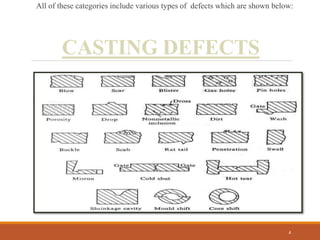
All of these categories include various types of defects which are shown below:
4
MISMATCH or MOULD
SHIFT
 The casting that does not match at
the parting line is known as Mismatch
or Mould shift.
 Causes :
• Worn out or bent clamping pins.
• Misalignment of two
halves of pattern.
• Improper location &
support of core.
• Faulty core boxes.
• Loose dowels.
5
MISMATCH or MOULD
SHIFT
 Remedies :
• Increase strength of mould & core.
• Provide adequate support to core.
• Proper alignment of two halves of
the pattern.
• Proper clamping of
mould box.
• Repair or replace dowels
& pin causing mismatch.
6
MISRUN & COLD SHUTS
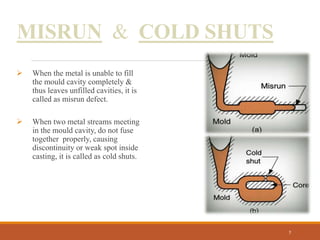
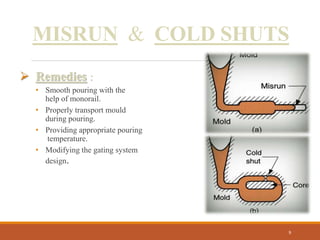
 When the metal is unable to fill
the mould cavity completely &
thus leaves unfilled cavities, it is
called as misrun defect.
 When two metal streams meeting
in the mould cavity, do not fuse
together properly, causing
discontinuity or weak spot inside
casting, it is called as cold shuts.
7
MISRUN & COLD SHUTS
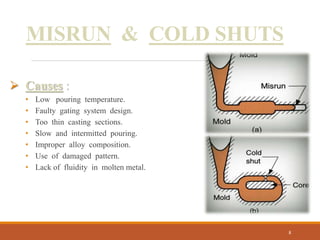
 Causes :
• Low pouring temperature.
• Faulty gating system design.
• Too thin casting sections.
• Slow and intermitted pouring.
• Improper alloy composition.
• Use of damaged pattern.
• Lack of fluidity in molten metal.
8
MISRUN & COLD SHUTS
 Remedies :
• Smooth pouring with the
help of monorail.
• Properly transport mould
during pouring.
• Providing appropriate pouring
temperature.
• Modifying the gating system
design.
9
SHRINKAGE CAVITY
 Shrinkage cavity is a void on
the surface of the casting
caused mainly due to
uncontrolled and haphazard
solidification of the metal.
 Shrinkage defects can be
split into two different types:
1) External shrinkage
2) Closed shrinkage defects.
10
SHRINKAGE CAVITY
 Causes :
• Inadequate and improper
gating & risering system.
• Too much high pouring
temperature.
• Improper chilling.
 Remedies :
• Ensure proper directional
solidification by modifying
gating, risering & chilling
system.
11
BLOW HOLES
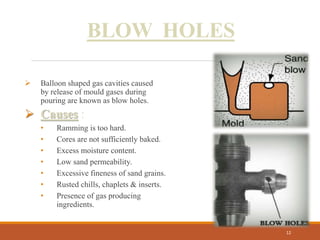
 Balloon shaped gas cavities caused
by release of mould gases during
pouring are known as blow holes.
 Causes :
• Ramming is too hard.
• Cores are not sufficiently baked.
• Excess moisture content.
• Low sand permeability.
• Excessive fineness of sand grains.
• Rusted chills, chaplets & inserts.
• Presence of gas producing
ingredients.
12
BLOW HOLES
 Remedies :
• Baking of cores properly.
• Control of moisture content
in moulding sand.
• Use of rust free chills, chaplets &
inserts.
• Provide adequate venting in
mould and cores.
• Ramming the mould less harder.
13
POROSITY
 Porosity is in the form of cavities caused due to gas entrapment during
solidification.
 Causes :
• High pouring temperature.
• Gas dissolved in metal charge.
• Less flux used.
• Molten metal not properly
degassed.
• Slow solidification of casting.
• High moisture and low
permeability of mould.
14
POROSITY
 Remedies :
• Regulate pouring temperature
• Control metal composition.
• Increase flux proportions.
• Ensure effective degassing.
• Modify gating and risering.
• Reduce moisture and increase
permeability of mould.
15
INCLUSIONS
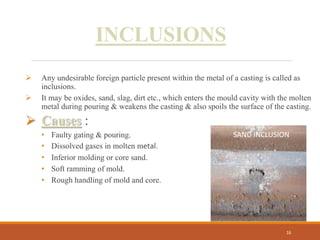
 Any undesirable foreign particle present within the metal of a casting is called as
inclusions.
 It may be oxides, sand, slag, dirt etc., which enters the mould cavity with the molten
metal during pouring & weakens the casting & also spoils the surface of the casting.
 Causes :
• Faulty gating & pouring.
• Dissolved gases in molten metal.
• Inferior molding or core sand.
• Soft ramming of mold.
• Rough handling of mold and core.
16
SAND INCLUSION
INCLUSIONS
 Remedies :
• Modify gating system.
• Improve pouring to minimize turbulence.
• Use of superior sand of good strength.
• Provide hard ramming.
• Use slag trapping methods for
preventing any slag from entering
the mould cavity.
17
SAND INCLUSION
HOT TEARS or
HOT CRACKING
 Hot tears are ragged irregular
internal or external cracks
occurring immediately after the
metal have solidified.
 Causes :
• Lack of collapsibility of
core & mould.
• Hard ramming of mould.
• Faulty casting design.
 Remedies :
• Providing softer ramming.
• Improve casting design.
• Improve collapsibility of core
& mould.
18
METAL PENETRATION
 Penetration occurs when the
molten metal flows between the
sand particles in the mould.
 Causes :
• Low strength of moulding sand.
• Large size of moulding sand.
• High permeability of sand.
• Soft ramming.
 Remedies :
• Use of fine grain with low
permeability.
• Appropriate ramming.
19
PIN HOLES
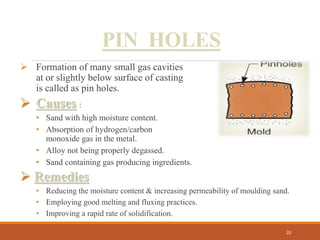
 Formation of many small gas cavities
at or slightly below surface of casting
is called as pin holes.
 Causes :
• Sand with high moisture content.
• Absorption of hydrogen/carbon
monoxide gas in the metal.
• Alloy not being properly degassed.
• Sand containing gas producing ingredients.
 Remedies :
• Reducing the moisture content & increasing permeability of moulding sand.
• Employing good melting and fluxing practices.
• Improving a rapid rate of solidification.
20
SWELL
 A swell is an enlargement of mould
cavity by localized metal pressure.
 Causes :
• Insufficient or soft ramming.
• Low strength mould & core.
• Mould not being supported
properly.
 Remedies :
• Sand should be rammed evenly and properly.
• Increase strength of mould & core.
21
DROP
 Drop is a projection on drag part of
casting due fall of its cope part.
 Causes :
• Low green strength of the moulding
sand.
• Low mould hardness.
• Insufficient reinforcement of sand projections in the cope.
 Remedies :
• Moulding sand should have sufficient green strength.
• Provide adequate reinforcement to sand projections and cope by using nails and
gaggers.
• Ramming should not be too soft.
22
FLASHES or FINS
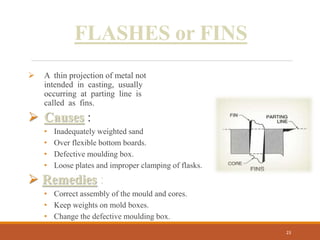
 A thin projection of metal not
intended in casting, usually
occurring at parting line is
called as fins.
 Causes :
• Inadequately weighted sand
• Over flexible bottom boards.
• Defective moulding box.
• Loose plates and improper clamping of flasks.
 Remedies :
• Correct assembly of the mould and cores.
• Keep weights on mold boxes.
• Change the defective moulding box.
23
RAT TAILS or BUCKLES
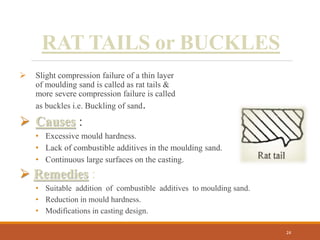
 Slight compression failure of a thin layer
of moulding sand is called as rat tails &
more severe compression failure is called
as buckles i.e. Buckling of sand.
 Causes :
• Excessive mould hardness.
• Lack of combustible additives in the moulding sand.
• Continuous large surfaces on the casting.
 Remedies :
• Suitable addition of combustible additives to moulding sand.
• Reduction in mould hardness.
• Modifications in casting design.
24
WARPAGE
 Warpage is an undesirable deformation in a casting occurring during or after
solidification due to improper solidification.
 Causes :
• Continuous large flat surfaces.
• No directional solidification of casting.
• Moulding sand having too low green strength.
• Improper cooling rate.
 Remedies :
• Follow principle of sufficient directional solidification.
• Make good casting & gating system design.
• Proper selection of moulding sand.
25
CRACKED CASTING
 These are cracks caused by inability of
casting to cope with internal stresses
resulting from solid shrinkage of metal
 Immediately after solidification some
metals have low strength and if stresses
set up are high cracks developed in the
casting.
 Cracks can be avoided by proper
design of casting, avoiding joining of
unequal stresses ,providing round
corners etc
26
BENT OR TWISTED
CASTING
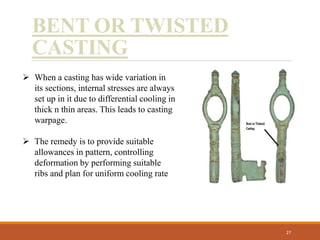
 When a casting has wide variation in
its sections, internal stresses are always
set up in it due to differential cooling in
thick n thin areas. This leads to casting
warpage.
 The remedy is to provide suitable
allowances in pattern, controlling
deformation by performing suitable
ribs and plan for uniform cooling rate
27
OPEN BLOWS AND BLOW
HOLES
 Open blows are smooth cavities or voids on
the surface of the casting .blow holes are
bubbles of gas entrapped inside the casting
.both are caused by gases carried by hot
metals.
 Blow holes are also caused by poor
permeability of sand, too fine sand grains,
over rammed moulds or insufficient venting.
Blow holes can be controlled by controlling
moisture content, providing proper venting
,not too hard ramming of the mould and
controlling binder content
28
FUSION
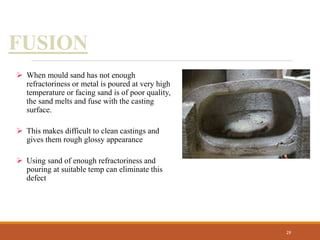
 When mould sand has not enough
refractoriness or metal is poured at very high
temperature or facing sand is of poor quality,
the sand melts and fuse with the casting
surface.
 This makes difficult to clean castings and
gives them rough glossy appearance
 Using sand of enough refractoriness and
pouring at suitable temp can eliminate this
defect
29
RUNOUT
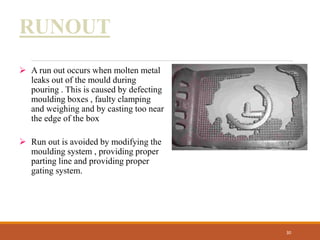
 A run out occurs when molten metal
leaks out of the mould during
pouring . This is caused by defecting
moulding boxes , faulty clamping
and weighing and by casting too near
the edge of the box
 Run out is avoided by modifying the
moulding system , providing proper
parting line and providing proper
gating system.
30
CRACK
Cracks may arise from locked up stresses set
up by non uniform heating and cooling
,excess sulphur or phosphorus in the metal,
and some other causes.
31
32

Metal casting defects 1

  • 1.
  • 2.
    CASTING DEFECTS  Acasting defect is an irregularity in the metal casting process that is undesired.  It can also be defined as conditions in a casting that must be corrected or removed, or the casting must be rejected.  It may sometimes be tolerated, sometimes eliminated with proper moulding practice or repaired using methods such as welding, metallization etc.  There are many types of defects which result from many different causes. Some of the remedies to certain defects may be the cause for another type of defect. 2
  • 3.
    CASTING DEFECTS  Defectsin castings occur due to various causes. Although it is quite difficult to establish a relationship between defects & causes, casting defects are roughly broken down into five main categories :  Gas Defects  Shrinkage Cavities  Moulding Material Defects  Pouring Metal Defects  Metallurgical Defects 3
  • 4.
    CASTING DEFECTS All ofthese categories include various types of defects which are shown below: 4
  • 5.
    MISMATCH or MOULD SHIFT The casting that does not match at the parting line is known as Mismatch or Mould shift.  Causes : • Worn out or bent clamping pins. • Misalignment of two halves of pattern. • Improper location & support of core. • Faulty core boxes. • Loose dowels. 5
  • 6.
    MISMATCH or MOULD SHIFT Remedies : • Increase strength of mould & core. • Provide adequate support to core. • Proper alignment of two halves of the pattern. • Proper clamping of mould box. • Repair or replace dowels & pin causing mismatch. 6
  • 7.
    MISRUN & COLDSHUTS  When the metal is unable to fill the mould cavity completely & thus leaves unfilled cavities, it is called as misrun defect.  When two metal streams meeting in the mould cavity, do not fuse together properly, causing discontinuity or weak spot inside casting, it is called as cold shuts. 7
  • 8.
    MISRUN & COLDSHUTS  Causes : • Low pouring temperature. • Faulty gating system design. • Too thin casting sections. • Slow and intermitted pouring. • Improper alloy composition. • Use of damaged pattern. • Lack of fluidity in molten metal. 8
  • 9.
    MISRUN & COLDSHUTS  Remedies : • Smooth pouring with the help of monorail. • Properly transport mould during pouring. • Providing appropriate pouring temperature. • Modifying the gating system design. 9
  • 10.
    SHRINKAGE CAVITY  Shrinkagecavity is a void on the surface of the casting caused mainly due to uncontrolled and haphazard solidification of the metal.  Shrinkage defects can be split into two different types: 1) External shrinkage 2) Closed shrinkage defects. 10
  • 11.
    SHRINKAGE CAVITY  Causes: • Inadequate and improper gating & risering system. • Too much high pouring temperature. • Improper chilling.  Remedies : • Ensure proper directional solidification by modifying gating, risering & chilling system. 11
  • 12.
    BLOW HOLES  Balloonshaped gas cavities caused by release of mould gases during pouring are known as blow holes.  Causes : • Ramming is too hard. • Cores are not sufficiently baked. • Excess moisture content. • Low sand permeability. • Excessive fineness of sand grains. • Rusted chills, chaplets & inserts. • Presence of gas producing ingredients. 12
  • 13.
    BLOW HOLES  Remedies: • Baking of cores properly. • Control of moisture content in moulding sand. • Use of rust free chills, chaplets & inserts. • Provide adequate venting in mould and cores. • Ramming the mould less harder. 13
  • 14.
    POROSITY  Porosity isin the form of cavities caused due to gas entrapment during solidification.  Causes : • High pouring temperature. • Gas dissolved in metal charge. • Less flux used. • Molten metal not properly degassed. • Slow solidification of casting. • High moisture and low permeability of mould. 14
  • 15.
    POROSITY  Remedies : •Regulate pouring temperature • Control metal composition. • Increase flux proportions. • Ensure effective degassing. • Modify gating and risering. • Reduce moisture and increase permeability of mould. 15
  • 16.
    INCLUSIONS  Any undesirableforeign particle present within the metal of a casting is called as inclusions.  It may be oxides, sand, slag, dirt etc., which enters the mould cavity with the molten metal during pouring & weakens the casting & also spoils the surface of the casting.  Causes : • Faulty gating & pouring. • Dissolved gases in molten metal. • Inferior molding or core sand. • Soft ramming of mold. • Rough handling of mold and core. 16 SAND INCLUSION
  • 17.
    INCLUSIONS  Remedies : •Modify gating system. • Improve pouring to minimize turbulence. • Use of superior sand of good strength. • Provide hard ramming. • Use slag trapping methods for preventing any slag from entering the mould cavity. 17 SAND INCLUSION
  • 18.
    HOT TEARS or HOTCRACKING  Hot tears are ragged irregular internal or external cracks occurring immediately after the metal have solidified.  Causes : • Lack of collapsibility of core & mould. • Hard ramming of mould. • Faulty casting design.  Remedies : • Providing softer ramming. • Improve casting design. • Improve collapsibility of core & mould. 18
  • 19.
    METAL PENETRATION  Penetrationoccurs when the molten metal flows between the sand particles in the mould.  Causes : • Low strength of moulding sand. • Large size of moulding sand. • High permeability of sand. • Soft ramming.  Remedies : • Use of fine grain with low permeability. • Appropriate ramming. 19
  • 20.
    PIN HOLES  Formationof many small gas cavities at or slightly below surface of casting is called as pin holes.  Causes : • Sand with high moisture content. • Absorption of hydrogen/carbon monoxide gas in the metal. • Alloy not being properly degassed. • Sand containing gas producing ingredients.  Remedies : • Reducing the moisture content & increasing permeability of moulding sand. • Employing good melting and fluxing practices. • Improving a rapid rate of solidification. 20
  • 21.
    SWELL  A swellis an enlargement of mould cavity by localized metal pressure.  Causes : • Insufficient or soft ramming. • Low strength mould & core. • Mould not being supported properly.  Remedies : • Sand should be rammed evenly and properly. • Increase strength of mould & core. 21
  • 22.
    DROP  Drop isa projection on drag part of casting due fall of its cope part.  Causes : • Low green strength of the moulding sand. • Low mould hardness. • Insufficient reinforcement of sand projections in the cope.  Remedies : • Moulding sand should have sufficient green strength. • Provide adequate reinforcement to sand projections and cope by using nails and gaggers. • Ramming should not be too soft. 22
  • 23.
    FLASHES or FINS A thin projection of metal not intended in casting, usually occurring at parting line is called as fins.  Causes : • Inadequately weighted sand • Over flexible bottom boards. • Defective moulding box. • Loose plates and improper clamping of flasks.  Remedies : • Correct assembly of the mould and cores. • Keep weights on mold boxes. • Change the defective moulding box. 23
  • 24.
    RAT TAILS orBUCKLES  Slight compression failure of a thin layer of moulding sand is called as rat tails & more severe compression failure is called as buckles i.e. Buckling of sand.  Causes : • Excessive mould hardness. • Lack of combustible additives in the moulding sand. • Continuous large surfaces on the casting.  Remedies : • Suitable addition of combustible additives to moulding sand. • Reduction in mould hardness. • Modifications in casting design. 24
  • 25.
    WARPAGE  Warpage isan undesirable deformation in a casting occurring during or after solidification due to improper solidification.  Causes : • Continuous large flat surfaces. • No directional solidification of casting. • Moulding sand having too low green strength. • Improper cooling rate.  Remedies : • Follow principle of sufficient directional solidification. • Make good casting & gating system design. • Proper selection of moulding sand. 25
  • 26.
    CRACKED CASTING  Theseare cracks caused by inability of casting to cope with internal stresses resulting from solid shrinkage of metal  Immediately after solidification some metals have low strength and if stresses set up are high cracks developed in the casting.  Cracks can be avoided by proper design of casting, avoiding joining of unequal stresses ,providing round corners etc 26
  • 27.
    BENT OR TWISTED CASTING When a casting has wide variation in its sections, internal stresses are always set up in it due to differential cooling in thick n thin areas. This leads to casting warpage.  The remedy is to provide suitable allowances in pattern, controlling deformation by performing suitable ribs and plan for uniform cooling rate 27
  • 28.
    OPEN BLOWS ANDBLOW HOLES  Open blows are smooth cavities or voids on the surface of the casting .blow holes are bubbles of gas entrapped inside the casting .both are caused by gases carried by hot metals.  Blow holes are also caused by poor permeability of sand, too fine sand grains, over rammed moulds or insufficient venting. Blow holes can be controlled by controlling moisture content, providing proper venting ,not too hard ramming of the mould and controlling binder content 28
  • 29.
    FUSION  When mouldsand has not enough refractoriness or metal is poured at very high temperature or facing sand is of poor quality, the sand melts and fuse with the casting surface.  This makes difficult to clean castings and gives them rough glossy appearance  Using sand of enough refractoriness and pouring at suitable temp can eliminate this defect 29
  • 30.
    RUNOUT  A runout occurs when molten metal leaks out of the mould during pouring . This is caused by defecting moulding boxes , faulty clamping and weighing and by casting too near the edge of the box  Run out is avoided by modifying the moulding system , providing proper parting line and providing proper gating system. 30
  • 31.
    CRACK Cracks may arisefrom locked up stresses set up by non uniform heating and cooling ,excess sulphur or phosphorus in the metal, and some other causes. 31
  • 32.