Rolling is a metal forming process that uses rolls to reduce the thickness and increase the length of metal workpieces. It can be done hot or cold. Hot rolling occurs above the metal's recrystallization temperature and results in a more uniform structure, while cold rolling occurs at room temperature and produces closer tolerances and a better surface finish. The document defines various products of rolling like billets, blooms, slabs, plates, sheets and strips based on their dimensions. It also describes different types of rolling processes like continuous, transverse, shape, ring and thread rolling as well as the types of mills used like two-high, three-high and four-high mills.
WHAT IS ROLLING??
•Rolling is the most widely used
forming process, which provides high
production and close control of final
product.
• The metal is subjected to high
compressive stresses as a result of
the friction between the rolls and the metal
surface
The process of plastically deforming metal by passing it
between rolls.
3.
TERMINOLOGY
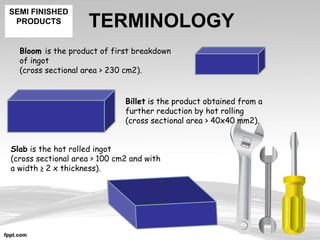
Billet is theproduct obtained from a
further reduction by hot rolling
(cross sectional area > 40x40 mm2).
Bloom is the product of first breakdown
of ingot
(cross sectional area > 230 cm2).
Slab is the hot rolled ingot
(cross sectional area > 100 cm2 and with
a width ≥ 2 x thickness).
SEMI FINISHED
PRODUCTS
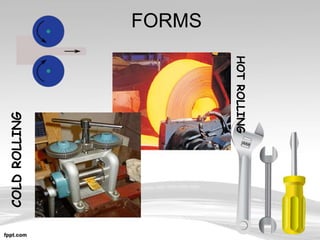
HOT ROLLING
Hot rollingis
a metalworking process that
occurs above the
recrystallization temperature of
the material.
Hot rolled metals generally have little
directionality in their mechanical
properties and deformation
induced residual stresses.
However, in certain instances non-
metallic inclusions will impart some
directionality
7.
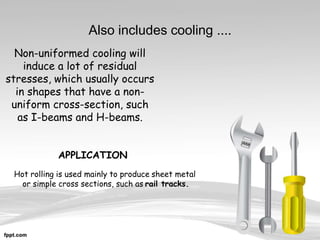
Also includes cooling....
Non-uniformed cooling will
induce a lot of residual
stresses, which usually occurs
in shapes that have a non-
uniform cross-section, such
as I-beams and H-beams.
Hot rolling is used mainly to produce sheet metal
or simple cross sections, such as rail tracks.
APPLICATION
8.
COLD ROLLING
It alsoimproves the surface finish and
holds tighter tolerances.
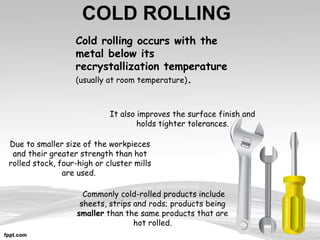
Cold rolling occurs with the
metal below its
recrystallization temperature
(usually at room temperature).
Commonly cold-rolled products include
sheets, strips and rods; products being
smaller than the same products that are
hot rolled.
Due to smaller size of the workpieces
and their greater strength than hot
rolled stock, four-high or cluster mills
are used.
9.
HOW IS THISDONE...?
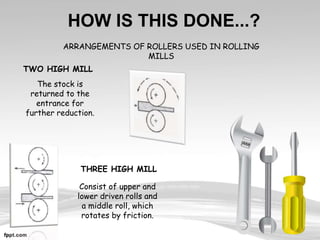
ARRANGEMENTS OF ROLLERS USED IN ROLLING
MILLS
TWO HIGH MILL
THREE HIGH MILL
The stock is
returned to the
entrance for
further reduction.
Consist of upper and
lower driven rolls and
a middle roll, which
rotates by friction.
10.
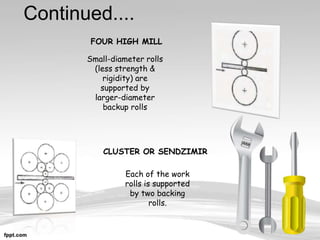
Continued....
CLUSTER OR SENDZIMIR
FOURHIGH MILL
Small-diameter rolls
(less strength &
rigidity) are
supported by
larger-diameter
backup rolls
Each of the work
rolls is supported
by two backing
rolls.
11.
WHERE
IT
IS
DONE?
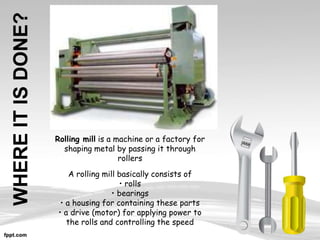
Rolling mill isa machine or a factory for
shaping metal by passing it through
rollers
A rolling mill basically consists of
• rolls
• bearings
• a housing for containing these parts
• a drive (motor) for applying power to
the rolls and controlling the speed
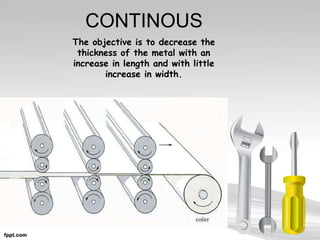
CONTINOUS
The objective isto decrease the
thickness of the metal with an
increase in length and with little
increase in width.
14.
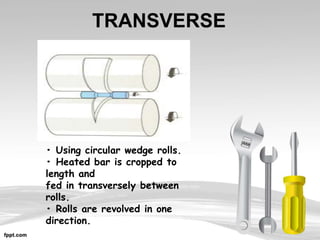
TRANSVERSE
• Using circularwedge rolls.
• Heated bar is cropped to
length and
fed in transversely between
rolls.
• Rolls are revolved in one
direction.
15.
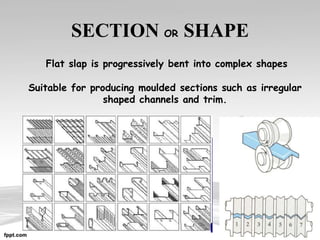
SECTION OR SHAPE
Flatslap is progressively bent into complex shapes
Suitable for producing moulded sections such as irregular
shaped channels and trim.
16.
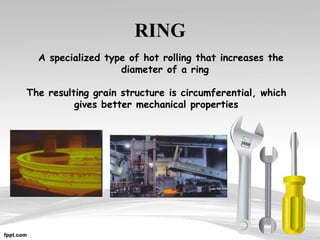
RING
A specialized typeof hot rolling that increases the
diameter of a ring
The resulting grain structure is circumferential, which
gives better mechanical properties
17.
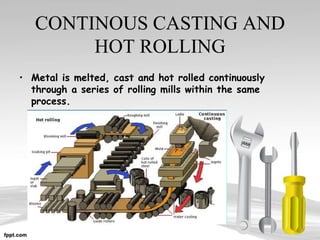
CONTINOUS CASTING AND
HOTROLLING
• Metal is melted, cast and hot rolled continuously
through a series of rolling mills within the same
process.
18.
THREAD
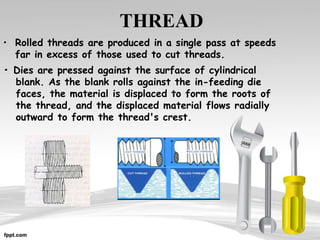
• Rolled threadsare produced in a single pass at speeds
far in excess of those used to cut threads.
• Dies are pressed against the surface of cylindrical
blank. As the blank rolls against the in-feeding die
faces, the material is displaced to form the roots of
the thread, and the displaced material flows radially
outward to form the thread's crest.