INTRODUCTION
• Production of castings involves a large number
of steps including casting design, pattern making,
moulding, melting, pouring, shake out, fettling,
inspection and finishing.
• It is not uncommon for one or more of these steps
to be performed unsatisfactorily due to use of
defective material or equipment, carelessness of
the operator or lack of skill.
• Such unsatisfactory operations result in a
defective casting which may be rejected at the
final stage.
• Since reclamation of defective castings is
often costly and sometimes outright impossible,
care should be taken to avoid the occurrence of
the defects in the first instance.
• It is therefore necessary to understand the
various defects that occur in sand castings and
the main factors that are responsible for their
occurrence
• Some of the common defects are described
below.
1. Open Blows and Blow Holes
2. Pin Hole Porosity
3. Entrapped Air and other gases
4. Cracked Casting
5. Bent or Twisted Casting
6. Dropped Mould
7. Fusion
8. Swell
9. Run out
10. Mismatch
11. Mis-run and Cold Shut
12. Shrinkage-Faults
13. Rat Tail and Buckles
14. Core Shift
15. Inclusions
16. Cuts and Washes
17. Metal penetration
18. Hard Spots
19. Scabs
20. Hot tears
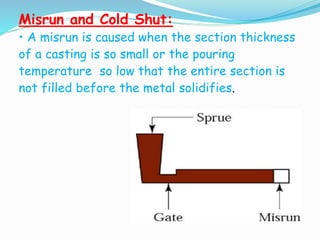
Misrun and Cold Shut:
• A misrun is caused when the section thickness
of a casting is so small or the pouring
temperature so low that the entire section is
not filled before the metal solidifies.
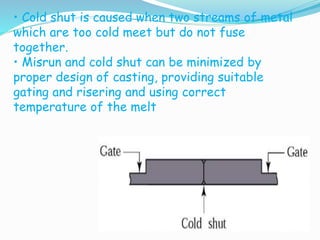
• Cold shut is caused when two streams of metal
which are too cold meet but do not fuse
together.
• Misrun and cold shut can be minimized by
proper design of casting, providing suitable
gating and risering and using correct
temperature of the melt
Shrinkage Faults:
• Shrinkage faults are faults caused by improper
directional solidifications, poor gating and
risering design and inadequate feeding.
• Solidification leads to volumetric contraction
which must be compensated by feeding. If this
compensation is inadequate either surface
shrinkage or internal shrinkage defects are
produced making the casting weaker.
• Shrinkage faults can be reduced by providing proper
gating system, pouring at correct temperature and taking
care of directional solidification.
Rat Tail and Buckles:
• Rat tails and buckles are caused by the expansion of a
thin outer layer of moulding sand on the surface of the
mould cavity due to metal heat.
• A rat tail is caused by depression of a part of the
mould under compression which appears as an irregular
line on the surface of the casting.
• A buckle is a more severe failure of the sand surface
under compression.
• The mould must provide for proper expansion instead
of forming compressed layers to avoid this defect.
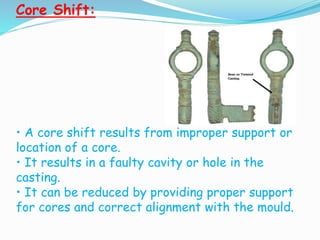
Core Shift:
• A core shift results from improper support or
location of a core.
• It results in a faulty cavity or hole in the
casting.
• It can be reduced by providing proper support
for cores and correct alignment with the mould.
Cuts and Washes:
• Cuts and washes are caused by erosion of mould
and core surfaces by the metal flowing in the
mould cavity.
• These defects are avoided by proper ramming,
having sand of required strength and controlling
the turbulence during pouring.
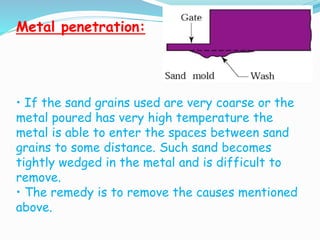
Metal penetration:
• If the sand grains used are very coarse or the
metal poured has very high temperature the
metal is able to enter the spaces between sand
grains to some distance. Such sand becomes
tightly wedged in the metal and is difficult to
remove.
• The remedy is to remove the causes mentioned
above.
Hard Spots:
• Hard spots are caused
by chilling action of
moulding sands in some
metals like gray cast
iron with insufficient
silicon.
• These spots are
extremely hard and
often lead to machining
difficulties.
• Hard spots are avoided by providing uniform
cooling and pouring at the right temperature.
Scabs:
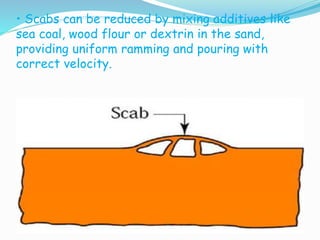
• Scabs are rough, irregular projections on
surface of castings containing embedded sand.
• Scabs occur when a portion on the face of
mould or core lifts and metal flows underneath
in a thin layer.
• They are caused by using too fine sand grains
or using sand of low permeability or moisture
content.
• They may also be caused by uneven mould
ramming or by intense local overheating.
• Scabs can be reduced by mixing additives like
sea coal, wood flour or dextrin in the sand,
providing uniform ramming and pouring with
correct velocity.
Hot tears:
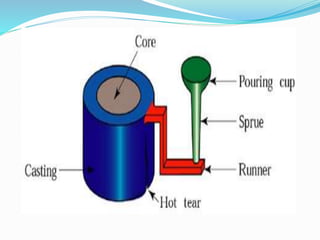
• Hot tears are ragged irregular internal or
external cracks occurring immediately after the
metal have solidified.
• Hot tears occur on poorly designed castings
having abrupt section changes or having no
proper fillets or corner radii. Wrongly placed
chills.
• Improper placement of gates and risers or
incorrect pouring temperatures can also
produce hot tears.
• Hot tears are also caused by poor collapsibility
of cores.
• If the core does not collapse when the casting
is contracting over it stresses will be set up in
the casting leading to its failure.
• Hot tears can be eliminated by improved design,
proper directional solidification, and uniform
rate of cooling, correct pouring temperature and
control of mould hardness.
THANK YOU

Shubhma mp2

  • 2.
    INTRODUCTION • Production ofcastings involves a large number of steps including casting design, pattern making, moulding, melting, pouring, shake out, fettling, inspection and finishing. • It is not uncommon for one or more of these steps to be performed unsatisfactorily due to use of defective material or equipment, carelessness of the operator or lack of skill. • Such unsatisfactory operations result in a defective casting which may be rejected at the final stage.
  • 3.
    • Since reclamationof defective castings is often costly and sometimes outright impossible, care should be taken to avoid the occurrence of the defects in the first instance. • It is therefore necessary to understand the various defects that occur in sand castings and the main factors that are responsible for their occurrence
  • 4.
    • Some ofthe common defects are described below. 1. Open Blows and Blow Holes 2. Pin Hole Porosity 3. Entrapped Air and other gases 4. Cracked Casting 5. Bent or Twisted Casting 6. Dropped Mould 7. Fusion 8. Swell 9. Run out 10. Mismatch 11. Mis-run and Cold Shut 12. Shrinkage-Faults
  • 5.
    13. Rat Tailand Buckles 14. Core Shift 15. Inclusions 16. Cuts and Washes 17. Metal penetration 18. Hard Spots 19. Scabs 20. Hot tears
  • 6.
    Misrun and ColdShut: • A misrun is caused when the section thickness of a casting is so small or the pouring temperature so low that the entire section is not filled before the metal solidifies.
  • 7.
    • Cold shutis caused when two streams of metal which are too cold meet but do not fuse together. • Misrun and cold shut can be minimized by proper design of casting, providing suitable gating and risering and using correct temperature of the melt
  • 8.
    Shrinkage Faults: • Shrinkagefaults are faults caused by improper directional solidifications, poor gating and risering design and inadequate feeding. • Solidification leads to volumetric contraction which must be compensated by feeding. If this compensation is inadequate either surface shrinkage or internal shrinkage defects are produced making the casting weaker.
  • 9.
    • Shrinkage faultscan be reduced by providing proper gating system, pouring at correct temperature and taking care of directional solidification.
  • 10.
    Rat Tail andBuckles: • Rat tails and buckles are caused by the expansion of a thin outer layer of moulding sand on the surface of the mould cavity due to metal heat. • A rat tail is caused by depression of a part of the mould under compression which appears as an irregular line on the surface of the casting. • A buckle is a more severe failure of the sand surface under compression. • The mould must provide for proper expansion instead of forming compressed layers to avoid this defect.
  • 11.
    Core Shift: • Acore shift results from improper support or location of a core. • It results in a faulty cavity or hole in the casting. • It can be reduced by providing proper support for cores and correct alignment with the mould.
  • 12.
    Cuts and Washes: •Cuts and washes are caused by erosion of mould and core surfaces by the metal flowing in the mould cavity. • These defects are avoided by proper ramming, having sand of required strength and controlling the turbulence during pouring.
  • 13.
    Metal penetration: • Ifthe sand grains used are very coarse or the metal poured has very high temperature the metal is able to enter the spaces between sand grains to some distance. Such sand becomes tightly wedged in the metal and is difficult to remove. • The remedy is to remove the causes mentioned above.
  • 14.
    Hard Spots: • Hardspots are caused by chilling action of moulding sands in some metals like gray cast iron with insufficient silicon. • These spots are extremely hard and often lead to machining difficulties. • Hard spots are avoided by providing uniform cooling and pouring at the right temperature.
  • 15.
    Scabs: • Scabs arerough, irregular projections on surface of castings containing embedded sand. • Scabs occur when a portion on the face of mould or core lifts and metal flows underneath in a thin layer. • They are caused by using too fine sand grains or using sand of low permeability or moisture content. • They may also be caused by uneven mould ramming or by intense local overheating.
  • 16.
    • Scabs canbe reduced by mixing additives like sea coal, wood flour or dextrin in the sand, providing uniform ramming and pouring with correct velocity.
  • 17.
    Hot tears: • Hottears are ragged irregular internal or external cracks occurring immediately after the metal have solidified. • Hot tears occur on poorly designed castings having abrupt section changes or having no proper fillets or corner radii. Wrongly placed chills. • Improper placement of gates and risers or incorrect pouring temperatures can also produce hot tears.
  • 18.
    • Hot tearsare also caused by poor collapsibility of cores. • If the core does not collapse when the casting is contracting over it stresses will be set up in the casting leading to its failure. • Hot tears can be eliminated by improved design, proper directional solidification, and uniform rate of cooling, correct pouring temperature and control of mould hardness.
  • 20.