WELDING DEFECTSWELDING DEFECTS
www.productiontechnolo.wixsite.co
m/tech
M SIVAKUMAR
Types of defects
Slag Inclusion
Undercut
Porosity
Incomplete fusion
Overlap
Underfill
Spatter
Excessive Convexity
Incomplete Penetration
Excessive Penetration
www.productiontechnolo.wixsite.co
m/tech
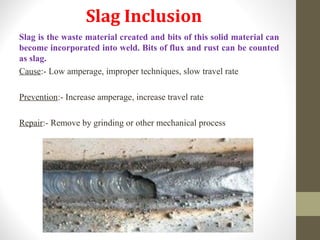
Slag Inclusion
www.productiontechnolo.wixsite.co
m/tech
Slag is the waste material created and bits of this solid material can
become incorporated into weld. Bits of flux and rust can be counted
as slag.
Cause:- Low amperage, improper techniques, slow travel rate
Prevention:- Increase amperage, increase travel rate
Repair:- Remove by grinding or other mechanical process
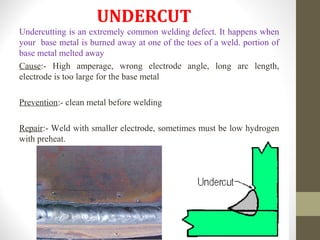
UNDERCUT
www.productiontechnolo.wixsite.co
m/tech
Undercutting is an extremely common welding defect. It happens when
your base metal is burned away at one of the toes of a weld. portion of
base metal melted away
Cause:- High amperage, wrong electrode angle, long arc length,
electrode is too large for the base metal
Prevention:- clean metal before welding
Repair:- Weld with smaller electrode, sometimes must be low hydrogen
with preheat.
POROSITY
www.productiontechnolo.wixsite.co
m/tech
In this defect, air bubbles or gases are present in the weld zone
Cause:- inclusion of atmospheric gases, sulfur in weld metal, or surface
contaminants
Prevention:- slower speed to allow gases time to escape
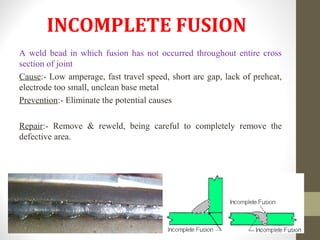
INCOMPLETE FUSION
www.productiontechnolo.wixsite.co
m/tech
A weld bead in which fusion has not occurred throughout entire cross
section of joint
Cause:- Low amperage, fast travel speed, short arc gap, lack of preheat,
electrode too small, unclean base metal
Prevention:- Eliminate the potential causes
Repair:- Remove & reweld, being careful to completely remove the
defective area.
Cracks
www.productiontechnolo.wixsite.co
m/tech
It is a discontinuity in the metal that significantly reduces strength
Cause:- low ductility of weld, solidification shrinkage
Prevention:-
When finishing move back the electrode to fill up the crack, Increase
crater fill time by power source.
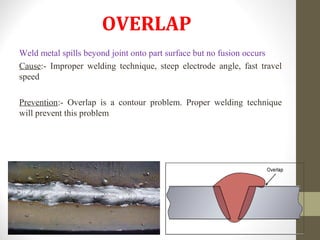
OVERLAP
www.productiontechnolo.wixsite.co
m/tech
Weld metal spills beyond joint onto part surface but no fusion occurs
Cause:- Improper welding technique, steep electrode angle, fast travel
speed
Prevention:- Overlap is a contour problem. Proper welding technique
will prevent this problem
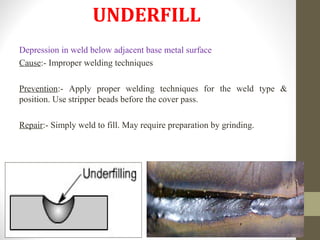
UNDERFILL
www.productiontechnolo.wixsite.co
m/tech
Depression in weld below adjacent base metal surface
Cause:- Improper welding techniques
Prevention:- Apply proper welding techniques for the weld type &
position. Use stripper beads before the cover pass.
Repair:- Simply weld to fill. May require preparation by grinding.
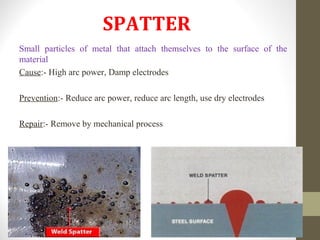
SPATTER
www.productiontechnolo.wixsite.co
m/tech
Small particles of metal that attach themselves to the surface of the
material
Cause:- High arc power, Damp electrodes
Prevention:- Reduce arc power, reduce arc length, use dry electrodes
Repair:- Remove by mechanical process
INCOMPLETE PENETRATION
www.productiontechnolo.wixsite.co
m/tech
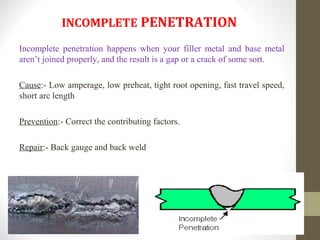
Incomplete penetration happens when your filler metal and base metal
aren’t joined properly, and the result is a gap or a crack of some sort.
Cause:- Low amperage, low preheat, tight root opening, fast travel speed,
short arc length
Prevention:- Correct the contributing factors.
Repair:- Back gauge and back weld
EXCESSIVE PENETRATION
www.productiontechnolo.wixsite.co
m/tech
EXCESSIVE CONVEXITY
www.productiontechnolo.wixsite.co
m/tech
Cause:- Amperage & travel speed
Prevention:- Observe proper parameters & techniques
Repair:- Must blend smoothly into the base metal
EXCESSIVE CONCAVITY
www.productiontechnolo.wixsite.co
m/tech
Cause:- Amperage & travel speed
Prevention:- Observe proper parameters & techniques
Repair:- Must blend smoothly into the base metal
Arc blow
www.productiontechnolo.wixsite.co
m/tech
Arc deflection as a result of magnetic effects into the opposite direction of
the earth lead clamp.
Arc deflection as a result of magnetic effects in the direction of heavy part of
work piece especially at corner and edges.
Remedies:
Use AC electrode where possible.
Try welding away from earth clamp connection. Try splitting the earth clamp
and correct to both side of the joint.
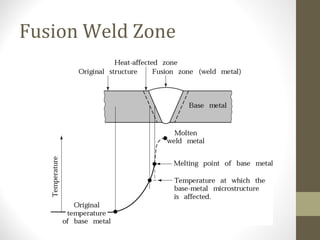
Fusion Weld Zone
www.productiontechnolo.wixsite.co
m/tech
Weldability
• Capacity of a metal or combination of metals to be welded into a
suitable structure, and for the resulting weld joint(s) to possess
the required metallurgical properties to perform satisfactorily in
intended service
• Good weldability characterized by:
• Absence of weld defects
• Strength, ductility, and toughness in welded joint
www.productiontechnolo.wixsite.co
m/tech
Inspection and Testing Methods
• Visual inspection
• Nondestructive evaluation
• Destructive testing
www.productiontechnolo.wixsite.co
m/tech
Visual Inspection
• Most widely used welding inspection method
• Human inspector visually examines for:
• Cracks, cavities, incomplete fusion, and other surface
defects
• Limitations:
• Only surface defects are detectable
• Welding inspector must also decide if additional tests
are warranted
www.productiontechnolo.wixsite.co
m/tech
Nondestructive Evaluation (NDE) Tests
• Ultrasonic testing - high frequency sound waves through
specimen to detect cracks and inclusions
• Radiographic testing - x rays or gamma radiation provide‑
photograph of internal flaws
• Dye penetrant and fluorescent penetrant tests‑ ‑ - to detect small
cracks and cavities at part surface
• Magnetic particle testing – iron filings sprinkled on surface reveal
subsurface defects by distorting magnetic field in part
www.productiontechnolo.wixsite.co
m/tech
Destructive Testing
Tests in which weld is destroyed either during testing or to prepare
test specimen
• Mechanical tests - purpose is similar to conventional testing
methods such as tensile tests, shear tests, etc
• Metallurgical tests - preparation of metallurgical specimens (e.g.,
photomicrographs) of weldment to examine metallic structure,
defects, extent and condition of heat affected zone, and similar
phenomena
www.productiontechnolo.wixsite.co
m/tech
Mechanical Tests in Welding
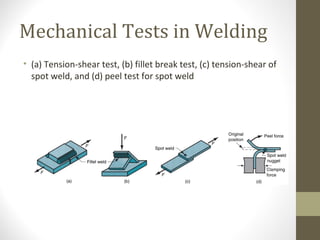
• (a) Tension-shear test, (b) fillet break test, (c) tension-shear of
spot weld, and (d) peel test for spot weld
www.productiontechnolo.wixsite.co
m/tech

Welding defects

  • 1.
  • 2.
    Types of defects SlagInclusion Undercut Porosity Incomplete fusion Overlap Underfill Spatter Excessive Convexity Incomplete Penetration Excessive Penetration www.productiontechnolo.wixsite.co m/tech
  • 3.
    Slag Inclusion www.productiontechnolo.wixsite.co m/tech Slag isthe waste material created and bits of this solid material can become incorporated into weld. Bits of flux and rust can be counted as slag. Cause:- Low amperage, improper techniques, slow travel rate Prevention:- Increase amperage, increase travel rate Repair:- Remove by grinding or other mechanical process
  • 4.
    UNDERCUT www.productiontechnolo.wixsite.co m/tech Undercutting is anextremely common welding defect. It happens when your base metal is burned away at one of the toes of a weld. portion of base metal melted away Cause:- High amperage, wrong electrode angle, long arc length, electrode is too large for the base metal Prevention:- clean metal before welding Repair:- Weld with smaller electrode, sometimes must be low hydrogen with preheat.
  • 5.
    POROSITY www.productiontechnolo.wixsite.co m/tech In this defect,air bubbles or gases are present in the weld zone Cause:- inclusion of atmospheric gases, sulfur in weld metal, or surface contaminants Prevention:- slower speed to allow gases time to escape
  • 6.
    INCOMPLETE FUSION www.productiontechnolo.wixsite.co m/tech A weldbead in which fusion has not occurred throughout entire cross section of joint Cause:- Low amperage, fast travel speed, short arc gap, lack of preheat, electrode too small, unclean base metal Prevention:- Eliminate the potential causes Repair:- Remove & reweld, being careful to completely remove the defective area.
  • 7.
    Cracks www.productiontechnolo.wixsite.co m/tech It is adiscontinuity in the metal that significantly reduces strength Cause:- low ductility of weld, solidification shrinkage Prevention:- When finishing move back the electrode to fill up the crack, Increase crater fill time by power source.
  • 8.
    OVERLAP www.productiontechnolo.wixsite.co m/tech Weld metal spillsbeyond joint onto part surface but no fusion occurs Cause:- Improper welding technique, steep electrode angle, fast travel speed Prevention:- Overlap is a contour problem. Proper welding technique will prevent this problem
  • 9.
    UNDERFILL www.productiontechnolo.wixsite.co m/tech Depression in weldbelow adjacent base metal surface Cause:- Improper welding techniques Prevention:- Apply proper welding techniques for the weld type & position. Use stripper beads before the cover pass. Repair:- Simply weld to fill. May require preparation by grinding.
  • 10.
    SPATTER www.productiontechnolo.wixsite.co m/tech Small particles ofmetal that attach themselves to the surface of the material Cause:- High arc power, Damp electrodes Prevention:- Reduce arc power, reduce arc length, use dry electrodes Repair:- Remove by mechanical process
  • 11.
    INCOMPLETE PENETRATION www.productiontechnolo.wixsite.co m/tech Incomplete penetrationhappens when your filler metal and base metal aren’t joined properly, and the result is a gap or a crack of some sort. Cause:- Low amperage, low preheat, tight root opening, fast travel speed, short arc length Prevention:- Correct the contributing factors. Repair:- Back gauge and back weld
  • 12.
  • 13.
    EXCESSIVE CONVEXITY www.productiontechnolo.wixsite.co m/tech Cause:- Amperage& travel speed Prevention:- Observe proper parameters & techniques Repair:- Must blend smoothly into the base metal
  • 14.
    EXCESSIVE CONCAVITY www.productiontechnolo.wixsite.co m/tech Cause:- Amperage& travel speed Prevention:- Observe proper parameters & techniques Repair:- Must blend smoothly into the base metal
  • 15.
    Arc blow www.productiontechnolo.wixsite.co m/tech Arc deflectionas a result of magnetic effects into the opposite direction of the earth lead clamp. Arc deflection as a result of magnetic effects in the direction of heavy part of work piece especially at corner and edges. Remedies: Use AC electrode where possible. Try welding away from earth clamp connection. Try splitting the earth clamp and correct to both side of the joint.
  • 16.
  • 17.
    Weldability • Capacity ofa metal or combination of metals to be welded into a suitable structure, and for the resulting weld joint(s) to possess the required metallurgical properties to perform satisfactorily in intended service • Good weldability characterized by: • Absence of weld defects • Strength, ductility, and toughness in welded joint www.productiontechnolo.wixsite.co m/tech
  • 18.
    Inspection and TestingMethods • Visual inspection • Nondestructive evaluation • Destructive testing www.productiontechnolo.wixsite.co m/tech
  • 19.
    Visual Inspection • Mostwidely used welding inspection method • Human inspector visually examines for: • Cracks, cavities, incomplete fusion, and other surface defects • Limitations: • Only surface defects are detectable • Welding inspector must also decide if additional tests are warranted www.productiontechnolo.wixsite.co m/tech
  • 20.
    Nondestructive Evaluation (NDE)Tests • Ultrasonic testing - high frequency sound waves through specimen to detect cracks and inclusions • Radiographic testing - x rays or gamma radiation provide‑ photograph of internal flaws • Dye penetrant and fluorescent penetrant tests‑ ‑ - to detect small cracks and cavities at part surface • Magnetic particle testing – iron filings sprinkled on surface reveal subsurface defects by distorting magnetic field in part www.productiontechnolo.wixsite.co m/tech
  • 21.
    Destructive Testing Tests inwhich weld is destroyed either during testing or to prepare test specimen • Mechanical tests - purpose is similar to conventional testing methods such as tensile tests, shear tests, etc • Metallurgical tests - preparation of metallurgical specimens (e.g., photomicrographs) of weldment to examine metallic structure, defects, extent and condition of heat affected zone, and similar phenomena www.productiontechnolo.wixsite.co m/tech
  • 22.
    Mechanical Tests inWelding • (a) Tension-shear test, (b) fillet break test, (c) tension-shear of spot weld, and (d) peel test for spot weld www.productiontechnolo.wixsite.co m/tech