CUTTING TOOL MATERIALS
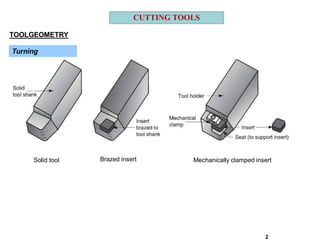
Solid tool Brazed insert Mechanically clamped insert
TOOLGEOMETRY
Turning
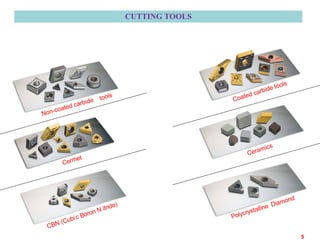
CUTTING TOOLS
VIDEO
2
CUTTING TOOLS
TOOLGEOMETRY
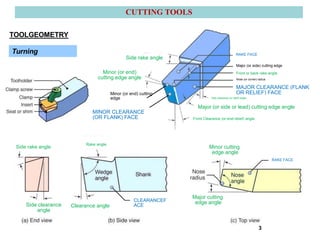
Turning RAKE FACE
Front Clearance (or end-relief) angle
Major (or side) cutting edge
Minor (or end) cutting
edge
Front or back rake angle
Nose (or corner) radius
MAJOR CLEARANCE (FLANK
OR RELIEF) FACE
Minor (or end)
cutting edge angle
MINOR CLEARANCE
(OR FLANK) FACE
Side rake angle
Major (or side or lead) cutting edge angle
Side clearance (or relief) angle
Major cutting
edge angle
Minor cutting
edge angle
RAKE FACE
CLEARANCEF
ACEClearance angle
Rake angle
Side clearance
angle
Side rake angle
VIDEO
3
TOOLGEOMETRY
CUTTING TOOLS
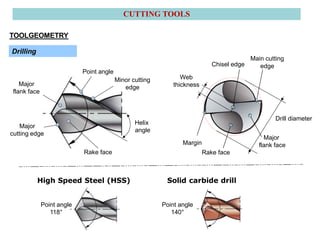
Drilling
Solid carbide drill
Chisel edge
Main cutting
edge
Rake face
Major
flank faceMargin
Drill diameter
Web
thicknessMajor
flank face
Major
cutting edge
Rake face
Point angle
Minor cutting
edge
Helix
angle
Point angle
140°
High Speed Steel (HSS)
Point angle
118°
CUTTING TOOLS
5
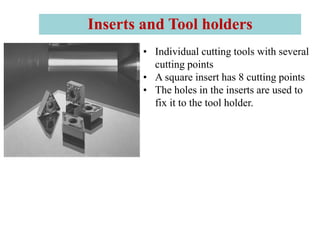
• Individual cutting tools with several
cutting points
• A square insert has 8 cutting points
• The holes in the inserts are used to
fix it to the tool holder.
Inserts and Tool holders
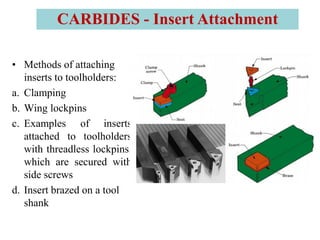
• Methods of attaching
inserts to toolholders:
a. Clamping
b. Wing lockpins
c. Examples of inserts
attached to toolholders
with threadless lockpins,
which are secured with
side screws
d. Insert brazed on a tool
shank
CARBIDES - Insert Attachment
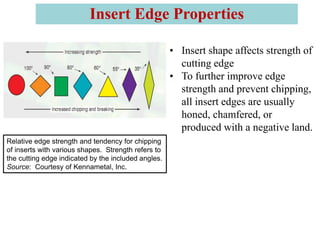
Relative edge strength and tendency for chipping
of inserts with various shapes. Strength refers to
the cutting edge indicated by the included angles.
Source: Courtesy of Kennametal, Inc.
• Insert shape affects strength of
cutting edge
• To further improve edge
strength and prevent chipping,
all insert edges are usually
honed, chamfered, or
produced with a negative land.
Insert Edge Properties
TOOL INSERT
CUTTING TOOLS
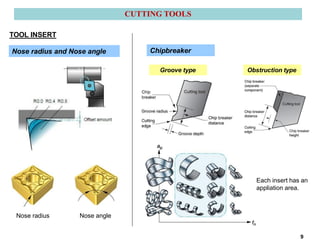
Nose radius and Nose angle Chipbreaker
Each insert has an
appliation area.
Groove type Obstruction type
Nose radius Nose angle
9
TOOL INSERT
CUTTING TOOLS
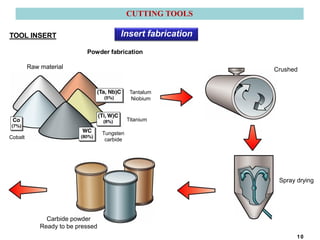
Insert fabrication
Raw material Crushed
Spray drying
Carbide powder
Ready to be pressed
Cobalt
Tungsten
carbide
Titanium
Tantalum
Niobium
Powder fabrication VIDEO
10
TOOL INSERT
CUTTING TOOLS
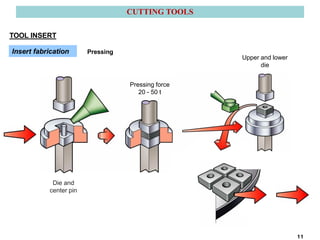
Insert fabrication
Pressing force
20 - 50 t
Upper and lower
die
Die and
center pin
Pressing
11
TOOL INSERT
CUTTING TOOLS
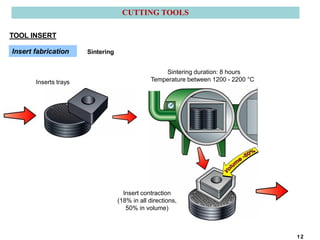
Insert fabrication Sintering
Sintering duration: 8 hours
Temperature between 1200 - 2200 °CInserts trays
Insert contraction
(18% in all directions,
50% in volume)
12
TOOL INSERT
CUTTING TOOLS
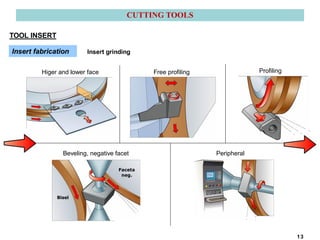
Insert fabrication Insert grinding
Higer and lower face Free profiling Profiling
Beveling, negative facet Peripheral
Bisel
Faceta
neg.
13
TOOL INSERT
CUTTING TOOLS
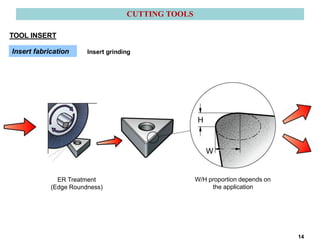
Insert fabrication Insert grinding
ER Treatment
(Edge Roundness)
W/H proportion depends on
the application
14
TOOL INSERT
CUTTING TOOLS
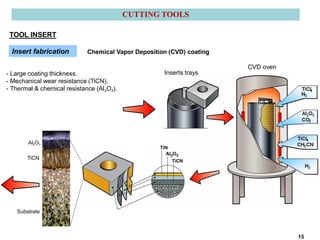
Insert fabrication Chemical Vapor Deposition (CVD) coating
- Large coating thickness.
- Mechanical wear resistance (TiCN).
- Thermal & chemical resistance (Al2O3).
Al2O3
TiCN
Substrate
Inserts trays
15
CVD oven
TOOL INSERT
CUTTING TOOLS
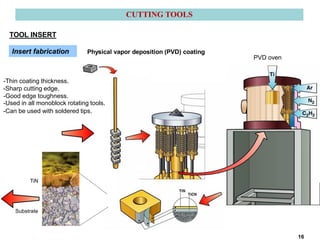
Insert fabrication Physical vapor deposition (PVD) coating
PVD oven
-Thin coating thickness.
-Sharp cutting edge.
-Good edge toughness.
-Used in all monoblock rotating tools.
-Can be used with soldered tips.
16
TiN
Substrate
TOOL INSERT
CUTTING TOOLS
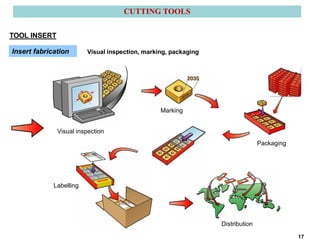
Insert fabrication Visual inspection, marking, packaging
Marking
Visual inspection
Packaging
17
Distribution
Labelling
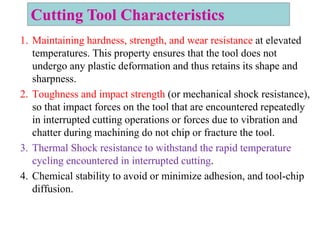
1. Maintaining hardness, strength, and wear resistance at elevated
temperatures. This property ensures that the tool does not
undergo any plastic deformation and thus retains its shape and
sharpness.
2. Toughness and impact strength (or mechanical shock resistance),
so that impact forces on the tool that are encountered repeatedly
in interrupted cutting operations or forces due to vibration and
chatter during machining do not chip or fracture the tool.
3. Thermal Shock resistance to withstand the rapid temperature
cycling encountered in interrupted cutting.
4. Chemical stability to avoid or minimize adhesion, and tool-chip
diffusion.
Cutting Tool Characteristics
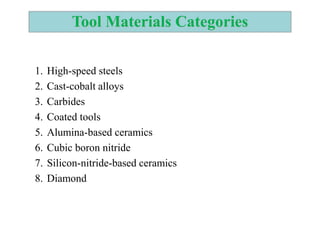
1. High-speed steels
2. Cast-cobalt alloys
3. Carbides
4. Coated tools
5. Alumina-based ceramics
6. Cubic boron nitride
7. Silicon-nitride-based ceramics
8. Diamond
Tool Materials Categories
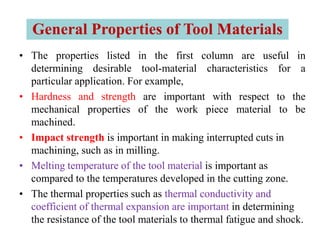
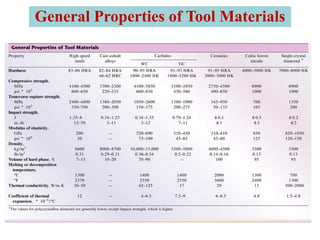
• The properties listed in the first column are useful in
determining desirable tool-material characteristics for a
particular application. For example,
• Hardness and strength are important with respect to the
mechanical properties of the work piece material to be
machined.
• Impact strength is important in making interrupted cuts in
machining, such as in milling.
• Melting temperature of the tool material is important as
compared to the temperatures developed in the cutting zone.
• The thermal properties such as thermal conductivity and
coefficient of thermal expansion are important in determining
the resistance of the tool materials to thermal fatigue and shock.
General Properties of Tool Materials
• Good wear resistance, relatively inexpensive
• Because of their toughness and high resistance to fracture, HSS are
especially suitable for:
1. high +ve rake-angle tools
2. interrupted cuts
1.HIGH SPEED STEELS
Two basic types of HSS:
• Molybdenum (M series)
Up to about 10% Mo, with Cr, Vn, W, Co as alloying elements
• Tungsten (T series)
12% -18% W, with Cr, Vn, and Co as alloying elements
M series generally has higher abrasion resistance than T series,
undergoes less distortion during heat treating, and is less
expensive
• List the major alloying elements in HSS and describe their
effects in cutting tools
• Chromium improves toughness, wear resistance, and high-
temperature strength.
• Vanadium improves toughness, abrasion resistance, and hot
hardness.
• Tungsten and cobalt have similar effects, namely, improved
strength and hot hardness.
• Molybdenum improves wear resistance, toughness, and high-
temperature strength and hardness.
1.HIGH SPEED STEELS
• 38%-53% Co, 30%-33% Cr, and 10%-20%W
• High hardness, good wear resistance, can maintain their
hardness at elevated temperatures
• They are not as tough as HSS and are sensitive to impact forces
• Stellite Tools
• These alloys are cast and ground into relatively simple tool
shapes.
• Used only for special applications that involve deep continuous
roughing cuts at relatively high feeds and speeds, as much as
twice the rates possible with HSS
2.CAST-COBALT ALLOYS
• The previous tools possess the required toughness, impact strength,
and thermal shock resistance, but they also have important
limitations, particularly with respect to strength and hot hardness.
• Carbides have:
a. Hardness over a wide range of temperatures.
b. high elastic modulus.
c. low thermal expansion.
• Tungsten carbide (WC):
• Composite material consisting of WC particles bonded together in
a cobalt matrix
• Manufactured with powder-metallurgy techniques
• As Co content increases, the strength, hardness, and wear
resistance of WC decrease, while its toughness increases because
of the higher toughness of cobalt
3.CARBIDES
• Titanium Carbide (TiC):
• Higher wear resistance than WC but is not as tough
• With a nickel-molybdenum alloy as the matrix, TiC is suitable
for machining hard materials, mainly steels and cast irons, and
for cutting at speeds higher than those for WC.
3.CARBIDES
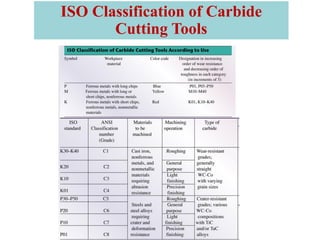
ISO Classification of Carbide
Cutting Tools
• Coatings thickness of 2-15 μm, are applied on cutting tools and
inserts by the following techniques:
1. Chemical-vapor deposition (CVD)
2. Physical-vapor deposition (PVD)
• Coatings for cutting tools should have the following general
characteristics:
1. High hardness at elevated temperatures
2. Chemical stability to the work piece material
3. Little or no porosity
• Honing of the cutting edges is an important procedure for the
maintenance of coating strength; otherwise, the coating may peel or
chip off at sharp edges
4.COATED TOOLS - Coating Materials
• Titanium Nitride coating (gold in color):
• low friction coefficient, high hardness, resistance to high
temp, and good adhesion to the substrate.
• perform well at higher cutting speeds and feeds
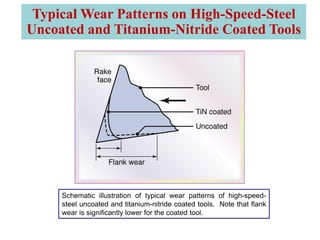
• Flank wear is significantly lower than that of uncoated tools
• do not perform as well at low cutting speeds because the
coating can be worn off by chip adhesion
• Titanium Carbide coatings:
• WC inserts have high flank-wear resistance in machining
abrasive materials
4.COATED TOOLS - Coating Materials
Schematic illustration of typical wear patterns of high-speed-
steel uncoated and titanium-nitride coated tools. Note that flank
wear is significantly lower for the coated tool.
Typical Wear Patterns on High-Speed-Steel
Uncoated and Titanium-Nitride Coated Tools
• Ceramics Coatings:
• Chemical inertness
• Low thermal conductivity
• Resistance to high temperature
• Resistance to flank and crater wear
• Most commonly used ceramic coating aluminum oxide
(Al2O3). However oxide coating generally bond weakly to
the substrate.
4.COATED TOOLS - Coating Materials
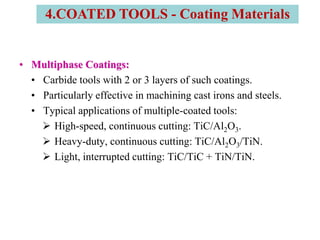
• Multiphase Coatings:
• Carbide tools with 2 or 3 layers of such coatings.
• Particularly effective in machining cast irons and steels.
• Typical applications of multiple-coated tools:
 High-speed, continuous cutting: TiC/Al2O3.
 Heavy-duty, continuous cutting: TiC/Al2O3/TiN.
 Light, interrupted cutting: TiC/TiC + TiN/TiN.
4.COATED TOOLS - Coating Materials
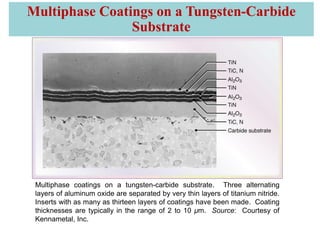
Multiphase coatings on a tungsten-carbide substrate. Three alternating
layers of aluminum oxide are separated by very thin layers of titanium nitride.
Inserts with as many as thirteen layers of coatings have been made. Coating
thicknesses are typically in the range of 2 to 10 μm. Source: Courtesy of
Kennametal, Inc.
Multiphase Coatings on a Tungsten-Carbide
Substrate
• Multiphase Coatings:
•Functions of coatings:
1.TiN: low friction
2.Al2O3: high thermal stability
3.TiCN: fiber reinforced with a good balance of resistance to
flank and crater wear for interrupted cutting
4.A thin carbide substrate: high fracture toughness
5.A thick carbide substrate: hard and resistant to plastic
deformation at high temperatures.
COATED TOOLS - Coating Materials
• Consist primarily of fine-grained, high-purity Al2O3. They are cold-
pressed into insert shapes under high pressure and sintered at high
temp; the end product is referred to as white, or cold-pressed,
ceramics.
• Additions of TiC and ZrO help improve toughness and thermal-
shock resistance.
• Alumina-based ceramic tools have very high abrasion resistance
and hot hardness.
• More stable than HSS and carbides, so they have less tendency to
adhere to metals during cutting leading to lower tendency to form a
BUE.
5.ALUMINA-BASED CERAMICS
• Consist of SiN with various additions of Al2O3, Yttrium oxide,
and TiC
• Toughness, hot hardness, and good thermal-shock resistance.
• An example of a SiN-base material is sialon, composed of : Si,
Al, and N.
• It has higher thermal-shock resistance than silicon nitride
• recommended for machining cast irons and nickel-based
super-alloys at intermediate cutting speeds
• Because of chemical affinity to iron, SiN-based tools are not
suitable for machining steels
6.SILICON-NITRIDE BASED
CERAMICS
• Made by bonding 0.5-1-mm layer of polycrystalline CBN to a
carbide substrate by sintering under pressure
• CBN tools are also made in small sizes without a substrate
• Because CBN tools are brittle, stiffness of machine tool and
fixturing is important in order to avoid vibration and chatter
7.CUBIC BORON NITRIDE (CBN)
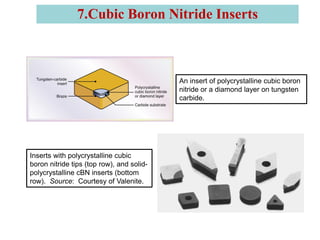
An insert of polycrystalline cubic boron
nitride or a diamond layer on tungsten
carbide.
Inserts with polycrystalline cubic
boron nitride tips (top row), and solid-
polycrystalline cBN inserts (bottom
row). Source: Courtesy of Valenite.
7.Cubic Boron Nitride Inserts
• Low friction
• High wear resistance
• Ability to maintain sharp edge
• Used when good surface finish and dimensional accuracy are
req. (soft non-ferrous & abrasive non-metallic materials)
• Used at high speed
• Diamond is not recommended for machining plain carbon
steels or titanium, because of its strong chem. Affinity
8.DIAMOND
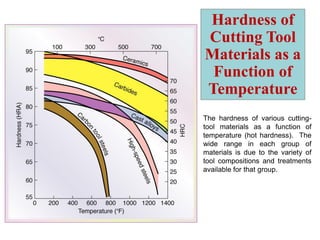
Hardness of
Cutting Tool
Materials as a
Function of
Temperature
The hardness of various cutting-
tool materials as a function of
temperature (hot hardness). The
wide range in each group of
materials is due to the variety of
tool compositions and treatments
available for that group.
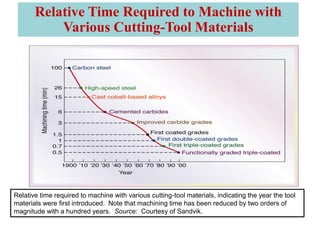
Relative time required to machine with various cutting-tool materials, indicating the year the tool
materials were first introduced. Note that machining time has been reduced by two orders of
magnitude with a hundred years. Source: Courtesy of Sandvik.
Relative Time Required to Machine with
Various Cutting-Tool Materials
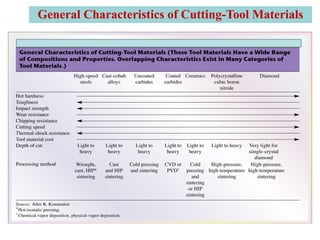
General Properties of Tool Materials
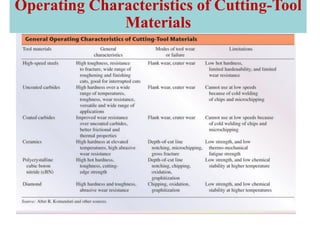
Operating Characteristics of Cutting-Tool
Materials
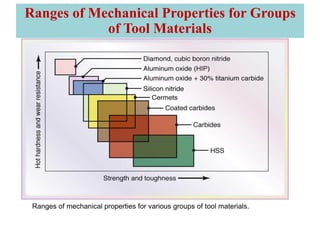
Ranges of Mechanical Properties for Groups
of Tool Materials
Ranges of mechanical properties for various groups of tool materials.
General Characteristics of Cutting-Tool Materials

03 cutting tool materials

  • 1.
  • 2.
    Solid tool Brazedinsert Mechanically clamped insert TOOLGEOMETRY Turning CUTTING TOOLS VIDEO 2
  • 3.
    CUTTING TOOLS TOOLGEOMETRY Turning RAKEFACE Front Clearance (or end-relief) angle Major (or side) cutting edge Minor (or end) cutting edge Front or back rake angle Nose (or corner) radius MAJOR CLEARANCE (FLANK OR RELIEF) FACE Minor (or end) cutting edge angle MINOR CLEARANCE (OR FLANK) FACE Side rake angle Major (or side or lead) cutting edge angle Side clearance (or relief) angle Major cutting edge angle Minor cutting edge angle RAKE FACE CLEARANCEF ACEClearance angle Rake angle Side clearance angle Side rake angle VIDEO 3
  • 4.
    TOOLGEOMETRY CUTTING TOOLS Drilling Solid carbidedrill Chisel edge Main cutting edge Rake face Major flank faceMargin Drill diameter Web thicknessMajor flank face Major cutting edge Rake face Point angle Minor cutting edge Helix angle Point angle 140° High Speed Steel (HSS) Point angle 118°
  • 5.
  • 6.
    • Individual cuttingtools with several cutting points • A square insert has 8 cutting points • The holes in the inserts are used to fix it to the tool holder. Inserts and Tool holders
  • 7.
    • Methods ofattaching inserts to toolholders: a. Clamping b. Wing lockpins c. Examples of inserts attached to toolholders with threadless lockpins, which are secured with side screws d. Insert brazed on a tool shank CARBIDES - Insert Attachment
  • 8.
    Relative edge strengthand tendency for chipping of inserts with various shapes. Strength refers to the cutting edge indicated by the included angles. Source: Courtesy of Kennametal, Inc. • Insert shape affects strength of cutting edge • To further improve edge strength and prevent chipping, all insert edges are usually honed, chamfered, or produced with a negative land. Insert Edge Properties
  • 9.
    TOOL INSERT CUTTING TOOLS Noseradius and Nose angle Chipbreaker Each insert has an appliation area. Groove type Obstruction type Nose radius Nose angle 9
  • 10.
    TOOL INSERT CUTTING TOOLS Insertfabrication Raw material Crushed Spray drying Carbide powder Ready to be pressed Cobalt Tungsten carbide Titanium Tantalum Niobium Powder fabrication VIDEO 10
  • 11.
    TOOL INSERT CUTTING TOOLS Insertfabrication Pressing force 20 - 50 t Upper and lower die Die and center pin Pressing 11
  • 12.
    TOOL INSERT CUTTING TOOLS Insertfabrication Sintering Sintering duration: 8 hours Temperature between 1200 - 2200 °CInserts trays Insert contraction (18% in all directions, 50% in volume) 12
  • 13.
    TOOL INSERT CUTTING TOOLS Insertfabrication Insert grinding Higer and lower face Free profiling Profiling Beveling, negative facet Peripheral Bisel Faceta neg. 13
  • 14.
    TOOL INSERT CUTTING TOOLS Insertfabrication Insert grinding ER Treatment (Edge Roundness) W/H proportion depends on the application 14
  • 15.
    TOOL INSERT CUTTING TOOLS Insertfabrication Chemical Vapor Deposition (CVD) coating - Large coating thickness. - Mechanical wear resistance (TiCN). - Thermal & chemical resistance (Al2O3). Al2O3 TiCN Substrate Inserts trays 15 CVD oven
  • 16.
    TOOL INSERT CUTTING TOOLS Insertfabrication Physical vapor deposition (PVD) coating PVD oven -Thin coating thickness. -Sharp cutting edge. -Good edge toughness. -Used in all monoblock rotating tools. -Can be used with soldered tips. 16 TiN Substrate
  • 17.
    TOOL INSERT CUTTING TOOLS Insertfabrication Visual inspection, marking, packaging Marking Visual inspection Packaging 17 Distribution Labelling
  • 18.
    1. Maintaining hardness,strength, and wear resistance at elevated temperatures. This property ensures that the tool does not undergo any plastic deformation and thus retains its shape and sharpness. 2. Toughness and impact strength (or mechanical shock resistance), so that impact forces on the tool that are encountered repeatedly in interrupted cutting operations or forces due to vibration and chatter during machining do not chip or fracture the tool. 3. Thermal Shock resistance to withstand the rapid temperature cycling encountered in interrupted cutting. 4. Chemical stability to avoid or minimize adhesion, and tool-chip diffusion. Cutting Tool Characteristics
  • 19.
    1. High-speed steels 2.Cast-cobalt alloys 3. Carbides 4. Coated tools 5. Alumina-based ceramics 6. Cubic boron nitride 7. Silicon-nitride-based ceramics 8. Diamond Tool Materials Categories
  • 20.
    • The propertieslisted in the first column are useful in determining desirable tool-material characteristics for a particular application. For example, • Hardness and strength are important with respect to the mechanical properties of the work piece material to be machined. • Impact strength is important in making interrupted cuts in machining, such as in milling. • Melting temperature of the tool material is important as compared to the temperatures developed in the cutting zone. • The thermal properties such as thermal conductivity and coefficient of thermal expansion are important in determining the resistance of the tool materials to thermal fatigue and shock. General Properties of Tool Materials
  • 21.
    • Good wearresistance, relatively inexpensive • Because of their toughness and high resistance to fracture, HSS are especially suitable for: 1. high +ve rake-angle tools 2. interrupted cuts 1.HIGH SPEED STEELS Two basic types of HSS: • Molybdenum (M series) Up to about 10% Mo, with Cr, Vn, W, Co as alloying elements • Tungsten (T series) 12% -18% W, with Cr, Vn, and Co as alloying elements M series generally has higher abrasion resistance than T series, undergoes less distortion during heat treating, and is less expensive
  • 22.
    • List themajor alloying elements in HSS and describe their effects in cutting tools • Chromium improves toughness, wear resistance, and high- temperature strength. • Vanadium improves toughness, abrasion resistance, and hot hardness. • Tungsten and cobalt have similar effects, namely, improved strength and hot hardness. • Molybdenum improves wear resistance, toughness, and high- temperature strength and hardness. 1.HIGH SPEED STEELS
  • 23.
    • 38%-53% Co,30%-33% Cr, and 10%-20%W • High hardness, good wear resistance, can maintain their hardness at elevated temperatures • They are not as tough as HSS and are sensitive to impact forces • Stellite Tools • These alloys are cast and ground into relatively simple tool shapes. • Used only for special applications that involve deep continuous roughing cuts at relatively high feeds and speeds, as much as twice the rates possible with HSS 2.CAST-COBALT ALLOYS
  • 24.
    • The previoustools possess the required toughness, impact strength, and thermal shock resistance, but they also have important limitations, particularly with respect to strength and hot hardness. • Carbides have: a. Hardness over a wide range of temperatures. b. high elastic modulus. c. low thermal expansion. • Tungsten carbide (WC): • Composite material consisting of WC particles bonded together in a cobalt matrix • Manufactured with powder-metallurgy techniques • As Co content increases, the strength, hardness, and wear resistance of WC decrease, while its toughness increases because of the higher toughness of cobalt 3.CARBIDES
  • 25.
    • Titanium Carbide(TiC): • Higher wear resistance than WC but is not as tough • With a nickel-molybdenum alloy as the matrix, TiC is suitable for machining hard materials, mainly steels and cast irons, and for cutting at speeds higher than those for WC. 3.CARBIDES
  • 26.
    ISO Classification ofCarbide Cutting Tools
  • 27.
    • Coatings thicknessof 2-15 μm, are applied on cutting tools and inserts by the following techniques: 1. Chemical-vapor deposition (CVD) 2. Physical-vapor deposition (PVD) • Coatings for cutting tools should have the following general characteristics: 1. High hardness at elevated temperatures 2. Chemical stability to the work piece material 3. Little or no porosity • Honing of the cutting edges is an important procedure for the maintenance of coating strength; otherwise, the coating may peel or chip off at sharp edges 4.COATED TOOLS - Coating Materials
  • 28.
    • Titanium Nitridecoating (gold in color): • low friction coefficient, high hardness, resistance to high temp, and good adhesion to the substrate. • perform well at higher cutting speeds and feeds • Flank wear is significantly lower than that of uncoated tools • do not perform as well at low cutting speeds because the coating can be worn off by chip adhesion • Titanium Carbide coatings: • WC inserts have high flank-wear resistance in machining abrasive materials 4.COATED TOOLS - Coating Materials
  • 29.
    Schematic illustration oftypical wear patterns of high-speed- steel uncoated and titanium-nitride coated tools. Note that flank wear is significantly lower for the coated tool. Typical Wear Patterns on High-Speed-Steel Uncoated and Titanium-Nitride Coated Tools
  • 30.
    • Ceramics Coatings: •Chemical inertness • Low thermal conductivity • Resistance to high temperature • Resistance to flank and crater wear • Most commonly used ceramic coating aluminum oxide (Al2O3). However oxide coating generally bond weakly to the substrate. 4.COATED TOOLS - Coating Materials
  • 31.
    • Multiphase Coatings: •Carbide tools with 2 or 3 layers of such coatings. • Particularly effective in machining cast irons and steels. • Typical applications of multiple-coated tools:  High-speed, continuous cutting: TiC/Al2O3.  Heavy-duty, continuous cutting: TiC/Al2O3/TiN.  Light, interrupted cutting: TiC/TiC + TiN/TiN. 4.COATED TOOLS - Coating Materials
  • 32.
    Multiphase coatings ona tungsten-carbide substrate. Three alternating layers of aluminum oxide are separated by very thin layers of titanium nitride. Inserts with as many as thirteen layers of coatings have been made. Coating thicknesses are typically in the range of 2 to 10 μm. Source: Courtesy of Kennametal, Inc. Multiphase Coatings on a Tungsten-Carbide Substrate
  • 33.
    • Multiphase Coatings: •Functionsof coatings: 1.TiN: low friction 2.Al2O3: high thermal stability 3.TiCN: fiber reinforced with a good balance of resistance to flank and crater wear for interrupted cutting 4.A thin carbide substrate: high fracture toughness 5.A thick carbide substrate: hard and resistant to plastic deformation at high temperatures. COATED TOOLS - Coating Materials
  • 34.
    • Consist primarilyof fine-grained, high-purity Al2O3. They are cold- pressed into insert shapes under high pressure and sintered at high temp; the end product is referred to as white, or cold-pressed, ceramics. • Additions of TiC and ZrO help improve toughness and thermal- shock resistance. • Alumina-based ceramic tools have very high abrasion resistance and hot hardness. • More stable than HSS and carbides, so they have less tendency to adhere to metals during cutting leading to lower tendency to form a BUE. 5.ALUMINA-BASED CERAMICS
  • 35.
    • Consist ofSiN with various additions of Al2O3, Yttrium oxide, and TiC • Toughness, hot hardness, and good thermal-shock resistance. • An example of a SiN-base material is sialon, composed of : Si, Al, and N. • It has higher thermal-shock resistance than silicon nitride • recommended for machining cast irons and nickel-based super-alloys at intermediate cutting speeds • Because of chemical affinity to iron, SiN-based tools are not suitable for machining steels 6.SILICON-NITRIDE BASED CERAMICS
  • 36.
    • Made bybonding 0.5-1-mm layer of polycrystalline CBN to a carbide substrate by sintering under pressure • CBN tools are also made in small sizes without a substrate • Because CBN tools are brittle, stiffness of machine tool and fixturing is important in order to avoid vibration and chatter 7.CUBIC BORON NITRIDE (CBN)
  • 37.
    An insert ofpolycrystalline cubic boron nitride or a diamond layer on tungsten carbide. Inserts with polycrystalline cubic boron nitride tips (top row), and solid- polycrystalline cBN inserts (bottom row). Source: Courtesy of Valenite. 7.Cubic Boron Nitride Inserts
  • 38.
    • Low friction •High wear resistance • Ability to maintain sharp edge • Used when good surface finish and dimensional accuracy are req. (soft non-ferrous & abrasive non-metallic materials) • Used at high speed • Diamond is not recommended for machining plain carbon steels or titanium, because of its strong chem. Affinity 8.DIAMOND
  • 39.
    Hardness of Cutting Tool Materialsas a Function of Temperature The hardness of various cutting- tool materials as a function of temperature (hot hardness). The wide range in each group of materials is due to the variety of tool compositions and treatments available for that group.
  • 40.
    Relative time requiredto machine with various cutting-tool materials, indicating the year the tool materials were first introduced. Note that machining time has been reduced by two orders of magnitude with a hundred years. Source: Courtesy of Sandvik. Relative Time Required to Machine with Various Cutting-Tool Materials
  • 41.
    General Properties ofTool Materials
  • 42.
    Operating Characteristics ofCutting-Tool Materials
  • 43.
    Ranges of MechanicalProperties for Groups of Tool Materials Ranges of mechanical properties for various groups of tool materials.
  • 44.
    General Characteristics ofCutting-Tool Materials