INVESTMENT CASTING
BY
ARAVINDKUMAR B
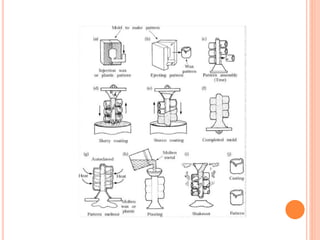
INVESTMENT CASTING PROCESS
 To create intricately detailed shapes
 Also called lost wax process begins with the production of wax
replicas or patterns of the desired shape of the castings.
 The patterns are prepared by injecting wax or polystyrene in a
metal dies.
 A number of patterns are attached to a central wax sprue to
form a assembly.
 The mold is prepared by surrounding the pattern with
refractory slurry that can set at room temperature.
 The mold is then heated so that pattern melts and flows out,
leaving a clean cavity behind.
 The mould is further hardened by heating and the molten
metal is poured while it is still hot.
 When the casting is solidified, the mold is broken and the
casting taken out
METHODOLOGY
 Pattern is made up of wax / polystyrene polyethylene
 Dipping is done in extremely fine silica and
water/gypsum solution.
 Baked in a oven for 2 hours to melt out the wax (100-
120 C)
 Mold is cured for sometime at 800-900 C
ADVANDAGES
 Intricate details can be cast
 smooth surface /no parting line
 high accuracy
 unmachinable alloys ( HRS + Nimonic alloys)
 mininimum wall thickness of 1-2mm
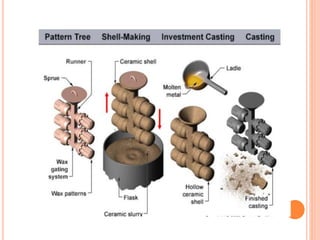
The basic steps of the investment casting process are
 Production of heat-disposable wax, plastic, or
polystyrene patterns
 Assembly of these patterns onto a gating system
 “Investing,” or covering the pattern assembly with
refractory slurry
 Melting the pattern assembly to remove the pattern
material
 Firing the mold to remove the last traces of the
pattern material
 Pouring
 Knockout, cutoff and finishing
APPLICATIONS
 Parts for aerospace industry / aircraft engines
 Food / beverage machinery
 m/c tools, scientific instruments, sewing machine
 nozzles, vanes, blades for gas turbines.

Investment casting

  • 1.
  • 2.
    INVESTMENT CASTING PROCESS To create intricately detailed shapes  Also called lost wax process begins with the production of wax replicas or patterns of the desired shape of the castings.  The patterns are prepared by injecting wax or polystyrene in a metal dies.  A number of patterns are attached to a central wax sprue to form a assembly.  The mold is prepared by surrounding the pattern with refractory slurry that can set at room temperature.  The mold is then heated so that pattern melts and flows out, leaving a clean cavity behind.  The mould is further hardened by heating and the molten metal is poured while it is still hot.  When the casting is solidified, the mold is broken and the casting taken out
  • 3.
    METHODOLOGY  Pattern ismade up of wax / polystyrene polyethylene  Dipping is done in extremely fine silica and water/gypsum solution.  Baked in a oven for 2 hours to melt out the wax (100- 120 C)  Mold is cured for sometime at 800-900 C
  • 5.
    ADVANDAGES  Intricate detailscan be cast  smooth surface /no parting line  high accuracy  unmachinable alloys ( HRS + Nimonic alloys)  mininimum wall thickness of 1-2mm
  • 7.
    The basic stepsof the investment casting process are  Production of heat-disposable wax, plastic, or polystyrene patterns  Assembly of these patterns onto a gating system  “Investing,” or covering the pattern assembly with refractory slurry  Melting the pattern assembly to remove the pattern material  Firing the mold to remove the last traces of the pattern material  Pouring  Knockout, cutoff and finishing
  • 8.
    APPLICATIONS  Parts foraerospace industry / aircraft engines  Food / beverage machinery  m/c tools, scientific instruments, sewing machine  nozzles, vanes, blades for gas turbines.