Capsule Dosage formCapsule Dosage form
Mr. Nitin M. KadamMr. Nitin M. Kadam
nitkadam@gmail.com
1. They may be used to mask the unpleasant tastes, aromas, or
appearance of a drug.
2. They allow powders to be dispensed in an uncompressed form, thus
allowing for quicker dissolution and absorption of the drug following
oral dosing (as compared with tablets).
3. They offer the pharmacist versatility to prepare any dose desired for a
variety of administration routes(e.g. oral, inhalation, rectal, or to be
diluted for vaginal, rectal, oral or topical use).
4. They may be easier than tablets for some people to swallow.
5. They can be make to alter the release rate of the drug.
 Easy to administer
 Easy to Manufacture
 Liquids can be encapsulated ( non water soluble) Small to large sizes
possible
 Elegance
 Portability
 Odour and taste masking
 Ready availability of drug hence faster action.
 Specialised dosage forms can be made
e.g. chewable, extended release, captabs etc. Can be used for ophthalmic
preparations e.g. aplicaps, vaginal / rectal suppositories
1. They are easily tampered
2. They are subject to the effects of relative humidity and to
microbial contamination.
3. They may be difficult for some people to swallow.
4. More expensive (commercially).
Water soluble material are difficult to incorporate
Highly Moisture sensitive Efflorescent material
cannot be incorporated, they may cause
softening / leaching
Deliquescent materials cannot be incorporated,
they may cause hardening or brittle capsules.
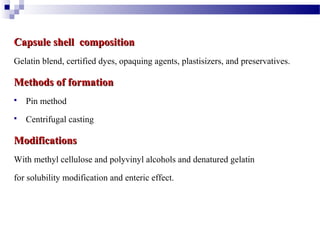
Capsule shell compositionCapsule shell composition
Gelatin blend, certified dyes, opaquing agents, plastisizers, and preservatives.
Methods of formationMethods of formation
 Pin method
 Centrifugal casting
ModificationsModifications
With methyl cellulose and polyvinyl alcohols and denatured gelatin
for solubility modification and enteric effect.
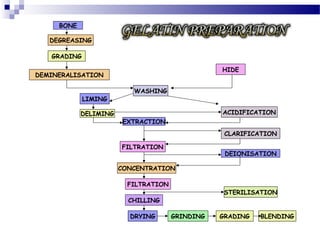
BONE
DEGREASING
CLARIFICATION
DEMINERALISATION
WASHING
FILTRATION
STERILISATION
EXTRACTION
CONCENTRATION
ACIDIFICATION
HIDE
DEIONISATION
DELIMING
LIMING
BLENDING
GRADING
GRINDINGDRYING
CHILLING
GRADING
FILTRATION
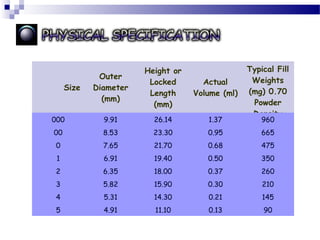
Size
Outer
Diameter
(mm)
Height or
Locked
Length
(mm)
Actual
Volume (ml)
Typical Fill
Weights
(mg) 0.70
Powder
Density
000 9.91 26.14 1.37 960
00 8.53 23.30 0.95 665
0 7.65 21.70 0.68 475
1 6.91 19.40 0.50 350
2 6.35 18.00 0.37 260
3 5.82 15.90 0.30 210
4 5.31 14.30 0.21 145
5 4.91 11.10 0.13 90
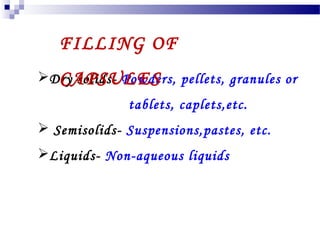
Dry solids- Powders, pellets, granules or
tablets, caplets,etc.
 Semisolids- Suspensions,pastes, etc.
Liquids- Non-aqueous liquids
FILLING OF
CAPSULES
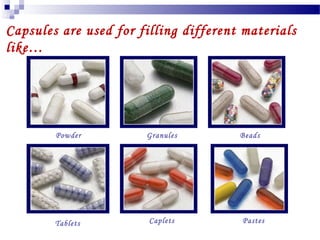
Capsules are used for filling different materials
like…
es of formulation such as:                                                                                                                                                      
Powder Granules Beads
PastesCapletsTablets
Capsule Filling, Problems in Filling & Remedies
Filling capsule with a
semisolid mass.
Forming a pipe or pouring a melt.
 Pipe:
Consistency is important.
[For fluid- cornstarch or similar material for firm
cosistancy.]
 Semisolid melt:
For too firm with satisfactory M.P. materials.
For enhancing the bioavailability of poorly soluble drugs.
[Drug + melt of materials like PEG]
Filling of Liquids in Capsule
 Manual Small Scale
 Solubility of gelatin.
 Alcoholic solutions, fixed oils & volatile oils
 Filling and sealing
 Industrial Scale Filling
 Variety of shapes and sizes
 Semi-to fully automatic
 Output from 5000 to 15000 per hour.
Filling of Solids in Capsule
 Homogeneous mixture
 Adequate flow properties
 Physical incompatibilities
 Choice of excipients:
Diluents, lubricants & glidants, wetting agents,
disintegrants.
DIFFICULTIES IN CAPSULE FILLING
1. Deliquescent / Hygroscopic powders.
Remedy: Adsorbent [magnesium carbonate, heavy / light
magnesium oxide]
2. Eutectic mixture
Remedy: Use of adsorbent [magnesium carbonate, kaolin]
3. Small dose of drug
Remedy: Addition of inert powder.
4. Incompatibilities of materials
Remedy: Use of two capsules – small in large
5. Lack of adhessiveness difficult to fill by punch method
Remedy: moistened with alcohol , granules reduced to powders
ALTERNATIVE MATERIAL
FOR
HARD GELATIN CAPSULES
Substitute for gelatin in two piece hard capsules
HPMC
QUALI-V by Shionogi Qualicaps: First HPMC Capsule
Capsule Processing
Empty Capsule
Filling [Formulation]
Finishing
# Dusting [Cloth Dusting]
# Polishing [Pan Polishing]
# Brushing
Inspection
Bottling
Labeling
Special Techniques of Processing
Imprinting
Special purpose Capsules
[To retard solubility of gelatin to delay absorption of drug]
* Formalin treatment
* Various coatings
Separation of Incompatible materials
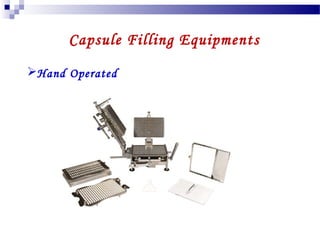
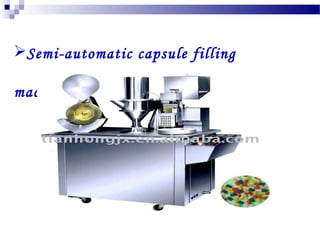
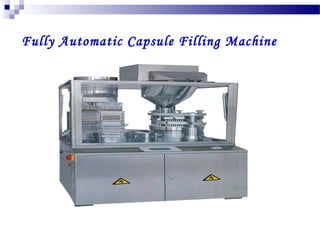
Capsule Filling Equipments
Hand Operated
Semi-automatic capsule filling
machine
Fully Automatic Capsule Filling Machine
In-process Quality And
Quality Control Parameters
Choice of suitable control procedure for filling operation:
[should desirable to provide 100% weight checking after filling]
Capsule Appearance
Weight veriation
Content uniformity
Solubility
Disintegration test
Thank you

Capsules

  • 1.
    Capsule Dosage formCapsuleDosage form Mr. Nitin M. KadamMr. Nitin M. Kadam nitkadam@gmail.com
  • 2.
    1. They maybe used to mask the unpleasant tastes, aromas, or appearance of a drug. 2. They allow powders to be dispensed in an uncompressed form, thus allowing for quicker dissolution and absorption of the drug following oral dosing (as compared with tablets). 3. They offer the pharmacist versatility to prepare any dose desired for a variety of administration routes(e.g. oral, inhalation, rectal, or to be diluted for vaginal, rectal, oral or topical use). 4. They may be easier than tablets for some people to swallow. 5. They can be make to alter the release rate of the drug.
  • 3.
     Easy toadminister  Easy to Manufacture  Liquids can be encapsulated ( non water soluble) Small to large sizes possible  Elegance  Portability  Odour and taste masking  Ready availability of drug hence faster action.  Specialised dosage forms can be made e.g. chewable, extended release, captabs etc. Can be used for ophthalmic preparations e.g. aplicaps, vaginal / rectal suppositories
  • 4.
    1. They areeasily tampered 2. They are subject to the effects of relative humidity and to microbial contamination. 3. They may be difficult for some people to swallow. 4. More expensive (commercially).
  • 5.
    Water soluble materialare difficult to incorporate Highly Moisture sensitive Efflorescent material cannot be incorporated, they may cause softening / leaching Deliquescent materials cannot be incorporated, they may cause hardening or brittle capsules.
  • 7.
    Capsule shell compositionCapsuleshell composition Gelatin blend, certified dyes, opaquing agents, plastisizers, and preservatives. Methods of formationMethods of formation  Pin method  Centrifugal casting ModificationsModifications With methyl cellulose and polyvinyl alcohols and denatured gelatin for solubility modification and enteric effect.
  • 8.
  • 10.
    Size Outer Diameter (mm) Height or Locked Length (mm) Actual Volume (ml) TypicalFill Weights (mg) 0.70 Powder Density 000 9.91 26.14 1.37 960 00 8.53 23.30 0.95 665 0 7.65 21.70 0.68 475 1 6.91 19.40 0.50 350 2 6.35 18.00 0.37 260 3 5.82 15.90 0.30 210 4 5.31 14.30 0.21 145 5 4.91 11.10 0.13 90
  • 11.
    Dry solids- Powders,pellets, granules or tablets, caplets,etc.  Semisolids- Suspensions,pastes, etc. Liquids- Non-aqueous liquids FILLING OF CAPSULES
  • 12.
    Capsules are usedfor filling different materials like… es of formulation such as:                                                                                                                                                       Powder Granules Beads PastesCapletsTablets
  • 13.
    Capsule Filling, Problemsin Filling & Remedies Filling capsule with a semisolid mass. Forming a pipe or pouring a melt.  Pipe: Consistency is important. [For fluid- cornstarch or similar material for firm cosistancy.]  Semisolid melt: For too firm with satisfactory M.P. materials. For enhancing the bioavailability of poorly soluble drugs. [Drug + melt of materials like PEG]
  • 14.
    Filling of Liquidsin Capsule  Manual Small Scale  Solubility of gelatin.  Alcoholic solutions, fixed oils & volatile oils  Filling and sealing  Industrial Scale Filling  Variety of shapes and sizes  Semi-to fully automatic  Output from 5000 to 15000 per hour.
  • 15.
    Filling of Solidsin Capsule  Homogeneous mixture  Adequate flow properties  Physical incompatibilities  Choice of excipients: Diluents, lubricants & glidants, wetting agents, disintegrants.
  • 16.
    DIFFICULTIES IN CAPSULEFILLING 1. Deliquescent / Hygroscopic powders. Remedy: Adsorbent [magnesium carbonate, heavy / light magnesium oxide] 2. Eutectic mixture Remedy: Use of adsorbent [magnesium carbonate, kaolin] 3. Small dose of drug Remedy: Addition of inert powder. 4. Incompatibilities of materials Remedy: Use of two capsules – small in large 5. Lack of adhessiveness difficult to fill by punch method Remedy: moistened with alcohol , granules reduced to powders
  • 17.
    ALTERNATIVE MATERIAL FOR HARD GELATINCAPSULES Substitute for gelatin in two piece hard capsules HPMC QUALI-V by Shionogi Qualicaps: First HPMC Capsule
  • 18.
    Capsule Processing Empty Capsule Filling[Formulation] Finishing # Dusting [Cloth Dusting] # Polishing [Pan Polishing] # Brushing Inspection Bottling Labeling
  • 19.
    Special Techniques ofProcessing Imprinting Special purpose Capsules [To retard solubility of gelatin to delay absorption of drug] * Formalin treatment * Various coatings Separation of Incompatible materials
  • 20.
  • 21.
  • 22.
    Fully Automatic CapsuleFilling Machine
  • 23.
    In-process Quality And QualityControl Parameters Choice of suitable control procedure for filling operation: [should desirable to provide 100% weight checking after filling] Capsule Appearance Weight veriation Content uniformity Solubility Disintegration test
  • 24.