CAPSULES
By
Ms . Prajakta Chawale
Lecturer,
Nagpur College of Pharmacy,
Wanadondgri,Nagpur
Content
 Definition of capsule and Types of capsules
 Advantages and disadvantages of capsule.
 Hard Gelatin Capsule – excipent, filling of capsules
 Soft Gelatin Capsule- filling of soft gelatin capsule.
 Difference between hard gelatin and soft gelatin capsule.
 Properties of powder to be filled in capsule.
 Special application of capsule.
 Capsule: Capsules are a solid unit dosage form in which the drug
substances are enclosed in a water soluble shell or an envelope.
Types of capsules
1. Hard gelatin capsule
2. Soft gelatin capsule
Advantages and disadvantages of
Capsules
Advantages of capsules:
 Drugs having unpleasant odor and taste can be administered by enclosing them in a
shell.
 They are smooth, become slippery when moist and can be easily swallowed.
 Economical.
 Easy to handle and carry.
 Capsules are made from gelatin and hence they are therapeutically inert.
 Attractive.
 Microencapsulation provides sustained release dosage form.
Disadvantages:
 Hygroscopic drugs cannot be filled in capsule as they make the shell very brittle.
 Concentrated preparation which needs dilution before administration cannot be
given in form of capsule.
1. Hard Gelatin Capsule
 These are used for administration of solid medicaments.
 The capsule shell is prepared from gelatin, colour and titanium
dioxide to make it opaque.
 It consists of two parts i.e. body and cap.
 The powdered material is filled into the cylindrical body of the
capsule and then the cap is placed over it.
 The empty capsules are available in various sizes.
 They are numbered according to the capacity of the capsules. The
number starts from 000 and goes up to 5.
Capsule Number with its capacity
Capsule no. Capacity in mg
000 950
00 650
0 450
1 300
2 250
3 200
4 150
5 100
Excipients used in filling of capsules
 Diluents: To increase bulk, e.g. lactose, sorbitol, starch etc.
 Absorbents: Eutectic or hygroscopic drug need absorbent for, e.g. oxides and
carbonates of magnesium and calcium.
 Glidants: To ensure a regular flow of powder, e.g. talc and magnesium
stearate.
 Antidusting agents: During filling of capsule in automatic filling machine a
lot of dust comes out to avoid this antidusting agents are added e.g. inert
oils.
Methods of filling the hard gelatin
capsules
 The capsules can be filled either by hand or by a semi-automatic device or by
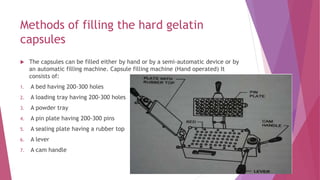
an automatic filling machine. Capsule filling machine (Hand operated) It
consists of:
1. A bed having 200-300 holes
2. A loading tray having 200-300 holes
3. A powder tray
4. A pin plate having 200-300 pins
5. A sealing plate having a rubber top
6. A lever
7. A cam handle
 Capsules are filled in the loading tray& placed over the filling bed.
 Cam handle is operated to separate the capsule caps from their bodies.
 The powder tray is placed on the filling tray to prevent the material from
being lost,
 The powder to be filled in the capsules is placed in powder trays and spread
with the help of a powder spreader, to fill the bodies of the capsules
uniformly.
 The pin plate is lowered so as to press the powder into the bodies.
 After pressing, the pin plate is raised and the excess powder is filled into the
bodies of the capsules.
 The cap-holding tray is again placed in position. The sealing plate with rubber
top is lowered and the lever is operated forcing the bodies into the caps,
 The well-filled capsules are then cleaned by wiping with clean cloth. This
gives good shine to the capsules.
 Cleaning of capsules:- All capsules, whether they have been filled by
hand or machine, will require cleaning. Small quantities of capsules
can be wiped individually with soft cloth. But case of large quantities,
capsules are rotated or shaken with crystalline sodium chloride. The
then rolled on cloth covered surfaces.
 Sealing of capsules:- The capsules are then sealed, to ensure that the
medicaments may not come out of the capsule due rough handling.
This can be done by banding them with molten gelatin, laid around
the joint in a strip and dried. Capsules can be sealed by spot welding,
by means of a heated metal pin, pressed against the cap and fusing
the body.
2. Soft gelatin capsule
 These are used for administration of liquid medicaments. Soft gelatin
capsules are available in round, oval and tube like shapes.
 They are made from gelatin.
 The gelatin is plasticized by the addition of glycerin and sorbitol etc.
 The soft gelatin shell may contain preservative prevent the growth of
fungi. They are used to enclose liquid medicaments, suspensions, food
concentrates and ophthalmic products.
Method of filling soft gelatin capsule
 Soft gelatin capsules are generally filled mechanically.
 The manufacturing of the capsule shell and the filling of the
medicament take place simultaneously.
 Nowadays, a rotary machine is used for this purpose.
 Rotary machine In a rotary die machine, the soft gelatin capsules are
prepared and then filled immediately with the liquid medicaments.
Liquid gelatin
produces two ribbons
These come between
rotating dies which
rotates in opposite
direction.
Form half shell of
capsule
At this stage
measured quantity of
drug is filled in shell
With further
movement of dies
other half is formed
Sealing is done by hot
rotating dies
The capsule formed
are washed and
dried.
Difference between hard gelatin
capsule and soft gelatin capsule
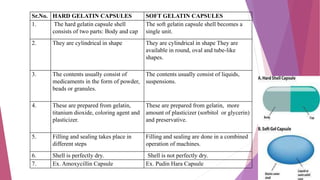
Sr.No. HARD GELATIN CAPSULES SOFT GELATIN CAPSULES
1. The hard gelatin capsule shell
consists of two parts: Body and cap
The soft gelatin capsule shell becomes a
single unit.
2. They are cylindrical in shape They are cylindrical in shape They are
available in round, oval and tube-like
shapes.
3. The contents usually consist of
medicaments in the form of powder,
beads or granules.
The contents usually consist of liquids,
suspensions.
4. These are prepared from gelatin,
titanium dioxide, coloring agent and
plasticizer.
These are prepared from gelatin, more
amount of plasticizer (sorbitol or glycerin)
and preservative.
5. Filling and sealing takes place in
different steps
Filling and sealing are done in a combined
operation of machines.
6. Shell is perfectly dry. Shell is not perfectly dry.
7. Ex. Amoxycillin Capsule Ex. Pudin Hara Capsule
Properties of powder to be filled in
capsule
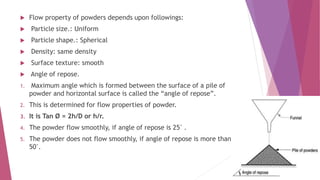
 Flow property of powders depends upon followings:
 Particle size.: Uniform
 Particle shape.: Spherical
 Density: same density
 Surface texture: smooth
 Angle of repose.
1. Maximum angle which is formed between the surface of a pile of
powder and horizontal surface is called the “angle of repose”.
2. This is determined for flow properties of powder.
3. It is Tan Ø = 2h/D or h/r.
4. The powder flow smoothly, if angle of repose is 25˚ .
5. The powder does not flow smoothly, if angle of repose is more than
50˚.
Special application of capsules
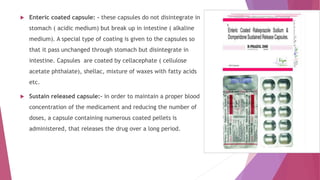
 Enteric coated capsule: - these capsules do not disintegrate in
stomach ( acidic medium) but break up in intestine ( alkaline
medium). A special type of coating is given to the capsules so
that it pass unchanged through stomach but disintegrate in
intestine. Capsules are coated by cellacephate ( cellulose
acetate phthalate), shellac, mixture of waxes with fatty acids
etc.
 Sustain released capsule:- in order to maintain a proper blood
concentration of the medicament and reducing the number of
doses, a capsule containing numerous coated pellets is
administered, that releases the drug over a long period.
 Rectal capsule (suppositories):- soft gelatin capsules may be used as substitutes
for rectal and vaginal suppositories.
 Capsules containing ophthalmic ointments:- soft gelatin capsules are employed
for packaging of ophthalmic ointments. It is very important that the ophthalmic
ointment should be sterile. To keep such preparations sterile during their storage
and later use it is required to fill in single dose containers. Hence soft gelatin
capsules are used.
1. Sterility can be maintained.
2. Contamination can be avoided.
3. No wastage.
4. Easy to handle.
5. Easy for transportation.
6. Economical.
7. Easy to use or good patient compliance.
Questions
1. Define capsule. Give merit and demerit of capsule as dosage form.
2. Discuss the excipients used in filling of hard gelatin capsule.
3. Differentiate between hard gelatin and soft gelatin capsules.
4. Write the approximate capacity in mg of a capsule having number
000, 0, 1, 2, 3, 4 and 5.
5. Write special application of capsule.
6. What should be the properties of powder to be filled in hard gelatine
capsule?
7. Describe the process of manufacturing of hard gelatine capsules.
8. Describe method for preparation of soft gelatin capsule using rotary
machine.
9. Why ophthalmic ointments are now days packed in capsules?
THANK YOU

capsules.pptx

  • 1.
    CAPSULES By Ms . PrajaktaChawale Lecturer, Nagpur College of Pharmacy, Wanadondgri,Nagpur
  • 2.
    Content  Definition ofcapsule and Types of capsules  Advantages and disadvantages of capsule.  Hard Gelatin Capsule – excipent, filling of capsules  Soft Gelatin Capsule- filling of soft gelatin capsule.  Difference between hard gelatin and soft gelatin capsule.  Properties of powder to be filled in capsule.  Special application of capsule.
  • 3.
     Capsule: Capsulesare a solid unit dosage form in which the drug substances are enclosed in a water soluble shell or an envelope. Types of capsules 1. Hard gelatin capsule 2. Soft gelatin capsule
  • 4.
    Advantages and disadvantagesof Capsules Advantages of capsules:  Drugs having unpleasant odor and taste can be administered by enclosing them in a shell.  They are smooth, become slippery when moist and can be easily swallowed.  Economical.  Easy to handle and carry.  Capsules are made from gelatin and hence they are therapeutically inert.  Attractive.  Microencapsulation provides sustained release dosage form. Disadvantages:  Hygroscopic drugs cannot be filled in capsule as they make the shell very brittle.  Concentrated preparation which needs dilution before administration cannot be given in form of capsule.
  • 5.
  • 6.
     These areused for administration of solid medicaments.  The capsule shell is prepared from gelatin, colour and titanium dioxide to make it opaque.  It consists of two parts i.e. body and cap.  The powdered material is filled into the cylindrical body of the capsule and then the cap is placed over it.  The empty capsules are available in various sizes.  They are numbered according to the capacity of the capsules. The number starts from 000 and goes up to 5.
  • 7.
    Capsule Number withits capacity Capsule no. Capacity in mg 000 950 00 650 0 450 1 300 2 250 3 200 4 150 5 100
  • 8.
    Excipients used infilling of capsules  Diluents: To increase bulk, e.g. lactose, sorbitol, starch etc.  Absorbents: Eutectic or hygroscopic drug need absorbent for, e.g. oxides and carbonates of magnesium and calcium.  Glidants: To ensure a regular flow of powder, e.g. talc and magnesium stearate.  Antidusting agents: During filling of capsule in automatic filling machine a lot of dust comes out to avoid this antidusting agents are added e.g. inert oils.
  • 9.
    Methods of fillingthe hard gelatin capsules  The capsules can be filled either by hand or by a semi-automatic device or by an automatic filling machine. Capsule filling machine (Hand operated) It consists of: 1. A bed having 200-300 holes 2. A loading tray having 200-300 holes 3. A powder tray 4. A pin plate having 200-300 pins 5. A sealing plate having a rubber top 6. A lever 7. A cam handle
  • 10.
     Capsules arefilled in the loading tray& placed over the filling bed.  Cam handle is operated to separate the capsule caps from their bodies.  The powder tray is placed on the filling tray to prevent the material from being lost,  The powder to be filled in the capsules is placed in powder trays and spread with the help of a powder spreader, to fill the bodies of the capsules uniformly.  The pin plate is lowered so as to press the powder into the bodies.  After pressing, the pin plate is raised and the excess powder is filled into the bodies of the capsules.  The cap-holding tray is again placed in position. The sealing plate with rubber top is lowered and the lever is operated forcing the bodies into the caps,  The well-filled capsules are then cleaned by wiping with clean cloth. This gives good shine to the capsules.
  • 11.
     Cleaning ofcapsules:- All capsules, whether they have been filled by hand or machine, will require cleaning. Small quantities of capsules can be wiped individually with soft cloth. But case of large quantities, capsules are rotated or shaken with crystalline sodium chloride. The then rolled on cloth covered surfaces.  Sealing of capsules:- The capsules are then sealed, to ensure that the medicaments may not come out of the capsule due rough handling. This can be done by banding them with molten gelatin, laid around the joint in a strip and dried. Capsules can be sealed by spot welding, by means of a heated metal pin, pressed against the cap and fusing the body.
  • 12.
  • 13.
     These areused for administration of liquid medicaments. Soft gelatin capsules are available in round, oval and tube like shapes.  They are made from gelatin.  The gelatin is plasticized by the addition of glycerin and sorbitol etc.  The soft gelatin shell may contain preservative prevent the growth of fungi. They are used to enclose liquid medicaments, suspensions, food concentrates and ophthalmic products.
  • 14.
    Method of fillingsoft gelatin capsule  Soft gelatin capsules are generally filled mechanically.  The manufacturing of the capsule shell and the filling of the medicament take place simultaneously.  Nowadays, a rotary machine is used for this purpose.  Rotary machine In a rotary die machine, the soft gelatin capsules are prepared and then filled immediately with the liquid medicaments.
  • 15.
    Liquid gelatin produces tworibbons These come between rotating dies which rotates in opposite direction. Form half shell of capsule At this stage measured quantity of drug is filled in shell With further movement of dies other half is formed Sealing is done by hot rotating dies The capsule formed are washed and dried.
  • 16.
    Difference between hardgelatin capsule and soft gelatin capsule
  • 17.
    Sr.No. HARD GELATINCAPSULES SOFT GELATIN CAPSULES 1. The hard gelatin capsule shell consists of two parts: Body and cap The soft gelatin capsule shell becomes a single unit. 2. They are cylindrical in shape They are cylindrical in shape They are available in round, oval and tube-like shapes. 3. The contents usually consist of medicaments in the form of powder, beads or granules. The contents usually consist of liquids, suspensions. 4. These are prepared from gelatin, titanium dioxide, coloring agent and plasticizer. These are prepared from gelatin, more amount of plasticizer (sorbitol or glycerin) and preservative. 5. Filling and sealing takes place in different steps Filling and sealing are done in a combined operation of machines. 6. Shell is perfectly dry. Shell is not perfectly dry. 7. Ex. Amoxycillin Capsule Ex. Pudin Hara Capsule
  • 18.
    Properties of powderto be filled in capsule
  • 19.
     Flow propertyof powders depends upon followings:  Particle size.: Uniform  Particle shape.: Spherical  Density: same density  Surface texture: smooth  Angle of repose. 1. Maximum angle which is formed between the surface of a pile of powder and horizontal surface is called the “angle of repose”. 2. This is determined for flow properties of powder. 3. It is Tan Ø = 2h/D or h/r. 4. The powder flow smoothly, if angle of repose is 25˚ . 5. The powder does not flow smoothly, if angle of repose is more than 50˚.
  • 20.
  • 21.
     Enteric coatedcapsule: - these capsules do not disintegrate in stomach ( acidic medium) but break up in intestine ( alkaline medium). A special type of coating is given to the capsules so that it pass unchanged through stomach but disintegrate in intestine. Capsules are coated by cellacephate ( cellulose acetate phthalate), shellac, mixture of waxes with fatty acids etc.  Sustain released capsule:- in order to maintain a proper blood concentration of the medicament and reducing the number of doses, a capsule containing numerous coated pellets is administered, that releases the drug over a long period.
  • 22.
     Rectal capsule(suppositories):- soft gelatin capsules may be used as substitutes for rectal and vaginal suppositories.  Capsules containing ophthalmic ointments:- soft gelatin capsules are employed for packaging of ophthalmic ointments. It is very important that the ophthalmic ointment should be sterile. To keep such preparations sterile during their storage and later use it is required to fill in single dose containers. Hence soft gelatin capsules are used. 1. Sterility can be maintained. 2. Contamination can be avoided. 3. No wastage. 4. Easy to handle. 5. Easy for transportation. 6. Economical. 7. Easy to use or good patient compliance.
  • 23.
    Questions 1. Define capsule.Give merit and demerit of capsule as dosage form. 2. Discuss the excipients used in filling of hard gelatin capsule. 3. Differentiate between hard gelatin and soft gelatin capsules. 4. Write the approximate capacity in mg of a capsule having number 000, 0, 1, 2, 3, 4 and 5. 5. Write special application of capsule. 6. What should be the properties of powder to be filled in hard gelatine capsule? 7. Describe the process of manufacturing of hard gelatine capsules. 8. Describe method for preparation of soft gelatin capsule using rotary machine. 9. Why ophthalmic ointments are now days packed in capsules?
  • 24.