Presented by: Mane P.P.
Under the guidance of : Dr.P.V.Swami







Introduction
Types & difference between SGC & HGC
Advantages & disadvantages
Contents of HGC
Shell composition
Shell manufacturing
The word “capsule” is derived from the Latin word “capsula”
meaning small box.
Definition;
Is defined as a solid dosage form in which the medicament
contained is enclosed within small shell or container.
Generally these shell are made from gelatin.
1) Capsule may be considered as a “container “drug delivery
system that provide a tasteless & odourless dosage form
without need for a secondary coating step, as like tablet.
2) Swallowing is easy for most patient, since shell is smooth &
hydrates in mouth.
3) Capsule often tends to float on swallowing in the liquid taken
with it.
4) There availability in a wide variety of colours makes capsule
pleasing.
There are numerous additional advantages to capsules as a
dosage form, depending on the type of capsule employed.
Capsule may be classified as “hard” or “soft “depending on
the nature of the shell.

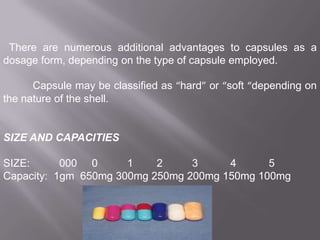
SIZE AND CAPACITIES
SIZE:
000 0
1
2
3
4
5
Capacity: 1gm 650mg 300mg 250mg 200mg 150mg 100mg
•Soft gelatin capsules (soft gel):
Made from a more flexible plasticized gelatin film than hard
gelatin capsules.

Most capsules of either type is intended to be swallowed
whole.
Some soft gelatin capsules are intended for rectal or vaginal
insertion as suppositories.
Most capsules product manufactured today are of the hard
gelatin type.

On the basis of shape, content & other features intended to
make the taste of certain unpleasant tasting medication, they
quickly gained popularity.
•Hard gelatin capsules:
Hard gelatin capsules often have better bioavailability than
tablets. This assumption derived from the fact that the gelatin shell
rapidly dissolves & ruptures.
HGC allow a degree of flexibility of formulation that are not
obtainable with tablets.
HGC are used for solid medicaments, they consist of a
cylindrical ‘body’ & ‘cap’. Both are with semispherical ends.
They are made from gelatin, sugar & water with added
preservatives. Though they are hard, they release readily &
dissolve after swallowing with water.
Liquids & semisolids are not used in HGC.
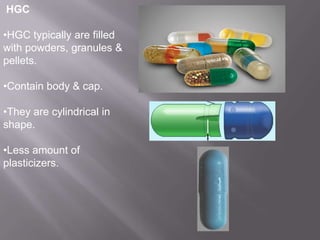
HGC
•HGC typically are filled
with powders, granules &
pellets.
•Contain body & cap.
•They are cylindrical in
shape.
•Less amount of
plasticizers.
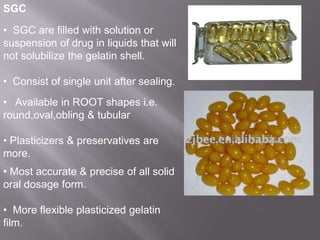
SGC
• SGC are filled with solution or
suspension of drug in liquids that will
not solubilize the gelatin shell.
• Consist of single unit after sealing.
• Available in ROOT shapes i.e.
round,oval,obling & tubular
• Plasticizers & preservatives are
more.
• Most accurate & precise of all solid
oral dosage form.
• More flexible plasticized gelatin
film.
ADVANTAGES:
• HGC often have grater bioavailability than tablets.
• Capsules allow a degree of flexibility of formulation which not
obtained with tablet.
• They are easier to formulate. because there is no requirement
that powder be formed in coherent compact from.
• HGC are uniquely suitable for blinded clinical tests & are widely
used in preliminary drug studies.
• Capsule is ideally suited to the dispensing of modified release
formulation.
•They are attractive in appearance.
DISADVANTAGES:
1) No. of supplies are limited & more over filling equipment is
slower than tableting.

2) Generally HGC tends to be costly to produce, than that of
tablet.
3) Highly soluble salt (e.g. Iodides, Bromides, and Chlorides)
generally should not be dispersed in HGC.
4) Their rapid release may cause gastric irritation owing to the
formation of a higher drug concentration in localized areas.

5) HGC may become lodged in esophagus, where the resulting
localized
high
concentration
of
certain
drugs.(e.g.
doxycyclin,indomethacin) may cause damage.
the shell of HGC basically consist of
 1) Gelatin
 2) Plasticizer
 3) Water
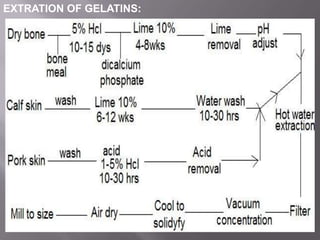
GELATINIs a derived protein formed by the hydrolysis of collagen of
the tissues (a protein found in skin, bone, keratin) by boiling in
water. it swells up in cold water, but dissolve only in hot water. It is
used …
A) Plasma substitute for transfusion.
B) It is also used hypodermically as a haemostatic (accessing
the flow of blood within the vessels).
C) To promote coagulation in gelatin cases of disorders.
EXTRATION OF GELATINS:
SHELL COMPOSITION:
the shell of HGC basically consist of:
•Gelatin

•Plasticizers
•Water








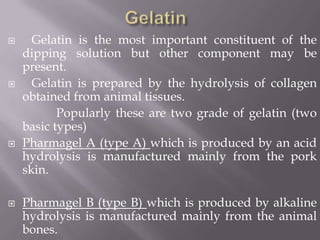
Gelatin is the most important constituent of the
dipping solution but other component may be
present.
Gelatin is prepared by the hydrolysis of collagen
obtained from animal tissues.
Popularly these are two grade of gelatin (two
basic types)
Pharmagel A (type A) which is produced by an acid
hydrolysis is manufactured mainly from the pork
skin.
Pharmagel B (type B) which is produced by alkaline
hydrolysis is manufactured mainly from the animal
bones.
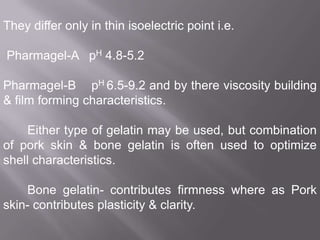
They differ only in thin isoelectric point i.e.
Pharmagel-A pH 4.8-5.2
Pharmagel-B pH 6.5-9.2 and by there viscosity building
& film forming characteristics.

Either type of gelatin may be used, but combination
of pork skin & bone gelatin is often used to optimize
shell characteristics.
Bone gelatin- contributes firmness where as Pork
skin- contributes plasticity & clarity.
the plasticizers used are glycerin, sorbitol etc.
If preservative are intended generally a mixture
of methyl & propyl paraben (4:1) up to 0.2 %
If flavors are used should not exceed up to 2%
generally ethyl vanillas or essential oils. If sugar up
to 5%.
The physiochemical properties of gelatin of most
interested to the shell manufactures are 1) Bloom strength
 2) Viscosity
Bloom strengthIf an empirical gel strength measure, that gives an
indication of the firmness of the gel.
It is measure in a bloom gelometer which determine
the weight in grams required to depress a standard
plunger a fixed distance in to the surface of a 6-2/3 %
w/w gel under standard condition.

Bloom strength in the range of 150-280 is
considered suitable for capsule.
ViscosityThe viscosity of the gelatin is vital to control the
thickness of the cast film.
Viscosity is measured on a standard 6-2/3%w/w
solution at 600 C in a capillary pipette & generally in the
range of 30-60 mille poise.
COLOURANTSCommonly, various soluble synthetic dyes (coal
tar dyes) & insoluble pigment are iron oxide.
Colorant plays an important role in improving
patient compliance.
Thus the color of drug product may be selected in
consideration of the disease state for which it is
intended.
e.g.
White – analgesics.
Orange/Yellow – stimulants & anti depressants.
OPAQUE AGENTS –
Titanium dioxide may be included to render the shell
opaque.
OPAQUE CAPSULES –
May be employed to provide protection against light
or to conceal the contents.
PRESERVATIVES –
When employed, to provide para-bens are often
selected.
WATER –

Hot, demineralised water is used in the preparation of the
dipping solution.
Initially a 30-40% w/w of solution of gelatin is prepared in
large stainless still tank.
Vacuum may be applied to assist in the removal of
entrapped air from this vacuum pumps.
Portion of this stock solution are removed & mixed with
only other ingredient as required to prepare the dipping solution,
at this point the viscosity of the dipping solution is measured &
adjusted.
The viscosity of solution is critical to control the thickness of
the capsule shell.




Empty hard gelatin capsules are manufactured on
Colton machines which was invented about 50 years
ago.
HGC are manufacture by a process in which
stainless steel mould pins are dipped into warm
gelatin solution & the shells are formed by the
gelatin on the pin surfaces.
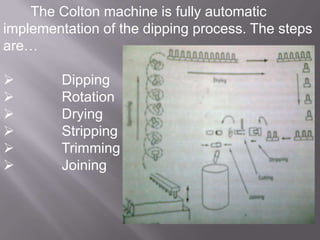
The Colton machine is fully automatic
implementation of the dipping process. The steps
are…







Dipping
Rotation
Drying
Stripping
Trimming
Joining
The entire cycle takes about 45 min however about
two third of this time is required for the drying step alone.
Capsule are produced by making use of machine
consisting of pair of pins corresponding to the body &
cap of the capsule, are dipped in the heated gelatin
solution.
The dipping is followed by the withdrawal of the pins
& then solution to distributed evenly by rotating the pins.
Cold air is simultaneously blown on the rotating
pins to firm-up the gelatin shell & further passed through
series of kilns with controlled rates of drying. After drying
the bodies & caps are removed.
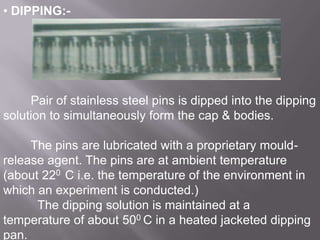
• DIPPING:-

Pair of stainless steel pins is dipped into the dipping
solution to simultaneously form the cap & bodies.
The pins are lubricated with a proprietary mouldrelease agent. The pins are at ambient temperature
(about 220 C i.e. the temperature of the environment in
which an experiment is conducted.)
The dipping solution is maintained at a
temperature of about 500 C in a heated jacketed dipping
pan.
The length of the time to last the film has been
reported to be about 12 secs.with larger capsules
requiring longer dipping times.
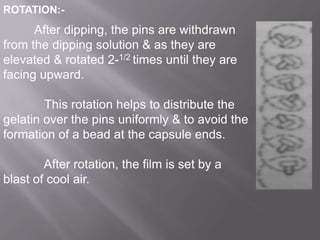
ROTATION:-

After dipping, the pins are withdrawn
from the dipping solution & as they are
elevated & rotated 2-1/2 times until they are
facing upward.
This rotation helps to distribute the
gelatin over the pins uniformly & to avoid the
formation of a bead at the capsule ends.
After rotation, the film is set by a
blast of cool air.
•DRYING:The racks of gelatin – coated pins then pass in to
a series of four drying ovens.
Drying is done mainly by dehumidification by
passing large volume of dry air over the pins.
A temperature elevation of only degrees is
permissible to prevent film melting.
Drying must not be raised to prevent “case
hardening”. Over-drying must be avoided, as this could
cause film to split on the pins from shrinkage or at least
make them too brittle for the later forming operation.
Over-drying will leave films sticky for subsequent
operation.
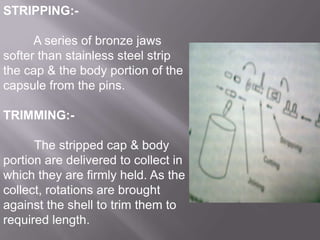
STRIPPING:A series of bronze jaws
softer than stainless steel strip
the cap & the body portion of the
capsule from the pins.
TRIMMING:The stripped cap & body
portion are delivered to collect in
which they are firmly held. As the
collect, rotations are brought
against the shell to trim them to
required length.
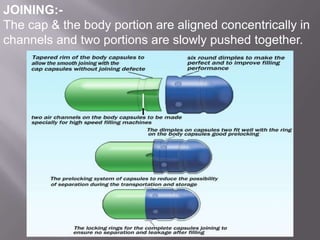
JOINING:The cap & the body portion are aligned concentrically in
channels and two portions are slowly pushed together.
SORTING
The moisture content of the capsule as they are
ejected from the machine will be in the range of15-18%
w/w, additional adjustment of moisture content towards
the final desired specification will occur during the
sorting step.
During the sorting, the capsule passing on a lighted
moving conveyer are examined visually by inspector,
any defective capsule spotted are thus manually
removed.
Defects are generally classified according to
their nature & potential to cause problems in use.
The most serious of these are that could
cause stoppage of a filling machine, such as
imperfect cuts, dented capsule or those with
holes.
Other defects may cause problems on use,
such as capsule with splits, long bodies or cracks
inside.
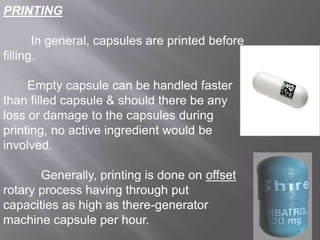
PRINTING
In general, capsules are printed before
filling.

Empty capsule can be handled faster
than filled capsule & should there be any
loss or damage to the capsules during
printing, no active ingredient would be
involved.
Generally, printing is done on offset
rotary process having through put
capacities as high as there-generator
machine capsule per hour.


Formulation of HGC



Sealing and self - locking system



Filling of HGC











The formulation of hard gelatin capsule includes
different substances which promote the release of
drug constituent from the hard gelatin capsule these
include:Active ingredients.
Fillers (diluents).
Glidents.
Lubricants.
Disintegrants.
Surfactants.
Hydrophilic agents.
Protectives.
Anti-dusting agents
ACTIVE INGREDIENTS :The amount and type of active ingredients influence
capsule size and the nature and amount to be used in
the formulation.
Active ingredients tends to make up to the high
percentage of the contents of a capsule as compared to
tablet.
Smaller the size of active ingredients, larger will be
the surface area of the active ingredients, hence greater
will be the rate of dissolution of the active ingredients.
Granulation of the active ingredient in the case of
hard gelatin capsule is carried out to

 Increase the flow properties.
 Increase Drug dissolution.
FILLERS(DILUENTS):-

Fillers are used to increase the bulk of the
formulation.
The most common capsule diluents are starch,
lactose & dicalcium phosphate.
These substances improve flow properties and
compatibility.
GLIDENTS:Glidents are used to improve the fluidity of powders.
Glidents include the colloidal silica, corn starch, talc and
magnesium stearate.
They are fine particles that appear to coat the surface of the
bulk powder and enhance fluidity by reducing roughness by filling
surface irregularities reducing attractive force by ….


Physically separating the host particles.



Modifying electrostatic charges.



Acting as moisture scavengers.

 Serving as ball bearing between host particles.
Optimum concentration for flow is less then 1% &
typically lies between 0.25-0.50 percent. Exceeding this
concentration will result in no further improvement in
flow.
LUBRICANTS:Capsule formulation usually requires lubricants :



To ease the ejection of plugs.


To reduce filming on piston and
adhesion of powders to metal surface.

Reduce the friction between sticking
surfaces in contact with powder.
Ex:- magnesium stearate and stearic acid.
DISINTEGRANTS:In capsule formulation, the substances which have
superior swelling or moisture absorbing properties are
generally used as disintegrants. Such disintegrants are
called “super disintegrants”.
E.g. croscarmellose sodium, sodium starch glycolate
and crospovidone.
SURFACTANTS:Surfactants are used in capsule formulation to
increase the wetting of the powder mass and enhance
drug dissolution.

Commonly used surfactants are sodium lauryl
sulphate and sodium docusate.
Surfactant in concentration range of 0.1-0.5% is
usually used.
HYDROPHILIC AGENTS:-

Hydrophilic agents are used to improve the
wettability of poorly soluble drug present in hard gelatin
capsule.
E.g.:Both wettability of the drug and the rate of
dissolution of hexobarbital from hard gelatin capsule
could be enhanced if the drug is treated with methyl
cellulose or hydroxyl ethyl cellulose.(hydrophilic agents).
SEALING AND SELF- LOCKING CLOSURES
Positive closures help to prevent the separation of filled
capsule during shipping and handling. Such safeguards have
become particularly important with the advantage of high – speed
filling & packaging equipment.
The problem is particularly acute in the filling of non
compacted or granular formulations.
Hard gelatin capsules are made self locking by forming notch
or grooves on the inside of the cap and body portion. When fully
engaged, a positive interlock create between cap and body
portion.
Sealing:-

Hard gelatin capsules may be made hermetically
sealed by banding .
Another method is a low- temperature thermal
method of hermetically sealing hard gelatin capsules.
Storage:During handling & storing capsules require to
maintain a relative humidity of 40-60%.
FILLING OF HARD GELATIN CAPSULE
The several types of filling machines are used in the
pharmaceutical industry have in common the following
operations…
Rectification.
Separation of cap from bodies.
Dosing of fill material.
Replacement of cap and ejection of filled capsules.
• Rectification ( the act of making straight or correct):

The empty capsule are oriented, so that all points are in the
same direction (i.e. body –end downward) in general, the capsule
pass one-at-a time, through a channel just wide enough to provide
a frictional grip at the cap end.
A special designed blade push against the capsule & causes
it to rotate about its cap end as a fulcrum (* as the fixed point on
which the liver moves) After two pushes (one horizontally & one
vertically downward) the capsule will always be aligned body end
downward.
•SEPERATION OF CAP FROM BODY:
This process also depends on the difference in
diameters between cap and body portions. Here the rectified
capsules are delivered body-end into the upper portion of the
split bushing or shift filling rings.
A vaccum applied from the below , pull the bodies
down into the longer portion of the split bushings.
The diameter of the caps is too large to allow them
to follow the bodies into the lower bushing portion. The split
bushing are then separated to expose the bodies for filling.
DOSING OF FILL MATERIAL:
Various methods are employed as discussed later.
REPLACEMENT OF CAPS & EJECTION OF FILLED
CAPSULES:
The cap and body bushing portion are required. Pins are used
to push the filled bodies up into the caps for closures and to push
the closed capsules out of the bushings.
Compressed air also may be used to eject the capsule.
These machines may be either semiautomatic or fully automatic.
Semiautomatic machines such as the capsugel type &
machines require on operator to be in attendance at all times
depending on the skill , the formulation & the size capsule being
filled,
These machines are capable of filling as many as 120,000160,000 capsule in an 8hr shift.
This out put contrasts sharply with the output of
fully automatic machines.
Some models of which are rated to fill that many
capsules in 1hr.

Some representative automatic capsule filling
machines will see earlier.
This machine may be classified as either
intermittent or continuous motion machines.
Intermittent machine:It exhibit an interrupted-filing sequence as must stop at
various station to execute the basic operation described earlier.
Continuous motion machine:- Executes these functions in a
continuous cycle. The limitation of the need to decelerate &
accelerate from one station to the next make greater machine
speed possible with continuous motion machine.
Although capsule-filling machines may vary widely in their
engineering design, the main difference among them from a
formulation point of view is the means by which the formulation is
dosed into the capsules.


Semi automatic machine



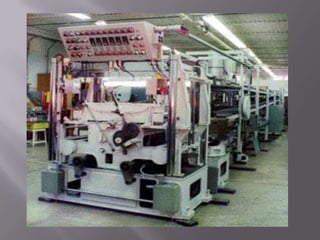
Fully automatic machine



Powder Filling
1) Augar fill principle
2) Vibratory fill principle
3) Piston-tamp principle
a) dosing disk machine
b) dosator machine
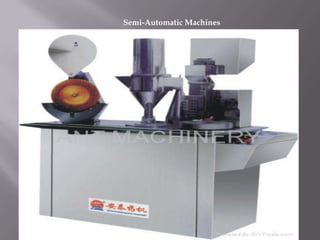
Semi-Automatic Machines
Semi-automatic machines, which require an operator to be
in attendance at all times, were once the workhorses of the
capsule filling industry. Today, they are more likely to be
employed when smaller batch sizes are required, such as
production of early phase clinical supplies.
Quoted production capacities for powder filling range from
6000-8000 capsules/hour up to as high as 15,000
capsules/hour, depending on the capsule size.
The rectified capsules are delivered into holes in a split ring
(equivalent to the split bushings above). As the ring rotates
on a turntable, vacuum pulls the capsule bodies into the lower
ring, leaving the caps behind in the upper ring.
Semi-Automatic Machines
After capsule separation, the operator separates the
rings and places the body ring on another turntable that
rotates beneath the foot of the powder hopper. An auger in
the hopper rotates to encourage a more or less constant
downward flow of the formulation while the filling ring
rotates.
The amount of formulation delivered to the capsule
bodies depends primarily on the dwell time of the bodies
under the foot of the hopper, i.e., the speed of rotation of the
filling ring.

Fill weight uniformity depends primarily on uniformity
of flow from the hopper, and formulations should be
designed accordingly.
Maintaining a more or less uniform bed height in the
hopper is also important to the maintenance of a uniform
powder feed rate.
However, any over run of already filled capsules under
the hopper can cause an increase in the fill weight of those
capsules.
some fill weight variation also can result because of
differences in the angular velocity of capsule bodies in the
filling ring at different radial distances from the center of
rotation.
Examples of these “ring machines” are Capsugel Cap 8
and Qualifill 8S machines.
Fully Automatic Machines
Most modern automatic filling machines employ pistons or
tamping pins that lightly compress the powder into plugs
(sometimes referred to
as “slugs”), and eject the plugs into the empty capsule bodies.
The compression forces are low, often in the range of 50–
150N, up to about 100- fold less than that employed in typical
tablet compression. Often, the plugs will be very soft compacts
and not able to be recovered intact from filled capsules.
There are two main types of these fillers: dosator machines
and dosingdisc machines. In a recent survey of the
pharmaceutical industry, it was reported that dosator machines
were used slightly more frequently among the firms responding;
however, about 18% of the firms indicated that they use both
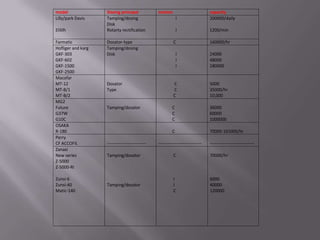
model
Lilly/park Davis
Elililh
Farmatic
Hofliger and karg
GKF-303
GKF-602
GKF-1500
GKF-2500
Macofar
MT-12
MT-B/1
MT-B/2
MG2
Future
G37W
G10C
OSAKA
R-180
Perry
CF ACCOFIL
Zanasi
New series
Z-5000
Z-5000-RI
Zunsi-6
Zunsi-40
Matic-140

Dosing principal
Tamping/dosing
Disk
Rotarty rectification

motion
I

capacity
200000/daily

I

1200/min

Dosator-type
Tamping/dosing
Disk

C

Dosator
Type

C
C
C

5000
35000/hr
10,000

Tamping/dosator

C
C
C

36000
60000
1000000

C

70000-165000/hr

---------------------------

I
I
I

------------------------------

160000/hr
24000
48000
180000

-------------------------------

Tamping/dosator

C

70000/hr

Tamping/dosator

I
I
C

6000
40000
120000
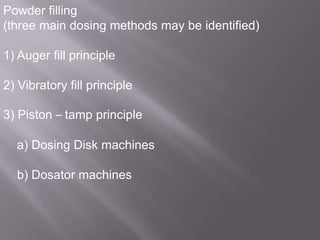
Powder filling
(three main dosing methods may be identified)

1) Auger fill principle
2) Vibratory fill principle

3) Piston – tamp principle
a) Dosing Disk machines
b) Dosator machines
Auger fill principle:At one time, nearly all capsules were filled by means of
semiautomatic equipment.

Where in the powder is driven into the capsule bodies by
means of rotary auger.
This type of filling machine is : capugel type 8 machines.
The empty bodies are held in a filling ring that rotates on a
turntable under the powder hopper.

The fill of the capsules is primarily volumetric i.e. the auger
mounted in the hopper rotates at constant rate, the delivery of the
powder to capsules tends to be at a constant rate.
Consequently, the major control over the fill weight is the rate
of rotation of the filling ring under the hopper . faster rates produce
lighter fill rate, because bodies have a shorter time under the
hopper.

The formulation requirement of this type of machine have
been the subject of only a limited number of reports.
In general, the flow properties of the powder blend should be
adequate to assure a uniform flow rate from the hopper. Glidents
may be helpful.
Lubricants, such as Mg.Stearate and Stearic acid , are also
required. These facilitate the passage of the filling ring under the
foot of the powder hopper and help to prevent the adherence of
certain materials to the auger.
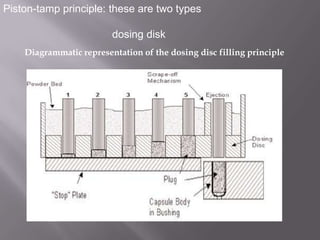
Piston-tamp principle: these are two types
dosing disk
Diagrammatic representation of the dosing disc filling principle
The basic operation is illustrated in Figure . The dosing-disc
forms the base of the dosing or filling chamber.
The dosing-disc is provided with holes that are closed off by
a solid brass “stop” plate that slides along the bottom of the disc
to form the dosing cavities.
In most machines, the cavities are indexed under tamping
pins at each of five tamping stations .
The formulation is maintained at a some what constant level
over the dosing-disc. A capacitance probe senses the powder level
and activates an auger feed mechanism when the powder depth
falls below a preset level.
As the disc rotates (indexes), the formulation is distributed
over the disc by centrifugation with the assistance of baffles
mounted to the disc.
Powder falls into the dosing cavities as they move from one
tamping station to the next. Additional powder is pushed into the
dosing cavities by the descending tamping pins at each tamping
station.

Each plug is thus tamped five times. Excess powder over the
disc is scraped off as the dosing-disc indexes the plugs to the
ejection station where they are positioned over empty capsule
bodies and ejected by transfer pins.
For a given formulation, size of tooling and powder depth
over the disc, the fill weight achieved is determined primarily by
the thickness of the dosing disc and the piston penetration setting
(or tamping force).
This observation suggests that a certain flow criterion may be required
for maximum fill weight uniformity.
At higher angles of repose, powders may not have sufficient mobility to
distribute well over the dosing disc. At lower angles of repose, the
powder may be too fluid to maintain a uniform bed.
. A different situation can be expected for
machines fitted with agitators to facilitate distribution of the powder
over the dosing disc.
Formulations for these machines should be adequately lubricated to
prevent filming on pins, to reduce friction between any sliding
components that the formulation comes into contact with, and to
facilitate plug ejection.
Some degree of formulation compactibility is desirable for clean,
efficient plug transfer at ejection.
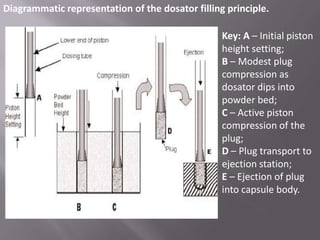
Diagrammatic representation of the dosator filling principle.
Key: A – Initial piston
height setting;
B – Modest plug
compression as
dosator dips into
powder bed;
C – Active piston
compression of the
plug;
D – Plug transport to
ejection station;
E – Ejection of plug
into capsule body.
The dosator consists of a moveable piston inserted in a cylindrical
tube. The position of the piston is preset to a height that defines a
volume that would contain the desired dose of the formulation ( A).
During the filling process, the open end of the dosator is first
pushed down into a powder bed the depth of which has been pre-set
and is maintained at that level by agitators and scrapers. Powder thus
enters the open end of the dosing tube where it is slightly compressed
against the piston (B).
Before the dosator is lifted from the powder bed, the piston may be
used to deliver a tamping blow that further compresses the forming
plug (C).

The dosator bearing the plug is then lifted from the powder bed (D)
and positioned over an empty capsule body where the piston is thrust
downward to eject the plug (E).
In certain machines, the empty capsule body is moved
into position under the raised dosator to receive the ejected
plug.

For a given size of tooling, the fill weight attained for a
given formulation is determined primarily by the initial height
of the piston in the dosing tube, and secondarily by the
height of the powder bed.
Vibratory fill principle:The okasa machines employed a vibratory feed mechanism. In this
mechanism, the capsules body passes under the feed frame that holds
the powder in the filling section.
In the powder, a perforated resin plate is positioned that is
connected to a vibrator.
The powder bed tends to be fluidized by the vibration of the plate,
and this assists the powder to flow into the bodies through the holes in
the resin plate.
The fill weight is controlled by the vibrations and by setting the
position of the body under the feed frame.
Much like the fill mechanism of a tablet press, there is over fill and
then adjusted with scrape-off of the excess materials as the capsule
bodies pass under the feed frame.
The capsule bodies are supported on pins in holes bored through
the disk plate. While they pass under the feed area the pins may be set
to drop the bodies to below the level of the disk, there by causing “over
fill”.
However, before there passage is completed under the feed frame
the capsules are eventually pushed up so their upper edges become
level with the surface of the disk plate.
This process offered some light compression of the powder against
the resin plates and offers the opportunities to modify the fill weight.

Weight variation has been related to the formulation flow
properties.
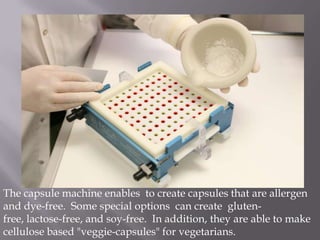
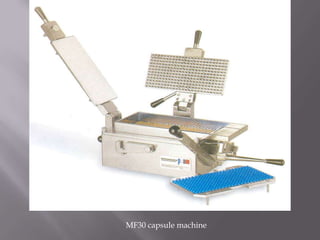
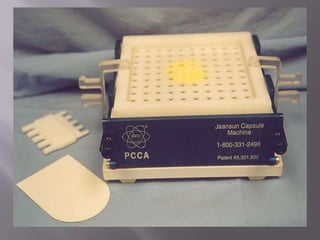
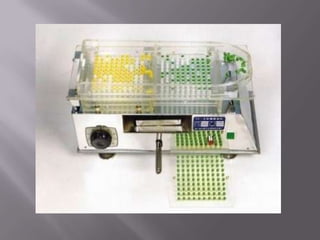
The capsule machine enables to create capsules that are allergen
and dye-free. Some special options can create glutenfree, lactose-free, and soy-free. In addition, they are able to make
cellulose based "veggie-capsules" for vegetarians.
MF30 capsule machine
Soft gelatin capsules:
These capsules are basically composed of
gelatin, plasticizers and water, additional ingredients
such as preservatives, coloring and pacifying agent,
flavoring, sugar , acids and medicaments.
Composition of shell:Similar to hard gelatin shells.
The basic component of soft gelatin shell is gelatin,
plasticizers are glycerin, sorbitol or propylene glycol.
Other components :- dyes, pacifier, preservatives and
flavors, plasticizers for soft gel shell 1.0- 1.8
Nature of capsule shell:

The basic gelatin formulation from which the plasticized film
are most usually consist of 1 part of gelatin, 1 part of water and
0.4-0.6 part of plasticizers. The residual shell moisture content of
finished capsule will be in the range of 6-10%
Formulation of soft gelatin capsules:Nature of capsule content:

The formulation for soft gelatin capsule involves liquid rather
than powders.
Soft gelatin capsule contain single liquid, a combination of
miscible liquid, a solution of drug in a liquid ,or a suspension of
drug in a liquid.
The liquid are limited to those that do not have an adverse
effect on the gelatin walls.
pH of liquid varies in between 2.5 and 7.5
Liquid with more acid ph would tend to cause
leakage, hydrolysis of the gelatin.
Emulations can’t be filled because unavoidable water will
be released that will affect the shell.
Type of vehicles used in soft gelatin capsules fall into two main
groups :

•Water- immiscible : volatile, or more likely non-volatile liquids,
such as vegetable oils, aromatic and aliphatic hydrocarbons
(minerals oil), medium-chain triglycerides and acetylated
glycerides.
•Water-miscible: non volatile, such as low molecular weight
polyethylene glycol (PEG400&600)A
All liquid used for filling must flow by gravity at a
temperature of 350C or less.
The sealing temperature of gelatin film is 37-400C.
To micronize (colloid mill) all materials during the
preparation of suspension typical suspending agents for oily
bases and concentration of base are beeswax(5%), paraffin
wax(5%) and aluminium stearates (1-6%).
Suspending agent for non oily bases include PEG4000
and 6000(1-5%), solid nonionic(10%), or solid glycol esters (10%).
Manufacturing of gelatin capsules:
•Preparation of gelatin mass:•
The gelatin is weighed and mixed with accurately
measured and chilled (70C) liquid components in a
suitable mixture.
•
The resultant fluffy mass is transferred to melting
tanks and melted under vacuum at 930C. the mixing
process requires about 25 min for 270 kg of mass, and
the melting process require about 3 hours.
•
The sample of the resulting fluid mass is visually
compared with a color standard, and additional colorants
are blended into the mass if adjustment are required.
•
The mass is then maintained at a temperature of
57-600C before and during the capsulation process.
• Prepration of fill materials:- The solids are mixed with the
liquid base, and the mixture is passed through a homogenizing
equipment such as colloidal mill, so that the solids are thoroughly
wetted with the liquid carrier and a smooth homogeneous mixture
is obtained.
•Deareation of the liquid mixture:- After homogenization all
liquid mixture are subjected to deareation. It is required to achieve
uniform capsule fill weight, it also prevents loss of potency through
oxidation. When small amount of volatile ingredients are included
in a formulation , they should be added after deareation.
•
The deareation equipment expose the liquid mixture
continuously to a vacuum in the form of thin layer and transfers it
from the mixing tank to the containers that will be used at the
encapsulation machine, after deareation the mixture is ready to
encapsulation.
•In – process quality control of the fill mixture:soon after deareation a sample of the mixture is sent to the
quality control department for various tests such as assay, specific
gravity, moisture content, air entrapment and tests for
homogeneity of the suspension
•Encapsulation:- (rotary die process)
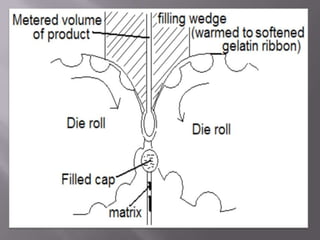
In the rotary die machine, the dies are set on two counter
rotating die rolls. Two continuous gelatin ribbons (lubricated by
mineral oil) are passing over the rolls. And they are warmed at 37400C. while they pass beneath the filling wedge, so that they are
softened. At the moment of converging of the opposing die
pockets, a measured volume of the filling material is forced
between the ribbons by a metering pump and simultaneously the
edges of the dies seal and cut out a complete capsule. These are
separated from the matrix (by brushes), washed in a solvent in
order to remove the mineral oil lubricant and dried. The production
capacity is approximately 30,000 capsule/hr
The gelatin mass is fed by gravity to a spreader box, which
control the flow of mass onto air-cooled rotating drums. Gelatin
ribbons of controlled thickness are formed. The wet shell
thickness may vary from 0.022 to 0.045 inch( but usual range is
0.025 to 0.032 inch). Thicker shells (0.6-1.1 mm) are used on
products requiring greater physical strength. The ribbons are fed
through a mineral oil lubricating bath, over guide-rolls and then to
the die rolls.
The materials to be filled flows by gravity into a metering
pump. An accurately measured volume of the fill material is forced
through the small orifices at the bottom of the wedge into the
gelatin ribbon between the die rolls. The capsule is about halfsealed when the pressure of the pumped material forced into the
die pockets, where the capsules are simultaneously filled, shaped,
sealed and cut from the gelatin ribbon. The sealing of the capsule
is achieved by mechanical pressure on the die roll and the heating
of the ribbon by the wedge (37-400C).
•In-process checking:During manufacturing capsules are taken at
intervals and checked for seal thickness(microscopy)
and fill weights.
For the determination of the fill weight each
capsule is weighed and the contents removed by cutting
open the capsule. The shell is then washed with
petroleum ether, and the empty shell is reweighed. If
necessary, adjustment can be made to obtain the proper
fill weight.
•Drying :Immediately after manufacturing the capsule are
washed in naphtha to remove the mineral oil lubricant.
The washed capsule are dried in an infrared dryer and
then spread on trays for final drying under conditions of
20-30% relative humidity and 21-240C temperature, so
that the moisture content of the capsule shell falls in the
range of 6- 10%.
All the processing area, except gelatin preparation
department, should be air-conditioned (40%RH at 20220C) to assure proper conditioning of the gelatin films,
the proper drying of the capsules and low moisture
content of raw material and mixtures.
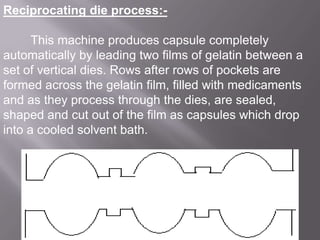
Reciprocating die process:This machine produces capsule completely
automatically by leading two films of gelatin between a
set of vertical dies. Rows after rows of pockets are
formed across the gelatin film, filled with medicaments
and as they process through the dies, are sealed,
shaped and cut out of the film as capsules which drop
into a cooled solvent bath.
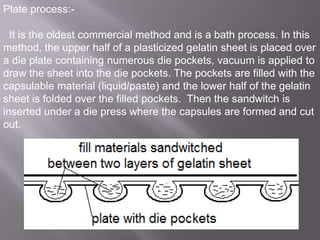
Plate process:It is the oldest commercial method and is a bath process. In this
method, the upper half of a plasticized gelatin sheet is placed over
a die plate containing numerous die pockets, vacuum is applied to
draw the sheet into the die pockets. The pockets are filled with the
capsulable material (liquid/paste) and the lower half of the gelatin
sheet is folded over the filled pockets. Then the sandwitch is
inserted under a die press where the capsules are formed and cut
out.
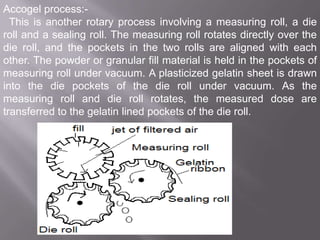
Accogel process:This is another rotary process involving a measuring roll, a die
roll and a sealing roll. The measuring roll rotates directly over the
die roll, and the pockets in the two rolls are aligned with each
other. The powder or granular fill material is held in the pockets of
measuring roll under vacuum. A plasticized gelatin sheet is drawn
into the die pockets of the die roll under vacuum. As the
measuring roll and die roll rotates, the measured dose are
transferred to the gelatin lined pockets of the die roll.
The continued rotation of the filled die converges
with the rotating sealing roll where a second gelatin
sheet is applied to form other half of the capsule.
Pressure develop between die roll and sealing roll, seal
and cut out the capsule.
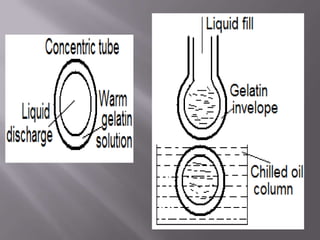
Bubble method:This method produces seamless, one piece soft
gelatin
capsule.
A concentric
tube
disperse
simultaneously discharge the molten gelatin from the
outer annulus and the liquid content from the inner tube.
By means of pulsating pump mechanism, the liquid are
discharged from the concentric tube orifice into a chilled
oil column as droplets that consist of liquid medicaments
core within the molten gelatin envelope. The droplets
assumes a spherical shape under surface tension forces
and the gelatin congeals on cooling. The finished
capsules are then washed with a solvent to remove the
mineral oil lubricant and dried.
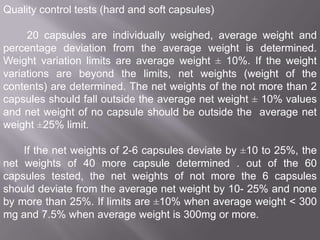
Quality control tests (hard and soft capsules)
20 capsules are individually weighed, average weight and
percentage deviation from the average weight is determined.
Weight variation limits are average weight ± 10%. If the weight
variations are beyond the limits, net weights (weight of the
contents) are determined. The net weights of the not more than 2
capsules should fall outside the average net weight ± 10% values
and net weight of no capsule should be outside the average net
weight ±25% limit.
If the net weights of 2-6 capsules deviate by ±10 to 25%, the
net weights of 40 more capsule determined . out of the 60
capsules tested, the net weights of not more the 6 capsules
should deviate from the average net weight by 10- 25% and none
by more than 25%. If limits are ±10% when average weight < 300
mg and 7.5% when average weight is 300mg or more.
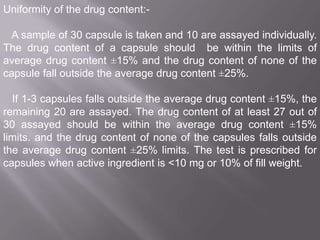
Uniformity of the drug content:A sample of 30 capsule is taken and 10 are assayed individually.
The drug content of a capsule should be within the limits of
average drug content ±15% and the drug content of none of the
capsule fall outside the average drug content ±25%.

If 1-3 capsules falls outside the average drug content ±15%, the
remaining 20 are assayed. The drug content of at least 27 out of
30 assayed should be within the average drug content ±15%
limits. and the drug content of none of the capsules falls outside
the average drug content ±25% limits. The test is prescribed for
capsules when active ingredient is <10 mg or 10% of fill weight.
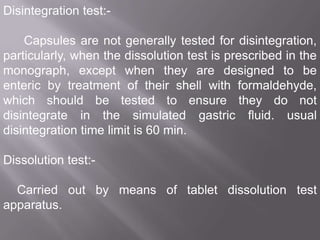
Disintegration test:Capsules are not generally tested for disintegration,
particularly, when the dissolution test is prescribed in the
monograph, except when they are designed to be
enteric by treatment of their shell with formaldehyde,
which should be tested to ensure they do not
disintegrate in the simulated gastric fluid. usual
disintegration time limit is 60 min.
Dissolution test:Carried out by means of tablet dissolution test
apparatus.
Special quality control test on soft gelatin capsules:•Seal thickness:Is measured under a microscope and it should one half to two
third of the ribbon thickness.
•Total or shell moisture test:Moisture content is determined by the toluene distillation method.
Collecting the distillate over a period of one hour.
•Capsule fragility or rupture test:Force required to rupture the capsule is determined.

•Determination of freezing and high temperature effect:(>450 for 30 days)
These are performed similarly to the shell integrity test.
Physical stability of capsules shell

The capsule manufacturer routinely conducts accelerated stability
study on all new capsule products as an integral part of the product
development programmed . These tests known as “shell integrity tests”
are used for determination of the effect of capsule content on the
gelatin shell, but not the stability of active ingredients of the capsule.
The result of these tests may indicate the reformulation of the capsule
content or the capsule shell and also assist in the selection proper retail
package.
For conducting these tests, sample of the capsules are exposed to
the following conditions over a period of 2 weeks, with periodic
observation.
•80% RH at room temperature in an open container.
•400C in an open container.
•400C in a closed container (glass bottle with tight screw cap).
Both gross and subtle(difficult to perceive) effect of the
above storage conditions on the capsule shell are noted and
recorded.

The control capsule ( containing mineral oil with Shell
Hardness Ratio of 0.5:1 and a water to dry gelatin ratio of 1:1)
should not be affected, except under 80 % RH, where it may
become soften, tackier and bloated (swollen) .
Advantages of soft gelatin capsule:-

1) Soft gelatin capsules permit liquid medicament to be easily portable.
2) Accuracy and uniformity of the dosage are predominant advantages
with soft capsules. Since the liquid fill is metered into individual capsule
by a positive displacement pump. Moreover a higher degree of
homogeneity is possible in the liquid system than can be achieved in
powder blend.
3) The bioavailability of drugs is often improved since these capsules
contain drug in liquid form i.e. as liquid drug substance, drug in solution
or drug in suspension.
4) Since soft gelatin capsules are hermetically sealed in nature, these
are best suited for liquid or volatile drugs. Many drugs which are liable
to atmospheric oxidation can be safely formulated as soft gelatin
capsule. Since the soft gelatin shell acts as all effective barrier to oxygen.
5) The gastric irritation or ulcerogenecity of some drugs such as
dexamethasone can be minimized by formulating them as liquids in soft
capsules, when compared to hard capsule formulation.
THE END

Capsule @ppm

  • 1.
    Presented by: ManeP.P. Under the guidance of : Dr.P.V.Swami
  • 2.
          Introduction Types & differencebetween SGC & HGC Advantages & disadvantages Contents of HGC Shell composition Shell manufacturing
  • 3.
    The word “capsule”is derived from the Latin word “capsula” meaning small box. Definition; Is defined as a solid dosage form in which the medicament contained is enclosed within small shell or container. Generally these shell are made from gelatin. 1) Capsule may be considered as a “container “drug delivery system that provide a tasteless & odourless dosage form without need for a secondary coating step, as like tablet. 2) Swallowing is easy for most patient, since shell is smooth & hydrates in mouth. 3) Capsule often tends to float on swallowing in the liquid taken with it. 4) There availability in a wide variety of colours makes capsule pleasing.
  • 4.
    There are numerousadditional advantages to capsules as a dosage form, depending on the type of capsule employed. Capsule may be classified as “hard” or “soft “depending on the nature of the shell. SIZE AND CAPACITIES SIZE: 000 0 1 2 3 4 5 Capacity: 1gm 650mg 300mg 250mg 200mg 150mg 100mg
  • 5.
    •Soft gelatin capsules(soft gel): Made from a more flexible plasticized gelatin film than hard gelatin capsules. Most capsules of either type is intended to be swallowed whole. Some soft gelatin capsules are intended for rectal or vaginal insertion as suppositories. Most capsules product manufactured today are of the hard gelatin type. On the basis of shape, content & other features intended to make the taste of certain unpleasant tasting medication, they quickly gained popularity.
  • 6.
    •Hard gelatin capsules: Hardgelatin capsules often have better bioavailability than tablets. This assumption derived from the fact that the gelatin shell rapidly dissolves & ruptures. HGC allow a degree of flexibility of formulation that are not obtainable with tablets. HGC are used for solid medicaments, they consist of a cylindrical ‘body’ & ‘cap’. Both are with semispherical ends. They are made from gelatin, sugar & water with added preservatives. Though they are hard, they release readily & dissolve after swallowing with water. Liquids & semisolids are not used in HGC.
  • 7.
    HGC •HGC typically arefilled with powders, granules & pellets. •Contain body & cap. •They are cylindrical in shape. •Less amount of plasticizers.
  • 8.
    SGC • SGC arefilled with solution or suspension of drug in liquids that will not solubilize the gelatin shell. • Consist of single unit after sealing. • Available in ROOT shapes i.e. round,oval,obling & tubular • Plasticizers & preservatives are more. • Most accurate & precise of all solid oral dosage form. • More flexible plasticized gelatin film.
  • 9.
    ADVANTAGES: • HGC oftenhave grater bioavailability than tablets. • Capsules allow a degree of flexibility of formulation which not obtained with tablet. • They are easier to formulate. because there is no requirement that powder be formed in coherent compact from. • HGC are uniquely suitable for blinded clinical tests & are widely used in preliminary drug studies. • Capsule is ideally suited to the dispensing of modified release formulation. •They are attractive in appearance.
  • 10.
    DISADVANTAGES: 1) No. ofsupplies are limited & more over filling equipment is slower than tableting. 2) Generally HGC tends to be costly to produce, than that of tablet. 3) Highly soluble salt (e.g. Iodides, Bromides, and Chlorides) generally should not be dispersed in HGC. 4) Their rapid release may cause gastric irritation owing to the formation of a higher drug concentration in localized areas. 5) HGC may become lodged in esophagus, where the resulting localized high concentration of certain drugs.(e.g. doxycyclin,indomethacin) may cause damage.
  • 11.
    the shell ofHGC basically consist of  1) Gelatin  2) Plasticizer  3) Water
  • 12.
    GELATINIs a derivedprotein formed by the hydrolysis of collagen of the tissues (a protein found in skin, bone, keratin) by boiling in water. it swells up in cold water, but dissolve only in hot water. It is used … A) Plasma substitute for transfusion. B) It is also used hypodermically as a haemostatic (accessing the flow of blood within the vessels). C) To promote coagulation in gelatin cases of disorders.
  • 13.
  • 14.
    SHELL COMPOSITION: the shellof HGC basically consist of: •Gelatin •Plasticizers •Water
  • 15.
        Gelatin is themost important constituent of the dipping solution but other component may be present. Gelatin is prepared by the hydrolysis of collagen obtained from animal tissues. Popularly these are two grade of gelatin (two basic types) Pharmagel A (type A) which is produced by an acid hydrolysis is manufactured mainly from the pork skin. Pharmagel B (type B) which is produced by alkaline hydrolysis is manufactured mainly from the animal bones.
  • 16.
    They differ onlyin thin isoelectric point i.e. Pharmagel-A pH 4.8-5.2 Pharmagel-B pH 6.5-9.2 and by there viscosity building & film forming characteristics. Either type of gelatin may be used, but combination of pork skin & bone gelatin is often used to optimize shell characteristics. Bone gelatin- contributes firmness where as Pork skin- contributes plasticity & clarity.
  • 17.
    the plasticizers usedare glycerin, sorbitol etc. If preservative are intended generally a mixture of methyl & propyl paraben (4:1) up to 0.2 % If flavors are used should not exceed up to 2% generally ethyl vanillas or essential oils. If sugar up to 5%. The physiochemical properties of gelatin of most interested to the shell manufactures are 1) Bloom strength  2) Viscosity
  • 18.
    Bloom strengthIf anempirical gel strength measure, that gives an indication of the firmness of the gel. It is measure in a bloom gelometer which determine the weight in grams required to depress a standard plunger a fixed distance in to the surface of a 6-2/3 % w/w gel under standard condition. Bloom strength in the range of 150-280 is considered suitable for capsule.
  • 19.
    ViscosityThe viscosity ofthe gelatin is vital to control the thickness of the cast film. Viscosity is measured on a standard 6-2/3%w/w solution at 600 C in a capillary pipette & generally in the range of 30-60 mille poise.
  • 20.
    COLOURANTSCommonly, various solublesynthetic dyes (coal tar dyes) & insoluble pigment are iron oxide. Colorant plays an important role in improving patient compliance. Thus the color of drug product may be selected in consideration of the disease state for which it is intended. e.g. White – analgesics. Orange/Yellow – stimulants & anti depressants.
  • 21.
    OPAQUE AGENTS – Titaniumdioxide may be included to render the shell opaque. OPAQUE CAPSULES – May be employed to provide protection against light or to conceal the contents. PRESERVATIVES – When employed, to provide para-bens are often selected.
  • 22.
    WATER – Hot, demineralisedwater is used in the preparation of the dipping solution. Initially a 30-40% w/w of solution of gelatin is prepared in large stainless still tank. Vacuum may be applied to assist in the removal of entrapped air from this vacuum pumps. Portion of this stock solution are removed & mixed with only other ingredient as required to prepare the dipping solution, at this point the viscosity of the dipping solution is measured & adjusted. The viscosity of solution is critical to control the thickness of the capsule shell.
  • 23.
      Empty hard gelatincapsules are manufactured on Colton machines which was invented about 50 years ago. HGC are manufacture by a process in which stainless steel mould pins are dipped into warm gelatin solution & the shells are formed by the gelatin on the pin surfaces.
  • 24.
    The Colton machineis fully automatic implementation of the dipping process. The steps are…       Dipping Rotation Drying Stripping Trimming Joining
  • 25.
    The entire cycletakes about 45 min however about two third of this time is required for the drying step alone. Capsule are produced by making use of machine consisting of pair of pins corresponding to the body & cap of the capsule, are dipped in the heated gelatin solution. The dipping is followed by the withdrawal of the pins & then solution to distributed evenly by rotating the pins. Cold air is simultaneously blown on the rotating pins to firm-up the gelatin shell & further passed through series of kilns with controlled rates of drying. After drying the bodies & caps are removed.
  • 26.
    • DIPPING:- Pair ofstainless steel pins is dipped into the dipping solution to simultaneously form the cap & bodies. The pins are lubricated with a proprietary mouldrelease agent. The pins are at ambient temperature (about 220 C i.e. the temperature of the environment in which an experiment is conducted.) The dipping solution is maintained at a temperature of about 500 C in a heated jacketed dipping pan.
  • 27.
    The length ofthe time to last the film has been reported to be about 12 secs.with larger capsules requiring longer dipping times.
  • 28.
    ROTATION:- After dipping, thepins are withdrawn from the dipping solution & as they are elevated & rotated 2-1/2 times until they are facing upward. This rotation helps to distribute the gelatin over the pins uniformly & to avoid the formation of a bead at the capsule ends. After rotation, the film is set by a blast of cool air.
  • 29.
    •DRYING:The racks ofgelatin – coated pins then pass in to a series of four drying ovens. Drying is done mainly by dehumidification by passing large volume of dry air over the pins. A temperature elevation of only degrees is permissible to prevent film melting. Drying must not be raised to prevent “case hardening”. Over-drying must be avoided, as this could cause film to split on the pins from shrinkage or at least make them too brittle for the later forming operation. Over-drying will leave films sticky for subsequent operation.
  • 30.
    STRIPPING:A series ofbronze jaws softer than stainless steel strip the cap & the body portion of the capsule from the pins. TRIMMING:The stripped cap & body portion are delivered to collect in which they are firmly held. As the collect, rotations are brought against the shell to trim them to required length.
  • 31.
    JOINING:The cap &the body portion are aligned concentrically in channels and two portions are slowly pushed together.
  • 32.
    SORTING The moisture contentof the capsule as they are ejected from the machine will be in the range of15-18% w/w, additional adjustment of moisture content towards the final desired specification will occur during the sorting step. During the sorting, the capsule passing on a lighted moving conveyer are examined visually by inspector, any defective capsule spotted are thus manually removed.
  • 33.
    Defects are generallyclassified according to their nature & potential to cause problems in use. The most serious of these are that could cause stoppage of a filling machine, such as imperfect cuts, dented capsule or those with holes. Other defects may cause problems on use, such as capsule with splits, long bodies or cracks inside.
  • 34.
    PRINTING In general, capsulesare printed before filling. Empty capsule can be handled faster than filled capsule & should there be any loss or damage to the capsules during printing, no active ingredient would be involved. Generally, printing is done on offset rotary process having through put capacities as high as there-generator machine capsule per hour.
  • 35.
     Formulation of HGC  Sealingand self - locking system  Filling of HGC
  • 36.
             The formulation ofhard gelatin capsule includes different substances which promote the release of drug constituent from the hard gelatin capsule these include:Active ingredients. Fillers (diluents). Glidents. Lubricants. Disintegrants. Surfactants. Hydrophilic agents. Protectives. Anti-dusting agents
  • 37.
    ACTIVE INGREDIENTS :Theamount and type of active ingredients influence capsule size and the nature and amount to be used in the formulation. Active ingredients tends to make up to the high percentage of the contents of a capsule as compared to tablet. Smaller the size of active ingredients, larger will be the surface area of the active ingredients, hence greater will be the rate of dissolution of the active ingredients.
  • 38.
    Granulation of theactive ingredient in the case of hard gelatin capsule is carried out to  Increase the flow properties.  Increase Drug dissolution.
  • 39.
    FILLERS(DILUENTS):- Fillers are usedto increase the bulk of the formulation. The most common capsule diluents are starch, lactose & dicalcium phosphate. These substances improve flow properties and compatibility.
  • 40.
    GLIDENTS:Glidents are usedto improve the fluidity of powders. Glidents include the colloidal silica, corn starch, talc and magnesium stearate. They are fine particles that appear to coat the surface of the bulk powder and enhance fluidity by reducing roughness by filling surface irregularities reducing attractive force by ….  Physically separating the host particles.  Modifying electrostatic charges.  Acting as moisture scavengers.  Serving as ball bearing between host particles.
  • 41.
    Optimum concentration forflow is less then 1% & typically lies between 0.25-0.50 percent. Exceeding this concentration will result in no further improvement in flow.
  • 42.
    LUBRICANTS:Capsule formulation usuallyrequires lubricants :  To ease the ejection of plugs.  To reduce filming on piston and adhesion of powders to metal surface.  Reduce the friction between sticking surfaces in contact with powder. Ex:- magnesium stearate and stearic acid.
  • 43.
    DISINTEGRANTS:In capsule formulation,the substances which have superior swelling or moisture absorbing properties are generally used as disintegrants. Such disintegrants are called “super disintegrants”. E.g. croscarmellose sodium, sodium starch glycolate and crospovidone.
  • 44.
    SURFACTANTS:Surfactants are usedin capsule formulation to increase the wetting of the powder mass and enhance drug dissolution. Commonly used surfactants are sodium lauryl sulphate and sodium docusate. Surfactant in concentration range of 0.1-0.5% is usually used.
  • 45.
    HYDROPHILIC AGENTS:- Hydrophilic agentsare used to improve the wettability of poorly soluble drug present in hard gelatin capsule. E.g.:Both wettability of the drug and the rate of dissolution of hexobarbital from hard gelatin capsule could be enhanced if the drug is treated with methyl cellulose or hydroxyl ethyl cellulose.(hydrophilic agents).
  • 46.
    SEALING AND SELF-LOCKING CLOSURES Positive closures help to prevent the separation of filled capsule during shipping and handling. Such safeguards have become particularly important with the advantage of high – speed filling & packaging equipment. The problem is particularly acute in the filling of non compacted or granular formulations. Hard gelatin capsules are made self locking by forming notch or grooves on the inside of the cap and body portion. When fully engaged, a positive interlock create between cap and body portion.
  • 47.
    Sealing:- Hard gelatin capsulesmay be made hermetically sealed by banding . Another method is a low- temperature thermal method of hermetically sealing hard gelatin capsules. Storage:During handling & storing capsules require to maintain a relative humidity of 40-60%.
  • 48.
    FILLING OF HARDGELATIN CAPSULE The several types of filling machines are used in the pharmaceutical industry have in common the following operations… Rectification. Separation of cap from bodies. Dosing of fill material. Replacement of cap and ejection of filled capsules.
  • 49.
    • Rectification (the act of making straight or correct): The empty capsule are oriented, so that all points are in the same direction (i.e. body –end downward) in general, the capsule pass one-at-a time, through a channel just wide enough to provide a frictional grip at the cap end. A special designed blade push against the capsule & causes it to rotate about its cap end as a fulcrum (* as the fixed point on which the liver moves) After two pushes (one horizontally & one vertically downward) the capsule will always be aligned body end downward.
  • 50.
    •SEPERATION OF CAPFROM BODY: This process also depends on the difference in diameters between cap and body portions. Here the rectified capsules are delivered body-end into the upper portion of the split bushing or shift filling rings. A vaccum applied from the below , pull the bodies down into the longer portion of the split bushings. The diameter of the caps is too large to allow them to follow the bodies into the lower bushing portion. The split bushing are then separated to expose the bodies for filling. DOSING OF FILL MATERIAL: Various methods are employed as discussed later.
  • 51.
    REPLACEMENT OF CAPS& EJECTION OF FILLED CAPSULES: The cap and body bushing portion are required. Pins are used to push the filled bodies up into the caps for closures and to push the closed capsules out of the bushings. Compressed air also may be used to eject the capsule. These machines may be either semiautomatic or fully automatic. Semiautomatic machines such as the capsugel type & machines require on operator to be in attendance at all times depending on the skill , the formulation & the size capsule being filled, These machines are capable of filling as many as 120,000160,000 capsule in an 8hr shift.
  • 52.
    This out putcontrasts sharply with the output of fully automatic machines. Some models of which are rated to fill that many capsules in 1hr. Some representative automatic capsule filling machines will see earlier. This machine may be classified as either intermittent or continuous motion machines.
  • 53.
    Intermittent machine:It exhibitan interrupted-filing sequence as must stop at various station to execute the basic operation described earlier. Continuous motion machine:- Executes these functions in a continuous cycle. The limitation of the need to decelerate & accelerate from one station to the next make greater machine speed possible with continuous motion machine. Although capsule-filling machines may vary widely in their engineering design, the main difference among them from a formulation point of view is the means by which the formulation is dosed into the capsules.
  • 54.
     Semi automatic machine  Fullyautomatic machine  Powder Filling 1) Augar fill principle 2) Vibratory fill principle 3) Piston-tamp principle a) dosing disk machine b) dosator machine
  • 55.
    Semi-Automatic Machines Semi-automatic machines,which require an operator to be in attendance at all times, were once the workhorses of the capsule filling industry. Today, they are more likely to be employed when smaller batch sizes are required, such as production of early phase clinical supplies. Quoted production capacities for powder filling range from 6000-8000 capsules/hour up to as high as 15,000 capsules/hour, depending on the capsule size. The rectified capsules are delivered into holes in a split ring (equivalent to the split bushings above). As the ring rotates on a turntable, vacuum pulls the capsule bodies into the lower ring, leaving the caps behind in the upper ring.
  • 56.
  • 57.
    After capsule separation,the operator separates the rings and places the body ring on another turntable that rotates beneath the foot of the powder hopper. An auger in the hopper rotates to encourage a more or less constant downward flow of the formulation while the filling ring rotates. The amount of formulation delivered to the capsule bodies depends primarily on the dwell time of the bodies under the foot of the hopper, i.e., the speed of rotation of the filling ring. Fill weight uniformity depends primarily on uniformity of flow from the hopper, and formulations should be designed accordingly.
  • 58.
    Maintaining a moreor less uniform bed height in the hopper is also important to the maintenance of a uniform powder feed rate. However, any over run of already filled capsules under the hopper can cause an increase in the fill weight of those capsules. some fill weight variation also can result because of differences in the angular velocity of capsule bodies in the filling ring at different radial distances from the center of rotation. Examples of these “ring machines” are Capsugel Cap 8 and Qualifill 8S machines.
  • 59.
    Fully Automatic Machines Mostmodern automatic filling machines employ pistons or tamping pins that lightly compress the powder into plugs (sometimes referred to as “slugs”), and eject the plugs into the empty capsule bodies. The compression forces are low, often in the range of 50– 150N, up to about 100- fold less than that employed in typical tablet compression. Often, the plugs will be very soft compacts and not able to be recovered intact from filled capsules. There are two main types of these fillers: dosator machines and dosingdisc machines. In a recent survey of the pharmaceutical industry, it was reported that dosator machines were used slightly more frequently among the firms responding; however, about 18% of the firms indicated that they use both
  • 61.
    model Lilly/park Davis Elililh Farmatic Hofliger andkarg GKF-303 GKF-602 GKF-1500 GKF-2500 Macofar MT-12 MT-B/1 MT-B/2 MG2 Future G37W G10C OSAKA R-180 Perry CF ACCOFIL Zanasi New series Z-5000 Z-5000-RI Zunsi-6 Zunsi-40 Matic-140 Dosing principal Tamping/dosing Disk Rotarty rectification motion I capacity 200000/daily I 1200/min Dosator-type Tamping/dosing Disk C Dosator Type C C C 5000 35000/hr 10,000 Tamping/dosator C C C 36000 60000 1000000 C 70000-165000/hr --------------------------- I I I ------------------------------ 160000/hr 24000 48000 180000 ------------------------------- Tamping/dosator C 70000/hr Tamping/dosator I I C 6000 40000 120000
  • 62.
    Powder filling (three maindosing methods may be identified) 1) Auger fill principle 2) Vibratory fill principle 3) Piston – tamp principle a) Dosing Disk machines b) Dosator machines
  • 63.
    Auger fill principle:Atone time, nearly all capsules were filled by means of semiautomatic equipment. Where in the powder is driven into the capsule bodies by means of rotary auger. This type of filling machine is : capugel type 8 machines. The empty bodies are held in a filling ring that rotates on a turntable under the powder hopper. The fill of the capsules is primarily volumetric i.e. the auger mounted in the hopper rotates at constant rate, the delivery of the powder to capsules tends to be at a constant rate.
  • 64.
    Consequently, the majorcontrol over the fill weight is the rate of rotation of the filling ring under the hopper . faster rates produce lighter fill rate, because bodies have a shorter time under the hopper. The formulation requirement of this type of machine have been the subject of only a limited number of reports. In general, the flow properties of the powder blend should be adequate to assure a uniform flow rate from the hopper. Glidents may be helpful. Lubricants, such as Mg.Stearate and Stearic acid , are also required. These facilitate the passage of the filling ring under the foot of the powder hopper and help to prevent the adherence of certain materials to the auger.
  • 65.
    Piston-tamp principle: theseare two types dosing disk Diagrammatic representation of the dosing disc filling principle
  • 66.
    The basic operationis illustrated in Figure . The dosing-disc forms the base of the dosing or filling chamber. The dosing-disc is provided with holes that are closed off by a solid brass “stop” plate that slides along the bottom of the disc to form the dosing cavities. In most machines, the cavities are indexed under tamping pins at each of five tamping stations . The formulation is maintained at a some what constant level over the dosing-disc. A capacitance probe senses the powder level and activates an auger feed mechanism when the powder depth falls below a preset level. As the disc rotates (indexes), the formulation is distributed over the disc by centrifugation with the assistance of baffles mounted to the disc.
  • 67.
    Powder falls intothe dosing cavities as they move from one tamping station to the next. Additional powder is pushed into the dosing cavities by the descending tamping pins at each tamping station. Each plug is thus tamped five times. Excess powder over the disc is scraped off as the dosing-disc indexes the plugs to the ejection station where they are positioned over empty capsule bodies and ejected by transfer pins. For a given formulation, size of tooling and powder depth over the disc, the fill weight achieved is determined primarily by the thickness of the dosing disc and the piston penetration setting (or tamping force).
  • 68.
    This observation suggeststhat a certain flow criterion may be required for maximum fill weight uniformity. At higher angles of repose, powders may not have sufficient mobility to distribute well over the dosing disc. At lower angles of repose, the powder may be too fluid to maintain a uniform bed. . A different situation can be expected for machines fitted with agitators to facilitate distribution of the powder over the dosing disc. Formulations for these machines should be adequately lubricated to prevent filming on pins, to reduce friction between any sliding components that the formulation comes into contact with, and to facilitate plug ejection. Some degree of formulation compactibility is desirable for clean, efficient plug transfer at ejection.
  • 69.
    Diagrammatic representation ofthe dosator filling principle. Key: A – Initial piston height setting; B – Modest plug compression as dosator dips into powder bed; C – Active piston compression of the plug; D – Plug transport to ejection station; E – Ejection of plug into capsule body.
  • 70.
    The dosator consistsof a moveable piston inserted in a cylindrical tube. The position of the piston is preset to a height that defines a volume that would contain the desired dose of the formulation ( A). During the filling process, the open end of the dosator is first pushed down into a powder bed the depth of which has been pre-set and is maintained at that level by agitators and scrapers. Powder thus enters the open end of the dosing tube where it is slightly compressed against the piston (B). Before the dosator is lifted from the powder bed, the piston may be used to deliver a tamping blow that further compresses the forming plug (C). The dosator bearing the plug is then lifted from the powder bed (D) and positioned over an empty capsule body where the piston is thrust downward to eject the plug (E).
  • 71.
    In certain machines,the empty capsule body is moved into position under the raised dosator to receive the ejected plug. For a given size of tooling, the fill weight attained for a given formulation is determined primarily by the initial height of the piston in the dosing tube, and secondarily by the height of the powder bed.
  • 72.
    Vibratory fill principle:Theokasa machines employed a vibratory feed mechanism. In this mechanism, the capsules body passes under the feed frame that holds the powder in the filling section. In the powder, a perforated resin plate is positioned that is connected to a vibrator. The powder bed tends to be fluidized by the vibration of the plate, and this assists the powder to flow into the bodies through the holes in the resin plate. The fill weight is controlled by the vibrations and by setting the position of the body under the feed frame. Much like the fill mechanism of a tablet press, there is over fill and then adjusted with scrape-off of the excess materials as the capsule bodies pass under the feed frame.
  • 73.
    The capsule bodiesare supported on pins in holes bored through the disk plate. While they pass under the feed area the pins may be set to drop the bodies to below the level of the disk, there by causing “over fill”. However, before there passage is completed under the feed frame the capsules are eventually pushed up so their upper edges become level with the surface of the disk plate. This process offered some light compression of the powder against the resin plates and offers the opportunities to modify the fill weight. Weight variation has been related to the formulation flow properties.
  • 74.
    The capsule machineenables to create capsules that are allergen and dye-free. Some special options can create glutenfree, lactose-free, and soy-free. In addition, they are able to make cellulose based "veggie-capsules" for vegetarians.
  • 75.
  • 78.
    Soft gelatin capsules: Thesecapsules are basically composed of gelatin, plasticizers and water, additional ingredients such as preservatives, coloring and pacifying agent, flavoring, sugar , acids and medicaments. Composition of shell:Similar to hard gelatin shells. The basic component of soft gelatin shell is gelatin, plasticizers are glycerin, sorbitol or propylene glycol. Other components :- dyes, pacifier, preservatives and flavors, plasticizers for soft gel shell 1.0- 1.8
  • 79.
    Nature of capsuleshell: The basic gelatin formulation from which the plasticized film are most usually consist of 1 part of gelatin, 1 part of water and 0.4-0.6 part of plasticizers. The residual shell moisture content of finished capsule will be in the range of 6-10% Formulation of soft gelatin capsules:Nature of capsule content: The formulation for soft gelatin capsule involves liquid rather than powders. Soft gelatin capsule contain single liquid, a combination of miscible liquid, a solution of drug in a liquid ,or a suspension of drug in a liquid. The liquid are limited to those that do not have an adverse effect on the gelatin walls. pH of liquid varies in between 2.5 and 7.5
  • 80.
    Liquid with moreacid ph would tend to cause leakage, hydrolysis of the gelatin. Emulations can’t be filled because unavoidable water will be released that will affect the shell. Type of vehicles used in soft gelatin capsules fall into two main groups : •Water- immiscible : volatile, or more likely non-volatile liquids, such as vegetable oils, aromatic and aliphatic hydrocarbons (minerals oil), medium-chain triglycerides and acetylated glycerides. •Water-miscible: non volatile, such as low molecular weight polyethylene glycol (PEG400&600)A
  • 81.
    All liquid usedfor filling must flow by gravity at a temperature of 350C or less. The sealing temperature of gelatin film is 37-400C. To micronize (colloid mill) all materials during the preparation of suspension typical suspending agents for oily bases and concentration of base are beeswax(5%), paraffin wax(5%) and aluminium stearates (1-6%). Suspending agent for non oily bases include PEG4000 and 6000(1-5%), solid nonionic(10%), or solid glycol esters (10%).
  • 82.
    Manufacturing of gelatincapsules: •Preparation of gelatin mass:• The gelatin is weighed and mixed with accurately measured and chilled (70C) liquid components in a suitable mixture. • The resultant fluffy mass is transferred to melting tanks and melted under vacuum at 930C. the mixing process requires about 25 min for 270 kg of mass, and the melting process require about 3 hours. • The sample of the resulting fluid mass is visually compared with a color standard, and additional colorants are blended into the mass if adjustment are required. • The mass is then maintained at a temperature of 57-600C before and during the capsulation process.
  • 83.
    • Prepration offill materials:- The solids are mixed with the liquid base, and the mixture is passed through a homogenizing equipment such as colloidal mill, so that the solids are thoroughly wetted with the liquid carrier and a smooth homogeneous mixture is obtained. •Deareation of the liquid mixture:- After homogenization all liquid mixture are subjected to deareation. It is required to achieve uniform capsule fill weight, it also prevents loss of potency through oxidation. When small amount of volatile ingredients are included in a formulation , they should be added after deareation. • The deareation equipment expose the liquid mixture continuously to a vacuum in the form of thin layer and transfers it from the mixing tank to the containers that will be used at the encapsulation machine, after deareation the mixture is ready to encapsulation.
  • 84.
    •In – processquality control of the fill mixture:soon after deareation a sample of the mixture is sent to the quality control department for various tests such as assay, specific gravity, moisture content, air entrapment and tests for homogeneity of the suspension •Encapsulation:- (rotary die process) In the rotary die machine, the dies are set on two counter rotating die rolls. Two continuous gelatin ribbons (lubricated by mineral oil) are passing over the rolls. And they are warmed at 37400C. while they pass beneath the filling wedge, so that they are softened. At the moment of converging of the opposing die pockets, a measured volume of the filling material is forced between the ribbons by a metering pump and simultaneously the edges of the dies seal and cut out a complete capsule. These are separated from the matrix (by brushes), washed in a solvent in order to remove the mineral oil lubricant and dried. The production capacity is approximately 30,000 capsule/hr
  • 86.
    The gelatin massis fed by gravity to a spreader box, which control the flow of mass onto air-cooled rotating drums. Gelatin ribbons of controlled thickness are formed. The wet shell thickness may vary from 0.022 to 0.045 inch( but usual range is 0.025 to 0.032 inch). Thicker shells (0.6-1.1 mm) are used on products requiring greater physical strength. The ribbons are fed through a mineral oil lubricating bath, over guide-rolls and then to the die rolls. The materials to be filled flows by gravity into a metering pump. An accurately measured volume of the fill material is forced through the small orifices at the bottom of the wedge into the gelatin ribbon between the die rolls. The capsule is about halfsealed when the pressure of the pumped material forced into the die pockets, where the capsules are simultaneously filled, shaped, sealed and cut from the gelatin ribbon. The sealing of the capsule is achieved by mechanical pressure on the die roll and the heating of the ribbon by the wedge (37-400C).
  • 87.
    •In-process checking:During manufacturingcapsules are taken at intervals and checked for seal thickness(microscopy) and fill weights. For the determination of the fill weight each capsule is weighed and the contents removed by cutting open the capsule. The shell is then washed with petroleum ether, and the empty shell is reweighed. If necessary, adjustment can be made to obtain the proper fill weight.
  • 88.
    •Drying :Immediately aftermanufacturing the capsule are washed in naphtha to remove the mineral oil lubricant. The washed capsule are dried in an infrared dryer and then spread on trays for final drying under conditions of 20-30% relative humidity and 21-240C temperature, so that the moisture content of the capsule shell falls in the range of 6- 10%. All the processing area, except gelatin preparation department, should be air-conditioned (40%RH at 20220C) to assure proper conditioning of the gelatin films, the proper drying of the capsules and low moisture content of raw material and mixtures.
  • 89.
    Reciprocating die process:Thismachine produces capsule completely automatically by leading two films of gelatin between a set of vertical dies. Rows after rows of pockets are formed across the gelatin film, filled with medicaments and as they process through the dies, are sealed, shaped and cut out of the film as capsules which drop into a cooled solvent bath.
  • 90.
    Plate process:It isthe oldest commercial method and is a bath process. In this method, the upper half of a plasticized gelatin sheet is placed over a die plate containing numerous die pockets, vacuum is applied to draw the sheet into the die pockets. The pockets are filled with the capsulable material (liquid/paste) and the lower half of the gelatin sheet is folded over the filled pockets. Then the sandwitch is inserted under a die press where the capsules are formed and cut out.
  • 91.
    Accogel process:This isanother rotary process involving a measuring roll, a die roll and a sealing roll. The measuring roll rotates directly over the die roll, and the pockets in the two rolls are aligned with each other. The powder or granular fill material is held in the pockets of measuring roll under vacuum. A plasticized gelatin sheet is drawn into the die pockets of the die roll under vacuum. As the measuring roll and die roll rotates, the measured dose are transferred to the gelatin lined pockets of the die roll.
  • 92.
    The continued rotationof the filled die converges with the rotating sealing roll where a second gelatin sheet is applied to form other half of the capsule. Pressure develop between die roll and sealing roll, seal and cut out the capsule.
  • 93.
    Bubble method:This methodproduces seamless, one piece soft gelatin capsule. A concentric tube disperse simultaneously discharge the molten gelatin from the outer annulus and the liquid content from the inner tube. By means of pulsating pump mechanism, the liquid are discharged from the concentric tube orifice into a chilled oil column as droplets that consist of liquid medicaments core within the molten gelatin envelope. The droplets assumes a spherical shape under surface tension forces and the gelatin congeals on cooling. The finished capsules are then washed with a solvent to remove the mineral oil lubricant and dried.
  • 95.
    Quality control tests(hard and soft capsules) 20 capsules are individually weighed, average weight and percentage deviation from the average weight is determined. Weight variation limits are average weight ± 10%. If the weight variations are beyond the limits, net weights (weight of the contents) are determined. The net weights of the not more than 2 capsules should fall outside the average net weight ± 10% values and net weight of no capsule should be outside the average net weight ±25% limit. If the net weights of 2-6 capsules deviate by ±10 to 25%, the net weights of 40 more capsule determined . out of the 60 capsules tested, the net weights of not more the 6 capsules should deviate from the average net weight by 10- 25% and none by more than 25%. If limits are ±10% when average weight < 300 mg and 7.5% when average weight is 300mg or more.
  • 96.
    Uniformity of thedrug content:A sample of 30 capsule is taken and 10 are assayed individually. The drug content of a capsule should be within the limits of average drug content ±15% and the drug content of none of the capsule fall outside the average drug content ±25%. If 1-3 capsules falls outside the average drug content ±15%, the remaining 20 are assayed. The drug content of at least 27 out of 30 assayed should be within the average drug content ±15% limits. and the drug content of none of the capsules falls outside the average drug content ±25% limits. The test is prescribed for capsules when active ingredient is <10 mg or 10% of fill weight.
  • 97.
    Disintegration test:Capsules arenot generally tested for disintegration, particularly, when the dissolution test is prescribed in the monograph, except when they are designed to be enteric by treatment of their shell with formaldehyde, which should be tested to ensure they do not disintegrate in the simulated gastric fluid. usual disintegration time limit is 60 min. Dissolution test:Carried out by means of tablet dissolution test apparatus.
  • 98.
    Special quality controltest on soft gelatin capsules:•Seal thickness:Is measured under a microscope and it should one half to two third of the ribbon thickness. •Total or shell moisture test:Moisture content is determined by the toluene distillation method. Collecting the distillate over a period of one hour. •Capsule fragility or rupture test:Force required to rupture the capsule is determined. •Determination of freezing and high temperature effect:(>450 for 30 days) These are performed similarly to the shell integrity test.
  • 99.
    Physical stability ofcapsules shell The capsule manufacturer routinely conducts accelerated stability study on all new capsule products as an integral part of the product development programmed . These tests known as “shell integrity tests” are used for determination of the effect of capsule content on the gelatin shell, but not the stability of active ingredients of the capsule. The result of these tests may indicate the reformulation of the capsule content or the capsule shell and also assist in the selection proper retail package. For conducting these tests, sample of the capsules are exposed to the following conditions over a period of 2 weeks, with periodic observation. •80% RH at room temperature in an open container. •400C in an open container. •400C in a closed container (glass bottle with tight screw cap).
  • 100.
    Both gross andsubtle(difficult to perceive) effect of the above storage conditions on the capsule shell are noted and recorded. The control capsule ( containing mineral oil with Shell Hardness Ratio of 0.5:1 and a water to dry gelatin ratio of 1:1) should not be affected, except under 80 % RH, where it may become soften, tackier and bloated (swollen) .
  • 101.
    Advantages of softgelatin capsule:- 1) Soft gelatin capsules permit liquid medicament to be easily portable. 2) Accuracy and uniformity of the dosage are predominant advantages with soft capsules. Since the liquid fill is metered into individual capsule by a positive displacement pump. Moreover a higher degree of homogeneity is possible in the liquid system than can be achieved in powder blend. 3) The bioavailability of drugs is often improved since these capsules contain drug in liquid form i.e. as liquid drug substance, drug in solution or drug in suspension. 4) Since soft gelatin capsules are hermetically sealed in nature, these are best suited for liquid or volatile drugs. Many drugs which are liable to atmospheric oxidation can be safely formulated as soft gelatin capsule. Since the soft gelatin shell acts as all effective barrier to oxygen. 5) The gastric irritation or ulcerogenecity of some drugs such as dexamethasone can be minimized by formulating them as liquids in soft capsules, when compared to hard capsule formulation.
  • 102.