PYROGEN TESTING
Present by :- Guided by:-
Mr.N.P.Sawadadkar Prof.Tushar Thakur
Sir
Pyrogens
 Pyrogens - fever inducing organic substances
 Responsible for many febrile reaction
 These are Endotoxin.
 Having nature
 Endogenous (inside body)
 Exogenous (outside body)
 Exogenous pyrogens –
 mainly lipopolysaccharides
 bacterial origin, but not necessary
Endotoxin characteristic
 thermostable
 water-soluble
 unaffected by the common bactericides
 non-volatile
 These are the reasons why pyrogens are
difficult to destroy once produced in a
product
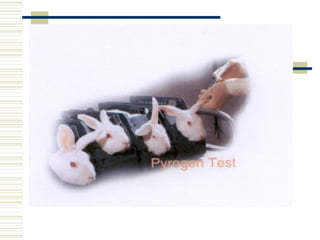
Test for pyrogens = Rabbit test
 the development of the test for pyrogens reach
in 1920
 a pyrogen test was introduced into the USP
XII (1942)
 The test consists of measuring the rise in body
temperature in healthy rabbits by the
intravenous injection of a sterile solution of
the substance under the test.
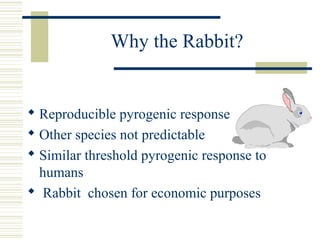
Why the Rabbit?
 Reproducible pyrogenic response
 Other species not predictable
 Similar threshold pyrogenic response to
humans
 Rabbit chosen for economic purposes
Rabbit Pyrogen Test
 Rabbits must be healthy and mature
 New Zealand or Belgian Whites used mostly
 Either sex may be used
 Must be individually housed between 20 and
23°C
 Not varies more than ± 3º c.
 Free from disturbances likely to excite them.
 equipment and material used in test (glassware,
syringes, needles etc)
 Must be free from Pyrogens by heating at 250º c
for not less then 30 minutes or any other method
 retaining boxes (comfortable for rabbits as
possible)
 Thermometers or thermistor probe (standardized
position in rectum, precision of ± 0.1°C)
Rabbit pyrogen test
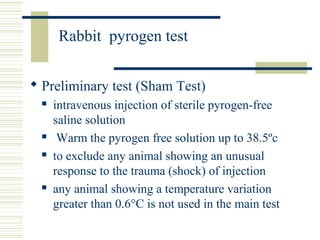
 Preliminary test (Sham Test)
 intravenous injection of sterile pyrogen-free
saline solution
 Warm the pyrogen free solution up to 38.5ºc
 to exclude any animal showing an unusual
response to the trauma (shock) of injection
 any animal showing a temperature variation
greater than 0.6°C is not used in the main test
Rabbit pyrogen test -
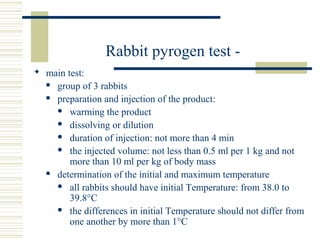
 main test:
 group of 3 rabbits
 preparation and injection of the product:
 warming the product
 dissolving or dilution
 duration of injection: not more than 4 min
 the injected volume: not less than 0.5 ml per 1 kg and not
more than 10 ml per kg of body mass
 determination of the initial and maximum temperature
 all rabbits should have initial Temperature: from 38.0 to
39.8°C
 the differences in initial Temperature should not differ from
one another by more than 1°C
 Interpretation of the results:
 the test is carried out on the first group of 3 rabbits; if
necessary on further groups of 3 rabbits to a total of 4
groups, depending on the results obtained
 intervals of passing or failing of products are on the
basis of summed temperature response
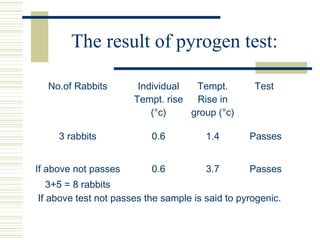
The result of pyrogen test:
No.of Rabbits Individual
Tempt. rise
(°c)
Tempt.
Rise in
group (°c)
Test
3 rabbits 0.6 1.4 Passes
If above not passes
3+5 = 8 rabbits
0.6 3.7 Passes
If above test not passes the sample is said to pyrogenic.
LAL Test
 Limulus amebocyte lysate test.
 to measure the concentration of endotoxins of
gram-negative bacterial origin
 reagent: amoebocyte lysate from horseshoe
crab, Limulus polyphemus
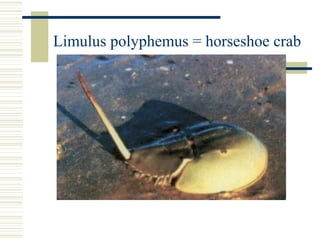
Limulus polyphemus = horseshoe crab
Principle
The addition of solution containing endotoxin
to a solution of lysate produce turbidity.
The rate of reaction depends upon
concentration of endotoxin , the pH and the
temperature.
The endotoxin reference standard is the freeze
dried.
The test is based on the primitive blood-
clotting mechanism of the horseshoe crab
Commercially derived LAL reagents
 bleeding adult crabs into an anticlotting solution
 washing and centrifuging to collect the amebocyte
 lysing in 3% NaCl
 lysate is washed and lyophilized for storage
 activity varies on a seasonal basis and
standardization is necessary.
Test performance (short)
 avoid endotoxin contamination
 Before the test:
 interfering factors should not be present
 equipment should be depyrogenated

the sensitivity of the lysate should be known
 Test:
 equal volume of LAL reagent and test solution (usually 0.1
ml of each) are mixed in a depyrogenated test-tube
 incubation at 37°C, 1 hour
 remove the tube - invert in one smooth motion (180°) - read
(observe) the result
Endotoxin concentration monitoring
 Following method are used to monitor the endotoxin
concentration
 Method A: El-clot method: limit test
 Method B: semi-quantitative gel-clot method
 Method C: kinetic turbidimetric method
 Method D: kinetic chromogenic method
 Method E: end-point chromomeric method
 different techniques:
 the gel-clot technique - gel formation
 the turbidimetric technique - the development
of turbidity after cleavage of an endogenous
substrate
 the chromogenic technique - the development
of color after cleavage of a synthetic peptide-
chromogen complex
REFERENCES
 U.S.PHARMACOPEIA
 Pharmaceutical Formulations by
M.E.Aulton, H.C. Ansel.page no 195-196.
Pyrogen testing

Pyrogen testing

  • 1.
    PYROGEN TESTING Present by:- Guided by:- Mr.N.P.Sawadadkar Prof.Tushar Thakur Sir
  • 2.
    Pyrogens  Pyrogens -fever inducing organic substances  Responsible for many febrile reaction  These are Endotoxin.  Having nature  Endogenous (inside body)  Exogenous (outside body)  Exogenous pyrogens –  mainly lipopolysaccharides  bacterial origin, but not necessary
  • 3.
    Endotoxin characteristic  thermostable water-soluble  unaffected by the common bactericides  non-volatile  These are the reasons why pyrogens are difficult to destroy once produced in a product
  • 4.
    Test for pyrogens= Rabbit test  the development of the test for pyrogens reach in 1920  a pyrogen test was introduced into the USP XII (1942)  The test consists of measuring the rise in body temperature in healthy rabbits by the intravenous injection of a sterile solution of the substance under the test.
  • 5.
    Why the Rabbit? Reproducible pyrogenic response  Other species not predictable  Similar threshold pyrogenic response to humans  Rabbit chosen for economic purposes
  • 6.
    Rabbit Pyrogen Test Rabbits must be healthy and mature  New Zealand or Belgian Whites used mostly  Either sex may be used  Must be individually housed between 20 and 23°C  Not varies more than ± 3º c.  Free from disturbances likely to excite them.
  • 7.
     equipment andmaterial used in test (glassware, syringes, needles etc)  Must be free from Pyrogens by heating at 250º c for not less then 30 minutes or any other method  retaining boxes (comfortable for rabbits as possible)  Thermometers or thermistor probe (standardized position in rectum, precision of ± 0.1°C)
  • 9.
    Rabbit pyrogen test Preliminary test (Sham Test)  intravenous injection of sterile pyrogen-free saline solution  Warm the pyrogen free solution up to 38.5ºc  to exclude any animal showing an unusual response to the trauma (shock) of injection  any animal showing a temperature variation greater than 0.6°C is not used in the main test
  • 10.
    Rabbit pyrogen test-  main test:  group of 3 rabbits  preparation and injection of the product:  warming the product  dissolving or dilution  duration of injection: not more than 4 min  the injected volume: not less than 0.5 ml per 1 kg and not more than 10 ml per kg of body mass  determination of the initial and maximum temperature  all rabbits should have initial Temperature: from 38.0 to 39.8°C  the differences in initial Temperature should not differ from one another by more than 1°C
  • 11.
     Interpretation ofthe results:  the test is carried out on the first group of 3 rabbits; if necessary on further groups of 3 rabbits to a total of 4 groups, depending on the results obtained  intervals of passing or failing of products are on the basis of summed temperature response
  • 12.
    The result ofpyrogen test: No.of Rabbits Individual Tempt. rise (°c) Tempt. Rise in group (°c) Test 3 rabbits 0.6 1.4 Passes If above not passes 3+5 = 8 rabbits 0.6 3.7 Passes If above test not passes the sample is said to pyrogenic.
  • 13.
    LAL Test  Limulusamebocyte lysate test.  to measure the concentration of endotoxins of gram-negative bacterial origin  reagent: amoebocyte lysate from horseshoe crab, Limulus polyphemus
  • 14.
    Limulus polyphemus =horseshoe crab
  • 15.
    Principle The addition ofsolution containing endotoxin to a solution of lysate produce turbidity. The rate of reaction depends upon concentration of endotoxin , the pH and the temperature. The endotoxin reference standard is the freeze dried. The test is based on the primitive blood- clotting mechanism of the horseshoe crab
  • 16.
    Commercially derived LALreagents  bleeding adult crabs into an anticlotting solution  washing and centrifuging to collect the amebocyte  lysing in 3% NaCl  lysate is washed and lyophilized for storage  activity varies on a seasonal basis and standardization is necessary.
  • 17.
    Test performance (short) avoid endotoxin contamination  Before the test:  interfering factors should not be present  equipment should be depyrogenated  the sensitivity of the lysate should be known  Test:  equal volume of LAL reagent and test solution (usually 0.1 ml of each) are mixed in a depyrogenated test-tube  incubation at 37°C, 1 hour  remove the tube - invert in one smooth motion (180°) - read (observe) the result
  • 18.
    Endotoxin concentration monitoring Following method are used to monitor the endotoxin concentration  Method A: El-clot method: limit test  Method B: semi-quantitative gel-clot method  Method C: kinetic turbidimetric method  Method D: kinetic chromogenic method  Method E: end-point chromomeric method
  • 19.
     different techniques: the gel-clot technique - gel formation  the turbidimetric technique - the development of turbidity after cleavage of an endogenous substrate  the chromogenic technique - the development of color after cleavage of a synthetic peptide- chromogen complex
  • 20.
    REFERENCES  U.S.PHARMACOPEIA  PharmaceuticalFormulations by M.E.Aulton, H.C. Ansel.page no 195-196.

Editor's Notes

  • #6 Monkeys, horses, dogs, cats, and rabbit have reproducible responses Rats, guinea pigs, mice, hamsters, chicks, etc, are irregular and unpredictable Rabbit and dog chosen chosen for economic purposes, BUT… Rabbit has labile thermoregulatory process, and is susceptible to false positives. A negative test is more significant than a positive one. The dog has a more stable thermoregulatory system, and is less sensitive to pyrogen. Therefore a positive is more significant than a negative one. Similar threshold pyrogenic response to humans. HOWEVER, as dose is increased, humans respond more vigorously.
  • #7 USP XX had only two requirements for the animals, that they be healthy and mature. NZ or Belgian Whites are mostly used Either sex may be used, but kept to a single sex to avoid outside stimuli