Capsules
B. Pharm. - III, (Sem-VI)
Sant Gajanan Maharaj College of
Pharmacy,Mahagaon
Contents…
Introduction
 Hard capsules
• Raw materials
• Shell manufacturing
• Capsule size
• Properties of filled material and
formulation
• Capsule filling equipments
•Evaluation of finished capsules and
official standards
Introduction
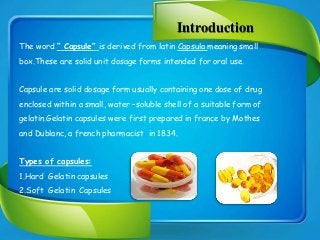
The word “ Capsule” is derived from latin Capsula meaning small
box.These are solid unit dosage forms intended for oral use.
Capsule are solid dosage form usually containing one dose of drug
enclosed within a small, water –soluble shell of a suitable form of
gelatin.Gelatin capsules were first prepared in france by Mothes
and Dublanc, a french pharmacist in 1834.
Types of capsules:
1.Hard Gelatin capsules
2.Soft Gelatin Capsules
Advantages of Capsules
1.Capsules are tasteless, odorless and can be easily
administered.
2.They are attractive in appearance.
3.The drugs having unpleasant odor and taste are
enclosed in a tasteless shell.
4.They are economical.
5.They are easy to handle and carry.
Disadvantages of Capsules
1.The drugs which are hygroscopic are not suitable
for filling into capsules.The y will absorb the water
present in capsule shell rendering the shell very
brittle and lead to crumble into pieces.
2.The concentrated solutions which require previous
dilution are unsuitable for capsules because if
administered as such lead to irritation in the
stomach.
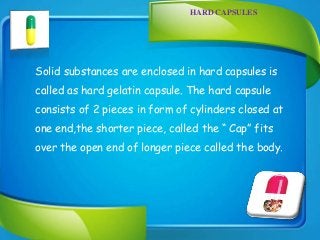
HARD CAPSULES
Solid substances are enclosed in hard capsules is
called as hard gelatin capsule. The hard capsule
consists of 2 pieces in form of cylinders closed at
one end,the shorter piece, called the “ Cap” fits
over the open end of longer piece called the body.
Hard capsules….
Raw material
Hard capsules are made up of base containing plasticizers
and water. The base may also contain
preservatives,colors,flavors and sugars. Raw materials
have been used in manufacturing of both types of capsule
both contain gelatin, water ,colourants and preservatives.
Soft capsules contain various plasticizers such as glycerin
and sorbitol.
Gelatin
It is the major component used for capsules.Gelatin is a protein
substances derived from collagen, a natural protein present in ligaments
and tissues of mammals. It is produced by boiling the connective tissues
,bones and skin of animals usually cows and pigs. Gelatin is a translucent,
colorless brittle (when dry) solid substances prepared by hydrolysis of
collagen which is a main protein constituent of connective tissues.
Gelatin possesses basic properties that make suitable for mfg of
capsule.
1.It is non-toxic
2.It is readily soluble in biological fluids at body temperature.
3.It is a good film-forming material producing a strong flexible film.
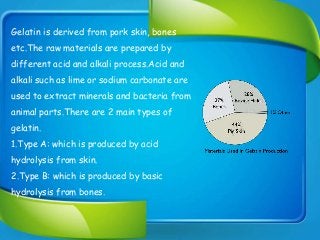
Gelatin is derived from pork skin, bones
etc.The raw materials are prepared by
different acid and alkali process.Acid and
alkali such as lime or sodium carbonate are
used to extract minerals and bacteria from
animal parts.There are 2 main types of
gelatin.
1.Type A: which is produced by acid
hydrolysis from skin.
2.Type B: which is produced by basic
hydrolysis from bones.
Shell
Manufacturing
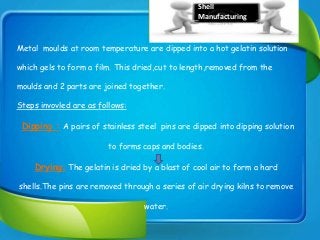
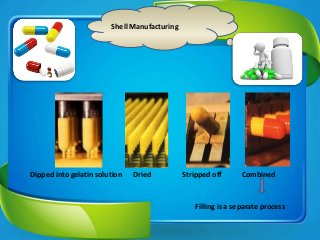
Metal moulds at room temperature are dipped into a hot gelatin solution
which gels to form a film. This dried,cut to length,removed from the
moulds and 2 parts are joined together.
Steps invovled are as follows:
Dipping : A pairs of stainless steel pins are dipped into dipping solution
to forms caps and bodies.
Drying: The gelatin is dried by a blast of cool air to form a hard
shells.The pins are removed through a series of air drying kilns to remove
water.
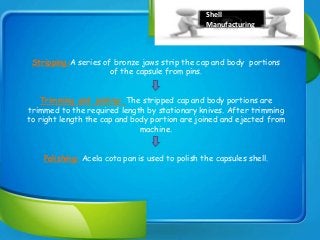
Stripping:A series of bronze jaws strip the cap and body portions
of the capsule from pins.
Trimming and joining: The stripped cap and body portions are
trimmed to the required length by stationary knives. After trimming
to right length the cap and body portion are joined and ejected from
machine.
Polishing: Acela cota pan is used to polish the capsules shell.
Shell
Manufacturing
Shell Manufacturing
Dipped into gelatin solution Dried Stripped off Combined
Filling is a separate process
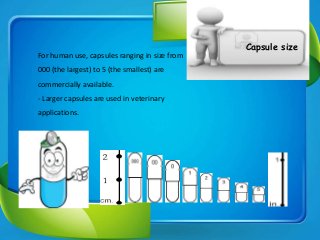
For human use, capsules ranging in size from
000 (the largest) to 5 (the smallest) are
commercially available.
- Larger capsules are used in veterinary
applications.
Capsule size
Properties of filled material and
formulation
1. Lubricant
- A lubricant is added to facilitate the flow of the drug-fill into the
machinery which reduce powder to metal adhesion.
E.g. Magnessium Stearate
2. Wetting Agent
- Wetting agents are used to enhance the dissolution of solid particles.
Lithium carbonate is a commonly used wetting agent.
-Wetting agent pre-vents agglomeration of particles and accelerates the
dissolution of particles by allowing water to penetrate.
-
Properties of filled material
and formulation
3.Fillers include lactose, starch, dicalcium phosphate.
4.Glidants: which improve powder flow.E.g:Talc
5.Disintegrants: which produce disruption of the powder mass.
Promoting liquid penetration (wicking) and Promoting deaggregation
E.g: Sodium starch glycolate
6.Stabilizers:Which improve product stability.Eg:Benzoic acid
Hard capsules…
Capsule filling Equipments
For filling of small no of capsules.
1.The proper size of capsule shell is selected which depends upon
the quantity and density of the powder to be filled in.
2.Each ingredient is weighed and finely powdered if already not in
a fine powder. They are mixed together by triturating so that a
uniform powder is obtained.
3. The mixed powder is placed on the paper and spread with a
spatula so as to make a small pile .
4.Remove the cap from the capsule and hold it in the left hand,
press the body repeatedly into the powder until it is filled.
5.Insert the cap on the body and weigh the capsule.
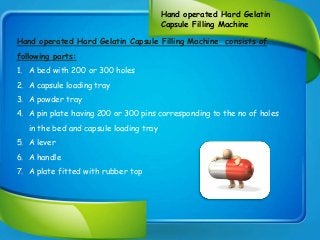
Hand operated Hard Gelatin
Capsule Filling Machine
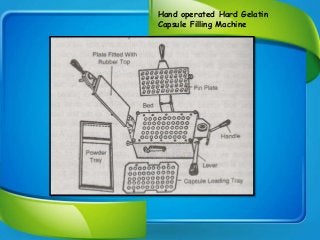
Hand operated Hard Gelatin Capsule Filling Machine consists of
following parts:
1. A bed with 200 or 300 holes
2. A capsule loading tray
3. A powder tray
4. A pin plate having 200 or 300 pins corresponding to the no of holes
in the bed and capsule loading tray
5. A lever
6. A handle
7. A plate fitted with rubber top
Hand operated Hard Gelatin
Capsule Filling Machine
Filling
equipments
1.Rotosort- for filled capsule machine .
2. Rotofill- to fill pellets in hard gelatin
capsule
3. Rotoweigh- A high speed capsule
weighing machine.
4. Accogel- filling of dry powder in soft
gelatin capsule.
5. Accofill- fill exact powder dose in hard
gelatin capsule
6.Osaka- capsule filling machine (powder, granules)
7. Zanasi- capsule filling (powder,pellets,tablets)
8. Lily/parke-davis- capsule filling (powder)
Filling
equipments
11. Erweka- De-dusting and polishing capsule
machine.
12. Seidender- Uses a Belt for visual inspection.
13. Vericap 1200- capsule weighing machine.
14.Wurster- for coating.
Evaluation of finished
capsules and official
standards
1. Containers for dispensing
 Tight, well closed and light resistant containers .
2. Disintegration Test for Capsules
 Introduce one capsule into each tube and suspend the apparatus in
beaker containing 900 ml of water at 37.If hard capsules float on the
surface of water,the discs may be added.Operate the apparatus for
30 min,,remove the assembly from the liquid.The capsules pass the
test if no residue remains on the screen of the apparatus.
Evaluation of finished
capsules and official
standards
3.Weight Variation
4. Content Uniformity
This test is applicable to all capsules which are meant
for oral administration. For this test a sample of the
contents is assayed as described in individual
monographs and the values calculated which must
comply with the prescribed standards.
Evaluation of finished
capsules and official
standards
5. Dissolution test
The capsule is placed in a basket formed from
stainless steel.A stirrer shaft is attached to the
basket and the basket is immersed in the dissolution
medium.The dissolution medium is held in a 1000 ml
glass vessel and maintained at 37 by means of
constant temperature water bath.
Thank u

Capsule

  • 1.
    Capsules B. Pharm. -III, (Sem-VI) Sant Gajanan Maharaj College of Pharmacy,Mahagaon
  • 2.
    Contents… Introduction  Hard capsules •Raw materials • Shell manufacturing • Capsule size • Properties of filled material and formulation • Capsule filling equipments •Evaluation of finished capsules and official standards
  • 3.
    Introduction The word “Capsule” is derived from latin Capsula meaning small box.These are solid unit dosage forms intended for oral use. Capsule are solid dosage form usually containing one dose of drug enclosed within a small, water –soluble shell of a suitable form of gelatin.Gelatin capsules were first prepared in france by Mothes and Dublanc, a french pharmacist in 1834. Types of capsules: 1.Hard Gelatin capsules 2.Soft Gelatin Capsules
  • 4.
    Advantages of Capsules 1.Capsulesare tasteless, odorless and can be easily administered. 2.They are attractive in appearance. 3.The drugs having unpleasant odor and taste are enclosed in a tasteless shell. 4.They are economical. 5.They are easy to handle and carry.
  • 5.
    Disadvantages of Capsules 1.Thedrugs which are hygroscopic are not suitable for filling into capsules.The y will absorb the water present in capsule shell rendering the shell very brittle and lead to crumble into pieces. 2.The concentrated solutions which require previous dilution are unsuitable for capsules because if administered as such lead to irritation in the stomach.
  • 6.
    HARD CAPSULES Solid substancesare enclosed in hard capsules is called as hard gelatin capsule. The hard capsule consists of 2 pieces in form of cylinders closed at one end,the shorter piece, called the “ Cap” fits over the open end of longer piece called the body.
  • 7.
    Hard capsules…. Raw material Hardcapsules are made up of base containing plasticizers and water. The base may also contain preservatives,colors,flavors and sugars. Raw materials have been used in manufacturing of both types of capsule both contain gelatin, water ,colourants and preservatives. Soft capsules contain various plasticizers such as glycerin and sorbitol.
  • 8.
    Gelatin It is themajor component used for capsules.Gelatin is a protein substances derived from collagen, a natural protein present in ligaments and tissues of mammals. It is produced by boiling the connective tissues ,bones and skin of animals usually cows and pigs. Gelatin is a translucent, colorless brittle (when dry) solid substances prepared by hydrolysis of collagen which is a main protein constituent of connective tissues. Gelatin possesses basic properties that make suitable for mfg of capsule. 1.It is non-toxic 2.It is readily soluble in biological fluids at body temperature. 3.It is a good film-forming material producing a strong flexible film.
  • 9.
    Gelatin is derivedfrom pork skin, bones etc.The raw materials are prepared by different acid and alkali process.Acid and alkali such as lime or sodium carbonate are used to extract minerals and bacteria from animal parts.There are 2 main types of gelatin. 1.Type A: which is produced by acid hydrolysis from skin. 2.Type B: which is produced by basic hydrolysis from bones.
  • 11.
    Shell Manufacturing Metal moulds atroom temperature are dipped into a hot gelatin solution which gels to form a film. This dried,cut to length,removed from the moulds and 2 parts are joined together. Steps invovled are as follows: Dipping : A pairs of stainless steel pins are dipped into dipping solution to forms caps and bodies. Drying: The gelatin is dried by a blast of cool air to form a hard shells.The pins are removed through a series of air drying kilns to remove water.
  • 12.
    Stripping:A series ofbronze jaws strip the cap and body portions of the capsule from pins. Trimming and joining: The stripped cap and body portions are trimmed to the required length by stationary knives. After trimming to right length the cap and body portion are joined and ejected from machine. Polishing: Acela cota pan is used to polish the capsules shell. Shell Manufacturing
  • 13.
    Shell Manufacturing Dipped intogelatin solution Dried Stripped off Combined Filling is a separate process
  • 14.
    For human use,capsules ranging in size from 000 (the largest) to 5 (the smallest) are commercially available. - Larger capsules are used in veterinary applications. Capsule size
  • 15.
    Properties of filledmaterial and formulation 1. Lubricant - A lubricant is added to facilitate the flow of the drug-fill into the machinery which reduce powder to metal adhesion. E.g. Magnessium Stearate 2. Wetting Agent - Wetting agents are used to enhance the dissolution of solid particles. Lithium carbonate is a commonly used wetting agent. -Wetting agent pre-vents agglomeration of particles and accelerates the dissolution of particles by allowing water to penetrate. -
  • 16.
    Properties of filledmaterial and formulation 3.Fillers include lactose, starch, dicalcium phosphate. 4.Glidants: which improve powder flow.E.g:Talc 5.Disintegrants: which produce disruption of the powder mass. Promoting liquid penetration (wicking) and Promoting deaggregation E.g: Sodium starch glycolate 6.Stabilizers:Which improve product stability.Eg:Benzoic acid
  • 17.
    Hard capsules… Capsule fillingEquipments For filling of small no of capsules. 1.The proper size of capsule shell is selected which depends upon the quantity and density of the powder to be filled in. 2.Each ingredient is weighed and finely powdered if already not in a fine powder. They are mixed together by triturating so that a uniform powder is obtained. 3. The mixed powder is placed on the paper and spread with a spatula so as to make a small pile . 4.Remove the cap from the capsule and hold it in the left hand, press the body repeatedly into the powder until it is filled. 5.Insert the cap on the body and weigh the capsule.
  • 18.
    Hand operated HardGelatin Capsule Filling Machine Hand operated Hard Gelatin Capsule Filling Machine consists of following parts: 1. A bed with 200 or 300 holes 2. A capsule loading tray 3. A powder tray 4. A pin plate having 200 or 300 pins corresponding to the no of holes in the bed and capsule loading tray 5. A lever 6. A handle 7. A plate fitted with rubber top
  • 19.
    Hand operated HardGelatin Capsule Filling Machine
  • 20.
    Filling equipments 1.Rotosort- for filledcapsule machine . 2. Rotofill- to fill pellets in hard gelatin capsule 3. Rotoweigh- A high speed capsule weighing machine. 4. Accogel- filling of dry powder in soft gelatin capsule. 5. Accofill- fill exact powder dose in hard gelatin capsule 6.Osaka- capsule filling machine (powder, granules) 7. Zanasi- capsule filling (powder,pellets,tablets) 8. Lily/parke-davis- capsule filling (powder)
  • 21.
    Filling equipments 11. Erweka- De-dustingand polishing capsule machine. 12. Seidender- Uses a Belt for visual inspection. 13. Vericap 1200- capsule weighing machine. 14.Wurster- for coating.
  • 22.
    Evaluation of finished capsulesand official standards 1. Containers for dispensing  Tight, well closed and light resistant containers . 2. Disintegration Test for Capsules  Introduce one capsule into each tube and suspend the apparatus in beaker containing 900 ml of water at 37.If hard capsules float on the surface of water,the discs may be added.Operate the apparatus for 30 min,,remove the assembly from the liquid.The capsules pass the test if no residue remains on the screen of the apparatus.
  • 23.
    Evaluation of finished capsulesand official standards 3.Weight Variation 4. Content Uniformity This test is applicable to all capsules which are meant for oral administration. For this test a sample of the contents is assayed as described in individual monographs and the values calculated which must comply with the prescribed standards.
  • 24.
    Evaluation of finished capsulesand official standards 5. Dissolution test The capsule is placed in a basket formed from stainless steel.A stirrer shaft is attached to the basket and the basket is immersed in the dissolution medium.The dissolution medium is held in a 1000 ml glass vessel and maintained at 37 by means of constant temperature water bath.
  • 25.