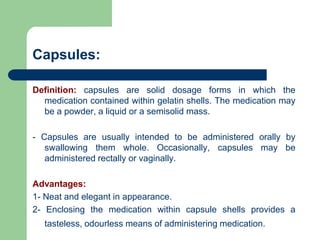
CAPSULES
Capsules:
Definition: capsules are solid dosage forms in which the
medication contained within gelatin shells. The medication may
be a powder, a liquid or a semisolid mass.
- Capsules are usually intended to be administered orally by
swallowing them whole. Occasionally, capsules may be
administered rectally or vaginally.
Advantages:
1- Neat and elegant in appearance.
2- Enclosing the medication within capsule shells provides a
tasteless, odourless means of administering medication.
Capsules (Cont.):
3- The ready solubility of gelatin at gastric pH provides rapid
release of medication in the stomach.
4- since hard gelatin capsules may be compounded by the
pharmacist, this dosage form offers physician’s greater
flexibility in dosages and drug combinations than is available
with prefabricated medication.
Disadvantages:
1- Capsules are not suitable containers for liquids that dissolve
gelatin, such as aqueous or hydroalcoholic solutions.
2- Very soluble salts, such as bromides or iodides should not be
dispensed in capsules, as the rapid release of such materials
may cause gastric irritation.
Capsules (Cont.):
Raw materials:
1- Gelatin:
-It is the major component of the capsule. The reason for this is
that gelatin possesses five basic properties:
A- Non-toxic.
B- Soluble in biological fluids at body temperature.
C- It is a good film-forming material.
D- Solutions of high concentration, 40% w/v, are mobile at 50°C.
E- A solution in water changes from a sol to a gel at temperatures
only a few degrees above ambient (Others require volatile
solvents or large quantities of heat).
Raw materials: 1- Gelatin (Cont.):
- There are two main types of gelatin:
Type A: produced by acid hydrolysis of animal skins.
Type B: produced by basic hydrolysis of bovine bones.
2- Colorants:
There are two types:
I water soluble dyes – e.g. erythrosine
II pigments – e.g. iron oxides , titanium dioxide (make
the capsule opaque to provide protection against
light)
3- Preservatives:
Types of capsules:
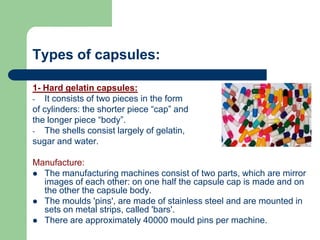
1- Hard gelatin capsules:
- It consists of two pieces in the form
of cylinders: the shorter piece “cap” and
the longer piece “body”.
- The shells consist largely of gelatin,
sugar and water.
Manufacture:
 The manufacturing machines consist of two parts, which are mirror
images of each other: on one half the capsule cap is made and on
the other the capsule body.
 The moulds 'pins', are made of stainless steel and are mounted in
sets on metal strips, called 'bars'.
 There are approximately 40000 mould pins per machine.
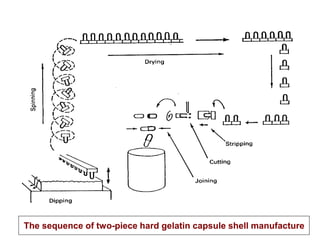
The sequence of two-piece hard gelatin capsule shell manufacture
1- Hard gelatin capsules (Cont.):
1-The prepared gelatin solution is then transferred to a heated holding
hopper on the manufacturing machine.
2- The level of solution is maintained automatically by a feed from the holding
hopper.
3- By dipping sets of moulds, which are at room temperature, 22°C, into this
solution → capsules are formed.
4- A film is formed on the surface of each mould by gelling.
5- The moulds are slowly withdrawn from the solution and then rotated
during their transfer to the upper level of the machine, in order to form a
film of uniform thickness.
6- Groups of 'pin bars' are then passed through a series of drying kilns
(ovens), in which large volumes of controlled humidity air are blown
over them.
7- The dried films are removed from the moulds, cut to the correct length, the
two parts joined together and the complete capsule delivered from the
machine.
8-The mould pins are then cleaned and lubricated for the start of the next
cycle.
1- Hard gelatin capsules (Cont.):
Capsule filling:
Capsule sizes: SIZE VOLUME (cm3
)
000 1.37
00 0.95
0 0.68
1 0.50
2 0.37
3 0.30
4 0.21
5 0.13
The fill weight = body volume x powder tapped bulk density
1- Hard gelatin capsules (Cont.):
Capsule shell filling:
- typically filled with dry solids (powders, granules, pellets, tablets) and
semisolids.
- Fixed oils and other liquids that do not dissolve gelatin may be filled into
hard gelatin capsules with a pipette or calibrated dropper, then capsules
are sealed by moisturizing the lower part of the caps with water.
- Liquids may often be sorbed onto inert carrier powders to form dry
powders suitable for capsule filling.
Limitations in properties of materials for filling into capsules:
- Must not react with gelatin e.g. formaldehyde (make the capsule insoluble).
- Must not contain a high level of free moisture (can be absorbed by gelatin
causing it to soften).
1- Hard gelatin capsules (Cont.):
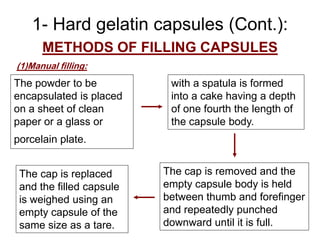
METHODS OF FILLING CAPSULES
(1)Manual filling:
with a spatula is formed
into a cake having a depth
of one fourth the length of
the capsule body.
The powder to be
encapsulated is placed
on a sheet of clean
paper or a glass or
porcelain plate.
The cap is removed and the
empty capsule body is held
between thumb and forefinger
and repeatedly punched
downward until it is full.
The cap is replaced
and the filled capsule
is weighed using an
empty capsule of the
same size as a tare.
1- Hard gelatin capsules (Cont.):
(2) Industrial filling:
a. removal of caps,
b. filling of the bodies,
c. replacement of caps, and
d. ejection of filled capsules.
 The industry uses semi-automatic and fully automatic equipment
for the large-scale filling of capsules.
 The semi-automatic machine is capable of filling all capsule sizes
from 000 through 5 and attains its maximum rated capacity of
15,000 capsules per hour.
1- Hard gelatin capsules (Cont.):
 Capsules are delivered into the perforated capsule filling ring. The
ring is rotated on a turntable, and a vacuum pulls the bodies into
the lower half of the ring, leaving the caps in the upper half of the
ring.
 The top & bottom halves of the filling ring are separated manually,
and the cap half of the ring is set aside.
 The body half of the ring is then moved to another turntable where
it is rotated mechanically under a powder hopper.
 The hopper contains an auger which feeds the powder into the
bodies.
 When the capsule bodies are filled, the cap and body rings are
rejoined.
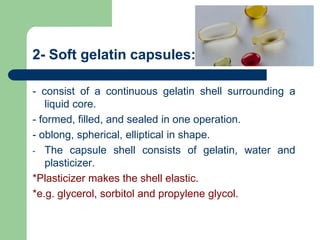
2- Soft gelatin capsules:
- consist of a continuous gelatin shell surrounding a
liquid core.
- formed, filled, and sealed in one operation.
- oblong, spherical, elliptical in shape.
- The capsule shell consists of gelatin, water and
plasticizer.
*Plasticizer makes the shell elastic.
*e.g. glycerol, sorbitol and propylene glycol.
2- Soft gelatin capsules (Cont.):
Advantages:
1- Improved drug absorption.
2- Easy to swallow.
3- Avoids dust handling problems during manufacture
and better operator safety.
4- Overcome problems with manufacture (e.g. oils, low
melting point drugs) as compressed tablet.
5- Dose uniformity for low-dose drugs.
6- Good product stability (drugs are protected against
oxidative degradation by lipid vehicles and gelatin
shells).
2- Soft gelatin capsules (Cont.):
Disadvantages:
1- Soft gelatin capsules are not easily prepared except on
a large scale and with specialized equipment.
2-They are an expensive dosage form, when compared
with direct compression tablets.
3- There is a more intimate contact between the shell and
its liquid contents than exists with dry-filled hard gelatin
capsules, which increases the possibility of interactions.
2- Soft gelatin capsules (Cont.):
SOFTGELS CAN BE FORMULATED TO PRODUCE
DIFFERENT DRUG DELIVERY SYSTEMS:
 Orally administered : containing solutions or suspensions that
release their contents in the stomach in an easy way to swallow.
(most common.)
 2.Chewable : a highly flavoured shell is chewed to release the
drug liquid fill matrix.
 3.Suckable : consist of a gelatin shell containing the flavoured
medicament to be sucked and a liquid matrix or just air inside the
capsule.
2- Soft gelatin capsules (Cont.):
 4.Twist-off : designed with a tag to be twisted or
snipped off, thereby allowing access to the fill
material. It can be very useful for unit dosing of
topical medication, inhalations, or indeed for oral
dosing of a pediatric product.
 5.Meltable : designed for use as 'patient-friendly'
pessaries or suppositories
2- Soft gelatin capsules (Cont.):
Types of fill matrixes:
- Lipophilic liquids / oils:e.g. soya bean oil.
- Hydrophilic liquids: PEG400.
- Self-emulsifying oils (oil + non ionic surfactant).
- Microemulsion and nanoemulsion systems.
- Suspensions.
2- Soft gelatin capsules (Cont.):
 Gelatin + water gel mass then plasticizer is added
(as glycerol).
 Once the gelatin is fully dissolved then other components, such as
colours, opacifier, flavours and preservatives, may be added.
 The hot gel mass is then supplied to the encapsulation machine through
heated transfer pipes by a casting method that forms two separate gelatin
ribbons (each approximately 150 mm wide).
 During the casting process the gelatin passes through the sol-gel
transition and the thickness of each gel ribbon is controlled to ± 0.1 mm.
 The two gel ribbons are then carried through rollers to the rotary die
encapsulation tooling.
 Each ribbon provides one half of the soft gel.
2- Soft gelatin capsules (Cont.):
Seamless gelatin capsules:
- It is a modern method for making soft gelatin capsules.
- The essential parts of the apparatus consist of two
concentric tubes.
- Through the inner tube flows the medicament, and
through the surrounding outer tube, the gelatin solution.
- The medicament, therefore, issues from the tube
surrounded by gelatin and forming a spherical drop.
This is insured by allowing the drop to form in liquid
paraffin in which the gelatin is insoluble.
- The capsules are subsequently degreased and dried.
Capsules (Cont.):
Sustained release capsules:
- In general, a sustained release dosage form is consisting of two
parts:
1- an immediate release portion.
2- a sustained release portion which gradually release medicament.
- The spansule is a hard gelatin capsule containing many coated
beads.
A-The medication is pan coated onto the surface of sugar starch
beads using non aqueous solution of the drug.
B- 1/3 of these drug-coated beads is intended to provide the initial
release of medication, and these receive no furthertreatmnet.
Capsules (Cont.):
C- The reminder (2/3 of the beads) are then pan coated with a fatty,
waxy material such as bees wax or cellulosic material such as
ethyl cellulose. Different portions of the beads receive different
thicknesses of coating.
- Sustained release capsules are suitable for antibiotics.
Advantage: Administration is more convenient, since a single dose
provides all-day or all-night medication.
Enteric coated capsules:
- They are capsules that are treated to resist dissolution in gastric
fluids but release their contents in the intestine.
- This delayed release medication may be desired if:
Capsules (Cont.):
A- The drug is inactivated in the gastric fluids.
B- The drug is irritating to the gastric mucosa.
C- A high local concentration of the drug is desirable in the intestine ,
as in the case of anthelminitics.
- Materials used for enteric coating: shellac and cellulose acetate
phathalate.
Formulation factors affecting drug availability from capsules:
The overall dissolution rate of a drug from capsules may be
regarded as a function of several variables:
1- The dissolution rate of the shell.
2- The rate of penetration of the dissolution medium into the powder.
3- The rate at which the powder mass deaggregates.
Capsules (Cont.):
4- The amount and nature of adjuvant such as diluent, surfactant (if used).
5- drug particle size.
6- The composition and characteristics of the capsule shell.
Evaluation of commercial capsules:
1- content uniformity:
- 30 capsules are selected and 10 of these are assayed individually.
- At least 9 of these contain 85 – 115 % of drug and none contain below 75
– 125% of drug.
- If 1 to 3 of them fall outside of 85 – 115% limits, the remaining 20 capsules
are individually assayed and the requirements are met if no few than 27
contain 85 – 115 % of drug and none contain less than 75 – 125 % of
drug.
Capsules (Cont.):
2- Weight Uniformity :
- This test applies to all types of capsules and it is to be
done on 20 capsules.
Method:
1- Weigh an intact capsule.
2- Open the capsule without losing any part of the shell
and remove the contents as completely as possible.
3- Weigh the shell.
4- The weight of the contents is the difference between
the weighing.
5- Repeat the procedure with a further 19 capsules
selected at random.
6- Determine the average weight.
Capsules (Cont.):
Limit:
Not more than two of the individual weights deviate from
the average weight by more than the percentage
deviation shown in the table below, and none deviates
by more than twice that percentage.
Average Weight of
Capsule Content
Percentage Deviation
Less than 300 mg 10
300 mg or more 7.5
Capsules (Cont.):
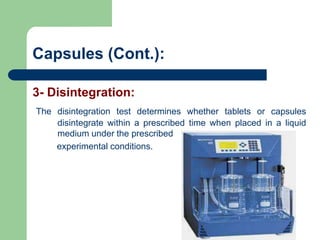
3- Disintegration:
The disintegration test determines whether tablets or capsules
disintegrate within a prescribed time when placed in a liquid
medium under the prescribed
experimental conditions.
Capsules (Cont.):
Method:
According to the B.P. and applies to hard and soft capsules.
1- Introduce one capsule into each tube and suspend the apparatus in
a beaker containing 600 ml water at 37 °C.
If hard capsules float on the surface of the water, the discs may be
added.
2- Operate the apparatus for 30 minutes; remove the assembly from
the liquid.
3-The capsules pass the test if
– No residue remains on the screen of the apparatus or,
– If a residue remains, it consists of fragments of shell or,
– Is a soft mass with no palpable core.
– If the disc is used, any residue remaining on its lower surface should
only consist of fragments of shell.
Capsules (Cont.):
4- Dissolution:
- The dissolution test is carried out using the dissolution apparatus
official in both the U.S.P. and N.F.
- The capsule is placed in a basket formed from 40-mesh stainless
steel fabric.
- A stirrer shaft is attached to the basket, and the basket is
immersed in the dissolution medium and caused to rotate at a
specified speed.
- The dissolution medium is held in a covered 1000 ml glass vessel
and maintained at 37°C ± 0.5°C by means of a suitable constant-
temperature water bath.
- The stirrer speed and type of dissolution medium are specified in
the individual monograph.
Capsules (Cont.):

Capsules

  • 1.
  • 2.
    Capsules: Definition: capsules aresolid dosage forms in which the medication contained within gelatin shells. The medication may be a powder, a liquid or a semisolid mass. - Capsules are usually intended to be administered orally by swallowing them whole. Occasionally, capsules may be administered rectally or vaginally. Advantages: 1- Neat and elegant in appearance. 2- Enclosing the medication within capsule shells provides a tasteless, odourless means of administering medication.
  • 3.
    Capsules (Cont.): 3- Theready solubility of gelatin at gastric pH provides rapid release of medication in the stomach. 4- since hard gelatin capsules may be compounded by the pharmacist, this dosage form offers physician’s greater flexibility in dosages and drug combinations than is available with prefabricated medication. Disadvantages: 1- Capsules are not suitable containers for liquids that dissolve gelatin, such as aqueous or hydroalcoholic solutions. 2- Very soluble salts, such as bromides or iodides should not be dispensed in capsules, as the rapid release of such materials may cause gastric irritation.
  • 4.
    Capsules (Cont.): Raw materials: 1-Gelatin: -It is the major component of the capsule. The reason for this is that gelatin possesses five basic properties: A- Non-toxic. B- Soluble in biological fluids at body temperature. C- It is a good film-forming material. D- Solutions of high concentration, 40% w/v, are mobile at 50°C. E- A solution in water changes from a sol to a gel at temperatures only a few degrees above ambient (Others require volatile solvents or large quantities of heat).
  • 5.
    Raw materials: 1-Gelatin (Cont.): - There are two main types of gelatin: Type A: produced by acid hydrolysis of animal skins. Type B: produced by basic hydrolysis of bovine bones. 2- Colorants: There are two types: I water soluble dyes – e.g. erythrosine II pigments – e.g. iron oxides , titanium dioxide (make the capsule opaque to provide protection against light) 3- Preservatives:
  • 6.
    Types of capsules: 1-Hard gelatin capsules: - It consists of two pieces in the form of cylinders: the shorter piece “cap” and the longer piece “body”. - The shells consist largely of gelatin, sugar and water. Manufacture:  The manufacturing machines consist of two parts, which are mirror images of each other: on one half the capsule cap is made and on the other the capsule body.  The moulds 'pins', are made of stainless steel and are mounted in sets on metal strips, called 'bars'.  There are approximately 40000 mould pins per machine.
  • 7.
    The sequence oftwo-piece hard gelatin capsule shell manufacture
  • 8.
    1- Hard gelatincapsules (Cont.): 1-The prepared gelatin solution is then transferred to a heated holding hopper on the manufacturing machine. 2- The level of solution is maintained automatically by a feed from the holding hopper. 3- By dipping sets of moulds, which are at room temperature, 22°C, into this solution → capsules are formed. 4- A film is formed on the surface of each mould by gelling. 5- The moulds are slowly withdrawn from the solution and then rotated during their transfer to the upper level of the machine, in order to form a film of uniform thickness. 6- Groups of 'pin bars' are then passed through a series of drying kilns (ovens), in which large volumes of controlled humidity air are blown over them. 7- The dried films are removed from the moulds, cut to the correct length, the two parts joined together and the complete capsule delivered from the machine. 8-The mould pins are then cleaned and lubricated for the start of the next cycle.
  • 9.
    1- Hard gelatincapsules (Cont.): Capsule filling: Capsule sizes: SIZE VOLUME (cm3 ) 000 1.37 00 0.95 0 0.68 1 0.50 2 0.37 3 0.30 4 0.21 5 0.13 The fill weight = body volume x powder tapped bulk density
  • 10.
    1- Hard gelatincapsules (Cont.): Capsule shell filling: - typically filled with dry solids (powders, granules, pellets, tablets) and semisolids. - Fixed oils and other liquids that do not dissolve gelatin may be filled into hard gelatin capsules with a pipette or calibrated dropper, then capsules are sealed by moisturizing the lower part of the caps with water. - Liquids may often be sorbed onto inert carrier powders to form dry powders suitable for capsule filling. Limitations in properties of materials for filling into capsules: - Must not react with gelatin e.g. formaldehyde (make the capsule insoluble). - Must not contain a high level of free moisture (can be absorbed by gelatin causing it to soften).
  • 11.
    1- Hard gelatincapsules (Cont.): METHODS OF FILLING CAPSULES (1)Manual filling: with a spatula is formed into a cake having a depth of one fourth the length of the capsule body. The powder to be encapsulated is placed on a sheet of clean paper or a glass or porcelain plate. The cap is removed and the empty capsule body is held between thumb and forefinger and repeatedly punched downward until it is full. The cap is replaced and the filled capsule is weighed using an empty capsule of the same size as a tare.
  • 12.
    1- Hard gelatincapsules (Cont.):
  • 13.
    1- Hard gelatincapsules (Cont.): (2) Industrial filling: a. removal of caps, b. filling of the bodies, c. replacement of caps, and d. ejection of filled capsules.  The industry uses semi-automatic and fully automatic equipment for the large-scale filling of capsules.  The semi-automatic machine is capable of filling all capsule sizes from 000 through 5 and attains its maximum rated capacity of 15,000 capsules per hour.
  • 14.
    1- Hard gelatincapsules (Cont.):
  • 15.
    1- Hard gelatincapsules (Cont.):  Capsules are delivered into the perforated capsule filling ring. The ring is rotated on a turntable, and a vacuum pulls the bodies into the lower half of the ring, leaving the caps in the upper half of the ring.  The top & bottom halves of the filling ring are separated manually, and the cap half of the ring is set aside.  The body half of the ring is then moved to another turntable where it is rotated mechanically under a powder hopper.  The hopper contains an auger which feeds the powder into the bodies.  When the capsule bodies are filled, the cap and body rings are rejoined.
  • 18.
    2- Soft gelatincapsules: - consist of a continuous gelatin shell surrounding a liquid core. - formed, filled, and sealed in one operation. - oblong, spherical, elliptical in shape. - The capsule shell consists of gelatin, water and plasticizer. *Plasticizer makes the shell elastic. *e.g. glycerol, sorbitol and propylene glycol.
  • 19.
    2- Soft gelatincapsules (Cont.): Advantages: 1- Improved drug absorption. 2- Easy to swallow. 3- Avoids dust handling problems during manufacture and better operator safety. 4- Overcome problems with manufacture (e.g. oils, low melting point drugs) as compressed tablet. 5- Dose uniformity for low-dose drugs. 6- Good product stability (drugs are protected against oxidative degradation by lipid vehicles and gelatin shells).
  • 20.
    2- Soft gelatincapsules (Cont.): Disadvantages: 1- Soft gelatin capsules are not easily prepared except on a large scale and with specialized equipment. 2-They are an expensive dosage form, when compared with direct compression tablets. 3- There is a more intimate contact between the shell and its liquid contents than exists with dry-filled hard gelatin capsules, which increases the possibility of interactions.
  • 21.
    2- Soft gelatincapsules (Cont.): SOFTGELS CAN BE FORMULATED TO PRODUCE DIFFERENT DRUG DELIVERY SYSTEMS:  Orally administered : containing solutions or suspensions that release their contents in the stomach in an easy way to swallow. (most common.)  2.Chewable : a highly flavoured shell is chewed to release the drug liquid fill matrix.  3.Suckable : consist of a gelatin shell containing the flavoured medicament to be sucked and a liquid matrix or just air inside the capsule.
  • 22.
    2- Soft gelatincapsules (Cont.):  4.Twist-off : designed with a tag to be twisted or snipped off, thereby allowing access to the fill material. It can be very useful for unit dosing of topical medication, inhalations, or indeed for oral dosing of a pediatric product.  5.Meltable : designed for use as 'patient-friendly' pessaries or suppositories
  • 23.
    2- Soft gelatincapsules (Cont.): Types of fill matrixes: - Lipophilic liquids / oils:e.g. soya bean oil. - Hydrophilic liquids: PEG400. - Self-emulsifying oils (oil + non ionic surfactant). - Microemulsion and nanoemulsion systems. - Suspensions.
  • 24.
    2- Soft gelatincapsules (Cont.):  Gelatin + water gel mass then plasticizer is added (as glycerol).  Once the gelatin is fully dissolved then other components, such as colours, opacifier, flavours and preservatives, may be added.  The hot gel mass is then supplied to the encapsulation machine through heated transfer pipes by a casting method that forms two separate gelatin ribbons (each approximately 150 mm wide).  During the casting process the gelatin passes through the sol-gel transition and the thickness of each gel ribbon is controlled to ± 0.1 mm.  The two gel ribbons are then carried through rollers to the rotary die encapsulation tooling.  Each ribbon provides one half of the soft gel.
  • 25.
    2- Soft gelatincapsules (Cont.):
  • 26.
    2- Soft gelatincapsules (Cont.): Seamless gelatin capsules: - It is a modern method for making soft gelatin capsules. - The essential parts of the apparatus consist of two concentric tubes. - Through the inner tube flows the medicament, and through the surrounding outer tube, the gelatin solution. - The medicament, therefore, issues from the tube surrounded by gelatin and forming a spherical drop. This is insured by allowing the drop to form in liquid paraffin in which the gelatin is insoluble. - The capsules are subsequently degreased and dried.
  • 27.
    Capsules (Cont.): Sustained releasecapsules: - In general, a sustained release dosage form is consisting of two parts: 1- an immediate release portion. 2- a sustained release portion which gradually release medicament. - The spansule is a hard gelatin capsule containing many coated beads. A-The medication is pan coated onto the surface of sugar starch beads using non aqueous solution of the drug. B- 1/3 of these drug-coated beads is intended to provide the initial release of medication, and these receive no furthertreatmnet.
  • 28.
    Capsules (Cont.): C- Thereminder (2/3 of the beads) are then pan coated with a fatty, waxy material such as bees wax or cellulosic material such as ethyl cellulose. Different portions of the beads receive different thicknesses of coating. - Sustained release capsules are suitable for antibiotics. Advantage: Administration is more convenient, since a single dose provides all-day or all-night medication. Enteric coated capsules: - They are capsules that are treated to resist dissolution in gastric fluids but release their contents in the intestine. - This delayed release medication may be desired if:
  • 29.
    Capsules (Cont.): A- Thedrug is inactivated in the gastric fluids. B- The drug is irritating to the gastric mucosa. C- A high local concentration of the drug is desirable in the intestine , as in the case of anthelminitics. - Materials used for enteric coating: shellac and cellulose acetate phathalate. Formulation factors affecting drug availability from capsules: The overall dissolution rate of a drug from capsules may be regarded as a function of several variables: 1- The dissolution rate of the shell. 2- The rate of penetration of the dissolution medium into the powder. 3- The rate at which the powder mass deaggregates.
  • 30.
    Capsules (Cont.): 4- Theamount and nature of adjuvant such as diluent, surfactant (if used). 5- drug particle size. 6- The composition and characteristics of the capsule shell. Evaluation of commercial capsules: 1- content uniformity: - 30 capsules are selected and 10 of these are assayed individually. - At least 9 of these contain 85 – 115 % of drug and none contain below 75 – 125% of drug. - If 1 to 3 of them fall outside of 85 – 115% limits, the remaining 20 capsules are individually assayed and the requirements are met if no few than 27 contain 85 – 115 % of drug and none contain less than 75 – 125 % of drug.
  • 31.
    Capsules (Cont.): 2- WeightUniformity : - This test applies to all types of capsules and it is to be done on 20 capsules. Method: 1- Weigh an intact capsule. 2- Open the capsule without losing any part of the shell and remove the contents as completely as possible. 3- Weigh the shell. 4- The weight of the contents is the difference between the weighing. 5- Repeat the procedure with a further 19 capsules selected at random. 6- Determine the average weight.
  • 32.
    Capsules (Cont.): Limit: Not morethan two of the individual weights deviate from the average weight by more than the percentage deviation shown in the table below, and none deviates by more than twice that percentage. Average Weight of Capsule Content Percentage Deviation Less than 300 mg 10 300 mg or more 7.5
  • 33.
    Capsules (Cont.): 3- Disintegration: Thedisintegration test determines whether tablets or capsules disintegrate within a prescribed time when placed in a liquid medium under the prescribed experimental conditions.
  • 34.
    Capsules (Cont.): Method: According tothe B.P. and applies to hard and soft capsules. 1- Introduce one capsule into each tube and suspend the apparatus in a beaker containing 600 ml water at 37 °C. If hard capsules float on the surface of the water, the discs may be added. 2- Operate the apparatus for 30 minutes; remove the assembly from the liquid. 3-The capsules pass the test if – No residue remains on the screen of the apparatus or, – If a residue remains, it consists of fragments of shell or, – Is a soft mass with no palpable core. – If the disc is used, any residue remaining on its lower surface should only consist of fragments of shell.
  • 35.
    Capsules (Cont.): 4- Dissolution: -The dissolution test is carried out using the dissolution apparatus official in both the U.S.P. and N.F. - The capsule is placed in a basket formed from 40-mesh stainless steel fabric. - A stirrer shaft is attached to the basket, and the basket is immersed in the dissolution medium and caused to rotate at a specified speed. - The dissolution medium is held in a covered 1000 ml glass vessel and maintained at 37°C ± 0.5°C by means of a suitable constant- temperature water bath. - The stirrer speed and type of dissolution medium are specified in the individual monograph.
  • 36.