Capsules
By
Pavani.G
Veda college of pharmacy
Capsules
• Defination: Capsules are solid dosage forms
consists of single doseof drug enclosed in a
water soluble shell of a suitable form of
gelatin.
• Types of capsules: There are two types of
capsules they are
1. Hard gelatin capsules
2. Soft gelatin capsules
Capsules
• Advantages and disadvantages of capsules:
• Advantages:
1.They are smooth and become slippery on moistening therfore they
are easily swallowed.
2.The unpleasant taste and odour of medicament can be masked
enclosing in capsules.
3.The labour and production cost is less.
4.Microencapsulation provides the sustained release dosage forms.
5.Capsules are aviailable in various sizes and there fore light and heavy
medicaments in smaller and larger volumes can be enclosed by
using its shell of appropriate size.
6.Enteric coating release the medicament in the intestine.
7.They are easy to handle and carry during transportation.
Capsules
• Disadvatages:
1.Hygroscopic drugs can not be filled in capsules, since
they absorb water present in the capsules shell which
ultimately breaks in to pieces.
2. Capsules can not be given orally to infants and
children.
3.The absorption rate of certain drugs like aspirin is
reduced if given in capsules.
4.Very soluble drugs are eg.potassium bromide
ammonium chloride etc. are not suitable for enclosing
into capsules form since they produce local irritation
on the stomach wall.
Capsules
Types of Capsules:
Hard gelatin capsules: Hard gelatin capsules are used for
administration of powders or solid medicaments. It consists
of two cylindrical halves.
1)Body 2) Cap
The diameter of the body is slightly smaller than the diameter
of the cap but larger in length and the cap is slightly larger
in diameter and smaller in length. The drug is filled in the
body part over which other half is fitted as a cap. Hard
gelatin capsule shell is made up of gelatin,color and
titanium dioxide and make it opaque. In addition to gelatin
other additives such as water preservative sugar etc. are
also added.
Capsules
Types of Capsules:
Hard gelatin capsules:Preservative : Methyl and
propyl paraben.
Opacifying agent: Titanum dioxide.
Flavour: 2%Concentration.
The empty capsules are available in various
sizes. The capsule number starts from 000
and goes up to 5.The former being the largest
and later the smallest.
Capsules
Types of Capsules:
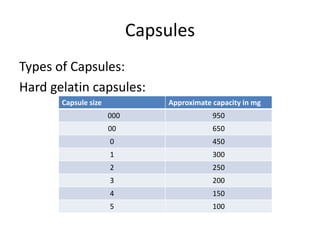
Hard gelatin capsules:
Capsule size Approximate capacity in mg
000 950
00 650
0 450
1 300
2 250
3 200
4 150
5 100
Capsules
Types of Capsules:
Hard gelatin capsules:
The capsules are numbered on the basis of their capacity i.e the
number of the capsules indicates its capacity. Collected on the
plateform of the powder.Lower the pin plate to press the powder in
the bodies. After pressing the pin plates is raised and the remaining
powder is filled is filled into the dodies of the capsules. Press the
caps with the help of plate with rubber top and operate the leaver
to unlock the cap with the help of plate with rubber top and
operate the leaver to unlock the body and cap of the capsules. The
loading tray is then removed and the filled capsules are collected in
a tray. With 200 holes machine about 5000 capsules can be filled in
one hour and with 300 holes about 7500 capsules can be filled in
one hour.
Capsules
Types of Capsules:
Hard gelatin capsules: All capsules require cleaning other wise the drug
remains sticking outside the capsules. Small quantites of capsules
can be cleaned by wiping each capsule with soft cloth. On large
scale they can be rolled or shaken gently with crystalline sodium
chloride. This process is known as salt polish. The capsules are then
rolled on clean surface to remove the sticked sodium chloride.
The capsules are then sealed with molten gelatin or moistening the
outside of the lower halves with water and then fitted on the cap.
The cleaned capsules may be polished by rolling them in a towel
sprinkled lightly with liquid paraffin. This gives good shine to the
capsules.
Capsules
• Types of Capsules:
Soft gelatin capsules: Soft gelatin capsules are also
known as “soft shell” or “soft elastic capsules” or
“soluble elastic”.These capsules are prepared
from gelatin and water to which glycerine,sorbital
or a similar polyol has been added as plasticizer
which imparts flexibility to the capsules. The
ingredients of soft gelatin capsule differ from
hard gelatin capsule in that sugar is replaced by a
plasticizer in soft gelatin capsules.
Capsules
• Types of Capsules:
Soft gelatin capsules : These capsules are used to fill
medicaments , flavours food concentrates cosmetics
etc. They are available in a number of shapes and sizes
eg. spherical, ovoid, eliptical etc. The contents of the
soft gelatin capsules may vary from 0.1 ml to 30ml.
The capsules are used for filling liquids, semi solids,
vitamins etc. They are also used for containing ear,
eye, nose and throat preparations. They have been
employed as a supposatory dosage form for rectal or
vaginal adminstration. They are hermatically sealed
Capsules
• Types of Capsules:
Soft gelatin capsules:
Filling of soft gelatin capsules :(Rotary die process)
Rotary die process machine consists of two
hoppers. One hopper filled with liquid gelatin
mixture the other hopper contains the liquid
medicaments to be filled in the capsules. There
are two rotating dies which rotate in opposite
directions. The liquid gelatin mixture enters into
the machine and produces two continuous
ribbons. These ribbons come over the dies from
Capsules
• Special application of capsules: special
application of capsules are
• 1.Enteric coated capsules
• 2.Sustained release capsules
• 3.Glutoid capsules
• 4.Capsules containing opthalamic ointments
• 5.Rectal capsules.
1.Enteric coated capsules: Enteric coated capsules
break up in intestine (alkaline medium)
Capsules
• Special application of capsules:
1.Enteric coated capsules:but donot disintegrate in the
stomach (acidic medium) .The coating material includes
CAP(Cellulose Acetate Pthalate) and mixture of waxes
with fatty acids or their esters. This coating material
makes the drug to pass unchanged through stomach
but set free in the intestine. Enteric coating may be
given to the following types of drugs.
a)Which are destroyed by gastric juices.
b)Which are required to produce delayed action.
c)Which interfere with the digestion.
Capsules
• Special application of capsules:
1.Enteric coated capsules:d) Which cause irritation
to the gastric mucosa and lead to nausea and
vomiting.
e) Which are specially intended to act in intestine.
Enteric coating is done by dipping the capsules in a
10% solution of cap in acetone . Remove the
capsule with forceps and dry them. Apply second
and third coat after drying each time.
Capsules
• Special application of capsules:
2)Sustained release Capsules: In sustained relese capsules, a capsule
contain number of coated pellets and releases the drug slowly and
continuously over a long period. Thus maintaining a minimum
effective concentration (MEC) of the drug in the blood throughout
the treatment period. The fine powdered drug is firstly converted in
to pellets .The pellets in same batch are coated to different
thickness with a coating which delays releases of drug. The pellets
with different thick ness are mixed and filled in capsule.eg a capsule
may be filled with a mixture containing 30% uncoated pellets for
immediate release of drug 30% each of the coated pellets that
release of drug at 4 hour and 8 hour duration 10% of the neutral
pellets are used only to fill the capsules.
Capsules
• Special application of capsules:
3)Glutoid capsules: In this technique, hard and
soft gelatin capsules are treated with
formaldehyde and are known as glutoid
capasules.These capasules are insoluble in
stomach and solube in alkaline media i.e in
intestine . Formaldehyde and alcohol mixture
is prepared in propotion 1:3 and the capsules
are dropped in this solution for five minutes.
Capsules
• Special application of capsules:
4) Capsules containing opthalamic ointments: soft
gelatin capsules are employed for packing of
opthalamic ointments the enclosed ointment in
capsules remains in sterile form. These capsules
are punctured with a sterile needle and its
contents are instilled into eye and the capsules
shell is discarded. The wastage is minimum and
chances of contamination is less.
Capsules
• Special application of capsules:
5)Rectal Capsules: Soft gelatin capsules can be
used as a substitute for rectal or vaginal
suppositories.Various sizes and shapes are
used for this purpose. Both liquid and solid
drugs can be filled into rectal capsules but the
base used for incorporating the medicament
must be nontoxic, non irritant and compatible
with capsule shell.
Capsules
• Evalution test for Capsules:The following tests
should be carried out for the evaluation of the
capsules.
a)Weight variation test
b)Disintegration test
c)Content uniformity test
d)Dissolution test
Capsules
• Excipients used in the hard gelatin capsule:
The various excipients used in filling of hard gelatin
capsules are.
a)Diluents
b)Glidents
c)Antidusting components
d)Absorbents /Sorbents
a)Diluents: The diluents is added in certain cases
when the quantity of drug is small and bring the
medicament upto the desired bulk.
Capsules
• Excipients used in the hard gelatin capsule:
• B)Glidants: Glidants are mixed with medicaments to ensure a
regular flow of powder into the automatic capsule machine
EX: Calcium sterate,Magnesium sterate and talc.
c) Antidusting components: Some antidusting components are added
to avoid dust which is inhaled by machine operator during its
operation.
EX:Inert edible oils are added.
d)Absorbents/Sorbents: Absorbents are added for physical separation
or incompatible substances
ex:Magnesium carbonate and its oxides, calcium carbonates and its
oxide, kaolin.
These inert substances act as a protective sorbent.
Capsules
• Construction and working of a hand operated hard gelatin
capsule filling machine:
• Construction: Hand operated hard gelatin capsule filling
machine consists of the following parts.
a) A bed having 200-300 holes.
b) A capsule loading tray having 200-300 holes
c) A Powder tray
d) A pin plate having 200-300 pins
e) A leaver
f) A cam handle
g) A lower bed
h) A sealing plate having a rubber top.
Capsules
• Construction and working of a hand operated
hard gelatin capsule filling machine:
• The machine is made up of stainless steel with
additional loading trays. Bed and pin plates so as
to fill the desired size of the capsule to be filled.
The cam handle locks the bodies of the capsules
and lever handles used to lift the loading trays
and move the lower bed upword the plate with
rubber machine is very simple and can be easily
dismandle and ressebled.
Capsules
• Construction and working of a hand operated
hard gelatin capsule filling machine:
• Working : The empty capsules are filled in the
loading tray which is then placed over the bed.
The bodies of the capsules are locked by using
cam handle and caps are separated in the loading
tray.
The powdered tray is filled with an accurate
quantity of durg and spread the drug with a
spreader so as to fill bodies of the capsules
uniformly.

capsules.pptx

  • 1.
  • 2.
    Capsules • Defination: Capsulesare solid dosage forms consists of single doseof drug enclosed in a water soluble shell of a suitable form of gelatin. • Types of capsules: There are two types of capsules they are 1. Hard gelatin capsules 2. Soft gelatin capsules
  • 3.
    Capsules • Advantages anddisadvantages of capsules: • Advantages: 1.They are smooth and become slippery on moistening therfore they are easily swallowed. 2.The unpleasant taste and odour of medicament can be masked enclosing in capsules. 3.The labour and production cost is less. 4.Microencapsulation provides the sustained release dosage forms. 5.Capsules are aviailable in various sizes and there fore light and heavy medicaments in smaller and larger volumes can be enclosed by using its shell of appropriate size. 6.Enteric coating release the medicament in the intestine. 7.They are easy to handle and carry during transportation.
  • 4.
    Capsules • Disadvatages: 1.Hygroscopic drugscan not be filled in capsules, since they absorb water present in the capsules shell which ultimately breaks in to pieces. 2. Capsules can not be given orally to infants and children. 3.The absorption rate of certain drugs like aspirin is reduced if given in capsules. 4.Very soluble drugs are eg.potassium bromide ammonium chloride etc. are not suitable for enclosing into capsules form since they produce local irritation on the stomach wall.
  • 5.
    Capsules Types of Capsules: Hardgelatin capsules: Hard gelatin capsules are used for administration of powders or solid medicaments. It consists of two cylindrical halves. 1)Body 2) Cap The diameter of the body is slightly smaller than the diameter of the cap but larger in length and the cap is slightly larger in diameter and smaller in length. The drug is filled in the body part over which other half is fitted as a cap. Hard gelatin capsule shell is made up of gelatin,color and titanium dioxide and make it opaque. In addition to gelatin other additives such as water preservative sugar etc. are also added.
  • 6.
    Capsules Types of Capsules: Hardgelatin capsules:Preservative : Methyl and propyl paraben. Opacifying agent: Titanum dioxide. Flavour: 2%Concentration. The empty capsules are available in various sizes. The capsule number starts from 000 and goes up to 5.The former being the largest and later the smallest.
  • 7.
    Capsules Types of Capsules: Hardgelatin capsules: Capsule size Approximate capacity in mg 000 950 00 650 0 450 1 300 2 250 3 200 4 150 5 100
  • 8.
    Capsules Types of Capsules: Hardgelatin capsules: The capsules are numbered on the basis of their capacity i.e the number of the capsules indicates its capacity. Collected on the plateform of the powder.Lower the pin plate to press the powder in the bodies. After pressing the pin plates is raised and the remaining powder is filled is filled into the dodies of the capsules. Press the caps with the help of plate with rubber top and operate the leaver to unlock the cap with the help of plate with rubber top and operate the leaver to unlock the body and cap of the capsules. The loading tray is then removed and the filled capsules are collected in a tray. With 200 holes machine about 5000 capsules can be filled in one hour and with 300 holes about 7500 capsules can be filled in one hour.
  • 9.
    Capsules Types of Capsules: Hardgelatin capsules: All capsules require cleaning other wise the drug remains sticking outside the capsules. Small quantites of capsules can be cleaned by wiping each capsule with soft cloth. On large scale they can be rolled or shaken gently with crystalline sodium chloride. This process is known as salt polish. The capsules are then rolled on clean surface to remove the sticked sodium chloride. The capsules are then sealed with molten gelatin or moistening the outside of the lower halves with water and then fitted on the cap. The cleaned capsules may be polished by rolling them in a towel sprinkled lightly with liquid paraffin. This gives good shine to the capsules.
  • 10.
    Capsules • Types ofCapsules: Soft gelatin capsules: Soft gelatin capsules are also known as “soft shell” or “soft elastic capsules” or “soluble elastic”.These capsules are prepared from gelatin and water to which glycerine,sorbital or a similar polyol has been added as plasticizer which imparts flexibility to the capsules. The ingredients of soft gelatin capsule differ from hard gelatin capsule in that sugar is replaced by a plasticizer in soft gelatin capsules.
  • 11.
    Capsules • Types ofCapsules: Soft gelatin capsules : These capsules are used to fill medicaments , flavours food concentrates cosmetics etc. They are available in a number of shapes and sizes eg. spherical, ovoid, eliptical etc. The contents of the soft gelatin capsules may vary from 0.1 ml to 30ml. The capsules are used for filling liquids, semi solids, vitamins etc. They are also used for containing ear, eye, nose and throat preparations. They have been employed as a supposatory dosage form for rectal or vaginal adminstration. They are hermatically sealed
  • 12.
    Capsules • Types ofCapsules: Soft gelatin capsules: Filling of soft gelatin capsules :(Rotary die process) Rotary die process machine consists of two hoppers. One hopper filled with liquid gelatin mixture the other hopper contains the liquid medicaments to be filled in the capsules. There are two rotating dies which rotate in opposite directions. The liquid gelatin mixture enters into the machine and produces two continuous ribbons. These ribbons come over the dies from
  • 13.
    Capsules • Special applicationof capsules: special application of capsules are • 1.Enteric coated capsules • 2.Sustained release capsules • 3.Glutoid capsules • 4.Capsules containing opthalamic ointments • 5.Rectal capsules. 1.Enteric coated capsules: Enteric coated capsules break up in intestine (alkaline medium)
  • 14.
    Capsules • Special applicationof capsules: 1.Enteric coated capsules:but donot disintegrate in the stomach (acidic medium) .The coating material includes CAP(Cellulose Acetate Pthalate) and mixture of waxes with fatty acids or their esters. This coating material makes the drug to pass unchanged through stomach but set free in the intestine. Enteric coating may be given to the following types of drugs. a)Which are destroyed by gastric juices. b)Which are required to produce delayed action. c)Which interfere with the digestion.
  • 15.
    Capsules • Special applicationof capsules: 1.Enteric coated capsules:d) Which cause irritation to the gastric mucosa and lead to nausea and vomiting. e) Which are specially intended to act in intestine. Enteric coating is done by dipping the capsules in a 10% solution of cap in acetone . Remove the capsule with forceps and dry them. Apply second and third coat after drying each time.
  • 16.
    Capsules • Special applicationof capsules: 2)Sustained release Capsules: In sustained relese capsules, a capsule contain number of coated pellets and releases the drug slowly and continuously over a long period. Thus maintaining a minimum effective concentration (MEC) of the drug in the blood throughout the treatment period. The fine powdered drug is firstly converted in to pellets .The pellets in same batch are coated to different thickness with a coating which delays releases of drug. The pellets with different thick ness are mixed and filled in capsule.eg a capsule may be filled with a mixture containing 30% uncoated pellets for immediate release of drug 30% each of the coated pellets that release of drug at 4 hour and 8 hour duration 10% of the neutral pellets are used only to fill the capsules.
  • 17.
    Capsules • Special applicationof capsules: 3)Glutoid capsules: In this technique, hard and soft gelatin capsules are treated with formaldehyde and are known as glutoid capasules.These capasules are insoluble in stomach and solube in alkaline media i.e in intestine . Formaldehyde and alcohol mixture is prepared in propotion 1:3 and the capsules are dropped in this solution for five minutes.
  • 18.
    Capsules • Special applicationof capsules: 4) Capsules containing opthalamic ointments: soft gelatin capsules are employed for packing of opthalamic ointments the enclosed ointment in capsules remains in sterile form. These capsules are punctured with a sterile needle and its contents are instilled into eye and the capsules shell is discarded. The wastage is minimum and chances of contamination is less.
  • 19.
    Capsules • Special applicationof capsules: 5)Rectal Capsules: Soft gelatin capsules can be used as a substitute for rectal or vaginal suppositories.Various sizes and shapes are used for this purpose. Both liquid and solid drugs can be filled into rectal capsules but the base used for incorporating the medicament must be nontoxic, non irritant and compatible with capsule shell.
  • 20.
    Capsules • Evalution testfor Capsules:The following tests should be carried out for the evaluation of the capsules. a)Weight variation test b)Disintegration test c)Content uniformity test d)Dissolution test
  • 21.
    Capsules • Excipients usedin the hard gelatin capsule: The various excipients used in filling of hard gelatin capsules are. a)Diluents b)Glidents c)Antidusting components d)Absorbents /Sorbents a)Diluents: The diluents is added in certain cases when the quantity of drug is small and bring the medicament upto the desired bulk.
  • 22.
    Capsules • Excipients usedin the hard gelatin capsule: • B)Glidants: Glidants are mixed with medicaments to ensure a regular flow of powder into the automatic capsule machine EX: Calcium sterate,Magnesium sterate and talc. c) Antidusting components: Some antidusting components are added to avoid dust which is inhaled by machine operator during its operation. EX:Inert edible oils are added. d)Absorbents/Sorbents: Absorbents are added for physical separation or incompatible substances ex:Magnesium carbonate and its oxides, calcium carbonates and its oxide, kaolin. These inert substances act as a protective sorbent.
  • 23.
    Capsules • Construction andworking of a hand operated hard gelatin capsule filling machine: • Construction: Hand operated hard gelatin capsule filling machine consists of the following parts. a) A bed having 200-300 holes. b) A capsule loading tray having 200-300 holes c) A Powder tray d) A pin plate having 200-300 pins e) A leaver f) A cam handle g) A lower bed h) A sealing plate having a rubber top.
  • 24.
    Capsules • Construction andworking of a hand operated hard gelatin capsule filling machine: • The machine is made up of stainless steel with additional loading trays. Bed and pin plates so as to fill the desired size of the capsule to be filled. The cam handle locks the bodies of the capsules and lever handles used to lift the loading trays and move the lower bed upword the plate with rubber machine is very simple and can be easily dismandle and ressebled.
  • 25.
    Capsules • Construction andworking of a hand operated hard gelatin capsule filling machine: • Working : The empty capsules are filled in the loading tray which is then placed over the bed. The bodies of the capsules are locked by using cam handle and caps are separated in the loading tray. The powdered tray is filled with an accurate quantity of durg and spread the drug with a spreader so as to fill bodies of the capsules uniformly.