Emulsions
Emulsions
Emulsion, in physical chemistry, mixture of two
or more liquids in which one is present as
droplets and distributed throughout the other.
At least 2 phases:
 Disperse or internal phase
 Continuous or external phase.
3
Emulsions
A
B C D
A.: Two immiscible liquids not emulsified
B. An emulsion of phase B dispersed in Phase A
C. Unstable emulsion slowly separates.
D. The emulsifying agent ( black film) places it self on the interface between phase A
and phase B and stabilizes the emulsion.
Phase A
Phase B
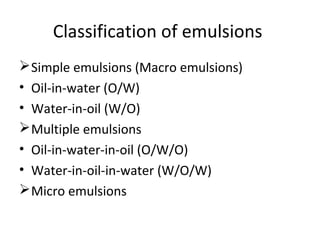
Classification of emulsions
Simple emulsions (Macro emulsions)
• Oil-in-water (O/W)
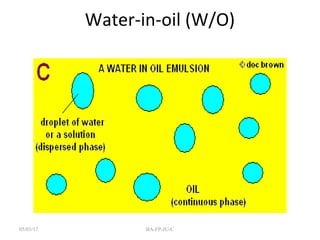
• Water-in-oil (W/O)
Multiple emulsions
• Oil-in-water-in-oil (O/W/O)
• Water-in-oil-in-water (W/O/W)
Micro emulsions
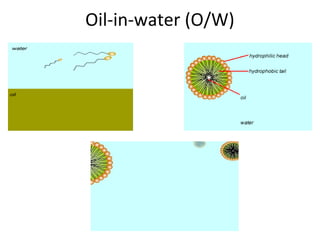
Oil-in-water (O/W)
Water-in-oil (W/O)
05/03/17 BA-FP-JU-C
7
Types of emulsions
w/o/w o/w/o
Multiple emulsions
Identification test for Emulsions:
1) Dye Test
2) Dilution Test
3) Electrical conductivity Test
4) Fluorescence Test.
5) Cobalt Chloride Test.
By using Naked eye, it is very difficult to differentiate between
o/w or w/o emulsions. Thus, the following methods have been
used to identify the type of emulsions.
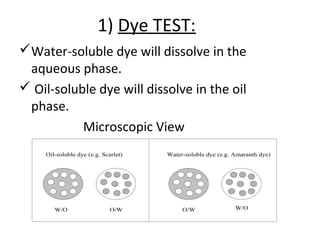
1) Dye TEST:
Water-soluble dye will dissolve in the
aqueous phase.
 Oil-soluble dye will dissolve in the oil
phase.
Microscopic View
Oil-soluble dye (e.g. Scarlet) Water-soluble dye (e.g. Amaranth dye)
O/W W/OO/WW/O
2) Dilution test:
Based on the solubility of external phase of
emulsion.
O/W emulsion can be diluted with water.
W/O emulsion can be diluted with oil.
Few drops
of emulsion
Few drops
of water Water distribute
uniformly
Water separate
out as layer
O/W emulsion
W/O emulsion
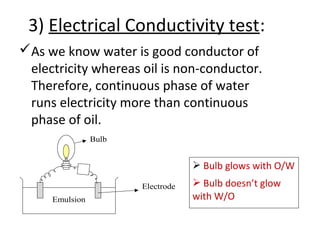
3) Electrical Conductivity test:
As we know water is good conductor of
electricity whereas oil is non-conductor.
Therefore, continuous phase of water
runs electricity more than continuous
phase of oil.
Electrode
Bulb
Emulsion
 Bulb glows with O/W
 Bulb doesn’t glow
with W/O
3) Fluorescence test:
Oils give fluorescence under UV light,
while water doesn’t.
Therefore, O/W emulsion shows spotty
pattern when observed under UV.
while W/O emulsion fluoresces.
4) Cobalt Chloride test:
Principle:
Cobalt Chloride solution is used for
identification of Emulsion. It is water
soluble so it changes colour when
encountered by O/W emulsion.
Procedure:
Filter paper is Dipped in Emulsion.
Filter paper changes its color from blue to
Pink
Theories of Emulsification:
 1) Surface Tension Theory:
- lowering of interfacial tension.
 2) Oriented-Wedge Theory:
- mono molecular layers of emulsifying
agents are curved around a droplet of the
internal phase of the emulsion.
 3) Interfacial film theory:
- A film of emulsifying agent prevents the contact
and coalescing of the dispersed phase.
ADDITIVES FOR FORMULATION OF
EMULSIONS
• 1. Emulsifying agents
• 2. Auxiliary emulsifiers.
• 3. Antimicrobial preservatives
• 4. Antioxidants
Emulsifying Agents:
It is a substance which stabilizes an emulsion .
Pharmaceutically acceptable emulsifiers must also :
 be stable .
 be compatible with other ingredients .
 be non – toxic .
 possess little odor , taste , or color .
 not interfere with the stability of efficacy of the
active agent .
Emulsifying Agents:
 1) Carbohydrate Materials:
- Acacia, Tragacanth, Agar, Pectin. o/w emulsion.
 2) Protein Substances:
-Gelatin, Egg yolk, Caesin o/w emulsion.
 3) High Molecular Weight Alcohols:
- Stearyl Alcohol, Cetyl Alcohol, Glyceryl Mono
stearate o/w emulsion, cholesterol w/o emulsion.
Methods of Preparation of Emulsions:
1) Continental or Dry Gum Method:
"4:2:1" Method
4 parts (volumes) of oil
2 parts of water
1 part of gum
2) English or wet Gum Method:
4 parts (volumes) of oil
2 parts of water
1 part of gum
3) Bottle or Forbes Bottle Method:
useful for extemporaneous preparation of
emulsion from volatile oils or oleaginous
substance of low viscosity.
powdered acacia
+ Dry bottle
2 parts of oil
This method is not suitable for viscous oils (i.e.
high viscosity oil).
Emulsion stability ( Instability) -
Types
• Physical instability
• i. Flocculation
• Ii. Creaming or sedimentation
• iii. Aggregation or coalescence
• Iv. Phase inversion
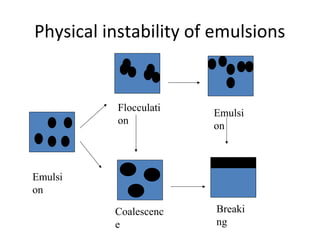
Physical instability of emulsions
Emulsi
on
Coalescenc
e
Flocculati
on
Emulsi
on
Breaki
ng
Advantages of Emulsions:
 Mask the unpleasant taste O/W is convenient means of oral
administration of water-insoluble liquids.
 Oil-soluble drugs can be given parentrally in form of oil-in
water emulsion. (e.g Taxol).
 Emulsion can be used for external application in cosmetic
and therapeutic Application because of Better and faster
absorption.
 Sustained release medication.
 Nutritional supplement.
 Inert and chemically non-reactive.
 Reasonably odorless and cost Effective.
disadvantages of
Emulsions:
Emulsions are thermodynamically unstable
and have short shelf-life.
Improper formulation of emulsions leads to
creaming and cracking of emulsion.
Improper selection of emulsifying agent leads
to phase inversion and some times it may also
lead to cracking.
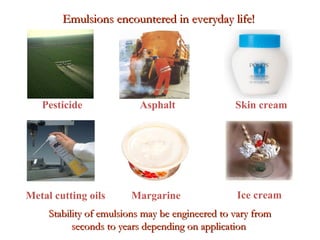
Emulsions encountered in everyday life!Emulsions encountered in everyday life!
Metal cutting oils Margarine Ice cream
Pesticide Asphalt Skin cream
Stability of emulsions may be engineered to vary fromStability of emulsions may be engineered to vary from
seconds to years depending on applicationseconds to years depending on application
General Types of Pharmaceutical Emulsions:
 1) Lotions
 2) Liniments
 3) Creams
 4) Ointments
 5) Vitamin drops