SEMISOLID
DOSAGE
FORMS
Presented By:
K. Arshad Ahmed Khan
M.Pharm
Departmernt of Pharmaceutics
RIPER.
Semisolid dosage forms are
dermatological preparations
intended to apply externally
on the skin to produce local
or systemic effect.
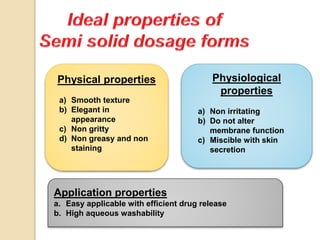
Physical properties
a) Smooth texture
b) Elegant in
appearance
c) Non gritty
d) Non greasy and non
staining
Physiological
properties
a) Non irritating
b) Do not alter
membrane function
c) Miscible with skin
secretion
Application properties
a. Easy applicable with efficient drug release
b. High aqueous washability
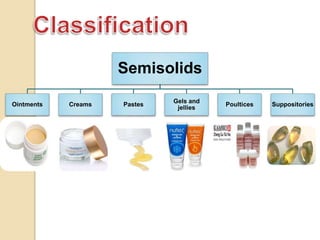
Semisolids
Ointments Creams Pastes
Gels and
jellies
Poultices Suppositories
Ointments
Viscous semi-solid preparations
Used for external or topical application
To skin or to mucous membrane
Usually contain medicament (s)
dispersed in base
Base is always anhydrous
In the form of suspension or solution
Advantages:
Site specific application
Convenient for unconscious patient.
Better adhesion and prolonged residence after
application
Chemically stable
Easily handled than liquids
Suitable for bitter tasted drugs
Disadvantages:
Staining by oily ointments
Less dose accuracy
Contamination when applied by finger tip
Bulky to handle than solids
Ointment classification:
1.Medicated ointment: contain medicament/
mixture of medicaments with ointment base.
Examples:
1. Antibiotic [Bacitracin,neomycin]
2. Antifungal [Benzoic acid, nystatin]
3. Anti inflammatory [Betamethasone valerate]
4. Astringent [Calamine, zinc oxide]
5. Counter-irritant [Capsicum, oleoresin]
6. Dandruff treatment [Salicylic acid, Cetrimide]
7. Psoriasis treatment[Corticosteroid, Dithranol]
8. Parasiticide [Benzylbenzoate, Sulphur]
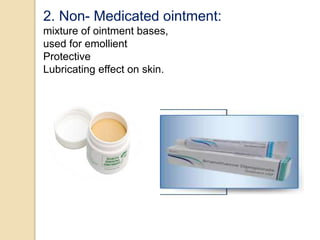
2. Non- Medicated ointment:
mixture of ointment bases,
used for emollient
Protective
Lubricating effect on skin.
PH201.48 9
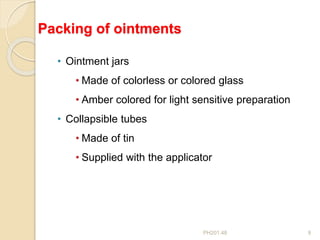
Packing of ointments
• Ointment jars
• Made of colorless or colored glass
• Amber colored for light sensitive preparation
• Collapsible tubes
• Made of tin
• Supplied with the applicator
PH201.48 10
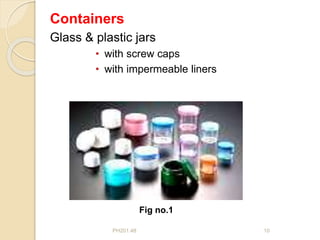
Containers
Glass & plastic jars
• with screw caps
• with impermeable liners
Fig no.1
PH201.48 11
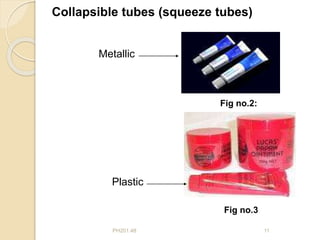
Collapsible tubes (squeeze tubes)
Fig no.2:
Metallic
Plastic
Fig no.3
PH 201.54 12
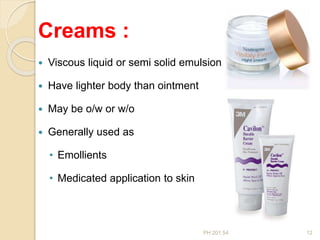
Creams :
 Viscous liquid or semi solid emulsion
 Have lighter body than ointment
 May be o/w or w/o
 Generally used as
• Emollients
• Medicated application to skin
PH 201.54 13
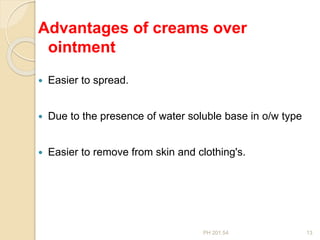
Advantages of creams over
ointment
 Easier to spread.
 Due to the presence of water soluble base in o/w type
 Easier to remove from skin and clothing's.
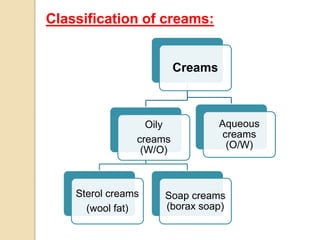
Classification of creams:
Creams
Oily
creams
(W/O)
Sterol creams
(wool fat)
Soap creams
(borax soap)
Aqueous
creams
(O/W)
PH 201.54 15
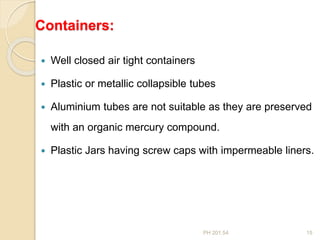
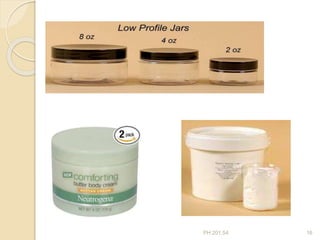
Containers:
 Well closed air tight containers
 Plastic or metallic collapsible tubes
 Aluminium tubes are not suitable as they are preserved
with an organic mercury compound.
 Plastic Jars having screw caps with impermeable liners.
PH 201.54 16
PH 201.56 17
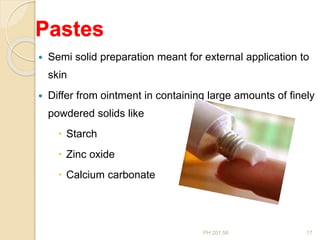
Pastes
 Semi solid preparation meant for external application to
skin
 Differ from ointment in containing large amounts of finely
powdered solids like
 Starch
 Zinc oxide
 Calcium carbonate
PH 201.56 18
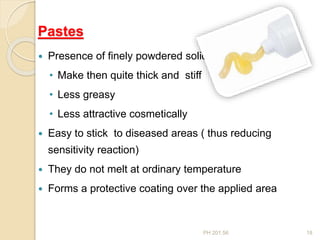
Pastes
 Presence of finely powdered solid
• Make then quite thick and stiff
• Less greasy
• Less attractive cosmetically
 Easy to stick to diseased areas ( thus reducing
sensitivity reaction)
 They do not melt at ordinary temperature
 Forms a protective coating over the applied area
PH 201.56 19
 Smoothen the inflammed and raw surface
 Minimize the damage of scratching in itching
condition (chronic eczema)
Application
 With a spatula
 Or spread on lint or other dressing.
PH 201.56 20
Advantages :
 Acute lesions that have a tendency for oozing
 Inflammation, chronic eczema
 Absorbing exudates
PH 201.56 21
Disadvantages :
 Not suitable for hairy part of the body and in deep
cuts
( as they are stiff and impenetrable )
 Difficult to remove form hair
i. Gels are aqueous colloidal system of
hydrated forms of insoluble medicaments.
ii. Jellies are transparent or translucent non
greasy semisolid and contain more water
than gels.
PH 201.59 23
 Semisolid to thick viscous fluids
 Consists of submicroscopic particles
 In rigid or plastic vehicle
 Transparent or translucent
 Non-greasy & mucilage type
 Applied to skin or mucous membrane
Jellies :
PH 201.59 24
• Are easy to apply
• Evaporation of water
• Produces a cooling sensation to skin
• Contents remaining stick to the applied area
• Gives protection
• Can be easily removed by wasting with water after
treatment
Jellies
PH 201.59 25
Based on its application classified into
• Medicated
• Lubricating
• miscellaneous
Types of Jellies
PH 201.59 26
• Used on mucous membrane for
• Lubrication and antiseptic
• Vasoconstrictor
• Ex: Ephedrine sulphate Jelly
• Contraceptive (spermicidal)
• Ex: Phenyl mercuric Nitrate
1. Medicated Jellies
PH 201.59 27
• Must be sterile when inserted into sterile
regions of the body
• Rectal Thermometers
• Urinary Bladders
• Fingerstalls
• Cystoscopes
• Surgical gloves
• Catheters
2. Lubricating Jellies
PH 201.59 28
3. Miscellaneous Jellies
• Patch testing
Eg: Used as vehicle for allergens in allergy test
• Electrocardiography
To reduce electrical resistance between skin and
electrode
PH 201.62 29
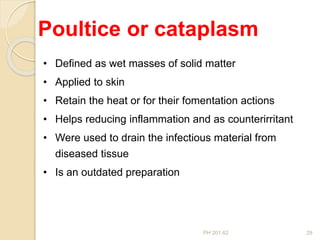
• Defined as wet masses of solid matter
• Applied to skin
• Retain the heat or for their fomentation actions
• Helps reducing inflammation and as counterirritant
• Were used to drain the infectious material from
diseased tissue
• Is an outdated preparation
Poultice or cataplasm
PH 201.62 30
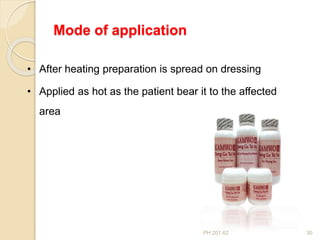
• After heating preparation is spread on dressing
• Applied as hot as the patient bear it to the affected
area
Mode of application
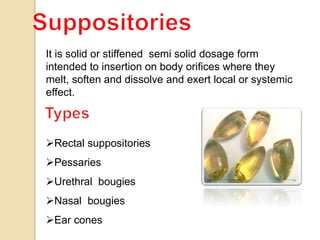
It is solid or stiffened semi solid dosage form
intended to insertion on body orifices where they
melt, soften and dissolve and exert local or systemic
effect.
Rectal suppositories
Pessaries
Urethral bougies
Nasal bougies
Ear cones
Labelling :
FOR EXTERNAL USE ONLY
Storage :
Store in cool and dry place
Protected from higher temperature or
direct sunlight.
Thank you…
Continue in
semisolids-2

semisolid dosage form-1

  • 1.
    SEMISOLID DOSAGE FORMS Presented By: K. ArshadAhmed Khan M.Pharm Departmernt of Pharmaceutics RIPER.
  • 2.
    Semisolid dosage formsare dermatological preparations intended to apply externally on the skin to produce local or systemic effect.
  • 3.
    Physical properties a) Smoothtexture b) Elegant in appearance c) Non gritty d) Non greasy and non staining Physiological properties a) Non irritating b) Do not alter membrane function c) Miscible with skin secretion Application properties a. Easy applicable with efficient drug release b. High aqueous washability
  • 4.
    Semisolids Ointments Creams Pastes Gelsand jellies Poultices Suppositories
  • 5.
    Ointments Viscous semi-solid preparations Usedfor external or topical application To skin or to mucous membrane Usually contain medicament (s) dispersed in base Base is always anhydrous In the form of suspension or solution
  • 6.
    Advantages: Site specific application Convenientfor unconscious patient. Better adhesion and prolonged residence after application Chemically stable Easily handled than liquids Suitable for bitter tasted drugs Disadvantages: Staining by oily ointments Less dose accuracy Contamination when applied by finger tip Bulky to handle than solids
  • 7.
    Ointment classification: 1.Medicated ointment:contain medicament/ mixture of medicaments with ointment base. Examples: 1. Antibiotic [Bacitracin,neomycin] 2. Antifungal [Benzoic acid, nystatin] 3. Anti inflammatory [Betamethasone valerate] 4. Astringent [Calamine, zinc oxide] 5. Counter-irritant [Capsicum, oleoresin] 6. Dandruff treatment [Salicylic acid, Cetrimide] 7. Psoriasis treatment[Corticosteroid, Dithranol] 8. Parasiticide [Benzylbenzoate, Sulphur]
  • 8.
    2. Non- Medicatedointment: mixture of ointment bases, used for emollient Protective Lubricating effect on skin.
  • 9.
    PH201.48 9 Packing ofointments • Ointment jars • Made of colorless or colored glass • Amber colored for light sensitive preparation • Collapsible tubes • Made of tin • Supplied with the applicator
  • 10.
    PH201.48 10 Containers Glass &plastic jars • with screw caps • with impermeable liners Fig no.1
  • 11.
    PH201.48 11 Collapsible tubes(squeeze tubes) Fig no.2: Metallic Plastic Fig no.3
  • 12.
    PH 201.54 12 Creams:  Viscous liquid or semi solid emulsion  Have lighter body than ointment  May be o/w or w/o  Generally used as • Emollients • Medicated application to skin
  • 13.
    PH 201.54 13 Advantagesof creams over ointment  Easier to spread.  Due to the presence of water soluble base in o/w type  Easier to remove from skin and clothing's.
  • 14.
    Classification of creams: Creams Oily creams (W/O) Sterolcreams (wool fat) Soap creams (borax soap) Aqueous creams (O/W)
  • 15.
    PH 201.54 15 Containers: Well closed air tight containers  Plastic or metallic collapsible tubes  Aluminium tubes are not suitable as they are preserved with an organic mercury compound.  Plastic Jars having screw caps with impermeable liners.
  • 16.
  • 17.
    PH 201.56 17 Pastes Semi solid preparation meant for external application to skin  Differ from ointment in containing large amounts of finely powdered solids like  Starch  Zinc oxide  Calcium carbonate
  • 18.
    PH 201.56 18 Pastes Presence of finely powdered solid • Make then quite thick and stiff • Less greasy • Less attractive cosmetically  Easy to stick to diseased areas ( thus reducing sensitivity reaction)  They do not melt at ordinary temperature  Forms a protective coating over the applied area
  • 19.
    PH 201.56 19 Smoothen the inflammed and raw surface  Minimize the damage of scratching in itching condition (chronic eczema) Application  With a spatula  Or spread on lint or other dressing.
  • 20.
    PH 201.56 20 Advantages:  Acute lesions that have a tendency for oozing  Inflammation, chronic eczema  Absorbing exudates
  • 21.
    PH 201.56 21 Disadvantages:  Not suitable for hairy part of the body and in deep cuts ( as they are stiff and impenetrable )  Difficult to remove form hair
  • 22.
    i. Gels areaqueous colloidal system of hydrated forms of insoluble medicaments. ii. Jellies are transparent or translucent non greasy semisolid and contain more water than gels.
  • 23.
    PH 201.59 23 Semisolid to thick viscous fluids  Consists of submicroscopic particles  In rigid or plastic vehicle  Transparent or translucent  Non-greasy & mucilage type  Applied to skin or mucous membrane Jellies :
  • 24.
    PH 201.59 24 •Are easy to apply • Evaporation of water • Produces a cooling sensation to skin • Contents remaining stick to the applied area • Gives protection • Can be easily removed by wasting with water after treatment Jellies
  • 25.
    PH 201.59 25 Basedon its application classified into • Medicated • Lubricating • miscellaneous Types of Jellies
  • 26.
    PH 201.59 26 •Used on mucous membrane for • Lubrication and antiseptic • Vasoconstrictor • Ex: Ephedrine sulphate Jelly • Contraceptive (spermicidal) • Ex: Phenyl mercuric Nitrate 1. Medicated Jellies
  • 27.
    PH 201.59 27 •Must be sterile when inserted into sterile regions of the body • Rectal Thermometers • Urinary Bladders • Fingerstalls • Cystoscopes • Surgical gloves • Catheters 2. Lubricating Jellies
  • 28.
    PH 201.59 28 3.Miscellaneous Jellies • Patch testing Eg: Used as vehicle for allergens in allergy test • Electrocardiography To reduce electrical resistance between skin and electrode
  • 29.
    PH 201.62 29 •Defined as wet masses of solid matter • Applied to skin • Retain the heat or for their fomentation actions • Helps reducing inflammation and as counterirritant • Were used to drain the infectious material from diseased tissue • Is an outdated preparation Poultice or cataplasm
  • 30.
    PH 201.62 30 •After heating preparation is spread on dressing • Applied as hot as the patient bear it to the affected area Mode of application
  • 31.
    It is solidor stiffened semi solid dosage form intended to insertion on body orifices where they melt, soften and dissolve and exert local or systemic effect. Rectal suppositories Pessaries Urethral bougies Nasal bougies Ear cones
  • 32.
    Labelling : FOR EXTERNALUSE ONLY Storage : Store in cool and dry place Protected from higher temperature or direct sunlight.
  • 33.