






Dr. Mohamed Kutty Kakkakunnan
Associate Professor
P.G. Dept. of Commerce
NAM College Kallikkandy
Kannur – Kerala – India
kuttynam@gmail.com
MEANING AND DEFINITION
• Capital the most important and scarce recourse
• Management should ensure efficient and effective
utilization of scarce resources
• Survival and growth of the firm depends upon the
efficient and effective management of resources
• Allocates scarce capital on different assets including
long-term fixed assets
• Profitability, risk and liquidity of the firm depends up
on the nature of assets held
• Thus, utilization or allocation of capital on different
assets is crucial and the management shall give
utmost important on such decisions
• Capital budgeting is also known as investment
decisions and capital expenditure decisions
• Decisions related with fixed/long term assets
• Defined as “the firm’s decision to invest its
current funds most efficiently in long-term
assets in anticipation of an expected flow of
benefits over a series of years”
• It is concerned with the current outlay of
funds in the anticipation of a series of inflow
of funds in future
• Investment decisions include acquisition,
expansion modernization and replacement of
long-term assets
• Sale of a division of business (divestment) is
also an investment decision
• All decisions which would have long-term
implication upon the firm’s expenditure and
benefits can be considered as capital
expenditure decisions
• Capital budgeting is employed to evaluate
expenditure decisions which involve current
outlays but are likely to produce benefits over a
period of time –longer than one year. These
benefits can be either in the form of increased
earnings or reduced costs.
• It involves the entire process of planning
expenditures whose benefits / return are
expected to extend beyond one year. (one
year is arbitrary – only for differentiating
capital and revenue)
• Total process of generating, evaluating
selecting and following up of capital
expenditure alternatives
• Thus, it is a process, involving different steps
(proposal generation, evaluation, selection,
and follow up of project)
Features of Investment Decisions
 Requires or involves large amount of funds
 Current exchange of funds for future benefits
 Funds are invested in long-term assets
 Future benefits accrue or occur to the firm over a series of years
 Involves both inflow and outflow of benefits
 These benefits can be measured in cash flows
 Will influence the value of the firm and wealth maximization
 Investment decision results in wealth maximization, if it yields
more benefits than the minimum benefits of alternative
investment opportunities (opportunity cost of capital)
Importance of investment decisions
• Affects survival and growth of firm
• Affects risk
• Large amount of funds
• Irreversible
• Complexity
Types of Investment Decisions
Different ways for classifying investment decisions
1. Expansion and diversification
Expand its current operations by adding more
capacity or more product lines.
 In diversification the firm expands its operation or enters
into more diversified products
 Related diversification and Unrelated diversification
 Require investment in assets and other production
activities
 Investments in existing or new products are also known
as revenue expansion decision
2. Replacement And Modernization
Assets become depreciated or outmoded, the firm has to
replace its assets – replacement results in economy and
efficiency in operations and cost reduction. Thus,
replacement decisions are also called as cost-reduction
investments
3. Mutually Exclusive Investments
Are the investments which serve the same purpose and
compete with each other, selection of one investment
results in the exclusion or rejection of all other
investments.
4- Independent Investments
Investments serve different purposes and do not compete
each other – decision to invest in one asset will not lead to
the rejection of investment in other assets.
5. Contingent Investments
Are dependent projects; choice of investment necessitates
investment in other assets.
6. Screening and Preference Decisions
Screening decisions relate to the evaluation of
project’s suitability for investment purposes. Sets
criterion or standards
Preference decisions relate with ranking of the
project for investment purposes
INVESTMENT DECISION PROCESS
Steps/ Stages
• Identification of investment opportunities
• Evaluation of investment
• Implementation of decision
EVALUATION CRIETERIA
Three steps
1. Estimation of cash flows
2. Estimation of the required rate of return
3. Application of decision rule for making the
choice
Cash Flows For Investment Decisions
• In capital budgeting decisions cash flows are
considered instead of profits or earnings
• Investments are evaluated on the basis of cash
flows
• Different definitions for profit (EBIT or EAT,
Earnings available to equity shareholders etc.)
• Different methods of providing for depreciation,
reserves, provisions, all affect amount of profit
• Thus, profit varies from person to person –
subjective
• The term cash flow is not subjective
Difference between Cash Flow and Profit
Two major differences:-
• Profit is based on accrual basis of accounting
• Divides the receipts and payments arbitrarily into two as –
capital and revenue. Only revenue items are considered for
calculating profit
In the absence of Interest and Tax
Profit = Revenues – Expenses – Depreciation
Cash flow = Revenue – Expenses – Capital Expenditure
Cash flow = (Revenue – Expenses – Depreciation +
Depreciation – Capital Expenditure or
Cash flow = (Profit + Depreciation) - Capital Expenditure
Profits can be changed by changing the accounting policy of the
firm (stock valuation method), without affecting the cash
flows
Incremental Cash Flows
In capital expenditure decisions incremental cash flows are taken
Incremental cash flow refers to all cash flows that are directly attributable
to the investment of the project (considers entire cash flow stream of a
project)
A cash flow stream is a series of cash receipts and payments over the life of
an investment.
Investment decision – decision, a matter or choice from alternatives and
involves comparison of alternatives-incremental cash flows
In replacement decisions, incremental cash flow is more important
It considers the flows that already exist in the organization or additional
flows
Components of Cash Flows
Three types of flows can be seen
• Initial investment
• Annual net cash flows
• Terminal cash flows
1. Initial investment
• Is the net cash outlay in the period in which the asset is
purchased
• It consists of the gross outlay or original value (OV) of the
assets and includes the cost of the assets, accessories and
spare parts, freight, transportation installation charges
• Additional working capital requirement is also considered
as initial investment (vice versa incase of reduction in
working capital requirement).
• In case of replacement of an old asset sale proceeds of the
old asset reduce the initial outlay of cash. Thus, it should
be deducted
Thus,
Initial cash outlay = Cₒ = original value of the asset + all
related expenses + increase in the working capital
requirement – release of or reduction in working capital –
sales proceeds from the old asset to be replaced
Thus, Initial Investment means
• The net cash outlay in the year in which the asset is acquired
• A major element of the initial investment is the Gross Outlay or
Original Value of the asset
• This comprises of price paid plus all other expenses incurred to
put the asset in a condition for starting initial production or
usage of that asset in the organization
• It is the value considered for calculating depreciation
• Further, if an asset require additional working capital
(permanently) it is also considered as a part of original
investment
• If investment project is replacement of an asset, sales proceeds
of the existing asset is deducted from the gross outlay to find out
the initial investment or net initial outflow of cash
2. Annual Cash Inflows / Net Cash Flows (NCF)
Investment is made in the anticipation of a series of future inflow of cash
Net cash flow (NCF = C₁, C₂, C₃, C₄ ….Cn) refer to after tax cash flows.
To ascertain net cash flows only actual cash receipts and payments are
considered. Non-cash items are not considered.
Depreciation is a non-cash item, it is not considered for calculating the
NCF.
Thus, if there is no tax
NCF = Revenue – Expenses (excluding depreciation)
= (Revenue – Expenses) + Depreciation
If there is tax
NCF = (Revenues – Expenses) – Tax + Depreciation or
NCF = (EBIT – TAX)+ DEPRECIATION
NCF = EBIT (1-T) + Depreciation
NCF = EBDIT (I-T) + T(DEP)
Where T stands for Tax rate and DEP stands for Depreciation
The above equation is based on cash system – but almost
all firms follow accrual system, there can be creditors
and debtors for revenues and expenses, and NCF shall
be adjusted accordingly,
Thus,
• Increase in accounts receivables should be deducted
from Revenues (and vice versa)
• Increase in inventory should be added to the expenses
(and vice versa)
• Increase in accounts payables should be deducted from
the expenses
Thus, NCF = EBIT (1-T) + DEP – NWC
NWC= Net Increase in working capital ( + vice versa)
3. Terminal cash flows
• Salvage Value (SV) is the market price of an
investment at the time of its sale.
Cash proceeds (after deducting tax, if any) is
treated as a cash inflow at the terminal year
• In the case of replacement decisions, in
addition to the salvage value of the new asset,
the salvage value of the existing asset need be
considered. Thus, the salvage value of the
existing asset (to be replaced) will reduce the
initial cash outlay.
Operating savings (as cash inflows)
Sometimes, for evaluation purpose, instead of
cash inflows operating savings may be
considered. It is the savings or reduction in
operating costs due to the usage of the
machine or asset. The reduction in operating
expenses is savings and will lead to profit
Characteristic features of a good Investment Criterion or
Capital Budgeting Technique or Investment Decision Rules
Capital budgeting techniques are used to evaluate the profitability of
different projects or investment alternatives
• Should measure the economic worth of a project (C<B)
• Should help in maximizing the wealth of shareholders
• Should consider all cash flows to determine the profitability
• Should provide an unambiguous and objective way of separating
good projects from bad projects
• Should help in ranking projects according to profitability
• Should recognize the fact that bigger cash flows are preferable to
smaller ones and early cash flows are preferable to latter cash flows
• Should help to chose among mutually exclusive projects that project
which maximizes the shareholders’ wealth
• Should be applicable to any conceivable investment project,
independently
INVESTMENT APPRAISAL TECHNIQUES /
CAPITAL BUDGETING TECHNIQUES / INVESTMENT CRITERIA
Can be broadly divided into two:-
I. Traditional / non-discounted cash flow criteria or techniques and
II. Discounted cash flow or non-traditional techniques
I. Traditional techniques
a). Payback Period
b). Accounting Rate of Return
II. Discounted cash flow techniques
a). Net Present Value Method
b). Internal Rate of Return Method
c). Profitability Index Method
d). Discounted Payback Period Method
e). Terminal Value Method
PAYBACK PERIOD METHOD
The most popular and widely used method
Payback period is the period (number of years) required to
recover the original cash outlay invested in the project.
The number of years required to recover the cost of the
investment
At the end of the period, the accumulated cash inflows from the
project will be equal to the total cash outflows
Specifies the recovery time, by accumulation of the cash inflows
(including depreciation) year by year until the cash inflows
equal to the amount of original investment.
Decision criterion : Projects with shortest payback period will be
selected. Or compared with Standard payback period set by
the management. Ranked according to the PBP
Calculation of Payback Period
Two situations :-
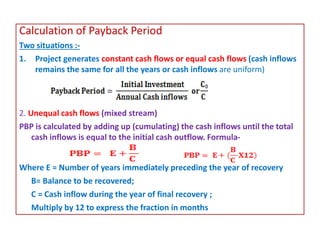
1. Project generates constant cash flows or equal cash flows (cash inflows
remains the same for all the years or cash inflows are uniform)
2. Unequal cash flows (mixed stream)
PBP is calculated by adding up (cumulating) the cash inflows until the total
cash inflows is equal to the initial cash outflow. Formula-
Where E = Number of years immediately preceding the year of recovery
B= Balance to be recovered;
C = Cash inflow during the year of final recovery ;
Multiply by 12 to express the fraction in months
Merits
• Simplicity
• Cost effective, no need of sophisticated or analytical
techniques
• Short-term effects
• Risk shield – shorter payback period – future is uncertain
• Liquidity - it emphasizes on the early recovery of investments.
Thus, it gives insight into liquidity of the project
Demerits
• Does not consider cash flow after payback period
• Does not consider all cash flows during the lifetime
• Fails to recognize the pattern, magnitude and timing of cash
flows
• Does not consider the salvage value
• Inconsistent with shareholder values.
Post Payback Profitability
• Neglects post payback profitability (the profitability of the
project during the excess of economic life period over payback
period of that investment) – major limitation of PBP
• Post payback profitability removes this limitation
• Considers savings of post payback profitability or profitability of
the project after the payback period in the entire economic life
of the project
• If other things remain the same, post payback profitability (also
known as surplus savings) will be considered for decisions
Steps:
1. Determine the surplus life in years (Economic life –PBP)
2. Determine the total savings during the surplus life. If annual
savings are the same during the surplus life, multiply annual
savings by the number surplus years. If annual savings vary, add
the savings of different years.
Step - 3. Add the estimated scrap value
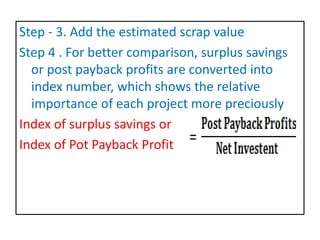
Step 4 . For better comparison, surplus savings
or post payback profits are converted into
index number, which shows the relative
importance of each project more preciously
Index of surplus savings or
Index of Pot Payback Profit
Payback Reciprocal
• The two major drawbacks of Payback period are-
1. Neglects time value (factor)
2. Lack of a rate of return for comparison
Is removed by calculating Payback Reciprocal
• When expressed as a percentage by multiplying by 100, it
tends to more or less equal to the IRR
Bailout Payback Period
• An improvement of traditional payback period
• Under this method for calculating payback
period, the salvage value of the asset is also
considered.
• The salvage value is added with the cumulative
savings
• Payback period is the period required to equate
the cumulative earnings plus salvage value with
the initial investment
• This method is generally used for evaluating risky
project
Example
Cost of the machine Rs. 100,000
Economic life 10 years
Annual savings Rs. 20,000
Salvage value
1st year Rs. 70,000
2nd year Rs. 50,000
3rd year Rs. 40,000
Payback period 3 year
20000+20000+20000+40000 = 1,00,000
ACCOUNTING RATE OF RETURN (ARR)
Also known as Return On Investment (ROI)
ARR is the ratio of the average after tax profit divided by the
average investment. Based on accounting information/data
Where:-
Average income means Earnings after taxes but before
interest. It is equal to Earnings After Tax plus Interest
Average Investment – if the investment is depreciated
constantly, it will be equal to half of the original
investment. It can also be calculated by the total of
investments book values after depreciation by the life of
the project
Acceptance Rule : Projects with ARR>the cut off rate or
minimum rate or standard rate fixed by the management
will be accepted. Projects are ranked in the order of ARR
Evaluation of ARR
Merits
• Simplicity – simple to understand and use, no need of
complicated calculations
• Accounting data – based on accounting information – readily
available, no need for calculating cash flows and other
adjustment
• Considers the entire stream of income in calculating project’s
profitability
Demerits
• Cash flows are ignored – non cash items
• Ignores time value of money
• Arbitrary cut-off rate
Conclusion: ARR is used as a tool for performance evaluation
and control measure. As an investment criterion, it is not
preferable
II – Discounted Cash Flow (DCF) Techniques or
Time Adjusted Rate of Return
These are the methods based on the concept of time value of
money
Time value of money
• Financial decisions involve cash inflows and outflows in different
periods. Majority of decisions involve current outlay of cash and
a series of future inflows.
• Cash flows differ in timings.
• Thus, risk comparison of absolute flows taking place in different
periods is meaningless. To be meaningful comparison of cash
flows be made after making adjustments for their difference in
timing and risk
• In other words, for comparison and decisions making one has to
consider the time value of money and risk
• Thus, Financial decisions should consider time value of cash
flows and risk
What is time value of money?
As a rational/economic men, which of the following
do you prefer and why?
i). To receive Rs. 5000 today for services rendered
today or
ii). To receive Rs. 5000 tomorrow for services
rendered today
Why?
Birds-in-hand theory
A rational or economic men prefer to receive an
amount today itself than receiving the same
amount tomorrow or a future date
Time value of money (TVM) or time preference for money is
an individual’s preference for possession of a given
amount of money now, rather than the same amount at
some future
Why we do prefer? Why time value for money?
Three reasons :-
• Risk – uncertainty about future
• Preference for consumption – to enjoy now
• Investment opportunities
Thus, a person expects more amount to receive in future
than an amount received today
The Required Rate of Return
Since he has to receive more amount, the additional amount
can be called as the return or interest.
The time preference for money is expressed as the interest
rate. The rate will be positive even in the absence of risk.
Because he will receive the interest, if deposits the same in
a bank. Thus, it is known as risk-free interest rate.
But for investing in business, which is risky, he has to get
additional return. The return expected by him in addition to
the risk-free interest rate is known as the risk premium
This required rate of return is also known as opportunity cost
of capital. This required rate of return helps to convert
different cash flows at different time periods into amounts
of equal value in the present
Required rate of return = Risk free rate + Risk premium
Compounding and Discounting
The two most common methods of adjusting cash flows for
time value of money are the compounding and discounting
Compounding is the process of determining future values of
cash flows and discounting is the process of calculating
present values of future cash flows
Compounding is the process of finding the future values of
cash flows by applying the concept of compound interest.
Compound interest received on principal and on interest
earned, not withdrawn during the earlier period. It
determines the future value of an amount at a prescribed
rate – growth of the amount after a period
Simple interest is the interest calculated on the original
amount (principal) without compounding or considering
the interest for further interest calculations
Present value of cash flow refers to the present value of a
future cash flow (inflow /outflow)
It is the amount of current cash that is of equivalent
value of a future cash flow to the decision maker.
This value is determined by means of discounting
process.
The rate used for determining the present value or for
discounting is known as discount rate.
This rate will be the required rate of return determined
by the management or cost of capital
Discounting is the process of determining the present
future value of a series of cash flows.
Through compounding and discounting, the present value
of future cash flows will be determined
Net Present Value Method
• A DCF technique for investment decisions or capital budgeting
• Considers the time value of money
• Present values of cash inflows and outflows (future) are
determined and compared
• Present value of a future cash flow (inflow or outflow) is the
amount of current cash that is equivalent value to the
decision maker
• Discounting is the process of determining the present value of
future cash flows.
• Compound interest rate is also used for discounting process.
The rate so used is known as the discount rate
• Thus, appropriate discount rate is to be determined, it can be
the overall cost of capital or standard rate fixed by the
management
• The difference between present values of cash outflows and
inflows is known as net present value
NPV is obtained by subtracting the Present Value of Cash Inflows from the
Present Value of Cash Outflows
NPV = PRESENT VAUE OF CASH INFLOWS –
PRESENNT VALUE OF CASH OUTFLOWS
Can be defined as “the summation of the present value of inflows in each
year minus the summation of present value cash outflows in each years”
Steps in the calculation of NPV
NPV = Present Value Of Cash Outflows – Present Value Of Cash Inflows
Thus determination of NPV involves
• Determining cash outflows
• Determining cash inflows
• Calculation of the present values of outflows and inflows by using appropriate
discount rate
• Comparison of the present values and finding out the difference
It is also important to note that it is cash flows and not profit is used for calculating the
present values
Determination of the Present Value of Cash Flows
NPV means the difference between the present value of
cash outflows and cash inflows.
Since cash outflow takes place at the initial time, there is
no need of calculating the present value of cash
outflow.
But inflow takes place in future, the present value of
future cash inflows need be calculated.
For calculating the Present value, appropriate discount
rate is used. The discount rate can be the overall cost
of capital or the standard rate determined by the
management
After discounting the cash flows, the sum of the cash
inflows will be determined for comparison with the
cash out flows
Determination of the Present Value of Cash Flows
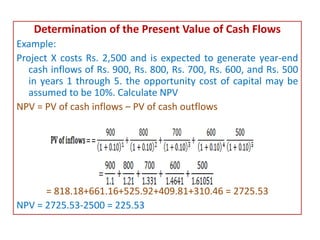
Example:
Project X costs Rs. 2,500 and is expected to generate year-end
cash inflows of Rs. 900, Rs. 800, Rs. 700, Rs. 600, and Rs. 500
in years 1 through 5. the opportunity cost of capital may be
assumed to be 10%. Calculate NPV
NPV = PV of cash inflows – PV of cash outflows
= 818.18+661.16+525.92+409.81+310.46 = 2725.53
NPV = 2725.53-2500 = 225.53
Use of Tables for calculating Present Values
Calculation of present value based on the above method is difficult. To
make calculations easy tables can be used
There are two tables
. First one is The Present Value Factor Table, which shows present
value of Re 1 received in different years at different interest rates.
This table is used when the cash flow vary from year to year. This
table contain PV factors. Interest rate is shown in columns and years
are shown in rows. By looking into the table, it is easy to ascertain
the respective PV factor for the year at the prescribed discount rate
or interest rate. To determine the present value of cash flow, the
cash flow is multiplied by the present factor
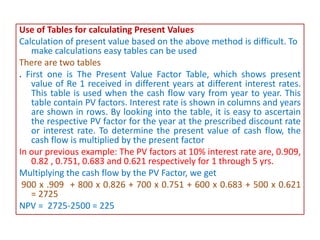
In our previous example: The PV factors at 10% interest rate are, 0.909,
0.82 , 0.751, 0.683 and 0.621 respectively for 1 through 5 yrs.
Multiplying the cash flow by the PV Factor, we get
900 x .909 + 800 x 0.826 + 700 x 0.751 + 600 x 0.683 + 500 x 0.621
= 2725
NPV = 2725-2500 = 225
Second table is the Present Value of Annuity Table.
When the cash flow remains constant over the years this
table is used.
This table also contain annuity factor. Usage of the table
is similar to the first one discussed.
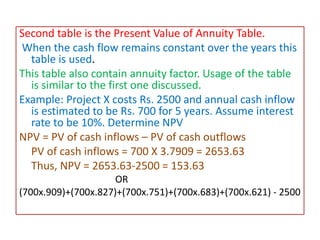
Example: Project X costs Rs. 2500 and annual cash inflow
is estimated to be Rs. 700 for 5 years. Assume interest
rate to be 10%. Determine NPV
NPV = PV of cash inflows – PV of cash outflows
PV of cash inflows = 700 X 3.7909 = 2653.63
Thus, NPV = 2653.63-2500 = 153.63
OR
(700x.909)+(700x.827)+(700x.751)+(700x.683)+(700x.621) - 2500
NPV – Acceptance Rule
 Accept the project when NPV is positive NPV>0
 Reject the project when NPV is negative NPV<0
 May accept the project when NPV=0
Positive NPV contributes to the wealth of shareholders and
would result in the increased price of shares.
Positive NPV indicates that the project generates cash inflows
at a rate higher than the opportunity cost of capital. Zero
NPV indicates that the rate of cash inflow is equal to the
opportunity cost of capital.
In case of mutually exclusive projects, projects with highest
NPV is accepted
NPV method can be used for ranking the projects. Projects are
ranked in the order of NPV, first rank will be given to the
project with highest positive NPVs and so one
Evaluation of NPV method
NPV is considered a true measure of profitability due to the following
merits-
 Recognizes time value of money
 True measure of profitability – considers all cash flows
 Value additivity- the discounting process in NPV method facilitates
measuring cash flows in terms of present values i.e. in terms of
equivalent current rupees. Therefore NPVs of different projects can
be added. NPV (A+B) = NPV (A) + NPV (B). This is called value
additivity.
It means that if the NPVs of individual projects are known, the value
of the firm will increase by the sum of their NPV
Value additivity is an important property of an investment criterion
because it means that each project can be evaluated independent
of others, on its own merit
 Shareholder value- the NPV method is always consistent with the
objective of the shareholder value maximization. This is the
greatest merit of this method
Demerits
 Accurate forecast of future cash inflows is very
difficult due to the uncertainty
 Difficulty in estimating the precise or accurate
discount rate
 In case of mutually exclusive projects, with
unequal lifetime and unequal outlays, the
NPV method may give false results
INTERNAL RATE OF RETURN
Another DCF technique considering the entire cash flows
Also known as Yield on Investment, Marginal Efficiency of Capital,
Rate of Return Over Cost, Time Adjusted Rate of Internal Return
It is the rate that equates the investment outlay with the present
value of cash inflows received, after one period
Defined as “the rate which equates present of the net cash inflows
with the aggregate present value of cash outflows of a project”
It is the discount rate which makes NPV = 0
The major difference between NPV and IRR is that in NPV method
the rate of return (denoted by k) is known but in IRR, the rate or
return (denoted by r) is not known, it is to be ascertained.
When the IRR (r) is used for discounting cash inflows NPV becomes
zero
Considered as the best measure of evaluation of long-term project
Calculation of IRR
Two situations
i. Even cash flows an
ii. Uneven cash flows
Even (annuity) Cash flows
Same amount is received as earnings
1. Determine payback period(investment ÷ inflows)
2. Take Cumulative Present Value Table (Annuity Table) and
ascertain the factor that is equal to or closest to the life of
the project, for the years (life time) concerned
3. Determine the rate (%) for the value. It is the IRR
4. To be more precious, in the year row, find two annuity
values or discount factors closest to the true factor one
bigger and the other smaller than it
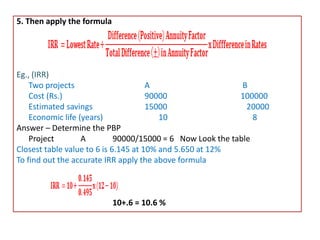
5. Then apply the formula
Eg., (IRR)
Two projects A B
Cost (Rs.) 90000 100000
Estimated savings 15000 20000
Economic life (years) 10 8
Answer – Determine the PBP
Project A 90000/15000 = 6 Now Look the table
Closest table value to 6 is 6.145 at 10% and 5.650 at 12%
To find out the accurate IRR apply the above formula
10+.6 = 10.6 %
IRR in Mixed stream (Uneven cash flows)
Trial and error method
1. Take an assumed interest rate
2. Determine the present value of inflows of each year. Use the PV Table
(Inflow X PV Factor)
3. Find the total of Present values of inflows
4. Compare it with the outflows
5. If both are the same and the difference is zero, the IRR (r) of the project
will be the assumed interest taken in the first step
6. If the PV of inflows > outflows, (NPV is positive) take a higher ‘r’ than
that of the first step and vice versa
7. Repeat the steps from two to five
8. Continue the process till NPV = 0
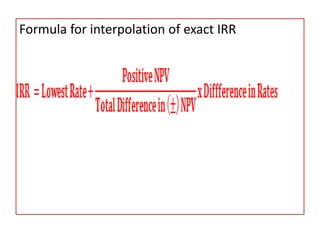
9. Sometimes the IRR may lie in between two rates (say 12% and 14%),
then the exact rate is to be determined by interpolation
Formula for interpolation of exact IRR
Acceptance Rule
 Accept the project if IRR is more than the cost of
capital or the cut-off rate or opportunity cost of capital,
hurdle rate required rate of return (r>k).
 Reject the project if IRR is less than the cost of capital
or the cut-off rate or opportunity cost of capital, hurdle
rate required rate of return (r<k).
 May accept or reject the project where r=k
Ranking of projects. Ranked in the descending order of
IRR
• When IRR > K, NPV will be positive
• When IRR < K, NPV will be negative
• When IRR = K, NPV will be zero
Merits of IRR method
A popular method of appraising projects. Since, it is in a
percentage form, comparison of IRR with cost of capital or
cut off rate is very easy.
• Recognizes the time value of money
• Considers profitability of the project during the entire
period of time
• Consistent with the shareholder wealth maximization
objective. When IRR is greater than cost of capital,
shareholders wealth is maximized
Demerits
• Multiple rates. There are different methods for computing
IRR. Each method may give different IRR
• In certain mutually exclusive projects, it may give wrong
conclusions
• As in the case of NPV, value additivity is not possible
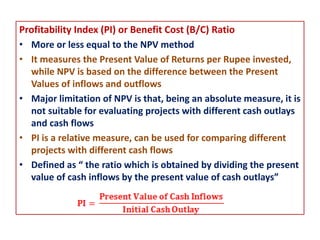
Profitability Index (PI) or Benefit Cost (B/C) Ratio
• More or less equal to the NPV method
• It measures the Present Value of Returns per Rupee invested,
while NPV is based on the difference between the Present
Values of inflows and outflows
• Major limitation of NPV is that, being an absolute measure, it is
not suitable for evaluating projects with different cash outlays
and cash flows
• PI is a relative measure, can be used for comparing different
projects with different cash flows
• Defined as “ the ratio which is obtained by dividing the present
value of cash inflows by the present value of cash outlays”
Acceptance Rule
• Accept the project, when PI>1
• Reject the project, when PI<1
• May accept or reject the project, when PI=1
When PI = +ve NPV is also +ve
PI= - ve NPV is also – ve
PI=0 NPV is also 0
Merits
• Considers time value
• Consistent with wealth maximization objective
• Relative measure of profitability, can be used to compare projects with
different costs, inflows and life-time
Demerit: Require calculation of cash flows, ascertain required rate of return.
All create problems
Discounted Payback Period
• Traditional payback period does not consider the
time value of money – the major drawback
• To avoid this drawback, discounted payback
period is calculated
• In this method, for calculating the PBP, cash flows
are discounted at the desired /required rate of
return / cost of capital
• Then PBP is calculated
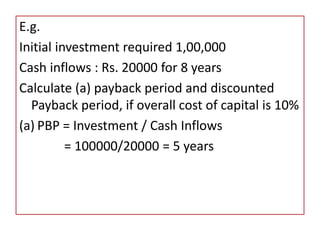
E.g.
Initial investment required 1,00,000
Cash inflows : Rs. 20000 for 8 years
Calculate (a) payback period and discounted
Payback period, if overall cost of capital is 10%
(a) PBP = Investment / Cash Inflows
= 100000/20000 = 5 years
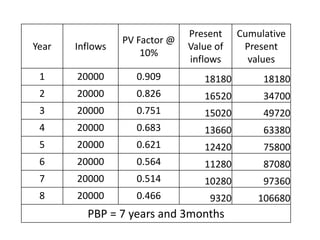
Year Inflows
PV Factor @
10%
Present
Value of
inflows
Cumulative
Present
values
1 20000 0.909 18180 18180
2 20000 0.826 16520 34700
3 20000 0.751 15020 49720
4 20000 0.683 13660 63380
5 20000 0.621 12420 75800
6 20000 0.564 11280 87080
7 20000 0.514 10280 97360
8 20000 0.466 9320 106680
PBP = 7 years and 3months
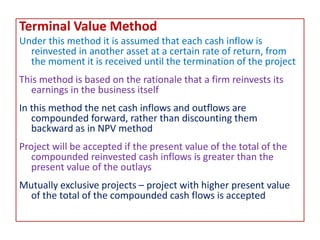
Terminal Value Method
Under this method it is assumed that each cash inflow is
reinvested in another asset at a certain rate of return, from
the moment it is received until the termination of the project
This method is based on the rationale that a firm reinvests its
earnings in the business itself
In this method the net cash inflows and outflows are
compounded forward, rather than discounting them
backward as in NPV method
Project will be accepted if the present value of the total of the
compounded reinvested cash inflows is greater than the
present value of the outlays
Mutually exclusive projects – project with higher present value
of the total of the compounded cash flows is accepted
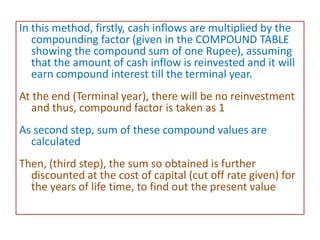
In this method, firstly, cash inflows are multiplied by the
compounding factor (given in the COMPOUND TABLE
showing the compound sum of one Rupee), assuming
that the amount of cash inflow is reinvested and it will
earn compound interest till the terminal year.
At the end (Terminal year), there will be no reinvestment
and thus, compound factor is taken as 1
As second step, sum of these compound values are
calculated
Then, (third step), the sum so obtained is further
discounted at the cost of capital (cut off rate given) for
the years of life time, to find out the present value
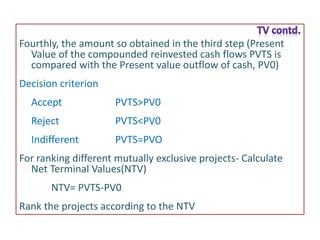
Fourthly, the amount so obtained in the third step (Present
Value of the compounded reinvested cash flows PVTS is
compared with the Present value outflow of cash, PV0)
Decision criterion
Accept PVTS>PV0
Reject PVTS<PV0
Indifferent PVTS=PVO
For ranking different mutually exclusive projects- Calculate
Net Terminal Values(NTV)
NTV= PVTS-PV0
Rank the projects according to the NTV
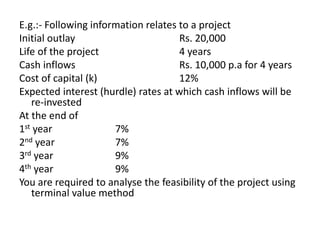
E.g.:- Following information relates to a project
Initial outlay Rs. 20,000
Life of the project 4 years
Cash inflows Rs. 10,000 p.a for 4 years
Cost of capital (k) 12%
Expected interest (hurdle) rates at which cash inflows will be
re-invested
At the end of
1st year 7%
2nd year 7%
3rd year 9%
4th year 9%
You are required to analyse the feasibility of the project using
terminal value method
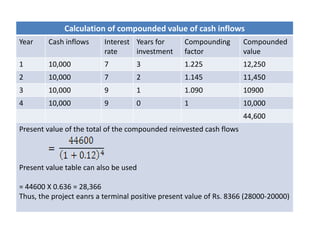
Calculation of compounded value of cash inflows
Year Cash inflows Interest
rate
Years for
investment
Compounding
factor
Compounded
value
1 10,000 7 3 1.225 12,250
2 10,000 7 2 1.145 11,450
3 10,000 9 1 1.090 10900
4 10,000 9 0 1 10,000
44,600
Present value of the total of the compounded reinvested cash flows
Present value table can also be used
= 44600 X 0.636 = 28,366
Thus, the project eanrs a terminal positive present value of Rs. 8366 (28000-20000)
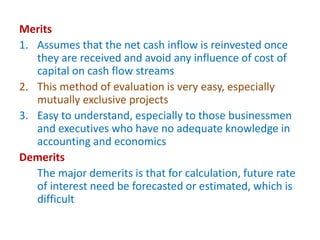
Merits
1. Assumes that the net cash inflow is reinvested once
they are received and avoid any influence of cost of
capital on cash flow streams
2. This method of evaluation is very easy, especially
mutually exclusive projects
3. Easy to understand, especially to those businessmen
and executives who have no adequate knowledge in
accounting and economics
Demerits
The major demerits is that for calculation, future rate
of interest need be forecasted or estimated, which is
difficult

Capital budgeting

  • 1.
    Dr. Mohamed KuttyKakkakunnan Associate Professor P.G. Dept. of Commerce NAM College Kallikkandy Kannur – Kerala – India kuttynam@gmail.com
  • 2.
    MEANING AND DEFINITION •Capital the most important and scarce recourse • Management should ensure efficient and effective utilization of scarce resources • Survival and growth of the firm depends upon the efficient and effective management of resources • Allocates scarce capital on different assets including long-term fixed assets • Profitability, risk and liquidity of the firm depends up on the nature of assets held • Thus, utilization or allocation of capital on different assets is crucial and the management shall give utmost important on such decisions
  • 3.
    • Capital budgetingis also known as investment decisions and capital expenditure decisions • Decisions related with fixed/long term assets • Defined as “the firm’s decision to invest its current funds most efficiently in long-term assets in anticipation of an expected flow of benefits over a series of years” • It is concerned with the current outlay of funds in the anticipation of a series of inflow of funds in future
  • 4.
    • Investment decisionsinclude acquisition, expansion modernization and replacement of long-term assets • Sale of a division of business (divestment) is also an investment decision • All decisions which would have long-term implication upon the firm’s expenditure and benefits can be considered as capital expenditure decisions
  • 5.
    • Capital budgetingis employed to evaluate expenditure decisions which involve current outlays but are likely to produce benefits over a period of time –longer than one year. These benefits can be either in the form of increased earnings or reduced costs. • It involves the entire process of planning expenditures whose benefits / return are expected to extend beyond one year. (one year is arbitrary – only for differentiating capital and revenue)
  • 6.
    • Total processof generating, evaluating selecting and following up of capital expenditure alternatives • Thus, it is a process, involving different steps (proposal generation, evaluation, selection, and follow up of project)
  • 7.
    Features of InvestmentDecisions  Requires or involves large amount of funds  Current exchange of funds for future benefits  Funds are invested in long-term assets  Future benefits accrue or occur to the firm over a series of years  Involves both inflow and outflow of benefits  These benefits can be measured in cash flows  Will influence the value of the firm and wealth maximization  Investment decision results in wealth maximization, if it yields more benefits than the minimum benefits of alternative investment opportunities (opportunity cost of capital)
  • 8.
    Importance of investmentdecisions • Affects survival and growth of firm • Affects risk • Large amount of funds • Irreversible • Complexity
  • 9.
    Types of InvestmentDecisions Different ways for classifying investment decisions 1. Expansion and diversification Expand its current operations by adding more capacity or more product lines.  In diversification the firm expands its operation or enters into more diversified products  Related diversification and Unrelated diversification  Require investment in assets and other production activities  Investments in existing or new products are also known as revenue expansion decision
  • 10.
    2. Replacement AndModernization Assets become depreciated or outmoded, the firm has to replace its assets – replacement results in economy and efficiency in operations and cost reduction. Thus, replacement decisions are also called as cost-reduction investments 3. Mutually Exclusive Investments Are the investments which serve the same purpose and compete with each other, selection of one investment results in the exclusion or rejection of all other investments.
  • 11.
    4- Independent Investments Investmentsserve different purposes and do not compete each other – decision to invest in one asset will not lead to the rejection of investment in other assets. 5. Contingent Investments Are dependent projects; choice of investment necessitates investment in other assets. 6. Screening and Preference Decisions Screening decisions relate to the evaluation of project’s suitability for investment purposes. Sets criterion or standards Preference decisions relate with ranking of the project for investment purposes
  • 12.
    INVESTMENT DECISION PROCESS Steps/Stages • Identification of investment opportunities • Evaluation of investment • Implementation of decision EVALUATION CRIETERIA Three steps 1. Estimation of cash flows 2. Estimation of the required rate of return 3. Application of decision rule for making the choice
  • 13.
    Cash Flows ForInvestment Decisions • In capital budgeting decisions cash flows are considered instead of profits or earnings • Investments are evaluated on the basis of cash flows • Different definitions for profit (EBIT or EAT, Earnings available to equity shareholders etc.) • Different methods of providing for depreciation, reserves, provisions, all affect amount of profit • Thus, profit varies from person to person – subjective • The term cash flow is not subjective
  • 14.
    Difference between CashFlow and Profit Two major differences:- • Profit is based on accrual basis of accounting • Divides the receipts and payments arbitrarily into two as – capital and revenue. Only revenue items are considered for calculating profit In the absence of Interest and Tax Profit = Revenues – Expenses – Depreciation Cash flow = Revenue – Expenses – Capital Expenditure Cash flow = (Revenue – Expenses – Depreciation + Depreciation – Capital Expenditure or Cash flow = (Profit + Depreciation) - Capital Expenditure Profits can be changed by changing the accounting policy of the firm (stock valuation method), without affecting the cash flows
  • 15.
    Incremental Cash Flows Incapital expenditure decisions incremental cash flows are taken Incremental cash flow refers to all cash flows that are directly attributable to the investment of the project (considers entire cash flow stream of a project) A cash flow stream is a series of cash receipts and payments over the life of an investment. Investment decision – decision, a matter or choice from alternatives and involves comparison of alternatives-incremental cash flows In replacement decisions, incremental cash flow is more important It considers the flows that already exist in the organization or additional flows Components of Cash Flows Three types of flows can be seen • Initial investment • Annual net cash flows • Terminal cash flows
  • 16.
    1. Initial investment •Is the net cash outlay in the period in which the asset is purchased • It consists of the gross outlay or original value (OV) of the assets and includes the cost of the assets, accessories and spare parts, freight, transportation installation charges • Additional working capital requirement is also considered as initial investment (vice versa incase of reduction in working capital requirement). • In case of replacement of an old asset sale proceeds of the old asset reduce the initial outlay of cash. Thus, it should be deducted Thus, Initial cash outlay = Cₒ = original value of the asset + all related expenses + increase in the working capital requirement – release of or reduction in working capital – sales proceeds from the old asset to be replaced
  • 17.
    Thus, Initial Investmentmeans • The net cash outlay in the year in which the asset is acquired • A major element of the initial investment is the Gross Outlay or Original Value of the asset • This comprises of price paid plus all other expenses incurred to put the asset in a condition for starting initial production or usage of that asset in the organization • It is the value considered for calculating depreciation • Further, if an asset require additional working capital (permanently) it is also considered as a part of original investment • If investment project is replacement of an asset, sales proceeds of the existing asset is deducted from the gross outlay to find out the initial investment or net initial outflow of cash
  • 18.
    2. Annual CashInflows / Net Cash Flows (NCF) Investment is made in the anticipation of a series of future inflow of cash Net cash flow (NCF = C₁, C₂, C₃, C₄ ….Cn) refer to after tax cash flows. To ascertain net cash flows only actual cash receipts and payments are considered. Non-cash items are not considered. Depreciation is a non-cash item, it is not considered for calculating the NCF. Thus, if there is no tax NCF = Revenue – Expenses (excluding depreciation) = (Revenue – Expenses) + Depreciation If there is tax NCF = (Revenues – Expenses) – Tax + Depreciation or NCF = (EBIT – TAX)+ DEPRECIATION NCF = EBIT (1-T) + Depreciation NCF = EBDIT (I-T) + T(DEP) Where T stands for Tax rate and DEP stands for Depreciation
  • 19.
    The above equationis based on cash system – but almost all firms follow accrual system, there can be creditors and debtors for revenues and expenses, and NCF shall be adjusted accordingly, Thus, • Increase in accounts receivables should be deducted from Revenues (and vice versa) • Increase in inventory should be added to the expenses (and vice versa) • Increase in accounts payables should be deducted from the expenses Thus, NCF = EBIT (1-T) + DEP – NWC NWC= Net Increase in working capital ( + vice versa)
  • 20.
    3. Terminal cashflows • Salvage Value (SV) is the market price of an investment at the time of its sale. Cash proceeds (after deducting tax, if any) is treated as a cash inflow at the terminal year • In the case of replacement decisions, in addition to the salvage value of the new asset, the salvage value of the existing asset need be considered. Thus, the salvage value of the existing asset (to be replaced) will reduce the initial cash outlay.
  • 21.
    Operating savings (ascash inflows) Sometimes, for evaluation purpose, instead of cash inflows operating savings may be considered. It is the savings or reduction in operating costs due to the usage of the machine or asset. The reduction in operating expenses is savings and will lead to profit
  • 22.
    Characteristic features ofa good Investment Criterion or Capital Budgeting Technique or Investment Decision Rules Capital budgeting techniques are used to evaluate the profitability of different projects or investment alternatives • Should measure the economic worth of a project (C<B) • Should help in maximizing the wealth of shareholders • Should consider all cash flows to determine the profitability • Should provide an unambiguous and objective way of separating good projects from bad projects • Should help in ranking projects according to profitability • Should recognize the fact that bigger cash flows are preferable to smaller ones and early cash flows are preferable to latter cash flows • Should help to chose among mutually exclusive projects that project which maximizes the shareholders’ wealth • Should be applicable to any conceivable investment project, independently
  • 24.
    INVESTMENT APPRAISAL TECHNIQUES/ CAPITAL BUDGETING TECHNIQUES / INVESTMENT CRITERIA Can be broadly divided into two:- I. Traditional / non-discounted cash flow criteria or techniques and II. Discounted cash flow or non-traditional techniques I. Traditional techniques a). Payback Period b). Accounting Rate of Return II. Discounted cash flow techniques a). Net Present Value Method b). Internal Rate of Return Method c). Profitability Index Method d). Discounted Payback Period Method e). Terminal Value Method
  • 25.
    PAYBACK PERIOD METHOD Themost popular and widely used method Payback period is the period (number of years) required to recover the original cash outlay invested in the project. The number of years required to recover the cost of the investment At the end of the period, the accumulated cash inflows from the project will be equal to the total cash outflows Specifies the recovery time, by accumulation of the cash inflows (including depreciation) year by year until the cash inflows equal to the amount of original investment. Decision criterion : Projects with shortest payback period will be selected. Or compared with Standard payback period set by the management. Ranked according to the PBP
  • 26.
    Calculation of PaybackPeriod Two situations :- 1. Project generates constant cash flows or equal cash flows (cash inflows remains the same for all the years or cash inflows are uniform) 2. Unequal cash flows (mixed stream) PBP is calculated by adding up (cumulating) the cash inflows until the total cash inflows is equal to the initial cash outflow. Formula- Where E = Number of years immediately preceding the year of recovery B= Balance to be recovered; C = Cash inflow during the year of final recovery ; Multiply by 12 to express the fraction in months
  • 27.
    Merits • Simplicity • Costeffective, no need of sophisticated or analytical techniques • Short-term effects • Risk shield – shorter payback period – future is uncertain • Liquidity - it emphasizes on the early recovery of investments. Thus, it gives insight into liquidity of the project Demerits • Does not consider cash flow after payback period • Does not consider all cash flows during the lifetime • Fails to recognize the pattern, magnitude and timing of cash flows • Does not consider the salvage value • Inconsistent with shareholder values.
  • 28.
    Post Payback Profitability •Neglects post payback profitability (the profitability of the project during the excess of economic life period over payback period of that investment) – major limitation of PBP • Post payback profitability removes this limitation • Considers savings of post payback profitability or profitability of the project after the payback period in the entire economic life of the project • If other things remain the same, post payback profitability (also known as surplus savings) will be considered for decisions Steps: 1. Determine the surplus life in years (Economic life –PBP) 2. Determine the total savings during the surplus life. If annual savings are the same during the surplus life, multiply annual savings by the number surplus years. If annual savings vary, add the savings of different years.
  • 29.
    Step - 3.Add the estimated scrap value Step 4 . For better comparison, surplus savings or post payback profits are converted into index number, which shows the relative importance of each project more preciously Index of surplus savings or Index of Pot Payback Profit
  • 30.
    Payback Reciprocal • Thetwo major drawbacks of Payback period are- 1. Neglects time value (factor) 2. Lack of a rate of return for comparison Is removed by calculating Payback Reciprocal • When expressed as a percentage by multiplying by 100, it tends to more or less equal to the IRR
  • 31.
    Bailout Payback Period •An improvement of traditional payback period • Under this method for calculating payback period, the salvage value of the asset is also considered. • The salvage value is added with the cumulative savings • Payback period is the period required to equate the cumulative earnings plus salvage value with the initial investment • This method is generally used for evaluating risky project
  • 32.
    Example Cost of themachine Rs. 100,000 Economic life 10 years Annual savings Rs. 20,000 Salvage value 1st year Rs. 70,000 2nd year Rs. 50,000 3rd year Rs. 40,000 Payback period 3 year 20000+20000+20000+40000 = 1,00,000
  • 33.
    ACCOUNTING RATE OFRETURN (ARR) Also known as Return On Investment (ROI) ARR is the ratio of the average after tax profit divided by the average investment. Based on accounting information/data Where:- Average income means Earnings after taxes but before interest. It is equal to Earnings After Tax plus Interest Average Investment – if the investment is depreciated constantly, it will be equal to half of the original investment. It can also be calculated by the total of investments book values after depreciation by the life of the project Acceptance Rule : Projects with ARR>the cut off rate or minimum rate or standard rate fixed by the management will be accepted. Projects are ranked in the order of ARR
  • 34.
    Evaluation of ARR Merits •Simplicity – simple to understand and use, no need of complicated calculations • Accounting data – based on accounting information – readily available, no need for calculating cash flows and other adjustment • Considers the entire stream of income in calculating project’s profitability Demerits • Cash flows are ignored – non cash items • Ignores time value of money • Arbitrary cut-off rate Conclusion: ARR is used as a tool for performance evaluation and control measure. As an investment criterion, it is not preferable
  • 35.
    II – DiscountedCash Flow (DCF) Techniques or Time Adjusted Rate of Return These are the methods based on the concept of time value of money Time value of money • Financial decisions involve cash inflows and outflows in different periods. Majority of decisions involve current outlay of cash and a series of future inflows. • Cash flows differ in timings. • Thus, risk comparison of absolute flows taking place in different periods is meaningless. To be meaningful comparison of cash flows be made after making adjustments for their difference in timing and risk • In other words, for comparison and decisions making one has to consider the time value of money and risk • Thus, Financial decisions should consider time value of cash flows and risk
  • 36.
    What is timevalue of money? As a rational/economic men, which of the following do you prefer and why? i). To receive Rs. 5000 today for services rendered today or ii). To receive Rs. 5000 tomorrow for services rendered today Why? Birds-in-hand theory A rational or economic men prefer to receive an amount today itself than receiving the same amount tomorrow or a future date
  • 37.
    Time value ofmoney (TVM) or time preference for money is an individual’s preference for possession of a given amount of money now, rather than the same amount at some future Why we do prefer? Why time value for money? Three reasons :- • Risk – uncertainty about future • Preference for consumption – to enjoy now • Investment opportunities Thus, a person expects more amount to receive in future than an amount received today
  • 38.
    The Required Rateof Return Since he has to receive more amount, the additional amount can be called as the return or interest. The time preference for money is expressed as the interest rate. The rate will be positive even in the absence of risk. Because he will receive the interest, if deposits the same in a bank. Thus, it is known as risk-free interest rate. But for investing in business, which is risky, he has to get additional return. The return expected by him in addition to the risk-free interest rate is known as the risk premium This required rate of return is also known as opportunity cost of capital. This required rate of return helps to convert different cash flows at different time periods into amounts of equal value in the present Required rate of return = Risk free rate + Risk premium
  • 39.
    Compounding and Discounting Thetwo most common methods of adjusting cash flows for time value of money are the compounding and discounting Compounding is the process of determining future values of cash flows and discounting is the process of calculating present values of future cash flows Compounding is the process of finding the future values of cash flows by applying the concept of compound interest. Compound interest received on principal and on interest earned, not withdrawn during the earlier period. It determines the future value of an amount at a prescribed rate – growth of the amount after a period Simple interest is the interest calculated on the original amount (principal) without compounding or considering the interest for further interest calculations
  • 40.
    Present value ofcash flow refers to the present value of a future cash flow (inflow /outflow) It is the amount of current cash that is of equivalent value of a future cash flow to the decision maker. This value is determined by means of discounting process. The rate used for determining the present value or for discounting is known as discount rate. This rate will be the required rate of return determined by the management or cost of capital Discounting is the process of determining the present future value of a series of cash flows. Through compounding and discounting, the present value of future cash flows will be determined
  • 41.
    Net Present ValueMethod • A DCF technique for investment decisions or capital budgeting • Considers the time value of money • Present values of cash inflows and outflows (future) are determined and compared • Present value of a future cash flow (inflow or outflow) is the amount of current cash that is equivalent value to the decision maker • Discounting is the process of determining the present value of future cash flows. • Compound interest rate is also used for discounting process. The rate so used is known as the discount rate • Thus, appropriate discount rate is to be determined, it can be the overall cost of capital or standard rate fixed by the management • The difference between present values of cash outflows and inflows is known as net present value
  • 42.
    NPV is obtainedby subtracting the Present Value of Cash Inflows from the Present Value of Cash Outflows NPV = PRESENT VAUE OF CASH INFLOWS – PRESENNT VALUE OF CASH OUTFLOWS Can be defined as “the summation of the present value of inflows in each year minus the summation of present value cash outflows in each years” Steps in the calculation of NPV NPV = Present Value Of Cash Outflows – Present Value Of Cash Inflows Thus determination of NPV involves • Determining cash outflows • Determining cash inflows • Calculation of the present values of outflows and inflows by using appropriate discount rate • Comparison of the present values and finding out the difference It is also important to note that it is cash flows and not profit is used for calculating the present values
  • 43.
    Determination of thePresent Value of Cash Flows NPV means the difference between the present value of cash outflows and cash inflows. Since cash outflow takes place at the initial time, there is no need of calculating the present value of cash outflow. But inflow takes place in future, the present value of future cash inflows need be calculated. For calculating the Present value, appropriate discount rate is used. The discount rate can be the overall cost of capital or the standard rate determined by the management After discounting the cash flows, the sum of the cash inflows will be determined for comparison with the cash out flows
  • 44.
    Determination of thePresent Value of Cash Flows Example: Project X costs Rs. 2,500 and is expected to generate year-end cash inflows of Rs. 900, Rs. 800, Rs. 700, Rs. 600, and Rs. 500 in years 1 through 5. the opportunity cost of capital may be assumed to be 10%. Calculate NPV NPV = PV of cash inflows – PV of cash outflows = 818.18+661.16+525.92+409.81+310.46 = 2725.53 NPV = 2725.53-2500 = 225.53
  • 45.
    Use of Tablesfor calculating Present Values Calculation of present value based on the above method is difficult. To make calculations easy tables can be used There are two tables . First one is The Present Value Factor Table, which shows present value of Re 1 received in different years at different interest rates. This table is used when the cash flow vary from year to year. This table contain PV factors. Interest rate is shown in columns and years are shown in rows. By looking into the table, it is easy to ascertain the respective PV factor for the year at the prescribed discount rate or interest rate. To determine the present value of cash flow, the cash flow is multiplied by the present factor In our previous example: The PV factors at 10% interest rate are, 0.909, 0.82 , 0.751, 0.683 and 0.621 respectively for 1 through 5 yrs. Multiplying the cash flow by the PV Factor, we get 900 x .909 + 800 x 0.826 + 700 x 0.751 + 600 x 0.683 + 500 x 0.621 = 2725 NPV = 2725-2500 = 225
  • 46.
    Second table isthe Present Value of Annuity Table. When the cash flow remains constant over the years this table is used. This table also contain annuity factor. Usage of the table is similar to the first one discussed. Example: Project X costs Rs. 2500 and annual cash inflow is estimated to be Rs. 700 for 5 years. Assume interest rate to be 10%. Determine NPV NPV = PV of cash inflows – PV of cash outflows PV of cash inflows = 700 X 3.7909 = 2653.63 Thus, NPV = 2653.63-2500 = 153.63 OR (700x.909)+(700x.827)+(700x.751)+(700x.683)+(700x.621) - 2500
  • 47.
    NPV – AcceptanceRule  Accept the project when NPV is positive NPV>0  Reject the project when NPV is negative NPV<0  May accept the project when NPV=0 Positive NPV contributes to the wealth of shareholders and would result in the increased price of shares. Positive NPV indicates that the project generates cash inflows at a rate higher than the opportunity cost of capital. Zero NPV indicates that the rate of cash inflow is equal to the opportunity cost of capital. In case of mutually exclusive projects, projects with highest NPV is accepted NPV method can be used for ranking the projects. Projects are ranked in the order of NPV, first rank will be given to the project with highest positive NPVs and so one
  • 48.
    Evaluation of NPVmethod NPV is considered a true measure of profitability due to the following merits-  Recognizes time value of money  True measure of profitability – considers all cash flows  Value additivity- the discounting process in NPV method facilitates measuring cash flows in terms of present values i.e. in terms of equivalent current rupees. Therefore NPVs of different projects can be added. NPV (A+B) = NPV (A) + NPV (B). This is called value additivity. It means that if the NPVs of individual projects are known, the value of the firm will increase by the sum of their NPV Value additivity is an important property of an investment criterion because it means that each project can be evaluated independent of others, on its own merit  Shareholder value- the NPV method is always consistent with the objective of the shareholder value maximization. This is the greatest merit of this method
  • 49.
    Demerits  Accurate forecastof future cash inflows is very difficult due to the uncertainty  Difficulty in estimating the precise or accurate discount rate  In case of mutually exclusive projects, with unequal lifetime and unequal outlays, the NPV method may give false results
  • 50.
    INTERNAL RATE OFRETURN Another DCF technique considering the entire cash flows Also known as Yield on Investment, Marginal Efficiency of Capital, Rate of Return Over Cost, Time Adjusted Rate of Internal Return It is the rate that equates the investment outlay with the present value of cash inflows received, after one period Defined as “the rate which equates present of the net cash inflows with the aggregate present value of cash outflows of a project” It is the discount rate which makes NPV = 0 The major difference between NPV and IRR is that in NPV method the rate of return (denoted by k) is known but in IRR, the rate or return (denoted by r) is not known, it is to be ascertained. When the IRR (r) is used for discounting cash inflows NPV becomes zero Considered as the best measure of evaluation of long-term project
  • 51.
    Calculation of IRR Twosituations i. Even cash flows an ii. Uneven cash flows Even (annuity) Cash flows Same amount is received as earnings 1. Determine payback period(investment ÷ inflows) 2. Take Cumulative Present Value Table (Annuity Table) and ascertain the factor that is equal to or closest to the life of the project, for the years (life time) concerned 3. Determine the rate (%) for the value. It is the IRR 4. To be more precious, in the year row, find two annuity values or discount factors closest to the true factor one bigger and the other smaller than it
  • 52.
    5. Then applythe formula Eg., (IRR) Two projects A B Cost (Rs.) 90000 100000 Estimated savings 15000 20000 Economic life (years) 10 8 Answer – Determine the PBP Project A 90000/15000 = 6 Now Look the table Closest table value to 6 is 6.145 at 10% and 5.650 at 12% To find out the accurate IRR apply the above formula 10+.6 = 10.6 %
  • 53.
    IRR in Mixedstream (Uneven cash flows) Trial and error method 1. Take an assumed interest rate 2. Determine the present value of inflows of each year. Use the PV Table (Inflow X PV Factor) 3. Find the total of Present values of inflows 4. Compare it with the outflows 5. If both are the same and the difference is zero, the IRR (r) of the project will be the assumed interest taken in the first step 6. If the PV of inflows > outflows, (NPV is positive) take a higher ‘r’ than that of the first step and vice versa 7. Repeat the steps from two to five 8. Continue the process till NPV = 0 9. Sometimes the IRR may lie in between two rates (say 12% and 14%), then the exact rate is to be determined by interpolation
  • 54.
  • 55.
    Acceptance Rule  Acceptthe project if IRR is more than the cost of capital or the cut-off rate or opportunity cost of capital, hurdle rate required rate of return (r>k).  Reject the project if IRR is less than the cost of capital or the cut-off rate or opportunity cost of capital, hurdle rate required rate of return (r<k).  May accept or reject the project where r=k Ranking of projects. Ranked in the descending order of IRR • When IRR > K, NPV will be positive • When IRR < K, NPV will be negative • When IRR = K, NPV will be zero
  • 56.
    Merits of IRRmethod A popular method of appraising projects. Since, it is in a percentage form, comparison of IRR with cost of capital or cut off rate is very easy. • Recognizes the time value of money • Considers profitability of the project during the entire period of time • Consistent with the shareholder wealth maximization objective. When IRR is greater than cost of capital, shareholders wealth is maximized Demerits • Multiple rates. There are different methods for computing IRR. Each method may give different IRR • In certain mutually exclusive projects, it may give wrong conclusions • As in the case of NPV, value additivity is not possible
  • 57.
    Profitability Index (PI)or Benefit Cost (B/C) Ratio • More or less equal to the NPV method • It measures the Present Value of Returns per Rupee invested, while NPV is based on the difference between the Present Values of inflows and outflows • Major limitation of NPV is that, being an absolute measure, it is not suitable for evaluating projects with different cash outlays and cash flows • PI is a relative measure, can be used for comparing different projects with different cash flows • Defined as “ the ratio which is obtained by dividing the present value of cash inflows by the present value of cash outlays”
  • 58.
    Acceptance Rule • Acceptthe project, when PI>1 • Reject the project, when PI<1 • May accept or reject the project, when PI=1 When PI = +ve NPV is also +ve PI= - ve NPV is also – ve PI=0 NPV is also 0 Merits • Considers time value • Consistent with wealth maximization objective • Relative measure of profitability, can be used to compare projects with different costs, inflows and life-time Demerit: Require calculation of cash flows, ascertain required rate of return. All create problems
  • 59.
    Discounted Payback Period •Traditional payback period does not consider the time value of money – the major drawback • To avoid this drawback, discounted payback period is calculated • In this method, for calculating the PBP, cash flows are discounted at the desired /required rate of return / cost of capital • Then PBP is calculated
  • 60.
    E.g. Initial investment required1,00,000 Cash inflows : Rs. 20000 for 8 years Calculate (a) payback period and discounted Payback period, if overall cost of capital is 10% (a) PBP = Investment / Cash Inflows = 100000/20000 = 5 years
  • 61.
    Year Inflows PV Factor@ 10% Present Value of inflows Cumulative Present values 1 20000 0.909 18180 18180 2 20000 0.826 16520 34700 3 20000 0.751 15020 49720 4 20000 0.683 13660 63380 5 20000 0.621 12420 75800 6 20000 0.564 11280 87080 7 20000 0.514 10280 97360 8 20000 0.466 9320 106680 PBP = 7 years and 3months
  • 62.
    Terminal Value Method Underthis method it is assumed that each cash inflow is reinvested in another asset at a certain rate of return, from the moment it is received until the termination of the project This method is based on the rationale that a firm reinvests its earnings in the business itself In this method the net cash inflows and outflows are compounded forward, rather than discounting them backward as in NPV method Project will be accepted if the present value of the total of the compounded reinvested cash inflows is greater than the present value of the outlays Mutually exclusive projects – project with higher present value of the total of the compounded cash flows is accepted
  • 63.
    In this method,firstly, cash inflows are multiplied by the compounding factor (given in the COMPOUND TABLE showing the compound sum of one Rupee), assuming that the amount of cash inflow is reinvested and it will earn compound interest till the terminal year. At the end (Terminal year), there will be no reinvestment and thus, compound factor is taken as 1 As second step, sum of these compound values are calculated Then, (third step), the sum so obtained is further discounted at the cost of capital (cut off rate given) for the years of life time, to find out the present value
  • 64.
    Fourthly, the amountso obtained in the third step (Present Value of the compounded reinvested cash flows PVTS is compared with the Present value outflow of cash, PV0) Decision criterion Accept PVTS>PV0 Reject PVTS<PV0 Indifferent PVTS=PVO For ranking different mutually exclusive projects- Calculate Net Terminal Values(NTV) NTV= PVTS-PV0 Rank the projects according to the NTV
  • 65.
    E.g.:- Following informationrelates to a project Initial outlay Rs. 20,000 Life of the project 4 years Cash inflows Rs. 10,000 p.a for 4 years Cost of capital (k) 12% Expected interest (hurdle) rates at which cash inflows will be re-invested At the end of 1st year 7% 2nd year 7% 3rd year 9% 4th year 9% You are required to analyse the feasibility of the project using terminal value method
  • 66.
    Calculation of compoundedvalue of cash inflows Year Cash inflows Interest rate Years for investment Compounding factor Compounded value 1 10,000 7 3 1.225 12,250 2 10,000 7 2 1.145 11,450 3 10,000 9 1 1.090 10900 4 10,000 9 0 1 10,000 44,600 Present value of the total of the compounded reinvested cash flows Present value table can also be used = 44600 X 0.636 = 28,366 Thus, the project eanrs a terminal positive present value of Rs. 8366 (28000-20000)
  • 67.
    Merits 1. Assumes thatthe net cash inflow is reinvested once they are received and avoid any influence of cost of capital on cash flow streams 2. This method of evaluation is very easy, especially mutually exclusive projects 3. Easy to understand, especially to those businessmen and executives who have no adequate knowledge in accounting and economics Demerits The major demerits is that for calculation, future rate of interest need be forecasted or estimated, which is difficult