INTERNATIONAL
FISHER EFFECT
Dr. Mohamed Kutty Kakkakunnan
Associate Professor
P G Dept. of Commerce
N A M College Kallikkandy
Kannur – Kerala - India
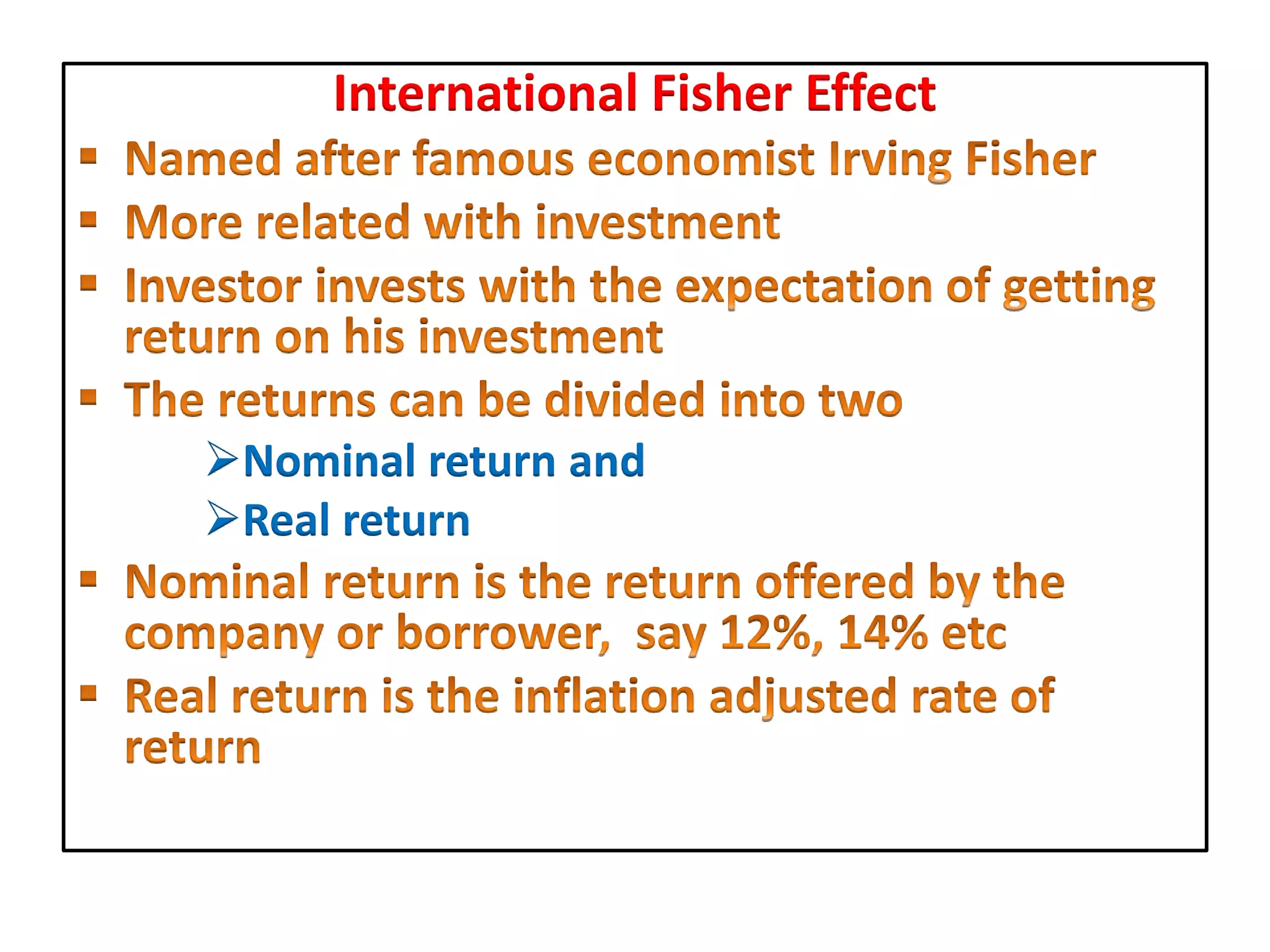
International Fisher Effect
Nominal return and
Real return
An investor saves his income through
postponement of consumption
He expects a better return on his investment
in future
He puts off his consumption anticipating the
saved money can be consumed in future and
better returns can be earned on his
investment
If there is inflation his postponement is not
effective
Suppose Mr. X’s has a savings of Rs. 200,000 on 1st
January, 2015 and he invests this in Mutual fund
for two years and gets 12% per annum.
His total wealth at the end of the second year (31st
December 2016) will be Rs. 250880.
Suppose he wants to construct a house, requires
Rs. 200,000 for constructing the house on 1st
January, 2015 and for constructing the same
home on 31st December 2016, he will require
Rs. 300,000.
Then whether the investment is profitable or not?
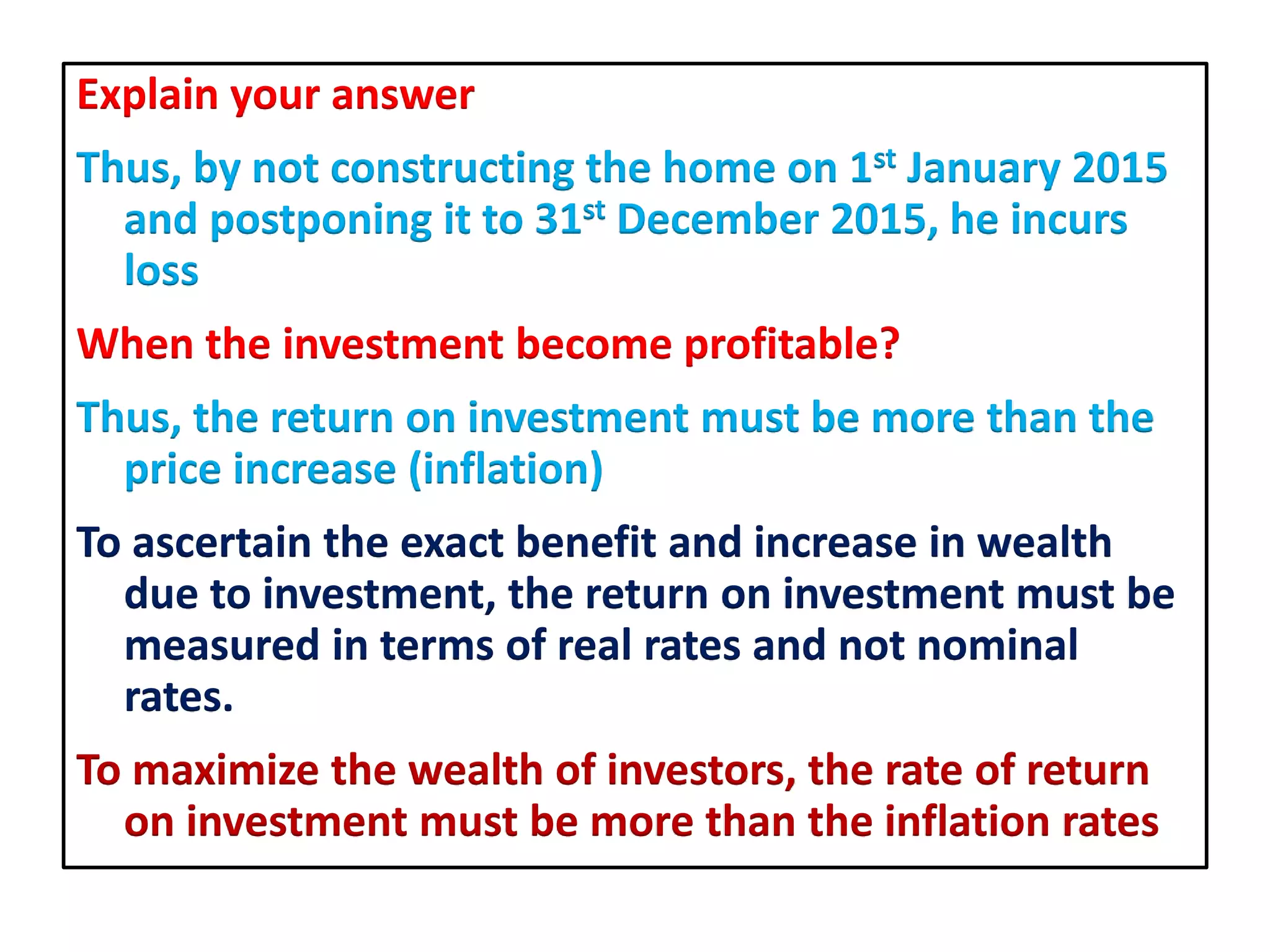
Explain your answer
Thus, by not constructing the home on 1st January 2015
and postponing it to 31st December 2015, he incurs
loss
When the investment become profitable?
Thus, the return on investment must be more than the
price increase (inflation)
To ascertain the exact benefit and increase in wealth
due to investment, the return on investment must be
measured in terms of real rates and not nominal
rates.
To maximize the wealth of investors, the rate of return
on investment must be more than the inflation rates
The nominal interest rate varies directly with the
expected inflation rates.
This proposition is known as the Fisher Effect
Quoted interest rates in a country reflect anticipated real
returns adjusted for local inflation expectations
In day-to-day transactions we use nominal interest rates
It is the risk-free interest rates paid on treasury bills and
expresses the rate of exchange between the current
money and future money
When prices change the value of money also change
Decrease in prices increases the value and vice versa
Investors consider value of money not in nominal but real
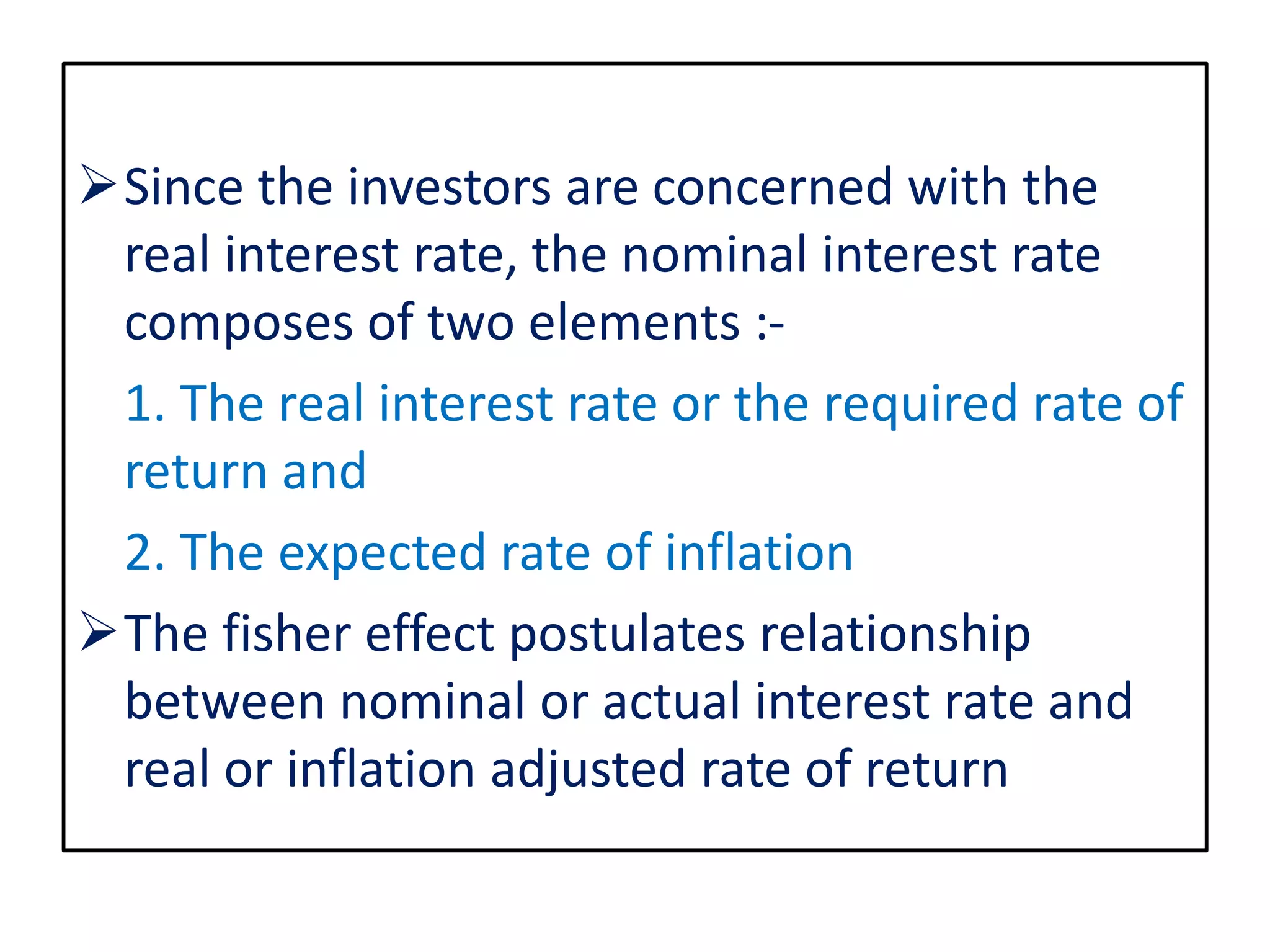
Since the investors are concerned with the
real interest rate, the nominal interest rate
composes of two elements :-
1. The real interest rate or the required rate of
return and
2. The expected rate of inflation
The fisher effect postulates relationship
between nominal or actual interest rate and
real or inflation adjusted rate of return
The relationship, now can be expressed in the
following equation
I + r = (1 + I) x (1 + a)
Where :-
r = Nominal rate
a = real rate or expected rate of return
I = inflation rate
In case the inflation rate is low, the product
terms of I x a can be ignored, then
r≈ 1+a or r≈ r – I
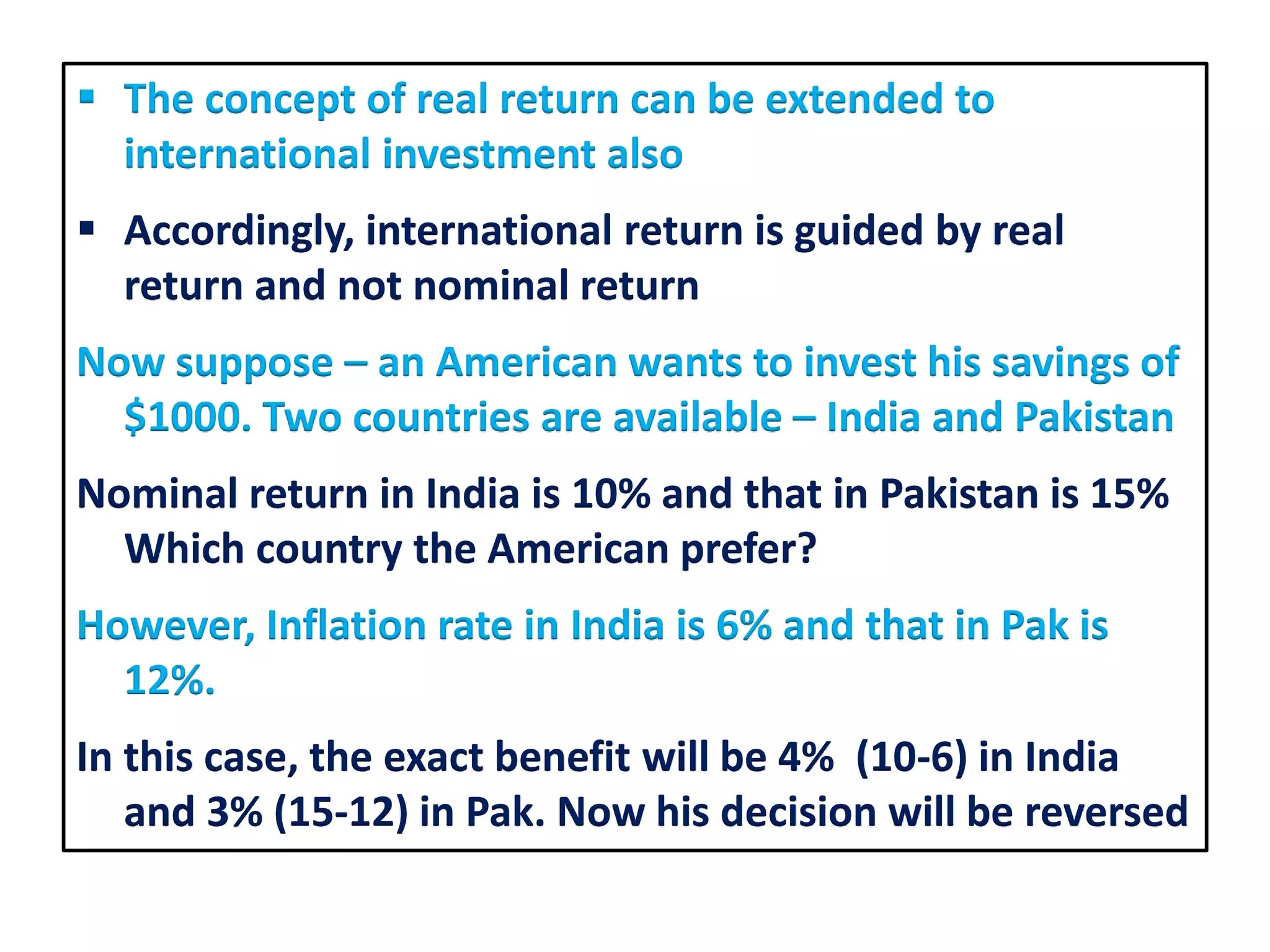
 The concept of real return can be extended to
international investment also
 Accordingly, international return is guided by real
return and not nominal return
Now suppose – an American wants to invest his savings of
$1000. Two countries are available – India and Pakistan
Nominal return in India is 10% and that in Pakistan is 15%
Which country the American prefer?
However, Inflation rate in India is 6% and that in Pak is
12%.
In this case, the exact benefit will be 4% (10-6) in India
and 3% (15-12) in Pak. Now his decision will be reversed
In the long run, through the interaction of the market forces,
international investment will balance
How?
In the present situation Americans prefer India for investments, and
they are interested in Bonds. Increase in the foreign demand for
Bonds in India, would increase the cost of debentures, resulting in
the decline of real rate of returns
At the same time, less demand for bonds result in decline of bond
prices in Pakistan but, return remain the same.
Availability of cheaper bonds and higher rate of return attract
American investors to that country
This leads to increase demand for bonds and to raise the bonds
prices. Ultimately bond prices and rate of return of the two
countries balance or reach in equilibrium
And now
aht = aft
Where aht is the real rate of the home country during the number of
years and aft is the real rate of the foreign country during the
period
 Fisher effect also throws light into the international
monetary policy followed by countries
 Developing countries, especially, those with deficit balance
of payment in current account, to attract foreign investment
offer higher (or increase) nominal rates of interest.
 The inflow of foreign capital, increases the supply of foreign
exchange, and surplus foreign exchange in capital account
can be used to make good of the deficit in current account
 Fisher effect also says that foreign capital can be attracted
through controlling inflation. But considering the difficulty in
controlling inflation rate, politicians and authorities go to
nominal rates.
 However, controlling of inflation rate is the better policy
 Thus, there is a direct relationship between
nominal interest rate and inflation rate.
 High inflation leads to high interest rate
 To offset the effect of high rate of inflation
higher interest rate is to be offered
 Investment will take place only when the
nominal rate of interest is higher than the real
rate
 Further, if the real rate of interest is common in
all countries of the world, the difference in
nominal rate of interest will be due to inflation
Since, the real rate of interest ‘a’ is the same in all the
countries, the following equation will be correct in the case
of two countries A and B
rA – IA = rB – IB
In PPP theory, we related the inflation rate with the exchange
rate and calculated the spot rate
On the basis of Fisher effect, now it is possible to calculate the
spot exchange rate by relating the relationship between
interest rate and inflation rate
Percentage change
d = domestic country and f = foreign country
INTEREST RATE PARITY (IRP)
 Developed by Lord Keynes in 1930
 Cornerstone of today’s international financial
transactions
 PPP is based on Law of one price of commodities,
IRP is also based on Law of one price of securities
 Argues that, when securities are quoted in a
common currency, identical securities should
have the same price
Interest rate parity is an equilibrium condition in
which interest rate differential between two
countries is offset by the forward premium or
discount, so that a forward contract cannot be
used to make a gain based on the interest rate
differential
IRP is based covered interest arbitrage
Interest rate differentials between countries tend
to be offset by the forward premium or discount
between currencies
Although it is called IRP it discusses the exchange
rates as well as interest rates

International fisher effect

  • 1.
    INTERNATIONAL FISHER EFFECT Dr. MohamedKutty Kakkakunnan Associate Professor P G Dept. of Commerce N A M College Kallikkandy Kannur – Kerala - India
  • 2.
    International Fisher Effect Nominalreturn and Real return
  • 3.
    An investor saveshis income through postponement of consumption He expects a better return on his investment in future He puts off his consumption anticipating the saved money can be consumed in future and better returns can be earned on his investment If there is inflation his postponement is not effective
  • 4.
    Suppose Mr. X’shas a savings of Rs. 200,000 on 1st January, 2015 and he invests this in Mutual fund for two years and gets 12% per annum. His total wealth at the end of the second year (31st December 2016) will be Rs. 250880. Suppose he wants to construct a house, requires Rs. 200,000 for constructing the house on 1st January, 2015 and for constructing the same home on 31st December 2016, he will require Rs. 300,000. Then whether the investment is profitable or not?
  • 5.
    Explain your answer Thus,by not constructing the home on 1st January 2015 and postponing it to 31st December 2015, he incurs loss When the investment become profitable? Thus, the return on investment must be more than the price increase (inflation) To ascertain the exact benefit and increase in wealth due to investment, the return on investment must be measured in terms of real rates and not nominal rates. To maximize the wealth of investors, the rate of return on investment must be more than the inflation rates
  • 6.
    The nominal interestrate varies directly with the expected inflation rates. This proposition is known as the Fisher Effect Quoted interest rates in a country reflect anticipated real returns adjusted for local inflation expectations In day-to-day transactions we use nominal interest rates It is the risk-free interest rates paid on treasury bills and expresses the rate of exchange between the current money and future money When prices change the value of money also change Decrease in prices increases the value and vice versa Investors consider value of money not in nominal but real
  • 7.
    Since the investorsare concerned with the real interest rate, the nominal interest rate composes of two elements :- 1. The real interest rate or the required rate of return and 2. The expected rate of inflation The fisher effect postulates relationship between nominal or actual interest rate and real or inflation adjusted rate of return
  • 8.
    The relationship, nowcan be expressed in the following equation I + r = (1 + I) x (1 + a) Where :- r = Nominal rate a = real rate or expected rate of return I = inflation rate In case the inflation rate is low, the product terms of I x a can be ignored, then r≈ 1+a or r≈ r – I
  • 9.
     The conceptof real return can be extended to international investment also  Accordingly, international return is guided by real return and not nominal return Now suppose – an American wants to invest his savings of $1000. Two countries are available – India and Pakistan Nominal return in India is 10% and that in Pakistan is 15% Which country the American prefer? However, Inflation rate in India is 6% and that in Pak is 12%. In this case, the exact benefit will be 4% (10-6) in India and 3% (15-12) in Pak. Now his decision will be reversed
  • 10.
    In the longrun, through the interaction of the market forces, international investment will balance How? In the present situation Americans prefer India for investments, and they are interested in Bonds. Increase in the foreign demand for Bonds in India, would increase the cost of debentures, resulting in the decline of real rate of returns At the same time, less demand for bonds result in decline of bond prices in Pakistan but, return remain the same. Availability of cheaper bonds and higher rate of return attract American investors to that country This leads to increase demand for bonds and to raise the bonds prices. Ultimately bond prices and rate of return of the two countries balance or reach in equilibrium And now aht = aft Where aht is the real rate of the home country during the number of years and aft is the real rate of the foreign country during the period
  • 11.
     Fisher effectalso throws light into the international monetary policy followed by countries  Developing countries, especially, those with deficit balance of payment in current account, to attract foreign investment offer higher (or increase) nominal rates of interest.  The inflow of foreign capital, increases the supply of foreign exchange, and surplus foreign exchange in capital account can be used to make good of the deficit in current account  Fisher effect also says that foreign capital can be attracted through controlling inflation. But considering the difficulty in controlling inflation rate, politicians and authorities go to nominal rates.  However, controlling of inflation rate is the better policy
  • 12.
     Thus, thereis a direct relationship between nominal interest rate and inflation rate.  High inflation leads to high interest rate  To offset the effect of high rate of inflation higher interest rate is to be offered  Investment will take place only when the nominal rate of interest is higher than the real rate  Further, if the real rate of interest is common in all countries of the world, the difference in nominal rate of interest will be due to inflation
  • 13.
    Since, the realrate of interest ‘a’ is the same in all the countries, the following equation will be correct in the case of two countries A and B rA – IA = rB – IB In PPP theory, we related the inflation rate with the exchange rate and calculated the spot rate On the basis of Fisher effect, now it is possible to calculate the spot exchange rate by relating the relationship between interest rate and inflation rate Percentage change d = domestic country and f = foreign country
  • 14.
    INTEREST RATE PARITY(IRP)  Developed by Lord Keynes in 1930  Cornerstone of today’s international financial transactions  PPP is based on Law of one price of commodities, IRP is also based on Law of one price of securities  Argues that, when securities are quoted in a common currency, identical securities should have the same price
  • 15.
    Interest rate parityis an equilibrium condition in which interest rate differential between two countries is offset by the forward premium or discount, so that a forward contract cannot be used to make a gain based on the interest rate differential IRP is based covered interest arbitrage Interest rate differentials between countries tend to be offset by the forward premium or discount between currencies Although it is called IRP it discusses the exchange rates as well as interest rates