
Dr. Mohamed Kutty Kakkakunnan
Associate Professor
P.G. Dept. of Commerce
N A M College Kallikkandy
Kannur – Kerala - India
Financial Statements
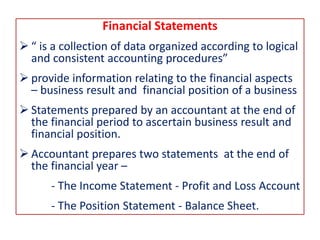
 “ is a collection of data organized according to logical
and consistent accounting procedures”
 provide information relating to the financial aspects
– business result and financial position of a business
 Statements prepared by an accountant at the end of
the financial period to ascertain business result and
financial position.
 Accountant prepares two statements at the end of
the financial year –
- The Income Statement - Profit and Loss Account
- The Position Statement - Balance Sheet.
Financial Statements
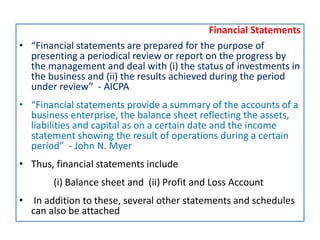
• “Financial statements are prepared for the purpose of
presenting a periodical review or report on the progress by
the management and deal with (i) the status of investments in
the business and (ii) the results achieved during the period
under review” - AICPA
• “Financial statements provide a summary of the accounts of a
business enterprise, the balance sheet reflecting the assets,
liabilities and capital as on a certain date and the income
statement showing the result of operations during a certain
period” - John N. Myer
• Thus, financial statements include
(i) Balance sheet and (ii) Profit and Loss Account
• In addition to these, several other statements and schedules
can also be attached
Balance Sheet
 A statement showing the financial position as on a
particular date
 Sets forth various assets, liabilities and capital of the
business on the date of preparation
 Reflects the assets owned by the business, and the sources
of funds (from creditors and owners) used in the
acquisition of those assets
 Prepared on the last day of the financial period
 Titled as “Balance Sheet as at /as on --------- (the date of
preparation)
 Known by different names like Statement of Financial
Position/ Condition; Statement of Assets and Liabilities,
Statement of Resources and Liabilities, Statement of Assets,
Liabilities and Owners Fund etc.
 ‘Balance Sheet’ is more popular and common in usage
Marshalling of Assets and Liabilities
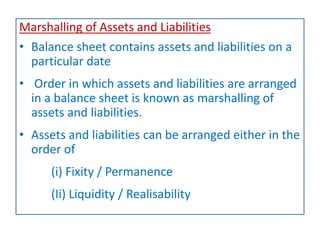
• Balance sheet contains assets and liabilities on a
particular date
• Order in which assets and liabilities are arranged
in a balance sheet is known as marshalling of
assets and liabilities.
• Assets and liabilities can be arranged either in the
order of
(i) Fixity / Permanence
(Ii) Liquidity / Realisability
Classification of assets and liabilities
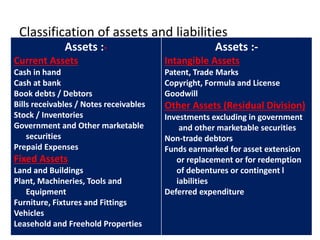
Assets :-
Current Assets
Cash in hand
Cash at bank
Book debts / Debtors
Bills receivables / Notes receivables
Stock / Inventories
Government and Other marketable
securities
Prepaid Expenses
Fixed Assets
Land and Buildings
Plant, Machineries, Tools and
Equipment
Furniture, Fixtures and Fittings
Vehicles
Leasehold and Freehold Properties
Assets :-
Intangible Assets
Patent, Trade Marks
Copyright, Formula and License
Goodwill
Other Assets (Residual Division)
Investments excluding in government
and other marketable securities
Non-trade debtors
Funds earmarked for asset extension
or replacement or for redemption
of debentures or contingent l
iabilities
Deferred expenditure
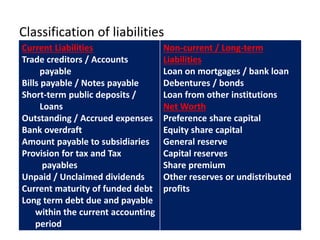
Classification of liabilities
Current Liabilities
Trade creditors / Accounts
payable
Bills payable / Notes payable
Short-term public deposits /
Loans
Outstanding / Accrued expenses
Bank overdraft
Amount payable to subsidiaries
Provision for tax and Tax
payables
Unpaid / Unclaimed dividends
Current maturity of funded debt
Long term debt due and payable
within the current accounting
period
Non-current / Long-term
Liabilities
Loan on mortgages / bank loan
Debentures / bonds
Loan from other institutions
Net Worth
Preference share capital
Equity share capital
General reserve
Capital reserves
Share premium
Other reserves or undistributed
profits
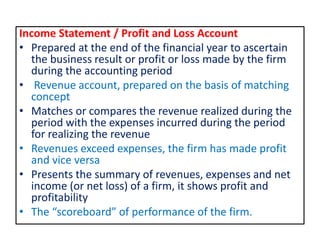
Income Statement / Profit and Loss Account
• Prepared at the end of the financial year to ascertain
the business result or profit or loss made by the firm
during the accounting period
• Revenue account, prepared on the basis of matching
concept
• Matches or compares the revenue realized during the
period with the expenses incurred during the period
for realizing the revenue
• Revenues exceed expenses, the firm has made profit
and vice versa
• Presents the summary of revenues, expenses and net
income (or net loss) of a firm, it shows profit and
profitability
• The “scoreboard” of performance of the firm.
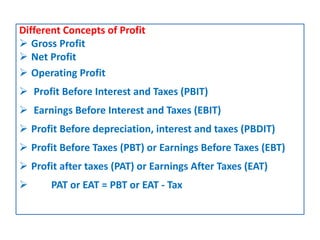
Different Concepts of Profit
 Gross Profit
 Net Profit
 Operating Profit
 Profit Before Interest and Taxes (PBIT)
 Earnings Before Interest and Taxes (EBIT)
 Profit Before depreciation, interest and taxes (PBDIT)
 Profit Before Taxes (PBT) or Earnings Before Taxes (EBT)
 Profit after taxes (PAT) or Earnings After Taxes (EAT)
 PAT or EAT = PBT or EAT - Tax
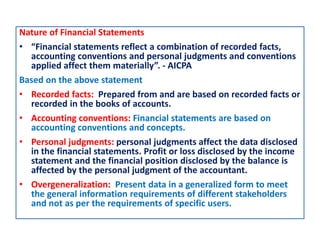
Nature of Financial Statements
• “Financial statements reflect a combination of recorded facts,
accounting conventions and personal judgments and conventions
applied affect them materially”. - AICPA
Based on the above statement
• Recorded facts: Prepared from and are based on recorded facts or
recorded in the books of accounts.
• Accounting conventions: Financial statements are based on
accounting conventions and concepts.
• Personal judgments: personal judgments affect the data disclosed
in the financial statements. Profit or loss disclosed by the income
statement and the financial position disclosed by the balance is
affected by the personal judgment of the accountant.
• Overgeneralization: Present data in a generalized form to meet
the general information requirements of different stakeholders
and not as per the requirements of specific users.

Financial statements

  • 1.
    Dr. Mohamed KuttyKakkakunnan Associate Professor P.G. Dept. of Commerce N A M College Kallikkandy Kannur – Kerala - India
  • 2.
    Financial Statements  “is a collection of data organized according to logical and consistent accounting procedures”  provide information relating to the financial aspects – business result and financial position of a business  Statements prepared by an accountant at the end of the financial period to ascertain business result and financial position.  Accountant prepares two statements at the end of the financial year – - The Income Statement - Profit and Loss Account - The Position Statement - Balance Sheet.
  • 3.
    Financial Statements • “Financialstatements are prepared for the purpose of presenting a periodical review or report on the progress by the management and deal with (i) the status of investments in the business and (ii) the results achieved during the period under review” - AICPA • “Financial statements provide a summary of the accounts of a business enterprise, the balance sheet reflecting the assets, liabilities and capital as on a certain date and the income statement showing the result of operations during a certain period” - John N. Myer • Thus, financial statements include (i) Balance sheet and (ii) Profit and Loss Account • In addition to these, several other statements and schedules can also be attached
  • 4.
    Balance Sheet  Astatement showing the financial position as on a particular date  Sets forth various assets, liabilities and capital of the business on the date of preparation  Reflects the assets owned by the business, and the sources of funds (from creditors and owners) used in the acquisition of those assets  Prepared on the last day of the financial period  Titled as “Balance Sheet as at /as on --------- (the date of preparation)  Known by different names like Statement of Financial Position/ Condition; Statement of Assets and Liabilities, Statement of Resources and Liabilities, Statement of Assets, Liabilities and Owners Fund etc.  ‘Balance Sheet’ is more popular and common in usage
  • 5.
    Marshalling of Assetsand Liabilities • Balance sheet contains assets and liabilities on a particular date • Order in which assets and liabilities are arranged in a balance sheet is known as marshalling of assets and liabilities. • Assets and liabilities can be arranged either in the order of (i) Fixity / Permanence (Ii) Liquidity / Realisability
  • 6.
    Classification of assetsand liabilities Assets :- Current Assets Cash in hand Cash at bank Book debts / Debtors Bills receivables / Notes receivables Stock / Inventories Government and Other marketable securities Prepaid Expenses Fixed Assets Land and Buildings Plant, Machineries, Tools and Equipment Furniture, Fixtures and Fittings Vehicles Leasehold and Freehold Properties Assets :- Intangible Assets Patent, Trade Marks Copyright, Formula and License Goodwill Other Assets (Residual Division) Investments excluding in government and other marketable securities Non-trade debtors Funds earmarked for asset extension or replacement or for redemption of debentures or contingent l iabilities Deferred expenditure
  • 7.
    Classification of liabilities CurrentLiabilities Trade creditors / Accounts payable Bills payable / Notes payable Short-term public deposits / Loans Outstanding / Accrued expenses Bank overdraft Amount payable to subsidiaries Provision for tax and Tax payables Unpaid / Unclaimed dividends Current maturity of funded debt Long term debt due and payable within the current accounting period Non-current / Long-term Liabilities Loan on mortgages / bank loan Debentures / bonds Loan from other institutions Net Worth Preference share capital Equity share capital General reserve Capital reserves Share premium Other reserves or undistributed profits
  • 8.
    Income Statement /Profit and Loss Account • Prepared at the end of the financial year to ascertain the business result or profit or loss made by the firm during the accounting period • Revenue account, prepared on the basis of matching concept • Matches or compares the revenue realized during the period with the expenses incurred during the period for realizing the revenue • Revenues exceed expenses, the firm has made profit and vice versa • Presents the summary of revenues, expenses and net income (or net loss) of a firm, it shows profit and profitability • The “scoreboard” of performance of the firm.
  • 9.
    Different Concepts ofProfit  Gross Profit  Net Profit  Operating Profit  Profit Before Interest and Taxes (PBIT)  Earnings Before Interest and Taxes (EBIT)  Profit Before depreciation, interest and taxes (PBDIT)  Profit Before Taxes (PBT) or Earnings Before Taxes (EBT)  Profit after taxes (PAT) or Earnings After Taxes (EAT)  PAT or EAT = PBT or EAT - Tax
  • 10.
    Nature of FinancialStatements • “Financial statements reflect a combination of recorded facts, accounting conventions and personal judgments and conventions applied affect them materially”. - AICPA Based on the above statement • Recorded facts: Prepared from and are based on recorded facts or recorded in the books of accounts. • Accounting conventions: Financial statements are based on accounting conventions and concepts. • Personal judgments: personal judgments affect the data disclosed in the financial statements. Profit or loss disclosed by the income statement and the financial position disclosed by the balance is affected by the personal judgment of the accountant. • Overgeneralization: Present data in a generalized form to meet the general information requirements of different stakeholders and not as per the requirements of specific users.