DR. MOHAMED KUTTY KAKKAKUNNAN
Associate Professor
P G Dept. of Commerce
N A M College Kallikkandy
Kannur – Kerala - India
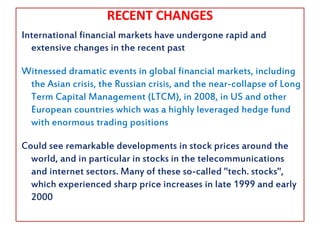
RECENT CHANGES
International financial markets have undergone rapid and
extensive changes in the recent past
Witnessed dramatic events in global financial markets, including
the Asian crisis, the Russian crisis, and the near-collapse of Long
Term Capital Management (LTCM), in 2008, in US and other
European countries which was a highly leveraged hedge fund
with enormous trading positions
Could see remarkable developments in stock prices around the
world, and in particular in stocks in the telecommunications
and internet sectors. Many of these so-called "tech. stocks",
which experienced sharp price increases in late 1999 and early
2000
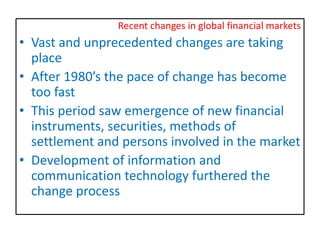
Recent changes in global financial markets
• Vast and unprecedented changes are taking
place
• After 1980’s the pace of change has become
too fast
• This period saw emergence of new financial
instruments, securities, methods of
settlement and persons involved in the market
• Development of information and
communication technology furthered the
change process
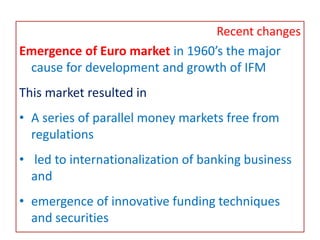
Recent changes
Emergence of Euro market in 1960’s the major
cause for development and growth of IFM
This market resulted in
• A series of parallel money markets free from
regulations
• led to internationalization of banking business
and
• emergence of innovative funding techniques
and securities
Introduction of Floating Exchange Rate
• Introduced in 1973, another important change,
which resulted in volatility
 This increased risk in exchange rates to both
borrowers and lenders
 To manage risk new institutions and products
emerged like futures, swaps, options etc.
 Reduction in the traditional income of banks
like interest, commission brokerage etc.
compelled them to introduce new products and
services, which often the banks themselves
cannot understood
Integration among the different financial markets
Another remarkable change taken place in 1980’s is
the integration among the different financial
markets in different countries
Integration resulted in
• Reducing the gap between local, regional,
national and offshore financial markets led to the
creation of a unified, globalised financial markets
• Increasing the rate of growth of financial systems
than that of production
 Establishment of branches of banks and financial
institutions of developed and industrial countries in
other countries
 Establishment of branch banks in different countries
and permission to tap the national financial
markets
 Integration among the financial markets of
industrialized countries like US, Japan and Europe
 Resulted in reducing the gap between the financial
markets of different advanced countries
Functional unification
 Different kinds of financial institutions to serve
different kinds of financial services – specialized
institutions for specific services
 Financial institutions were divided as commercial
banks, investment banks, EXIM banks etc.
 Recently these functional specialization became
unimportant and at present “everybody does
everything”
 Financial institutions started to render wide range of
services instead of specializing one or two tasks –
from commercial banking to merchant banking
 Thus recently, there is a spatial and functional
integration
Major reasons for these changes are :-
I. Liberalization in cross boarder financial transaction
II. Deregulation within the financial system of the
major industrialized nations
Major liberalization steps include:-
o Lifting exchange controls in UK, France and Japan
(other nations like US, Germany, Switzerland etc,
which were already liberalized)
o Removal of tax on interest paid for non-resident
o Opening up of domestic financial markets to foreign
borrowers
o Allowing domestic borrowers to borrow from
foreign markets
 Liberalization and Deregulation helped portfolio
investors to invest their funds in a wide range of
assets over different parts of the world, on their
own risk, on their own estimates (formerly this
was not possible due to regulations and control
 This helped the borrower in borrowing funds
economically from different parts of the world
at competitive level, minimizing all costs
 Competition in international financial markets
resulted in efficient and effective operations
 Emergence of international financial markets stock
markets etc., resulted reducing the importance of national
markets
Another remarkable change was in the field of securitization
and disintermediation
 Competition resulted financial service industry also
 Borrowers began to borrow directly by issuing new variety
of securities like depository receipt etc. The importance of
intermediaries reduced and resulted in disintermediation
 Underwriting commission, brokerage etc reduced and the
hegemony of US financial institutions also reduced
 One aspect of this securitization process has been the
increase in corporate bond issue, which has also coincided
with a diminishing supply of government bonds in many
countries, particularly in the United States
Emergence and development derivative markets
• Another interesting development
• Rapid advances in technology, financial engineering,
and risk management – major reasons
• These helped to enhance both the supply of and the
demand for more complex and sophisticated
derivatives products
• Increased use of derivatives to adjust exposure to risk
in financial markets has also contributed to the rise in
speculation in securities
• The leveraged nature of derivative instruments
increased risks to individual investors
• derivatives also provide scope for a more efficient
allocation of risks in the economy, which is beneficial
for the functioning of financial markets, and hence
enhances the conditions for economic growth.
Launch of Euro
• Euro launched in 1st January 1999. Was a historic
event.
• 11 national currencies were converted into one single
currency overnight
• Marked the start of a period of profound change in
Europe's financial settings
• The successful launch of the euro, resulted in the
creation of a stable, prosperous and peaceful Europe,
and boosted the integration of financial markets in the
euro area
• This process of integration in European financial
markets coincided with the trend towards globalisation
• However, at present, there conflicts in the euro zone
and UK is trying to come out from the Union
Matters of Concern
• Liberalization and globalization still continue imposing
more and more changes and creating more and more
challenges
• Still some countries and governments indirectly control
the flow capital through taxes and other kinds of
regulations
• Excessive speculation, hoarding and profiteering in the
international financial market is rampant
• Greedy nature of operations have resulted in the
collapse several well-known financial institutions and
several such institutions have to be rescued by the
government
Conclusion
• Unprecedented development in international financial
markets
• Due to the liberalization of markets, rapid technological
progress and major advances in telecommunications
• Has opened new vistas for investment and financing
opportunities for businesses and people around the
world , and easier access to global financial markets
for individuals and corporations
• Which has led to a more efficient allocation of capital,
paving way to economic growth and prosperity.

Recent changes in ifm

  • 1.
    DR. MOHAMED KUTTYKAKKAKUNNAN Associate Professor P G Dept. of Commerce N A M College Kallikkandy Kannur – Kerala - India
  • 2.
    RECENT CHANGES International financialmarkets have undergone rapid and extensive changes in the recent past Witnessed dramatic events in global financial markets, including the Asian crisis, the Russian crisis, and the near-collapse of Long Term Capital Management (LTCM), in 2008, in US and other European countries which was a highly leveraged hedge fund with enormous trading positions Could see remarkable developments in stock prices around the world, and in particular in stocks in the telecommunications and internet sectors. Many of these so-called "tech. stocks", which experienced sharp price increases in late 1999 and early 2000
  • 3.
    Recent changes inglobal financial markets • Vast and unprecedented changes are taking place • After 1980’s the pace of change has become too fast • This period saw emergence of new financial instruments, securities, methods of settlement and persons involved in the market • Development of information and communication technology furthered the change process
  • 4.
    Recent changes Emergence ofEuro market in 1960’s the major cause for development and growth of IFM This market resulted in • A series of parallel money markets free from regulations • led to internationalization of banking business and • emergence of innovative funding techniques and securities
  • 5.
    Introduction of FloatingExchange Rate • Introduced in 1973, another important change, which resulted in volatility  This increased risk in exchange rates to both borrowers and lenders  To manage risk new institutions and products emerged like futures, swaps, options etc.  Reduction in the traditional income of banks like interest, commission brokerage etc. compelled them to introduce new products and services, which often the banks themselves cannot understood
  • 6.
    Integration among thedifferent financial markets Another remarkable change taken place in 1980’s is the integration among the different financial markets in different countries Integration resulted in • Reducing the gap between local, regional, national and offshore financial markets led to the creation of a unified, globalised financial markets • Increasing the rate of growth of financial systems than that of production
  • 7.
     Establishment ofbranches of banks and financial institutions of developed and industrial countries in other countries  Establishment of branch banks in different countries and permission to tap the national financial markets  Integration among the financial markets of industrialized countries like US, Japan and Europe  Resulted in reducing the gap between the financial markets of different advanced countries
  • 8.
    Functional unification  Differentkinds of financial institutions to serve different kinds of financial services – specialized institutions for specific services  Financial institutions were divided as commercial banks, investment banks, EXIM banks etc.  Recently these functional specialization became unimportant and at present “everybody does everything”  Financial institutions started to render wide range of services instead of specializing one or two tasks – from commercial banking to merchant banking  Thus recently, there is a spatial and functional integration
  • 9.
    Major reasons forthese changes are :- I. Liberalization in cross boarder financial transaction II. Deregulation within the financial system of the major industrialized nations Major liberalization steps include:- o Lifting exchange controls in UK, France and Japan (other nations like US, Germany, Switzerland etc, which were already liberalized) o Removal of tax on interest paid for non-resident o Opening up of domestic financial markets to foreign borrowers o Allowing domestic borrowers to borrow from foreign markets
  • 10.
     Liberalization andDeregulation helped portfolio investors to invest their funds in a wide range of assets over different parts of the world, on their own risk, on their own estimates (formerly this was not possible due to regulations and control  This helped the borrower in borrowing funds economically from different parts of the world at competitive level, minimizing all costs  Competition in international financial markets resulted in efficient and effective operations
  • 11.
     Emergence ofinternational financial markets stock markets etc., resulted reducing the importance of national markets Another remarkable change was in the field of securitization and disintermediation  Competition resulted financial service industry also  Borrowers began to borrow directly by issuing new variety of securities like depository receipt etc. The importance of intermediaries reduced and resulted in disintermediation  Underwriting commission, brokerage etc reduced and the hegemony of US financial institutions also reduced  One aspect of this securitization process has been the increase in corporate bond issue, which has also coincided with a diminishing supply of government bonds in many countries, particularly in the United States
  • 12.
    Emergence and developmentderivative markets • Another interesting development • Rapid advances in technology, financial engineering, and risk management – major reasons • These helped to enhance both the supply of and the demand for more complex and sophisticated derivatives products • Increased use of derivatives to adjust exposure to risk in financial markets has also contributed to the rise in speculation in securities • The leveraged nature of derivative instruments increased risks to individual investors • derivatives also provide scope for a more efficient allocation of risks in the economy, which is beneficial for the functioning of financial markets, and hence enhances the conditions for economic growth.
  • 13.
    Launch of Euro •Euro launched in 1st January 1999. Was a historic event. • 11 national currencies were converted into one single currency overnight • Marked the start of a period of profound change in Europe's financial settings • The successful launch of the euro, resulted in the creation of a stable, prosperous and peaceful Europe, and boosted the integration of financial markets in the euro area • This process of integration in European financial markets coincided with the trend towards globalisation • However, at present, there conflicts in the euro zone and UK is trying to come out from the Union
  • 14.
    Matters of Concern •Liberalization and globalization still continue imposing more and more changes and creating more and more challenges • Still some countries and governments indirectly control the flow capital through taxes and other kinds of regulations • Excessive speculation, hoarding and profiteering in the international financial market is rampant • Greedy nature of operations have resulted in the collapse several well-known financial institutions and several such institutions have to be rescued by the government
  • 15.
    Conclusion • Unprecedented developmentin international financial markets • Due to the liberalization of markets, rapid technological progress and major advances in telecommunications • Has opened new vistas for investment and financing opportunities for businesses and people around the world , and easier access to global financial markets for individuals and corporations • Which has led to a more efficient allocation of capital, paving way to economic growth and prosperity.