OPEN ECONOMY IDENTITY
Dr. Mohamed Kutty Kakkakunnan
Associate Professor
P G Dept. Of Commerce
N A M College Kallikkandy
Kannur – Kerala - India
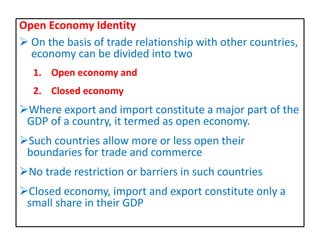
Open Economy Identity
 On the basis of trade relationship with other countries,
economy can be divided into two
1. Open economy and
2. Closed economy
Where export and import constitute a major part of the
GDP of a country, it termed as open economy.
Such countries allow more or less open their
boundaries for trade and commerce
No trade restriction or barriers in such countries
Closed economy, import and export constitute only a
small share in their GDP
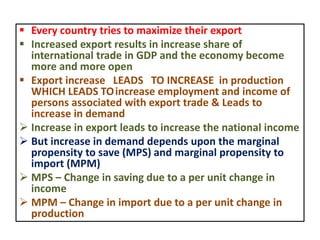
 Every country tries to maximize their export
 Increased export results in increase share of
international trade in GDP and the economy become
more and more open
 Export increase LEADS TO INCREASE in production
WHICH LEADS TOincrease employment and income of
persons associated with export trade & Leads to
increase in demand
 Increase in export leads to increase the national income
 But increase in demand depends upon the marginal
propensity to save (MPS) and marginal propensity to
import (MPM)
 MPS – Change in saving due to a per unit change in
income
 MPM – Change in import due to a per unit change in
production
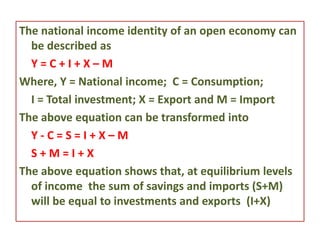
The national income identity of an open economy can
be described as
Y = C + I + X – M
Where, Y = National income; C = Consumption;
I = Total investment; X = Export and M = Import
The above equation can be transformed into
Y - C = S = I + X – M
S + M = I + X
The above equation shows that, at equilibrium levels
of income the sum of savings and imports (S+M)
will be equal to investments and exports (I+X)
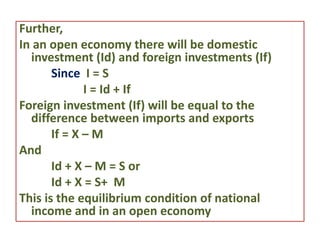
Further,
In an open economy there will be domestic
investment (Id) and foreign investments (If)
Since I = S
I = Id + If
Foreign investment (If) will be equal to the
difference between imports and exports
If = X – M
And
Id + X – M = S or
Id + X = S+ M
This is the equilibrium condition of national
income and in an open economy
Open Economy Multiplier
The concept of multiplier was developed by RF Kahn, latter it was
popularized by Keynes and then by Fritz Machlup
Multiplier is the coefficient relating and increment in output (return
or income) to an increment of investment
Open economy multiplier relates the increase in GNP due to increase
in export
The open economy multiplier depends upon the Marginal propensity
to save (MPS) and marginal propensity to import (MPM)
MPS means increase in savings for a per unit increase of income
MPM means the increase in import for a per unit increase in output
(GNP).
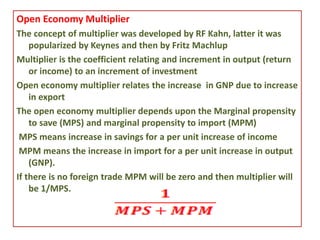
If there is no foreign trade MPM will be zero and then multiplier will
be 1/MPS.
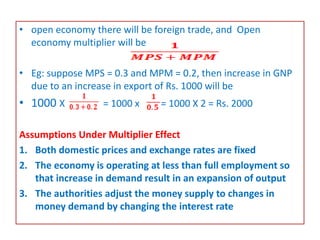
• open economy there will be foreign trade, and Open
economy multiplier will be
• Eg: suppose MPS = 0.3 and MPM = 0.2, then increase in GNP
due to an increase in export of Rs. 1000 will be
• 1000 X = 1000 x = 1000 X 2 = Rs. 2000
Assumptions Under Multiplier Effect
1. Both domestic prices and exchange rates are fixed
2. The economy is operating at less than full employment so
that increase in demand result in an expansion of output
3. The authorities adjust the money supply to changes in
money demand by changing the interest rate

Open economy identity

  • 1.
    OPEN ECONOMY IDENTITY Dr.Mohamed Kutty Kakkakunnan Associate Professor P G Dept. Of Commerce N A M College Kallikkandy Kannur – Kerala - India
  • 2.
    Open Economy Identity On the basis of trade relationship with other countries, economy can be divided into two 1. Open economy and 2. Closed economy Where export and import constitute a major part of the GDP of a country, it termed as open economy. Such countries allow more or less open their boundaries for trade and commerce No trade restriction or barriers in such countries Closed economy, import and export constitute only a small share in their GDP
  • 3.
     Every countrytries to maximize their export  Increased export results in increase share of international trade in GDP and the economy become more and more open  Export increase LEADS TO INCREASE in production WHICH LEADS TOincrease employment and income of persons associated with export trade & Leads to increase in demand  Increase in export leads to increase the national income  But increase in demand depends upon the marginal propensity to save (MPS) and marginal propensity to import (MPM)  MPS – Change in saving due to a per unit change in income  MPM – Change in import due to a per unit change in production
  • 4.
    The national incomeidentity of an open economy can be described as Y = C + I + X – M Where, Y = National income; C = Consumption; I = Total investment; X = Export and M = Import The above equation can be transformed into Y - C = S = I + X – M S + M = I + X The above equation shows that, at equilibrium levels of income the sum of savings and imports (S+M) will be equal to investments and exports (I+X)
  • 5.
    Further, In an openeconomy there will be domestic investment (Id) and foreign investments (If) Since I = S I = Id + If Foreign investment (If) will be equal to the difference between imports and exports If = X – M And Id + X – M = S or Id + X = S+ M This is the equilibrium condition of national income and in an open economy
  • 6.
    Open Economy Multiplier Theconcept of multiplier was developed by RF Kahn, latter it was popularized by Keynes and then by Fritz Machlup Multiplier is the coefficient relating and increment in output (return or income) to an increment of investment Open economy multiplier relates the increase in GNP due to increase in export The open economy multiplier depends upon the Marginal propensity to save (MPS) and marginal propensity to import (MPM) MPS means increase in savings for a per unit increase of income MPM means the increase in import for a per unit increase in output (GNP). If there is no foreign trade MPM will be zero and then multiplier will be 1/MPS.
  • 7.
    • open economythere will be foreign trade, and Open economy multiplier will be • Eg: suppose MPS = 0.3 and MPM = 0.2, then increase in GNP due to an increase in export of Rs. 1000 will be • 1000 X = 1000 x = 1000 X 2 = Rs. 2000 Assumptions Under Multiplier Effect 1. Both domestic prices and exchange rates are fixed 2. The economy is operating at less than full employment so that increase in demand result in an expansion of output 3. The authorities adjust the money supply to changes in money demand by changing the interest rate