OPEN SYSTEM
INTERCONNECTION (OSI)
MODEL
PRESENTED BY
SIMRAN KAUR
OSI MODEL
• OSI model is a reference tool for understanding data
communication between any two networked system.
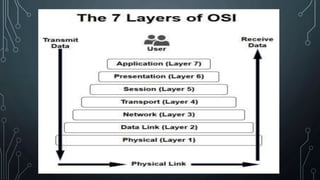
• It divides the communication processes into 7 layers.
• Each layer performs specific functions to support the layers
above it and uses services of the layers below it.
• Each layer represents a different level of abstraction and layers
boundaries are well defined.
PHYSICAL LAYER
• It coordinates the functions required to transmit a bit stream
over a physical medium.
• It deals with the mechanical and electrical specifications of
interface and transmission medium.
• It defines the procedures and functions that physical devices
and interfaces have to perform for transmission to occur.
FUNCTIONS OF PHYSICAL LAYER
• It defines characteristics of the interface between the devices
and the transmission medium.
• It defines the type of transmission medium and transmission
rate.
• It performs synchronization of sender and receiver clocks.
• It is concerned with physical topology.
• It transmits bit stream over the communication channel
UNITS USED IN PHYSICAL LAYER
• Hardware used: Repeater and Hub
• Data unit: Bit stream
DATA LINK LAYER
• It transforms the physical layer, a raw transmission facility, to a
reliable link and is responsible for Node-to-Node delivery.
• It makes the physical layer appear error free to the upper layer
(i.e., network layer).
FUNCTIONS OF DATA LINK LAYER
• Framing
• Flow control
• Error control
• Access control
• Physical addressing
UNITS USED IN DATA LINK LAYER
• Hardware used: Bridges and Switches
• Data unit: Frames
• Protocol used: Simplex protocol, stop and wait protocol, sliding
window, HDLC, SDLC, NDP, ISDN, ARP, PSL, OSPF, NDP
NETWORK LAYER
• It is responsible for source to destination delivery of a packet
possibly across multiple networks (links).
• If the two systems are connected to the same link, there is
usually no need for a network layer.
• If the two systems are attached to different links with
connecting devices between networks, there is often a need of
the network layer to accomplish source to destination delivery.
FUNCTIONS OF NETWORK LAYER
• Logical addressing
• Routing
UNITS USED IN NETWORK LAYER
• Hardware used: Routers
• Data units: Packets
• Protocols used: IP(Internet Protocol), NAT(Network Address
Translation), ARP(Address Resolution Protocol), ICMP(Internet
Control Message Protocol), BGP(Border Gateway Protocol),
RARP(Reverse Address Resolution Protocol), DHCP(Dynamic
Host Configuration Protocol), BOOTP, OSPF
TRANSPORT LAYER
• It is responsible for source to destination delivery of the entire
message.
• It ensures that the whole message arrives intact and in order.
FUNCTIONS OF TRANSPORT LAYER
• Service point addressing
• Segmentation and reassembly
• Flow control
• Error control
• Connection control
UNITS USED IN TRANSPORT LAYER
• Hardware used: Transport gateway
• Data units: Segments
• Protocol used: TCP(Transmission Control Protocol) for
connection oriented approach and UDP(User Datagram
Protocol) for connectionless approach
SESSION LAYER
• It is the network dialog controller.
• It establishes, maintains and synchronizes the interaction
between communicating systems.
• It plays an important role in keeping applications data separate.
FUNCTIONS OF SESSION LAYER
• Dialog control
• Synchronization
UNITS USED IN SESSION LAYER
• Data unit: Data
• Protocol used: ADSP, ASP, ISO-SP, L2TP, F2F, PAP, PPTP, RPC,
SMPP, SDP, ZIP, RTCP
PRESENTATION LAYER
• It is responsible for how an application formats data to be sent
out onto the network.
• It basically allows an application to read (to understand) the
message.
FUNCTIONS OF PRESENTATION LAYER
• Translation
• Encryption and decryption
• Compression
UNITS USED IN PRESENTATION LAYER
• Data unit: Data
• Protocol used: AFP, ASCII, EBCDIC, ICA, LPP, NCP, NDR, XDR,
X.25 PAP
APPLICATION LAYER
• It enables the user, whether human or software, to access the
network.
• It provides user interfaces and support for services such as
electronic mail, remote file access and transfer shared database
management and other types of distributed information
services.
FUNCTIONS OF APPLICATION LAYER
• Network virtual terminal
• File transfer, access and management
• Mail services
• Directory services
UNITS USED IN APPLICATION LAYER
• Hardware used: Application Gateway
• Protocol used: HTTP, SMTP, POP3, FTP, Telnet, etc.
• Data unit: Data
THANK YOU!!!

OSI Model

  • 1.
  • 2.
    OSI MODEL • OSImodel is a reference tool for understanding data communication between any two networked system. • It divides the communication processes into 7 layers. • Each layer performs specific functions to support the layers above it and uses services of the layers below it. • Each layer represents a different level of abstraction and layers boundaries are well defined.
  • 4.
    PHYSICAL LAYER • Itcoordinates the functions required to transmit a bit stream over a physical medium. • It deals with the mechanical and electrical specifications of interface and transmission medium. • It defines the procedures and functions that physical devices and interfaces have to perform for transmission to occur.
  • 5.
    FUNCTIONS OF PHYSICALLAYER • It defines characteristics of the interface between the devices and the transmission medium. • It defines the type of transmission medium and transmission rate. • It performs synchronization of sender and receiver clocks. • It is concerned with physical topology. • It transmits bit stream over the communication channel
  • 6.
    UNITS USED INPHYSICAL LAYER • Hardware used: Repeater and Hub • Data unit: Bit stream
  • 7.
    DATA LINK LAYER •It transforms the physical layer, a raw transmission facility, to a reliable link and is responsible for Node-to-Node delivery. • It makes the physical layer appear error free to the upper layer (i.e., network layer).
  • 8.
    FUNCTIONS OF DATALINK LAYER • Framing • Flow control • Error control • Access control • Physical addressing
  • 9.
    UNITS USED INDATA LINK LAYER • Hardware used: Bridges and Switches • Data unit: Frames • Protocol used: Simplex protocol, stop and wait protocol, sliding window, HDLC, SDLC, NDP, ISDN, ARP, PSL, OSPF, NDP
  • 10.
    NETWORK LAYER • Itis responsible for source to destination delivery of a packet possibly across multiple networks (links). • If the two systems are connected to the same link, there is usually no need for a network layer. • If the two systems are attached to different links with connecting devices between networks, there is often a need of the network layer to accomplish source to destination delivery.
  • 11.
    FUNCTIONS OF NETWORKLAYER • Logical addressing • Routing
  • 12.
    UNITS USED INNETWORK LAYER • Hardware used: Routers • Data units: Packets • Protocols used: IP(Internet Protocol), NAT(Network Address Translation), ARP(Address Resolution Protocol), ICMP(Internet Control Message Protocol), BGP(Border Gateway Protocol), RARP(Reverse Address Resolution Protocol), DHCP(Dynamic Host Configuration Protocol), BOOTP, OSPF
  • 13.
    TRANSPORT LAYER • Itis responsible for source to destination delivery of the entire message. • It ensures that the whole message arrives intact and in order.
  • 14.
    FUNCTIONS OF TRANSPORTLAYER • Service point addressing • Segmentation and reassembly • Flow control • Error control • Connection control
  • 15.
    UNITS USED INTRANSPORT LAYER • Hardware used: Transport gateway • Data units: Segments • Protocol used: TCP(Transmission Control Protocol) for connection oriented approach and UDP(User Datagram Protocol) for connectionless approach
  • 16.
    SESSION LAYER • Itis the network dialog controller. • It establishes, maintains and synchronizes the interaction between communicating systems. • It plays an important role in keeping applications data separate.
  • 17.
    FUNCTIONS OF SESSIONLAYER • Dialog control • Synchronization
  • 18.
    UNITS USED INSESSION LAYER • Data unit: Data • Protocol used: ADSP, ASP, ISO-SP, L2TP, F2F, PAP, PPTP, RPC, SMPP, SDP, ZIP, RTCP
  • 19.
    PRESENTATION LAYER • Itis responsible for how an application formats data to be sent out onto the network. • It basically allows an application to read (to understand) the message.
  • 20.
    FUNCTIONS OF PRESENTATIONLAYER • Translation • Encryption and decryption • Compression
  • 21.
    UNITS USED INPRESENTATION LAYER • Data unit: Data • Protocol used: AFP, ASCII, EBCDIC, ICA, LPP, NCP, NDR, XDR, X.25 PAP
  • 22.
    APPLICATION LAYER • Itenables the user, whether human or software, to access the network. • It provides user interfaces and support for services such as electronic mail, remote file access and transfer shared database management and other types of distributed information services.
  • 23.
    FUNCTIONS OF APPLICATIONLAYER • Network virtual terminal • File transfer, access and management • Mail services • Directory services
  • 24.
    UNITS USED INAPPLICATION LAYER • Hardware used: Application Gateway • Protocol used: HTTP, SMTP, POP3, FTP, Telnet, etc. • Data unit: Data
  • 25.