Presented by,
       Morteza.A
2nd sem of M.F.M
Mysore University
1.   Portfolio is a group of financial assets such as shares,
     stocks, bonds, debt instruments, mutual funds, cash
     equivalents, etc. A portfolio is planned to stabilize the risk
     of non-performance of various pools of investment.

    Portfolio refers to invest in a group of securities
     rather to invest in a single security.

    “Don’t Put all your eggs in one basket”

    Portfolio help in reducing risk without sacrificing
     return.
   Management is the organization and
    coordination of the activities of an
    enterprise in accordance with well-
    defined policies and in achievement of
    its pre-defined objectives.
   Portfolio Management is the process of
    creation and maintenance of investment
    portfolio.

   Portfolio management is a complex process
    which tries to make investment activity
    more rewarding and less risky.
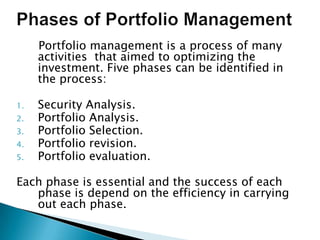
Portfolio management is a process of many
     activities that aimed to optimizing the
     investment. Five phases can be identified in
     the process:

1.   Security Analysis.
2.   Portfolio Analysis.
3.   Portfolio Selection.
4.   Portfolio revision.
5.   Portfolio evaluation.

Each phase is essential and the success of each
   phase is depend on the efficiency in carrying
   out each phase.
   Security analysis is the initial phase of the
    portfolio management process.

   The basic approach for investing in securities
    is to sell the overpriced securities and
    purchase under priced securities

   The security analysis comprises of
    Fundamental Analysis and technical Analysis.
   A large number of portfolios can be created
    by using the securities from desired set of
    securities obtained from initial phase of
    security analysis.

   . It involves the mathematically calculation
    of return and risk of each portfolio.
   The portfolios that yield good returns at
    a level of risk are called as efficient
    portfolios.

   The set of efficient portfolios is formed
    and from this set of efficient portfolios,
    the optimal portfolio is chosen for
    investment.
   Due to dynamic changes in the economy
    and financial markets, the attractive
    securities may cease to provide profitable
    returns.
   This phase involves the regular analysis
    and assessment of portfolio performances
    in terms of risk and returns over a period
    of time.
   SECURITY ANALYSIS: Classification of securities( shares, debentures,
    bonds etc..), examining the risk-return characteristics of individual
    securities, fundamental and technical analysis.

   PORTFOLIO ANALYSIS: Identification of range of possible portfolio
    from a different set and ascertaining risk and return.

   PORTFOLIO SELECTION: Efficient portfolio is identified and optimal
    portfolio is selected.

   PORTFOLIO REVISION: Addition or deletion of securities due to
    change in availability of additional funds, change in risk, need for
    cash etc.

   PORTFOLIO EVALUATION : Comparison of objective norms with
    relative performance. Provides feedback mechanism for improving
    the entire portfolio management process.

Portfolio mangement

  • 1.
    Presented by, Morteza.A 2nd sem of M.F.M Mysore University
  • 3.
    1. Portfolio is a group of financial assets such as shares, stocks, bonds, debt instruments, mutual funds, cash equivalents, etc. A portfolio is planned to stabilize the risk of non-performance of various pools of investment.  Portfolio refers to invest in a group of securities rather to invest in a single security.  “Don’t Put all your eggs in one basket”  Portfolio help in reducing risk without sacrificing return.
  • 4.
    Management is the organization and coordination of the activities of an enterprise in accordance with well- defined policies and in achievement of its pre-defined objectives.
  • 5.
    Portfolio Management is the process of creation and maintenance of investment portfolio.  Portfolio management is a complex process which tries to make investment activity more rewarding and less risky.
  • 6.
    Portfolio management isa process of many activities that aimed to optimizing the investment. Five phases can be identified in the process: 1. Security Analysis. 2. Portfolio Analysis. 3. Portfolio Selection. 4. Portfolio revision. 5. Portfolio evaluation. Each phase is essential and the success of each phase is depend on the efficiency in carrying out each phase.
  • 7.
    Security analysis is the initial phase of the portfolio management process.  The basic approach for investing in securities is to sell the overpriced securities and purchase under priced securities  The security analysis comprises of Fundamental Analysis and technical Analysis.
  • 8.
    A large number of portfolios can be created by using the securities from desired set of securities obtained from initial phase of security analysis.  . It involves the mathematically calculation of return and risk of each portfolio.
  • 9.
    The portfolios that yield good returns at a level of risk are called as efficient portfolios.  The set of efficient portfolios is formed and from this set of efficient portfolios, the optimal portfolio is chosen for investment.
  • 10.
    Due to dynamic changes in the economy and financial markets, the attractive securities may cease to provide profitable returns.
  • 11.
    This phase involves the regular analysis and assessment of portfolio performances in terms of risk and returns over a period of time.
  • 12.
    SECURITY ANALYSIS: Classification of securities( shares, debentures, bonds etc..), examining the risk-return characteristics of individual securities, fundamental and technical analysis.  PORTFOLIO ANALYSIS: Identification of range of possible portfolio from a different set and ascertaining risk and return.  PORTFOLIO SELECTION: Efficient portfolio is identified and optimal portfolio is selected.  PORTFOLIO REVISION: Addition or deletion of securities due to change in availability of additional funds, change in risk, need for cash etc.  PORTFOLIO EVALUATION : Comparison of objective norms with relative performance. Provides feedback mechanism for improving the entire portfolio management process.