Understanding of Investment
&
Speculation
Investment Definitions
• Investment: An investment is the current
commitment of money or other resources in
the expectation of reaping future benefits.
(Kane, Bodie and Marcus 2005)
Speculation: Act of trading in an asset, or
conducting transaction, that has significant
risk of losing most or all of initial outlay, in
expectation of substantial gain.
Speculation Definitions
Definitions
Generally, “investments” refers to financial
assets and in particular to marketable securities.
ď‚—Financial assets are paper or electronic claims
on some issuer, such as the government or a
company.
ď‚—Marketable securities financial assets that are
easily and cheaply tradable in organized markets
ď‚—Real assets are tangible assets such as gold,
silver, diamonds, real estate.
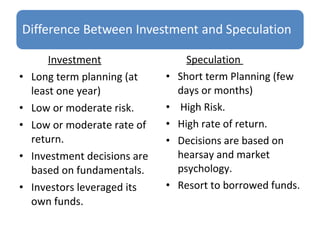
Investment
• Long term planning (at
least one year)
• Low or moderate risk.
• Low or moderate rate of
return.
• Investment decisions are
based on fundamentals.
• Investors leveraged its
own funds.
Speculation
• Short term Planning (few
days or months)
• High Risk.
• High rate of return.
• Decisions are based on
hearsay and market
psychology.
• Resort to borrowed funds.
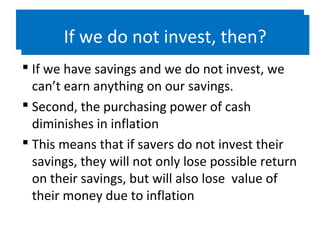
If we do not invest, then?
ď‚§ If we have savings and we do not invest, we
can’t earn anything on our savings.
ď‚§ Second, the purchasing power of cash
diminishes in inflation
ď‚§ This means that if savers do not invest their
savings, they will not only lose possible return
on their savings, but will also lose value of
their money due to inflation
If we do not invest, then?
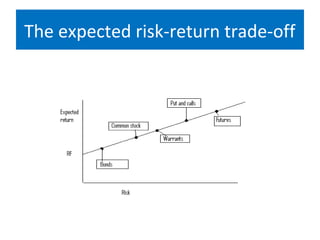
The expected risk-return trade-off
Steps in the decision process
• Traditionally, the investment decision process
has been structured using two-steps:
– Security analysis
– Portfolio management
Security Analysis
ď‚—Security analysis: this is the first part of
investment decision process
ď‚—It involves the analysis and valuation of
individual securities
ď‚—To analyze securities, it is important to
understand the characteristics of the various
securities and the factors that affect them
ď‚—Then valuation model is applied to find out
their value or price
Security Analysis
ď‚—Value of a security is a function of estimated
future earnings from the security and the risk
attached
ď‚—For securities valuation, investors must deal
with economy, industry or the individual
company
ď‚—Both the expected return and risk must be
estimated keeping in view the economic,
market or company related factors
Portfolio Management
ď‚—The second major component of the decision
processes is portfolio management
ď‚—After securities have been analyzed and
valued, portfolio of selected securities is made
ď‚—Once a portfolio is made, it is managed with
the passage of time
ď‚—For management, there can be two
approaches
Portfolio Management
ď‚—Approaches to portfolio management:
â—¦ A. Passive investment strategy
â—¦ B. Active investment strategy
In Passive Strategy, investors make few changes in
the portfolio so that transactions costs, time and
search costs are minimum
In Active Strategy, investors believe that they can
earn better returns by actively making changes in
the portfolio

Investment and speculation

  • 1.
  • 2.
    Investment Definitions • Investment:An investment is the current commitment of money or other resources in the expectation of reaping future benefits. (Kane, Bodie and Marcus 2005)
  • 3.
    Speculation: Act oftrading in an asset, or conducting transaction, that has significant risk of losing most or all of initial outlay, in expectation of substantial gain. Speculation Definitions
  • 4.
    Definitions Generally, “investments” refersto financial assets and in particular to marketable securities. Financial assets are paper or electronic claims on some issuer, such as the government or a company. Marketable securities financial assets that are easily and cheaply tradable in organized markets Real assets are tangible assets such as gold, silver, diamonds, real estate.
  • 5.
    Investment • Long termplanning (at least one year) • Low or moderate risk. • Low or moderate rate of return. • Investment decisions are based on fundamentals. • Investors leveraged its own funds. Speculation • Short term Planning (few days or months) • High Risk. • High rate of return. • Decisions are based on hearsay and market psychology. • Resort to borrowed funds.
  • 6.
    If we donot invest, then?  If we have savings and we do not invest, we can’t earn anything on our savings.  Second, the purchasing power of cash diminishes in inflation  This means that if savers do not invest their savings, they will not only lose possible return on their savings, but will also lose value of their money due to inflation If we do not invest, then?
  • 7.
  • 8.
    Steps in thedecision process • Traditionally, the investment decision process has been structured using two-steps: – Security analysis – Portfolio management
  • 9.
    Security Analysis ď‚—Security analysis:this is the first part of investment decision process ď‚—It involves the analysis and valuation of individual securities ď‚—To analyze securities, it is important to understand the characteristics of the various securities and the factors that affect them ď‚—Then valuation model is applied to find out their value or price
  • 10.
    Security Analysis ď‚—Value ofa security is a function of estimated future earnings from the security and the risk attached ď‚—For securities valuation, investors must deal with economy, industry or the individual company ď‚—Both the expected return and risk must be estimated keeping in view the economic, market or company related factors
  • 11.
    Portfolio Management ď‚—The secondmajor component of the decision processes is portfolio management ď‚—After securities have been analyzed and valued, portfolio of selected securities is made ď‚—Once a portfolio is made, it is managed with the passage of time ď‚—For management, there can be two approaches
  • 12.
    Portfolio Management ď‚—Approaches toportfolio management: â—¦ A. Passive investment strategy â—¦ B. Active investment strategy In Passive Strategy, investors make few changes in the portfolio so that transactions costs, time and search costs are minimum In Active Strategy, investors believe that they can earn better returns by actively making changes in the portfolio