Module 4 : Investment Avenues
Mutual funds, Investor life cycle, Personal investment, Personal
Finance, Portfolio Management of funds in banks, insurance
companies, pension funds, International investing, international
funds management, emerging opportunities.

Module 1: Introduction to portfolio Management
Meaning of portfolio management, portfolio analysis, why
portfolios, Portfolio objectives, portfolio management process,
selection of securities.
Module II


 Mohammed Umair: Dept of Commerce- Kristu Jayanti College
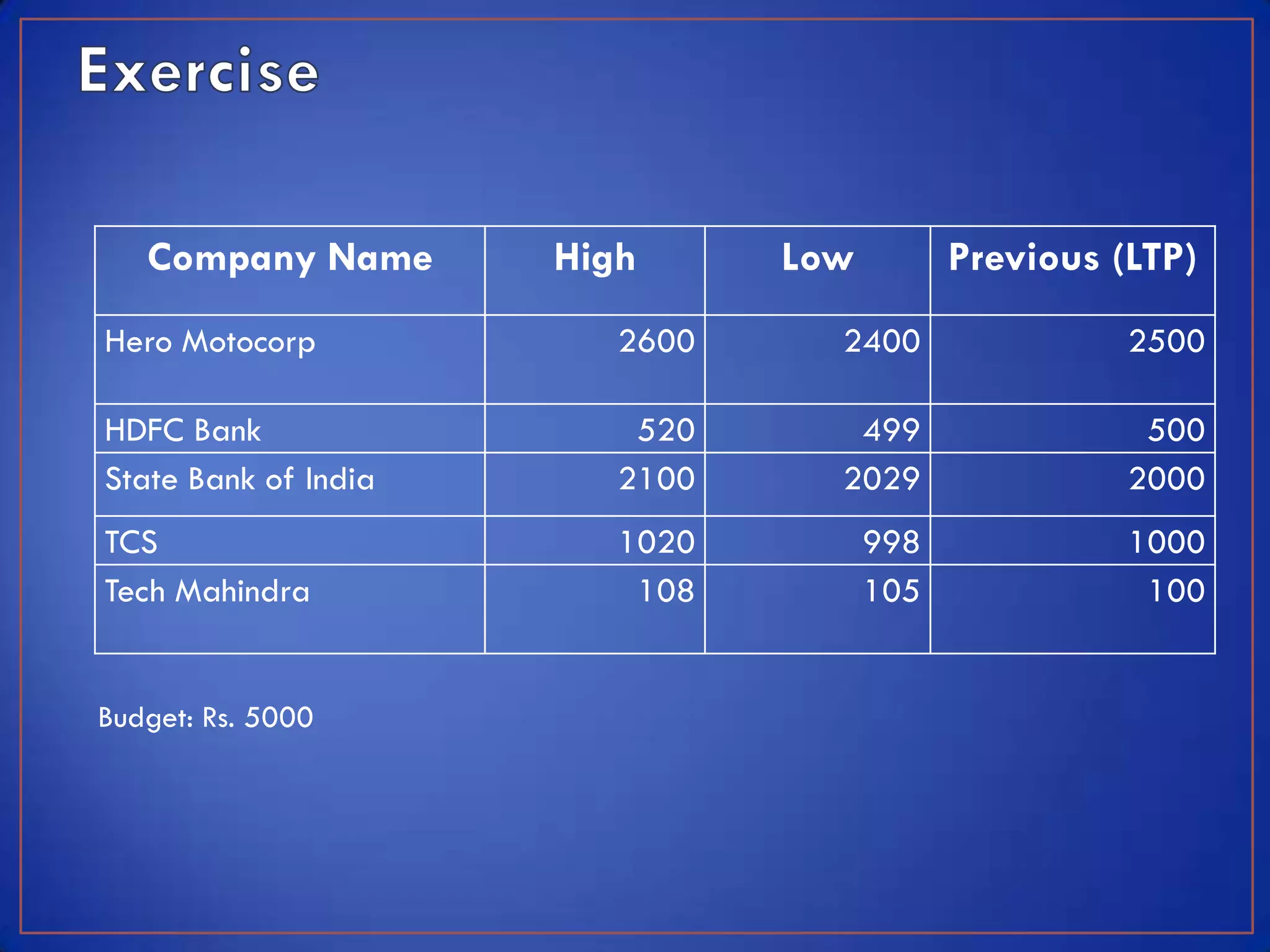
Company Name       High      Low         Previous (LTP)
Hero Motocorp            2600     2400                2500

HDFC Bank                 520      499                 500
State Bank of India      2100     2029                2000
TCS                      1020         998             1000
Tech Mahindra             108         105              100


Budget: Rs. 5000
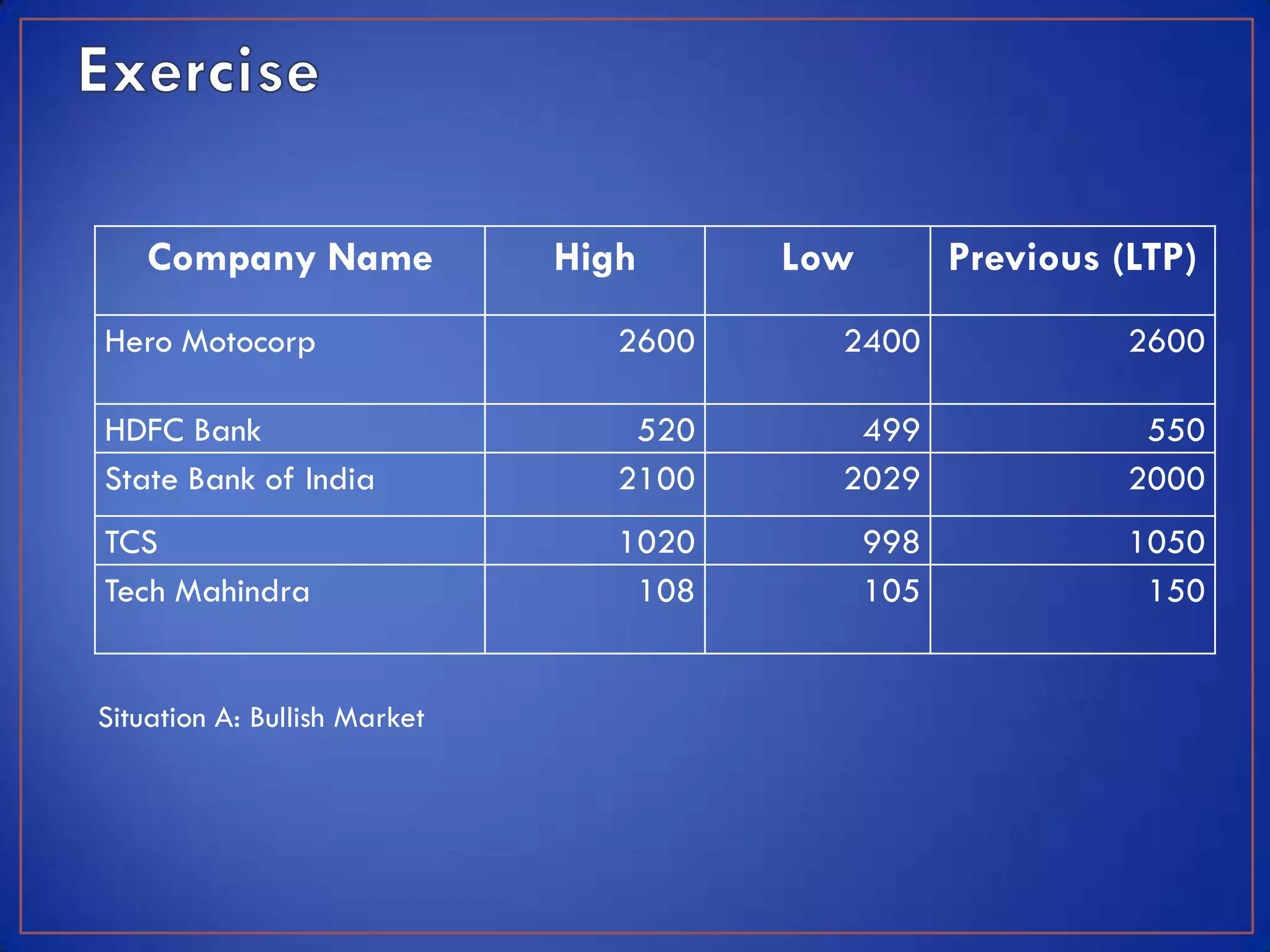
Company Name              High      Low         Previous (LTP)
Hero Motocorp                    2600     2400                2600

HDFC Bank                         520      499                 550
State Bank of India              2100     2029                2000
TCS                              1020         998             1050
Tech Mahindra                     108         105              150


Situation A: Bullish Market
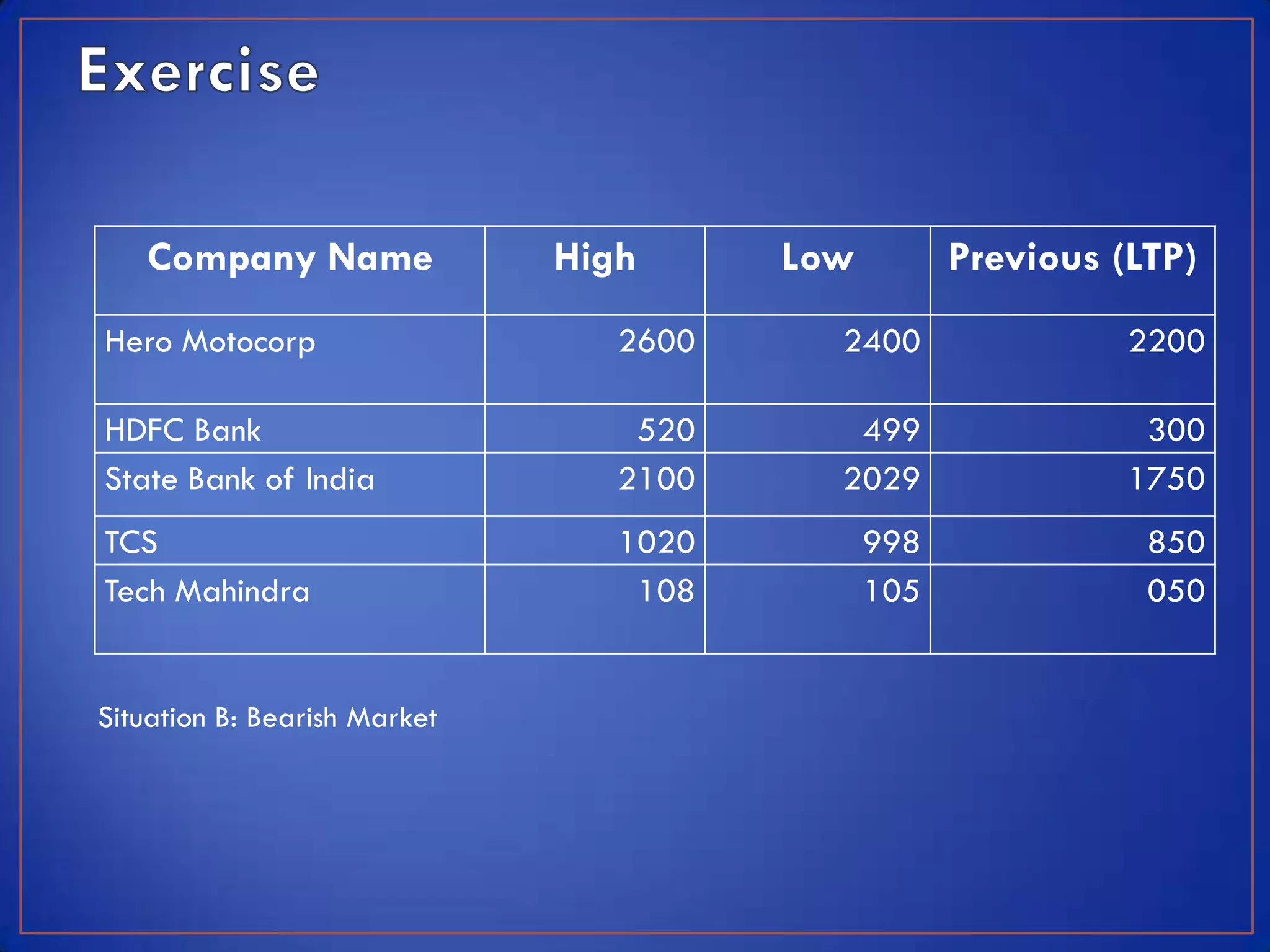
Company Name               High      Low         Previous (LTP)
Hero Motocorp                    2600     2400                2200

HDFC Bank                         520      499                 300
State Bank of India              2100     2029                1750
TCS                              1020         998              850
Tech Mahindra                     108         105              050


Situation B: Bearish Market
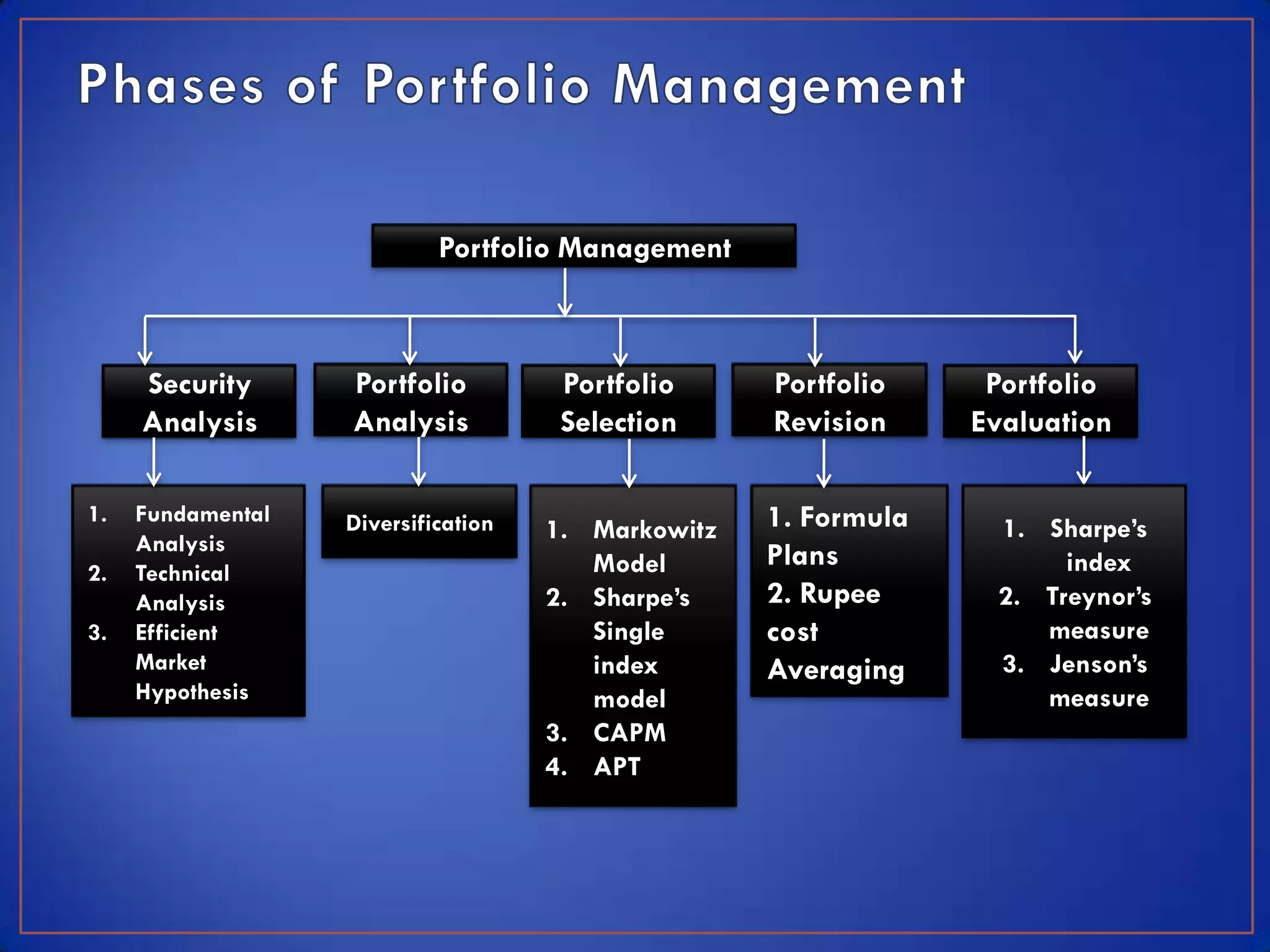
Portfolio Management


     Security      Portfolio          Portfolio     Portfolio     Portfolio
     Analysis      Analysis           Selection     Revision     Evaluation

1.   Fundamental   Diversification   1. Markowitz   1. Formula    1. Sharpe’s
     Analysis
                                        Model       Plans              index
2.   Technical
     Analysis                        2. Sharpe’s    2. Rupee      2. Treynor’s
3.   Efficient                          Single      cost             measure
     Market                             index       Averaging     3. Jenson’s
     Hypothesis                         model                        measure
                                     3. CAPM
                                     4. APT
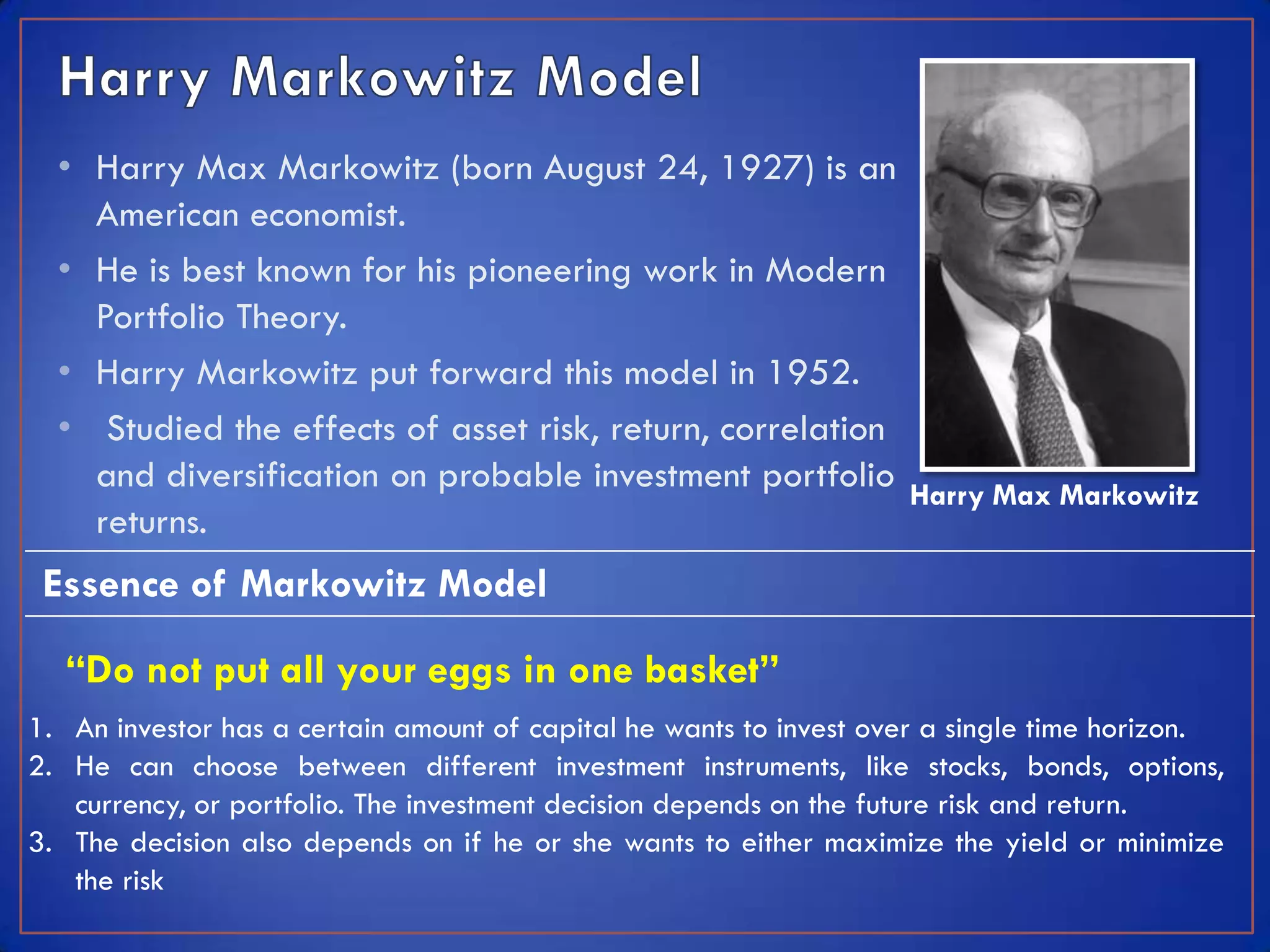
• Harry Max Markowitz (born August 24, 1927) is an
    American economist.
  • He is best known for his pioneering work in Modern
    Portfolio Theory.
  • Harry Markowitz put forward this model in 1952.
  • Studied the effects of asset risk, return, correlation
    and diversification on probable investment portfolio Harry Max Markowitz
    returns.
 Essence of Markowitz Model

  “Do not put all your eggs in one basket”
1. An investor has a certain amount of capital he wants to invest over a single time horizon.
2. He can choose between different investment instruments, like stocks, bonds, options,
   currency, or portfolio. The investment decision depends on the future risk and return.
3. The decision also depends on if he or she wants to either maximize the yield or minimize
   the risk
Essence of Markowitz Model
1. Markowitz model assists in the selection of the most efficient by analysing various
   possible portfolios of the given securities.
2. By choosing securities that do not 'move' exactly together, the HM model shows
   investors how to reduce their risk.
3. The HM model is also called Mean-Variance Model due to the fact that it is based on
   expected returns (mean) and the standard deviation (variance) of the various
   portfolios.

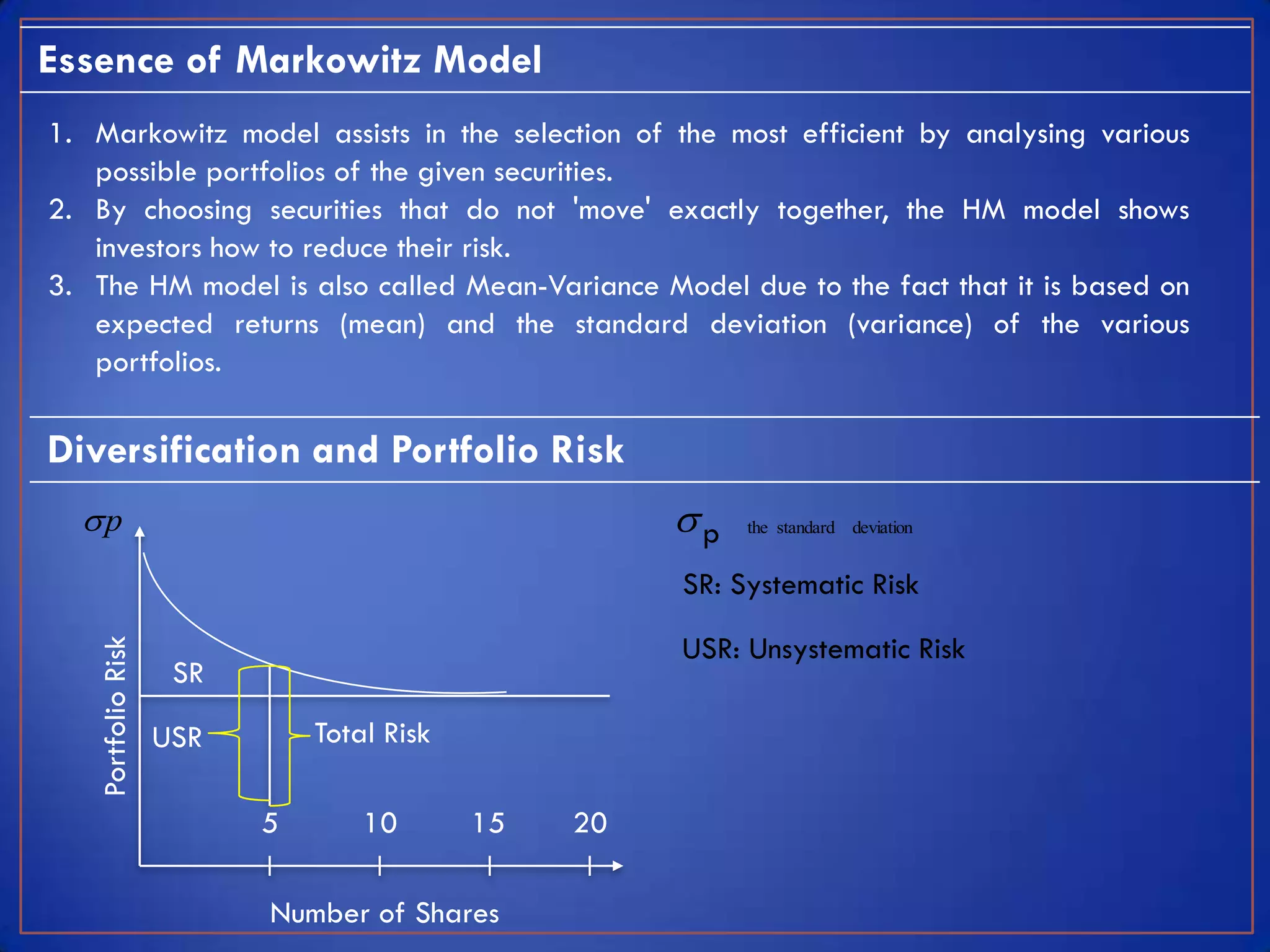
Diversification and Portfolio Risk
  p                                                 p   the standard deviation


                                                     SR: Systematic Risk

                                                     USR: Unsystematic Risk
   Portfolio Risk


                     SR

                    USR       Total Risk

                          5       10       15   20

                          Number of Shares
• An investor has a certain amount of capital he wants to invest
  over a single time horizon.
• He can choose between different investment instruments, like
  stocks, bonds, options, currency, or portfolio.
• The investment decision depends on the future risk and return.
• The decision also depends on if he or she wants to either
  maximize the yield or minimize the risk.
• The investor is only willing to accept a higher risk if he or she
  gets a higher expected return.
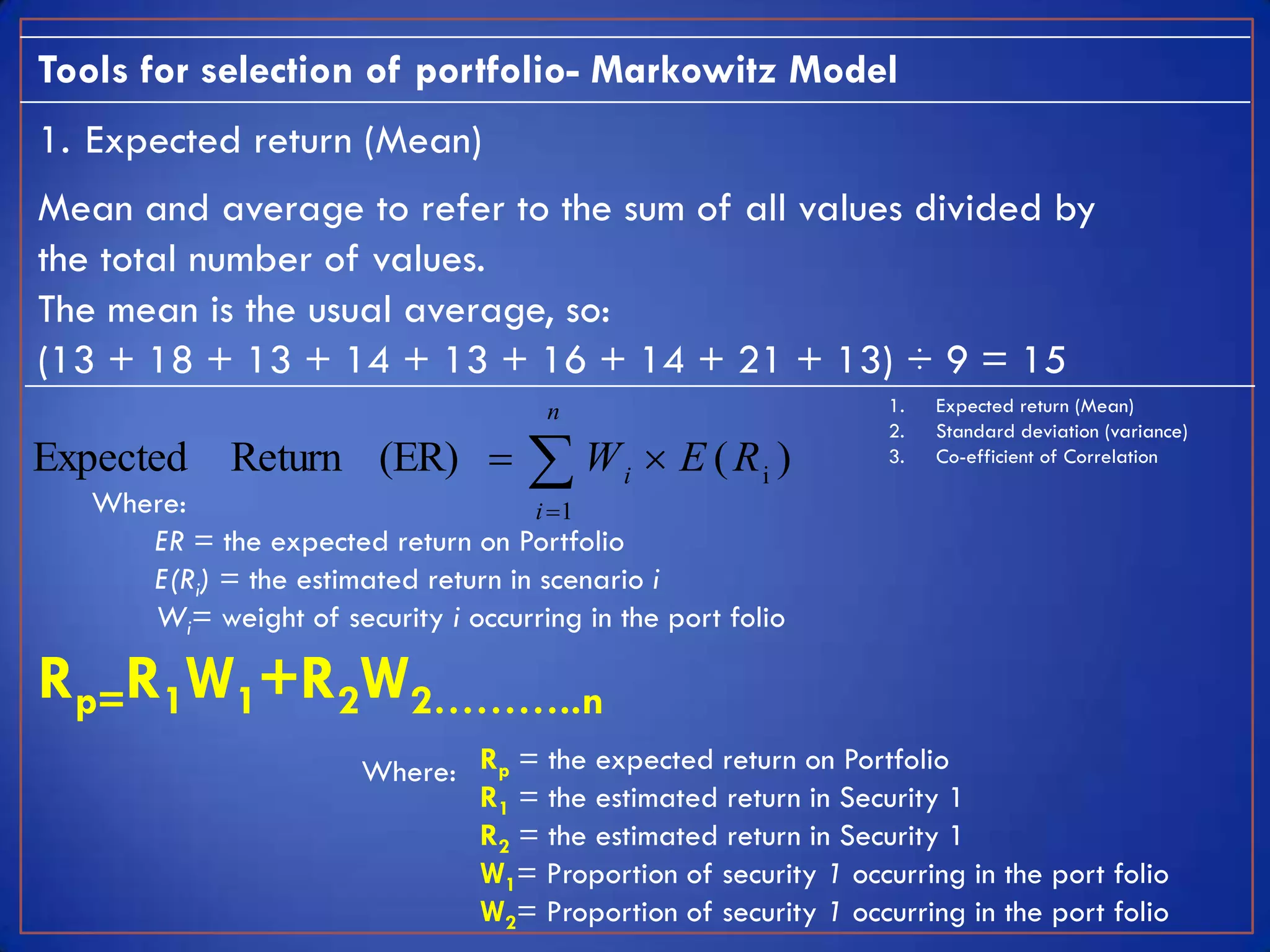
Tools for selection of portfolio- Markowitz Model
1. Expected return (Mean)
Mean and average to refer to the sum of all values divided by
the total number of values.
The mean is the usual average, so:
(13 + 18 + 13 + 14 + 13 + 16 + 14 + 21 + 13) ÷ 9 = 15
                                       n                         1.   Expected return (Mean)


                                     W
                                                                 2.   Standard deviation (variance)
Expected      Return (ER)                   i
                                                  E ( Ri )      3.   Co-efficient of Correlation

   Where:                            i 1
      ER = the expected return on Portfolio
      E(Ri) = the estimated return in scenario i
      Wi= weight of security i occurring in the port folio

Rp=R1W1+R2W2………..n
                        Where: Rp = the expected return on Portfolio
                               R1 = the estimated return in Security 1
                               R2 = the estimated return in Security 1
                               W1= Proportion of security 1 occurring in the port folio
                               W2= Proportion of security 1 occurring in the port folio
Tools for selection of portfolio- Markowitz Model
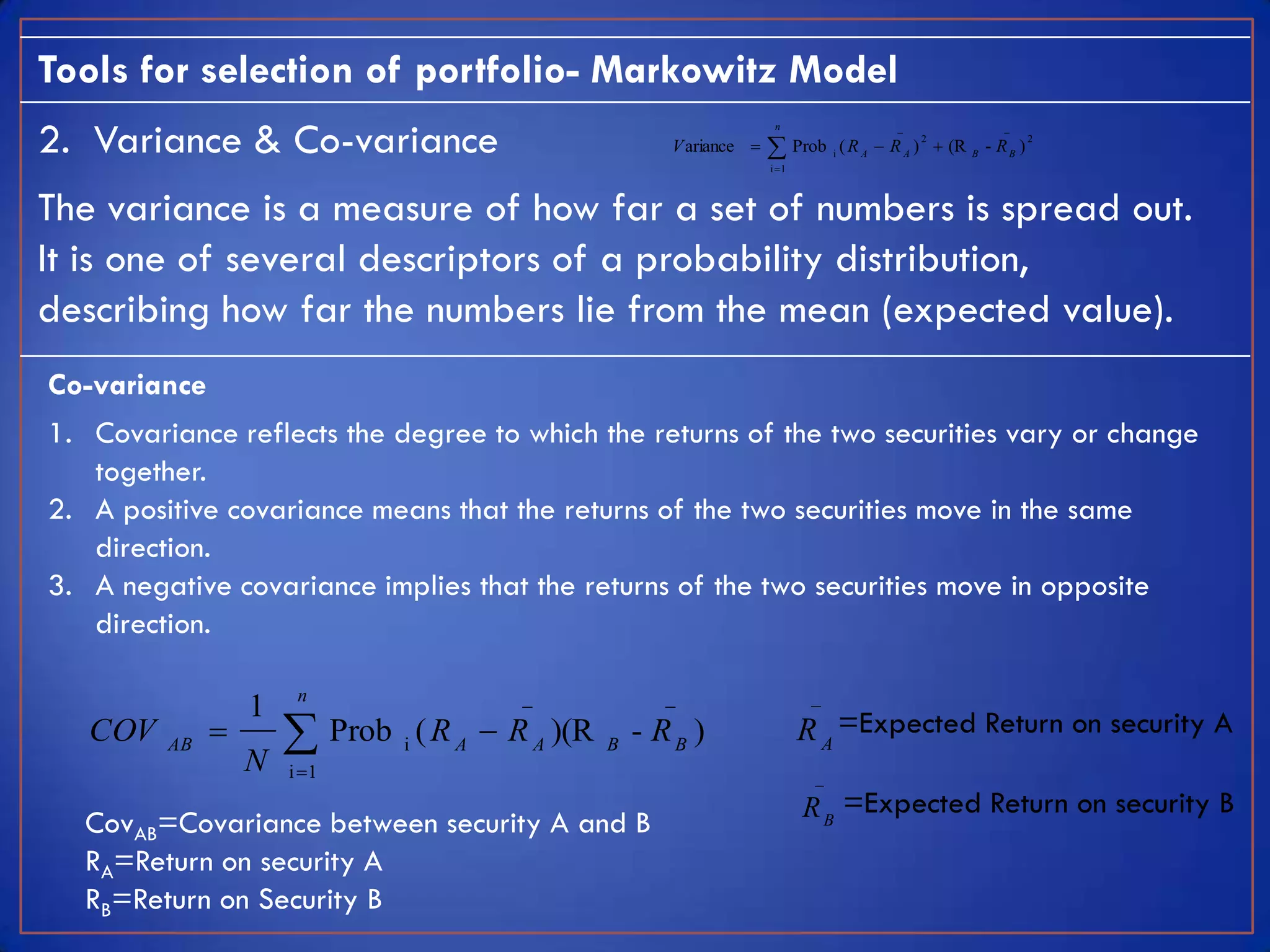
2. Variance & Co-variance
                                                                           n                    _                  _
                                                            V ariance          Prob i ( R A  R A )  (R
                                                                                                    2                     2
                                                                                                             B
                                                                                                                 - RB )
                                                                          i 1


The variance is a measure of how far a set of numbers is spread out.
It is one of several descriptors of a probability distribution,
describing how far the numbers lie from the mean (expected value).
Co-variance
1. Covariance reflects the degree to which the returns of the two securities vary or change
   together.
2. A positive covariance means that the returns of the two securities move in the same
   direction.
3. A negative covariance implies that the returns of the two securities move in opposite
   direction.

                       n                    _              _                       _
                  1
   COV   AB
              
                  N
                       Prob   i
                                   ( R A  R A )(R   B
                                                         - RB )                  R A =Expected Return on security A
                      i 1                                                          _
                                                                                  R B =Expected Return on security B
  CovAB=Covariance between security A and B
  RA=Return on security A
  RB=Return on Security B
Tools for selection of portfolio- Markowitz Model
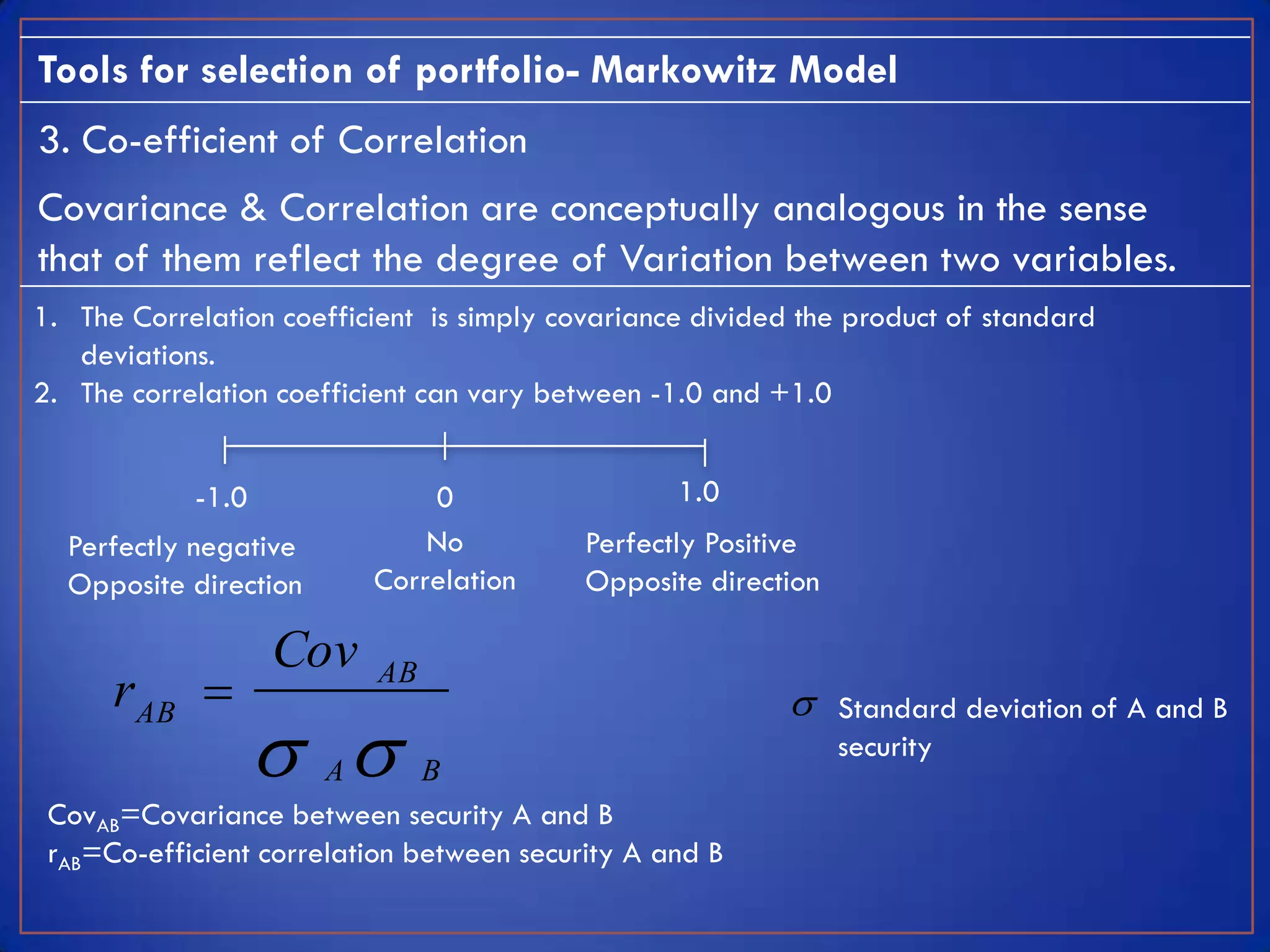
3. Co-efficient of Correlation
Covariance & Correlation are conceptually analogous in the sense
that of them reflect the degree of Variation between two variables.
1. The Correlation coefficient is simply covariance divided the product of standard
   deviations.
2. The correlation coefficient can vary between -1.0 and +1.0


            -1.0              0                   1.0
  Perfectly negative          No           Perfectly Positive
  Opposite direction      Correlation      Opposite direction

                   Cov
      r AB               AB
                                                               Standard deviation of A and B
                     A       B
                                                                security

 CovAB=Covariance between security A and B
 rAB=Co-efficient correlation between security A and B
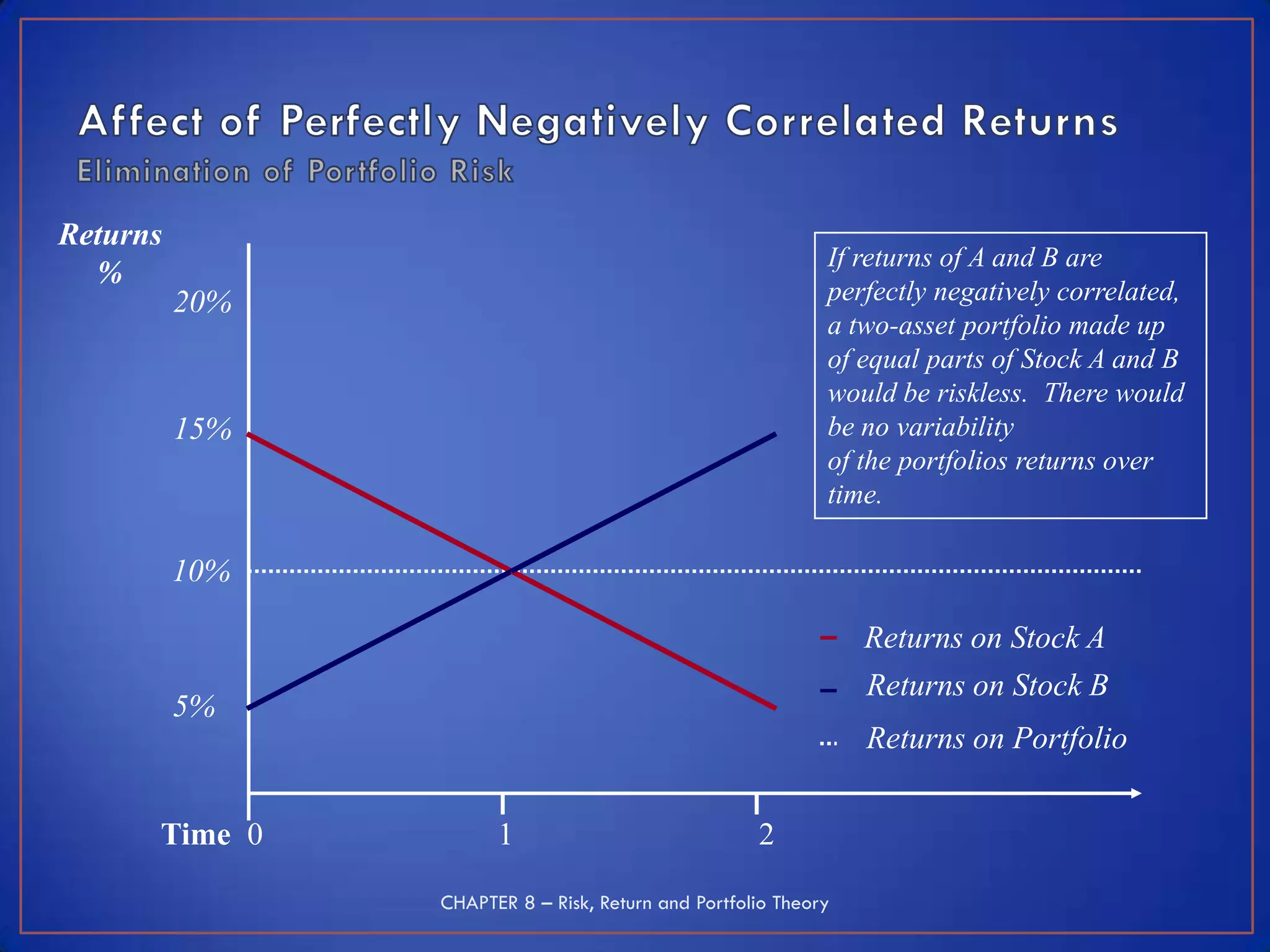
Returns
                                                            If returns of A and B are
  %
          20%                                               perfectly negatively correlated,
                                                            a two-asset portfolio made up
                                                            of equal parts of Stock A and B
                                                            would be riskless. There would
          15%                                               be no variability
                                                            of the portfolios returns over
                                                            time.

          10%

                                                                Returns on Stock A
                                                                Returns on Stock B
          5%
                                                                Returns on Portfolio


      Time 0          1                             2

                CHAPTER 8 – Risk, Return and Portfolio Theory
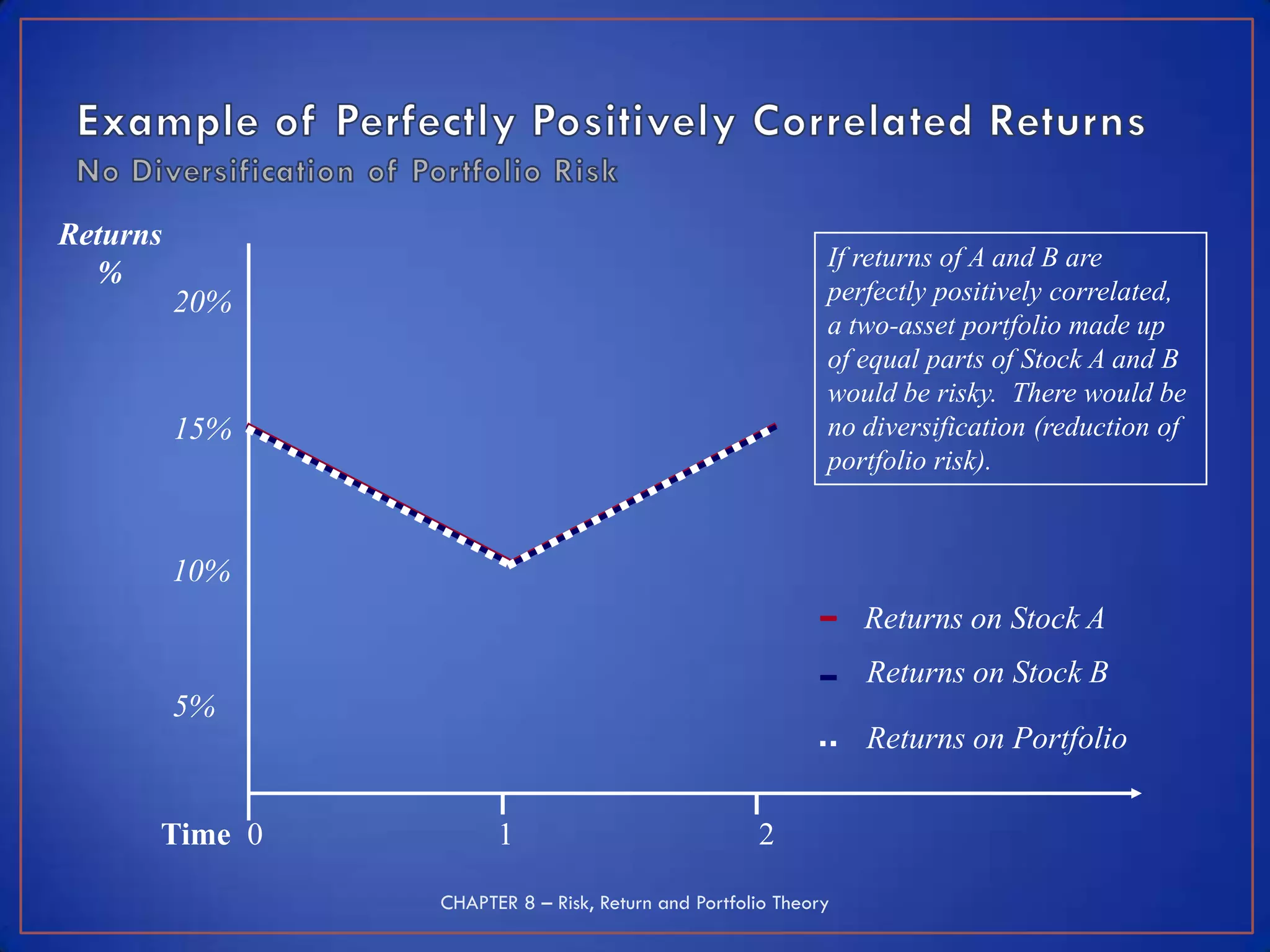
Returns
                                                            If returns of A and B are
  %
          20%                                               perfectly positively correlated,
                                                            a two-asset portfolio made up
                                                            of equal parts of Stock A and B
                                                            would be risky. There would be
          15%                                               no diversification (reduction of
                                                            portfolio risk).


          10%
                                                                Returns on Stock A
                                                                Returns on Stock B
          5%
                                                                Returns on Portfolio


      Time 0          1                             2

                CHAPTER 8 – Risk, Return and Portfolio Theory
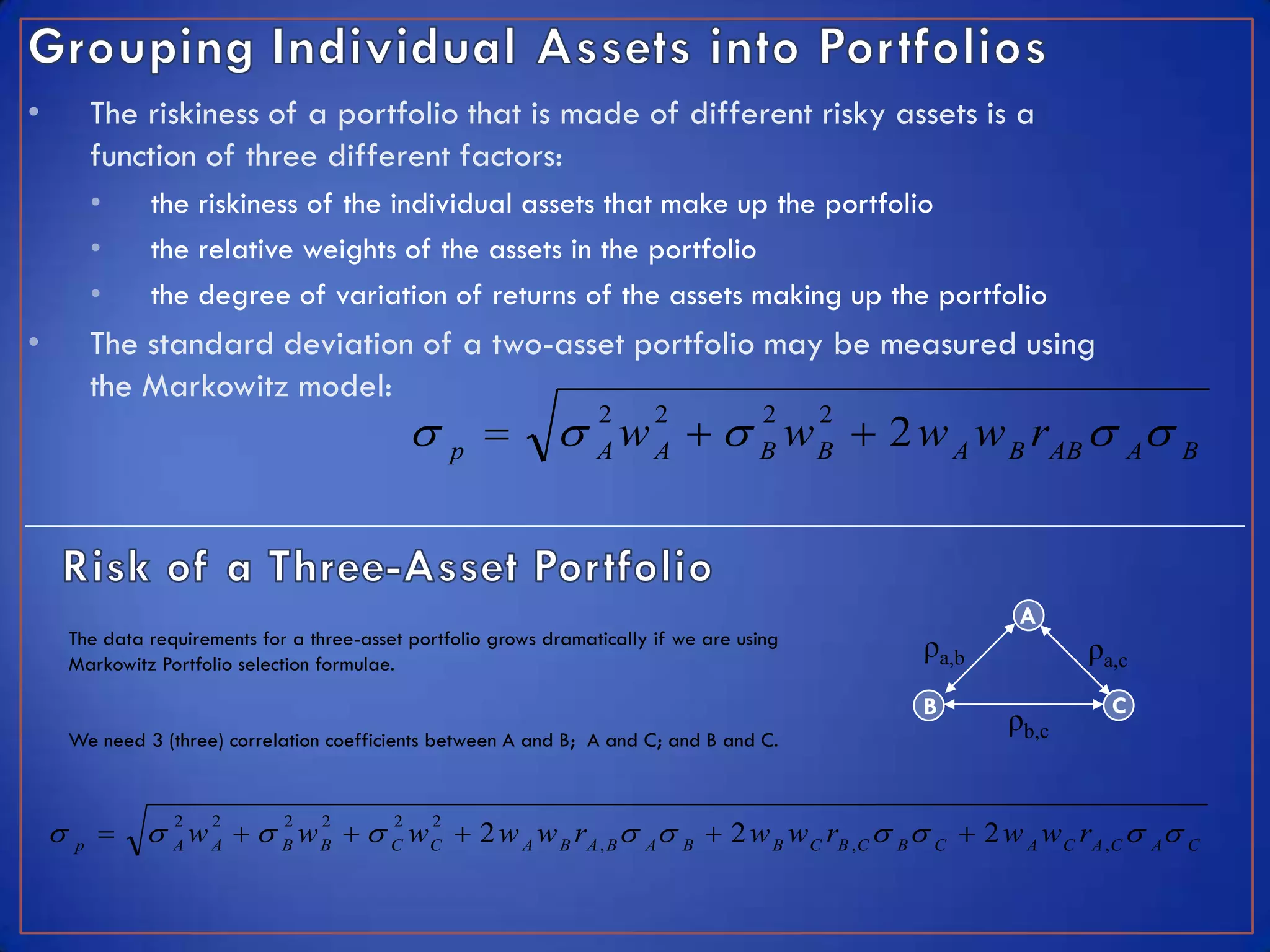
•           The riskiness of a portfolio that is made of different risky assets is a
            function of three different factors:
            •    the riskiness of the individual assets that make up the portfolio
            •    the relative weights of the assets in the portfolio
            •    the degree of variation of returns of the assets making up the portfolio
•           The standard deviation of a two-asset portfolio may be measured using
            the Markowitz model:
                                                                w   w  2 w A w B rAB  A B
                                                                      2      2           2     2
                                                       p              A      A           B     B


                                                                                                           A
        The data requirements for a three-asset portfolio grows dramatically if we are using
        Markowitz Portfolio selection formulae.
                                                                                                   ρa,b          ρa,c
                                                                                                   B               C
                                                                                                          ρb,c
        We need 3 (three) correlation coefficients between A and B; A and C; and B and C.


                A w A   B w B   C w C  2 w A w B rA , B  A B  2 w B w C rB , C  B  C  2 w A w C rA , C  A C
                    2   2        2   2        2    2
        p
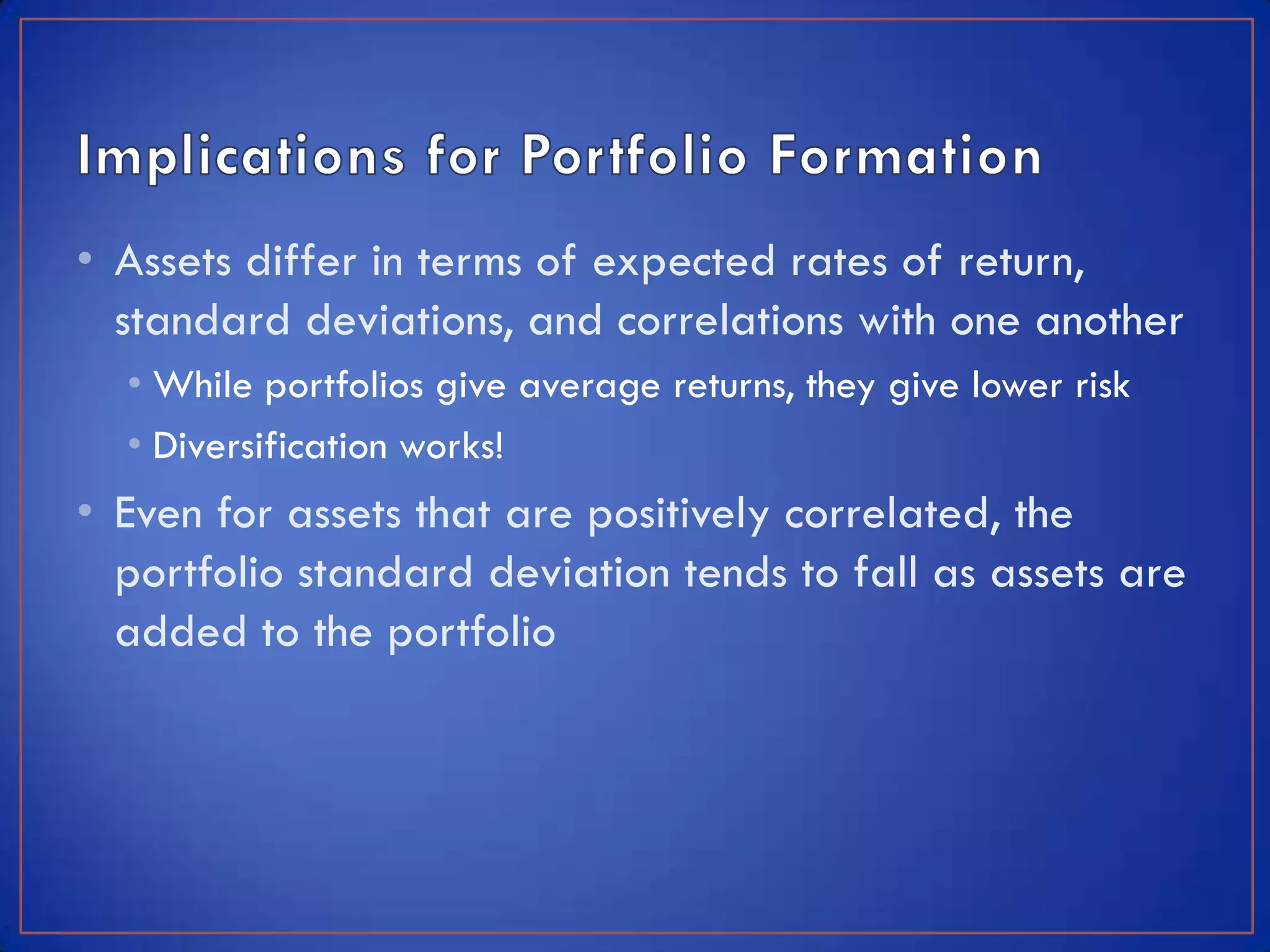
• Assets differ in terms of expected rates of return,
  standard deviations, and correlations with one another
  • While portfolios give average returns, they give lower risk
  • Diversification works!
• Even for assets that are positively correlated, the
  portfolio standard deviation tends to fall as assets are
  added to the portfolio
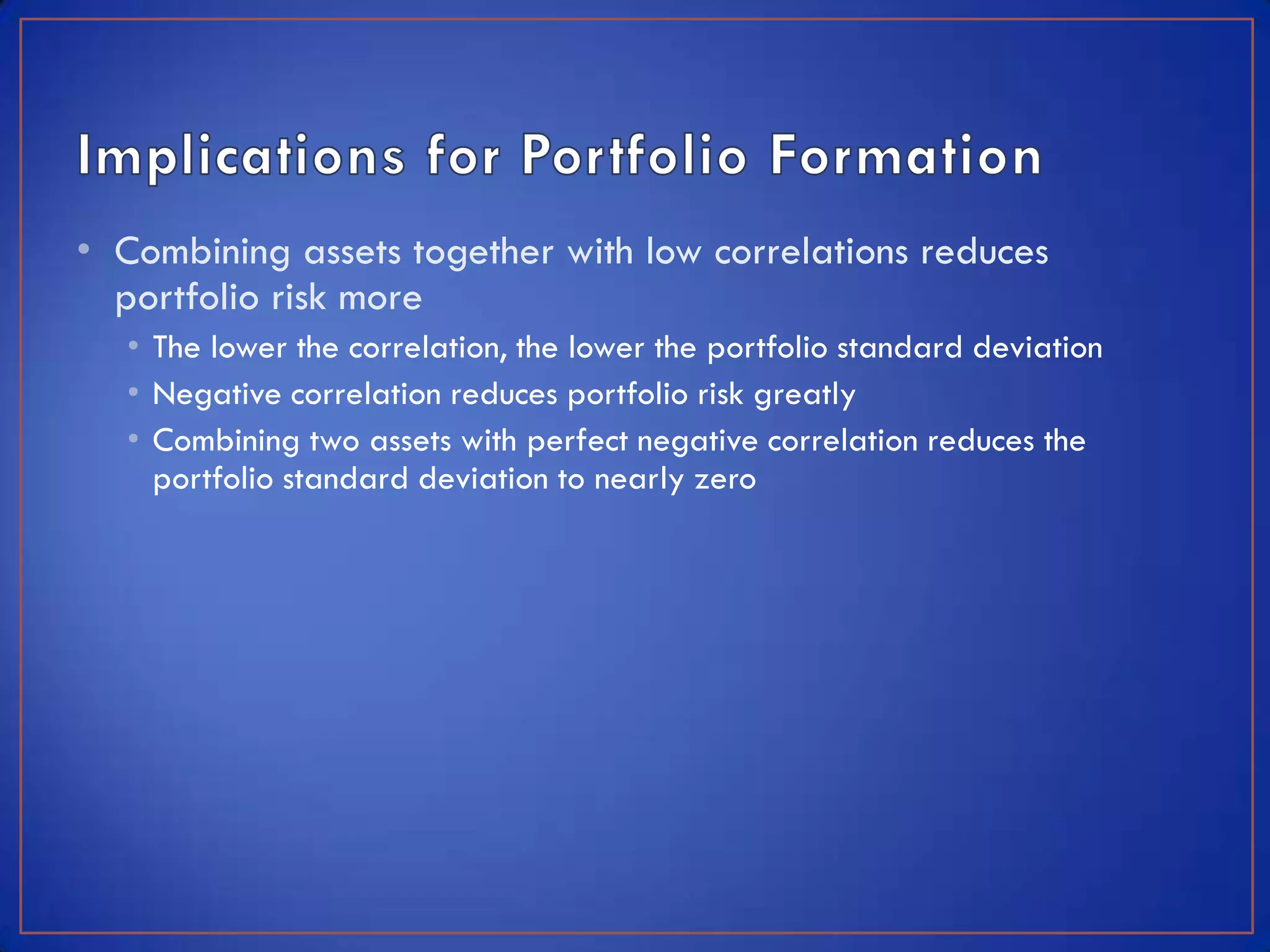
• Combining assets together with low correlations reduces
  portfolio risk more
  • The lower the correlation, the lower the portfolio standard deviation
  • Negative correlation reduces portfolio risk greatly
  • Combining two assets with perfect negative correlation reduces the
    portfolio standard deviation to nearly zero
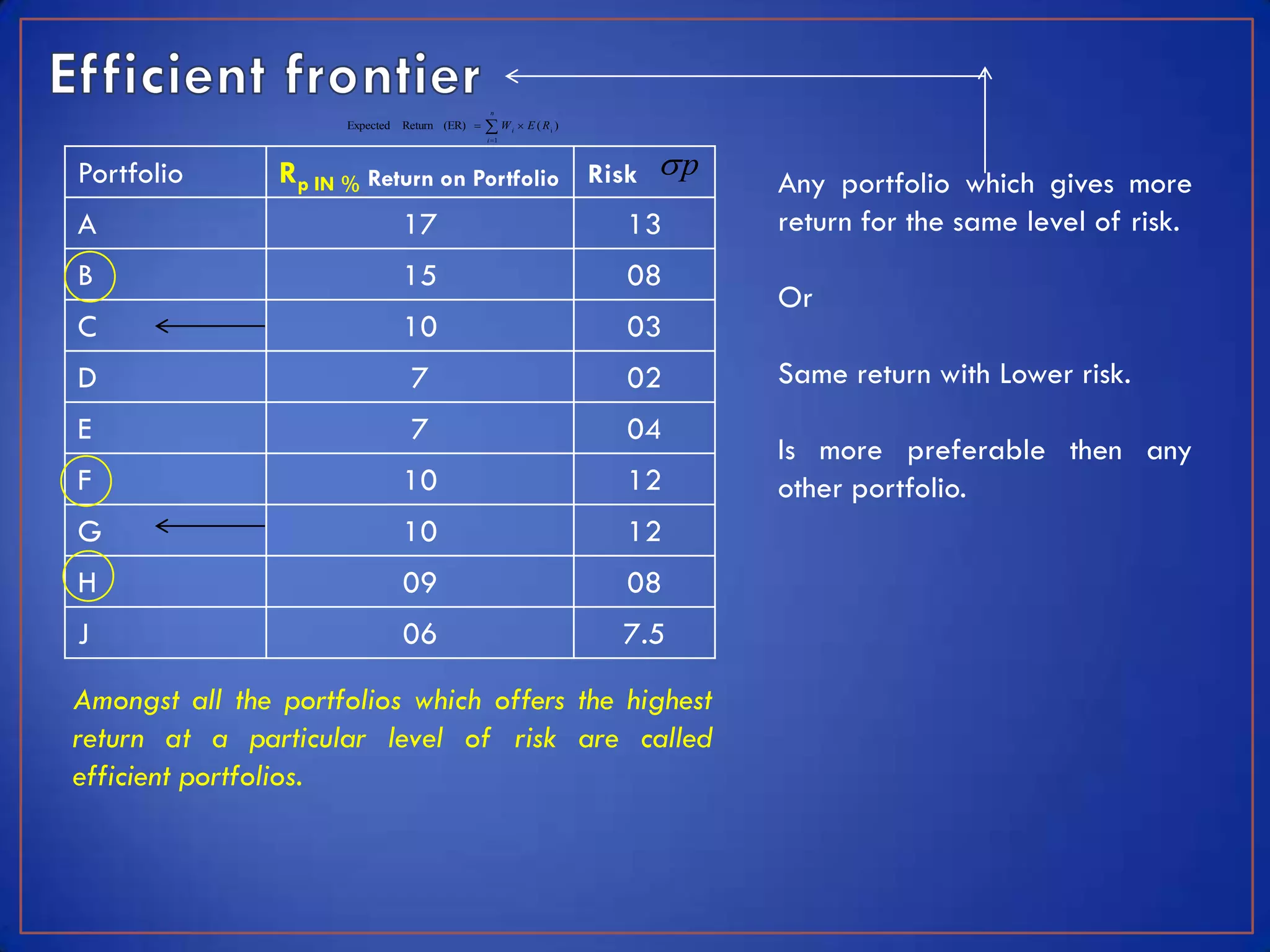
n

                     Expected   Return (ER)    W     i
                                                            E ( Ri )
                                                i 1


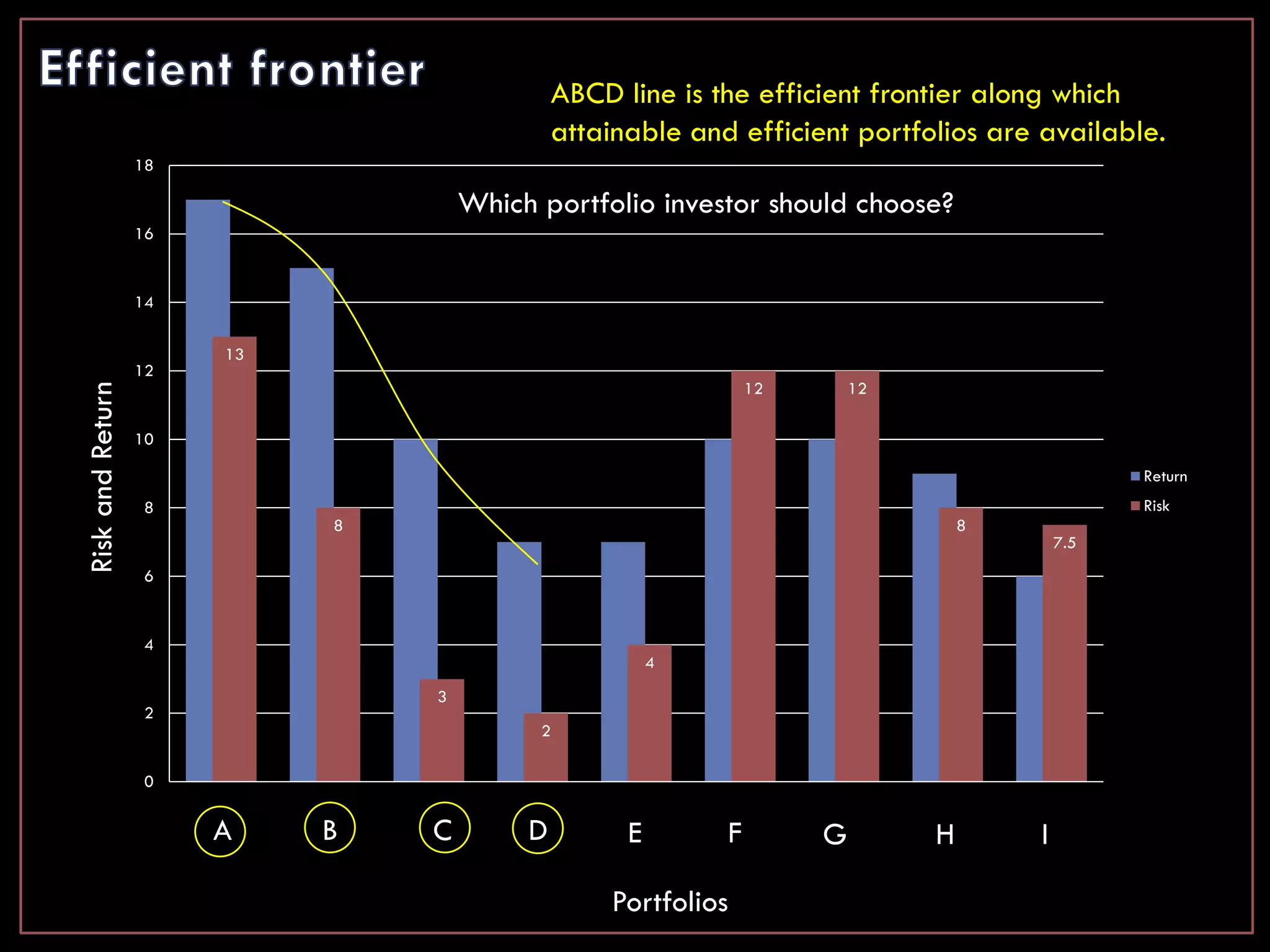
Portfolio       Rp IN % Return on Portfolio Risk  p                          Any portfolio which gives more
A                               17                                      13    return for the same level of risk.
B                               15                                      08
                                                                              Or
C                               10                                      03
D                                7                                      02    Same return with Lower risk.
E                                7                                      04
                                                                              Is more preferable then any
F                               10                                      12    other portfolio.
G                               10                                      12
H                               09                                      08
J                               06                                      7.5

Amongst all the portfolios which offers the highest
return at a particular level of risk are called
efficient portfolios.
ABCD line is the efficient frontier along which
                                             attainable and efficient portfolios are available.
                  18

                                    Which portfolio investor should choose?
                  16


                  14

                       13
                  12
                                                               12       12
Risk and Return


                  10

                                                                                               Return
                   8                                                                           Risk
                            8                                                    8
                                                                                         7.5
                   6


                   4
                                                       4
                                3
                   2
                                          2

                   0


                       A    B   C        D         E       F        G        H       I

                                                 Portfolios
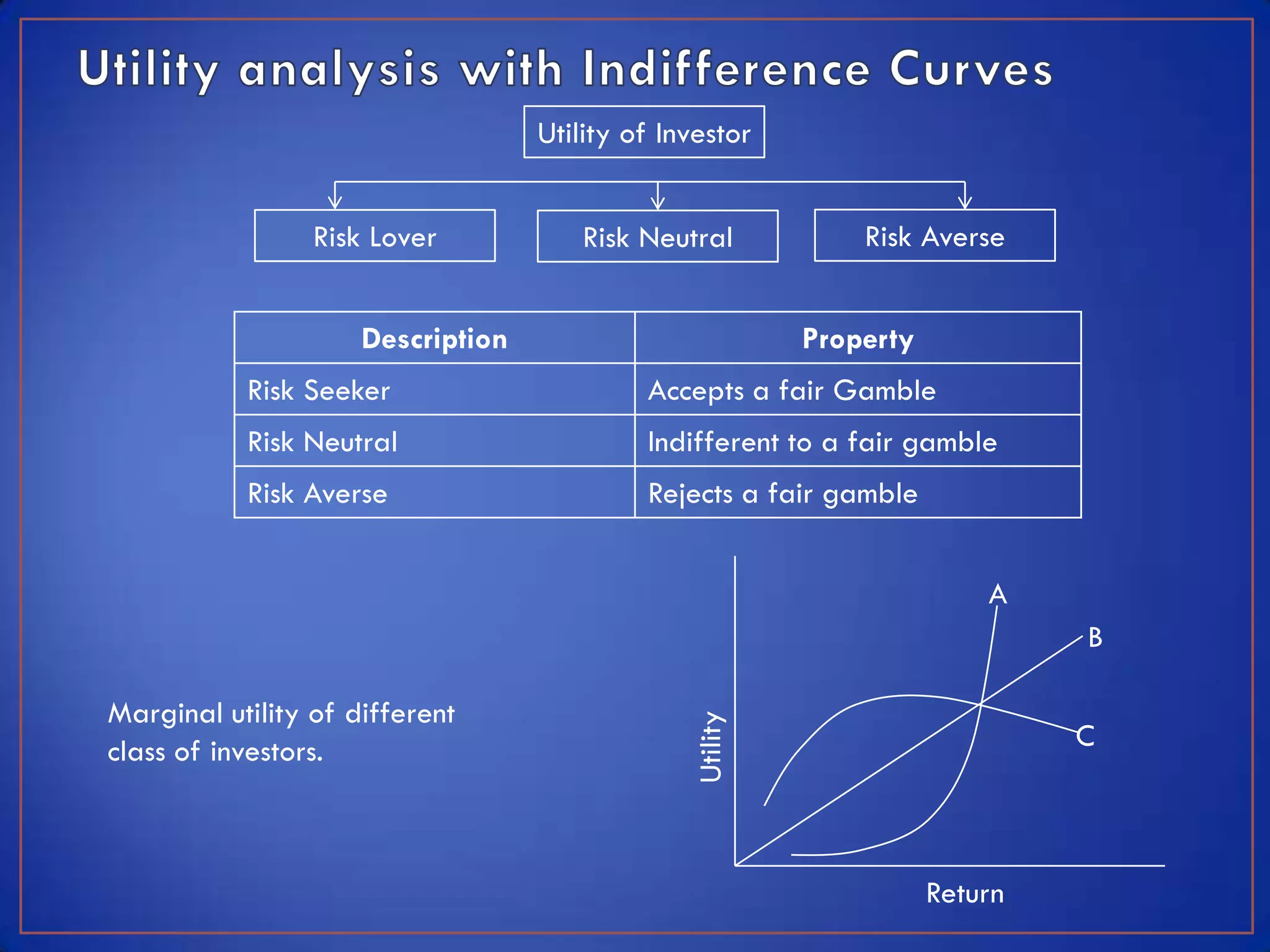
Utility of Investor


                 Risk Lover            Risk Neutral           Risk Averse


                     Description                          Property
           Risk Seeker                      Accepts a fair Gamble
           Risk Neutral                     Indifferent to a fair gamble
           Risk Averse                      Rejects a fair gamble


                                                                         A
                                                                              B

Marginal utility of different                   Utility
class of investors.                                                           C


                                                                     Return
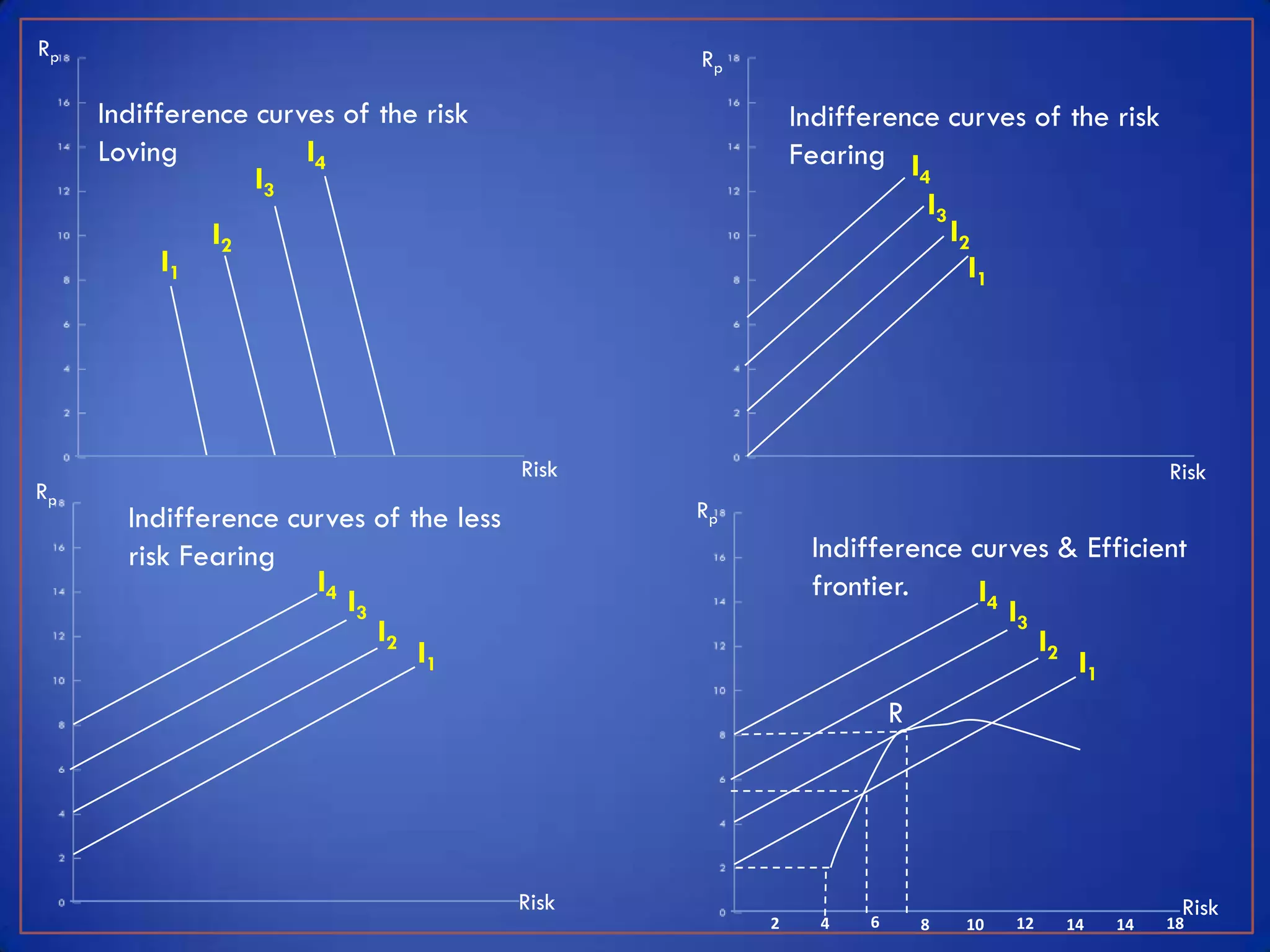
Rp                                              Rp

     Indifference curves of the risk                     Indifference curves of the risk
     Loving           I4                                 Fearing I
                  I3                                                   4
                                                                       I3
               I2                                                           I2
          I1                                                                  I1


                                         Risk                                                     Risk
Rp
       Indifference curves of the less          Rp
       risk Fearing                                       Indifference curves & Efficient
                      I4                                  frontier.     I4
                         I3                                                I3
                            I2                                                I2
                               I1                                                I1
                                                                   R


                                         Risk                                                      Risk
                                                     2     4   6       8     10    12   14   14   18
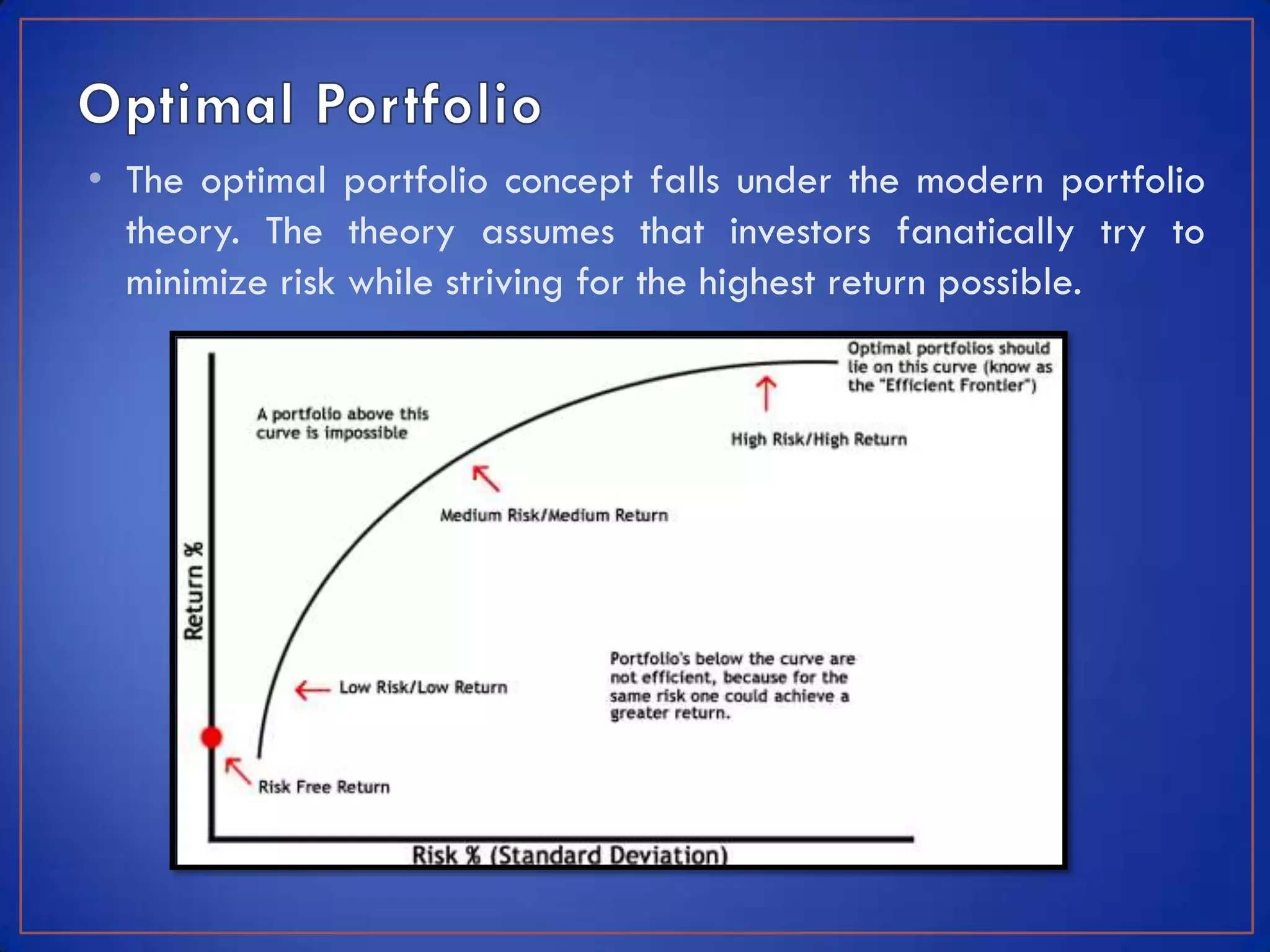
• The optimal portfolio concept falls under the modern portfolio
  theory. The theory assumes that investors fanatically try to
  minimize risk while striving for the highest return possible.
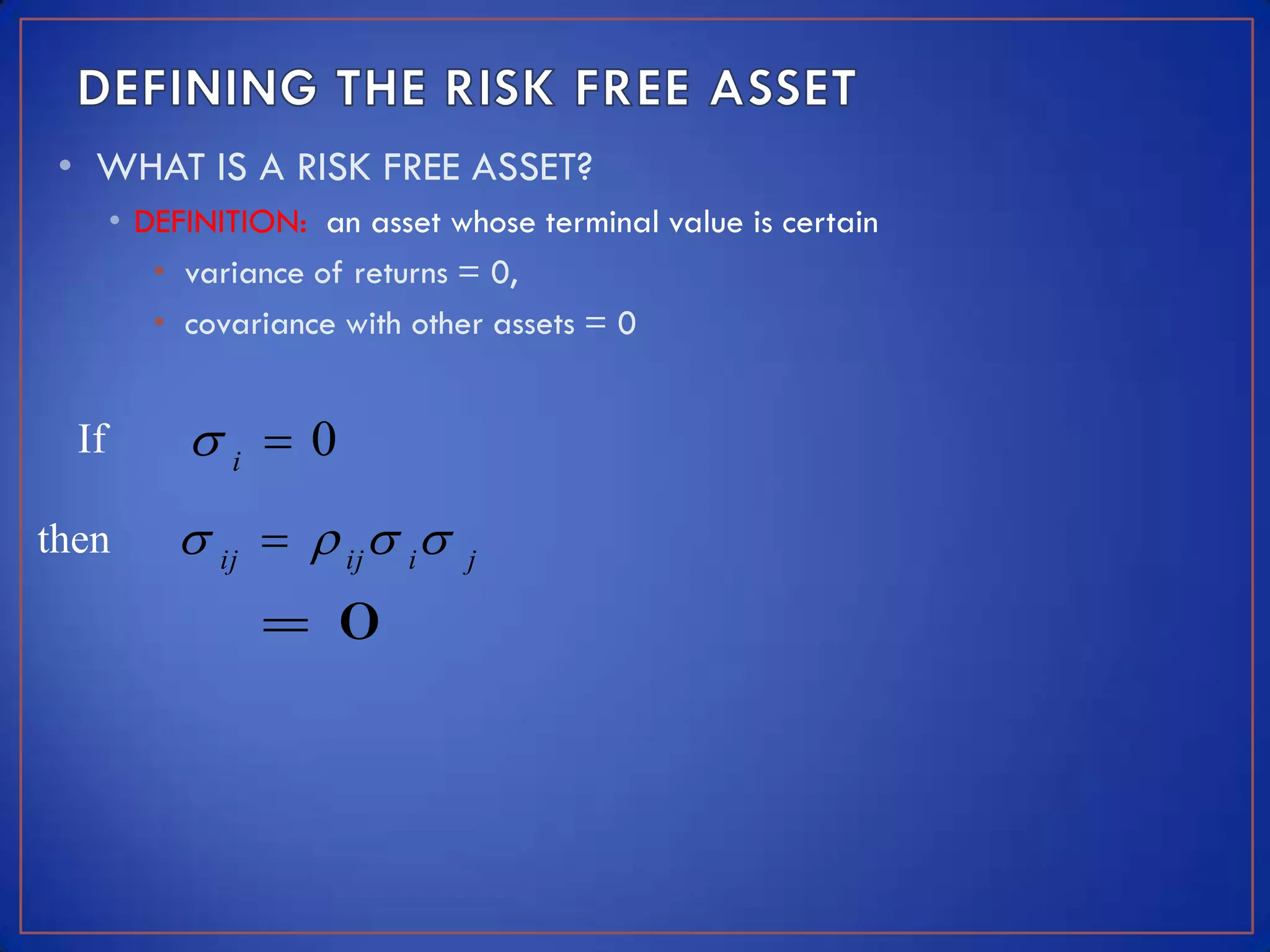
• WHAT IS A RISK FREE ASSET?
       • DEFINITION: an asset whose terminal value is certain
          • variance of returns = 0,
          • covariance with other assets = 0


  If        i  0
then        ij   ij  i     j

                  0
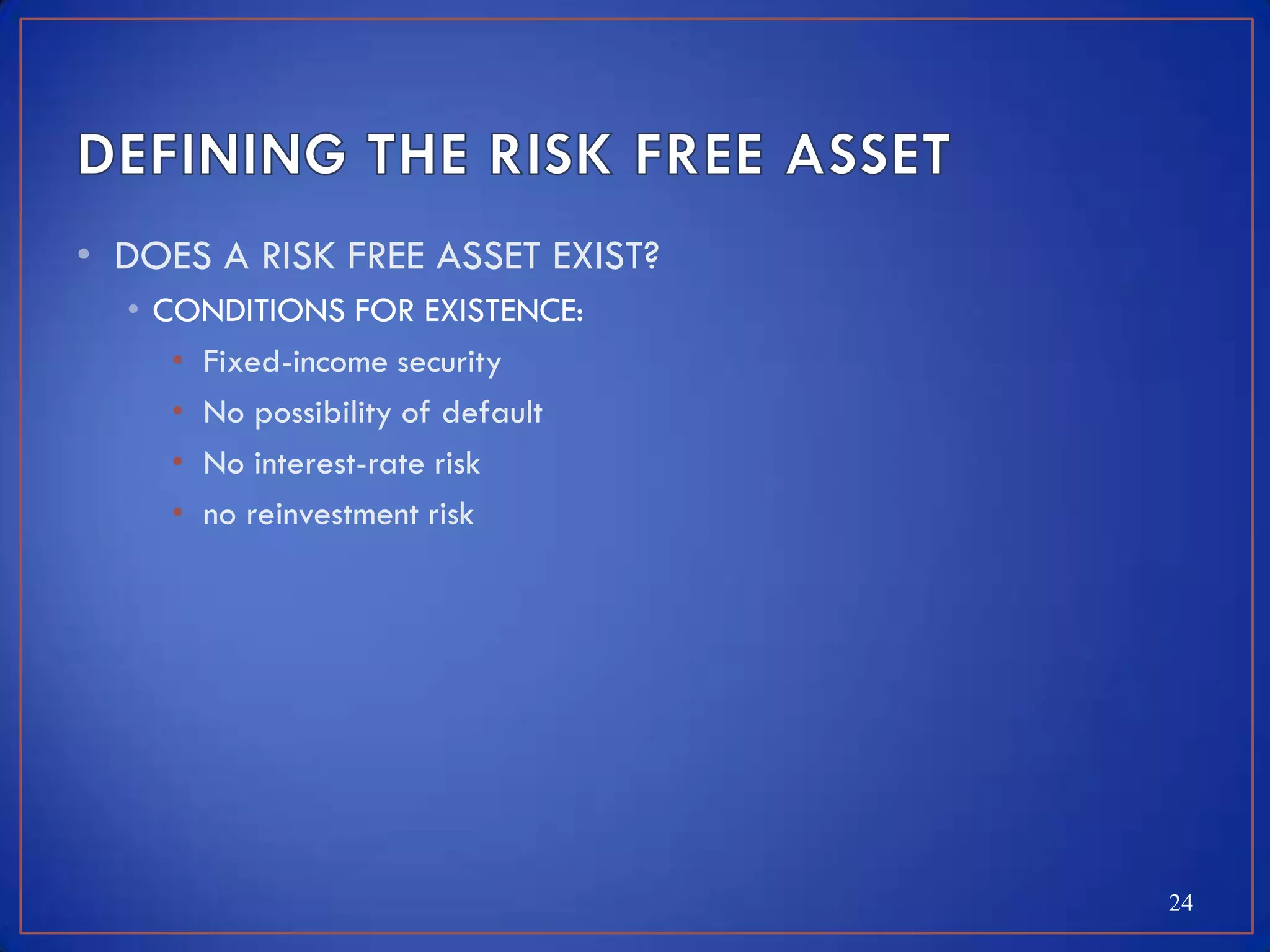
• DOES A RISK FREE ASSET EXIST?
  • CONDITIONS FOR EXISTENCE:
     • Fixed-income security
     • No possibility of default
     • No interest-rate risk
     • no reinvestment risk


                                   24
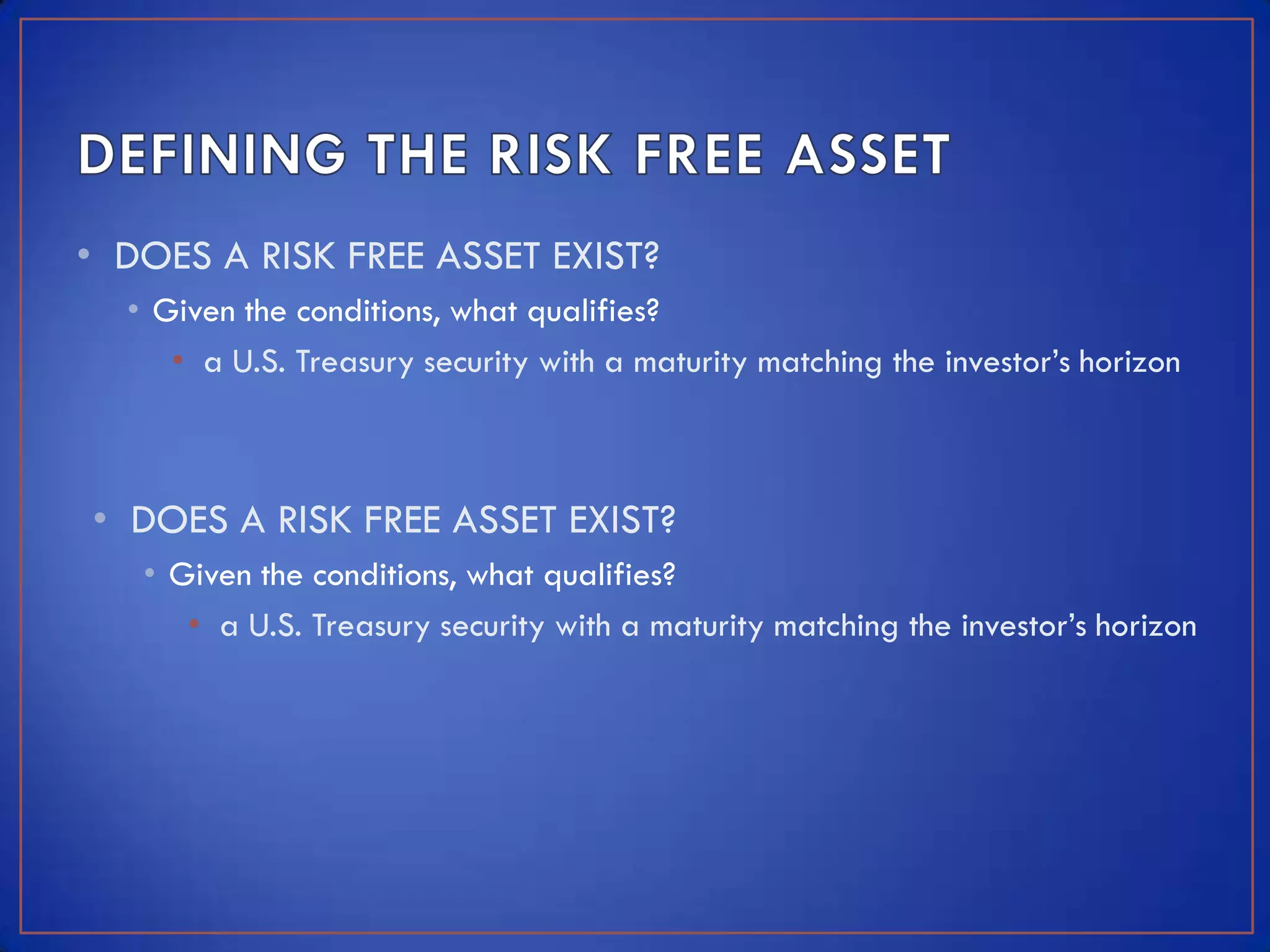
• DOES A RISK FREE ASSET EXIST?
  • Given the conditions, what qualifies?
     • a U.S. Treasury security with a maturity matching the investor’s horizon


• DOES A RISK FREE ASSET EXIST?
   • Given the conditions, what qualifies?
      • a U.S. Treasury security with a maturity matching the investor’s horizon
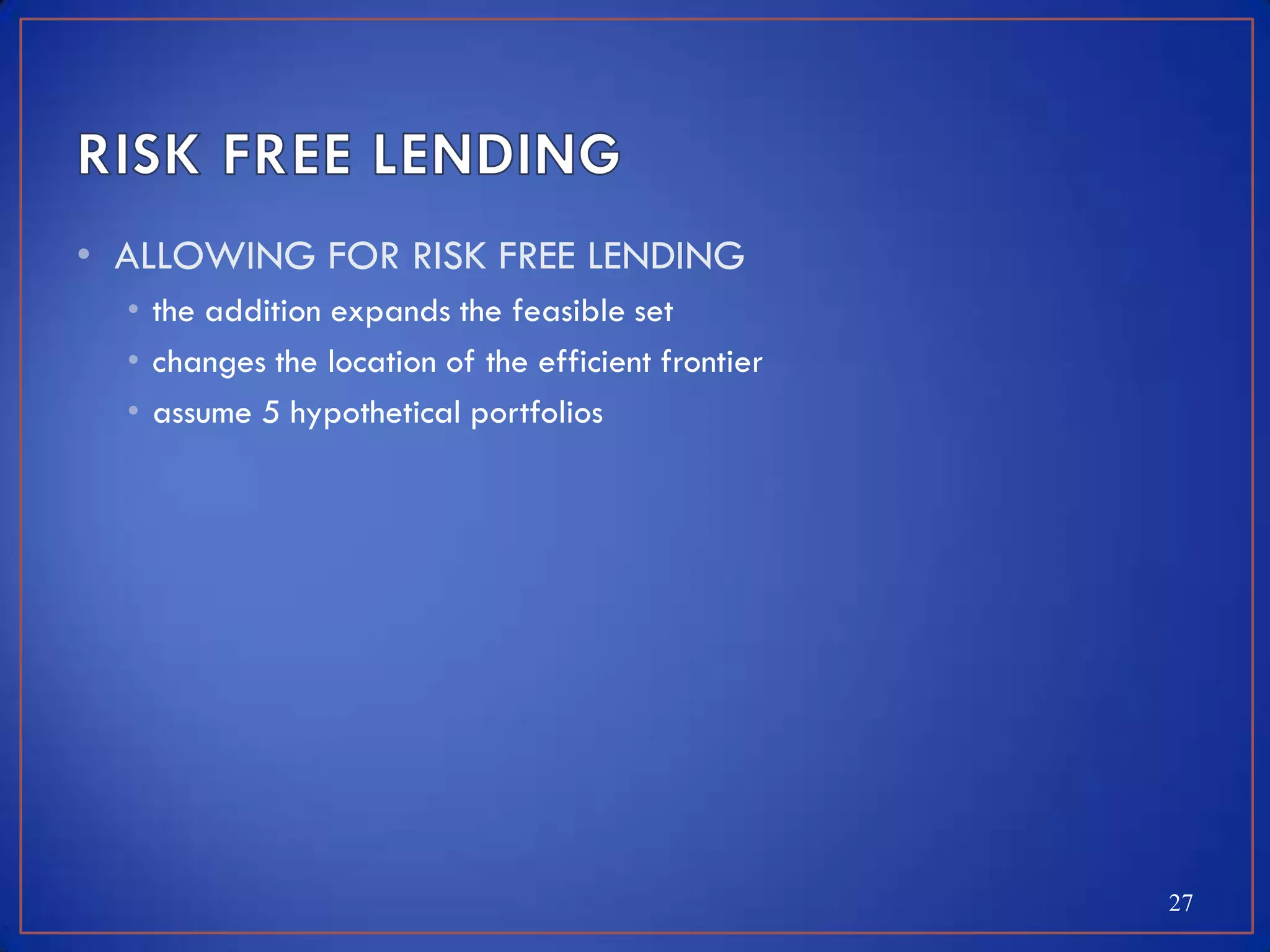
• ALLOWING FOR RISK FREE LENDING
  • investor now able to invest in either or both,
  • a risk free and a risky asset
• ALLOWING FOR RISK FREE LENDING
  • the addition expands the feasible set
  • changes the location of the efficient frontier
  • assume 5 hypothetical portfolios


                                                     27
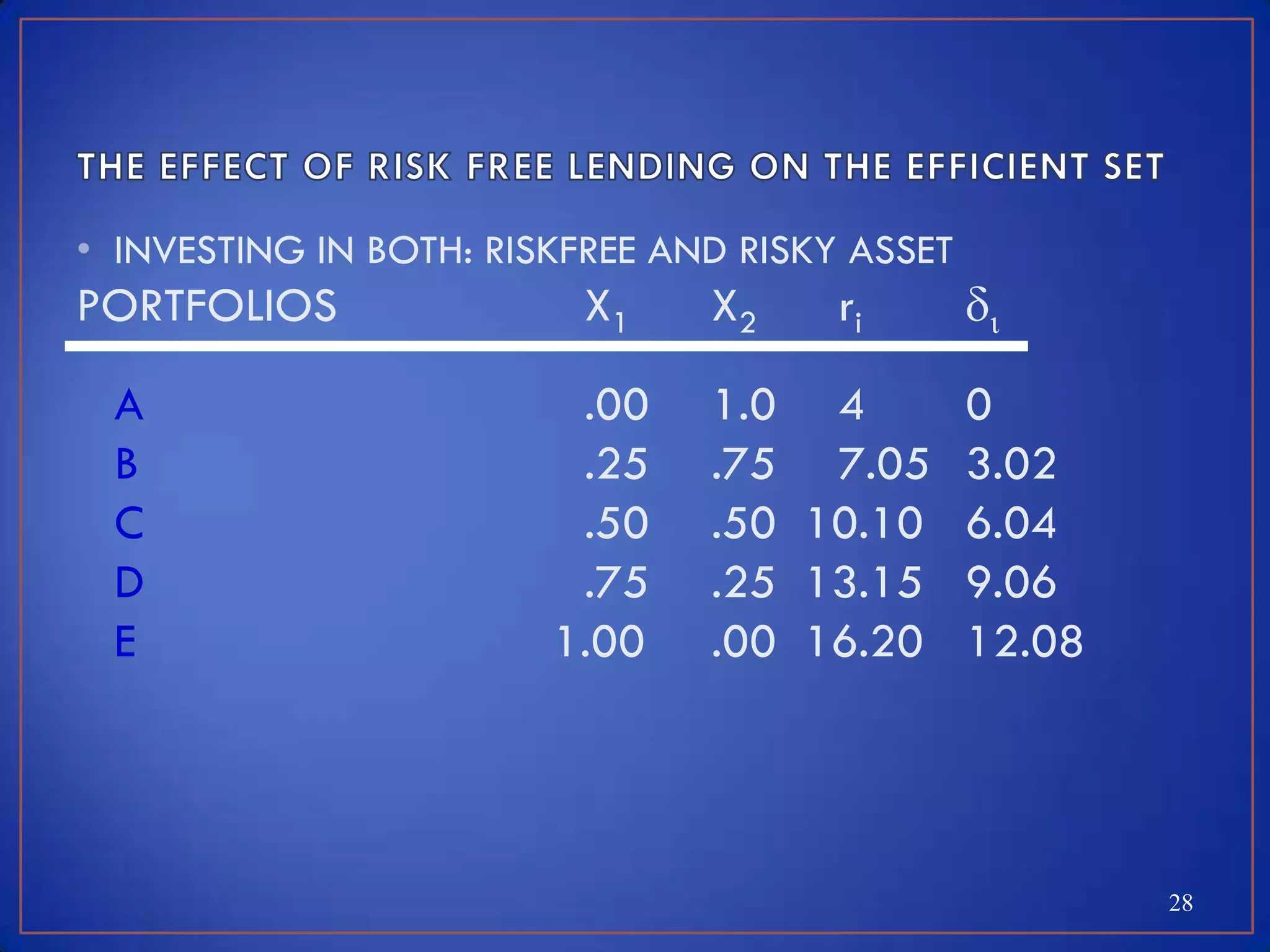
• INVESTING IN BOTH: RISKFREE AND RISKY ASSET
PORTFOLIOS                X1    X2     ri       di

 A                       .00    1.0 4     0
 B                       .25    .75 7.05 3.02
 C                       .50    .50 10.10 6.04
 D                       .75    .25 13.15 9.06
 E                      1.00    .00 16.20 12.08


                                                     28
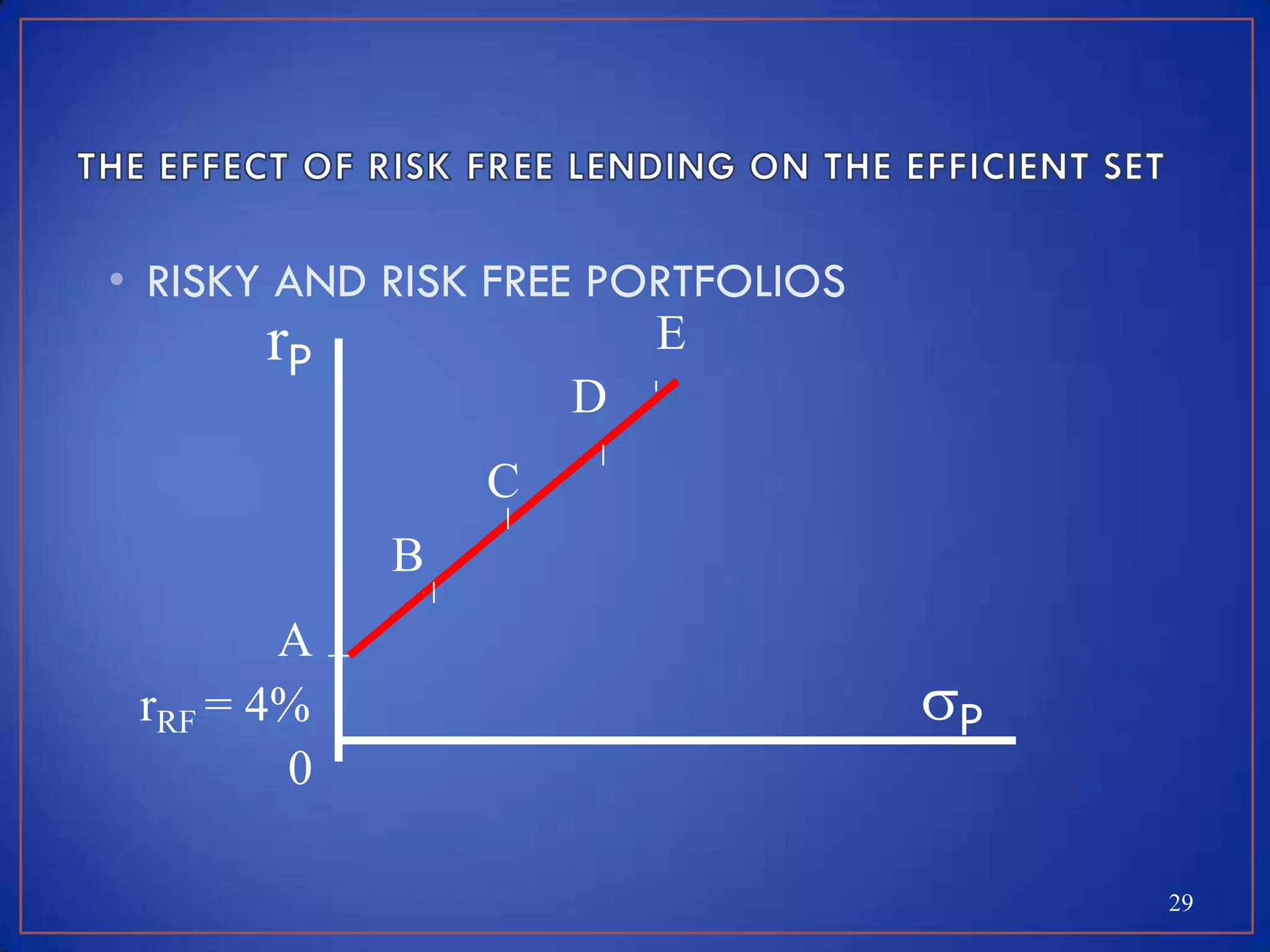
• RISKY AND RISK FREE PORTFOLIOS
       rP               E
                     D
                C
            B
        A
 rRF = 4%                          P
        0

                                        29
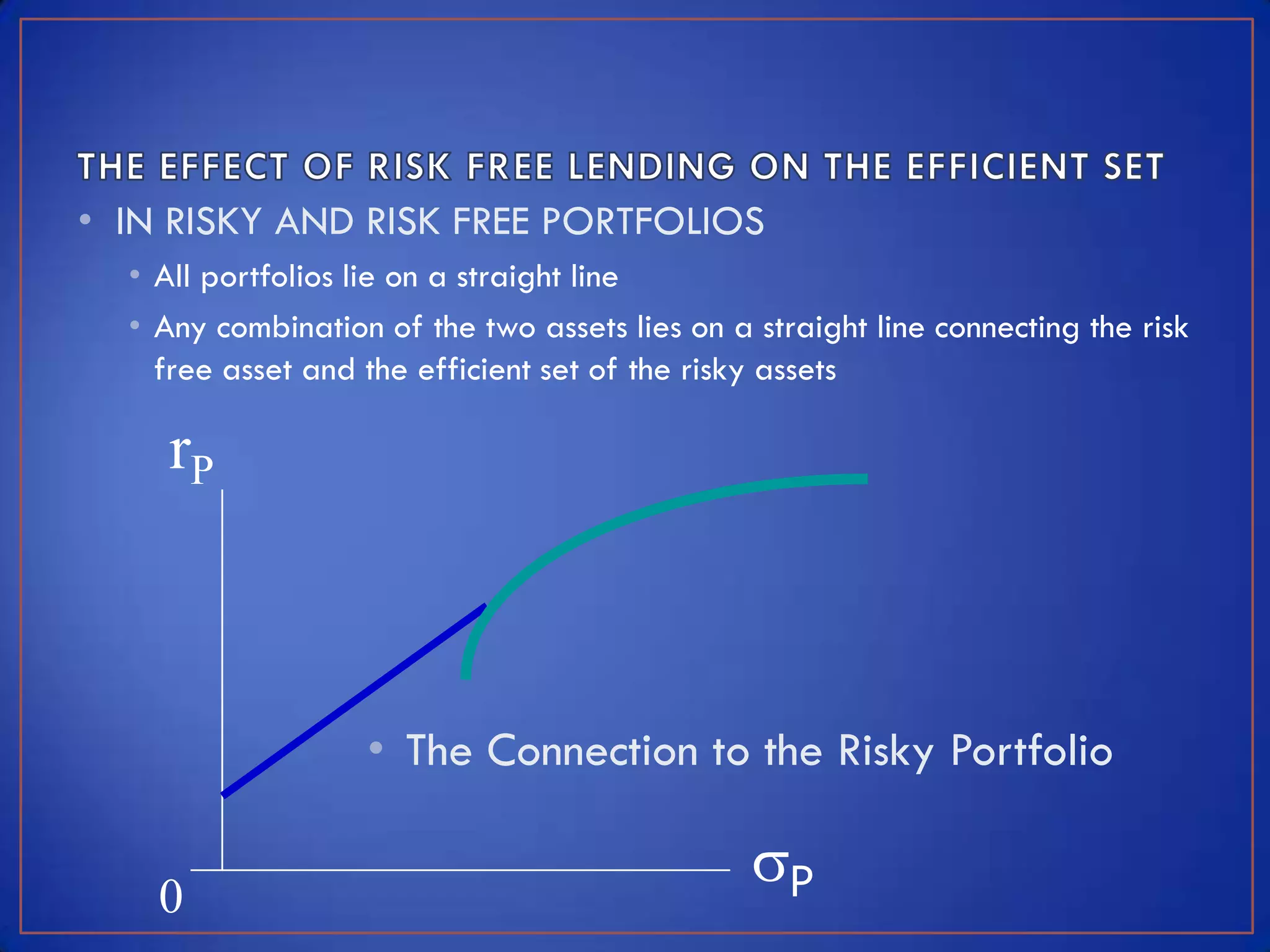
• IN RISKY AND RISK FREE PORTFOLIOS
  • All portfolios lie on a straight line
  • Any combination of the two assets lies on a straight line connecting the risk
    free asset and the efficient set of the risky assets

     rP


                   • The Connection to the Risky Portfolio

    0
                                                P
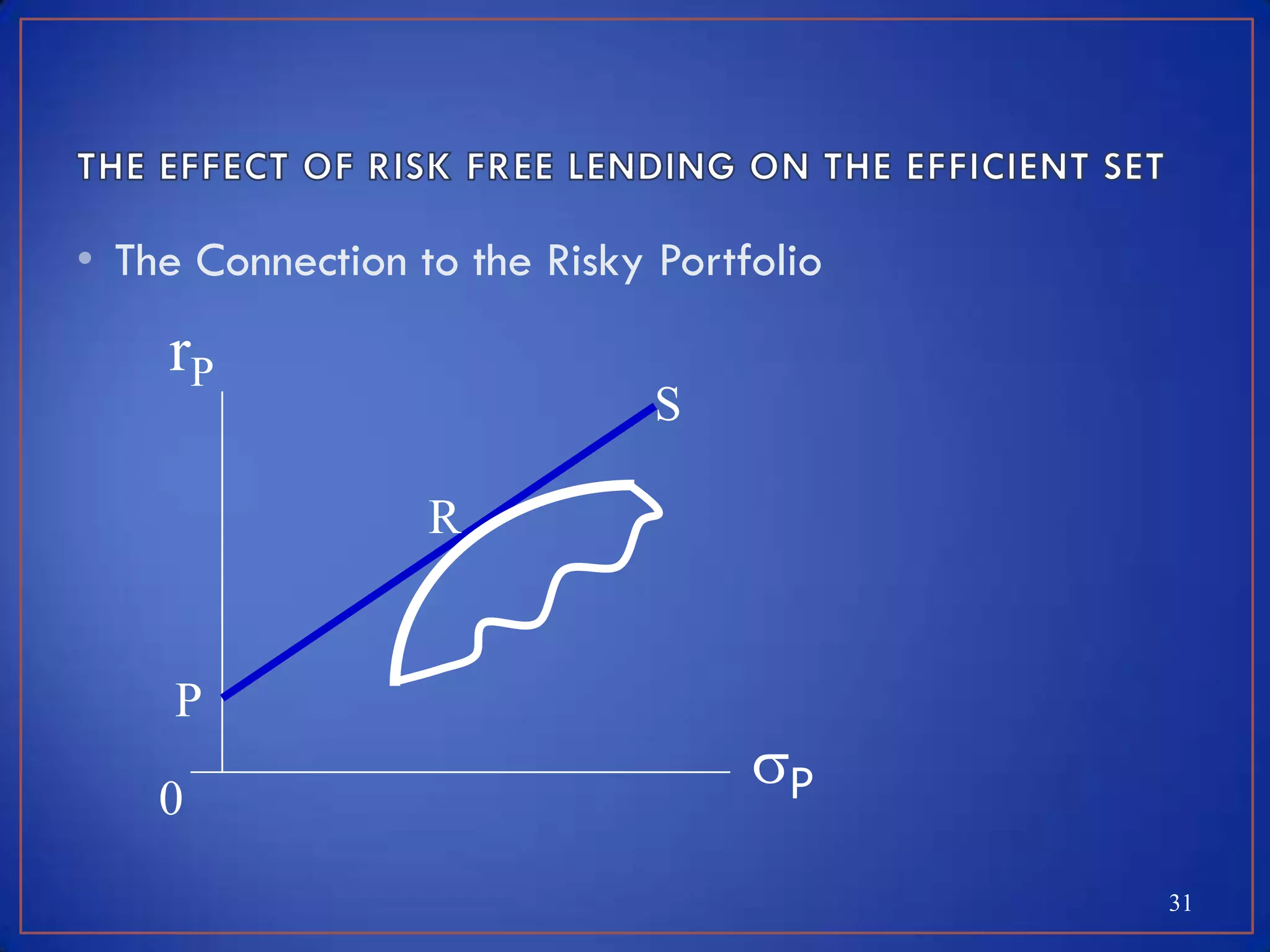
• The Connection to the Risky Portfolio
    rP
                              S

                  R


     P
                                   P
    0
                                          31

Portfolio theory

  • 1.
    Module 4 :Investment Avenues Mutual funds, Investor life cycle, Personal investment, Personal Finance, Portfolio Management of funds in banks, insurance companies, pension funds, International investing, international funds management, emerging opportunities. Module 1: Introduction to portfolio Management Meaning of portfolio management, portfolio analysis, why portfolios, Portfolio objectives, portfolio management process, selection of securities.
  • 2.
    Module II MohammedUmair: Dept of Commerce- Kristu Jayanti College
  • 3.
    Company Name High Low Previous (LTP) Hero Motocorp 2600 2400 2500 HDFC Bank 520 499 500 State Bank of India 2100 2029 2000 TCS 1020 998 1000 Tech Mahindra 108 105 100 Budget: Rs. 5000
  • 4.
    Company Name High Low Previous (LTP) Hero Motocorp 2600 2400 2600 HDFC Bank 520 499 550 State Bank of India 2100 2029 2000 TCS 1020 998 1050 Tech Mahindra 108 105 150 Situation A: Bullish Market
  • 5.
    Company Name High Low Previous (LTP) Hero Motocorp 2600 2400 2200 HDFC Bank 520 499 300 State Bank of India 2100 2029 1750 TCS 1020 998 850 Tech Mahindra 108 105 050 Situation B: Bearish Market
  • 6.
    Portfolio Management Security Portfolio Portfolio Portfolio Portfolio Analysis Analysis Selection Revision Evaluation 1. Fundamental Diversification 1. Markowitz 1. Formula 1. Sharpe’s Analysis Model Plans index 2. Technical Analysis 2. Sharpe’s 2. Rupee 2. Treynor’s 3. Efficient Single cost measure Market index Averaging 3. Jenson’s Hypothesis model measure 3. CAPM 4. APT
  • 7.
    • Harry MaxMarkowitz (born August 24, 1927) is an American economist. • He is best known for his pioneering work in Modern Portfolio Theory. • Harry Markowitz put forward this model in 1952. • Studied the effects of asset risk, return, correlation and diversification on probable investment portfolio Harry Max Markowitz returns. Essence of Markowitz Model “Do not put all your eggs in one basket” 1. An investor has a certain amount of capital he wants to invest over a single time horizon. 2. He can choose between different investment instruments, like stocks, bonds, options, currency, or portfolio. The investment decision depends on the future risk and return. 3. The decision also depends on if he or she wants to either maximize the yield or minimize the risk
  • 8.
    Essence of MarkowitzModel 1. Markowitz model assists in the selection of the most efficient by analysing various possible portfolios of the given securities. 2. By choosing securities that do not 'move' exactly together, the HM model shows investors how to reduce their risk. 3. The HM model is also called Mean-Variance Model due to the fact that it is based on expected returns (mean) and the standard deviation (variance) of the various portfolios. Diversification and Portfolio Risk p p the standard deviation SR: Systematic Risk USR: Unsystematic Risk Portfolio Risk SR USR Total Risk 5 10 15 20 Number of Shares
  • 9.
    • An investorhas a certain amount of capital he wants to invest over a single time horizon. • He can choose between different investment instruments, like stocks, bonds, options, currency, or portfolio. • The investment decision depends on the future risk and return. • The decision also depends on if he or she wants to either maximize the yield or minimize the risk. • The investor is only willing to accept a higher risk if he or she gets a higher expected return.
  • 10.
    Tools for selectionof portfolio- Markowitz Model 1. Expected return (Mean) Mean and average to refer to the sum of all values divided by the total number of values. The mean is the usual average, so: (13 + 18 + 13 + 14 + 13 + 16 + 14 + 21 + 13) ÷ 9 = 15 n 1. Expected return (Mean) W 2. Standard deviation (variance) Expected Return (ER)  i  E ( Ri ) 3. Co-efficient of Correlation Where: i 1 ER = the expected return on Portfolio E(Ri) = the estimated return in scenario i Wi= weight of security i occurring in the port folio Rp=R1W1+R2W2………..n Where: Rp = the expected return on Portfolio R1 = the estimated return in Security 1 R2 = the estimated return in Security 1 W1= Proportion of security 1 occurring in the port folio W2= Proportion of security 1 occurring in the port folio
  • 11.
    Tools for selectionof portfolio- Markowitz Model 2. Variance & Co-variance n _ _ V ariance   Prob i ( R A  R A )  (R 2 2 B - RB ) i 1 The variance is a measure of how far a set of numbers is spread out. It is one of several descriptors of a probability distribution, describing how far the numbers lie from the mean (expected value). Co-variance 1. Covariance reflects the degree to which the returns of the two securities vary or change together. 2. A positive covariance means that the returns of the two securities move in the same direction. 3. A negative covariance implies that the returns of the two securities move in opposite direction. n _ _ _ 1 COV AB  N  Prob i ( R A  R A )(R B - RB ) R A =Expected Return on security A i 1 _ R B =Expected Return on security B CovAB=Covariance between security A and B RA=Return on security A RB=Return on Security B
  • 12.
    Tools for selectionof portfolio- Markowitz Model 3. Co-efficient of Correlation Covariance & Correlation are conceptually analogous in the sense that of them reflect the degree of Variation between two variables. 1. The Correlation coefficient is simply covariance divided the product of standard deviations. 2. The correlation coefficient can vary between -1.0 and +1.0 -1.0 0 1.0 Perfectly negative No Perfectly Positive Opposite direction Correlation Opposite direction Cov r AB  AB  Standard deviation of A and B   A B security CovAB=Covariance between security A and B rAB=Co-efficient correlation between security A and B
  • 13.
    Returns If returns of A and B are % 20% perfectly negatively correlated, a two-asset portfolio made up of equal parts of Stock A and B would be riskless. There would 15% be no variability of the portfolios returns over time. 10% Returns on Stock A Returns on Stock B 5% Returns on Portfolio Time 0 1 2 CHAPTER 8 – Risk, Return and Portfolio Theory
  • 14.
    Returns If returns of A and B are % 20% perfectly positively correlated, a two-asset portfolio made up of equal parts of Stock A and B would be risky. There would be 15% no diversification (reduction of portfolio risk). 10% Returns on Stock A Returns on Stock B 5% Returns on Portfolio Time 0 1 2 CHAPTER 8 – Risk, Return and Portfolio Theory
  • 15.
    The riskiness of a portfolio that is made of different risky assets is a function of three different factors: • the riskiness of the individual assets that make up the portfolio • the relative weights of the assets in the portfolio • the degree of variation of returns of the assets making up the portfolio • The standard deviation of a two-asset portfolio may be measured using the Markowitz model:    w   w  2 w A w B rAB  A B 2 2 2 2 p A A B B A The data requirements for a three-asset portfolio grows dramatically if we are using Markowitz Portfolio selection formulae. ρa,b ρa,c B C ρb,c We need 3 (three) correlation coefficients between A and B; A and C; and B and C.    A w A   B w B   C w C  2 w A w B rA , B  A B  2 w B w C rB , C  B  C  2 w A w C rA , C  A C 2 2 2 2 2 2 p
  • 16.
    • Assets differin terms of expected rates of return, standard deviations, and correlations with one another • While portfolios give average returns, they give lower risk • Diversification works! • Even for assets that are positively correlated, the portfolio standard deviation tends to fall as assets are added to the portfolio
  • 17.
    • Combining assetstogether with low correlations reduces portfolio risk more • The lower the correlation, the lower the portfolio standard deviation • Negative correlation reduces portfolio risk greatly • Combining two assets with perfect negative correlation reduces the portfolio standard deviation to nearly zero
  • 18.
    n Expected Return (ER)  W i  E ( Ri ) i 1 Portfolio Rp IN % Return on Portfolio Risk  p Any portfolio which gives more A 17 13 return for the same level of risk. B 15 08 Or C 10 03 D 7 02 Same return with Lower risk. E 7 04 Is more preferable then any F 10 12 other portfolio. G 10 12 H 09 08 J 06 7.5 Amongst all the portfolios which offers the highest return at a particular level of risk are called efficient portfolios.
  • 19.
    ABCD line isthe efficient frontier along which attainable and efficient portfolios are available. 18 Which portfolio investor should choose? 16 14 13 12 12 12 Risk and Return 10 Return 8 Risk 8 8 7.5 6 4 4 3 2 2 0 A B C D E F G H I Portfolios
  • 20.
    Utility of Investor Risk Lover Risk Neutral Risk Averse Description Property Risk Seeker Accepts a fair Gamble Risk Neutral Indifferent to a fair gamble Risk Averse Rejects a fair gamble A B Marginal utility of different Utility class of investors. C Return
  • 21.
    Rp Rp Indifference curves of the risk Indifference curves of the risk Loving I4 Fearing I I3 4 I3 I2 I2 I1 I1 Risk Risk Rp Indifference curves of the less Rp risk Fearing Indifference curves & Efficient I4 frontier. I4 I3 I3 I2 I2 I1 I1 R Risk Risk 2 4 6 8 10 12 14 14 18
  • 22.
    • The optimalportfolio concept falls under the modern portfolio theory. The theory assumes that investors fanatically try to minimize risk while striving for the highest return possible.
  • 23.
    • WHAT ISA RISK FREE ASSET? • DEFINITION: an asset whose terminal value is certain • variance of returns = 0, • covariance with other assets = 0 If i  0 then  ij   ij  i j  0
  • 24.
    • DOES ARISK FREE ASSET EXIST? • CONDITIONS FOR EXISTENCE: • Fixed-income security • No possibility of default • No interest-rate risk • no reinvestment risk 24
  • 25.
    • DOES ARISK FREE ASSET EXIST? • Given the conditions, what qualifies? • a U.S. Treasury security with a maturity matching the investor’s horizon • DOES A RISK FREE ASSET EXIST? • Given the conditions, what qualifies? • a U.S. Treasury security with a maturity matching the investor’s horizon
  • 26.
    • ALLOWING FORRISK FREE LENDING • investor now able to invest in either or both, • a risk free and a risky asset
  • 27.
    • ALLOWING FORRISK FREE LENDING • the addition expands the feasible set • changes the location of the efficient frontier • assume 5 hypothetical portfolios 27
  • 28.
    • INVESTING INBOTH: RISKFREE AND RISKY ASSET PORTFOLIOS X1 X2 ri di A .00 1.0 4 0 B .25 .75 7.05 3.02 C .50 .50 10.10 6.04 D .75 .25 13.15 9.06 E 1.00 .00 16.20 12.08 28
  • 29.
    • RISKY ANDRISK FREE PORTFOLIOS rP E D C B A rRF = 4% P 0 29
  • 30.
    • IN RISKYAND RISK FREE PORTFOLIOS • All portfolios lie on a straight line • Any combination of the two assets lies on a straight line connecting the risk free asset and the efficient set of the risky assets rP • The Connection to the Risky Portfolio 0 P
  • 31.
    • The Connectionto the Risky Portfolio rP S R P P 0 31